
The
963d Airborne Air Control Squadron (
963 AACS) is a
squadronA squadron in air force, army aviation or naval aviation is mainly a unit comprising a number of military aircraft, usually of the same type, typically with 12 to 24 aircraft, sometimes divided into three or four flights, depending on aircraft type and air force...
of the
United States Air ForceThe United States Air Force is the aerial warfare service branch of the United States Armed Forces and one of the American uniformed services. Initially part of the United States Army, the USAF was formed as a separate branch of the military on September 18, 1947 under the National Security Act of...
based at
Tinker Air Force BaseTinker Air Force Base is a major U.S. Air Force base, with tenant U.S. Navy and other Department of Defense missions, located in the southeast Oklahoma City, Oklahoma area, directly south of the suburb of Midwest City, Oklahoma.-Overview:...
,
OklahomaOklahoma is a state located in the South Central region of the United States of America. With an estimated 3,751,351 residents as of the 2010 census and a land area of 68,667 square miles , Oklahoma is the 28th most populous and 20th-largest state...
. The squadron is a subordinate unit of the 552nd Air Control Wing and it flies the
E-3 SentryThe Boeing E-3 Sentry is an airborne warning and control system developed by Boeing as the prime contractor. Derived from the Boeing 707, it provides all-weather surveillance, command, control and communications, and is used by the United States Air Force , NATO, Royal Air Force , French Air Force...
, radar surveillance aircraft. The squadron currently falls under the authority of
Air Combat CommandAir Combat Command is a major command of the United States Air Force. ACC is one of ten major commands , reporting to Headquarters, United States Air Force ....
and Twelfth Air Force.
Emblem
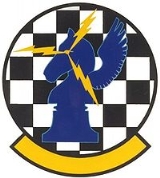
The 963d's mascot is the Blue
KnightA knight was a member of a class of lower nobility in the High Middle Ages.By the Late Middle Ages, the rank had become associated with the ideals of chivalry, a code of conduct for the perfect courtly Christian warrior....
which is represented on the unit's insignia as a blue colored winged
chess knightThe knight is a piece in the game of chess, representing a knight . It is normally represented by a horse's head and neck. Each player starts with two knights, which begin on the row closest to the player, one square from the corner...
. The background is a series of black and white squares that resembles a chess board. Three bolts of lightning emitted from the knight's eye shows the lightening fast deployability of the AWACS, and the knight's wings represents the flying mission of the unit.
History
The
963d Airborne Early Warning and Control Squadron (963 AEW&Cs) was activated, on 8 July 1955 at McClellan AFB, California. The squadron flew the
EC-121 Warning StarThe Lockheed EC-121 Warning Star was a United States Navy and United States Air Force airborne early warning radar surveillance aircraft. A military version of the Lockheed Constellation, it was designed to serve as an airborne early warning system to supplement the Distant Early Warning Line,...
, which was a military version of the
Lockheed ConstellationThe Lockheed Constellation was a propeller-driven airliner powered by four 18-cylinder radial Wright R-3350 engines. It was built by Lockheed between 1943 and 1958 at its Burbank, California, USA, facility. A total of 856 aircraft were produced in numerous models, all distinguished by a...
aircraft, until the unit's deactivation in 1976
.
It was inactivated on 30 April 1976.
The inactivation lasted less than a week however, as the Air Force again activated the unit on 5 May 1976 and redesignated it as the
963d Airborne Warning and Control Squadron (963 AWACS). On 1 July 1976, the squadron relocated to Tinker AFB, Oklahoma. The squadron was under the command of the 552 AWACW, which reported directly to Headquarters,
Tactical Air CommandTactical Air Command is an inactive United States Air Force organization. It was a Major Command of the United States Air Force, established on 21 March 1946 being headquartered at Langley Air Force Base, Virginia...
(TAC).
http://www.af.mil/shared/media/document/AFD-070517-087.pdf The squadron began flying the new E-3 Sentry aircraft upon being reactivated. This new airframe is a military version of the
Boeing 707The Boeing 707 is a four-engine narrow-body commercial passenger jet airliner developed by Boeing in the early 1950s. Its name is most commonly pronounced as "Seven Oh Seven". The first airline to operate the 707 was Pan American World Airways, inaugurating the type's first commercial flight on...
aircraft.
During the 1980s the squadron flew training missions in
Saudi ArabiaThe Kingdom of Saudi Arabia , commonly known in British English as Saudi Arabia and in Arabic as as-Sa‘ūdiyyah , is the largest state in Western Asia by land area, constituting the bulk of the Arabian Peninsula, and the second-largest in the Arab World...
and throughout the Middle East.
In 1990 the squadron deployed to Riyadh AB, Saudi Arabia with the military build-up prior to Operations Desert Shield/Desert Storm.
In 1992, the unit (and its superior unit the 552 ACW) came under the authority of the newly formed
Air Combat CommandAir Combat Command is a major command of the United States Air Force. ACC is one of ten major commands , reporting to Headquarters, United States Air Force ....
(ACC). Throughout the early to mid 1990s, 963d aircrews routinely deployed to Incirlik AB, Turkey to support the northern Iraqi no-fly zone (Operation Provide Comfort). Crews from the 963d also continued operations in Saudi Arabia on the southern no-fly zone (Operation Southern Watch). They were also deployed to other trouble spots around the world as a modern form of
Gunboat diplomacyIn international politics, gunboat diplomacy refers to the pursuit of foreign policy objectives with the aid of conspicuous displays of military power — implying or constituting a direct threat of warfare, should terms not be agreeable to the superior force....
. On April 14, 1994 an aircraft and crew from the 963d operating out of Incirlik AB, Turkey featured prominently in the
1994 Black Hawk shootdown incidentThe 1994 Black Hawk shootdown incident, sometimes referred to as the Black Hawk Incident, was a friendly fire incident over northern Iraq that occurred on April 14, 1994 during Operation Provide Comfort...
.
In 1994, the squadron's name was redesignated to
963d Airborne Air Control Squadron (963 AACS).
The 963d AACS also participated in the invasion of Iraq in Operation Iraqi Freedom.
Operations
- World War II
World War II, or the Second World War , was a global conflict lasting from 1939 to 1945, involving most of the world's nations—including all of the great powers—eventually forming two opposing military alliances: the Allies and the Axis...
- Vietnam War
The Vietnam War was a Cold War-era military conflict that occurred in Vietnam, Laos, and Cambodia from 1 November 1955 to the fall of Saigon on 30 April 1975. This war followed the First Indochina War and was fought between North Vietnam, supported by its communist allies, and the government of...
- Operation Just Cause
- Operation Earnest Will
Operation Earnest Will was the U.S. military protection of Kuwaiti owned tankers from Iranian attacks in 1987 and 1988, three years into the Tanker War phase of the Iran–Iraq War. It was the largest naval convoy operation since World War II.The U.S. Navy warships that escorted the tankers, part of...
- Operation Desert Storm
Lineage
- 3rd Search Attack Squadron (Heavy) (1942–1944)
- 163rd Liaison Squadron (Commando) (1944–1949)
- 963d Airborne Early Warning and Control Squadron (1954–1976)
- 963d Airborne Warning and Control Squadron (1976–1994)
- 963d Airborne Air Control Squadron (1994–Present)
Assignments
- 1st Sea–Search Attack Group (1942–1944)
III Tactical Air DivisionThe 3d Air Division is an inactive United States Air Force organization. Its last assignment was with Strategic Air Command, assigned to Fifteenth Air Force, being stationed at Hickam AFB, Hawaii...
(1944)
Army Air ForcesThe United States Army Air Forces was the military aviation arm of the United States of America during and immediately after World War II, and the direct predecessor of the United States Air Force....
, Pacific Ocean Areas (1945)
- Tenth Army (1945)
Seventh Air ForceThe Seventh Air Force is a numbered air force of the United States Air Force Pacific Air Forces . It is headquartered at Osan Air Base, Republic of Korea....
(1945)
- VII Bomber Command (1945)
- Pacific Air Command (1945–1946)
Ninth Air ForceThe Ninth Air Force is a numbered air force of the United States Air Force's Air Combat Command . It is headquartered at Shaw Air Force Base, South Carolina....
(1946)
Tenth Air ForceThe Tenth Air Force is a numbered air force of the United States Air Force Reserve Command . It is headquartered at Naval Air Station Joint Reserve Base Fort Worth, Texas....
(1948–1949)
- 8th Air Division
The 8th Air Division is an inactive United States Air Force organization. Its last assignment was with Air Defense Command, being stationed at McClellan Air Force Base, California. It was inactivated on 1 July 1957.-History:...
(1955)
- 552d Airborne Early Warning and Control Wing (1955–1976)
- 552d Airborne Warning and Control Wing (1976–1978)
552d Air Control WingThe 552d Air Control Wing is an operational wing of the United States Air Force based at Tinker Air Force Base, Oklahoma. The wing flies the E-3 Sentry aircraft.-History:...
(1978–Present)
Bases stationed
- Langley Field, Virginia
The Commonwealth of Virginia , is a U.S. state on the Atlantic Coast of the Southern United States. Virginia is nicknamed the "Old Dominion" and sometimes the "Mother of Presidents" after the eight U.S. presidents born there...
(1942–1944)
- Cox Field
Cox Field is a city-owned, public-use airport located six nautical miles east of the central business district of Paris, a city in Lamar County, Texas, United States. It is owned by the city of Paris but is operated and maintained by J.R...
, TexasTexas is the second largest U.S. state by both area and population, and the largest state by area in the contiguous United States.The name, based on the Caddo word "Tejas" meaning "friends" or "allies", was applied by the Spanish to the Caddo themselves and to the region of their settlement in...
(1944)
- Brownwood Army Air Field
Brownwood Regional Airport is a public airport located in west central Texas, near the cities of Brownwood and Early. The airport has 2 runways 35/17 & 31/13....
, TexasTexas is the second largest U.S. state by both area and population, and the largest state by area in the contiguous United States.The name, based on the Caddo word "Tejas" meaning "friends" or "allies", was applied by the Spanish to the Caddo themselves and to the region of their settlement in...
(1944–1945)
- Schofield Barracks, Territory of Hawaii
Hawaii is the newest of the 50 U.S. states , and is the only U.S. state made up entirely of islands. It is the northernmost island group in Polynesia, occupying most of an archipelago in the central Pacific Ocean, southwest of the continental United States, southeast of Japan, and northeast of...
(1945)
- Yara Hikojo, Okinawa, Japan
Japan is an island nation in East Asia. Located in the Pacific Ocean, it lies to the east of the Sea of Japan, China, North Korea, South Korea and Russia, stretching from the Sea of Okhotsk in the north to the East China Sea and Taiwan in the south...
(1945)
- Fort William McKinley
Fort William McKinley, was established in the Philippines during the Philippine–American War in 1901 when the whole land south of Pasig River down to Alabang was declared a U.S. Military Reservation. During the World War II era, it was where USAFFE had its headquarters for the Philippine Department...
, LuzonLuzon is the largest island in the Philippines. It is located in the northernmost region of the archipelago, and is also the name for one of the three primary island groups in the country centered on the Island of Luzon...
, PhilippinesThe Philippines , officially known as the Republic of the Philippines , is a country in Southeast Asia in the western Pacific Ocean. To its north across the Luzon Strait lies Taiwan. West across the South China Sea sits Vietnam...
(1945–1946)
- Marshall Field
Marshall Army Airfield is a military airfield located on Fort Riley, Kansas. It was opened in 1921. The primary mission for MAAF is to provide fully integrated fixed base helicopter operations for the Combat Aviation Brigade....
, KansasKansas is a US state located in the Midwestern United States. It is named after the Kansas River which flows through it, which in turn was named after the Kansa Native American tribe, which inhabited the area. The tribe's name is often said to mean "people of the wind" or "people of the south...
(1946–1949)
- McClellan AFB, California
California is a state located on the West Coast of the United States. It is by far the most populous U.S. state, and the third-largest by land area...
(1955–1976)
- Tinker AFB, Oklahoma
Oklahoma is a state located in the South Central region of the United States of America. With an estimated 3,751,351 residents as of the 2010 census and a land area of 68,667 square miles , Oklahoma is the 28th most populous and 20th-largest state...
(1976–Present)
Aircraft Operated
- B-18 Bolo
The Douglas B-18 Bolo was a United States Army Air Corps and Royal Canadian Air Force bomber of the late 1930s and early 1940s. The Bolo was built by Douglas Aircraft Company and based on its DC-2 and was developed to replace the Martin B-10....
(1942–1943)
- B-24 Liberator
The Consolidated B-24 Liberator was an American heavy bomber, designed by Consolidated Aircraft of San Diego, California. It was known within the company as the Model 32, and a small number of early models were sold under the name LB-30, for Land Bomber...
(1943–1944)
- L-5 Sentinel
The Stinson L-5 Sentinel was a World War II era liaison aircraft used by all branches of the U.S. military and by the British Royal Air Force. Along with the Stinson L-1 Vigilant, the L-5 was the only other American liaison aircraft of WWII that was purpose-built for military use and had no...
(1944–1945)
- UC–64 Norseman (1944)
- L–4 Grasshopper
The Piper J-3 Cub is a small, simple, light aircraft that was built between 1937 and 1947 by Piper Aircraft. With tandem seating, it was intended for flight training but became one of the most popular and best-known light aircraft of all time...
(1945)
- L–5 Sentinel (1946–1949)
- C–45 Expeditor
The Beechcraft Model 18, or "Twin Beech", as it is better known, is a 6-11 seat, twin-engine, low-wing, conventional-gear aircraft that was manufactured by the Beech Aircraft Corporation of Wichita, Kansas...
(1946–1947)
- R–5 Dragonfly
The Sikorsky H-5, is a helicopter built by Sikorsky Aircraft Corporation, formerly used by the United States Air Force, and its predecessor, the United States Army Air Forces, as well as the United States Navy and United States Coast Guard The Sikorsky H-5, (aka R-5, S-51, HO3S-1, or Horse) (R-5...
(1947–1949)
- R-6 Hoverfly II (1947)
- L–13 Grasshopper
-References:*"." Flight, 9 September 1955, p. 466.* rare photos of L-13 folded for towing by jeep*Harding, Stephen. U.S. Army Aircraft Since 1947. Shrewsbury, UK:Airlife, 1990. ISBN 1-85310-102-8....
(1948–1949)
- Sikorsky H-5
The Sikorsky H-5, is a helicopter built by Sikorsky Aircraft Corporation, formerly used by the United States Air Force, and its predecessor, the United States Army Air Forces, as well as the United States Navy and United States Coast Guard The Sikorsky H-5, (aka R-5, S-51, HO3S-1, or Horse) (R-5...
(1948–1949)
- RC-121
The Lockheed Constellation was a propeller-driven airliner powered by four 18-cylinder radial Wright R-3350 engines. It was built by Lockheed between 1943 and 1958 at its Burbank, California, USA, facility. A total of 856 aircraft were produced in numerous models, all distinguished by a...
(1955–1959 & 1961–1963)
- TC–121 (1959–1961 & 1972–1975)
- EC-121 Warning Star
The Lockheed EC-121 Warning Star was a United States Navy and United States Air Force airborne early warning radar surveillance aircraft. A military version of the Lockheed Constellation, it was designed to serve as an airborne early warning system to supplement the Distant Early Warning Line,...
(1963–1972)
- C–121 (1969–1976)
- E-3 Sentry
The Boeing E-3 Sentry is an airborne warning and control system developed by Boeing as the prime contractor. Derived from the Boeing 707, it provides all-weather surveillance, command, control and communications, and is used by the United States Air Force , NATO, Royal Air Force , French Air Force...
(1976–Present)
| |
|
|
|
B-18 BoloThe Douglas B-18 Bolo was a United States Army Air Corps and Royal Canadian Air Force bomber of the late 1930s and early 1940s. The Bolo was built by Douglas Aircraft Company and based on its DC-2 and was developed to replace the Martin B-10....
(1942–1943) |
B-24 LiberatorThe Consolidated B-24 Liberator was an American heavy bomber, designed by Consolidated Aircraft of San Diego, California. It was known within the company as the Model 32, and a small number of early models were sold under the name LB-30, for Land Bomber...
(1943–1944) |
L-5 SentinelThe Stinson L-5 Sentinel was a World War II era liaison aircraft used by all branches of the U.S. military and by the British Royal Air Force. Along with the Stinson L-1 Vigilant, the L-5 was the only other American liaison aircraft of WWII that was purpose-built for military use and had no...
(1944–1945) |
UC–64 Norseman (1944) |
| |
|
|
|
L–4 GrasshopperThe Piper J-3 Cub is a small, simple, light aircraft that was built between 1937 and 1947 by Piper Aircraft. With tandem seating, it was intended for flight training but became one of the most popular and best-known light aircraft of all time...
(1945) |
C–45 Expeditor The Beechcraft Model 18, or "Twin Beech", as it is better known, is a 6-11 seat, twin-engine, low-wing, conventional-gear aircraft that was manufactured by the Beech Aircraft Corporation of Wichita, Kansas...
(1946–1947) |
R–5 DragonflyThe Sikorsky H-5, is a helicopter built by Sikorsky Aircraft Corporation, formerly used by the United States Air Force, and its predecessor, the United States Army Air Forces, as well as the United States Navy and United States Coast Guard The Sikorsky H-5, (aka R-5, S-51, HO3S-1, or Horse) (R-5...
(1947–1949) |
R-6 Hoverfly II (1947) |
| |
|
|
|
| L–13 Grasshopper -References:*"." Flight, 9 September 1955, p. 466.* rare photos of L-13 folded for towing by jeep*Harding, Stephen. U.S. Army Aircraft Since 1947. Shrewsbury, UK:Airlife, 1990. ISBN 1-85310-102-8....
(1948–1949) |
RC-121The Lockheed Constellation was a propeller-driven airliner powered by four 18-cylinder radial Wright R-3350 engines. It was built by Lockheed between 1943 and 1958 at its Burbank, California, USA, facility. A total of 856 aircraft were produced in numerous models, all distinguished by a...
(1955–1959 & 1961–1963) |
EC-121 Warning StarThe Lockheed EC-121 Warning Star was a United States Navy and United States Air Force airborne early warning radar surveillance aircraft. A military version of the Lockheed Constellation, it was designed to serve as an airborne early warning system to supplement the Distant Early Warning Line,...
(1963–1972) |
E-3 Sentry The Boeing E-3 Sentry is an airborne warning and control system developed by Boeing as the prime contractor. Derived from the Boeing 707, it provides all-weather surveillance, command, control and communications, and is used by the United States Air Force , NATO, Royal Air Force , French Air Force...
(1976–Present) |
External links