
All Topics  
101 Battalion


   Email Print
   Bookmark   Link


101 Battalion


101 Battalion was one of eight South West African (now Namibian) military units that made up the South West African Territorial Force (SWATF) and was the final name of the Owambo Battalion - South West Africa was a territory administered by South Africa under United Nations Mandate. 101 had a brief life, but was highly effective at their task, and whilst not being seen as a Special Forces unit (with the exception of their Pathfinder or Reconnaissance sections), is recognized as a 'specialised force' unit.

Background
With the advent of the South West Africa People's Organization's intensified assault on Owamboland
Ovamboland

Ovamboland was the name given by English-speaking visitors to the land occupied by the Ovambo people in what is now northern Namibia and southern Angola....
, the South African Army
South African Army

The South African Army is the army of South Africa, first formed after the Union of South Africa was created in 1910.The South African military evolved within the tradition of frontier warfare fought by popular militias and small irregular military commando forces, reinforced by the Afrikaner historical distrust of large standing armies....
 decided to expand the old Owambo Battalion to a strength of about 200 men.


Discussion
Ask a question about '101 Battalion'
Start a new discussion about '101 Battalion'
Answer questions from other users
Full Discussion Forum


Encyclopedia


101 Battalion was one of eight South West African (now Namibian) military units that made up the South West African Territorial Force (SWATF) and was the final name of the Owambo Battalion - South West Africa was a territory administered by South Africa under United Nations Mandate. 101 had a brief life, but was highly effective at their task, and whilst not being seen as a Special Forces unit (with the exception of their Pathfinder or Reconnaissance sections), is recognized as a 'specialised force' unit.

Background


With the advent of the South West Africa People's Organization's intensified assault on Owamboland
Ovamboland

Ovamboland was the name given by English-speaking visitors to the land occupied by the Ovambo people in what is now northern Namibia and southern Angola....
, the South African Army
South African Army

The South African Army is the army of South Africa, first formed after the Union of South Africa was created in 1910.The South African military evolved within the tradition of frontier warfare fought by popular militias and small irregular military commando forces, reinforced by the Afrikaner historical distrust of large standing armies....
 decided to expand the old Owambo Battalion to a strength of about 200 men. The first platoon
Platoon

A platoon is a military unit typically composed of two to four Section or squads and containing about 30 to 50 soldiers. Platoons are organised into a company , which typically consists of three, four or five platoons....
 of Owambos (under command of Cpl J. Ndamekele) were dispatched to 21 Battalion at Lenz in the Transvaal
Transvaal

File:Flag of Transvaal.svgFile:Transvaal map.pngFile:Spelterini Transvaal.jpgThe Transvaal is the name of an area of northern South Africa....
 for training in 1976. The unit – which had been under command of Capt GMP McClahlan since founding – underwent a name change to 35 Battalion in 1978 and training at the unit became the foremost priority. This included a year of intensive infantry training in counter insurgency
Counter insurgency

In the context of an Military occupation or a civil war, counter-insurgency is a military terminology for the combat against a rebellion, or movement of primary resistance, termed an "insurgency," by forces aligned with the controlling government of the territory in which the combat takes place....
 operations, weapons handling, management, communications and first aid
First aid

First aid is the provision of initial care for an illness or injury. It is usually performed by a layman to a sick or injured Casualty until definitive medical treatment can be accessed....
. After this advanced training in machine gun
Machine gun

A machine gun is a Automatic firearm mounted or portable firearm, usually designed to fire List of rifle cartridgess in quick succession from an Belt or large-capacity Magazine , typically at a rate of several hundred rounds per minute....
s, light cannon, mortar
Mortar (weapon)

A mortar is a Muzzleloader indirect fire weapon that fires shell at low velocities, short ranges, and high-arcing Ballistics trajectories. It typically has a barrel length less than 15 times its caliber....
s and anti-tank weapons followed. The Owambo soldiers were in demand because of their environmental and local knowledge and their tracking abilities, and 35 Battalion had to provide trackers and interpreters to all RSA units. A company was also placed under the operational control of 53 Battalion at Ondangwa where it was responsible for the unit's first combat successes in its own right.

Whilst under the command of Maj W.L. (Willie) Snyders (1977 - 1980) the unit had already developed a pride (esprit de corps) and especially a cohesiveness such as can only be compared with that encountered with Colonel Kurtz in "Apocalypse Now" and operated as a fully-fledged fighting force, and Cmdt. L. De Bruin (1980 - 1981), members of the unit were only occasionally used as trackers and interpreters anymore. During a re-evaluation in 1981 by Cmdt WH Welgemoed (1981 - 1987) - known throughout the Operational Area by his radio call sign
Call sign

In broadcasting and radio communications, a call sign is a unique designation for a transmitting station. In some countries they are used as names for broadcasting stations, but in many other countries they are not....
 of Whiskey Whiskey - it was realized that coupled with the aforementioned merits, the Owambo's aggression, traditional values, loyalty to his leaders, patriotism
Patriotism

Patriotism is commonly defined as love of and/or devotion to one's country. The word comes from the Latin language, patria, and Greek language patritha. However, patriotism has had different meanings over time, and its meaning is highly dependent upon context, geography and philosophy....
 and pride, lent the unit more towards deployment in a combat scenario. Between 1983 and 1984, the Battalion's strength was raised significantly by an intake of 700. Beginning in 1984, there was an annual intake which kept the unit's strength at approximately 2500. The Owambo's were eager to join and, on occasion, 4000 would apply for 250 posts. The high rate of unemployment
Unemployment

File:World map of countries by rate of unemployment.pngUnemployment occurs when a person is available to work and currently seeking work, but the person is without Wage labour....
 in Owamboland, the economic advantages of a fixed salary
Salary

A salary is a form of periodic payment from an employer to an employee, which may be specified in an employment contract. It is contrasted with piece wages, where each job, hour or other unit is paid separately, rather than on a periodic basis....
, and reaction to numerous infractions committed against the local population by the insurgent
Insurgent

Insurgent, insurgents or insurgency can refer to:*The act of Insurgency*Iraqi insurgency, uprising in Iraq*USS Insurgent , US Navy ship...
s.

Leader courses were offered as part of career planning which was introduced in 1984. By 1988, (when the Battalion was demobilized) the unit had a black Captain, seven black Lieutenant
Lieutenant

Lieutenant is a military, naval, paramilitary, fire service, emergency medical services or police commissioned officer military rank.Lieutenant may also appear as part of a title used in various other organisations with a codified command structure....
s, a black Sergeant Major
Sergeant Major

A Sergeant Major is a rank or appointment in many militaries around the world. In Commonwealth of Nations countries, Sergeants Major are usually appointments held by senior non-commissioned officers or warrant officers....
, five Staff Sergeant
Staff Sergeant

Staff Sergeant is a Military rank of non-commissioned officer used in several countries.The origin of the name is that they were part of the staff of a British army regiment and paid at that level rather than as a member of a battalion or company....
s and 260 Corporal
Corporal

Corporal is a Military rank in use in some form by most militaries and also by some police forces or other uniformed organizations. It is usually equivalent to Ranks and insignia of NATO....
s in service.

Romeo Mike

The signal development in 101's history occurred during 1982. This was the development of the Reaction Force concept which led to the development of two Special Service Companies (901 and 903) in 1984 and, eventually, a further two (902 and 904) in 1985. These Reaction Force teams were responsible, in short order, for 70% of all enemy casualties inflicted by the SWATF.

Under Cmdt Welgemoed's command, Lieutenant Tom Ferreira, Staff Sergeant Andre Venter and Corporal Andries (Dries) Van Wyk had been working to develop a more effective means of operating. Up to this point 101's operational companies (Alpha and Charlie Companies) had been deployed in a standard infantry role, and as interpretors/trackers on attachment to SADF operational elements. There was also a very small Pathfinder element operating as Echo Coy - this was essentially a Lieutenant, a Platoon Sergeant (with the rank of Corporal) and up to 15 Riflemen, who would operate on attachment to one Parachute Battalion, or forty-four Parachute Brigade's Pathfinder elements.

In mid 1982, 101 Battalion was the proud recipient of a collection of the sorriest looking Buffel
Buffel

The Buffel is a mine-protected armored personnel carrier used by the South Africa Army during the South African Border War. It was certainly not the most comfortable vehicle, but it offered the necessary protection against mine attack....
 (or mine protected troop carriers) that could be scrounged from the scrapyards and LWTs (Light Workshop Troops) of the SADF. Up to this time, 101's sole motorized transport had been a few ancient medium-sized Bedford trucks. The unit was responsible for 'renovating' and equipping these vehicles themselves, and officers, NCOs and troops were all roped in to clean, paint, weld, etc. this collection of cast-off vehicles into combat readiness.

Each platoon was assigned five Buffels. Four troop carriers and a logistics vehicle - typically the log vehicle was the Buffel judged to be in the worst state of repair. The log vehicles had their seats removed to provide more packing space for the rations, ammunition
Ammunition

Ammunition, often referred to as ammo, is a generic term derived from the French language la munition which embraced all material used for war , but which in time came to refer specifically to gunpowder and artillery....
, and main packs of the troops on the 'fighting' vehicles.

Dries Van Wyk's team (designated Romeo Mike Alpha - shortened to Mike Alpha) was deployed whilst Alpha Coy was still engaged in the infantry role (cross-grain foot patrol
Patrol

Sorry, no overview for this topic
s) at Ombalantu. Shortly thereafter four more teams were put in the field; Mike Foxtrot (under Tom Ferreira), Mike Victor (under Andre Venter), Mike Hotel (under Andre Nel, a Second Lieutenant
Second Lieutenant

Second Lieutenant is the lowest Officer military rank in many armed forces.In British English the rank is pronounced second /l?f't?n?nt/ , while in American English it is pronounced second /lu't?n?nt/ ....
), and Mike November (under Second Lieutenant Arthur Norval). By the last quarter of 1982, all five initial teams were operational.

In a short period of time 101 went from being the poor relatives of the SADF to flavor of the month. 1 Parachute Battalion wanted in on the concept, and their operational company was attached to 101 to provide manpower for several more teams which were manned partially by Owambos and partially by paratrooper
Paratrooper

Paratroopers are soldiers trained in parachuting and generally operate as part of an Airborne forces.Paratroopers are used for tactical advantage as they can be inserted into the battlefield from the air, thereby allowing them to be positioned in areas not accessible by land....
s. In 1983, the paratroopers were withdrawn and additional teams were staffed with the new recruits being churned out by 101's own training companies.

New vehicles were provided for the teams, and the logistics vehicles were replaced with Moffels (the Buffel chassis and driver's cab, with a Unimog
Unimog

Unimog designates a range of multi purpose four wheel drive medium trucks produced by Mercedes-Benz, a division of Daimler AG. The name Unimog is in German and is an acronym for the German language "UNIversal-MOtor-Ger?t", Ger?t being the German word for machine or device....
 load platform). The biggest problem the teams faced, particularly when operating internally, or within kilometers of the cut line, was radio interdiction of the signals by the SWAPol Koevoet
Koevoet

Koevoet , also known as "Operation K" and officially known as the "South West Africa Police Counter-Insurgency Unit" , was a SWAPOL counter insurgency unit in South-West Africa during the 1970s and 1980s....
 teams (equipped with the Casspir
Casspir

The Casspir is a land mine-protected armored personnel carrier that has been in use in South Africa for over 20 years. It is a four wheeled armoured vehicle, used for transport of troops....
 APC, or Armoured Personnel Carrier
Armoured personnel carrier

Armoured personnel carriers are armoured fighting vehicles developed to transport infantry on the battlefield. They usually have only a machine gun although variants carry recoilless rifles, anti-tank guided missiles , or mortar ....
 - with a superior bundu-bashing ability and far higher road speed, allowing them to race ahead of the 101 teams, and 'steal' the contact). Both Koevoet and 101 Battalion were responsible for bringing the Casspir to prominence, and it is still in use today in the region. In 1983, brand new "Turbo" Casspirs (the Mark 2 - although the Casspir was designated as an APC, it was more accurately an IFV, or Infantry Fighting Vehicle
Infantry fighting vehicle

An infantry fighting vehicle is a type of armoured fighting vehicle used to carry infantry into battle and provide fire support for them....
) were delivered to the unit, along with Kwevoel 50 logistics vehicles. At the same time the vehicles were equipped with TR15A Hoppers — High frequency
High frequency

High frequency radio frequency are between 3 and 30 Megahertz. Also known as the decameter band or decameter wave as the wavelengths range from one to ten decameters ....
 radios which use frequency-hopping spread spectrum
Frequency-hopping spread spectrum

Frequency-hopping spread spectrum is a method of transmitting radio signals by rapidly switching a carrier wave among many frequency channel , using a pseudorandom sequence known to both transmitter and receiver ....
 technology — effectively eliminating competition from the Koevoet teams.

Towards the end of 1983, the teams were renamed and grouped into the two Special Service Companies; 901 SSC under (now) Major Tom Ferreira, and 903 SSC under newly arrived Captain Derrick Els.

Maturity

In 1984, Cmdt. Jaco Kruger (2IC 101 BN, Willem Welgemoed had now been promoted to Colonel) refined the Reaction Force concept with the addition of the further two Special Service Companies as well as a reconnaissance
Reconnaissance

Reconnaissance is a military and medical term denoting exploration conducted to gain information. Militarily, its shorthand Australian, Canadian, and British form is recce , its American usage form is recon ....
 wing (Lieutenant Mannetjies Fourie was specifically tasked to create the Recce Wing by Brigadier, later General, Oom Kool Swart who was at that stage GOC Sector 10). From 1985 all 101's troops operated under the unit's own command and the operational elements comprised both the Reaction Forces, and an internal wing. The Reaction Forces were now dealt into four Special Service Companies (each with 3 Reaction Force teams), and the Reconnaissance Wing which was mainly deployed for external operations. The SADF elements in Sector 10 (51, 52, 53 and 54 Battalions) were henceforth responsible for all foot patrols, while 101 provided the mobile reaction capability. The effectiveness of the new tactic
Military tactics

Military tactics are the techniques for using weapons or military units in combination for engaging and defeating an Enemy in battle. Changes in philosophy and technology over time have been reflected in changes to military tactics....
s was proven so worthwhile that by 1987, a PLAN cadre would have approximately one and a half days to survive in Owamboland. 101s Internal Wing's two companies had operational bases at Etale, Miershoop, Ombalantu and Okandjera and concentrated on COMOPS (Community Relations) and protection services.

Apart from the Reaction Forces, Internal Wing, and Reconnaissance Company, there was also a Support Company (with Anti-tank capabilities, mortars, interpreters and trackers), medical platoon, Light Workshop Troop, Engineers Troop, and Headquarters Company.

Exploits

In 1987, the Battalion was involved in conventional operations in southeast Angola for the first time. Elements of the unit had, in fact, participated in all the larger cross-border operations (such as Reindeer, Skeptic, Rekstok, Daisy, Protea, Askari, Boswilger, and Modular), as well as many smaller ones such as Zeppelin and Egret (1985), Cinema and Tremour (1986), Pineapple, Paternoster, Firewood, Daffodil, Suikerdop/Choke (1987), and Chronic (1988). Actually, operations such as Egret, Cinema, Pineapple, and Paternoster were virtually exclusively 101 operations. Many achievements characterize these operations. During Operation Cinema in 1986, in the Cuamato area in Angola
Angola

Angola, officially the Republic of Angola , is a country in south-central Africa bordering Namibia to the south, Democratic Republic of the Congo to the north, and Zambia to the east, and with a west coast along the Atlantic Ocean....
, two Reaction Force teams rode into a well-prepared enemy ambush
Ambush

An ambush is a long-established military tactics, in which the aggressors use concealment to attack a passing enemy. Ambushers strike from concealed positions, such as among dense underbrush or behind hilltops....
, and killed 58 of the 60 PLAN fighters, whilst only two 101 members were wounded. In another incident 10 PLAN fighters were chased for 98 kilometers in one day, before they were all eliminated. The Battalion increased it's success rate per contact from 20% to 80%. In 1986, 101 had the best combat record of all units in the Operational Area.

During the 1987 Operation Pineapple offensive, two Special Service Companies under command of Capt Ryno van Rooyen (903 SSC) and Capt Koos Maritz (901 SSC) killed 190 of 250 PLAN fighters, whilst only two of 101 Battalion's troops were injured. During Operation Modular
Operation Modular

Operation Modular was a military operation by the South African Defence Force during the South African Border War. It formed part of what has come to be called the Battle of Cuito Cuanavale....
 in 1987, two Special Service Companies under Lieutenant Suis Prinsloo engaged two FAPLA and Cuba
Cuba

The Republic of Cuba is a country in the Caribbean. It consists of the island of Cuba , the island of Isla de la Juventud, and several adjacent small islands....
n battalions, killing 1200 enemy personnel. On 101's side two troops were wounded, and three Casspirs were lost. In all the operations the unit maintained about 200 contacts per year and sometimes operated constantly for up to six months in Angola without relief.

Humanitarian efforts

From 1988, and with a view to the approaching independence of South West Africa/Namibia (by way of the Tripartite Accord), 101 Battalion focussed itself on COMOPS in Owamboland, under command of Cols L. Marais and L. Kotze. The idea was to portray the unit, in comparison to SWAPO, as a force for true freedom who had already won the battle against SWAPO and who was representative of Owamboland's population. The SWATF estimates that it reached 80000 people in Owamboland via the 2500 members of 101 Battalion.

Assistance via material
Material

Materials are substances or components with certain physical properties which are used as inputs to Production, costs, and pricing or manufacturing....
 was also extended to civilians. Much development work was actually done in the military context - amongst others by members of the wives of the permanent force members who started women's clubs.

The unit also had a military band
Military band

File:Band Trooping the Colour, 16th June 2007.jpgA military band is a group of personnel that perform musical duties for military functions, usually for the armed forces....
 and a drill platoon (under the command of Lt Karel Njoba - son of the assassinated Chief Minister of Owamboland). Amongst its accomplishments it performed at the South African defense Force's 75 anniversary celebrations in the RSA in 1987.

On demobilisation in 1988, the unit had reached a total strength of 2600 of which 90% were Owambos. Approximately 35% of whom were previously members of SWAPO. The rest of the unit's strength was made up of the South African and South West African leader group and other indigenous groups.

Legacy

Alongside Koevoet — the SWA Police's COIN unit which was also mostly made up of Owambos — and , 101 Battalion was viewed as SWAPO/PLAN's most formidable opponents. Sam Nujoma, the SWAPO/PLAN leader, and past President of the Republic of Namibia often referred to 101 Battalion as "the murder Battalion".

The Battalion's members were awarded eight Honoris Crux
Honoris Crux

The Honoris Crux Decoration was a South African military decorations that was in use from 1952 to 2003. There were two distinct versions.The first type, introduced on 6 April 1952, was awarded for gallantry in action against the enemy in the field....
 medals for exceptional bravery (nine if one counts Maj Lourens Anderson, who earned his HC before he was posted to the unit), placing it just behind with 10 award recipients.

101's recipients include:

  • Rifleman DH Hashomwenda (HC Silver - 1985)


Photo from Sergamus (the ex journal of the ex South West Arican Territorial Force of the ex South West Africa) - neither the publication, nor the organisation, nor the country exists anymore so I don't know where copyright will lay.
The soldier on the left is David Hashomwenda, he was the Combat Medic in RM4, an ex-UNITA fighter. He was put him up for the Honoris Crux when during a follow-up RM4 drove into a full frontal ambush. The first RPG7 took RM4's Kaokaland Himba Tracker's head off and most of the trackers on the ground were wounded and pinned down, Dawie (Dave) as he was called jumped off the Casspir with his back-pack and two metal ammo boxes full of med aid and kit and in the middle of a fierce firefight with a hell of a lot of lead flying around between us and them ran to each guy he could see and sorted out blood…

The soldier on the right is another Combat Medic, Petrus Shoombe, who was awarded his Honoris Crux a year earlier, in 1984.
  • Major LA Anderson (HC - 1981)
  • Second Lieutenant DAC Bock (HC - 1987)
  • Corporal JJ Bronkhorst (HC - 1987)
  • Corporal F Frederick (HC - 1987)
  • Lieutenant NJA Prinsloo (HC - 1987)
  • Rifleman PA Shoombe (HC - 1984)
  • Corporal T Stander (HC - 1987)
  • Corporal J Theunissen (HC - 1987)


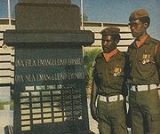
In 1985, a memorial cenotaph
Cenotaph

A cenotaph is a tomb or a monument erected in honor of a person or group of persons whose remains are elsewhere. It can also be the initial tomb for a person who has since been interred elsewhere....
 was unveiled at the Battalion's headquarters in Oluno near Ondangwa to commemorate the death of troops during operations between 1977 and 1988. When the unit was demobilized in 1988, this cenotaph was relocated to 5 Reconnaissance Regiment's – now 5 Special Forces Regiment – headquarters in Phalaborwa, South Africa, outside the Special Forces' church. The unit's colors - presented to the Battalion in 1985 by the Chief of the South African Army - were first laid up inside the Special Forces church alongside those of 1 Special Forces Regiment who had been retired, but were recently removed to the South African Special Forces Brigade's museum in Pretoria where they can be seen (below) hanging alongside the old South African flag and the colours of 1 SFR .