

Gnetophyta

Encyclopedia
The plant
division Gnetophyta or gnetophytes consists of three genera
of woody plant
s grouped in the gymnosperm
s. The living Gnetophyta consists of around 70 species across the three genera Gnetum
(family
Gnetaceae), Welwitschia
(family Welwitschiaceae), and Ephedra
(family Ephedraceae).
The gnetophytes differ from other gymnosperms (i.e. conifers, cycad
s, and ginkgo
s) in having vessel element
s (which transport water within the plant) as found in flowering plant
s. The gnetophytes evolutionary relationships remain unclear: in some classifications, all three genera are placed in a single order
(Gnetales), while in other classifications they are distributed among three orders, each containing a single family and genus. Most morphological and molecular studies confirm that Gnetum and Welwitschia diverged from each other more recently than from Ephedra.
. Some synapomorphies of the gnetophytes include enveloping bract
s around the ovule
s and microsporangia
, and a micropylar projection of the outer membrane of the ovule that produces a pollination
droplet.
Gnetum
species are mostly wood
y climbers
in tropical forests. However, the most well-known member of this group, Gnetum gnemon
, is a tree. Its seeds are used to produce a crispy krupuk snack known as emping or krupuk belinjo.
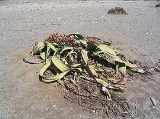
Welwitschia
comprises only one species, Welwitschia mirabilis. It grows only in the deserts of Namibia
and Angola
. This strange species has only two large strap-like leaves that grow continuously from the base throughout the plant's life.
Plants of the genus Ephedra
are known as jointfirs because they have long slender branches which bear tiny scale-like leaves at their nodes. Ephedra has been traditionally used as a stimulant
, but is a controlled substance
today in many jurisdictions because of the risk of harmful or even fatal overdosing.
Knowledge of fossils of the gnetophytes has increased greatly since the 1980s. There are fossils from the Permian
, the Triassic
, and the Jurassic
which may belong to the gnetophytes, but this is uncertain. The fossil record is richer starting in the early Cretaceous
, with fossils of plants as well as seed
s and pollen
which can be clearly assigned to the gnetophytes.
are highly unresolved, and the gnetophytes have played an important role in the formation of phylogenetic
hypotheses. Molecular phylogenies of extant gymnosperms have conflicted with morphological characters with regard to whether the gymnosperms as a whole (including gnetophytes) comprise a monophyletic group or a paraphyletic one that gave rise to angiosperms. At issue is whether the Gnetophyta are the sister group of angiosperms, or whether they are sister to, or nested within, other extant gymnosperms. Numerous fossil gymnosperm clades once existed that are morphologically at least as distinctive as the four living gymnosperm
groups, such as Bennettitales
, Caytonia and the glossopterids. When these gymnosperm fossils are considered, the question of gnetophyte relationships to other seed plants becomes even more complicated. Several hypotheses, illustrated below, have been presented to explain seed plant evolution.
characters between the gnetophytes and angiosperms. In this hypothesis, the gnetophytes, along with the extinct order Bennettitales
, are sister to the angiosperms, forming the “anthophytes”. Some morphological characters that were suggested to unite the anthophytes include vessels in wood, net-veined leaves (in Gnetum
only), lignin
chemistry, the layering of cells in the apical meristem
, pollen
and megaspore
features (including thin megaspore wall), short cambial initials, and lignin syringal groups. However, most genetic studies have rejected the anthophyte hypothesis. Several of these studies have suggested that the gnetophytes and angiosperms have independently derived characters, including flower-like reproductive structures and tracheid vessel elements, that appear shared but are actually the result of parallel evolution.
s are a monophyletic group, sister to the angiosperms. The gnetifer hypothesis first formally emerged in the mid-twentieth century, when vessel elements in the gnetophytes were interpreted as being derived from tracheid
s with circular bordered pits, as in conifers. It did not gain strong support, however, until the emergence of molecular data in the late 1990s. Although the morphological evidence still largely supports the anthophyte hypothesis, there are some morphological commonalities between the gnetophytes and conifers that lend support to the gnetifer hypothesis. These shared traits include: tracheids with scalariform pits with tori interspersed with annular thickenings, absence of scalariform pitting in primary xylem
, scale-like and strap-shaped leaves
of Ephedra
and Welwitschia
; and reduced sporophyll
s.
. According to this hypothesis, the conifers as currently defined are not a monophyletic group, in contrast with molecular findings that support its monophyly. All existing evidence for this hypothesis comes from molecular studies within the last decade. However, the morphological evidence remains difficult to reconcile with the gnepine hypothesis. If the gnetophytes are nested within conifers, they must have lost several shared derived characters of the conifers (or these characters must have evolved in parallel in the other conifer lineages): narrowly triangular leaves (gnetophytes have diverse leaf shapes), resin
canals, a tiered proembryo
, and flat woody ovuliferous cone
scales.
Plant
Plants are living organisms belonging to the kingdom Plantae. Precise definitions of the kingdom vary, but as the term is used here, plants include familiar organisms such as trees, flowers, herbs, bushes, grasses, vines, ferns, mosses, and green algae. The group is also called green plants or...
division Gnetophyta or gnetophytes consists of three genera
Genus
In biology, a genus is a low-level taxonomic rank used in the biological classification of living and fossil organisms, which is an example of definition by genus and differentia...
of woody plant
Woody plant
A woody plant is a plant that uses wood as its structural tissue. These are typically perennial plants whose stems and larger roots are reinforced with wood produced adjacent to the vascular tissues. The main stem, larger branches, and roots of these plants are usually covered by a layer of...
s grouped in the gymnosperm
Gymnosperm
The gymnosperms are a group of seed-bearing plants that includes conifers, cycads, Ginkgo, and Gnetales. The term "gymnosperm" comes from the Greek word gymnospermos , meaning "naked seeds", after the unenclosed condition of their seeds...
s. The living Gnetophyta consists of around 70 species across the three genera Gnetum
Gnetum
Gnetum is a genus of about 30-35 species of gymnosperms, the sole genus in the family Gnetaceae and order Gnetales. They are tropical evergreen trees, shrubs and lianas. Unlike other gymnosperms they possess vessel elements in the xylem...
(family
Family (biology)
In biological classification, family is* a taxonomic rank. Other well-known ranks are life, domain, kingdom, phylum, class, order, genus, and species, with family fitting between order and genus. As for the other well-known ranks, there is the option of an immediately lower rank, indicated by the...
Gnetaceae), Welwitschia
Welwitschia
Welwitschia is a monotypic genus of gymnosperm plant, composed solely of the very distinct Welwitschia mirabilis. The plant is commonly simply known as Welwitschia in English. It is known locally as !kharos or khurub , tweeblaarkanniedood , nyanka , or onyanga , among others...
(family Welwitschiaceae), and Ephedra
Ephedra (genus)
Ephedra is a genus of gymnosperm shrubs, the only genus in its family, Ephedraceae, and order, Ephedrales. Ephedra grows in dry climates over wide areas of the northern hemisphere, including southwestern North America, Europe, north Africa, and southwest and central Asia, and, in the southern...
(family Ephedraceae).
The gnetophytes differ from other gymnosperms (i.e. conifers, cycad
Cycad
Cycads are seed plants typically characterized by a stout and woody trunk with a crown of large, hard and stiff, evergreen leaves. They usually have pinnate leaves. The individual plants are either all male or all female . Cycads vary in size from having a trunk that is only a few centimeters...
s, and ginkgo
Ginkgo
Ginkgo , also spelled gingko and known as the Maidenhair Tree, is a unique species of tree with no close living relatives...
s) in having vessel element
Vessel element
A vessel element is one of the cell types found in xylem, the water conducting tissue of plants. Vessel elements are typically found in the angiosperms but absent from most gymnosperms such as the conifers....
s (which transport water within the plant) as found in flowering plant
Flowering plant
The flowering plants , also known as Angiospermae or Magnoliophyta, are the most diverse group of land plants. Angiosperms are seed-producing plants like the gymnosperms and can be distinguished from the gymnosperms by a series of synapomorphies...
s. The gnetophytes evolutionary relationships remain unclear: in some classifications, all three genera are placed in a single order
Order (biology)
In scientific classification used in biology, the order is# a taxonomic rank used in the classification of organisms. Other well-known ranks are life, domain, kingdom, phylum, class, family, genus, and species, with order fitting in between class and family...
(Gnetales), while in other classifications they are distributed among three orders, each containing a single family and genus. Most morphological and molecular studies confirm that Gnetum and Welwitschia diverged from each other more recently than from Ephedra.
Ecology and Morphology
The three genera of the gnetophytes are highly specialized to their respective environments, making it difficult to identify homologous characters. The three extant genera of gnetophytes, a “bizarre and enigmatic” trio, are likely aberrant members of the group, which was diverse and dominant in the TertiaryTertiary
The Tertiary is a deprecated term for a geologic period 65 million to 2.6 million years ago. The Tertiary covered the time span between the superseded Secondary period and the Quaternary...
. Some synapomorphies of the gnetophytes include enveloping bract
Bract
In botany, a bract is a modified or specialized leaf, especially one associated with a reproductive structure such as a flower, inflorescence axis, or cone scale. Bracts are often different from foliage leaves. They may be smaller, larger, or of a different color, shape, or texture...
s around the ovule
Ovule
Ovule means "small egg". In seed plants, the ovule is the structure that gives rise to and contains the female reproductive cells. It consists of three parts: The integument forming its outer layer, the nucellus , and the megaspore-derived female gametophyte in its center...
s and microsporangia
Microsporangia
Microsporangium is a sporangium that produces spores that give rise to male gametophytes. Microsporangia are notable in spikemosses, and a minority of ferns. In Gymnosperms and Angiosperms , the microsporangium produce the microsporocyte, also known as the microspore mother cell, which then creates...
, and a micropylar projection of the outer membrane of the ovule that produces a pollination
Pollination
Pollination is the process by which pollen is transferred in plants, thereby enabling fertilisation and sexual reproduction. Pollen grains transport the male gametes to where the female gamete are contained within the carpel; in gymnosperms the pollen is directly applied to the ovule itself...
droplet.
Gnetum
Gnetum
Gnetum is a genus of about 30-35 species of gymnosperms, the sole genus in the family Gnetaceae and order Gnetales. They are tropical evergreen trees, shrubs and lianas. Unlike other gymnosperms they possess vessel elements in the xylem...
species are mostly wood
Wood
Wood is a hard, fibrous tissue found in many trees. It has been used for hundreds of thousands of years for both fuel and as a construction material. It is an organic material, a natural composite of cellulose fibers embedded in a matrix of lignin which resists compression...
y climbers
Vine
A vine in the narrowest sense is the grapevine , but more generally it can refer to any plant with a growth habit of trailing or scandent, that is to say climbing, stems or runners...
in tropical forests. However, the most well-known member of this group, Gnetum gnemon
Gnetum gnemon
Gnetum gnemon is a species of Gnetum native to southeast Asia and the western Pacific Ocean islands, from Assam south and east through Indonesia and Malaysia to the Philippines and Fiji...
, is a tree. Its seeds are used to produce a crispy krupuk snack known as emping or krupuk belinjo.
Welwitschia
Welwitschia
Welwitschia is a monotypic genus of gymnosperm plant, composed solely of the very distinct Welwitschia mirabilis. The plant is commonly simply known as Welwitschia in English. It is known locally as !kharos or khurub , tweeblaarkanniedood , nyanka , or onyanga , among others...
comprises only one species, Welwitschia mirabilis. It grows only in the deserts of Namibia
Namibia
Namibia, officially the Republic of Namibia , is a country in southern Africa whose western border is the Atlantic Ocean. It shares land borders with Angola and Zambia to the north, Botswana to the east and South Africa to the south and east. It gained independence from South Africa on 21 March...
and Angola
Angola
Angola, officially the Republic of Angola , is a country in south-central Africa bordered by Namibia on the south, the Democratic Republic of the Congo on the north, and Zambia on the east; its west coast is on the Atlantic Ocean with Luanda as its capital city...
. This strange species has only two large strap-like leaves that grow continuously from the base throughout the plant's life.
Plants of the genus Ephedra
Ephedra (genus)
Ephedra is a genus of gymnosperm shrubs, the only genus in its family, Ephedraceae, and order, Ephedrales. Ephedra grows in dry climates over wide areas of the northern hemisphere, including southwestern North America, Europe, north Africa, and southwest and central Asia, and, in the southern...
are known as jointfirs because they have long slender branches which bear tiny scale-like leaves at their nodes. Ephedra has been traditionally used as a stimulant
Stimulant
Stimulants are psychoactive drugs which induce temporary improvements in either mental or physical function or both. Examples of these kinds of effects may include enhanced alertness, wakefulness, and locomotion, among others...
, but is a controlled substance
Controlled substance
A controlled substance is generally a drug or chemical whose manufacture, possession, or use are regulated by a government. This may include illegal drugs and prescription medications ....
today in many jurisdictions because of the risk of harmful or even fatal overdosing.
Knowledge of fossils of the gnetophytes has increased greatly since the 1980s. There are fossils from the Permian
Permian
The PermianThe term "Permian" was introduced into geology in 1841 by Sir Sir R. I. Murchison, president of the Geological Society of London, who identified typical strata in extensive Russian explorations undertaken with Edouard de Verneuil; Murchison asserted in 1841 that he named his "Permian...
, the Triassic
Triassic
The Triassic is a geologic period and system that extends from about 250 to 200 Mya . As the first period of the Mesozoic Era, the Triassic follows the Permian and is followed by the Jurassic. Both the start and end of the Triassic are marked by major extinction events...
, and the Jurassic
Jurassic
The Jurassic is a geologic period and system that extends from about Mya to Mya, that is, from the end of the Triassic to the beginning of the Cretaceous. The Jurassic constitutes the middle period of the Mesozoic era, also known as the age of reptiles. The start of the period is marked by...
which may belong to the gnetophytes, but this is uncertain. The fossil record is richer starting in the early Cretaceous
Cretaceous
The Cretaceous , derived from the Latin "creta" , usually abbreviated K for its German translation Kreide , is a geologic period and system from circa to million years ago. In the geologic timescale, the Cretaceous follows the Jurassic period and is followed by the Paleogene period of the...
, with fossils of plants as well as seed
Seed
A seed is a small embryonic plant enclosed in a covering called the seed coat, usually with some stored food. It is the product of the ripened ovule of gymnosperm and angiosperm plants which occurs after fertilization and some growth within the mother plant...
s and pollen
Pollen
Pollen is a fine to coarse powder containing the microgametophytes of seed plants, which produce the male gametes . Pollen grains have a hard coat that protects the sperm cells during the process of their movement from the stamens to the pistil of flowering plants or from the male cone to the...
which can be clearly assigned to the gnetophytes.
Classification
The evolutionary relationships among the seed plantsSpermatophyte
The spermatophytes comprise those plants that produce seeds. They are a subset of the embryophytes or land plants...
are highly unresolved, and the gnetophytes have played an important role in the formation of phylogenetic
Phylogenetics
In biology, phylogenetics is the study of evolutionary relatedness among groups of organisms , which is discovered through molecular sequencing data and morphological data matrices...
hypotheses. Molecular phylogenies of extant gymnosperms have conflicted with morphological characters with regard to whether the gymnosperms as a whole (including gnetophytes) comprise a monophyletic group or a paraphyletic one that gave rise to angiosperms. At issue is whether the Gnetophyta are the sister group of angiosperms, or whether they are sister to, or nested within, other extant gymnosperms. Numerous fossil gymnosperm clades once existed that are morphologically at least as distinctive as the four living gymnosperm
Gymnosperm
The gymnosperms are a group of seed-bearing plants that includes conifers, cycads, Ginkgo, and Gnetales. The term "gymnosperm" comes from the Greek word gymnospermos , meaning "naked seeds", after the unenclosed condition of their seeds...
groups, such as Bennettitales
Bennettitales
Bennettitales is an extinct order of seed plants that first appeared in the Triassic period and became extinct toward the end of the Cretaceous...
, Caytonia and the glossopterids. When these gymnosperm fossils are considered, the question of gnetophyte relationships to other seed plants becomes even more complicated. Several hypotheses, illustrated below, have been presented to explain seed plant evolution.
Anthophyte hypothesis
From the early twentieth century, the anthophyte hypothesis was the prevailing explanation for seed plant evolution, based on shared morphologicalMorphology (biology)
In biology, morphology is a branch of bioscience dealing with the study of the form and structure of organisms and their specific structural features....
characters between the gnetophytes and angiosperms. In this hypothesis, the gnetophytes, along with the extinct order Bennettitales
Bennettitales
Bennettitales is an extinct order of seed plants that first appeared in the Triassic period and became extinct toward the end of the Cretaceous...
, are sister to the angiosperms, forming the “anthophytes”. Some morphological characters that were suggested to unite the anthophytes include vessels in wood, net-veined leaves (in Gnetum
Gnetum
Gnetum is a genus of about 30-35 species of gymnosperms, the sole genus in the family Gnetaceae and order Gnetales. They are tropical evergreen trees, shrubs and lianas. Unlike other gymnosperms they possess vessel elements in the xylem...
only), lignin
Lignin
Lignin or lignen is a complex chemical compound most commonly derived from wood, and an integral part of the secondary cell walls of plants and some algae. The term was introduced in 1819 by de Candolle and is derived from the Latin word lignum, meaning wood...
chemistry, the layering of cells in the apical meristem
Meristem
A meristem is the tissue in most plants consisting of undifferentiated cells , found in zones of the plant where growth can take place....
, pollen
Pollen
Pollen is a fine to coarse powder containing the microgametophytes of seed plants, which produce the male gametes . Pollen grains have a hard coat that protects the sperm cells during the process of their movement from the stamens to the pistil of flowering plants or from the male cone to the...
and megaspore
Megaspore
Megaspores, also called macrospores, are a type of spore that is present in heterosporous plants. These types of plants have two spore types, megaspores and microspores. Generally speaking, the megaspore, or large spore, germinates into a female gametophyte, which is fertilized by sperm produced...
features (including thin megaspore wall), short cambial initials, and lignin syringal groups. However, most genetic studies have rejected the anthophyte hypothesis. Several of these studies have suggested that the gnetophytes and angiosperms have independently derived characters, including flower-like reproductive structures and tracheid vessel elements, that appear shared but are actually the result of parallel evolution.
Gnetifer hypothesis
In the gnetifer hypothesis, the gnetophytes are sister to the conifers, and the gymnospermGymnosperm
The gymnosperms are a group of seed-bearing plants that includes conifers, cycads, Ginkgo, and Gnetales. The term "gymnosperm" comes from the Greek word gymnospermos , meaning "naked seeds", after the unenclosed condition of their seeds...
s are a monophyletic group, sister to the angiosperms. The gnetifer hypothesis first formally emerged in the mid-twentieth century, when vessel elements in the gnetophytes were interpreted as being derived from tracheid
Tracheid
Tracheids are elongated cells in the xylem of vascular plants that serve in the transport of water and mineral salts. Tracheids are one of two types of tracheary elements, vessel elements being the other. All tracheary elements develop a thick lignified cell wall, and at maturity the protoplast...
s with circular bordered pits, as in conifers. It did not gain strong support, however, until the emergence of molecular data in the late 1990s. Although the morphological evidence still largely supports the anthophyte hypothesis, there are some morphological commonalities between the gnetophytes and conifers that lend support to the gnetifer hypothesis. These shared traits include: tracheids with scalariform pits with tori interspersed with annular thickenings, absence of scalariform pitting in primary xylem
Xylem
Xylem is one of the two types of transport tissue in vascular plants. . The word xylem is derived from the Classical Greek word ξυλον , meaning "wood"; the best-known xylem tissue is wood, though it is found throughout the plant...
, scale-like and strap-shaped leaves
Leaf
A leaf is an organ of a vascular plant, as defined in botanical terms, and in particular in plant morphology. Foliage is a mass noun that refers to leaves as a feature of plants....
of Ephedra
Ephedra
Ephedra refers to the plant Ephedra sinica. E. sinica, known in Chinese as ma huang , has been used in traditional Chinese medicine for 5,000 years for the treatment of asthma and hay fever, as well as for the common cold...
and Welwitschia
Welwitschia
Welwitschia is a monotypic genus of gymnosperm plant, composed solely of the very distinct Welwitschia mirabilis. The plant is commonly simply known as Welwitschia in English. It is known locally as !kharos or khurub , tweeblaarkanniedood , nyanka , or onyanga , among others...
; and reduced sporophyll
Sporophyll
A sporophyll is a leaf that bears sporangia. Both microphylls and megaphylls can be sporophylls. In heterosporous plants, sporophylls bear either megasporangia , or microsporangia...
s.
Gnepine hypothesis
The gnepine hypothesis is a modification of the gnetifer hypothesis, and suggests that the gnetophytes belong within the conifers as a sister group to the PinaceaePinaceae
Pinaceae are trees or shrubs, including many of the well-known conifers of commercial importance such as cedars, firs, hemlocks, larches, pines and spruces. The family is included in the order Pinales, formerly known as Coniferales. Pinaceae are supported as monophyletic by its protein-type sieve...
. According to this hypothesis, the conifers as currently defined are not a monophyletic group, in contrast with molecular findings that support its monophyly. All existing evidence for this hypothesis comes from molecular studies within the last decade. However, the morphological evidence remains difficult to reconcile with the gnepine hypothesis. If the gnetophytes are nested within conifers, they must have lost several shared derived characters of the conifers (or these characters must have evolved in parallel in the other conifer lineages): narrowly triangular leaves (gnetophytes have diverse leaf shapes), resin
Resin
Resin in the most specific use of the term is a hydrocarbon secretion of many plants, particularly coniferous trees. Resins are valued for their chemical properties and associated uses, such as the production of varnishes, adhesives, and food glazing agents; as an important source of raw materials...
canals, a tiered proembryo
Proembryo
Proembryo, or pro-embryo, is a botanical term that has been used for centuries, to denote the series of cells that are formed after fertilization within the ovule of a flowering plant, before formation of the embryo....
, and flat woody ovuliferous cone
Conifer cone
A cone is an organ on plants in the division Pinophyta that contains the reproductive structures. The familiar woody cone is the female cone, which produces seeds. The male cones, which produce pollen, are usually herbaceous and much less conspicuous even at full maturity...
scales.