
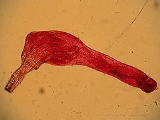
Acanthocephala is a phylum of parasitic worms known as
acanthocephales,
thorny-headed worms, or
spiny-headed worms, characterized by the presence of an evertable
proboscisA proboscis is an elongated appendage from the head of an animal, either a vertebrate or an invertebrate. In simpler terms, a proboscis is the straw-like mouth found in several varieties of species.-Etymology:...
, armed with spines, which it uses to pierce and hold the
gutIn zoology, the gut, also known as the alimentary canal or alimentary tract, is a tube by which bilaterian animals transfer food to the digestion organs. In large bilaterians the gut generally also has an exit, the anus, by which the animal disposes of solid wastes...
wall of its host. Acanthocephalans typically have
complex life cyclesParasite life cycles can take a variety of forms, all involving the exploitation of one or more hosts. Those that must infect more than one host species to complete their life cycles are said to have complex or indirect life cycles, while those that infect a single species have direct life...
, involving a number of hosts, including
invertebrateAn invertebrate is an animal without a backbone. The group includes 97% of all animal species – all animals except those in the chordate subphylum Vertebrata .Invertebrates form a paraphyletic group...
s,
fishFish are a paraphyletic group of organisms that consist of all gill-bearing aquatic vertebrate animals that lack limbs with digits. Included in this definition are the living hagfish, lampreys, and cartilaginous and bony fish, as well as various extinct related groups...
es,
amphibianAmphibians , are a class of vertebrate animals including animals such as toads, frogs, caecilians, and salamanders. They are characterized as non-amniote ectothermic tetrapods...
s,
birdBirds are feathered, winged, bipedal, endothermic , egg-laying, vertebrate animals. Around 10,000 living species and 188 families makes them the most speciose class of tetrapod vertebrates. They inhabit ecosystems across the globe, from the Arctic to the Antarctic. Extant birds range in size from...
s, and
mammalMammals are members of a class of air-breathing vertebrate animals characterised by the possession of endothermy, hair, three middle ear bones, and mammary glands functional in mothers with young...
s. About 1150
speciesIn biology, a species is one of the basic units of biological classification and a taxonomic rank. A species is often defined as a group of organisms capable of interbreeding and producing fertile offspring. While in many cases this definition is adequate, more precise or differing measures are...
have been described.
The Acanthocephala were thought to be a discrete
phylumIn biology, a phylum The term was coined by Georges Cuvier from Greek φῦλον phylon, "race, stock," related to φυλή phyle, "tribe, clan." is a taxonomic rank below kingdom and above class. "Phylum" is equivalent to the botanical term division....
. Recent
genomeIn modern molecular biology and genetics, the genome is the entirety of an organism's hereditary information. It is encoded either in DNA or, for many types of virus, in RNA. The genome includes both the genes and the non-coding sequences of the DNA/RNA....
analysis has shown that they are descended from, and should be considered as, highly modified
rotiferThe rotifers make up a phylum of microscopic and near-microscopic pseudocoelomate animals. They were first described by Rev. John Harris in 1696, and other forms were described by Anton van Leeuwenhoek in 1703...
s. This is an example of molecular phylogenetics.
Morphological characteristics
There are several morphological characteristics that distinguish acanthocephalans from other phyla of parasitic worms.
Digestion
Acanthocephalans lack a
mouthThe mouth is the first portion of the alimentary canal that receives food andsaliva. The oral mucosa is the mucous membrane epithelium lining the inside of the mouth....
or alimentary canal. This is a feature they share with the
cestodaThis article describes the flatworm. For the medical condition, see Tapeworm infection.Cestoda is the name given to a class of parasitic flatworms, commonly called tapeworms, of the phylum Platyhelminthes. Its members live in the digestive tract of vertebrates as adults, and often in the bodies...
(tapeworms), although the two groups are not closely related. Adult stages live in the
intestineIn human anatomy, the intestine is the segment of the alimentary canal extending from the pyloric sphincter of the stomach to the anus and, in humans and other mammals, consists of two segments, the small intestine and the large intestine...
s of their host and uptake nutrients which have been
digestDigest can refer to any of the following:*A condensed collection or compendium of writings:**Pandects, or "The Digest", a digest of Roman law**A tax digest...
ed by the host, directly, through their body surface.
Proboscis
The most notable feature of the acanthocephala is the presence of an anterior, protrudible
proboscisA proboscis is an elongated appendage from the head of an animal, either a vertebrate or an invertebrate. In simpler terms, a proboscis is the straw-like mouth found in several varieties of species.-Etymology:...
that is usually covered with spiny hooks (hence the common name: thorny headed worm). The proboscis bears rings of recurved hooks arranged in horizontal rows, and it is by means of these hooks that the animal attaches itself to the tissues of its host. The hooks may be of two or three shapes, usually, longer, more slender hooks are arranged along the length of the proboscis, with several rows of more sturdy, shorter nasal hooks around the base of the proboscis. The proboscis is used to pierce the gut wall of the final host, and hold the parasite fast while it completes its life cycle.
Like the body, the proboscis is hollow, and its cavity is separated from the body cavity by a
septum or
proboscis sheath. Traversing the cavity of the proboscis are
muscleMuscle is a contractile tissue of animals and is derived from the mesodermal layer of embryonic germ cells. Muscle cells contain contractile filaments that move past each other and change the size of the cell. They are classified as skeletal, cardiac, or smooth muscles. Their function is to...
-strands inserted into the tip of the proboscis at one end and into the septum at the other. Their contraction causes the proboscis to be invaginated into its cavity. The whole proboscis apparatus can also be, at least partially, withdrawn into the body cavity, and this is effected by two retractor muscles which run from the posterior aspect of the septum to the body wall.
Some of the acanthocephalans (perforating acanthocephalans) can insert their proboscis in the intestine of the host and open the way to the abdominal cavity.
Phylogenetic relationships
Acanthocephalans are highly adapted to a parasitic mode of life, and have lost many organs and structures through evolutionary processes. This makes determining relationships with other higher taxa through morphological comparison problematic. Phylogenetic analysis of the 18S
ribosomalA ribosome is a component of cells that assembles the twenty specific amino acid molecules to form the particular protein molecule determined by the nucleotide sequence of an RNA molecule....
gene has revealed that the Acanthocephala are most closely related to the
rotiferThe rotifers make up a phylum of microscopic and near-microscopic pseudocoelomate animals. They were first described by Rev. John Harris in 1696, and other forms were described by Anton van Leeuwenhoek in 1703...
s. They are possibly closer to the two rotifer classes Bdelloidea and Monogononta than to the other class, Seisonidea, producing the names and relationships shown in the
cladogramA cladogram is a diagram used in cladistics which shows ancestral relations between organisms, to represent the evolutionary tree of life. Although traditionally such cladograms were generated largely on the basis of morphological characters, DNA and RNA sequencing data and computational...
below.
The three rotifer classes and the Acanthocephala make up a
cladeA clade is a group consisting of a species and all its descendants. In the terms of biological systematics, a clade is a single "branch" on the "tree of life". The idea that such a "natural group" of organisms should be grouped together and given a taxonomic name is central to biological...
called Syndermata. This clade is placed in the
PlatyzoaThe Platyzoa are a group of protostome animals proposed by Thomas Cavalier-Smith in 1998. Cavalier-Smith included in Platyzoa the Phylum Platyhelminthes or flatworms, and a new phylum, Acanthognatha, into which he gathered several previously described phyla of microscopic animals...
.
Size
The size of the animals varies greatly, from forms a few millimetres in length to
Gigantorhynchus gigas, which measures from 10 to 65 cm (3.9 to 25.6 in).
Skin
The body surface of the acanthocephala is peculiar. Externally, the skin has a thin
cuticleA cuticle , or cuticula, is a term used for any of a variety of tough but flexible, non-mineral outer coverings of an organism, or parts of an organism, that provide protection. Various types of "cuticles" are non-homologous; differing in their origin, structure, function, and chemical composition...
covering the
epidermisIn anatomy, squamous epithelium is an epithelium characterised by its most superficial layer consisting of flat, scale-like cells called squamous epithelial cells...
, which consists of a
syncytiumIn biology, a syncytium is a large cell-like structure; filled with cytoplasm and containing many nuclei. Most cells in eukaryotic organisms have a single nucleus; syncytia are specialized forms used by various organisms.The term may also refer to cells that are connected by specialized membrane...
with no
cell wallThe cell wall is the tough, usually flexible but sometimes fairly rigid layer that surrounds some types of cells. It is located outside the cell membrane and provides these cells with structural support and protection, and also acts as a filtering mechanism. A major function of the cell wall is to...
s. The syncytium is traversed by a series of branching
tubuleA tubule is a very small tube or fistular structure.A system of surface-connected membranes in muscle that enables a nerve impulse to travel to the interior of the muscle fibre.In anatomy, a tubule is a minute tube lined with glandular epithelium....
s containing fluid and is controlled by a few wandering,
amoeboidAmoeboids are single-celled life-forms characterized by an irregular shape."Amoeboid" and "amœba" are often used interchangeably even by biologists, and especially refer to a creature moving by using pseudopodia. Most references to "amoebas" or "amoebae" are to amoeboids in general rather than to...
nucleiIn cell biology, the nucleus is a membrane-enclosed organelle found in eukaryotic cells. It contains most of the cell's genetic material, organized as multiple long linear DNA molecules in complex with a large variety of proteins, such as histones, to form chromosomes. The genes within these...
. Inside the syncytium is an irregular layer of circular muscle fibres, and within this again some rather scattered longitudinal fibres; there is no
endotheliumThe endothelium is the thin layer of cells that lines the interior surface of blood vessels, forming an interface between circulating blood in the lumen and the rest of the vessel wall. These cells are called endothelial cells. Endothelial cells line the entire circulatory system, from the heart...
. In their micro-structure the muscular fibres resemble those of
nematodeThe nematodes or roundworms are the most diverse phylum of pseudocoelomates, and one of the most diverse of all animals. Nematode species are very difficult to distinguish; over 28,000 have been described, of which over 16,000 are parasitic. It has been estimated that the total number of nematode...
s.
Except for the absence of the longitudinal fibres the skin of the proboscis resembles that of the body, but the fluid-containing tubules of the proboscis are shut off from those of the body. The canals of the proboscis open into a circular vessel which runs round its base. From the circular canal two sac-like projections called the
lemnisci run into the cavity of the body, alongside the proboscis cavity. Each consists of a prolongation of the syncytial material of the proboscis skin, penetrated by canals and sheathed with a muscular coat. They seem to act as reservoirs into which the fluid which is used to keep the proboscis "erect" can withdraw when it is retracted, and from which the fluid can be driven out when it is wished to expand the proboscis.
Nervous system
The central ganglion of the nervous system lies behind the proboscis sheath or septum. It innervates the proboscis and projects two stout trunks posteriorly which supply the body. Each of these trunks is surrounded by muscles, and this nerve-muscle complex is called a
retinaculum. In the male at least there is also a genital
ganglionIn anatomy, a ganglion is a biological tissue mass, most commonly a mass of nerve cell bodies. Cells found in a ganglion are called ganglion cells, though this term is also sometimes used to refer specifically to retinal ganglion cells....
. Some scattered papillae may possibly be sense-organs.
"Brain-jacking"
Thorny-headed worms begin their life cycle inside invertebrates that reside in marine or freshwater systems.
Gammarus lacustrisGammarus lacustris is an aquatic amphipod.-Description:G. lacustris is semi-transparent and lacks a webbed tail. It may be colorless, brown, reddish or bluish in color, depending on the local environment. It has seven abdominal segments, a fused cephalothorax, and two pairs of antennae. Unlike...
, a small crustacean that feeds near ponds and rivers, is one invertebrate that the thorny-headed worm may occupy. This crustacean is preyed on by ducks and hides by avoiding light and staying away from the surface. However, when infected by a thorny-headed worm it becomes attracted toward light and swims to the surface.
Gammarus lacustris will even go so far as to find a rock or a plant on the surface, clamp its mouth down, and latch on, making it easy prey for the duck. The duck is the definitive host for the acanthocephalan parasite. In order to be transmitted to the duck, the parasite's intermediate host (the gammarid) must be eaten by the duck. This modification of gammarid behavior by the acanthocephalan is thought to increase the rate of transmission of the parasite to its next host by increasing the susceptibility of the gammarid to predation.
It is thought that when
Gammarus lacustris is infected with a thorny-headed worm, the parasite causes
serotoninSerotonin or 5-hydroxytryptamine is a monoamine neurotransmitter. Biochemically derived from tryptophan, serotonin is primarily found in the gastrointestinal tract, platelets, and in the central nervous system of animals including humans...
to be massively expressed. Serotonin is a neurotransmitter involved in emotions and mood. Researchers have found that during mating
Gammarus lacustris expresses high levels of serotonin. Also during mating, the male
Gammarus lacustris clamps down on the female and holds on for days. Researchers have additionally found that blocking serotonin releases clamping. Another experiment found that serotonin also reduces the photophobic behavior in
Gammarus lacustris. Thus, it is thought that the thorny-headed worm physiologically changes the behavior of the
Gammarus lacustris in order to enter its final host, the bird.
Sex
The Acanthocephala are
dioeciousDioecy is the property of a group of biological organisms that have males and females, but not members that have organs of both sexes at the same time. I.e., those whose individual members can usually produce only one type of gamete; each individual organism is thus distinctly female or male...
. There is a structure called the
genital ligament which runs from the posterior end of the proboscis sheath to the posterior end of the body. In the male, two testes lie on either side of this. Each opens in a
vas deferensThe vas deferens , also called ductus deferens, , is part of the male anatomy of many vertebrates; they transport sperm from the epididymis in anticipation of ejaculation....
which bears three diverticula or
vesiculae seminales. The male also possesses three pairs of cement glands, found behind the testes, which pour their secretions through a duct into the vasa deferentia. These unite and end in a
penisThe penis is a biological feature of male animals including both vertebrates and invertebrates...
which opens posteriorly.
In the female, the ovaries are found, like the testes, as rounded bodies along the ligament. From these masses of ova dehisce into the body cavity and float in its fluid. Here the eggs are fertilized and segment so that the young
embryoAn embryo is a multicellular diploid eukaryote in its earliest stage of development, from the time of first cell division until birth, hatching, or germination...
s are formed within their mother's body. The embryos escape into the
uterusThe uterus or womb is a major female hormone-responsive reproductive sex organ of most mammals including humans. One end, the cervix, opens into the vagina, while the other is connected to one or both fallopian tubes, depending on the species...
through the
uterine bell, a funnel like opening continuous with the uterus. At the junction of the bell and the uterus there is a second small opening situated
dorsallyIn anatomy, the dorsum is the upper side of animals that typically run, fly, or swim in a horizontal position, and the back side of animals that walk upright. In vertebrates the dorsum contains the backbone. The term dorsal refers to anatomical structures that are either situated toward or grow...
. The bell "swallows" the matured embryos and passes them on into the uterus, and from there, out of the body via the
oviductIn non-mammalian vertebrates, the passageway from the ovaries to the outside of the body is known as the oviduct. The eggs travel along the oviduct. These eggs will either be fertilized by sperm to become a zygote, or will degenerate in the body...
. Should the bell swallow any of the ova, or even one of the younger embryos, these are passed back into the body cavity through the second, dorsal, opening.
The embryo passes from the body of the female into the alimentary canal of the host and leaves this with the
fecesFeces, faeces, or fæces is a waste product from an animal's digestive tract expelled through the anus or cloaca during defecation.-Etymology:...
.
Other features
A curious feature shared by both larva and adult is the large size of many of the cells, e.g. the nerve cells and cells forming the uterine bell. Polyploidy is common, with up to 343n having been recorded in some species. The acanthocephalans lack an excretory system, although some species have been shown to possess
flame cellright|frameA flame cell is a specialized excretory cell found in the simplest freshwater invertebrates, including flatworms , rotifers and nemerteans; these are the simplest animals to have a dedicated excretory system. Flame cells function like a kidney, removing waste materials...
s (protonephridia).
History
The earliest recognisable description of Acanthocephala - a worm with a proboscis armed with hooks - was made by Italian author
Francesco RediFrancesco Redi was an Italian physician, naturalist, and poet.-Biography:The son of Gregorio Redi and Cecilia de Ghinci was born in Arezzo on February 18, 1626. After schooling with the Jesuits, he attended the University of Pisa...
(1684). In 1771, I. T. Koelreuther proposed the name Acanthocephala. Müller independently called them
Echinorhynchus in 1776.
Karl RudolphiKarl Asmund Rudolphi was a Swedish-born naturalist, who is credited with being the "father of helminthology"....
in 1809 formally named them Acanthocephala.
Currently the phylum is divided into four classes –
PalaeacanthocephalaPalaeacanthocephala is a class within the phylum Acanthocephala. The adults of these parasitic platyzoans feed mainly on fish, aquatic birds and mammals....
,
ArchiacanthocephalaArchiacanthocephala is a class within the phylum of Acanthocephala . They are microscopic parasitic worms that attach themselves to the intestinal wall of terrestrial vertebrates, including man...
, Polyacanthocephala and
EoacanthocephalaEoacanthocephala is a class of parasitic worms, within the phylum Acanthocephala. They feed on any aquatic cold-blooded creature such as turtles and fish. The only reliable way to identify the group is that they only have one cement gland. This is a primitive characteristic and hence the name....
.
Life cycles
General patterns
Acanthocephalans have complex life cycles, involving a number of hosts, for both
developmentalMorphogenesis , is the biological process that causes an organism to develop its shape...
and resting stages. Complete life cycles have been worked out for only 25 species.
Having been expelled by the female, the acanthocephalan embryo is released along with the feces of the host. For development to occur, the embryo needs to be ingested by an invertebrate, almost always a
crustaceanCrustaceans form a very large group of arthropods, usually treated as a subphylum, which includes such familiar animals as crabs, lobsters, crayfish, shrimp, krill and barnacles. The 50,000 described species range in size from Stygotantulus stocki at , to the Japanese spider crab with a leg span...
(there is one known life cycle which uses a
molluscThe Mollusca , common name molluscs or mollusksSpelled mollusks in the USA, see reasons given in Rosenberg's ; for the spelling mollusc see the reasons given by , is a large phylum of invertebrate animals. There are around 85,000 recognized extant species of molluscs. Mollusca is the largest...
as a first intermediate host). Inside the intermediate host, the acanthocephalan penetrates the gut wall, moves into the body cavity, encysts, and begins transformation into the infective
cystacanth stage. This form has all the organs of the adult save the reproductive ones.
The parasite is released when the first intermediate host is ingested. This can be by a suitable final host, in which case the cystacanth develops into a mature adult, or by a
paratenicIn parasitology, the term paratenic describes a host which is not needed for the development of the parasite, but nonetheless serves to maintain the life cycle of the parasite. Alaria americana may serve as an example: the so-called mesocercarial stages of this parasite reside in tadpoles, which...
host, in which the parasite again forms a cyst. When consumed by a suitable final host, the cycstacant
excysts, everts its proboscis and pierces the gut wall. It then feeds, grows and develops its sexual organs. Adult worms then mate. The male uses the excretions of its
cement glands to plug the
vaginaThe vagina is a fibromuscular tubular tract leading from the uterus to the exterior of the body in female placental mammals and marsupials, or to the cloaca in female birds, monotremes, and some reptiles. Female insects and other invertebrates also have a vagina, which is the terminal part of the...
of the female, preventing subsequent matings from occurring. Embryos develop inside the female, and the life cycle repeats.
An example - Polymorphus spp.
Polymorphus spp. are parasites of seabirds, particularly the Eider Duck (
Somateria mollissima). Heavy infections of up to 750 parasites per bird are common, causing
ulcerationA peptic ulcer, also known as PUD or peptic ulcer disease, is the most common ulcer of an area of the gastrointestinal tract that is usually acidic and thus extremely painful. It is defined as mucosal erosions equal to or greater than 0.5 cm...
to the gut, disease and seasonal mortality. Recent research has suggested that there is no evidence of
pathogenA pathogen gignomai "I give birth to") or infectious agent — colloquially, a germ — is a microbe or microorganism such as a virus, bacterium, prion, or fungus that causes disease in its animal or plant host...
icity of
Polymorphus spp. to intermediate
crabTrue crabs are decapod crustaceans of the infraorder Brachyura, which typically have a very short projecting "tail" , or where the reduced abdomen is entirely hidden under the thorax...
hosts. The cystacanth stage is long lived and probably remains infective throughout the life of the crab.
The life cycle of
Polymorphus spp. normally occurs between sea ducks (e.g. eiders and
scoterThe scoters are stocky seaducks in the genus Melanitta. The drakes are mostly black and have swollen bills. Females are brown.They breed in the far north of Europe, Asia and North America, and winter further south in temperate zones of those continents. They form large flocks on suitable coastal...
s) and small crabs. Infections found in commercial-sized
lobsterClawed lobsters comprise a family of large marine crustaceans. Highly prized as seafood, lobsters are economically important, and are often one of the most profitable commodities in coastal areas they populate.Though several groups of crustaceans are known as lobsters, the clawed lobsters are most...
s in Canada were probably acquired from crabs that form an important dietary item of lobsters. Cystacanths occurring in lobsters can cause economic loss to fishermen. There are no known methods of prevention or control.
Use in medicine
Acanthocephala have been used as a medical treatment for various diseases, particularly those involving an over active
immune responseAn immune system is a system of biological structures and processes within an organism that protects against disease by identifying and killing pathogens and tumor cells. It detects a wide variety of agents, from viruses to parasitic worms, and needs to distinguish them from the organism's own...
. As
humanHumans are the only living species in the Homo genus...
s have evolved with parasitic worms, proponents argue that they are needed for a healthy immune system. Scientists are looking to see if there is a connection between the prevention and control of parasitic worms and the increase in
allergiesAn Allergy is a hypersensitivity disorder of the immune system. Allergic reactions occur when a person's immune system reacts to normally harmless substances in the environment. A substance that causes a reaction is called an allergen. These reactions are acquired, predictable, and rapid...
such as hay-fever in developed countries. Acanthocephala and other parasitic worms may be able to damp down the immune system of their host, making it easier for them to live in the intestine without coming under attack. This may be one mechanism for their proposed medicinal effect.
Further reading
- Gupta, P. C; Pramod Kumar. (1984) Two new species of Acanthocephalan Parasites of marine fishes from Bay of Bengal off Purri coast Orissa." Kanpur University Res. J.[sci] 4:75-80.
- List of published articles about different species in international journals http://parasites-world.com/category/parasitology-articles/world/
External links