
All Topics  
Zuni


   Email Print
   Bookmark   Link


Zuni


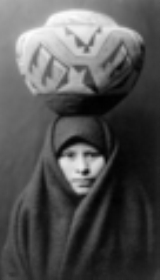
The Zuni (also spelled Zuņi by the Spanish and in early 20th Century ethnological texts) or A:shiwi (as the Zuni refer to themselves in their own language) are a Native American
Native Americans in the United States

Native Americans in the United States are the Indigenous peoples of the Americas from the regions of North America now encompassed by the continental United States United States, including parts of Alaska and the island state of Hawaii....
 tribe, one of the Pueblo people
Pueblo people

The Pueblo people are a Native Americans in the United States people in the Southwestern United States. Their traditional economy is based on agriculture and trade....
s, most of whom live in the Pueblo of Zuni
Zuni Pueblo, New Mexico

Zuni Pueblo is a census-designated place in McKinley County, New Mexico, New Mexico, United States. The population was 6,367 at the United States Census, 2000....
 on the Zuni River
Zuni River

The Zuni River, a tributary of the Little Colorado River, has its origin in Cibola County, New Mexico, at the Continental Divide, flowing generally in a southwesterly direction through the Zuni Indian Reservation to join the Little Colorado River in eastern Arizona....
, a tributary of the Little Colorado River
Little Colorado River

File:L. Colo bridge.jpgThe Little Colorado River is a tributary of the Colorado River , approximately 315 mi long, in the U.S. state of Arizona....
, in western New Mexico
New Mexico

New Mexico is a U. S. State located in the Southwestern United States of the United States. Inhabited by Native Americans in the United States populations for many centuries, it has also has been part of the Spanish Empire viceroyalty of New Spain, part of Mexico, and a U.S....
, United States
United States

The United States of America is a Federal government constitutional republic comprising U.S. state and a federal district. The country is situated mostly in central North America, where its Contiguous United States and Washington, D.C., the Capital districts and territories, lie between the Pacific Ocean and Atlantic Oceans, Borders of the U...
. Zuņi is 55 km (35 miles) south of Gallup, New Mexico
Gallup, New Mexico

Gallup is a city in McKinley County, New Mexico, New Mexico, United States. The population was 20,209 at the 2000 United States Census. It is the county seat of McKinley County, New Mexico....
 and has a population of about 12,000, with over 80% being Native Americans, with 43.0% of the population below the poverty line as defined by the U.S.


Discussion
Ask a question about 'Zuni'
Start a new discussion about 'Zuni'
Answer questions from other users
Full Discussion Forum


Encyclopedia


The Zuni (also spelled Zuņi by the Spanish and in early 20th Century ethnological texts) or A:shiwi (as the Zuni refer to themselves in their own language) are a Native American
Native Americans in the United States

Native Americans in the United States are the Indigenous peoples of the Americas from the regions of North America now encompassed by the continental United States United States, including parts of Alaska and the island state of Hawaii....
 tribe, one of the Pueblo people
Pueblo people

The Pueblo people are a Native Americans in the United States people in the Southwestern United States. Their traditional economy is based on agriculture and trade....
s, most of whom live in the Pueblo of Zuni
Zuni Pueblo, New Mexico

Zuni Pueblo is a census-designated place in McKinley County, New Mexico, New Mexico, United States. The population was 6,367 at the United States Census, 2000....
 on the Zuni River
Zuni River

The Zuni River, a tributary of the Little Colorado River, has its origin in Cibola County, New Mexico, at the Continental Divide, flowing generally in a southwesterly direction through the Zuni Indian Reservation to join the Little Colorado River in eastern Arizona....
, a tributary of the Little Colorado River
Little Colorado River

File:L. Colo bridge.jpgThe Little Colorado River is a tributary of the Colorado River , approximately 315 mi long, in the U.S. state of Arizona....
, in western New Mexico
New Mexico

New Mexico is a U. S. State located in the Southwestern United States of the United States. Inhabited by Native Americans in the United States populations for many centuries, it has also has been part of the Spanish Empire viceroyalty of New Spain, part of Mexico, and a U.S....
, United States
United States

The United States of America is a Federal government constitutional republic comprising U.S. state and a federal district. The country is situated mostly in central North America, where its Contiguous United States and Washington, D.C., the Capital districts and territories, lie between the Pacific Ocean and Atlantic Oceans, Borders of the U...
. Zuņi is 55 km (35 miles) south of Gallup, New Mexico
Gallup, New Mexico

Gallup is a city in McKinley County, New Mexico, New Mexico, United States. The population was 20,209 at the 2000 United States Census. It is the county seat of McKinley County, New Mexico....
 and has a population of about 12,000, with over 80% being Native Americans, with 43.0% of the population below the poverty line as defined by the U.S. income standards. However, many of the people do not consider their low income and lifestyle to be poverty. They are known for their unique culture
Culture

Culture is difficult to define. For example, in 1952, Alfred Kroeber and Clyde Kluckhohn compiled a list of 164 definitions of "culture" in Culture: A Critical Review of Concepts and Definitions....
 and cuisine
Cuisine

Cuisine is a specific set of cooking traditions and practices, often associated with a specific culture. A cuisine is primarily influenced by the ingredients that are available locally or through trade....
.

Culture

Zuni traditionally speak the Zuni language
Zuni language

Zuni is a language of the Zuni people, indigenous to western New Mexico and eastern Arizona in the United States. It is spoken by around 9,500 people worldwide, especially in the vicinity of Zuni Pueblo, New Mexico and much smaller numbers in parts of Arizona....
, a unique language (also called an "isolate") which is unrelated to any other Native American language. The Zuni continue to practice their traditional religion with its regular ceremonies
Ceremony

A ceremony is an activity, infused with ritual significance, performed on a special occasion....
 and dances and an independent and unique belief system.

The Zuni Tribal Fair and rodeo
Indian rodeo

Indian rodeo is the rodeo subculture of Native Americans in the United States rodeo athletes and, in Canada, First Nations athletes. In the United States there are a number of regional associations and at least two national Finals....
 is held the third weekend in August. The Zuni also participate in the Gallup Inter-Tribal Ceremonial usually held in early or mid-August.

History

Zuni Lang
The Zuni, like other Pueblo peoples, are believed to be the descendants of the Ancient Pueblo Peoples
Ancient Pueblo Peoples

Ancient Pueblo People or Ancestral Puebloans were an ancient Native Americans in the United States culture centered on the present-day Four Corners area of the Southwest United States, noted for their distinctive pottery and dwelling construction styles....
 who lived in the deserts of New Mexico, Arizona
Arizona

The State of Arizona is a U.S. state located in the Southwestern United States of the United States. The capital and largest city is Phoenix, Arizona....
, Southern Colorado
Colorado

The State of Colorado is a U.S. state located in the Mountain States of the United States of America. Colorado may also be considered to be a part of the Western United States and Southwestern United States regions of the United States....
 and Utah
Utah

The State of Utah is a western United States U.S. state of the United States. It was the List of U.S. states by date of statehood admitted to the United States on January 4, 1896....
 for centuries. Archaeological evidence
Archaeology

Archaeology, archeology, or arch?ology is the science that studies Homo cultures through the recovery, documentation, analysis, and interpretation of material remains and environmental data, including architecture, Artifact , features, Biofact s, and cultural landscape....
 shows they have lived in their present location for about 1,300 years. However, before the Pueblo Revolt
Pueblo Revolt

The Pueblo Revolt of 1680 or Pop?'s Rebellion was an uprising of many pueblos of the Pueblo people against Spanish colonization of the Americas in the New Spain province of New Mexico....
 of 1680, the Zuni lived in six different villages. After the revolt, until 1692, they took refuge in a defensible position atop Dowa Yalanne, a steep mesa
Mesa

A mesa is an elevated area of land with a flat top and sides that are usually steep cliffs. It takes its name from its characteristic table-top shape....
 5 km (2 miles) southeast of the present Pueblo of Zuni. "Dowa" meaning "corn", and "yalanne" meaning "mountain." After the establishment of peace and the return of the Spanish
Spanish colonization of the Americas

The Spanish colonization of the Americas was Spain's conquest, settlement, and rule over much of the western hemisphere. Beginning with the arrival of Christopher Columbus in 1492, over three centuries the Spanish Empire expanded from early small settlements in the Caribbean to include Central America, most of South America, Mexico, what toda...
, the Zuni relocated in their present location, only briefly returning to the mesa top in 1703.

In 1539, a Spanish exploratory party under the Moorish slave Estevanico
Estevanico

Estevanico of North African origins, possibly from Azemmour, Morocco. He is mentioned in various 16th century Southwestern United States United States expeditionary logs as a slave servant in the Spanish explorer Cabeza de Vaca's party....
 arrived, though the villagers eventually killed him. This was Spain's first contact with any of the Pueblo peoples.

Frank Hamilton Cushing

Frank Hamilton Cushing July 22, 1857- April 10, 1900 was born in Northeastern Pennsylvania, later moving with his family to western New York. As a boy he took an interest in the Native Americans in the United States Artifact s in the surrounding countryside and taught himself how to Flintknapper ....
, a pioneering anthropologist
Anthropology

Anthropology is the study of humans and humanity in its totality. Anthropology has origins in the natural sciences, and the humanities. In Great Britain it was originally divided into physical anthropology and cultural anthropology, which itself was divided into archaeology, technology, ethnology and sociology ....
 associated with the Smithsonian Institution
Smithsonian Institution

The Smithsonian Institution is an educational and research institute and associated museum complex, administered and funded by the government of the United States and by funds from its Financial endowment, contributions, and profits from its shops and its magazine....
, lived with the Zuni from 1879 to 1884. He was one of the first participant observer
Participant observation

Participant observation is a type of research strategy. Its aim is to gain a close and intimate familiarity with a given group of individuals and their practices through an intensive involvement with people in their natural environment, often though not always over an extended period of time....
s and an ethnologist
Ethnology

Ethnology is the branch of anthropology that compares and analyzes the origins, distribution, technology, religion, language, and social structure of the ethnicity, Race , and/or national divisions of humanity....
.

A recent controversy involved Zuni opposing the development of a coal mine
Coal mining

Coal mining is the extraction or removal of coal from the earth by mining. When coal is used for fuel in power generation it is referred to as steaming or thermal coal....
 near the Zuni Salt Lake
Zuni Salt Lake

Zuni Salt Lake, also Zu?i Salt Lake or Fence Lake , is a rare high desert lake, and a classic maar. It is located in Catron County, New Mexico, about 60 miles south of the Zuni Pueblo, New Mexico, USA....
, a site considered sacred by the Zuni and under Zuni control. The mine would have extracted water from the aquifer
Aquifer

An aquifer is an underground layer of water-bearing permeable rock or unconsolidated materials from which groundwater can be usefully extracted using a water well....
 below the lake and would also have involved construction between the lake and Zuni. The plan died after several lawsuits.

Zuni life


Zuni crafts

In the earlier days of that age when Native Zuni clan
Clan

A clan is a group of people united by kinship and descent, which is defined by actual or perceived descent from a common ancestor. Even if actual lineage patterns are unknown, clan members may nonetheless recognize a founding member or apical ancestor....
s roamed an area that is now the Southwestern United States
Southwestern United States

The Southwestern area of the United States could be defined as the states west of the Mississippi River, with the qualification of a certain northern limit, such as the 37th parallel north, 38th parallel north, 39th parallel north, or 40th parallel north line....
, they made pottery
Pottery

Pottery is the ceramic ware made by potters. Major types of pottery include earthenware, stoneware, and porcelain. The places where such wares are made are called potteries....
 for food and water storage. Women made pottery according to the clan's tradition of functionality and design. Clay
Clay

Clay is a naturally occurring material composed primarily of fine-grained minerals, which show plasticity through a variable range of water content, and which can be hardened when dried and/or fired....
 for the pottery is sourced locally and thanks is given to the Earth Mother (Awidelin Tsitda
Zuni mythology

The Zuni mythology is the mythology of the Zuni tribe. The Zuni are a Pueblo people located in the southwest of the United States. They worship many Kachinas ....
) according to ritual prior to extraction. It is prepared first by grinding, and then sifting and mixing with water. After the clay is shaped into a vessel or ornament, it will be scraped smooth with a scraper. Then a thin layer of finer clay will be applied to the surface for extra smoothness. Next the vessel will be polished with a stone. Then the piece is painted with home-made organic dyes using a traditional yucca
Yucca

The yuccas comprise the genus Yucca of 40-50 species of perennial plants, shrubs, and trees in the agave family Agavaceae, notable for their rosettes of evergreen, tough, sword-shaped Leaf and large terminal clusters of white or whitish flowers....
 brush. The function of the ware is determined by its shape, and its design and painted images. To fire the pottery the Zuni used sheep
Sheep

#REDIRECT Domestic sheep...
 dung in traditional kiln
Kiln

Kilns are thermally insulated chambers, or ovens, in which controlled temperature regimes are produced. They are used to harden, burn or dry materials....
s which had not changed for hundreds of years. However, most contemporary Zuni pottery is now fired in modern, electric kilns. While the firing of the pottery was usually a community enterprise, silence or communication in low voices was essential in order to maintain the original "voice" of the "being" of the clay and the purpose of the end product. The selling of pottery and other traditional arts and crafts is a major source of income for many of the Zuni, and an artisan may be the sole financial support for their immediate family as well as others. They made pottery, clothing, baskets, and Kachina dolls.

They also make fetish carvings
Zuni fetishes

Zuni fetishes are small Stone carving from various stones, made by the Zuni Indians. These carvings serve a ceremonial purpose for their creators, or they can be sold, with non-religious intentions, to collectors worldwide....
 and necklace
Necklace

A necklace is an article of jewellery which is worn around the neck. Necklaces are frequently formed from a metal chain, often attached to a locket or pendant....
s for the purpose of ritual and trade, and more recently for sale to their avid collectors. The art of silversmith
Silversmith

A silversmith is a person who works primarily making objects in solid silver; historically the training and guild organization of goldsmiths included silversmiths as well, and the two crafts remain largely overlapping....
ing was introduced to the Zuni by [Anglo#United States|Anglo]] vendors
Merchant

Merchants function as professionals who deal with trade, dealing in commodities that they do not produce themselves, in order to produce profit....
 and trading post
Trading post

A trading post is a place where the Trade of product takes place. The preferred travel route to a trading post, or between trading posts, is known as a trade route....
s, soon after being introduced to the Navajo
Navajo people

The Navajo or Din? of the Southwestern United States are the largest Native Americans in the United States tribe of North America....
 towards the end of the 19th century.

Beliefs

Life for these agricultural
Agriculture

Agriculture refers to the production of food and goods through farming and forestry. Agriculture was the key development that led to the rise of civilization, with the animal husbandry of domestication animals and plants creating food surpluses that enabled the development of more Population density and Social stratification societies....
 people revolves around their religious
Religion

A religion is an organized approach to human spirituality which usually encompasses a set of myth, symbols, beliefs and practices, often with a supernatural or transcendence quality, that give meaning to the practitioner's experiences of life through reference to a higher power or truth....
 beliefs. They have a cycle of religious ceremonies which takes precedence over all else. Their religious beliefs are centered on the three most powerful of their deities
Deity

A deity is a postulated preternatural or supernatural immortal being, who may be thought of as holy, divinity, or sacred, held in high regard, and respected by human beings....
 – Earth Mother, Sun Father, and Moonlight-Giving Mother. The Sun is especially worshipped
Solar deity

A Solar Deity , is a deity who represents the sun, or an aspect of it. People have worshiped these for all of recorded history. Hence, many beliefs have formed around this worship, such as the "missing sun" found in many cultures ....
. In fact the Zuni words for daylight and life are the same word. The Sun is, therefore, seen as the giver of life. Each person's life is marked by important ceremonies to celebrate their coming to certain milestones in their existence. Birth, coming of age, marriage and death are especially celebrated.

Zuni religiously pilgrimage every four years on the Barefoot Trail to Kolhu/wala:wa, also called Zuni Heaven or Kachina Village; a 12,482-acre detached portion of the Zuni Reservation about sixty miles Southwest of Zuni Pueblo. The four-day observance occurs around the summer solstice
Solstice

A solstice is an astronomical event that occurs twice each year, when the tilt of the Earth's Rotation is most inclined toward or away from the Sun, causing the Sun's apparent position in the sky to reach its north or south extreme....
, practiced for many hundreds of years and is well known to local residents.
Zuni Pueblo
Another pilgrimage conducted annually for centuries by the Zuni and other southwestern tribes is made to Zuni Salt Lake
Zuni Salt Lake

Zuni Salt Lake, also Zu?i Salt Lake or Fence Lake , is a rare high desert lake, and a classic maar. It is located in Catron County, New Mexico, about 60 miles south of the Zuni Pueblo, New Mexico, USA....
 for the harvesting of salt during the dry months, and for religious purposes. The lake is home to the Salt Mother, Ma'l Okyattsik'i and is led to by several ancient Pueblo roads and trails.

Coming of age, or rite of passage
Rite of passage

A rite of passage is a ritual that marks a change in a person's social status. It is a universal phenomenon which can show anthropologists what social hierarchies, values and beliefs are important in specific cultures....
, is celebrated differently by boys and girls. A girl who is ready to declare herself as a maiden
Maiden

Maiden may refer to:* Maiden or maid, a female virgin or any young female* Maidenhead or maidenhood, virginity* Maiden name, the family name carried by a woman before marriage: see married and maiden names...
, will go to the home of her father's mother early in the morning and grind corn
Corn

Corn may refer to:...
 all day long. Corn is a sacred food and a staple in the diet of the Zuni. The girl is, therefore, declaring that she is ready to play a role in the welfare of her people. When it is time for a boy to become a man he will be taken under the wing of a spiritual
Spirituality

Spirituality, in a narrow sense, concerns itself with matters of the spirit, a concept closely tied to religion and faith, transcendence , or one or more Deity....
 'father', selected by the parents. This one will instruct the boy through the ceremony to follow. The boy will go through certain initiation rites to enter one of the men's societies. He will learn how to take on either religious, secular or political
Politics

Politics is the process by which groups of people make decisions. The term is generally applied to behaviour within civil governments, but politics has been observed in all human group interactions, including corporation, academia, and religion institutions....
 duties within that order.

Miscellaneous

]] The Zuni were and are a peaceful, deeply traditional people who lived by irrigated agriculture and now by the sale of traditional craft
Craft

A craft is a skill, especially involving practical The Arts. It may refer to a trade or particular art.The terms is often used as part of a longer word ....
s. Some Zuni still live in the old style Pueblos, while others live in modern flat-roofed houses made from adobe
Adobe

Adobe is a natural building material made from sand, clay, and water, with some kind of fibrous or organic material , which is shaped into bricks using frames and dried in the sun....
 and concrete block. Their location is relatively isolated, but they welcome respectful tourists. Carved stone animal fetish
Fetishism

A fetish is an object believed to have supernatural powers, or in particular, a man-made object that has power over others. Essentially, fetishism is the attribution of inherent value or powers to an object....
es, jewelry, needlepoint
Needlepoint

Needlepoint is a form of canvas work embroidery, in which yarn is stitched through a canvas ground textile. Unlike surface embroidery, needlepoint uses the canvas, or ground fabric, to create a new fabric....
, and pottery
Pottery

Pottery is the ceramic ware made by potters. Major types of pottery include earthenware, stoneware, and porcelain. The places where such wares are made are called potteries....
 are popular items.

Many Zuni also became master silversmith
Silversmith

A silversmith is a person who works primarily making objects in solid silver; historically the training and guild organization of goldsmiths included silversmiths as well, and the two crafts remain largely overlapping....
s and perfected the skill of stone inlay. They found that by using small pieces of stone they were able to create intricate designs and unique patterns. Small oval-shaped stones with pointed ends are set close to one another and side by side. The technique is normally used with turquoise
Turquoise

Turquoise is an opaque, blue-to-green mineral that is a hydrate phosphate of copper and aluminium, with the chemical formula copperaluminium648?4water....
 in creating necklaces or rings. Another technique they have mastered is needlepoint.

There is an old Spanish mission
Mission (Christian)

A Christianity mission has been widely defined, since the Lausanne Congress of 1974, as that which is designed "to form a viable indigenous Christian Church-planting and world changing movement." This definition is motivated by a Christian theology imperative theme of the Bible to make God known, as outlined in the Great Commission....
, Our Lady of Guadalupe Mission, which is a popular attraction; and a tribal museum
Museum

A museum is a "permanent institution in the service of society and of its development, open to the public, which acquires, conserves, researches, communicates and exhibits the tangible and intangible heritage of humanity and its environment, for the purposes of education, study, and entertainment", as defined by the International Coun...
, .

Nancy Yaw Davis, in the Zuni Enigma, and Gavin Menzies
Gavin Menzies

Rowan Gavin Paton Menzies is a retired British submarine commander and amateur historian best known as the author of the controversial book 1421: The Year China Discovered the World, which asserts that ships from the Chinese fleet of admiral Zheng He traveled to the Americas prior to Christopher Columbus' arrival in 1492 and circumnaviga...
, have suggested that the Zuni share some affinities with the Japanese people
Japanese people

The are the predominant ethnic group of Japan. Worldwide, approximately 130 million people are of Japanese descent; of these, approximately 127 million are residents of Japan....
, due in part to genetic, linguistic and cultural similarities. However, it should be noted that much of Gavin Menzies' work has been subjected to harsh criticism as "nonsense" and "unsubstantiated" by experts on the respective topics (see main article).

Zuni in popular culture

  • People living the Zuni way play a role in Brave New World
    Brave New World

    Brave New World is a novel by Aldous Huxley, written in 1931 in literature and published in 1932 in literature. Set in the London of AD 2540 , the novel anticipates developments in reproductive technology and sleep-learning that combine to change society....
     (1932), a novel by Aldous Huxley
    Aldous Huxley

    Aldous Leonard Huxley was an English writer and one of the most prominent members of the famous Huxley family. He spent the later part of his life in the United States, living in Los Angeles from 1937 until his death in 1963....
    .
  • Zuni culture plays a prominent role in the 1973 novel Dance Hall of the Dead, by the American writer Tony Hillerman
    Tony Hillerman

    Tony Hillerman was an award-winning United States author of detective novels and non-fiction works best known for his Navajo Tribal Police mystery novels....
    .
  • Tori Amos
    Tori Amos

    Tori Amos is a pianist and singer-songwriter of dual United Kingdom and United States citizenship. She is married to England sound engineer Mark Hawley, with whom she has one child, Natashya "Tash" L?rien Hawley, born on September 5, 2000....
     has said that a Zuni boy in her dream inspired the song "Iieee".
  • A Zuni fetish doll called "He Who Kills" is the subject of the short horror story Prey by Richard Matheson
    Richard Matheson

    Richard Matheson is an United States author and screenwriter, typically of fantasy fiction, Horror film, or science fiction.Born in Allendale, New Jersey, New Jersey to Norway immigrant parents, Matheson was raised in Brooklyn and graduated from Brooklyn Technical High School in 1943....
    . An adaptation of the story for TV (called Amelia) appeared in the Trilogy of Terror
    Trilogy of Terror

    Trilogy of Terror is a three part television horror thriller film, first aired on American Broadcasting Company on March 4, 1975. The film, directed by Dan Curtis and starring Karen Black in the four lead roles of each chapter, including roles as twin sisters, was originally a failed Television pilot for a horror anthology television ser...
     special.
  • Devendra Banhart
    Devendra Banhart

    Devendra Banhart is an United States/Venezuelan folk rock singer-songwriter and musician. Banhart's music has been classified as indie folk, psych folk, Naturalismo, and New Weird America; his lyrics are often surreal and Naturalism ....
     is very vocal about his love of Zuni culture, and wears many Zuni pieces of jewelry.
  • The Zuni tribe is central to the plot of book #44, Dawn and the Big Sleepover, in the juvenile book series The Baby-sitters Club
    The Baby-Sitters Club

    The Baby-sitters Club is a series of children's books, written by Ann M. Martin and published by Scholastic Press between 1986-2000, which sold over 175 million copies....
    . In BSC Super Special #14, BSC in the USA, several characters from the series visit the Zuni reservation.


See also

  • Zuni Indian Reservation
    Zuni Indian Reservation

    The Zuni Indian Reservation is the homeland of the Zuni tribe of Native Americans in the United Statess. It lies in the Zuni River valley and is located primarily in Cibola County, New Mexico and McKinley County, New Mexico counties in western New Mexico, about 150 miles west of Albuquerque, New Mexico....
  • Zuni language
    Zuni language

    Zuni is a language of the Zuni people, indigenous to western New Mexico and eastern Arizona in the United States. It is spoken by around 9,500 people worldwide, especially in the vicinity of Zuni Pueblo, New Mexico and much smaller numbers in parts of Arizona....
  • Zuni mythology
    Zuni mythology

    The Zuni mythology is the mythology of the Zuni tribe. The Zuni are a Pueblo people located in the southwest of the United States. They worship many Kachinas ....
  • Zuni Pueblo, New Mexico
    Zuni Pueblo, New Mexico

    Zuni Pueblo is a census-designated place in McKinley County, New Mexico, New Mexico, United States. The population was 6,367 at the United States Census, 2000....
  • Zuni college students social network, Greece


Bibliography of sources on Zuņi

  • Baxter, Sylvestor, Frank H. Cushing, My Adventurers in Zuni: Including Father of The Pueblos & An Aboriginal Pilgrimage, , LLC, 1999, paperback, 1999, 79 pages, ISBN 0-86541-045-3
  • Benedict, Ruth. Zuni Mythology. 2 vols. Columbia University Contributions to Anthropology, no. 21. New York: Columbia University Press, 1935. AMS Press reprint, 1969.
  • Bunzel, Ruth L. "". (1932a); "Zuni Origin Myths". (1932b); "Zuni Ritual Poetry". (1932c). In Forty-Seventh Annual Report of the Bureau of American Ethnology. Pp. 467-835. Washington, D.C.: Government Printing Office, 1932. Reprint, Zuni Ceremonialism: Three Studies. Introduction by Nancy Pareto. University of New Mexico Press, 1992.
  • Bunzel, Ruth L. "Zuni Katcinas: An Analytic Study". (1932d). Forty-Seventh Annual Report of the Bureau of American Ethnology. Pp. 836-1086. Washington, D.C.: Government Printing Office, 1932. Reprint, Zuni Katcinas: 47th Annual Report. Albuquerque: Rio Grande Classics, 1984.
  • Bunzel, Ruth L. Zuni Texts. Publications of the American Ethnological Society, 15. New York: G.E. Steckert & Co., 1933.
  • Cushing, Frank Hamilton. My Adventures in Zuni, Pamphlet, ISBN 1-121-39551-1
  • Cushing, Frank Hamilton, Barton Wright, The mythic world of the Zuni, , 1992, hardcover, ISBN 0-8263-1036-2
  • Cushing, Frank Hamilton. Outlines of Zuni Creation Myths, AMS Press, Reprint edition (June 1, 1996), hardcover, 121 pages, ISBN 0-404-11834-8
  • Cushing, Frank Hamilton. Zuni Coyote Tales, , 1998, paperback, 104 pages, ISBN 0-8165-1892-0
  • Cushing, Frank Hamilton. Zuni Fetishes, pamphlet, ISBN 1-199-17971-X and ISBN 1-122-26704-5
  • Cushing, Frank Hamilton. designed by K. C. DenDooven, photographed by Bruce Hucko, Annotations by Mark Bahti, Zuni Fetishes, , 1999, paperback, 48 pages, ISBN 0-88714-144-7
  • Cushing, Frank Hamilton. Zuni Fetishes Facsimile, pamphlet, ISBN 1-125-28500-1
  • Cushing, Frank Hamilton. Zuni Folk Tales, hardcover, ISBN 1-125-91410-6 (expensive if you search by ISBN, try for older used copies without ISBN)
  • Cushing, Frank Hamilton. Zuni Folk Tales, , 1999, trade paperback, ISBN 0-8165-0986-7 (reasonably priced)
  • Cushing, Frank Hamilton. edited by Jesse Green, foreword by Fred Eggan, Introduction by Jesse Green, Zuni: Selected Writings of Frank Hamilton Cushing , 1978, hardcover, 440 pages, ISBN 0-8032-2100-2; trade paperback, 1979, 449 pages, ISBN 0-8032-7007-0
  • Cushing, Frank Hamilton. Zuni Breadstuff (Indian Notes and Monographs, V. 8.), AMS Press, 1975, hardcover, 673 pages, ISBN 0-404-11835-6
  • Eggan, Fred and T.N. Pandey. "Zuni History, 1855-1970". Handbook of North American Indians, Southwest. Vol.9. Ed. By Alfonso Ortiz. Pp. 474-481. Washington, D.C.: Government Printing Office, 1979.
  • M. Conrad Hyers
    Conrad Hyers

    Conrad Hyers is a United States writer, lecturer, and Ordination Presbyterian Church Minister . He received his Doctorate in Theology and Philosophy of religion from Princeton Theological Seminary....
      1996, Transaction Publishers ISBN 1560002182
  • Green Jesse, Sharon Weiner Green and Frank Hamilton Cushing, Cushing at Zuni: The Correspondence and Journals of Frank Hamilton Cushing, 1879-1884, , 1990, hardcover ISBN 0-8263-1172-5
  • Elsie Clews Parsons
    Elsie Clews Parsons

    Elsie Clews Parsons was an United States anthropologist, sociologist, folklorist, and feminist who studied Indigenous peoples of the Americas tribes?such as the Pueblo people and Hopi?in Arizona, New Mexico, and Mexico....
     and Ralph L. Beals, "The Sacred Clowns of the Pueblo and Mayo-Yaqui Indians," American Anthropologist, vol. 36 (October-December 1934), p.493
  • Newman, Stanley. Zuni Dictionary. Indiana University Research Center Publication Six. Bloomington: Indiana University, 1958.
  • Roberts, John. "The Zuni". In Variations in Value Orientations. Ed. by F.R. Kluckhorn and F.L. Strodbeck. Pp. 285-316. Evanston, IL and Elmsford, NY: Row, Peterson, 1961.
  • Smith, Watson and John Roberts. Zuni Law: A Field of Values. Papers of the Peabody Museum of the balch American Archaeology and Ethnology, Vol. 43. Cambridge, MA: Peabody Museum, 1954.
  • Tedlock, Barbara. The Beautiful and the Dangerous: Dialogues with the Zuni Indians. New York: Penguin Books, 1992.
  • Tedlock, Dennis, tr. Finding the Center: Narrative Poetry of the Zuni Indians. From performances in the Zuni by Andrew Peynetsa and Walter Sanchez. Lincoln: University of Nebraska Press, 1972.
  • Young, M. Jane. Signs from the Ancestors: Zuni Cultural Symbolism and Perceptions in Rock Art. Albuquerque: University of New Mexico Press, 1988.


  • Bunzel, Ruth L. (1929). The Pueblo potter: A study of creative imagination in primitive art. New York: Dover. ISBN 0-486-22875-4
  • Green, Jesse (Ed.). (1979). Zuni: Selected writings of Frank Hamilton Cushing. Lincoln: University of Nebraska Press. ISBN 0-8032-7007-0
  • Hieb, Louis A. (1984). Meaning and mismeaning: Toward an understanding of the ritual clowns. In A. Ortiz (Ed.), New perspectives on the Pueblos (pp. 163-195). Albuquerque: University of New Mexico Press. (Original work published 1972). ISBN 0-8263-0387-0
  • Kroeber, Alfred L. (1984). Zuni kin and clan. AMS Press. ISBN 0-404-15618-5


Footnotes and references


External links

  • and
  • by (Mrs.) Tilly E. (Matilda Coxe Evans) Stevenson
    Matilda Coxe Stevenson

    Matilda Coxe Stevenson was an United States Ethnology, born at San Augustine, TexasIn 1872 she was married to James Stevenson, an ethnologist , with whom she spent 13 years in explorations of the Rocky Mountains region....
    , from Project Gutenberg
    Project Gutenberg

    Project Gutenberg, abbreviated as PG, is a volunteer effort to digitize, archive and distribute cultural works, as founder Michael Hart said "To encourage the creation and distribution of eBooks."....