

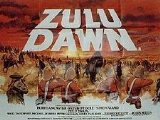
Zulu Dawn

Encyclopedia
Zulu Dawn is a 1979 war film
about the historical Battle of Isandlwana
between British
and Zulu
forces in 1879 in South Africa
. The screenplay was by Cy Endfield
, from his book, and Anthony Story. The film was directed by Douglas Hickox
. The score was composed by Elmer Bernstein
.
Zulu Dawn is a prequel
to Zulu
, released in 1964, which depicts the historical Battle of Rorke's Drift later the same day, and was written and co-directed by Cy Endfield.
, in January 1879. The first half of the film revolves around the administrators and officials of Cape Colony
, notably the supremely arrogant Lord Chelmsford
and the scheming Sir Henry Bartle Frere
, who both wish to crush the neighbouring Zulu Empire
, which is perceived as a threat to Cape Colony's emerging industrial economy
. Bartle Frere issues an impossible ultimatum
to the Zulu king, Cetshwayo
, demanding that he dissolve the Zulu Empire. Cetshwayo refuses, providing Cape Colony with a pretext
to invade Zululand
. Despite objections from leading members of Cape Colony's high society and from Great Britain
itself, Bartle Frere authorises Lord Chelmsford to lead a British invasion force into Zululand.
The second half of the film focuses on the British invasion of Zululand and the lead-up to the Battle of Isandlwana
. The invading British army, laden with an immense network of supply wagons, invades Zululand and marches in the direction of Ulundi, the Zulu capital. British forces, eager to fight a large battle in which they can unleash their cutting-edge military technology against the vast Zulu army, become increasingly frustrated as the main Zulu army refuses to attack the British, and fighting is restricted to a few small skirmishes between British and Zulu scouts. Concerned that their supply lines are becoming overstretched and that the main Zulu army is still at large, British troops begin torturing
captive Zulu warriors in an effort to learn the location and tactics of the Zulu army. Halfway to Ulundi, Chelmsford halts his army at the base of Mount Isandhlwana
, ignoring the advice of Boer
attendants to entrench the camp and laager the supply wagons, leaving the camp dangerously exposed. During the night, Colonel Durnford and an escort of fifty mounted Basutos approach the camp. Lord Chelmsford then orders Durnford to return to his unit, bringing them to the camp immediately to reinforce Colonel Pulleine. Lt. Vereker should join Durnford as aide-de-camp
.
Reacting to false intelligence, Chelmsford leads half of the British army, including the best infantry
, cavalry
and artillery
units, on a wild goose chase
far from the camp, in pursuit of a phantom Zulu army. On the day of battle, Durnford and his troops are arriving at 11:00 a.m. at the camp at Isandlwana. Meanwhile, the Zulu captives escape their torturers and regroup with the Zulu army, informing them of the British army's direction and strength. After having lunch with Colonel Pulleine and Lt. Vereker, Durnford quickly decides to send Vereker to scout the hills. Durnford then decides to take his own command out from the camp too, and scout the iNyoni heights.
The entire Zulu army is later discovered by men of Lt. Vereker's troop of scouts, who chase a number of Zulu herdsmen, trying to hurry away their cattle, only to discover the main Zulu enemy force of thousands at the bottom of a valley. Lt. Vereker then sends Lt. Raw to warn the camp that it is about to be attacked.
As Zulu impis descend upon the camp, Durnford's cavalry retreat to a donga
in an effort to hold back the Zulu advance. Forced back, the British take heavy casualties, including the battery of Congreve rocket
s, which is overrun by the Zulus. Initially, the British infantry succeed in defending the camp, and Zulu forces retreat under a hail of artillery fire. British units defending the camp are now becoming dangerously spread-out, and are oblivious to Zulu forces moving round the sides of the mountain in an encircling move. As British infantrymen begin to run out of ammunition
and the British cavalry are driven back towards the camp, Zulu warriors charge the British troops en masse, sustaining horrific casualties, but succeed in breaking the British lines. As British troops break and flee towards the camp, the battle breaks down into hand-to-hand fighting between British soldiers and Zulu warriors, amongst the débris of tents, fallen soldiers and supply wagons. Overwhelmed by the sheer number of Zulu warriors, British soldiers and their African allies are slaughtered in the camp, some being cut down as they attempt to flee back towards Natal. During the last minutes of the battle, the camp's commander, Colonel Pulleine, entrusts the Queen's Colours
of the 2nd battalion, 24th Regiment of Foot to two junior officers, Lts. Melvill and Coghill, who attempt to carry them to safety in Natal, passing gruesome scenes as Zulu warriors hunt down British and African infantrymen attempting to flee across the river. While crossing the Buffalo River
, the three lieutenants are cut down by Zulus and the Colours (a Union Flag
embroidered with the Regiment's insignia) are captured. In his dying moments, Vereker shoots and kills the Zulu wielding the Colours, and the Colours fall gracefully into the river, where they are carried out of reach. In the evening, Chelmsford and the rest of the British army return to Isandlwana, to be greeted by the sight of their slaughtered comrades, and the news that a mass Zulu army has invaded Natal and laid siege to Rorke's Drift. The film ends with Zulu warriors in a silhouette
d victory procession, dragging captured British artillery back to Ulundi.
s with tea
to reduce the shimmering glare; a practice popular among British soldiers on tropical service, and unlike the film Zulu
, which inaccurately depicted shining white helmets. The uniforms of the NNC are also accurate replicas, as are the costumes worn by members of the Royal Artillery and irregular cavalry units, such as the Natal Mounted Police. One notable inaccuracy in the film is that some of the rifles carried by British infantrymen are not Martini-Henry
rifles as at the actual battle, but Martini-Henry cavalry carbine
s. In addition, as in Zulu
, at certain points in the film, most notably toward the end as the camp is overrun, extras portraying British soldiers can be seen wielding Lee Enfield rifles not introduced until some time after the Battle of Isandhlwana. Colonel Durnford is shown using a Webley
Mk VI .455 revolver which was not introduced until 1915 (36 years after the events depicted in the film), so the appearance in the film is an anachronism. However, the British officer of the time was allowed to use any sort of sidearm he wished, as long as it fired .455 ammunition. Officers often privately purchased Webley top-break revolvers (in 1879 not yet officially adopted for service) somewhat similar in appearance to the Mk VI Webley. These Webley models had been put on the market during the 1870s - such as the Webley-Green army model 1879 or the Webley-Pryse model. So Durnford's Webley model Mk VI was not yet developed when the film was set, but the design is typical of Webley revolvers of the period and can be seen as an example of artistic licence.
Several events portrayed in the film are erroneous. These include:
, the film was received with mixed reviews.
War film
War films are a film genre concerned with warfare, usually about naval, air or land battles, sometimes focusing instead on prisoners of war, covert operations, military training or other related subjects. At times war films focus on daily military or civilian life in wartime without depicting battles...
about the historical Battle of Isandlwana
Battle of Isandlwana
The Battle of Isandlwana on 22 January 1879 was the first major encounter in the Anglo-Zulu War between the British Empire and the Zulu Kingdom...
between British
British Empire
The British Empire comprised the dominions, colonies, protectorates, mandates and other territories ruled or administered by the United Kingdom. It originated with the overseas colonies and trading posts established by England in the late 16th and early 17th centuries. At its height, it was the...
and Zulu
Zulu Kingdom
The Zulu Kingdom, sometimes referred to as the Zulu Empire or, rather imprecisely, Zululand, was a monarchy in Southern Africa that extended along the coast of the Indian Ocean from the Tugela River in the south to Pongola River in the north....
forces in 1879 in South Africa
South Africa
The Republic of South Africa is a country in southern Africa. Located at the southern tip of Africa, it is divided into nine provinces, with of coastline on the Atlantic and Indian oceans...
. The screenplay was by Cy Endfield
Cy Endfield
Cyril Raker Endfield was an American screenwriter, film director, theatre director, author, magician and inventor, based in Britain from 1953.- Biography :...
, from his book, and Anthony Story. The film was directed by Douglas Hickox
Douglas Hickox
Douglas Hickox was an English film director. Hickox was born in London, where he was educated at Emanuel School. Hickox worked extensively as an assistant director and second unit director throughout the 50's and early 60's, making his first major picture in 1970...
. The score was composed by Elmer Bernstein
Elmer Bernstein
Elmer Bernstein was an American composer and conductor best known for his many film scores. In a career which spanned fifty years, he composed music for hundreds of film and television productions...
.
Zulu Dawn is a prequel
Prequel
A prequel is a work that supplements a previously completed one, and has an earlier time setting.The widely recognized term was a 20th-century neologism, and a portmanteau from pre- and sequel...
to Zulu
Zulu (film)
Zulu is a 1964 historical war film depicting the Battle of Rorke's Drift between the British Army and the Zulus in January 1879, during the Anglo-Zulu War....
, released in 1964, which depicts the historical Battle of Rorke's Drift later the same day, and was written and co-directed by Cy Endfield.
Plot
The film is set in British South Africa, in the province of NatalColony of Natal
The Colony of Natal was a British colony in south-eastern Africa. It was proclaimed a British colony on May 4, 1843 after the British government had annexed the Boer Republic of Natalia, and on 31 May 1910 combined with three other colonies to form the Union of South Africa, as one of its...
, in January 1879. The first half of the film revolves around the administrators and officials of Cape Colony
Cape Colony
The Cape Colony, part of modern South Africa, was established by the Dutch East India Company in 1652, with the founding of Cape Town. It was subsequently occupied by the British in 1795 when the Netherlands were occupied by revolutionary France, so that the French revolutionaries could not take...
, notably the supremely arrogant Lord Chelmsford
Frederic Thesiger, 2nd Baron Chelmsford
General Frederic Augustus Thesiger, 2nd Baron Chelmsford GCB, GCVO, was a British general, best known for his commanding role during the Anglo-Zulu war. The centre column of his forces was defeated at the Battle of Isandlwana, a crushing victory for the Zulus and the British army's worst ever...
and the scheming Sir Henry Bartle Frere
Henry Bartle Frere
Sir Henry Bartle Edward Frere, 1st Baronet, GCB, GCSI, was a British colonial administrator.-Early life:Frere was born at Clydach House, Clydach, Monmouthshire, the son of Edward Frere, manager of Clydach Ironworks...
, who both wish to crush the neighbouring Zulu Empire
Zulu Kingdom
The Zulu Kingdom, sometimes referred to as the Zulu Empire or, rather imprecisely, Zululand, was a monarchy in Southern Africa that extended along the coast of the Indian Ocean from the Tugela River in the south to Pongola River in the north....
, which is perceived as a threat to Cape Colony's emerging industrial economy
Mineral Revolution
The Mineral Revolution is a term used by historians to refer to the rapid industrialisation and economic changes which occurred in South Africa from the 1870s onwards. The Mineral Revolution was largely driven by the need to create a permanent workforce to work in the mining industry, and saw South...
. Bartle Frere issues an impossible ultimatum
Ultimatum
An ultimatum is a demand whose fulfillment is requested in a specified period of time and which is backed up by a threat to be followed through in case of noncompliance. An ultimatum is generally the final demand in a series of requests...
to the Zulu king, Cetshwayo
Cetshwayo
Cetshwayo kaMpande was the King of the Zulu Kingdom from 1872 to 1879 and their leader during the Anglo-Zulu War . His name has been transliterated as Cetawayo, Cetewayo, Cetywajo and Ketchwayo.- Early life :...
, demanding that he dissolve the Zulu Empire. Cetshwayo refuses, providing Cape Colony with a pretext
Pretext
A pretext is an excuse to do something or say something. Pretexts may be based on a half-truth or developed in the context of a misleading fabrication. Pretexts have been used to conceal the true purpose or rationale behind actions and words....
to invade Zululand
Zulu Kingdom
The Zulu Kingdom, sometimes referred to as the Zulu Empire or, rather imprecisely, Zululand, was a monarchy in Southern Africa that extended along the coast of the Indian Ocean from the Tugela River in the south to Pongola River in the north....
. Despite objections from leading members of Cape Colony's high society and from Great Britain
Great Britain
Great Britain or Britain is an island situated to the northwest of Continental Europe. It is the ninth largest island in the world, and the largest European island, as well as the largest of the British Isles...
itself, Bartle Frere authorises Lord Chelmsford to lead a British invasion force into Zululand.
The second half of the film focuses on the British invasion of Zululand and the lead-up to the Battle of Isandlwana
Battle of Isandlwana
The Battle of Isandlwana on 22 January 1879 was the first major encounter in the Anglo-Zulu War between the British Empire and the Zulu Kingdom...
. The invading British army, laden with an immense network of supply wagons, invades Zululand and marches in the direction of Ulundi, the Zulu capital. British forces, eager to fight a large battle in which they can unleash their cutting-edge military technology against the vast Zulu army, become increasingly frustrated as the main Zulu army refuses to attack the British, and fighting is restricted to a few small skirmishes between British and Zulu scouts. Concerned that their supply lines are becoming overstretched and that the main Zulu army is still at large, British troops begin torturing
Torture
Torture is the act of inflicting severe pain as a means of punishment, revenge, forcing information or a confession, or simply as an act of cruelty. Throughout history, torture has often been used as a method of political re-education, interrogation, punishment, and coercion...
captive Zulu warriors in an effort to learn the location and tactics of the Zulu army. Halfway to Ulundi, Chelmsford halts his army at the base of Mount Isandhlwana
Isandlwana
Isandlwana is an isolated hill in the KwaZulu-Natal province of South Africa, southeast of Rorke's Drift and north by northwest of Durban....
, ignoring the advice of Boer
Boer
Boer is the Dutch and Afrikaans word for farmer, which came to denote the descendants of the Dutch-speaking settlers of the eastern Cape frontier in Southern Africa during the 18th century, as well as those who left the Cape Colony during the 19th century to settle in the Orange Free State,...
attendants to entrench the camp and laager the supply wagons, leaving the camp dangerously exposed. During the night, Colonel Durnford and an escort of fifty mounted Basutos approach the camp. Lord Chelmsford then orders Durnford to return to his unit, bringing them to the camp immediately to reinforce Colonel Pulleine. Lt. Vereker should join Durnford as aide-de-camp
Aide-de-camp
An aide-de-camp is a personal assistant, secretary, or adjutant to a person of high rank, usually a senior military officer or a head of state...
.
Reacting to false intelligence, Chelmsford leads half of the British army, including the best infantry
Infantry
Infantrymen are soldiers who are specifically trained for the role of fighting on foot to engage the enemy face to face and have historically borne the brunt of the casualties of combat in wars. As the oldest branch of combat arms, they are the backbone of armies...
, cavalry
Cavalry
Cavalry or horsemen were soldiers or warriors who fought mounted on horseback. Cavalry were historically the third oldest and the most mobile of the combat arms...
and artillery
Artillery
Originally applied to any group of infantry primarily armed with projectile weapons, artillery has over time become limited in meaning to refer only to those engines of war that operate by projection of munitions far beyond the range of effect of personal weapons...
units, on a wild goose chase
Wild goose chase
A wild-goose chase or wild goose chase may refer to:* A wild-goose chase, a futile search or fruitless errand, a task inordinately complex relative to its outcome...
far from the camp, in pursuit of a phantom Zulu army. On the day of battle, Durnford and his troops are arriving at 11:00 a.m. at the camp at Isandlwana. Meanwhile, the Zulu captives escape their torturers and regroup with the Zulu army, informing them of the British army's direction and strength. After having lunch with Colonel Pulleine and Lt. Vereker, Durnford quickly decides to send Vereker to scout the hills. Durnford then decides to take his own command out from the camp too, and scout the iNyoni heights.
The entire Zulu army is later discovered by men of Lt. Vereker's troop of scouts, who chase a number of Zulu herdsmen, trying to hurry away their cattle, only to discover the main Zulu enemy force of thousands at the bottom of a valley. Lt. Vereker then sends Lt. Raw to warn the camp that it is about to be attacked.
As Zulu impis descend upon the camp, Durnford's cavalry retreat to a donga
Donga (ditch)
In Afrikaans and Zulu, a Donga is a ditch formed by the erosion of soil. The word means "bank, side of a gully" in Zulu.They were extensively used by both sides during the Boer Wars as serendipitous defensive positions. Though present during this period, Dongas have become increasingly prevalent...
in an effort to hold back the Zulu advance. Forced back, the British take heavy casualties, including the battery of Congreve rocket
Congreve rocket
The Congreve Rocket was a British military weapon designed and developed by Sir William Congreve in 1804.The rocket was developed by the British Royal Arsenal following the experiences of the Second, Third and Fourth Mysore Wars. The wars fought between the British East India Company and the...
s, which is overrun by the Zulus. Initially, the British infantry succeed in defending the camp, and Zulu forces retreat under a hail of artillery fire. British units defending the camp are now becoming dangerously spread-out, and are oblivious to Zulu forces moving round the sides of the mountain in an encircling move. As British infantrymen begin to run out of ammunition
Ammunition
Ammunition is a generic term derived from the French language la munition which embraced all material used for war , but which in time came to refer specifically to gunpowder and artillery. The collective term for all types of ammunition is munitions...
and the British cavalry are driven back towards the camp, Zulu warriors charge the British troops en masse, sustaining horrific casualties, but succeed in breaking the British lines. As British troops break and flee towards the camp, the battle breaks down into hand-to-hand fighting between British soldiers and Zulu warriors, amongst the débris of tents, fallen soldiers and supply wagons. Overwhelmed by the sheer number of Zulu warriors, British soldiers and their African allies are slaughtered in the camp, some being cut down as they attempt to flee back towards Natal. During the last minutes of the battle, the camp's commander, Colonel Pulleine, entrusts the Queen's Colours
Colours, standards and guidons
In military organizations, the practice of carrying colours, standards or Guidons, both to act as a rallying point for troops and to mark the location of the commander, is thought to have originated in Ancient Egypt some 5,000 years ago...
of the 2nd battalion, 24th Regiment of Foot to two junior officers, Lts. Melvill and Coghill, who attempt to carry them to safety in Natal, passing gruesome scenes as Zulu warriors hunt down British and African infantrymen attempting to flee across the river. While crossing the Buffalo River
Buffalo River (KwaZulu-Natal)
The Buffalo River is the largest tributary of the Thukela River. Its source is northeast of Volksrust, close to the Mpumalanga / KwaZulu-Natal border in South Africa. It follows a southerly route into KwaZulu-Natal past Newcastle then turns southeast past Rorke's Drift, before joining the Tugela...
, the three lieutenants are cut down by Zulus and the Colours (a Union Flag
Union Flag
The Union Flag, also known as the Union Jack, is the flag of the United Kingdom. It retains an official or semi-official status in some Commonwealth Realms; for example, it is known as the Royal Union Flag in Canada. It is also used as an official flag in some of the smaller British overseas...
embroidered with the Regiment's insignia) are captured. In his dying moments, Vereker shoots and kills the Zulu wielding the Colours, and the Colours fall gracefully into the river, where they are carried out of reach. In the evening, Chelmsford and the rest of the British army return to Isandlwana, to be greeted by the sight of their slaughtered comrades, and the news that a mass Zulu army has invaded Natal and laid siege to Rorke's Drift. The film ends with Zulu warriors in a silhouette
Silhouette
A silhouette is the image of a person, an object or scene consisting of the outline and a basically featureless interior, with the silhouetted object usually being black. Although the art form has been popular since the mid-18th century, the term “silhouette” was seldom used until the early decades...
d victory procession, dragging captured British artillery back to Ulundi.
British
- Peter O'ToolePeter O'ToolePeter Seamus Lorcan O'Toole is an Irish actor of stage and screen. O'Toole achieved stardom in 1962 playing T. E. Lawrence in Lawrence of Arabia, and then went on to become a highly-honoured film and stage actor. He has been nominated for eight Academy Awards, and holds the record for most...
: Lord ChelmsfordFrederic Thesiger, 2nd Baron ChelmsfordGeneral Frederic Augustus Thesiger, 2nd Baron Chelmsford GCB, GCVO, was a British general, best known for his commanding role during the Anglo-Zulu war. The centre column of his forces was defeated at the Battle of Isandlwana, a crushing victory for the Zulus and the British army's worst ever...
. The arrogant commander of British forces in South Africa, Chelmsford is eager to advance his military career by crushing neighbouring Zululand, believing that "for the savage as for the child, chastisement is sometimes a blessing". During the invasion, Chelmsford refuses to listen to advice from his British and BoerBoerBoer is the Dutch and Afrikaans word for farmer, which came to denote the descendants of the Dutch-speaking settlers of the eastern Cape frontier in Southern Africa during the 18th century, as well as those who left the Cape Colony during the 19th century to settle in the Orange Free State,...
advisers, and from the comfort of his tent and personal coachCarriageA carriage is a wheeled vehicle for people, usually horse-drawn; litters and sedan chairs are excluded, since they are wheelless vehicles. The carriage is especially designed for private passenger use and for comfort or elegance, though some are also used to transport goods. It may be light,...
, authorises his troops to torture Zulu captives. On the day of the battle, Chelmsford commits a cardinal error in splitting his forces. While the troops at Isandlwana fight for their lives, Chelmsford and his equally arrogant officers, a few miles away, enjoy a silver-service luncheonLuncheonLuncheon, commonly abbreviated to lunch, is a mid-day meal, and is smaller than dinner.In English-speaking countries during the eighteenth century, lunch was originally called "dinner"— a word still used regularly to mean a noontime meal in Scotland, Ireland, Wales and some parts of England,...
. Chelmsford is last seen arriving at the site of the battle several hours later, mortified by the defeat of his soldiers, absorbing the news that the victorious Zulu army has invaded Natal.
- Chelmsford's arrogance was mixed with incompetence as he left unclear instructions to those left behind at Isandlwana including which officer was in charge, Durnford or Pulleine. Chelmsford would later lay the blame for the disaster on Colonel Durnford.
- Burt LancasterBurt LancasterBurton Stephen "Burt" Lancaster was an American film actor noted for his athletic physique and distinctive smile...
: Colonel DurnfordAnthony DurnfordColonel Anthony William Durnford was a career British Army officer who served in the Anglo-Zulu War. Breveted colonel, Durnford is mainly known for his presence at the defeat of the British army by the Zulu at the Battle of Isandlwana.-Background:Durnford was born in to a military family at Manor...
. Commander of a large force of the Natal Native ContingentNatal Native ContingentThe Natal Native Contingent was a large force of auxiliary soldiers in British South Africa, forming a large portion of the defence forces of the British colony of Natal, and saw action during the 1879 Anglo-Zulu War. The NNC was originally created in 1878 out of the local black population in order...
(NNC), Britain's African allies, Durnford is a humane officer who expresses concern for the lives and welfare of his African troops. When war breaks out, Durnford, much to his chagrin, is ordered to remain in Natal and defend the border rather than accompany the invasion force. His troops are ultimately called to reinforce the invasion army, and on the day of battle, Durnford and his African cavalrymen are driven into the camp at Isandlwana. As the British forces break apart, the one-armed Durnford becomes trapped in the camp. Hoping to save his men, Durnford orders his African cavalrymen to retreat. Remaining on foot at the battlefield, Durnford is killed alongside his infantrymen.
- Burt Lancaster
- Durnford would later be painted by Chelmsford as the scape-goat for the disaster.
- Simon WardSimon WardSimon Ward is an English stage and film actor.-Early life:Simon Ward was born in Beckenham, Kent, near London, the son of a car dealer. From an early age he wanted to be an actor. He was educated at Alleyn's School, London, the home of the National Youth Theatre, which he joined at age 13 and...
: Lt. William Vereker. A young officer who has recently attached to Durnford's command, Vereker is a light-hearted cavalry officer eager to see war. Vereker's enthusiasm, though, evaporates as he sees Zulu warriors tortured and slain by British troops. Vereker and his men discover the main Zulu army on the morning of the battle, and as British lines collapse, Vereker accompanies Lts. Melvill and Coghill in an effort to return the Queen's Colours to Natal. Zulu warriors attack and kill Melvill and Coghill, and seize the Colours. Vereker, despite his injuries, shoots the Zulu wielding the Colours with his Martini-Henry cavalry carbine, ensuring that they fall into the Buffalo River, where they are washed away. Vereker's fate remains unknown. - Denholm ElliottDenholm ElliottDenholm Mitchell Elliott, CBE was an English film, television and theatre actor with over 120 film and television credits...
: Colonel PulleineHenry PulleineLieutenant-Colonel Henry Burmester Pulleine was an administrator and commander in the British Army in the Cape Frontier and Anglo-Zulu Wars. He held the acting rank of Brevet Lieutenant Colonel....
. A mild-mannered man, Pulleine is a military bureaucratBureaucratA bureaucrat is a member of a bureaucracy and can comprise the administration of any organization of any size, though the term usually connotes someone within an institution of a government or corporation...
who accompanies the army into Zululand, and finds himself left in command of the camp at Isandlwana after Chelmsford leaves on a sortieSortieSortie is a term for deployment or dispatch of one military unit, be it an aircraft, ship, or troops from a strongpoint. The sortie, whether by one or more aircraft or vessels, usually has a specific mission....
. News of the approaching Zulu army unnerves Pulleine, and his overstretched troops are unable to defend the camp. After having entrusted the Union Flag to Lts. Melvill and Coghill, Pulleine returns to his tent to pen a last letter to his wife. He is discovered by one of the escaped Zulu prisoners and, unwilling to kill the young soldier, the elderly Pulleine allows himself to be killed in his tent. - James Sebastian Faulkner: Lieutenant MelvillTeignmouth MelvillTeignmouth Melvill VC was an English recipient of the Victoria Cross, the highest and most prestigious award for gallantry in the face of the enemy that can be awarded to British and Commonwealth forces.-Details:...
. An arrogant, conceited and unpleasant man, when a lone Zulu warrior calls from a mountaintop asking why British forces are invading, Melvill shouts back, "we come here by the order of the great Queen Victoria, Queen of all Africa!" Towards the end of the battle, Melvill carries the Union Flag back towards Natal, ignoring British infantrymen being killed as they flee towards the river. Melvill reaches the river border between Zululand and Natal, but is assegaied by Zulu warriors while defending the flag. - Christopher CazenoveChristopher CazenoveChristopher Cazenove was an English cinema, television and stage actor.-Early life and career:He was born Christopher de Lerisson Cazenove, the son of Arnold de Lerisson Cazenove and Elizabeth Laura in Winchester, Hampshire, but was brought up in Bowlish, Somerset...
: Lieutenant CoghillNevill Josiah Aylmer CoghillNevill Josiah Aylmer Coghill VC was born in Drumcondra, Dublin was an Irish recipient of the Victoria Cross, the highest and most prestigious award for gallantry in the face of the enemy that can be awarded to British and Commonwealth forces.-Family:Coghill was the eldest son of Sir John Joscelyn...
. A polite and educated young officer, Lieutenant Coghill is temporarily attached to Colonel Pulleine's staff, due to an injured leg which requires him to ride on horseback. Coghill has a close friendship with Lt. Melvill, and during the invasion he expresses dissatisfaction at Chelmsford's strategy. Towards the end of the battle, Coghill accompanies Melvill in his attempt to gallop the Union Flag back towards Natal. When Melvill nearly drowns while trying to cross the Buffalo River, Coghill turns to help him, and is ambushed by Zulu warriors. Coghill attempts to defend himself with his revolver, but is killed. - Bob HoskinsBob HoskinsRobert William "Bob" Hoskins, Jr. is an English actor known for playing Cockney rough diamonds, psychopaths and gangsters, in films such as The Long Good Friday , and Mona Lisa , and lighter roles in family films such as Who Framed Roger Rabbit and Hook .- Early life :Hoskins was born in Bury St...
: Colour-Sergeant-Major Williams. The loud, aggressive Williams, a high-ranking NCONon-commissioned officerA non-commissioned officer , called a sub-officer in some countries, is a military officer who has not been given a commission...
, is viewed by his soldiers with a mixture of fear and respect, but displays genuine concern for his troops. During the battle, Williams loses many of his infantrymen during hand-to-hand fighting, and is injured while defending a group of unarmed artillerymen. Williams is stabbed in the back while attempting to save the life of one of his young soldiers, and having killed several Zulu soldiers with his bayonetBayonetA bayonet is a knife, dagger, sword, or spike-shaped weapon designed to fit in, on, over or underneath the muzzle of a rifle, musket or similar weapon, effectively turning the gun into a spear...
, dies at the hands of a large band of Zulus. - Peter VaughanPeter VaughanPeter Vaughan is an English character actor, known for many supporting roles in a variety of British film and television productions. He has worked extensively on the stage, becoming known for roles such as police inspectors, Soviet agents and similar parts...
: Quartermaster Sergeant-Major Bloomfield. An elderly and jovial sergeant, Bloomfield, who claims to have been the bugler for the Duke of Wellington, is a military administrator responsible for overseeing the invasion force's supply network. Bloomfield takes Boy Pullen, a young soldier, under his wing, but his compassion and concern do not extend to the NNC's black soldiers, who he sees as little more than savage animals. During the battle, Bloomfield refuses to bypass regulations requiring that ammunition be dispensed in small, properly recorded quantities, causing ammunition shortages that oblige British troops to retreat. He also refuses to dispense ammunition designated for British troops to Natal units. Bloomfield is injured when his ammunition wagon explodes, and is killed when a Zulu warrior impales him from behind. - Michael JaystonMichael JaystonMichael Jayston is a Nottingham-born English actor.- Early life :He attended the Becket Grammar School in West Bridgford, then worked briefly as a trainee accountant at the offices of the National Coal Board before obtaining a scholarship to the Guildhall School of Music and Drama to train as an...
: Colonel Crealock. An officer of the Royal ArtilleryRoyal ArtilleryThe Royal Regiment of Artillery, commonly referred to as the Royal Artillery , is the artillery arm of the British Army. Despite its name, it comprises a number of regiments.-History:...
and lickspittle to his commander, Colonel Crealock acts as Lord Chelmsford's secretary, constantly expressing his agreement with Chelmsford's decisions. He accompanies Chelmsford's expedition away from Isandhlwana, and is seen idly sketching the landscape. When questioned by Newman on the logic of splitting the British army, Crealock acidly replies that the Zulus' primitive weaponry does not pose any real threat. When Lieutenant Harford relays news from Isandhlwana with an urgent request for reinforcements, Crealock lectures Harford on military etiquette, and does nothing to facilitate the request. Crealock is last seen with Chelmsford after returning to the devastated camp, bringing news of an ongoing battle at Rorke's DriftRorke's DriftThe Battle of Rorke's Drift, also known as the Defence of Rorke's Drift, was a battle in the Anglo-Zulu War. The defence of the mission station of Rorke's Drift, under the command of Lieutenant John Chard of the Royal Engineers, immediately followed the British Army's defeat at the Battle of...
and a Zulu invasion of Natal. - Ronald PickupRonald Pickup-Life and career:Pickup was born in Chester, England, the son of Daisy and Eric Pickup, who was a lecturer. Pickup was educated at The King's School, Chester, trained at the Royal Academy of Dramatic Art in London, and became an Associate Member of RADA.His television work began with an episode...
: Lieutenant Harford. A well-meaning officer of the NNC, Harford distinguishes himself from his colleagues through his concern for his African soldiers, and is appalled at British soldiers' lack of interest in the lives of their black workers, and at Chelmsford's casual attitude to the torture of Zulu captives. On the day of the battle, Harford accompanies Chelmsford's column. During the early stages of the battle, a rider, dispatched by Colonel Pulleine to catch up with Chelmsford's army, brings an urgent request for reinforcements. His message is ignored, and Harford is denied permission to return to Isandhlwana. He is last seen in the evening, weeping as he sees the bodies of young soldiers. - Ronald LaceyRonald LaceyRonald Lacey was an English actor. He made numerous television and film appearances over a 30 year period and is perhaps best remembered for his villainous roles in Hollywood films, most famously Major Arnold Toht in Raiders of the Lost Ark.-Career:Lacey attended Harrow Weald Grammar School and...
: Charles L. Norris-Newman. A war correspondentWar correspondentA war correspondent is a journalist who covers stories firsthand from a war zone. In the 19th century they were also called Special Correspondents.-Methods:...
for The StandardEvening StandardThe Evening Standard, now styled the London Evening Standard, is a free local daily newspaper, published Monday–Friday in tabloid format in London. It is the dominant regional evening paper for London and the surrounding area, with coverage of national and international news and City of London...
, Norris-Newman accompanies the army into Zululand to report on the war. Norris-Newman is deeply critical of Chelmsford, frequently points out his tactical errors, and makes no effort to conceal his contempt for the general. Norris-Newman appears to have much more background knowledge on the Zulus than the officers, and frequently expresses sympathy for Zulus who stand little chance against British weaponry. Norris-Newman accompanies Chelmsford's expedition and so avoids the battle, and is last seen with Chelmsford, staring at the devastation of the battlefield. - John MillsJohn MillsSir John Mills CBE , born Lewis Ernest Watts Mills, was an English actor who made more than 120 films in a career spanning seven decades.-Life and career:...
: Sir Henry Bartle FrereHenry Bartle FrereSir Henry Bartle Edward Frere, 1st Baronet, GCB, GCSI, was a British colonial administrator.-Early life:Frere was born at Clydach House, Clydach, Monmouthshire, the son of Edward Frere, manager of Clydach Ironworks...
. The British High CommissionerHigh CommissionerHigh Commissioner is the title of various high-ranking, special executive positions held by a commission of appointment.The English term is also used to render various equivalent titles in other languages.-Bilateral diplomacy:...
for South Africa who provokes the war by issuing King Cetshwayo with an impossible ultimatum. Viewing the Zulus as savage barbarians, Bartle Frere believes that the war will provide "a final solution to the Zulu problem." Frere is last seen on the night of the British invasion, and does not appear again in the film.
- Simon Ward
Zulu
- Simon Sabela: King CetshwayoCetshwayoCetshwayo kaMpande was the King of the Zulu Kingdom from 1872 to 1879 and their leader during the Anglo-Zulu War . His name has been transliterated as Cetawayo, Cetewayo, Cetywajo and Ketchwayo.- Early life :...
. King of Zululand, Cetshwayo is depicted as a peaceful and effective ruler, eager to avoid war but unwilling to compromise Zululand's security by agreeing to Bartle Frere's ultimatum. Cetshwayo is concerned that mobilising his armies will leave a chronic labour shortage, and is eager to defeat the British army in time for his soldiers to return and gather the harvestHarvestHarvest is the process of gathering mature crops from the fields. Reaping is the cutting of grain or pulse for harvest, typically using a scythe, sickle, or reaper...
. Cetshwayo is last seen in his kraalKraalKraal is an Afrikaans and Dutch word for an enclosure for cattle or other livestock, located within an African settlement or village surrounded by a palisade, mud wall, or other fencing, roughly circular in form.In the Dutch language a kraal is a term derived from the Portuguese word , cognate...
at Ulundi, reluctantly announcing a state of war between Zululand and Cape Colony. - Ken GampuKen GampuKen Gampu was a South African actor.Before he began his career, Gampu was a physical training instructor, salesman, interpreter and police officer. His first acting job was in Athol Fugard's play, No Good Friday . His big break came in in the 1965 film Dingaka by Jamie Uys...
: Mantshonga. A Zulu regarded as a traitor by Cetshwayo because of his support for a rival claimant to the Zulu throne, Mantshonga delivered the British ultimatum to Cetshwayo and returned his response. - Abe Temba: Uhama. A leading general in the Zulu army, Uhama masterminds various schemes to confuse British forces, using scouts to gain intelligence on the British army, and small raiding parties to confuse their scouts on the whereabouts of Zulu impis. Uhama realises he must overwhelm the British while they are exposed and vulnerable; and that an open battle would result in a crushing Zulu defeat. He keeps his impis hidden, allowing the invaders to progress deep into Zululand, waiting for them to commit an error that will give the impis the opportunity to overwhelm the British before they have time to commit their technology to the battle. While chasing a Boer scout, Uhama instructs three of his warriors to allow themselves to be captured by the British, who eventually escape and advise Uhama on British weaknesses. In contrast to the British commanders, Uhama displays immense bravery, and is last seen leading his warriors into the débâcle of the British camp, where he is shot and presumably killed.
- Gilbert Tiabane: Bayele. A young warrior in the Zulu army, Bayele leads several scouting missions to glean intelligence on British forces. Under orders from Uhama, Bayele allows himself to be captured by cavalrymen of the NNC, and with two other warriors, is taken to the camp at Isandhlwana. While lashed to wagon wheels, Bayele and his two comrades are tortured but only reveal false information. Bayele later uses a distraction in the camp to kill the guard, releases his two comrades, and the three escape to rejoin the Zulu army. Bayele takes part in the assault on the camp, and by chance finds himself face-to-face with Colonel Pulleine in the command tent. Pulleine, recognising Bayele as the tortured prisoner, is unable to shoot Bayele, and Bayele seizes the opportunity to kill him.
Historical accuracy
The film generally avoids historical inaccuracies and is fairly true to the events of 22 January 1879. The costumes of the British soldiers are reasonably accurate, and feature the soldiers staining their pith helmetPith helmet
The pith helmet is a lightweight cloth-covered helmet made of cork or pith...
s with tea
Tea
Tea is an aromatic beverage prepared by adding cured leaves of the Camellia sinensis plant to hot water. The term also refers to the plant itself. After water, tea is the most widely consumed beverage in the world...
to reduce the shimmering glare; a practice popular among British soldiers on tropical service, and unlike the film Zulu
Zulu (film)
Zulu is a 1964 historical war film depicting the Battle of Rorke's Drift between the British Army and the Zulus in January 1879, during the Anglo-Zulu War....
, which inaccurately depicted shining white helmets. The uniforms of the NNC are also accurate replicas, as are the costumes worn by members of the Royal Artillery and irregular cavalry units, such as the Natal Mounted Police. One notable inaccuracy in the film is that some of the rifles carried by British infantrymen are not Martini-Henry
Martini-Henry
The Martini-Henry was a breech-loading single-shot lever-actuated rifle adopted by the British, combining an action worked on by Friedrich von Martini , with the rifled barrel designed by Scotsman Alexander Henry...
rifles as at the actual battle, but Martini-Henry cavalry carbine
Carbine
A carbine , from French carabine, is a longarm similar to but shorter than a rifle or musket. Many carbines are shortened versions of full rifles, firing the same ammunition at a lower velocity due to a shorter barrel length....
s. In addition, as in Zulu
Zulu (film)
Zulu is a 1964 historical war film depicting the Battle of Rorke's Drift between the British Army and the Zulus in January 1879, during the Anglo-Zulu War....
, at certain points in the film, most notably toward the end as the camp is overrun, extras portraying British soldiers can be seen wielding Lee Enfield rifles not introduced until some time after the Battle of Isandhlwana. Colonel Durnford is shown using a Webley
Webley Revolver
The Webley Revolver was, in various marks, the standard issue service pistol for the armed forces of the United Kingdom, the British Empire, and the Commonwealths from 1887 until 1963.The Webley is a top-break revolver with automatic extraction...
Mk VI .455 revolver which was not introduced until 1915 (36 years after the events depicted in the film), so the appearance in the film is an anachronism. However, the British officer of the time was allowed to use any sort of sidearm he wished, as long as it fired .455 ammunition. Officers often privately purchased Webley top-break revolvers (in 1879 not yet officially adopted for service) somewhat similar in appearance to the Mk VI Webley. These Webley models had been put on the market during the 1870s - such as the Webley-Green army model 1879 or the Webley-Pryse model. So Durnford's Webley model Mk VI was not yet developed when the film was set, but the design is typical of Webley revolvers of the period and can be seen as an example of artistic licence.
Several events portrayed in the film are erroneous. These include:
- Scenes early in the battle which depict British infantrymen clustered into tightly-packed firing lines. Recent research has revealed that British soldiers were very thinly-spread, with a gap of two or three metres between each soldier.
- As reported by Horace Smith-DorrienHorace Smith-DorrienGeneral Sir Horace Lockwood Smith-Dorrien GCB, GCMG, DSO, ADC was a British soldier and commander of the British II Corps and Second Army of the BEF during World War I.-Early life and career:...
, the British had difficulty unpacking their ammunition boxes fast enough and that the quartermasters were reluctant to distribute ammunition to units other than their own and the lack of ammunition caused a lull in the defence. - The film portrays the artillery units being overwhelmed inside the camp; in reality, the field gunField gunA field gun is an artillery piece. Originally the term referred to smaller guns that could accompany a field army on the march and when in combat could be moved about the battlefield in response to changing circumstances, as to opposed guns installed in a fort, or to siege cannon or mortars which...
s were attached to their limberLimberLimber may refer to:*Limbers and caissons, a 2-way cart used to support artillery* Limber , a song off the album Aneurythm by the American hard rock band Living Syndication.*Limber Pine, a species of pine tree found in the Western United States and Canada...
s and attempted to escape the camp, and almost reached the Natal border before being caught by Zulu soldiers. - Col. Pulleine is depicted as being killed whilst writing a letter in his tent. In fact, Pulleine was killed by a stray bullet whilst directing the battle before the fall of the camp.
- Lt. Melville is shown commanding a company of the 24th, this is erroneous. Lt. Melville was the Adjutant and as such would not have commanded a company on the firing line.
- The scene depicting Lts. Melvill and Coghill's escape with the Union Flag is inaccurate. In the film, Lt. Melvill carries the Union Flag unfurled, whereas in reality the Union Flag of the 24th Regiment was furled up inside its leather case. Also it is unlikely that Melvill and Coghill rode together from the battlefield, instead they only met at the river itself. In addition, the scene in which Lt. Vereker shoots dead a Zulu warrior in order to save the flag from Zulu capture is entirely fictional; in reality, Melvill was too exhausted to hold onto the heavy flag while trying to swim the river, and it slipped from his grip. It was later recovered, so probably was never touched by a Zulu.
- The film does not portray the solar eclipseSolar eclipseAs seen from the Earth, a solar eclipse occurs when the Moon passes between the Sun and the Earth, and the Moon fully or partially blocks the Sun as viewed from a location on Earth. This can happen only during a new moon, when the Sun and the Moon are in conjunction as seen from Earth. At least...
which occurred at 2:37 PM, near the end of the battle, interpreted by the Zulus as an omenOmenAn omen is a phenomenon that is believed to foretell the future, often signifying the advent of change...
of their impending victory. - During the battle, a large group of British and African soldiers led by Captain Younghusband rallied near the foot of the mountain, succeeding in holding off Zulu attacks for some time. When the soldiers finally ran out of ammunition Captain Younghusband went down the line and shook the hand of every man. They then executed a bayonetBayonetA bayonet is a knife, dagger, sword, or spike-shaped weapon designed to fit in, on, over or underneath the muzzle of a rifle, musket or similar weapon, effectively turning the gun into a spear...
charge against Zulu warriors, led by a group of infantry officers wielding their swords. Zulu accounts state that the Zulus respected these soldiers' bravery, and having killed them, accorded them ceremonial honours usually reserved for fallen Zulu warriors. This event is not portrayed in the film. There are a number of conflicting reports as to Younghusband's charge, many of which are less dramatic than this one. - The film does not depict an event which occurred in the evening, when a large Zulu impi heading in the direction of Rorke's Drift passed within shooting range of Chelmsford's force returning to Isandhlwana. The two forces, wary of each other, shadowed one another for some time without making any attacks, and finally broke off after around an hour.
- The rank and file soldiers' uniforms were made of a very poor quality thin cloth (presumably because of the weather) which was far too bright a red. The helmets were obviously moulded plastic with the tan effect flaking off in places.
- During the shot when the camera looks down the firing line, on the line "Front rank, present...FIRE!", as British soldiers bring carbines to shoulders to unleash the first volley at the Zulus, it is clear that one of the soldiers is wearing a wristwatch, or bracelet, which soldiers would not have been wearing in the Victorian period.
- The real Lt. William Vereker was an officer in Zikalhi's Horse at Isandhlwana. However he was in no way connected to the escape of Melvill and Coghill. The third officer with Melvill and Coghill was in fact a man named Higginson who escaped the battle, apparently deserting his brother officers. In reality Vereker's act of bravery on the battlefield was to surrender his horse to a native trooper in the knowledge that he had no chance of escape on foot, an act attributed to Colonel Durnford in the film.
- The trailer at the end of the film shows an out-of-context quotation from the British statesman, Disraeli, which would lead the uninformed viewer to believe that the Zulus overthrew the British Empire. "Who are these Zulus, who.... have put an end to a great dynasty?" The quote actually refers to the slaughter of Napoléon, Prince Imperial, the heir of Napoleon III, in this same war, who was killed on an ill-conceived scouting mission unrelated to the Battle of Isandhlwana.
- The British firing drills used in the movie are not accurate historically. The commands "front rank, present...fire!" were not adoped by the British infantry until approx a year later. The historically accurate commands would have been "at 100 yards, ready...present!" The yardage would be adjusted as needed by the section leader. Each soldier would then present his rifle and count silently to himself for a count of three. He would then discharge his weapon without any command to fire. Generally, the vollies would have been slightly less crisp. The British adopted a "fire" command soon after the onset of the Zulu war so the section leader had final authority as to whether or not to release the volly depending on if there was still a target present. This stemmed from the Zulu tactic of skirmishing throughout their advance, often going to ground just as a volly was about to be discharged.
Reception
Despite having a large budget and being designed to complement the hugely successful film ZuluZulu (film)
Zulu is a 1964 historical war film depicting the Battle of Rorke's Drift between the British Army and the Zulus in January 1879, during the Anglo-Zulu War....
, the film was received with mixed reviews.