
All Topics  
Zinc oxide

 
Zinc Oxide

   Email Print
   Bookmark   Link


Zinc oxide


Zinc oxide is an inorganic compound
Inorganic compound

Traditionally, inorganic compounds are considered to be of a mineral, not biological, origin. Complementarily, most organic compounds are traditionally viewed as being of biological origin....
 with the formula
Chemical formula

A chemical formula is a way of expressing information about the atoms that constitute a particular chemical compound, and how the relationship between those atoms changes in chemical reactions....
 ZnO. It usually appears as a white powder, nearly insoluble in water. The powder is widely used as an additive into numerous materials and products including plastics, ceramics, glass, cement, rubber (e.g. car tyres), lubricants, paints, ointments, adhesives, sealants, pigments, foods (source of Zn nutrient
Nutrient

A nutrient is a chemical that an organism needs to live and grow or a substance used in an organism's metabolism which must be taken in from its environment....
), batteries, ferrites, fire retardants, etc. ZnO is present in the Earth crust as a mineral zincite
Zincite

Zincite is the mineral form of zinc oxide . In nature its crystal form is rare, with the exception of the Franklin Furnace locality near Franklin, New Jersey, an area also famed for its many fluorescent minerals....
; however, most ZnO used commercially is produced synthetically.

In materials science
Materials science

Materials science or materials engineering is an interdisciplinary field involving the properties of matter and its applications to various areas of science and engineering....
, ZnO is often called a II-VI semiconductor because zinc
Zinc

Zinc is a metallic chemical element with the symbol Zn and atomic number 30. It is a first-row transition metal of the group 12 element of the periodic table....
 and oxygen
Oxygen

Oxygen no O2 produced; 2) O2 produced, but absorbed in oceans & seabed rock; 3) O2 starts to gas out of the oceans, but is absorbed by land surfaces and formation of ozone layer; 4-5) O2 sinks filled and the gas accumulates]]...
 belong to the 2nd and 6th groups of the periodic table
Periodic table

The periodic table of the chemical elements is a table method of displaying the chemical elements. Although precursors to this table exist, its invention is generally credited to Russian chemist Dmitri Mendeleev in 1869....
, respectively.


Discussion
Ask a question about 'Zinc oxide'
Start a new discussion about 'Zinc oxide'
Answer questions from other users
Full Discussion Forum


Encyclopedia


Zinc oxide is an inorganic compound
Inorganic compound

Traditionally, inorganic compounds are considered to be of a mineral, not biological, origin. Complementarily, most organic compounds are traditionally viewed as being of biological origin....
 with the formula
Chemical formula

A chemical formula is a way of expressing information about the atoms that constitute a particular chemical compound, and how the relationship between those atoms changes in chemical reactions....
 ZnO. It usually appears as a white powder, nearly insoluble in water. The powder is widely used as an additive into numerous materials and products including plastics, ceramics, glass, cement, rubber (e.g. car tyres), lubricants, paints, ointments, adhesives, sealants, pigments, foods (source of Zn nutrient
Nutrient

A nutrient is a chemical that an organism needs to live and grow or a substance used in an organism's metabolism which must be taken in from its environment....
), batteries, ferrites, fire retardants, etc. ZnO is present in the Earth crust as a mineral zincite
Zincite

Zincite is the mineral form of zinc oxide . In nature its crystal form is rare, with the exception of the Franklin Furnace locality near Franklin, New Jersey, an area also famed for its many fluorescent minerals....
; however, most ZnO used commercially is produced synthetically.

In materials science
Materials science

Materials science or materials engineering is an interdisciplinary field involving the properties of matter and its applications to various areas of science and engineering....
, ZnO is often called a II-VI semiconductor because zinc
Zinc

Zinc is a metallic chemical element with the symbol Zn and atomic number 30. It is a first-row transition metal of the group 12 element of the periodic table....
 and oxygen
Oxygen

Oxygen no O2 produced; 2) O2 produced, but absorbed in oceans & seabed rock; 3) O2 starts to gas out of the oceans, but is absorbed by land surfaces and formation of ozone layer; 4-5) O2 sinks filled and the gas accumulates]]...
 belong to the 2nd and 6th groups of the periodic table
Periodic table

The periodic table of the chemical elements is a table method of displaying the chemical elements. Although precursors to this table exist, its invention is generally credited to Russian chemist Dmitri Mendeleev in 1869....
, respectively. This semiconductor has several favorable properties: good transparency, high electron mobility
Electron mobility

In physics, electron mobility , is a quantity relating the drift velocity of electrons to the applied electric field across a material, according to the formula:...
, wide bandgap, strong room-temperature luminescence
Luminescence

Luminescence is light that usually occurs at low temperatures, and is thus a form of cold body radiation. It can be caused by chemical reactions, electrical energy, subatomic motions, or Stress on a crystal....
, etc. Those properties are already used in emerging applications for transparent electrode
Electrode

An electrode is an electrical conductor used to make contact with a nonmetallic part of a Electronic circuit . The word was coined by the scientist Michael Faraday from the Greek language words elektron and hodos, a way....
s in liquid crystal display
Liquid crystal display

A liquid crystal display is an Electro-optic modulator shaped into a thin, flat panel made up of any number of color or monochrome pixels filled with liquid crystals and arrayed in front of a Light#Light sources or reflector....
s and in energy-saving or heat-protecting windows, and electronic applications of ZnO as thin-film transistor
Transistor

In electronics, a transistor is a semiconductor device commonly used to Electronic amplifier or switch Electronics signals. A transistor is made of a solid piece of a semiconductor material, with at least three terminals for connection to an external circuit....
 and light-emitting diode
Light-emitting diode

A light-emitting diode , is an electronic light source. The LED was discovered in the early 20th century, and introduced as a practical electronic component in 1962....
 are forthcoming as of 2009.

Chemical properties

ZnO occurs as white powder commonly known as zinc white or as the mineral zincite
Zincite

Zincite is the mineral form of zinc oxide . In nature its crystal form is rare, with the exception of the Franklin Furnace locality near Franklin, New Jersey, an area also famed for its many fluorescent minerals....
. The mineral usually contains a certain amount of manganese and other elements and is of yellow to red color. Crystalline zinc oxide is thermochromic
Thermochromism

Thermochromism is the ability of substance to change color due to a change in temperature. A mood ring is an excellent example of this, but it has many other uses....
, changing from white to yellow when heated and in air reverting to white on cooling. This is caused by a very small loss of oxygen at high temperatures to form the non-stoichiometric Zn1+xO, where at 800 °C, x= 0.00007.

Zinc oxide is an amphoteric oxide. It is nearly insoluble
Solubility

Solubility is often seen as a property of a substance; for instance the solubility of a solid substance usually refers to the concentration of the substance in a liquid that has reached equilibrium with the substance in solid phase ....
 in water and alcohol, but it is soluble in (degraded by) most acid
Acid

An acid is traditionally considered any chemical compound that, when dissolved in water, gives a solution with a hydrogen ion Activity greater than in pure water, i.e....
s, such as hydrochloric acid:
ZnO + 2 HCl ? ZnCl2 + H2O


Bases also degrade the solid to give soluble zincates:
ZnO + 2NaOH + H2O ? Na2(Zn(OH)4)


ZnO reacts slowly with fatty acids in oils to produce the corresponding carboxylates, such as oleate or stearate. ZnO forms cement-like products when mixed with a strong aqueous solution of zinc chloride
Zinc chloride

Zinc chloride is the name of chemical compound with the chemical formula zincchlorine2 and its hydrates. Zinc chlorides, of which nine crystalline forms are known, are colorless or white and highly soluble in water....
 and these are best described as zinc hydroxy chlorides.. This cement was used in dentistry.

ZnO also forms cement-like products when reacted with phosphoric acid
Phosphoric acid

Phosphoric acid, also known as orthophosphoric acid or phosphoric acid, is a mineral acid having the chemical formula Hydrogen3PhosphorusOxygen4....
, and this forms the basis of zinc phosphate cements used in dentistry. A major component of zinc phosphate cement produced by this reaction is hopeite
Hopeite

Hopeite is a hydrated zinc phosphate with formula: Zn32·4H2O. It is a rare mineral used mainly as a collectors specimen....
, Zn3(PO4)2·4H2O.

ZnO decomposes into zinc vapor and oxygen only at around 1975 °C, reflecting its considerable stability. Heating with carbon converts the oxide into zinc vapor:
ZnO + C ? Zn + CO
Carbon monoxide

Carbon monoxide, with the chemical formula CO, is a colorless and odorless, tasteless, yet highly toxic gas. Its molecules consist of one carbon atom covalent bond to one oxygen atom....


Zinc oxide reacts violently with aluminum and magnesium
Magnesium

Magnesium is a chemical element with the symbol Mg, atomic number 12, atomic weight 24.3050 and common oxidation number +2.Magnesium, an alkaline earth metal, is the ninth most abundance of the chemical elements in the universe by mass....
 powders, with chlorinated rubber and linseed oil
Linseed oil

Linseed oil, also known as flax seed oil or simply flax oil, is a clear to yellowish drying oil derived from the dried ripe seeds of the flax plant ....
 on heating causing fire and explosion hazard.

It reacts with hydrogen sulfide
Hydrogen sulfide

Hydrogen sulfide is the chemical compound with the chemical formula Hydrogen2Sulfur. This colorless, toxic and flammable gas is partially responsible for the foul odor of egg and flatulence....
 to give the sulfide: this reaction is used commercially in removing H2S using ZnO powder (e.g., as deodorant).
ZnO + H2S ? ZnS + H2O


When ointments containing ZnO and water are melted and exposed to ultraviolet
Ultraviolet

Ultraviolet light is electromagnetic radiation with a wavelength shorter than that of visible light, but longer than x-rays, in the range 400 nanometer to 10 nm, and energies from 3 Electron volt to 124 eV....
 light, hydrogen peroxide
Hydrogen peroxide

Hydrogen peroxide is a very pale blue liquid which appears colorless in a dilute solution, slightly more viscous than water. It is a weak acid....
 is produced.

Physical properties

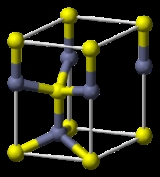
Wurtzite Unit Cell 3d Balls

Crystal structure

Zinc oxide crystallizes in three forms: hexagonal wurtzite, cubic zincblende
Cubic crystal system

The cubic crystal system is a crystal system where the unit cell is in the shape of a cube. This is one of the most common and simplest shapes found in crystals and minerals....
, and the rarely observed cubic rocksalt
Sodium chloride

Sodium chloride, also known as common salt, table salt, or halite, is a chemical compound with the chemical formula SodiumChlorine....
). The wurtzite structure is most stable and thus most common at ambient conditions. The zincblende form can be stabilized by growing ZnO on substrates with cubic lattice structure. In both cases, the zinc and oxide are tetrahedral. The rocksalt NaCl-type structure is only observed at relatively high pressures - ~10 GPa.

The hexagonal and zincblende ZnO lattices have no inversion symmetry
Reflection symmetry

The triangles with this symmetry are isosceles. The quadrilaterals with this symmetry are the kite s and the isosceles trapezoids.For each line or plane of reflection, the symmetry group is isomorphic with Cs , one of the three types of order two , hence algebraically C2....
 (reflection of a crystal relatively any given point does not transform it into itself). This and other lattice symmetry properties result in piezoelectricity
Piezoelectricity

Piezoelectricity is the ability of some materials to generate an electric potential in response to applied mechanical Stress . This may Piezoelectricity#Crystal classes of a separation of electric charge across the crystal lattice....
 of the hexagonal and zincblende ZnO, and in pyroelectricity
Pyroelectricity

Pyroelectricity is the ability of certain materials to generate a temporary electrical potential when they are heated or cooled. The change in temperature slightly modifies the positions of the atoms within the crystal structure, such that the polarization of the material changes....
 of hexagonal ZnO.

The hexagonal structure has a point group 6 mm (Hermann-Mauguin notation
Hermann-Mauguin notation

Hermann-Mauguin notation is used to represent the symmetry elements in point groups, plane groups and space groups. It is named after the German crystallographer Carl Hermann and the French minerologist Charles-Victor Mauguin....
) or C6v (Schoenflies notation
Schoenflies notation

The Schoenflies notation is one of two conventions commonly used to describe crystallographic point groups. This notation is used in spectroscopy....
), and the space group
Space group

The space group of a crystal or crystallographic group is a mathematical description of the symmetry inherent in the structure. The word 'group' in the name comes from the group , which is used to build the set of space groups....
 is P63mc or C6v4. The lattice constants are a = 3.25 Ĺ and c = 5.2 Ĺ; their ratio c/a ~ 1.60 is close to the ideal value for hexagonal cell c/a = 1.633. As in most II-VI materials, the bonding in ZnO is largely ionic
Ionic bond

An ionic bond is a type of chemical bond that involves a metal and a non-metal ions through electrostatic attraction. In short, it is a bond formed by the attraction between two oppositely charged ions....
, which explains its strong piezoelectricity
Piezoelectricity

Piezoelectricity is the ability of some materials to generate an electric potential in response to applied mechanical Stress . This may Piezoelectricity#Crystal classes of a separation of electric charge across the crystal lattice....
. Due to this ionicity, zinc and oxygen planes bear electric charge (positive and negative, respectively). Therefore, to maintain electrical neutrality, those planes reconstruct at atomic level in most relative materials, but not in ZnO - its surfaces are atomically flat, stable and exhibit no reconstruction. This anomaly of ZnO is not fully explained yet.

Mechanical properties

ZnO is a relatively soft material with approximate hardness of 4.5 on the Mohs scale. Its elastic constants are smaller than those of relevant III-V semiconductors, such as GaN
Gan

selfref|For Wikipedia's good article promotion process, see...
. The high heat capacity and heat conductivity, low thermal expansion and high melting temperature of ZnO are benefitial for ceramics .

Among the tetrahedrally bonded semiconductors, it has been stated that ZnO has the highest piezoelectric tensor or at least one comparable to that of GaN
Gan

selfref|For Wikipedia's good article promotion process, see...
 and AlN
ALN

ALN, AlN or Aln may refer to:* A??o Libertadora Nacional* Africa Liberal Network* Alianza Liberal Nicarag?ense, a political party in Nicaragua...
. This property makes it a technologically important material for many piezoelectrical
Piezoelectricity

Piezoelectricity is the ability of some materials to generate an electric potential in response to applied mechanical Stress . This may Piezoelectricity#Crystal classes of a separation of electric charge across the crystal lattice....
 applications, which require a large electromechanical coupling.

Electronic properties

ZnO has a relatively large direct band gap
Band gap

In solid state physics and related applied fields, a band gap, also called an energy gap or bandgap, is an energy range in a solid where no electron states exist....
 of ~3.3 eV at room temperature; therefore, pure ZnO is colorless and transparent. Advantages associated with a large band gap include higher breakdown voltages, ability to sustain large electric fields, lower electronic noise
Electronic noise

Electronic noise is an unwanted signal characteristic of all electronics electrical circuit. Depending on the circuit, the noise put out by electronic devices can vary greatly....
, and high-temperature and high-power operation. The bandgap of ZnO can further be tuned from ~3–4 eV by its alloying with magnesium oxide
Magnesium oxide

Magnesium oxide, or magnesia, is a white solid mineral that occurs naturally as periclase and is a source of magnesium . It has an empirical formula of ....
 or cadmium oxide
Cadmium oxide

Cadmium oxide is an inorganic compound with the chemical formula cadmiumO. CdO is one of the main precursors to other cadmium compounds It crystallizes in a cubic lattice like sodium chloride, with octahedral cation and anion centers....
.

Most ZnO has n-type
N-type

* N-type semiconductor is a key material in the manufacture of transistors and integrated circuits* N connectors are commonly used to terminate the ends of coaxial cable...
 character, even in the absence of intentional doping
Doping (semiconductor)

In semiconductor production, doping is the process of intentionally introducing impurities into an extremely pure semiconductor to change its electrical properties....
. Native defects
Crystallographic defect

Crystalline solids have a very regular atomic structure: that is, the local positions of atoms with respect to each other are repeated at the atomic scale....
 such as oxygen vacancies or zinc interstitials
Interstitial defect

Interstitials are a variety of crystallographic defects, i.e. atoms which occupy a site in the crystal structure at which there is usually not an atom, or two or more atoms sharing one or more lattice sites such that the number of atoms is larger than the number of lattice sites....
 are often assumed to be the origin of this, but the subject remains controversial. An alternative explanation has been proposed, based on theoretical calculations, that unintentional substitutional hydrogen impurities are responsible. Controllable n-type doping is easily achieved by substituting Zn with group-III elements Al, Ga, In or by substituting oxygen with group-VII elements chlorine
Chlorine

Chlorine...
 or iodine
Iodine

Iodine , is a chemical element that has the symbol I and atomic number 53. Naturally-occurring iodine is a single isotope with 74 neutrons....
.

Reliable p-type doping of ZnO remains difficult. This problem originates from low solubility of p-type dopants and their compensation by abundant n-type impurities, and it is pertinent not only to ZnO, but also to similar compounds GaN
Gan

selfref|For Wikipedia's good article promotion process, see...
 and ZnSe. Measurement of p-type in "intrinsically" n-type material is also not easy because inhomogeneity results in spurious signals.

Current absence of p-type ZnO does limit its electronic and optoelectronic applications which usually require junctions of n-type and p-type material. Known p-type dopants include group-I elements Li, Na, K; group-V elements N, P and As; as well as copper and silver. However, many of these form deep acceptors and do not produce significant p-type conduction at room temperature.

Electron mobility
Electron mobility

In physics, electron mobility , is a quantity relating the drift velocity of electrons to the applied electric field across a material, according to the formula:...
 of ZnO strongly varies with temperature and has a maximum of ~2000 cm2/(V·s) at ~80 Kelvin. Data on hole mobility are scarce with values in the range 5-30 cm2/(V·s).

Production


For industrial use, ZnO is produced at levels of 105 tons per year by three main processes :

Indirect (French) process

Metallic zinc is melted in a graphite crucible and vaporized at temperatures above 907 °C (typically around 1000 °C). Zinc vapor instantaneously reacts with the oxygen in the air to give ZnO, accompanied by a drop in its temperature and bright luminescence. Zinc oxide particles are transported into a cooling duct and collected in a bag house. This indirect method was popularized by LeClaire (France) in 1844 and therefore is commonly known as the French process. Its product normally consists of agglomerated zinc oxide particles with an average size of 0.1 micrometres to a few micrometres. By weight, most of the world's zinc oxide is manufactured via French process. Major applications involve industries related to rubber
Rubber

Natural rubber is an elastomer?an Elasticity_ hydrocarbon polymer?that was originally derived from a milky colloidal suspension, or latex , found in the sap of some plants....
, varistors, sunscreens, paints, healthcare, and poultry nutrients. Recent developments involve acicular nanostructures (rods, wires, tripods, tetrapods, plates) synthesized using a modified French process known as catalyst-free combust-oxidized mesh (CFCOM) process. Acicular nanostructures usually have micrometre-length nanorods with nanometric diameters (below 100 nm).

Direct (American) process

In the direct process, the starting material is various contaminated zinc composites, such as zinc ores
Calamine (mineral)

Calamine is a historic name for an ore of zinc. The name calamine was derived from the Belgium town of Kelmis, whose French language name is "La Calamine", which is home to a zinc mine....
 or smeleter by-products. It is reduced by heating with a carbon additive (e.g. antracite) to produce zinc vapor, which is then oxidized as in the indirect process. Because of the lower purity of the source material, the final product is also of lower quality in the direct process as compared to the indirect one.

Wet chemical process

Wet chemical processes start with purified zinc solutions, from which zinc carbonate or zinc hydroxide
Zinc hydroxide

Zinc hydroxide Zinc2 is an inorganic chemical compound. It also occurs naturally as 3 rare minerals: w?lfingite , ashoverite and sweetite ....
 is precipitated. It is then filtered, washed, dried and calcined at temperatures ~800 °C.

Laboratory synthesis

A large number of ZnO production methods exist for producing ZnO for scientific studies and electronic applications. These methods can be classified by the resulting ZnO form (bulk, thin film, nanowire
Nanowire

A nanowire is a nanostructure, with the diameter of the order of a nanometer . Alternatively, nanowires can be defined as structures that have a lateral size constrained to tens of nanometers or less and an unconstrained longitudinal size....
), temperature ("low", i.e. close to room temperature or "high", i.e. T ~ 1000 °C), process type (vapor deposition or growth from solution) and other parameters.

Large single crystals (many cubic centimeters) are usually grown by the gas transport (vapor-phase deposition), hydrothermal synthesis
Hydrothermal synthesis

Hydrothermal synthesis includes the various techniques of crystallizing substances from high-temperature aqueous solutions at high vapor pressures; also termed "hydrothermal method"....
, or melt growth. However, because of high vapor pressure
Vapor pressure

Vapor pressure , is the pressure of a vapor in Thermodynamic equilibrium with its non-vapor Phase s. All liquids and solids have a tendency to evaporate to a gaseous form, and all gases have a tendency to Condensation back into their original form ....
 of ZnO, growth from the melt is problematic. Growth by gas transport is difficult to control, leaving the hydrothermal method as a preference. Thin films can be produced by chemical vapor deposition
Chemical vapor deposition

Chemical vapor deposition is a chemical process used to produce high-purity, high-performance solid materials. The process is often used in the semiconductor industry to produce thin films....
, metalorganic vapour phase epitaxy
Metalorganic vapour phase epitaxy

Metalorganic vapour phase epitaxy is a chemical vapour deposition method of epitaxy of materials, especially compound semiconductors from the surface reaction of organic compounds or metalorganics and metal hydrides containing the required chemical elements....
, electrodeposition
Electrophoretic deposition

Electrophoretic deposition , is a term for a broad range of industrial processes which includes electrocoating, cathodic electrodeposition, and electrophoretic coating, or electrophoretic painting....
, pulsed laser deposition
Pulsed laser deposition

Pulsed laser deposition is a thin film deposition technique where a high power pulsed laser beam is focused inside a vacuum chamber to strike a target of the desired composition....
, sputtering
Sputtering

Sputtering is a process whereby atoms are ejected from a solid target material due to bombardment of the target by energetic ions. It is commonly used for thin-film deposition, etching and analytical techniques ....
, sol-gel synthesis, spray pyrolysis, etc. Nanostructures can be obtained with most above-mentioned techniques, at certain conditions, and also with the vapor-liquid-solid method
Vapor-liquid-solid method

The vapor-liquid-solid process is a mechanism for the growth of one-dimensional structures, such as nanowires, from chemical vapor deposition....
.

Applications

The applications of zinc oxide powder are numerous, and the principal ones are summarized below. Most applications exploit the reactivity of the oxide as a precursor to other zinc compounds. For material science applications, zinc oxide has high refractive index
Refractive index

The refractive index of a medium is a measure for how much the speed of light is reduced inside the medium. For example, typical soda-lime glass has a refractive index of 1.5, which means that in glass, light travels at times the speed of light in a vacuum....
, good thermal, binding, antibacterial and UV-protection properties. Consequently, it is added into various materials and products, including plastics, ceramics, glass, cement, rubber, lubricants, paints, ointments, adhesive, sealants, pigments, foods, batteries, ferrites, fire retardants, etc.

Rubber manufacture

About 50% of ZnO use is in rubber industry. Zinc oxide activates vulcanization, which otherwise may not occur at all . Zinc oxide and stearic acid
Stearic acid

Stearic acid or 18:0 is a saturated fatty acid. It is a waxy solid, and its chemical formula is C18H36O2....
 are ingredients in the commercial manufacture of rubber
Rubber

Natural rubber is an elastomer?an Elasticity_ hydrocarbon polymer?that was originally derived from a milky colloidal suspension, or latex , found in the sap of some plants....
 goods. A mixture of these two compounds allows a quicker and more controllable rubber cure. ZnO is also an important additive to the rubber of car tyres. Vulcanization
Vulcanization

Vulcanization refers to a specific curing process of rubber involving high heat and the addition of sulfur or other equivalent curatives. It is a chemical process in which polymer molecules are linked to other polymer molecules by atomic bridges composed of sulfur atoms or carbon to carbon bonds....
 catalysts are derived from zinc oxide, and it considerably improves the thermal conductivity
Thermal conductivity

In physics, thermal conductivity, , is the List of materials properties of a material that indicates its ability to conduct heat. It appears primarily in Heat conduction#Fourier's law for heat conduction....
, which is crucial to dissipate the heat produced by the deformation when the tyre rolls. ZnO additive also protect rubber from fungi (see medical applications) and UV light.

Concrete industry

Zinc oxide is widely used for concrete
Concrete

Concrete is a construction material composed of cement as well as other cementitious materials such as fly ash and slag cement, construction aggregate , water , and Chemistry admixtures....
 manufacturing. Addition of ZnO improves the processing time and the resistance of concrete against water.

Medical

Zinc oxide as a mixture with about 0.5% iron(III) oxide
Iron(III) oxide

Iron oxide?also known as ferric oxide, Hematite, red iron oxide, synthetic maghemite, colcothar, or simply rust?is one of the several oxide Chemical compounds of iron, and has Paramagnetism properties....
 (Fe2O3) is called calamine
Calamine

Calamine is a mixture of zinc oxide with about 0.5% iron oxide . It is the main ingredient in calamine lotion and is used as an antipruritic to treat mild pruritic conditions such as sunburn, eczema, rashes, poison ivy, chickenpox, insect bites and stings.It is also used as a mild antiseptic to prevent infections that can be caused b...
 and is used in calamine lotion. There are also two minerals, zincite
Zincite

Zincite is the mineral form of zinc oxide . In nature its crystal form is rare, with the exception of the Franklin Furnace locality near Franklin, New Jersey, an area also famed for its many fluorescent minerals....
 and hemimorphite
Hemimorphite

Hemimorphite, is a Silicate minerals mineral which has been mined from days of old from the upper parts of zinc and lead ores, chiefly associated with smithsonite....
, which have been called calamine historically (see: calamine (mineral)
Calamine (mineral)

Calamine is a historic name for an ore of zinc. The name calamine was derived from the Belgium town of Kelmis, whose French language name is "La Calamine", which is home to a zinc mine....
).

When mixed with eugenol
Eugenol

Eugenol , is an allyl chain-substituted guaiacol. Eugenol is a member of the phenylpropanoids class of chemical compounds. It is a clear to pale yellow oily liquid extracted from certain essential oils especially from clove oil, nutmeg, cinnamon, and bay leaf....
, a chelate, zinc oxide eugenol
Zinc Oxide Eugenol

Combining zinc oxide and eugenol forms zinc oxide eugenol which can be used as a filling or cement material in dentistry. It is often used in dentistry when the decay is very deep or very close to the nerve or pulp chamber....
 is formed which has restorative
Dental restoration

A dental restoration or dental filling is a dental restorative material used to restore the function, integrity and Comparative anatomy of missing tooth structure....
 and prosthodontic
Prosthodontics

Prosthodontics is one of nine dental specialties recognized by the American Dental Association, Royal College of Dentists of Canada, and Royal Australasian College of Dental Surgeons....
 applications in dentistry
Dentistry

Dentistry is the known evaluation, diagnosis, prevention, and treatment of diseases, disorders and conditions of the mouth, maxillofacial area and the adjacent and associated structures and their impact on the human body....
.

Reflecting the basic properties of ZnO, fine particles of the oxide have deodorizing and antibacterial action and for that reason are added into various materials including cotton fabric, rubber, food packaging, etc. Enhanced antibacterial action of fine particles compared to bulk material is not intrinsic to ZnO and is observed for other materials, such as silver
Silver

Silver is a chemical element with the chemical symbol Ag and atomic number 47. A soft, white, lustrous transition metal, it has the highest electrical conductivity of any element and the highest thermal conductivity of any metal....
.

Zinc oxide is also a component of barrier cream
Barrier cream

Barrier Cream A barrier cream is a topical formulation used in industrial and medical environments to place a physical barrier between the skin and contaminants which may irritate the skin and cause contact dermatitis or occupational dermatitis....
 used in nappy rash or diaper rash
Diaper rash

Diaper rash or nappy rash , is a generic term applied to skin rashes in the diaper area that are caused by various skin disorders and/or irritants....
 

Cigarette filters

Zinc oxide is a constituent of cigarette filters for removal of selected components from tobacco smoke. A filter consisting of charcoal impregnated with zinc oxide and iron oxide removes significant amounts of HCN
Hydrogen cyanide

Hydrogen cyanide is a chemical compound with chemical formula HCN. A solution of hydrogen cyanide in water is called hydrocyanic acid. Hydrogen cyanide is a colorless, extremely poisonous, and highly volatility liquid that boiling slightly above room temperature at 26 Celsius ....
 and H2S
Hydrogen sulfide

Hydrogen sulfide is the chemical compound with the chemical formula Hydrogen2Sulfur. This colorless, toxic and flammable gas is partially responsible for the foul odor of egg and flatulence....
 from tobacco smoke without affecting its flavour.

Food additive

Zinc oxide is added to many food products, e.g., breakfast cereal
Breakfast cereal

A breakfast cereal is a Fast moving consumer goods food product intended to be consumed as part of a breakfast. It is usually eaten cold as a ready-to-eat meal and mixed with a liquid, such as milk or water, though occasionally Nut and fruit are also added....
s, as a source of zinc, a necessary nutrient
Nutrient

A nutrient is a chemical that an organism needs to live and grow or a substance used in an organism's metabolism which must be taken in from its environment....
. (Other cereals may contain zinc sulfate
Zinc sulfate

Zinc sulfate is a colorless crystalline, water-soluble chemical compound. The hydrated form, ZnSO4?7H2O, the mineral goslarite, was historically known as "white vitriol" and can be prepared by reacting zinc with aqueous sulfuric acid....
 for the same purpose.) Some prepackaged foods also include trace amounts of ZnO even if it is not intended as a nutrient.

Pigment

Zinc white is used as a pigment in paint
Paint

Paint is any liquid, liquifiable, or mastic composition which after application to a Substrate in a thin layer is converted to an opaque solid film....
s and is more opaque than lithopone
Lithopone

Lithopone is a white pigment, a mixture of barium sulfate and zinc sulfide. It is used in interior paints and in some vitreous enamel.Wooden artifacts are treated with zinc sulfate and barium sulfide, which undergo metathesis reaction to form the aforementioned precipitates, which render a marble-like finish to the wooden piece....
, but less opaque than titanium dioxide
Titanium dioxide

Titanium dioxide, also known as titanium oxide or titania, is the naturally occurring oxide of titanium, chemical formula titaniumoxygen2....
. It is also used in coatings for paper. Chinese white is a special grade of zinc white used in artists' pigment
Pigment

A pigment is a material that changes the color of light it Reflection as the result of selective color absorption. This physical process differs from fluorescence, phosphorescence, and other forms of luminescence, in which the material itself emits light....
s. Because it absorbs both UVA and UVB rays of ultraviolet light, zinc oxide can be used in ointments, creams, and lotion
Lotion

A lotion is a low- to medium-viscosity, topical preparation intended for application to unbroken skin; creams and gels have a higher viscosity. Most lotions are oil-in-water emulsions using a substance such as Cetearyl alcohol to keep the emulsion together, but water-in-oil lotions are also formulated....
s to protect against sunburn
SunBurn

SunBurn is a regional event held in Florida. Although SunBurn has its roots in the annual Burning Man festival in Nevada, it is not an official Burning Man event, because the organizers of SunBurn do not condone the direction that the Burning Man Organization has taken over the years....
 and other damage to the skin caused by ultraviolet light (see sunscreen
Sunscreen

Sunscreen is a lotion, spray, gel or other topical product that absorbs or reflects the sun's ultraviolet radiation and protects the skin.Sunscreens contain one or more UV filters of which there are three main types :...
). It is the broadest spectrum UVA and UVB absorber that is approved for use as a sunscreen by the FDA, and is completely photostable. It is also a main ingredient of mineral makeup.

Coatings

Paints containing zinc oxide powder have long been utilized as anticorrosive coatings for various metals. They are especially effective for galvanised Iron. The latter is difficult to protect because its reactivity with organic coatings leads to brittleness and lack of adhesion. Zinc oxide paints however, retain their flexibility and adherence on such surfaces for many years.

ZnO highly n-type doped with Al, Ga or nitrogen is transparent and conductive (transparency
Transparency (optics)

In optics, transparency is the material property of allowing light to pass through. In mineralogy, another term for this property is diaphaneity....
 ~90%, lowest resistivity
Resistivity

Electrical resistivity is a measure of how strongly a material opposes the flow of electric current. A low resistivity indicates a material that readily allows the movement of electrical charge....
 ~10-4 Ocm), and is used as a transparent electrode
Electrode

An electrode is an electrical conductor used to make contact with a nonmetallic part of a Electronic circuit . The word was coined by the scientist Michael Faraday from the Greek language words elektron and hodos, a way....
. The constituents Zn and Al are much cheaper and less poisonous compared to the generally used indium tin oxide
Indium tin oxide

Indium tin oxide is a solid solution of indium oxide and tin oxide , typically 90% In2O3, 10% SnO2 by weight....
 (ITO). One application which has begun to be commercially available is the use of ZnO as the front contact for solar cells or of liquid crystal display
Liquid crystal display

A liquid crystal display is an Electro-optic modulator shaped into a thin, flat panel made up of any number of color or monochrome pixels filled with liquid crystals and arrayed in front of a Light#Light sources or reflector....
s.

Another application is ZnO:Al coating for energy-saving or heat-protecting windows. The coating lets the visible part of the spectrum in but either reflects the infrared (IR) radiation back into the room (energy saving) or does not let the IR radiation into the room (heat protection), depending on which side of the window has the coating.

Corrosion prevention in nuclear reactors

Zinc oxide depleted in the zinc isotope
Isotopes of zinc

Naturally occurring zinc is composed of the 5 stable isotopes 64Zn, 66Zn, 67Zn, 68Zn, and 70Zn with 64Zn being the most abundant ....
 with the atomic mass
Atomic mass

The atomic mass is the mass of an atom, most often expressed in Atomic mass units. The atomic mass may be considered to be the total mass of protons, neutrons and electrons in a single atom ....
 64 is used in corrosion prevention in nuclear pressurized water reactor
Pressurized water reactor

Pressurized water reactor are Generation II reactor nuclear reactors that use ordinary water under high pressure as coolant to remove heat generated by nuclear chain reaction from nuclear fuel, and as the neutron moderator to thermalise the neutron flux so that it interacts with the nuclear fuel to maintain the chain reaction....
s. The depletion is necessary, because 64Zn is transformed
Neutron activation

Neutron activation is the process in which neutron radiation induces radioactivity in materials, and occurs when Atomic nucleus capture free neutrons, becoming heavier and entering excited states....
 into radioactive 65Zn under irradiation by the reactor neutrons.

Potential applications


Electronics

ZnO has wide direct band gap (3.37 eV or 375 nm at room temperature). Therefore, its most common potential applications are in laser diodes and light emitting diodes (LEDs). Some optoelectronic applications of ZnO overlap with that of GaN
Gan

selfref|For Wikipedia's good article promotion process, see...
, which has a similar bandgap (~3.4 eV at room temperature). Compared to GaN, ZnO has a larger exciton binding energy (~60 meV, 2.4 times of the room-temperature thermal energy), which results in bright room-temperature emission from ZnO. Other properties of ZnO favorable for electronic applications include its stability to high-energy radiation and to wet chemical etching. Radiation resistance makes ZnO a suitable candidate for space applications.

The pointed tips of ZnO nanorods result in a strong enhancement of an electric field. Therefore, they can be used as field emitters
Field emission

Field electron emission is an experimental phenomenon involving the electric-field-induced emission of electrons from the surface of a condensed material , into vacuum or into another material....
.

Transparent thin-film transistor
Transistor

In electronics, a transistor is a semiconductor device commonly used to Electronic amplifier or switch Electronics signals. A transistor is made of a solid piece of a semiconductor material, with at least three terminals for connection to an external circuit....
s (TTFT) can be produced with ZnO. As field-effect transistors, they even may not need a p–n junction, thus avoiding the p-type doping problem of ZnO. Some of the field-effect transistors even use ZnO nanorods as conducting channels.

Zinc oxide nanorod sensor

Zinc oxide nanorod sensor

A zinc oxide nanorod sensor or ZnO nanorod sensor is an electronic device detecting presence of certain gas or liquid molecules in the ambient atmosphere....
s are devices detecting changes in electrical current passing through zinc oxide nanowire
Nanowire

A nanowire is a nanostructure, with the diameter of the order of a nanometer . Alternatively, nanowires can be defined as structures that have a lateral size constrained to tens of nanometers or less and an unconstrained longitudinal size....
s due to adsorption
Adsorption

Adsorption is a process that occurs when a gas or liquid solute accumulates on the surface of a solid or a liquid , forming a film of molecules or atoms ....
 of gas molecules. Selectivity to hydrogen gas was achieved by sputtering Pd clusters on the nanorod surface. The addition of Pd appears to be effective in the catalytic dissociation of hydrogen molecules into atomic hydrogen, increasing the sensitivity of the sensor device. The sensor detects hydrogen concentrations down to 10 parts per million at room temperature, whereas there is no response to oxygen.

Spintronics

ZnO has also been considered for spintronics
Spintronics

Spintronics , also known as magnetoelectronics, is an emerging technology which exploits the intrinsic spin of electrons and its associated magnetic moment, in addition to its fundamental electronic charge, in Solid state ....
 applications: if doped with 1-10% of magnetic ions (Mn, Fe, Co, V, etc.), ZnO could become ferromagnetic, even at room temperature. Such room temperature ferromagnetism
Ferromagnetism

Ferromagnetism is the basic mechanism by which certain materials form permanent magnets and/or exhibit strong interactions with magnets; it is responsible for most phenomena of magnetism Magnet#Common uses of magnets ....
 in ZnO:Mn has been observed, but it is not clear yet whether it originates from the matrix itself or from Mn-containing precipitates.

Piezoelectricity

The piezoelectricity
Piezoelectricity

Piezoelectricity is the ability of some materials to generate an electric potential in response to applied mechanical Stress . This may Piezoelectricity#Crystal classes of a separation of electric charge across the crystal lattice....
 in textile
Textile

A textile is a flexible material consisting of a network of natural or artificial fibres often referred to as thread or yarn. Yarn is produced by Spinning raw wool fibres, linen, cotton, or other material on a spinning wheel to produce long strands known as yarn....
 fibers coated in ZnO have been shown capable of "self-powering nanosystems" with everyday mechanical stress generated by wind or body movements.

In 2008 the Center for Nanostructure Characterization at the Georgia Institute of Technology
Georgia Institute of Technology

The Georgia Institute of Technology, commonly known as Georgia Tech or simply Tech, is a public university, coeducational research university in Atlanta, Georgia in the United States....
 reported producing an electricity generating device (called flexible charge pump generator) delivering alternating current by stretching and releasing zinc oxide wires. This mini-generator creates an oscillating voltage up to 45 millivolts, converting close to seven percent of the applied mechanical energy into electricity. Researchers used wires with lengths of 200-300 micrometres and diameters of three to five micrometres, but the device could be scaled down to nanometer size.

Biosensor

ZnO has high biocompatibility and fast electron transfer kinetics. Such features advocate the use of this material as a biomimic membrane to immobilize and modify biomolecules.

History


It is hardly possible to trace the first usage of zinc oxide - various zinc compounds have been widely used by early humans, in various processed and unprocessed forms, as a paint or medicinal ointment, but their exact composition is uncertain. As mentioned in the production sections, common ways of making zinc oxide require relatively high temperatures of 1000 °C that probably hindered ZnO manufacture in the early ages. The Romans produced considerable quantities of brass
Brass

Brass is any alloy of copper and zinc; the proportions of zinc and copper can be varied to create a range of brasses with varying properties. In comparison, bronze is principally an alloy of copper and tin....
 (an alloy of zinc
Zinc

Zinc is a metallic chemical element with the symbol Zn and atomic number 30. It is a first-row transition metal of the group 12 element of the periodic table....
 and copper
Copper

Copper is a chemical element with the symbol Cu and atomic number 29.It is a ductile metal with very high thermal and electrical conductivity....
) as early as 200 bc. Zinc oxide should have been obtained as by product, but its usage is not documented .

From the 12th to the 16th century zinc and zinc oxide were recognized and produced in India
India

India, officially the Republic of India , is a country in South Asia. It is the List of countries and outlying territories by total area country by geographical area, the List of countries by population country, and the most populous liberal democracy in the world....
 using a primitive form of the direct synthesis process. From India, zinc manufacture moved to China
China

China is a Culture of China, an ancient civilization, and, depending on perspective, a national or multinational entity extending over a large area in East Asia....
 in the 17th century. Zinc was recognized as a separate metal in Europe in 1546. In 1743, the first European zinc smelter was established in Bristol
Bristol

Bristol is a City status in the United Kingdom, unitary authority area and Ceremonial counties of England in South West England, west of London, and east of Cardiff....
, United Kingdom
United Kingdom

The United Kingdom of Great Britain and Northern Ireland, commonly known as the United Kingdom , the UK or Britain,is a sovereign state located off the northwestern coast of continental Europe....
 .

The main usage of zinc oxide (zinc zhite) was again paints and additive to ointments. Zinc white was accepted as a watercolor by 1834 but it did not mix well with oil. This problem was quickly solved by optimizing the synthesis of ZnO. In 1845, LeClaire in Paris was producing the oil paint on a large scale, and by 1850, zinc white was being manufactured throughout Europe. The success of zinc white paints was due to its advantages over the traditional white lead: zinc white is essentially permanent in sunlight, it is not blackened by sulfur-bearing air, it is non-toxic and more economical. Because zinc white is so "clean" it is very valuable for making tints with other colors, however, it makes a rather brittle dry film when unmixed with other colors. For example, during the late 1890's and early 1900's, some artists used zinc white as a ground for their oil paintings. All those paintings developed cracks over the years

In the recent times, most zinc oxide was used in the rubber industry (see applications above). In the 1970ies, the second largest application of ZnO was photocopying. High-quality ZnO produced by the French process was added into the photocopying paper as a filler. This application was however soon expelled from the market by optimizing the process to use ordinary paper .

Safety

As a food additive, Zinc oxide is on FDA's generally recognized as safe
Generally recognized as safe

Generally Recognized as Safe is a United States of America Food and Drug Administration designation that a chemical or substance added to food is considered safe by experts, and so is exempted from the usual Federal Food, Drug, and Cosmetic Act food additive tolerance requirements....
, or GRAS, substances.

Zinc oxide itself is non-toxic; however it is hazardous to breathe zinc oxide fumes. Fumes of zinc oxide are generated when zinc or zinc alloys are melted and oxidized at high temperature. This occurs while melting brass
Brass

Brass is any alloy of copper and zinc; the proportions of zinc and copper can be varied to create a range of brasses with varying properties. In comparison, bronze is principally an alloy of copper and tin....
 because the melting point of brass is close to the boiling point of zinc. Exposure to zinc oxide in the air, which also occurs while welding galvanized (zinc plated) steel
Steel

Steel is an alloy consisting mostly of iron, with a carbon content between 0.2% and 2.14% by weight , depending on grade. Carbon is the most cost-effective alloying material for iron, but various other alloying elements are used such as manganese, chromium, vanadium, and tungsten....
, can result in a nervous malady called metal fume fever
Metal fume fever

Metal fume fever is illness caused primarily by exposure to certain metal fumes. Chemicals such as zinc oxide or magnesium oxide , often cause this through breathing fumes created by heating or welding certain metals, such as galvanized steel....
. For this reason, typically galvanized steel is not welded, or the zinc is removed first.

See also

  • Zinc
    Zinc

    Zinc is a metallic chemical element with the symbol Zn and atomic number 30. It is a first-row transition metal of the group 12 element of the periodic table....
  • Zinc-zinc oxide cycle
    Zinc-zinc oxide cycle

    The zinc-zinc oxide cycle or Zn/ZnO cycle is a two step Thermochemistry process based on zinc and zinc oxide for hydrogen production with a typical efficiency around 40%....
  • Zinc peroxide
    Zinc peroxide

    Zinc peroxide is a chemical compound used as a bleaching and curing agent. It appears as white to yellow powder. Perhaps its most important use is to promote cross-linking in carboxylated nitrile rubber and other elastomers....
  • Gallium(III) nitride
    Gallium(III) nitride

    Gallium nitride is a very hard material commonly used in bright Light Emitting Diodes since the 1990s.The compound is a direct-bandgap semiconductor material of Wurtzite crystal structure, with a wide band gap, used in optoelectronic, high-power and high-frequency devices....
  • Depleted zinc oxide
    Depleted zinc oxide

    Depleted zinc oxide is a zinc oxide depleted in the isotopes of zinc with the atomic mass 64, and used in corrosion prevention in nuclear pressurized water reactors....
  • Zinc smelting
    Zinc smelting

    Zinc smelting is the process of converting zinc concentrates into pure zinc.The most common zinc concentrate processed is zinc sulfide, which is obtained by concentrating sphalerite using the froth flotation method....


Reviews

  • U. Ozgur et al. "A comprehensive review of ZnO materials and devices" (103 pages) - a very highly cited article (~800 citations in the period 2005-2008 according to Web of Science
    Web of Science

    ISI Web of Knowledge is an online academic database provided by Thomson Scientific. It provides access to many databases and other resources: Web of Science , ISI Proceedings, Current Contents, Medline, ISI Essential Science Indicators, Journal Citation Reports , in-cites, Science Watch, ISI_highly_cited_researcher, Index to Organism Names, a...
    )
  • S. Baruah and J. Dutta "Hydrothermal growth of ZnO nanostructures" (18 pages) Sci. Technol. Adv. Mater. 10 (2009) 013001
  • R. Janisch et al. "Transition metal-doped TiO2 and ZnO—present status of the field" (32 pages)
  • Y.W. Heo et al. "ZnO nanowire growth and devices" (47 pages)
  • C. Klingshirn "ZnO: From basics towards applications" (46 pages)
  • C. Klingshirn "ZnO: Material, Physics and Applications" (21 pages)
  • J. G. Lu et al. "Quasi-one-dimensional metal oxide materials—Synthesis, properties and applications" (42 pages)


External links

  • .
  • .
  • . (describes industrial uses of zinc oxide)
  • .