
A
Ziegler–Natta catalyst is a catalyst used in the synthesis of polymers of 1-alkenes (α-olefins). Three types of Ziegler–Natta catalysts are currently employed:
- Solid and supported catalysts based on titanium compounds. They are used in polymerization reactions in combination with cocatalysts, organoaluminum
Organometallic chemistry is the study of chemical compounds containing bonds between carbon and a metal. Since many compounds without such bonds are chemically similar, an alternative may be compounds containing metal-element bonds of a largely covalent character...
compounds such as triethylaluminiumTriethylaluminium is an organoaluminium compound. This volatile, colorless liquid is highly pyrophoric, igniting immediately upon exposure to air. It is normally stored in stainless steel containers either as a pure liquid or as a solution in hydrocarbon solvents such as hexane, heptane, or ...
, Al(C2H5)3.
- Metallocene catalysts, combination of various mono- and bis-metallocene, in particular ansa- (or bridged) metallocene
An ansa-metallocene is a type of organometallic compound containing two cyclopentadienyl ligands that are linked by a bridging group such that both cyclopentadienyl groups are bound to the same metal. The link prevents rotation of the cyclopentadienyl ligand and often modifies the structure and...
complexes of Ti, Zr or Hf. They are usually used in polymerization reactions in combination with a different organoaluminum cocatalyst, methylaluminoxaneMethylaluminoxane, commonly called MAO, is a white solid with the general formula n.-Physical properties:MAO is pyrophoric, and is violently reactive with any chemical bearing an acidic proton. However, MAO is generally used as a solution in an hydrocarbon due to its relatively high solubility in...
(or methylalumoxane, MAO).
- Post-metallocene catalysts based on complexes of various transition metals with multidentate oxygen- and nitrogen-based ligands. These complexes are also activated with MAO.
Ziegler–Natta catalysts are used to polymerize terminal 1-
alkeneIn organic chemistry, an alkene, olefin, or olefine is an unsaturated chemical compound containing at least one carbon-to-carbon double bond...
s (ethylene and alkenes with the vinyl double bond):
n CH
2=CHR → −[CH
2−CHR]
n−
German
Karl ZieglerKarl Waldemar Ziegler was a German chemist who won the Nobel Prize in Chemistry in 1963, with Giulio Natta, for work on polymers. The Nobel Committee recognized his "excellent work on organometallic compounds [which]...led to new polymerization reactions and ... paved the way for new and highly...
, for his discovery of first titanium-based catalysts, and Italian
Giulio NattaGiulio Natta was an Italian chemist and Nobel laureate. He won a Nobel Prize in Chemistry in 1963 with Karl Ziegler for work on high polymers.-Early years:...
, for using them to prepare stereoregular polymers, were awarded the Nobel Prize in Chemistry in 1963.
Ziegler–Natta catalysts have been used in the commercial manufacture of various polymeric materials since 1956. In 2010, the total volume of plastics, elastomers, and rubbers produced from alkenes with these catalysts worldwide exceeds 100 million metric tons. Together, these polymers represent the largest-volume commodity plastics as well as the largest-volume commodity chemicals in the world.
Stereochemistry of poly-1-alkenes
Giulio Natta used first polymerization catalysts based on titanium chlorides to polymerize propylene and other 1-alkenes. He discovered that these polymers are crystalline materials and ascribed their crystallinity to a special feature of the polymer structure called stereoregularity.
The concept of stereoregularity in polymer chains is illustrated in the picture above with polypropylene. Stereoregular poly(1-alkene) can be isotactic or syndiotactic depending on the relative orientation of the alkyl groups in polymer chains consisting of units −[CH
2-CHR]−, like the CH
3 groups in the figure. In the isotactic polymers, all stereogenic centers CHR share the same configuration. The stereogenic centers in syndiotactic polymers alternate their relative configuration. A polymer that lacks any regular arrangement in the position of its alkyl substituents (R) is called atactic. Both isotactic and syndiotactic polypropylene are crystalline, whereas atactic polypropylene, which can also be prepared with special Ziegler–Natta catalysts, is amorphous. The stereoregularity of the polymer is determined by the catalyst used to prepare it.
Catalysts derived from titanium chlorides
The first class of modern Ti-based catalysts (and some V-based catalysts) for alkene polymerization can be roughly subdivided into two subclasses, (a) catalysts suitable for homopolymerization of ethylene and for ethylene/1-alkene copolymerization reactions leading to copolymers with a low 1-alkene content, 2–4 mol.% (LLDPE resins), and (b) catalysts suitable for the synthesis of isotactic 1-alkenes. The overlap between these two subclasses is relatively small because the requirements to the respective catalysts differ widely.
Ziegler discovered the first catalyst suitable for polymerization of ethylene into a linear, highly crystalline polymer. This catalyst was a combination of TiCl
4 and Al(C
2H
5)
2Cl. Modern commercial catalysts of this type are nearly all supported, i.e. bound to a solid with a high surface area. Both TiCl
4 and TiCl
3 give active catalysts. The support in the majority of the catalysts is
MgCl2Magnesium chloride is the name for the chemical compounds with the formulas MgCl2 and its various hydrates MgCl2x. These salts are typical ionic halides, being highly soluble in water. The hydrated magnesium chloride can be extracted from brine or sea water...
. A third component of most catalysts is a carrier, a material that determines the size and the shape of catalyst particles. The preferred carrier is microporous spheres of amorphous silica with a diameter of 30–40 mm. During the catalyst synthesis, both the Ti compounds and MgCl
2 are packed into the silica pores. All these catalysts are activated with organoaluminum compounds such as
Al(C2H5)3Triethylaluminium is an organoaluminium compound. This volatile, colorless liquid is highly pyrophoric, igniting immediately upon exposure to air. It is normally stored in stainless steel containers either as a pure liquid or as a solution in hydrocarbon solvents such as hexane, heptane, or ...
.
Natta used crystalline α-TiCl
3 in combination with Al(C
2H
5)
3 to produce first isotactic
polypropylenePolypropylene , also known as polypropene, is a thermoplastic polymer used in a wide variety of applications including packaging, textiles , stationery, plastic parts and reusable containers of various types, laboratory equipment, loudspeakers, automotive components, and polymer banknotes...
. All modern supported Ziegler–Natta catalysts designed for polymerization of propylene and higher 1-alkenes are prepared with TiCl
4 as the active ingredient and MgCl
2 as a support. The third component of all such catalysts is an organic modifier, usually an ester of an aromatic diacid or a diether. The modifiers react both with inorganic ingredients of the solid catalysts as well as with organoaluminum cocatalysts. These catalysts polymerize propylene and other 1-alkenes to highly crystalline isotactic polymers.,
Metallocene catalysts
The second class of Ziegler–Natta catalysts are
metalloceneA metallocene is a compound typically consisting of two cyclopentadienyl anions bound to a metal center in the oxidation state II, with the resulting general formula 2M. Closely related to the metallocenes are the metallocene derivatives, e.g. titanocene dichloride, vanadocene dichloride...
s. They are soluble in aromatic hydrocarbons and usually contain two components, a metallocene complex and a special organometallic cocatalyst, MAO, [−O–Al–CH(CH
3-)
n. The idealized metallocene catalysts have the composition Cp
2MCl
2 (M = Ti, Zr, Hf) such as
titanocene dichlorideTitanocene dichloride is the organotitanium compound with the formula 2TiCl2, commonly abbreviated as Cp2TiCl2. This metallocene is a common reagent in organometallic and organic synthesis. It exists as a bright red solid that slowly hydrolyzes in air...
. Typically, the organic ligands are derivatives of
cyclopentadienylIn organic chemistry, cyclopentadienyl is a cyclic group of atoms with the formula C5H5. Cyclopentadienyl are closely related to cyclopentadiene. Cyclopentadienyl have five carbon atoms bonded together in a pentagonal planar ring, all five of which are bonded to individual hydrogen atoms...
. In some complexes, the two Cp rings are linked with bridges, like −CH
2−CH
2− or >SiPh
2.,,
Depending of the type of their cyclopentadienyl ligands, metallocene catalysts can produce either isotactic or syndiotactic polymers of propylene and other 1-alkenes.,
Non-metallocene catalysts
Ziegler–Natta catalysts of the third class, non-metallocene catalysts, use a variety of complexes of various metals, ranging from scandium to lanthanoid and actinoid metals, and a large variety of ligands containing oxygen, nitrogen, phosphorus, and sulfur. The complexes are activated using MAO, as is done for metallocene catalysts.
Most Ziegler–Natta catalysts and all the alkylaluminium cocatalysts are unstable in air, and the alkylaluminium compounds are pyrophoric. The catalysts, therefore, are always prepared and handled under an inert atmosphere.
Chemistry of the polymerization reactions
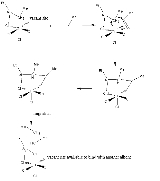
The structure of active centers in Ziegler–Natta catalysts is firmly established only for metallocene catalysts. A metallocene complex Cp
2ZrCl
2 reacts with MAO and is transformed into a metallocenium ion Cp
2Zr
+-CH
3. A polymer molecule grows in length by numerous insertion reactions of C=C bonds of 1-alkene molecules into the Zr–C bond in the ion:
Cp
2Zr
+−CH
3 + n CH
2=CHR →
Cp
2Zr
+−(CH
2−CHR)
n−CH
3
Many thousands of alkene insertion reactions occur at each active center resulting in the formation of long polymer chains attached to the center. On occasion, the polymer chain is disengaged from the active centers in the chain termination reaction:
Cp
2Zr
+−(CH
2−CHR)
n−CH
3
+ CH
2=CHR →
Cp
2Zr
+−CH
2−CH
2R + CH
2=CR–Polymer
Another type of chain termination reaction called β-hydrogen elimination reaction also occurs periodically:
Cp
2Zr
+−(CH
2−CHR)
n−CH
3 →
Cp
2Zr
+−H + CH
2=CR–Polymer
Polymerization reactions of alkene with solid Ti-based catalysts occur at special Ti centers located on the exterior of the catalyst crystallites. Some titanium atoms in these crystallites react with organoaluminum cocatalysts with the formation of Ti–C bonds. The polymerization reaction of alkenes occurs similarly to the reactions in metallocene catalysts
- LnTi–CH2−CHR–Polymer + CH2=CHR →
L
nTi–CH
2-CHR–CH
2−CHR–Polymer
The two chain termination reactions occurs quite rarely in Ziegler–Natta catalysis and the formed polymers have a too high molecular weight to be of commercial use. To reduce the molecular weight, hydrogen is added to the polymerization reaction:
- LnTi–CH2-CHR–Polymer + H2 → LnTi-H + CH3-CHR–Polymer
The
Cossee-Arlman mechanismThe Cossee-Arlman mechanism in polymer chemistry is the main pathway for the formation of C-C bonds in the polymerization of alkenes. The mechanism features an intermediate coordination complex that contains both the growing polymer chain and the monomer...
describes the growth of stereospecific polymers,. This mechanism states that the polymer grows through alkene coordination at a vacant site at the Ti atom, which is followed by insertion of the C=C bond into the Ti-C bond at the active center.
Commercial polymers prepared with Ziegler–Natta catalysts
- Polyethylene
Polyethylene or polythene is the most widely used plastic, with an annual production of approximately 80 million metric tons...
- Polypropylene
Polypropylene , also known as polypropene, is a thermoplastic polymer used in a wide variety of applications including packaging, textiles , stationery, plastic parts and reusable containers of various types, laboratory equipment, loudspeakers, automotive components, and polymer banknotes...
- Copolymers of ethylene and 1-alkenes
- Polybutene-1
- Polymethylpentene
Polymethylpentene is a thermoplastic polymer of methylpentene monomer units. It is used for gas permeable packaging, autoclavable medical and laboratory equipment, microwave components, and cookware...
- Polycycloolefins
- Polybutadiene
Polybutadiene is a synthetic rubber that is a polymer formed from the polymerization process of the monomer 1,3-butadiene.It has a high resistance to wear and is used especially in the manufacture of tires, which consumes about 70% of the production...
- Polyisoprene
- Amorphous poly-alpha-olefins (APAO
Amorphous Poly-alpha-olefins are produced by polymerisation of α-olefins, e.g. propylene or 1-butene with Ziegler-Natta catalysts. The polymers have an amorphous structure which makes them useful for the production of hot melt adhesives....
)
- Polyacetylene
Polyacetylene is an organic polymer with the repeat unit n. The high electrical conductivity discovered for these polymers beginning in the 1960's accelerated interest in the use of organic compounds in microelectronics...