

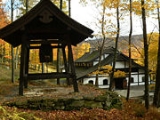
Zendo

Encyclopedia
or is a Japanese
term translating roughly as "meditation
hall". In Zen
Buddhism
, the zen-dō is a spiritual dōjō
where zazen
(sitting meditation) is practiced. A full-sized Zen Buddhist temple will typically have at least one zen-dō as well as a ("main hall
", but sometimes translated as "Buddha hall"), which is used for ceremonial purposes, plus a variety of other buildings with different functions. However, any place where people go to practice Zen can be referred to as a zen-dō.
and the "five meditations" are recited, after which monks will be served with the gruel and vegetables. Often monks will offer some of their meal to the pretas or hungry ghosts. Two meals are taken later; in the late morning and late afternoon. These meals usually consist of rice, vegetable soup and pickled vegetables. The monks remain silent during mealtimes and communicate via hand and arm gestures.
Japanese language
is a language spoken by over 130 million people in Japan and in Japanese emigrant communities. It is a member of the Japonic language family, which has a number of proposed relationships with other languages, none of which has gained wide acceptance among historical linguists .Japanese is an...
term translating roughly as "meditation
Meditation
Meditation is any form of a family of practices in which practitioners train their minds or self-induce a mode of consciousness to realize some benefit....
hall". In Zen
Zen
Zen is a school of Mahāyāna Buddhism founded by the Buddhist monk Bodhidharma. The word Zen is from the Japanese pronunciation of the Chinese word Chán , which in turn is derived from the Sanskrit word dhyāna, which can be approximately translated as "meditation" or "meditative state."Zen...
Buddhism
Buddhism
Buddhism is a religion and philosophy encompassing a variety of traditions, beliefs and practices, largely based on teachings attributed to Siddhartha Gautama, commonly known as the Buddha . The Buddha lived and taught in the northeastern Indian subcontinent some time between the 6th and 4th...
, the zen-dō is a spiritual dōjō
Dojo
A is a Japanese term which literally means "place of the way". Initially, dōjōs were adjunct to temples. The term can refer to a formal training place for any of the Japanese do arts but typically it is considered the formal gathering place for students of any Japanese martial arts style to...
where zazen
Zazen
In Zen Buddhism, zazen is a meditative discipline practitioners perform to calm the body and the mind, and be able to concentrate enough to experience insight into the nature of existence and thereby gain enlightenment .- Significance :Zazen is considered the heart of Zen Buddhist practice...
(sitting meditation) is practiced. A full-sized Zen Buddhist temple will typically have at least one zen-dō as well as a ("main hall
Main Hall (Japanese Buddhism)
Main hall is the term used in English for the building within a Japanese Buddhist temple compound which enshrines the main object of veneration. Because the various denominations deliberately use different terms, this single English term translates several Japanese words, among them Butsuden,...
", but sometimes translated as "Buddha hall"), which is used for ceremonial purposes, plus a variety of other buildings with different functions. However, any place where people go to practice Zen can be referred to as a zen-dō.
Zen-dō mealtimes
The first meal of the day in the zen-dō will often be taken in the early morning, before dawn. It normally consists of rice gruel and pickled vegetables. The monks are summoned to meals by a gong that is struck. The Hridaya SūtraSutra
Sūtra is an aphorism or a collection of such aphorisms in the form of a manual. Literally it means a thread or line that holds things together and is derived from the verbal root siv-, meaning to sew , as does the medical term...
and the "five meditations" are recited, after which monks will be served with the gruel and vegetables. Often monks will offer some of their meal to the pretas or hungry ghosts. Two meals are taken later; in the late morning and late afternoon. These meals usually consist of rice, vegetable soup and pickled vegetables. The monks remain silent during mealtimes and communicate via hand and arm gestures.