


Yvonne Fletcher

Encyclopedia
WPC Yvonne Joyce Fletcher (15 June 1958 – 17 April 1984) was a British police officer
fatally shot during a protest
outside the Libya
n embassy
at St. James's Square
, London, in 1984. Fletcher, who had been on duty and deployed to police the protest, died shortly afterwards at Westminster Hospital
. Her death resulted in the Metropolitan Police Service
laying siege to the embassy for the next eleven days, and the United Kingdom severing all diplomatic relations with Libya. Two years later it became a major factor in Prime Minister Margaret Thatcher
's decision to allow U.S. President
Ronald Reagan
to launch the U.S. bombing of Libya in 1986 from American bases in the United Kingdom.
No one has ever been convicted for the murder of Yvonne Fletcher. However in 1999, the government of Muammar Gaddafi
accepted responsibility for her death and agreed to pay compensation to her family.
In just an 18-month period, Fletcher's death became the third murder/manslaughter of an on-duty policewoman in mainland Britain
.
in 1977, was part of a detachment of 30 officers sent to St. James's Square to monitor a demonstration
by Libyan dissident
s opposed to the rule of Colonel Muammar Gaddafi
. Among the detachment with Fletcher was her fiancé.
The demonstration had been organised by the Libyan National Salvation Front
(LNSF) following the execution of two students who had criticised Gaddafi. Since February 1984, the Libyan embassy, which was also known as the Libyan People's Bureau, had been staffed by "revolutionary committees" made up of students loyal to Gaddafi who had assumed control of the embassy with the tacit approval of the Libyan government. They were not professional diplomat
s. Gaddafi loyalists at the embassy warned police that they intended to mount a counter-demonstration.
On the day, about 75 protesters arrived by coach from northern England. The demonstration began peacefully as police successfully kept the two sides apart with crowd control barrier
s. Both groups shouted at each other and waved banners and placards. Loud music was played from the embassy in an apparent attempt to drown out the noise of the protesters.
Fletcher's hat and four other officers' helmets
were left lying in the square during the ensuing siege of the embassy. In the days that followed, the images of them were shown repeatedly in the British media.
The official inquest into Fletcher's death concluded she had been killed by shots from a Sterling submachine gun
fired from the first floor of the Libyan embassy.
in response.
The British government eventually resolved the incident by allowing the embassy staff to leave the embassy and then expelling
them from the country. The United Kingdom then ended all diplomatic relations with Libya. However six British nationals
were held as political hostages in Libya by a Revolutionary Committee following the shooting. They were released after nine months of detention on 5 February 1985, four days after the unveiling of Fletcher's memorial in Berkeley Square.
in 1992, Libyan colonel Abdul Fatah Younis
apologised on behalf of the Libyan government and offered to extradite her killers. However the Foreign Office did not accede to the offer.
In July 1999, the Libyan government publicly accepted "general responsibility" for the murder and agreed to pay compensation to Fletcher's family. This, together with Libya's eventual efforts in the aftermath of the Lockerbie bombing
, paved the way for the normalisation of Anglo-Libyan relations. Once diplomatic relations were restored in 1999, Metropolitan Police detectives visited Libya on a number of occasions to pursue their investigations into her murder.
But on 24 February 2004, the Today programme on BBC Radio 4
reported that the new Libyan prime minister, Shukri Ghanem
, had claimed his country was not responsible for Fletcher's murder (nor for the Lockerbie bombing). Ghanem said that Libya had made the admission and paid compensation in order to bring "peace" and an end to international sanctions
. Gaddafi was said to have later retracted Ghanem's claims.
Finally in June 2007, British detectives were able to interview the chief Libyan suspect for the first time following the normalisation of political ties with the country. Detectives spent seven weeks in Libya interviewing both witnesses and suspects. Queenie Fletcher, Yvonne's mother, described these developments as "promising".
In February 2009, Queenie Fletcher suggested that Abdelbaset al-Megrahi, who at the time was appealing against his conviction for the Lockerbie bombing, should be moved to a prison in Libya, on condition that the Libyan government co-operate with detectives investigating her daughter's murder. Mrs Fletcher said: "I know he is ill and I think he should be returned to a prison in Libya so his family can visit him. The appeal could still go ahead in Scotland, but he could stay in prison in Libya. It's got to be a fair exchange, so Yvonne's case can be closed. I'd like the police here to be given permission to interview whoever they've got to interview in Libya and see whoever they need to for someone to be brought to trial."
In October 2009 The Daily Telegraph revealed that the Crown Prosecution Service
had been told by an independent prosecutor that there was sufficient evidence to prosecute two Libyans. A report from April 2007 concluded that the two men, who are now senior members of the Libyan regime, played an "instrumental role" in the shooting.
. The 59-year-old member of Libya's Revolutionary Committee said he was in the Libyan Embassy in 1984 but "was not at the scene" when the shooting happened. Following the collapse of the Gaddafi regime in August 2011, new evidence emerged that a diplomat working at the Libyan embassy in London was seen firing an automatic weapon from a window in April 1984. A witness identified a man called Abdulmagid Salah Ameri after a review of evidence by an independent Canadian prosecutor at the request of the Metropolitan Police. On 30th August it was reported that a "co-conspirator", Abdulqadir al-Baghdadi
, had been killed in in-fighting amongst Gaddafi loyalists.
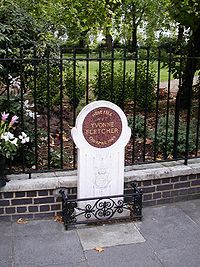 Two weeks after Fletcher's death, a dedicated charity called the Police Memorial Trust
was created to honour British police officers killed in the line of duty. It was the idea of UK film director Michael Winner
who wrote a letter to the editor
of The Times
newspaper suggesting a memorial be erected in Fletcher's honour. After receiving a flood of donations from members of the public, the trust was established on 3 May 1984.
WPC Yvonne Fletcher would become the first police officer to be honoured by the new charity. On 1 February 1985, her memorial was unveiled in St. James's Square by Prime Minister Margaret Thatcher
in a ceremony attended by the leaders of all the main British political parties. Hundreds of members of the public also attended the ceremony to show their support for this recognition of police bravery. In April 2004, Baroness Thatcher joined members of WPC Fletcher's family for a service to commemorate the 20-year anniversary of Yvonne's murder. Floral wreaths were laid at her memorial and a police helicopter flew over in a mark of respect. A minute's silence was also observed by those attending.
The memorial, which lies in a slightly modified location, stands in the north-east corner of the square. Westminster City Council
augmented part of St. James's Square to accommodate the granite
and Portland stone
commemorative pillar with a rounded-pavement area of pavement which extends into the roadway to create an architectural feature.
The Police Memorial Trust later commissioned the National Police Memorial
, which was unveiled in central London by Queen Elizabeth II on 26 April 2005.
senior ballistics
officer Lieutenant Colonel George Styles and Home Office
pathologist
Hugh Thomas. On 24 June 1997, Tam Dalyell
MP
questioned Prime Minister
Tony Blair
about the death of Yvonne Fletcher. Dalyell made particular reference to a Channel 4 documentary about the murder:
A major issue is the discrepancy in the bullet trajectory noted by the pathologist who examined the body of Yvonne Fletcher. Dr. Ian West wrote in his initial post mortem report she was shot from the upper floors of an adjacent building because "the angle of wound was between 60 and 70 degrees". However at the official inquest Dr. West stated her wounds were "entirely consistent with a shot fired from the first floor window of the Embassy, an angle of 15 degrees."
Police officer
A police officer is a warranted employee of a police force...
fatally shot during a protest
Demonstration (people)
A demonstration or street protest is action by a mass group or collection of groups of people in favor of a political or other cause; it normally consists of walking in a mass march formation and either beginning with or meeting at a designated endpoint, or rally, to hear speakers.Actions such as...
outside the Libya
Libya
Libya is an African country in the Maghreb region of North Africa bordered by the Mediterranean Sea to the north, Egypt to the east, Sudan to the southeast, Chad and Niger to the south, and Algeria and Tunisia to the west....
n embassy
Diplomatic mission
A diplomatic mission is a group of people from one state or an international inter-governmental organisation present in another state to represent the sending state/organisation in the receiving state...
at St. James's Square
St. James's Square
St. James's Square is the only square in the exclusive St James's district of the City of Westminster. It has predominantly Georgian and neo-Georgian architecture and a private garden in the centre...
, London, in 1984. Fletcher, who had been on duty and deployed to police the protest, died shortly afterwards at Westminster Hospital
Westminster Hospital
Westminster Hospital was a hospital in London, England, founded in 1719. In 1834 a medical school attached to the hospital was formally founded....
. Her death resulted in the Metropolitan Police Service
Metropolitan Police Service
The Metropolitan Police Service is the territorial police force responsible for Greater London, excluding the "square mile" of the City of London which is the responsibility of the City of London Police...
laying siege to the embassy for the next eleven days, and the United Kingdom severing all diplomatic relations with Libya. Two years later it became a major factor in Prime Minister Margaret Thatcher
Margaret Thatcher
Margaret Hilda Thatcher, Baroness Thatcher, was Prime Minister of the United Kingdom from 1979 to 1990...
's decision to allow U.S. President
President of the United States
The President of the United States of America is the head of state and head of government of the United States. The president leads the executive branch of the federal government and is the commander-in-chief of the United States Armed Forces....
Ronald Reagan
Ronald Reagan
Ronald Wilson Reagan was the 40th President of the United States , the 33rd Governor of California and, prior to that, a radio, film and television actor....
to launch the U.S. bombing of Libya in 1986 from American bases in the United Kingdom.
No one has ever been convicted for the murder of Yvonne Fletcher. However in 1999, the government of Muammar Gaddafi
Muammar Gaddafi
Muammar Muhammad Abu Minyar Gaddafi or "September 1942" 20 October 2011), commonly known as Muammar Gaddafi or Colonel Gaddafi, was the official ruler of the Libyan Arab Republic from 1969 to 1977 and then the "Brother Leader" of the Libyan Arab Jamahiriya from 1977 to 2011.He seized power in a...
accepted responsibility for her death and agreed to pay compensation to her family.
In just an 18-month period, Fletcher's death became the third murder/manslaughter of an on-duty policewoman in mainland Britain
Great Britain
Great Britain or Britain is an island situated to the northwest of Continental Europe. It is the ninth largest island in the world, and the largest European island, as well as the largest of the British Isles...
.
Protest
Fletcher, who had joined the Metropolitan Police ServiceMetropolitan Police Service
The Metropolitan Police Service is the territorial police force responsible for Greater London, excluding the "square mile" of the City of London which is the responsibility of the City of London Police...
in 1977, was part of a detachment of 30 officers sent to St. James's Square to monitor a demonstration
Demonstration (people)
A demonstration or street protest is action by a mass group or collection of groups of people in favor of a political or other cause; it normally consists of walking in a mass march formation and either beginning with or meeting at a designated endpoint, or rally, to hear speakers.Actions such as...
by Libyan dissident
Dissident
A dissident, broadly defined, is a person who actively challenges an established doctrine, policy, or institution. When dissidents unite for a common cause they often effect a dissident movement....
s opposed to the rule of Colonel Muammar Gaddafi
Muammar Gaddafi
Muammar Muhammad Abu Minyar Gaddafi or "September 1942" 20 October 2011), commonly known as Muammar Gaddafi or Colonel Gaddafi, was the official ruler of the Libyan Arab Republic from 1969 to 1977 and then the "Brother Leader" of the Libyan Arab Jamahiriya from 1977 to 2011.He seized power in a...
. Among the detachment with Fletcher was her fiancé.
The demonstration had been organised by the Libyan National Salvation Front
National Front for the Salvation of Libya
The National Front for the Salvation of Libya is an opposition movement to Muammar al-Gaddafi's regime in Libya. NFSL was established on 7 October 1981 at a press conference held in Khartoum, Sudan...
(LNSF) following the execution of two students who had criticised Gaddafi. Since February 1984, the Libyan embassy, which was also known as the Libyan People's Bureau, had been staffed by "revolutionary committees" made up of students loyal to Gaddafi who had assumed control of the embassy with the tacit approval of the Libyan government. They were not professional diplomat
Diplomat
A diplomat is a person appointed by a state to conduct diplomacy with another state or international organization. The main functions of diplomats revolve around the representation and protection of the interests and nationals of the sending state, as well as the promotion of information and...
s. Gaddafi loyalists at the embassy warned police that they intended to mount a counter-demonstration.
On the day, about 75 protesters arrived by coach from northern England. The demonstration began peacefully as police successfully kept the two sides apart with crowd control barrier
Crowd control barrier
Crowd control barriers , are commonly used at many public events. They are frequently visible at sporting events, parades, political rallies, demonstrations, and outdoor festivals...
s. Both groups shouted at each other and waved banners and placards. Loud music was played from the embassy in an apparent attempt to drown out the noise of the protesters.
Shooting
Without warning, automatic gunfire was discharged into the anti-Gaddafi protesters at 10:18 am. Eleven people were hit, including the unarmed Fletcher who was fatally wounded in the stomach. As she lay on the ground, her fiancé was at her side. Fletcher was taken to Westminster Hospital where she died from her injuries approximately one hour later. Libyan radio reported that the embassy was stormed and that those in the building fired back in self-defence against "a most horrible terrorist action".Fletcher's hat and four other officers' helmets
Custodian helmet
Custodian helmet or centurion helmet, technically known as a 'Home Office pattern helmet', is a helmet worn by many policemen in England and Wales.-History:...
were left lying in the square during the ensuing siege of the embassy. In the days that followed, the images of them were shown repeatedly in the British media.
The official inquest into Fletcher's death concluded she had been killed by shots from a Sterling submachine gun
Sterling submachine gun
The Sterling submachine gun is a British submachine gun which was in service with the British Army from 1944 until 1994, when it was phased out with the introduction of the L85A1 assault rifle.-History:...
fired from the first floor of the Libyan embassy.
Siege
Following the shooting, the embassy was surrounded by armed police for eleven days, in one of the longest police sieges in London's history. Meanwhile, Gaddafi claimed that the embassy was under attack from British forces, and Libyan soldiers surrounded the United Kingdom's embassy in TripoliTripoli
Tripoli is the capital and largest city in Libya. It is also known as Western Tripoli , to distinguish it from Tripoli, Lebanon. It is affectionately called The Mermaid of the Mediterranean , describing its turquoise waters and its whitewashed buildings. Tripoli is a Greek name that means "Three...
in response.
The British government eventually resolved the incident by allowing the embassy staff to leave the embassy and then expelling
Persona non grata
Persona non grata , literally meaning "an unwelcome person", is a legal term used in diplomacy that indicates a proscription against a person entering the country...
them from the country. The United Kingdom then ended all diplomatic relations with Libya. However six British nationals
Libyan Hostage Situation 1984
The Libyan Hostage Situation began on the night of the murder of WPC Fletcher, April 17, 1984 and lasted until February 5, 1985 . In accordance with the hostage release agreement that no negative media be released about the Libyan government under the Gaddafi regime, all information has been...
were held as political hostages in Libya by a Revolutionary Committee following the shooting. They were released after nine months of detention on 5 February 1985, four days after the unveiling of Fletcher's memorial in Berkeley Square.
Gaddafi regime
The British government took no further official action following the cessation of ambassadorial affairs with Libya. Some unconfirmed reports even suggested that Fletcher's murderer had been hanged shortly after returning to Libya in 1984. But at a meeting with the British ambassador to EgyptEgypt
Egypt , officially the Arab Republic of Egypt, Arabic: , is a country mainly in North Africa, with the Sinai Peninsula forming a land bridge in Southwest Asia. Egypt is thus a transcontinental country, and a major power in Africa, the Mediterranean Basin, the Middle East and the Muslim world...
in 1992, Libyan colonel Abdul Fatah Younis
Abdul Fatah Younis
Abdul Fatah Younis , sometimes transliterated Fattah Younis or Fattah Younes or Fatah Younes, was a senior military officer in Libya. He held the rank of Major General and the post of Minister of Interior, but resigned on 22 February 2011 to defect to the rebel side in what was to become the 2011...
apologised on behalf of the Libyan government and offered to extradite her killers. However the Foreign Office did not accede to the offer.
In July 1999, the Libyan government publicly accepted "general responsibility" for the murder and agreed to pay compensation to Fletcher's family. This, together with Libya's eventual efforts in the aftermath of the Lockerbie bombing
Pan Am Flight 103
Pan Am Flight 103 was Pan American World Airways' third daily scheduled transatlantic flight from London Heathrow Airport to New York's John F. Kennedy International Airport...
, paved the way for the normalisation of Anglo-Libyan relations. Once diplomatic relations were restored in 1999, Metropolitan Police detectives visited Libya on a number of occasions to pursue their investigations into her murder.
But on 24 February 2004, the Today programme on BBC Radio 4
BBC Radio 4
BBC Radio 4 is a British domestic radio station, operated and owned by the BBC, that broadcasts a wide variety of spoken-word programmes, including news, drama, comedy, science and history. It replaced the BBC Home Service in 1967. The station controller is currently Gwyneth Williams, and the...
reported that the new Libyan prime minister, Shukri Ghanem
Shukri Ghanem
Shukri Mohammed Ghanem is a Libyan politician who was General Secretary of the General People's Committee of Libya from June 2003 until March 2006 when, in the first major government re-shuffle in over a decade, he was replaced by his deputy, Baghdadi Mahmudi...
, had claimed his country was not responsible for Fletcher's murder (nor for the Lockerbie bombing). Ghanem said that Libya had made the admission and paid compensation in order to bring "peace" and an end to international sanctions
International sanctions
International sanctions are actions taken by countries against others for political reasons, either unilaterally or multilaterally.There are several types of sanctions....
. Gaddafi was said to have later retracted Ghanem's claims.
Finally in June 2007, British detectives were able to interview the chief Libyan suspect for the first time following the normalisation of political ties with the country. Detectives spent seven weeks in Libya interviewing both witnesses and suspects. Queenie Fletcher, Yvonne's mother, described these developments as "promising".
In February 2009, Queenie Fletcher suggested that Abdelbaset al-Megrahi, who at the time was appealing against his conviction for the Lockerbie bombing, should be moved to a prison in Libya, on condition that the Libyan government co-operate with detectives investigating her daughter's murder. Mrs Fletcher said: "I know he is ill and I think he should be returned to a prison in Libya so his family can visit him. The appeal could still go ahead in Scotland, but he could stay in prison in Libya. It's got to be a fair exchange, so Yvonne's case can be closed. I'd like the police here to be given permission to interview whoever they've got to interview in Libya and see whoever they need to for someone to be brought to trial."
In October 2009 The Daily Telegraph revealed that the Crown Prosecution Service
Crown Prosecution Service
The Crown Prosecution Service, or CPS, is a non-ministerial department of the Government of the United Kingdom responsible for public prosecutions of people charged with criminal offences in England and Wales. Its role is similar to that of the longer-established Crown Office in Scotland, and the...
had been told by an independent prosecutor that there was sufficient evidence to prosecute two Libyans. A report from April 2007 concluded that the two men, who are now senior members of the Libyan regime, played an "instrumental role" in the shooting.
Post-Gaddafi era
During the Libyan uprising in March 2011, British journalists spoke to a man named Omar al-Sodani being held by rebel forces in BenghaziBenghazi
Benghazi is the second largest city in Libya, the main city of the Cyrenaica region , and the former provisional capital of the National Transitional Council. The wider metropolitan area is also a district of Libya...
. The 59-year-old member of Libya's Revolutionary Committee said he was in the Libyan Embassy in 1984 but "was not at the scene" when the shooting happened. Following the collapse of the Gaddafi regime in August 2011, new evidence emerged that a diplomat working at the Libyan embassy in London was seen firing an automatic weapon from a window in April 1984. A witness identified a man called Abdulmagid Salah Ameri after a review of evidence by an independent Canadian prosecutor at the request of the Metropolitan Police. On 30th August it was reported that a "co-conspirator", Abdulqadir al-Baghdadi
Abdulqadir al-Baghdadi
Abdulqadir al-Baghdadi was Secretary General of the People's Committee for Education of Libya. He was an official in the Libyan Embassy in London in 1984, at the time WPC Yvonne Fletcher was shot outside the embassy....
, had been killed in in-fighting amongst Gaddafi loyalists.
Legacy
Police Memorial Trust
The Police Memorial Trust is a charitable organisation founded in 1984 and based in London. The trust's objective is to erect memorials to British police officers killed in the line of duty, at or near the spot where they died, thereby acting as a permanent reminder to the public of the sacrifice...
was created to honour British police officers killed in the line of duty. It was the idea of UK film director Michael Winner
Michael Winner
Michael Robert Winner is a British film director and producer, active in both Europe and the United States, also known as a food critic for the Sunday Times.-Early life and early career :...
who wrote a letter to the editor
Letter to the editor
A letter to the editor is a letter sent to a publication about issues of concern from its readers. Usually, letters are intended for publication...
of The Times
The Times
The Times is a British daily national newspaper, first published in London in 1785 under the title The Daily Universal Register . The Times and its sister paper The Sunday Times are published by Times Newspapers Limited, a subsidiary since 1981 of News International...
newspaper suggesting a memorial be erected in Fletcher's honour. After receiving a flood of donations from members of the public, the trust was established on 3 May 1984.
WPC Yvonne Fletcher would become the first police officer to be honoured by the new charity. On 1 February 1985, her memorial was unveiled in St. James's Square by Prime Minister Margaret Thatcher
Margaret Thatcher
Margaret Hilda Thatcher, Baroness Thatcher, was Prime Minister of the United Kingdom from 1979 to 1990...
in a ceremony attended by the leaders of all the main British political parties. Hundreds of members of the public also attended the ceremony to show their support for this recognition of police bravery. In April 2004, Baroness Thatcher joined members of WPC Fletcher's family for a service to commemorate the 20-year anniversary of Yvonne's murder. Floral wreaths were laid at her memorial and a police helicopter flew over in a mark of respect. A minute's silence was also observed by those attending.
The memorial, which lies in a slightly modified location, stands in the north-east corner of the square. Westminster City Council
Westminster City Council
Westminster City Council is the local authority for the City of Westminster in Greater London, England. It is a London borough council and is entitled to be known as a city council, which is a rare distinction in the United Kingdom. The city is divided into 20 wards, each electing three councillors...
augmented part of St. James's Square to accommodate the granite
Granite
Granite is a common and widely occurring type of intrusive, felsic, igneous rock. Granite usually has a medium- to coarse-grained texture. Occasionally some individual crystals are larger than the groundmass, in which case the texture is known as porphyritic. A granitic rock with a porphyritic...
and Portland stone
Portland stone
Portland stone is a limestone from the Tithonian stage of the Jurassic period quarried on the Isle of Portland, Dorset. The quarries consist of beds of white-grey limestone separated by chert beds. It has been used extensively as a building stone throughout the British Isles, notably in major...
commemorative pillar with a rounded-pavement area of pavement which extends into the roadway to create an architectural feature.
The Police Memorial Trust later commissioned the National Police Memorial
National Police Memorial
The National Police Memorial is a memorial in central London, commemorating about 4000 police officers killed in the course of their duties in the United Kingdom. It was designed by Lord Foster of Thames Bank and Per Arnoldi and unveiled in 2005...
, which was unveiled in central London by Queen Elizabeth II on 26 April 2005.
Ballistics controversy
The official inquest concluded that WPC Fletcher was killed by someone firing a 9mm calibre automatic weapon from a lower floor in the Libyan embassy. But this verdict has been disputed by a number of experts, including the British Army'sBritish Army
The British Army is the land warfare branch of Her Majesty's Armed Forces in the United Kingdom. It came into being with the unification of the Kingdom of England and Scotland into the Kingdom of Great Britain in 1707. The new British Army incorporated Regiments that had already existed in England...
senior ballistics
Ballistics
Ballistics is the science of mechanics that deals with the flight, behavior, and effects of projectiles, especially bullets, gravity bombs, rockets, or the like; the science or art of designing and accelerating projectiles so as to achieve a desired performance.A ballistic body is a body which is...
officer Lieutenant Colonel George Styles and Home Office
Home Office
The Home Office is the United Kingdom government department responsible for immigration control, security, and order. As such it is responsible for the police, UK Border Agency, and the Security Service . It is also in charge of government policy on security-related issues such as drugs,...
pathologist
Pathology
Pathology is the precise study and diagnosis of disease. The word pathology is from Ancient Greek , pathos, "feeling, suffering"; and , -logia, "the study of". Pathologization, to pathologize, refers to the process of defining a condition or behavior as pathological, e.g. pathological gambling....
Hugh Thomas. On 24 June 1997, Tam Dalyell
Tam Dalyell
Sir Thomas Dalyell Loch, 11th Baronet , known as Tam Dalyell, is a British Labour Party politician, who was a Member of Parliament in the House of Commons from 1962 to 2005, first for West Lothian and then for Linlithgow.-Early life:...
MP
Member of Parliament
A Member of Parliament is a representative of the voters to a :parliament. In many countries with bicameral parliaments, the term applies specifically to members of the lower house, as upper houses often have a different title, such as senate, and thus also have different titles for its members,...
questioned Prime Minister
Prime Minister of the United Kingdom
The Prime Minister of the United Kingdom of Great Britain and Northern Ireland is the Head of Her Majesty's Government in the United Kingdom. The Prime Minister and Cabinet are collectively accountable for their policies and actions to the Sovereign, to Parliament, to their political party and...
Tony Blair
Tony Blair
Anthony Charles Lynton Blair is a former British Labour Party politician who served as the Prime Minister of the United Kingdom from 2 May 1997 to 27 June 2007. He was the Member of Parliament for Sedgefield from 1983 to 2007 and Leader of the Labour Party from 1994 to 2007...
about the death of Yvonne Fletcher. Dalyell made particular reference to a Channel 4 documentary about the murder:
A major issue is the discrepancy in the bullet trajectory noted by the pathologist who examined the body of Yvonne Fletcher. Dr. Ian West wrote in his initial post mortem report she was shot from the upper floors of an adjacent building because "the angle of wound was between 60 and 70 degrees". However at the official inquest Dr. West stated her wounds were "entirely consistent with a shot fired from the first floor window of the Embassy, an angle of 15 degrees."
External links
- BBC News (25 March 2004), "Timeline: WPC Yvonne Fletcher"
- National Police Memorial image of the Fletcher memorial
- The Guardian (23 July 1997), speech by Tam Dalyell on Lockerbie and Fletcher's murder
