

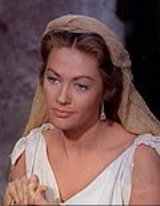
Yvonne De Carlo

Encyclopedia
Yvonne De Carlo was a Canadian-born American actress of film
and television
. During her six-decade career, her most frequent appearances in film came in the 1940s and 1950s and included her best-known film roles, such as of Anna Marie in Salome Where She Danced
(1945); Anna in Criss Cross (1949); Sephora
the wife of Moses in The Ten Commandments
(1956), starring Charlton Heston
; and Amantha Starr in Band of Angels
(1957) with Clark Gable
. In the early 1960s, De Carlo accepted the offer to play Lily Munster
for the CBS
television series The Munsters
, alongside Fred Gwynne
and Al Lewis.
, British Columbia
, and nicknamed 'Peggy'. "I was named Margaret Yvonne – Margaret because my mother was very fond of one of the derivatives of the name. She was fascinated at the time by the movie star Baby Peggy
, and I suppose she wanted a Baby Peggy of her own." Her maternal grandfather, Michael de Carlo, was Sicilian
-born, and her maternal grandmother, Margaret Purvis, was Scottish
-born. Margaret's mother ran away from home when she was 16 to become a ballerina; after a couple of years of working as a shop girl, she was married in 1924. Little Peggy was three years old when her father abandoned the family. She lived with her grandparents. By the time she entered grade school, she found that her strong singing voice brought her the attention she longed for. Although her mother recognized Peggy's singing talent, she had already decided that her daughter would be a dancer. As a teenager Peggy was taken by her mother to Hollywood where she enrolled her in dancing school; she also attended Le Conte Middle School
in Hollywood. Margaret lived in a downtown apartment with her mother, while Marie took on odd jobs such as waitressing. Mother and daughter were uprooted when their visa
s expired. Unable to find work, they returned to Vancouver.
She attended and dropped out of Vancouver's now-defunct King Edward High School, to focus more on her dance studies. She then attended the B.C. School of Dancing. It was there that Canadian
dance instructor, June Roper, started her in a new direction, for which she was grateful and relieved. The following year at the Orpheum Theatre, Peggy appeared as a hula dancer in the famous revue Waikiki. A new nightclub, the Palomar, opened in Vancouver, and she acquired a week-long booking. Hoping to present a more sophisticated image, she combined her middle name with her mother's maiden name and became "Yvonne De Carlo."
The pair made several such trips until 1940, when De Carlo was first runner-up to "Miss Venice Beach
" and was hired by showman Nils Granlund
as a dancer at the Florentine Gardens. She had been dancing for Granlund only a short time when she was arrested by immigration officials and deported to Canada, but in January 1941, Granlund sent a telegram to Canadian immigration officials pledging his sponsorship of De Carlo in the United States, and affirmed his offer of steady employment, both requirements to reenter the country.
Before she worked at Florentine, she also got her first job at 16, working at Vancouver's Palomar, where it expanded from a ballroom to a nightclub in 1938. Her time at the nightclub ended when she allegedly was pressured to expose her breasts.
Seeking contract work in the movies, she abruptly quit the Florentine Gardens after less than a year, landing a role as a bathing beauty in the 1941 B-movie Harvard, Here I Come. Other roles were slow to follow, and De Carlo took a job in the chorus line of Earl Carroll
, another Hollywood showman. Her sixth film appearance was at the request of Nils Granlund
, and the film Rhythm Parade was set at the Florentine Gardens nightclub in Hollywood.
In December 1941, the Japanese attack on Pearl Harbor
signaled America's entrance into World War II
. During this period she engaged in morale boosting performances for U.S. servicemen. De Carlo was a favorite leading lady in the 1940s, and a recipient of many letters from GI's.
starlet, but the studio apparently signed her mainly for her slight resemblance to Dorothy Lamour
, as it was common then for studios to sign lookalikes in order to remind the stars in question that they easily could be replaced should their behavior become difficult or their box-office appeal begin to wane. When she moved to Universal Studios
, she was used as a B-movie version of Maria Montez
, one of the studio's reigning divas.
Her break came in 1945 playing the title role in Salome, Where She Danced. Though not a critical success, it was a box office favorite, and De Carlo was hailed as an up-and-coming star. Of the role, she was less sure, saying of her entrance, "I came through these beaded curtains, wearing a Japanese kimono and a Japanese headpiece, and then performed a Siamese dance. Nobody seemed to know quite why."
In 1947 she played her first leading role in Slave Girl and then in 1949 had her biggest success. As the female lead opposite Burt Lancaster
in Criss Cross, she played a femme fatale
, and her career began to ascend. She starred in the 1953 film The Captain's Paradise
, as one of two wives a ship captain (Alec Guinness
) keeps in separate ports.
's biblical-epic The Ten Commandments
(1956
), actress Audrey Hepburn
was suggested for the role of "Nefretiri" and actress Anne Baxter
was chosen for the part of "Sephora". After Hepburn was turned down for the role of the Egyptian throne princess for being too "flat chested", the part of "Nefretiri" was handed down to Baxter.
When DeMille saw De Carlo in Sombrero (1953), he offered her the vacant role of "Sephora
". De Carlo accepted, and declined another role she was offered in a German film at the time. De Carlo quotes "working with Mr. DeMille was a learning experience that I will never forget".
With a pay of 25,000; De Carlo's performance in the film made her into a first-class actress who could play any kind of role in big-budget films. Besides filming at Paramount Studios, De Carlo accompanied DeMille and the rest of the crew to Egypt
, where several exterior shots were filmed. De Carlo met stuntman Robert Morgan in Egypt, and married him on November 21, 1955 in Reno, Nevada
.
film Band of Angels
featured her opposite Clark Gable
in an American Civil War
story, along with Sidney Poitier
and Efrem Zimbalist, Jr.
The actress worked steadily for the next several years, although many of the films failed to advance her career.
, Schlitz Playhouse of Stars
, Bonanza
, Screen Directors Playhouse, Playhouse 90
, Burke's Law
, Follow the Sun
(2 episodes), Adventures in Paradise
, The Greatest Show on Earth
, The Girl from U.N.C.L.E.
, Custer, The Name of the Game
and The Virginian
(2 episodes), among others.
. She signed a contract with Universal Studios
after receiving an offer to perform the female lead role in The Munsters
opposite Fred Gwynne
as Herman Munster
. She was also the producers' choice to play Lily Munster
when Joan Marshall, who played Phoebe, was dropped from consideration for the role. When De Carlo was asked how a glamorous actress could succeed as a ghoulish matriarch of a haunted house, she replied simply, "I follow the directions I received on the first day of shooting: 'Play her just like Donna Reed
.'
The short-lived cult sitcom also starred familiar actor Al Lewis as Lily's father, Grandpa Munster, and new actors Beverley Owen
/Pat Priest as Marilyn Munster
and Butch Patrick
as Eddie Munster
.
During its second season, ratings began to drop, due in part to the debut of Batman
, which dominated the ratings, early in 1966. Later that year, De Carlo accepted an offer to reprise her role in a color Munster movie, Munster, Go Home!
(1966), partially in hopes of renewing interest in the TV series. Despite the attempt, The Munsters was cancelled after 72 episodes.
at 6124 Hollywood Blvd. and a second star at 6715 Hollywood Blvd. for her contribution to television.
voice. In 1951 she was cast in the role of Prince Orlovsky in a production of the opera Die Fledermaus
at the Hollywood Bowl. De Carlo released an LP of standards called Yvonne De Carlo Sings in 1957. This album was orchestrated by the movie composer John Williams. She sang and played the harp
on at least one episode of The Munsters.
From 1967 onward she became increasingly active in musicals, appearing in off-broadway productions of Pal Joey and Catch Me If You Can (not to be confused with the 2002 movie, or the 2009/2011 musical). In early 1968 she joined Donald O'Connor
in a 15 week run of Little Me
staged between Lake Tahoe and Las Vegas, performing 2 shows per night. But her defining stage role came with her big break on Broadway
in Stephen Sondheim
's Follies
, which ran from February 1971 until July 1, 1972. As "Carlotta Campion" she introduced the song "I'm Still Here", which would become an anthem of sorts. The show opened later in Los Angeles with the original Broadway cast on July 22, 1972, and closed 11 weeks later. She was the last lead female performer from the original production to die (having been predeceased by Alexis Smith
, Dorothy Collins
, Ethel Shutta
, Mary McCarty
, and Fifi D'Orsay
).
DeCarlo received recognition for her work in various B-horror films and thrillers, such as The Power
, The Seven Minutes
, House of Shadows, Sorority House Murders, Cellar Dweller
, The Man with Bogart's Face
, Mirror, Mirror
, Blazing Stewardesses
, and American Gothic
.
She also made a cameo appearance
on The Late Show
which was hosted by comedian Ross Shafer
in 1988, to talk about her own autobiography, she had written Yvonne: An Autobiography in 1987.
comedy Oscar
, directed by John Landis
. De Carlo also appeared on the talk show, Vicki
, hosted by her lifelong fan, Vicki Lawrence
, on a special episode Sitcom Legends, along with Dawn Wells
, Jamie Farr
, Dick Sargent
, Donna Douglas
and former co-star Butch Patrick
in 1994.
She had a small cameo role on the Munsters TV movie remake Here Come the Munsters
in 1995. Her last TV movie appearance was as Norma, in the 1995 Disney remake of The Barefoot Executive
, opposite Eddie Albert
.
Her last TV interview appearance was on January 20, 2002, in a segment of Larry King Live
which also featured Richard Hack
, author of Hughes: The Private Diaries, Memos and Letters.
, who was her boyfriend at the time. She and Jock were going to start a family, and in 1949, they were engaged. In her first trimester, she suffered a miscarriage, and De Carlo called off the engagement.
She married the stuntman
Robert Morgan, whom she met on the set of Shotgun, on November 21, 1955. They had two sons, Bruce and Michael. Morgan also had a daughter, Bari, from a previous marriage. Morgan's left leg had to be amputated after he was run over by a train while doing stunt work on How the West Was Won
(1962). However, his contract with MGM assumed no responsibility for the accident. De Carlo and Morgan filed a $1.4 million lawsuit against the studio, claiming her husband was permanently disabled. They divorced in June 1974.
In her autobiography, published in 1987
, she listed 22 intimate friends, including Prince Aly Khan
, Billy Wilder
, Burt Lancaster
, Howard Hughes
, Robert Stack
and Robert Taylor
.
Her mother died in 1993 from a fall. Her son Michael died in 1997; causes were unknown, although a Santa Barbara Police report contains concerns about possible foul play. De Carlo had a stroke
the following year, but soon recovered.
De Carlo was a naturalized citizen
of the United States.
, where she spent her last years. Her son Bruce was her key caregiver during her last days. There, on January 8, 2007, she died of natural causes. A memorial service was held a few days later at The Woodland Hills MGM Theater; among those attending the service was television and film producer Kevin Burns. She is survived by her son, Bruce, who is filming ProjectLodestar, a film featuring a cameo appearance by De Carlo. After she died she was cremated, and the ashes were given to either her family or her friend.
Film
A film, also called a movie or motion picture, is a series of still or moving images. It is produced by recording photographic images with cameras, or by creating images using animation techniques or visual effects...
and television
Television
Television is a telecommunication medium for transmitting and receiving moving images that can be monochrome or colored, with accompanying sound...
. During her six-decade career, her most frequent appearances in film came in the 1940s and 1950s and included her best-known film roles, such as of Anna Marie in Salome Where She Danced
Salome Where She Danced
- Cast :*Yvonne De Carlo as Anna Marie*Rod Cameron as Jim Steed*David Bruce as Cleve Blunt*Walter Slezak as Col. Ivan Dimitrioff*Albert Dekker as Count Erik Von Bohlen*Marjorie Rambeau as Madam Europe*J. Edward Bromberg as Prof. Max*Abner Biberman as Dr. Ling...
(1945); Anna in Criss Cross (1949); Sephora
Zipporah
Zipporah or Tzipora is mentioned in the Book of Exodus as the wife of Moses, and the daughter of Reuel/Jethro, the priest or prince of Midian...
the wife of Moses in The Ten Commandments
The Ten Commandments (1956 film)
The Ten Commandments is a 1956 American epic film that dramatized the biblical story of the Exodus, in which the Hebrew-born Moses, an adopted Egyptian prince, becomes the deliverer of the Hebrew slaves. The film, released by Paramount Pictures in VistaVision on October 5, 1956, was directed by...
(1956), starring Charlton Heston
Charlton Heston
Charlton Heston was an American actor of film, theatre and television. Heston is known for heroic roles in films such as The Ten Commandments, Ben-Hur for which he won the Academy Award for Best Actor, El Cid, and Planet of the Apes...
; and Amantha Starr in Band of Angels
Band of Angels
Band of Angels is a 1957 romantic drama film set in the American South before and during the American Civil War, based on the novel of the same name by Robert Penn Warren. It starred Clark Gable, Yvonne De Carlo, and Sidney Poitier. The movie was directed by Raoul Walsh.-Plot:Amantha Starr is the...
(1957) with Clark Gable
Clark Gable
William Clark Gable , known as Clark Gable, was an American film actor most famous for his role as Rhett Butler in the 1939 Civil War epic film Gone with the Wind, in which he starred with Vivien Leigh...
. In the early 1960s, De Carlo accepted the offer to play Lily Munster
Lily Munster
Lily Munster, Countess of Shroudshire , is a fictional character in the CBS sitcom The Munsters, originally played by Yvonne De Carlo. The matriarch of the Munster household, Lily is an undead vampire. Her character resembles Vampira...
for the CBS
CBS
CBS Broadcasting Inc. is a major US commercial broadcasting television network, which started as a radio network. The name is derived from the initials of the network's former name, Columbia Broadcasting System. The network is sometimes referred to as the "Eye Network" in reference to the shape of...
television series The Munsters
The Munsters
The Munsters is a 1960s American family television sitcom depicting the home life of a family of monsters. It starred Fred Gwynne as Herman Munster and Yvonne De Carlo as his wife, Lily Munster. The series was a satire of both traditional monster movies and popular family entertainment of the era,...
, alongside Fred Gwynne
Fred Gwynne
Frederick Hubbard "Fred" Gwynne was an American actor. Gwynne was best known for his roles in the 1960s sitcoms Car 54, Where Are You? and The Munsters, as well as his later roles: Pet Sematary and My Cousin Vinny...
and Al Lewis.
Early life
The daughter of an aspiring actress, Marie De Carlo, and a salesman, William Middleton, De Carlo was born Margaret Yvonne Middleton in VancouverVancouver
Vancouver is a coastal seaport city on the mainland of British Columbia, Canada. It is the hub of Greater Vancouver, which, with over 2.3 million residents, is the third most populous metropolitan area in the country,...
, British Columbia
British Columbia
British Columbia is the westernmost of Canada's provinces and is known for its natural beauty, as reflected in its Latin motto, Splendor sine occasu . Its name was chosen by Queen Victoria in 1858...
, and nicknamed 'Peggy'. "I was named Margaret Yvonne – Margaret because my mother was very fond of one of the derivatives of the name. She was fascinated at the time by the movie star Baby Peggy
Diana Serra Cary
Diana Serra Cary , best known as Baby Peggy, was one of the three major American child stars of the Hollywood silent movie era along with Jackie Coogan and Baby Marie....
, and I suppose she wanted a Baby Peggy of her own." Her maternal grandfather, Michael de Carlo, was Sicilian
Sicily
Sicily is a region of Italy, and is the largest island in the Mediterranean Sea. Along with the surrounding minor islands, it constitutes an autonomous region of Italy, the Regione Autonoma Siciliana Sicily has a rich and unique culture, especially with regard to the arts, music, literature,...
-born, and her maternal grandmother, Margaret Purvis, was Scottish
Scotland
Scotland is a country that is part of the United Kingdom. Occupying the northern third of the island of Great Britain, it shares a border with England to the south and is bounded by the North Sea to the east, the Atlantic Ocean to the north and west, and the North Channel and Irish Sea to the...
-born. Margaret's mother ran away from home when she was 16 to become a ballerina; after a couple of years of working as a shop girl, she was married in 1924. Little Peggy was three years old when her father abandoned the family. She lived with her grandparents. By the time she entered grade school, she found that her strong singing voice brought her the attention she longed for. Although her mother recognized Peggy's singing talent, she had already decided that her daughter would be a dancer. As a teenager Peggy was taken by her mother to Hollywood where she enrolled her in dancing school; she also attended Le Conte Middle School
Le Conte Middle School
Joseph Le Conte Middle School is located at 1316 North Bronson Avenue in Hollywood, in Los Angeles, California with a ZIP code of 90028 next to Tribune Studios. The middle school was named after the geologist, Joseph Le Conte....
in Hollywood. Margaret lived in a downtown apartment with her mother, while Marie took on odd jobs such as waitressing. Mother and daughter were uprooted when their visa
Visa (document)
A visa is a document showing that a person is authorized to enter the territory for which it was issued, subject to permission of an immigration official at the time of actual entry. The authorization may be a document, but more commonly it is a stamp endorsed in the applicant's passport...
s expired. Unable to find work, they returned to Vancouver.
She attended and dropped out of Vancouver's now-defunct King Edward High School, to focus more on her dance studies. She then attended the B.C. School of Dancing. It was there that Canadian
Canada
Canada is a North American country consisting of ten provinces and three territories. Located in the northern part of the continent, it extends from the Atlantic Ocean in the east to the Pacific Ocean in the west, and northward into the Arctic Ocean...
dance instructor, June Roper, started her in a new direction, for which she was grateful and relieved. The following year at the Orpheum Theatre, Peggy appeared as a hula dancer in the famous revue Waikiki. A new nightclub, the Palomar, opened in Vancouver, and she acquired a week-long booking. Hoping to present a more sophisticated image, she combined her middle name with her mother's maiden name and became "Yvonne De Carlo."
The pair made several such trips until 1940, when De Carlo was first runner-up to "Miss Venice Beach
Venice, Los Angeles, California
Venice is a beachfront district on the Westside of Los Angeles, California, United States. It is known for its canals, beaches and circus-like Ocean Front Walk, a two-and-a-half mile pedestrian-only promenade that features performers, fortune-tellers, artists, and vendors...
" and was hired by showman Nils Granlund
Nils Granlund
Nils T. Granlund was an American Broadway show producer, radio industry pioneer, a publicist for Marcus Loew who formed Loews Theatres and Metro-Goldwyn-Mayer...
as a dancer at the Florentine Gardens. She had been dancing for Granlund only a short time when she was arrested by immigration officials and deported to Canada, but in January 1941, Granlund sent a telegram to Canadian immigration officials pledging his sponsorship of De Carlo in the United States, and affirmed his offer of steady employment, both requirements to reenter the country.
Before she worked at Florentine, she also got her first job at 16, working at Vancouver's Palomar, where it expanded from a ballroom to a nightclub in 1938. Her time at the nightclub ended when she allegedly was pressured to expose her breasts.
Seeking contract work in the movies, she abruptly quit the Florentine Gardens after less than a year, landing a role as a bathing beauty in the 1941 B-movie Harvard, Here I Come. Other roles were slow to follow, and De Carlo took a job in the chorus line of Earl Carroll
Earl Carroll
Earl Carroll was an American theatrical producer, director, songwriter and composer born in Pittsburgh, Pennsylvania.-Career:...
, another Hollywood showman. Her sixth film appearance was at the request of Nils Granlund
Nils Granlund
Nils T. Granlund was an American Broadway show producer, radio industry pioneer, a publicist for Marcus Loew who formed Loews Theatres and Metro-Goldwyn-Mayer...
, and the film Rhythm Parade was set at the Florentine Gardens nightclub in Hollywood.
In December 1941, the Japanese attack on Pearl Harbor
Pearl Harbor
Pearl Harbor, known to Hawaiians as Puuloa, is a lagoon harbor on the island of Oahu, Hawaii, west of Honolulu. Much of the harbor and surrounding lands is a United States Navy deep-water naval base. It is also the headquarters of the U.S. Pacific Fleet...
signaled America's entrance into World War II
World War II
World War II, or the Second World War , was a global conflict lasting from 1939 to 1945, involving most of the world's nations—including all of the great powers—eventually forming two opposing military alliances: the Allies and the Axis...
. During this period she engaged in morale boosting performances for U.S. servicemen. De Carlo was a favorite leading lady in the 1940s, and a recipient of many letters from GI's.
Early successes
She was a ParamountParamount Pictures
Paramount Pictures Corporation is an American film production and distribution company, located at 5555 Melrose Avenue in Hollywood. Founded in 1912 and currently owned by media conglomerate Viacom, it is America's oldest existing film studio; it is also the last major film studio still...
starlet, but the studio apparently signed her mainly for her slight resemblance to Dorothy Lamour
Dorothy Lamour
Dorothy Lamour was an American film actress. She is best remembered for appearing in the Road to... movies, a series of successful comedies starring Bing Crosby and Bob Hope .-Early life:Lamour was born Mary Leta Dorothy Slaton in New Orleans, Louisiana, the daughter of Carmen Louise Dorothy...
, as it was common then for studios to sign lookalikes in order to remind the stars in question that they easily could be replaced should their behavior become difficult or their box-office appeal begin to wane. When she moved to Universal Studios
Universal Studios
Universal Pictures , a subsidiary of NBCUniversal, is one of the six major movie studios....
, she was used as a B-movie version of Maria Montez
María Montez
María Montez was a Dominican-born motion picture actress who gained fame and popularity in the 1940s as an exotic beauty starring in a series of filmed-in-Technicolor costume adventure films. Her screen image was that of a hot-blooded Latin seductress, dressed in fanciful costumes and sparkling...
, one of the studio's reigning divas.
Her break came in 1945 playing the title role in Salome, Where She Danced. Though not a critical success, it was a box office favorite, and De Carlo was hailed as an up-and-coming star. Of the role, she was less sure, saying of her entrance, "I came through these beaded curtains, wearing a Japanese kimono and a Japanese headpiece, and then performed a Siamese dance. Nobody seemed to know quite why."
In 1947 she played her first leading role in Slave Girl and then in 1949 had her biggest success. As the female lead opposite Burt Lancaster
Burt Lancaster
Burton Stephen "Burt" Lancaster was an American film actor noted for his athletic physique and distinctive smile...
in Criss Cross, she played a femme fatale
Femme fatale
A femme fatale is a mysterious and seductive woman whose charms ensnare her lovers in bonds of irresistible desire, often leading them into compromising, dangerous, and deadly situations. She is an archetype of literature and art...
, and her career began to ascend. She starred in the 1953 film The Captain's Paradise
The Captain's Paradise
The Captain's Paradise is a 1953 British comedy film starring Alec Guinness and directed by Anthony Kimmins. It is set in Gibraltar and northern Morocco, and on a ship that travels between them....
, as one of two wives a ship captain (Alec Guinness
Alec Guinness
Sir Alec Guinness, CH, CBE was an English actor. He was featured in several of the Ealing Comedies, including Kind Hearts and Coronets in which he played eight different characters. He later won the Academy Award for Best Actor for his role as Colonel Nicholson in The Bridge on the River Kwai...
) keeps in separate ports.
The Ten Commandments
In 1954, during the casting for Cecil B. DeMilleCecil B. DeMille
Cecil Blount DeMille was an American film director and Academy Award-winning film producer in both silent and sound films. He was renowned for the flamboyance and showmanship of his movies...
's biblical-epic The Ten Commandments
The Ten Commandments (1956 film)
The Ten Commandments is a 1956 American epic film that dramatized the biblical story of the Exodus, in which the Hebrew-born Moses, an adopted Egyptian prince, becomes the deliverer of the Hebrew slaves. The film, released by Paramount Pictures in VistaVision on October 5, 1956, was directed by...
(1956
1956 in film
The year 1956 in film involved some significant events.-Events:* October 5 - The Ten Commandments opens in cinemas and becomes one of the most successful and popular movies of all time, currently ranking 5th on the list of all time moneymakers * February 5 - First showing of documentary films by...
), actress Audrey Hepburn
Audrey Hepburn
Audrey Hepburn was a British actress and humanitarian. Although modest about her acting ability, Hepburn remains one of the world's most famous actresses of all time, remembered as a film and fashion icon of the twentieth century...
was suggested for the role of "Nefretiri" and actress Anne Baxter
Anne Baxter
Anne Baxter was an American actress known for her performances in films such as The Magnificent Ambersons , The Razor's Edge , All About Eve and The Ten Commandments .-Early life:...
was chosen for the part of "Sephora". After Hepburn was turned down for the role of the Egyptian throne princess for being too "flat chested", the part of "Nefretiri" was handed down to Baxter.
When DeMille saw De Carlo in Sombrero (1953), he offered her the vacant role of "Sephora
Zipporah
Zipporah or Tzipora is mentioned in the Book of Exodus as the wife of Moses, and the daughter of Reuel/Jethro, the priest or prince of Midian...
". De Carlo accepted, and declined another role she was offered in a German film at the time. De Carlo quotes "working with Mr. DeMille was a learning experience that I will never forget".
With a pay of 25,000; De Carlo's performance in the film made her into a first-class actress who could play any kind of role in big-budget films. Besides filming at Paramount Studios, De Carlo accompanied DeMille and the rest of the crew to Egypt
Egypt
Egypt , officially the Arab Republic of Egypt, Arabic: , is a country mainly in North Africa, with the Sinai Peninsula forming a land bridge in Southwest Asia. Egypt is thus a transcontinental country, and a major power in Africa, the Mediterranean Basin, the Middle East and the Muslim world...
, where several exterior shots were filmed. De Carlo met stuntman Robert Morgan in Egypt, and married him on November 21, 1955 in Reno, Nevada
Reno, Nevada
Reno is the county seat of Washoe County, Nevada, United States. The city has a population of about 220,500 and is the most populous Nevada city outside of the Las Vegas metropolitan area...
.
Band of Angels
The 19571957 in film
The year 1957 in film involved some significant events.-Events:* October 21 - The movie Jailhouse Rock, starring Elvis Presley, opens.-Top grossing films : After theatrical re-issue-Awards:...
film Band of Angels
Band of Angels
Band of Angels is a 1957 romantic drama film set in the American South before and during the American Civil War, based on the novel of the same name by Robert Penn Warren. It starred Clark Gable, Yvonne De Carlo, and Sidney Poitier. The movie was directed by Raoul Walsh.-Plot:Amantha Starr is the...
featured her opposite Clark Gable
Clark Gable
William Clark Gable , known as Clark Gable, was an American film actor most famous for his role as Rhett Butler in the 1939 Civil War epic film Gone with the Wind, in which he starred with Vivien Leigh...
in an American Civil War
American Civil War
The American Civil War was a civil war fought in the United States of America. In response to the election of Abraham Lincoln as President of the United States, 11 southern slave states declared their secession from the United States and formed the Confederate States of America ; the other 25...
story, along with Sidney Poitier
Sidney Poitier
Sir Sidney Poitier, KBE is a Bahamian American actor, film director, author, and diplomat.In 1963, Poitier became the first black person to win an Academy Award for Best Actor for his role in Lilies of the Field...
and Efrem Zimbalist, Jr.
Efrem Zimbalist, Jr.
Efrem Zimbalist, Jr. is an American actor known for his starring roles in the television series 77 Sunset Strip and The F.B.I. He is also known as recurring character "Dandy Jim Buckley" in the series Maverick and as the voice behind the character Alfred Pennyworth in Batman: The Animated Series...
The actress worked steadily for the next several years, although many of the films failed to advance her career.
Character actress
Prior to becoming a full-fledged movie star, De Carlo also became a character actress, and made her debut on a 1952 episode of Lights Out. The part led to other roles in The Ford Television Theatre, Shower of StarsShower of Stars
Shower of Stars is an American variety television series broadcast in the United States from 1954 to 1958 by CBS. The series was also known as Chrysler Shower of Stars. Unusually at the time for CBS, the series was telecast in color.-Overview:...
, Schlitz Playhouse of Stars
Schlitz Playhouse of Stars
Schlitz Playhouse of Stars, is a weekly CBS anthology television series, was telecast on Friday nights from 1951 until 1959. Offering both comedies and drama, the series was sponsored by Schlitz beer...
, Bonanza
Bonanza
Bonanza is an American western television series that both ran on and was a production of NBC from September 12, 1959 to January 16, 1973. Lasting 14 seasons and 430 episodes, it ranks as the second longest running western series and still continues to air in syndication. It centers on the...
, Screen Directors Playhouse, Playhouse 90
Playhouse 90
Playhouse 90 is an American television anthology series that was telecast on CBS from 1956 to 1960 for a total of 133 episodes. It originated from CBS Television City in Los Angeles, California...
, Burke's Law
Burke's Law
Burke's Law is a detective series that ran on ABC from 1963 to 1965 and was revived on CBS in the 1990s. The show starred Gene Barry as Amos Burke, millionaire captain of Los Angeles police homicide division, who was chauffeured around to solve crimes in his Rolls-Royce Silver Cloud...
, Follow the Sun
Follow the Sun
Follow the Sun is a 1951 biographical film of the life of golf legend Ben Hogan. It starred Glenn Ford as Hogan and Anne Baxter as his wife. Many golfers and sports figures of the day appeared in the movie.-Plot summary:...
(2 episodes), Adventures in Paradise
Adventures in Paradise
Adventures in Paradise is an American television series which ran on ABC from 1959 until 1962. It starred Gardner McKay as Adam Troy, the captain of the schooner Tiki III which sailed the South Pacific looking for passengers and adventure. The show was created by James Michener...
, The Greatest Show on Earth
The Greatest Show on Earth
The Greatest Show on Earth is a 1952 drama film set in the Ringling Bros. and Barnum & Bailey Circus. The film was produced, directed, and narrated by Cecil B. DeMille, and won the Academy Award for Best Picture...
, The Girl from U.N.C.L.E.
The Girl from U.N.C.L.E.
The Girl from U.N.C.L.E. is an American spy-fi TV series that aired on NBC for one season from September 16, 1966 to April 11, 1967. The series was a spin-off from The Man from U.N.C.L.E. and used the same theme music composed by Jerry Goldsmith, which was rearranged into a slightly different,...
, Custer, The Name of the Game
The Name of the Game
"The Name of the Game" is a 1977 song by Swedish pop group ABBA, and was released as the first single from the group's fifth studio album, The Album...
and The Virginian
The Virginian (TV series)
The Virginian is an American Western television series starring James Drury and Doug McClure, which aired on NBC from 1962 to 1971 for a total of 249 episodes. Filmed in color, The Virginian became television's first 90-minute western series...
(2 episodes), among others.
The Munsters
The year 1964 was a rocky one for De Carlo, as she was deeply in debt. After having worked for over 30 years, her film career came to a sudden end, and she was suffering from depressionDepression (mood)
Depression is a state of low mood and aversion to activity that can affect a person's thoughts, behaviour, feelings and physical well-being. Depressed people may feel sad, anxious, empty, hopeless, helpless, worthless, guilty, irritable, or restless...
. She signed a contract with Universal Studios
Universal Studios
Universal Pictures , a subsidiary of NBCUniversal, is one of the six major movie studios....
after receiving an offer to perform the female lead role in The Munsters
The Munsters
The Munsters is a 1960s American family television sitcom depicting the home life of a family of monsters. It starred Fred Gwynne as Herman Munster and Yvonne De Carlo as his wife, Lily Munster. The series was a satire of both traditional monster movies and popular family entertainment of the era,...
opposite Fred Gwynne
Fred Gwynne
Frederick Hubbard "Fred" Gwynne was an American actor. Gwynne was best known for his roles in the 1960s sitcoms Car 54, Where Are You? and The Munsters, as well as his later roles: Pet Sematary and My Cousin Vinny...
as Herman Munster
Herman Munster
Herman Munster, 5th Earl of Shroudshire, is a fictional character in the CBS sitcom The Munsters, originally played by Fred Gwynne. The patriarch of the Munster household, Herman is an entity much like Frankenstein's monster along with Lurch on the show's competitor The Addams Family.Due to the...
. She was also the producers' choice to play Lily Munster
Lily Munster
Lily Munster, Countess of Shroudshire , is a fictional character in the CBS sitcom The Munsters, originally played by Yvonne De Carlo. The matriarch of the Munster household, Lily is an undead vampire. Her character resembles Vampira...
when Joan Marshall, who played Phoebe, was dropped from consideration for the role. When De Carlo was asked how a glamorous actress could succeed as a ghoulish matriarch of a haunted house, she replied simply, "I follow the directions I received on the first day of shooting: 'Play her just like Donna Reed
The Donna Reed Show
The Donna Reed Show is an American sitcom starring Donna Reed as the upper middle class housewife Donna Stone. Carl Betz appears as her pediatrician husband Alex, and Shelley Fabares and Paul Petersen as their teenage children Mary and Jeff. The show originally aired on ABC at 10 pm from September...
.'
The short-lived cult sitcom also starred familiar actor Al Lewis as Lily's father, Grandpa Munster, and new actors Beverley Owen
Beverley Owen
Beverley Owen is a classically-trained American actress perhaps most widely known for having played the role of Marilyn Munster during the first season of The Munsters...
/Pat Priest as Marilyn Munster
Marilyn Munster
Marilyn Munster is a fictional character in the CBS sitcom The Munsters, originally played by Beverley Owen with actress Pat Priest later assuming the role. In the original series she is the daughter of Lily Munster's sister, with Herman alluding to her "plain" looks coming from Lily's side of the...
and Butch Patrick
Butch Patrick
Butch Patrick is a former American child actor. He is widely known for his role on the TV show The Munsters where he played Eddie Munster, the son of Herman and Lily Munster...
as Eddie Munster
Eddie Munster
Edward Wolfgang "Eddie" Munster is a fictional character on the CBS sitcom The Munsters, originally played by Butch Patrick. The only child of Herman and Lily Munster, Eddie is a werewolf...
.
During its second season, ratings began to drop, due in part to the debut of Batman
Batman (TV series)
Batman is an American television series, based on the DC comic book character of the same name. It stars Adam West as Batman and Burt Ward as Robin — two crime-fighting heroes who defend Gotham City. It aired on the American Broadcasting Company network for three seasons from January 12, 1966 to...
, which dominated the ratings, early in 1966. Later that year, De Carlo accepted an offer to reprise her role in a color Munster movie, Munster, Go Home!
Munster, Go Home!
Munster, Go Home! is a 1966 American film based on the hit 1960s family television sitcom The Munsters. It was directed by Earl Bellamy, who also directed a number of episodes in the series...
(1966), partially in hopes of renewing interest in the TV series. Despite the attempt, The Munsters was cancelled after 72 episodes.
Stars on the Hollywood Walk of Fame
For her contribution to the motion picture industry, Yvonne De Carlo was honored with a star on the Hollywood Walk of FameHollywood Walk of Fame
The Hollywood Walk of Fame consists of more than 2,400 five-pointed terrazzo and brass stars embedded in the sidewalks along fifteen blocks of Hollywood Boulevard and three blocks of Vine Street in Hollywood, California...
at 6124 Hollywood Blvd. and a second star at 6715 Hollywood Blvd. for her contribution to television.
Opera and Musical Theatre
Trained in opera and a former chorister at St Paul's Anglican Church, Vancouver, when she was a child, De Carlo possessed a powerful contraltoAlto
Alto is a musical term, derived from the Latin word altus, meaning "high" in Italian, that has several possible interpretations.When designating instruments, "alto" frequently refers to a member of an instrumental family that has the second highest range, below that of the treble or soprano. Hence,...
voice. In 1951 she was cast in the role of Prince Orlovsky in a production of the opera Die Fledermaus
Die Fledermaus
Die Fledermaus is an operetta composed by Johann Strauss II to a German libretto by Karl Haffner and Richard Genée.- Literary sources :...
at the Hollywood Bowl. De Carlo released an LP of standards called Yvonne De Carlo Sings in 1957. This album was orchestrated by the movie composer John Williams. She sang and played the harp
Harp
The harp is a multi-stringed instrument which has the plane of its strings positioned perpendicularly to the soundboard. Organologically, it is in the general category of chordophones and has its own sub category . All harps have a neck, resonator and strings...
on at least one episode of The Munsters.
From 1967 onward she became increasingly active in musicals, appearing in off-broadway productions of Pal Joey and Catch Me If You Can (not to be confused with the 2002 movie, or the 2009/2011 musical). In early 1968 she joined Donald O'Connor
Donald O'Connor
Donald David Dixon Ronald O’Connor was an American dancer, singer, and actor who came to fame in a series of movies in which he co-starred alternately with Gloria Jean, Peggy Ryan, and Francis the Talking Mule...
in a 15 week run of Little Me
Little Me
Little Me was the parody "confessional" self-indulgent autobiography of "Belle Poitrine" , subtitled The Intimate Memoirs of the Great Star of Stage, Screen and Television, by Patrick Dennis, who had achieved a great success with Auntie Mame...
staged between Lake Tahoe and Las Vegas, performing 2 shows per night. But her defining stage role came with her big break on Broadway
Broadway theatre
Broadway theatre, commonly called simply Broadway, refers to theatrical performances presented in one of the 40 professional theatres with 500 or more seats located in the Theatre District centered along Broadway, and in Lincoln Center, in Manhattan in New York City...
in Stephen Sondheim
Stephen Sondheim
Stephen Joshua Sondheim is an American composer and lyricist for stage and film. He is the winner of an Academy Award, multiple Tony Awards including the Special Tony Award for Lifetime Achievement in the Theatre, multiple Grammy Awards, a Pulitzer Prize and the Laurence Olivier Award...
's Follies
Follies
Follies is a musical with music and lyrics by Stephen Sondheim and a book by James Goldman. The story concerns a reunion in a crumbling Broadway theatre, scheduled for demolition, of the past performers of the "Weismann's Follies," a musical revue , that played in that theatre between the World Wars...
, which ran from February 1971 until July 1, 1972. As "Carlotta Campion" she introduced the song "I'm Still Here", which would become an anthem of sorts. The show opened later in Los Angeles with the original Broadway cast on July 22, 1972, and closed 11 weeks later. She was the last lead female performer from the original production to die (having been predeceased by Alexis Smith
Alexis Smith
Alexis Smith was a Canadian-born stage, film, and television actress. She appeared in several major Hollywood movies in the 1940s and had a notable career on Broadway in the 1970s, winning a Tony Award in 1972.-Life and career:...
, Dorothy Collins
Dorothy Collins
Dorothy Collins was a Canadian/American singer, actress, and recording artist. She was born Marjorie Chandler in Windsor, Ontario, Canada, and adopted her stage name in her mid-teens.-Radio and TV:...
, Ethel Shutta
Ethel Shutta
Ethel Shutta was an American actress and singer, who came to prominence through her performances on Jack Benny's radio show, her role in the early Eddie Cantor musical Whoopee!, and her Broadway comeback in Follies at the age of 74.By age 7, she was known as "the little girl with the big voice"...
, Mary McCarty
Mary McCarty
Mary McCarty was a County Commissioner in Palm Beach County, Florida from November 1990 until her resignation - announced on January 8, 2009. Along with her husband, Kevin McCarty, she steered bond deals with the county government, the county's Housing Finance Authority, the city of Delray Beach,...
, and Fifi D'Orsay
Fifi D'Orsay
-Biography:Born Marie-Rose Angelina Yvonne Lussier in Montreal, Quebec, as a young typist, filled with the desire to become an actress, she went to New York City. There, she found work in The Greenwich Village Follies after an audition in which she sang the song "Yes, We Have No Bananas' in French...
).
DeCarlo received recognition for her work in various B-horror films and thrillers, such as The Power
The Power (film)
The Power is a 1968 film based on the science fiction novel The Power by Frank M. Robinson. It stars George Hamilton and Suzanne Pleshette.-Plot:...
, The Seven Minutes
The Seven Minutes (film)
The Seven Minutes is 1971 drama film directed and produced by Russ Meyer. The film was based on the 1969 novel of the same name by Irving Wallace.-Plot:After a teenager who purchased the erotic novel The Seven Minutes is charged for rape, an...
, House of Shadows, Sorority House Murders, Cellar Dweller
Cellar Dweller
Cellar Dweller is a 1988 horror film, about a comic book artist who unleashes a demon after drawing it. It was directed by John Carl Buechler, written by Don Mancini , and stars Debrah Farentino and Brian Robbins.-Plot:...
, The Man with Bogart's Face
The Man with Bogart's Face
The Man with Bogart's Face is a 1980 comedy film, released by 20th Century Fox and based on a novel of the same name. Andrew J...
, Mirror, Mirror
Mirror, Mirror (1990 film)
Mirror, Mirror is a 1990 horror film directed by Marina Sargenti, based on a screenplay by Annette and Gina Cascone. It stars Karen Black, Rainbow Harvest, Yvonne De Carlo and William Sanderson...
, Blazing Stewardesses
Blazing Stewardesses
Blazing Stewardesses is a 1975 sex comedy film that reunited the last remaining members of the Ritz Brothers comedy team. Originally, the film was to have starred the Three Stooges featuring Moe Howard, Emil Sitka , and Curly Joe DeRita, but Howard's illness led to the Ritz Brothers being brought...
, and American Gothic
American Gothic (film)
American Gothic is a 1988 horror film written by Burt Wetanson and Michael Vines and directed by John Hough. It stars Rod Steiger, Yvonne DeCarlo and Michael J. Pollard.-Plot:...
.
She also made a cameo appearance
Cameo appearance
A cameo role or cameo appearance is a brief appearance of a known person in a work of the performing arts, such as plays, films, video games and television...
on The Late Show
The Late Show (1986 TV series)
The Late Show is an American late-night talk show and the first series broadcast on the then-new Fox Network. Originally hosted by comic actress Joan Rivers, it first aired on October 9, 1986 under the title The Late Show Starring Joan Rivers...
which was hosted by comedian Ross Shafer
Ross Shafer
Ross Shafer is a comedian and television host turned motivational and customer service speaker/trainer, based in Carlsbad, California. Although he now splits time in Nashville, Tennessee, where his wife Leah has an aspiring singing career.-Biography:Shafer graduated from Federal Way High School in...
in 1988, to talk about her own autobiography, she had written Yvonne: An Autobiography in 1987.
Last appearances
De Carlo's final appearance on the big-screen was as Aunt Rosa in the 1991 Sylvester StalloneSylvester Stallone
Michael Sylvester Gardenzio Stallone , commonly known as Sylvester Stallone, and nicknamed Sly Stallone, is an American actor, filmmaker, screenwriter, film director and occasional painter. Stallone is known for his machismo and Hollywood action roles. Two of the notable characters he has portrayed...
comedy Oscar
Oscar (1991 film)
Oscar is a 1991 American comedy film directed by John Landis. Based on the Claude Magnier stage play, it is can be considered a remake of the 1967 film of the same name, but the settings has been moved to the Depression era New York City and centers around a mob boss trying to go straight...
, directed by John Landis
John Landis
John David Landis is an American film director, screenwriter, actor, and producer. He is known for his comedies, his horror films, and his music videos with singer Michael Jackson.-Early life and career:...
. De Carlo also appeared on the talk show, Vicki
Vicki
Vicki is a fictional character played by Maureen O'Brien in the long-running British science fiction television series Doctor Who. An orphan from the 25th century, she was a companion of the First Doctor and a regular in the programme in Seasons 2 and 3 in 1965...
, hosted by her lifelong fan, Vicki Lawrence
Vicki Lawrence
Vicki Lawrence is an American actress, comedienne, and Billboard Hot 100 #1 singer, who was frequently a game show panelist in the 1970s and 1980s...
, on a special episode Sitcom Legends, along with Dawn Wells
Dawn Wells
Dawn Elberta Wells is an American actress known for playing Mary Ann Summers on the sitcom Gilligan's Island during its run from 1964 until 1967.- Early life :...
, Jamie Farr
Jamie Farr
Jamie Farr is an American television, film, and theater actor. He is best known for having played the role of cross-dressing Corporal Maxwell Q. Klinger in the television sitcom M*A*S*H.-Early life:...
, Dick Sargent
Dick Sargent
Richard Stanford Cox , known professionally as Dick Sargent, was an American actor, notable as the second actor to portray Darrin Stephens on the television series Bewitched...
, Donna Douglas
Donna Douglas
Donna Douglas is an American actress best known for her role as Elly May Clampett, in the long-running television series The Beverly Hillbillies.-Early life:...
and former co-star Butch Patrick
Butch Patrick
Butch Patrick is a former American child actor. He is widely known for his role on the TV show The Munsters where he played Eddie Munster, the son of Herman and Lily Munster...
in 1994.
She had a small cameo role on the Munsters TV movie remake Here Come the Munsters
Here Come the Munsters
Here Come the Munsters is a telefilm that aired on Fox October 31, 1995. It starred Edward Herrmann, Christine Taylor and Veronica Hamel. It included cameos from original Munsters surviving cast members Yvonne De Carlo, Al Lewis, Butch Patrick, and Pat Priest...
in 1995. Her last TV movie appearance was as Norma, in the 1995 Disney remake of The Barefoot Executive
The Barefoot Executive
The Barefoot Executive is a live-action Disney film released by Buena Vista Distribution in 1971 starring Kurt Russell, Joe Flynn, Wally Cox, Heather North and John Ritter , about a pet chimpanzee, named Raffles, who can predict the popularity of television programs...
, opposite Eddie Albert
Eddie Albert
Edward Albert Heimberger , known professionally as Eddie Albert, was an American actor and activist. He was nominated for the Academy Award for Best Supporting Actor in 1954 for his performance in Roman Holiday, and in 1973 for The Heartbreak Kid.Other well-known screen roles of his include Bing...
.
Her last TV interview appearance was on January 20, 2002, in a segment of Larry King Live
Larry King Live
Larry King Live is an American talk show hosted by Larry King on CNN from 1985 to 2010. It was CNN's most watched and longest-running program, with over one million viewers nightly....
which also featured Richard Hack
Richard Hack
Richard Hack is an American writer best known for his biographical books and screenplays. He is a frequent guest on talk shows and an outspoken critic of bias in television news.- Background :...
, author of Hughes: The Private Diaries, Memos and Letters.
Quotes
- Yvonne: "Men, no matter what their promises, rarely leave their spouses... the louses." (Source: Behind The Bedroom Doors of Famous Women)
- Yvonne on writing her own autobiography: "If I could, I'd change a lot of things because I'm not proud of everything I've done in my life. But to those people who helped me, and there were a lot, I say, thank you. They're the reason I wrote this book." (Source: USAToday.com)
- Yvonne on The MunstersThe MunstersThe Munsters is a 1960s American family television sitcom depicting the home life of a family of monsters. It starred Fred Gwynne as Herman Munster and Yvonne De Carlo as his wife, Lily Munster. The series was a satire of both traditional monster movies and popular family entertainment of the era,...
: "It meant security. It gave me a new, young audience I wouldn't have had otherwise. It made me 'hot' again, which I wasn't for a while." (Source: LATimes.com)
- Yvonne on using a car that would be perfect for The MunstersThe MunstersThe Munsters is a 1960s American family television sitcom depicting the home life of a family of monsters. It starred Fred Gwynne as Herman Munster and Yvonne De Carlo as his wife, Lily Munster. The series was a satire of both traditional monster movies and popular family entertainment of the era,...
: "I thought it would be fun to drive around." (Source: LATimes.com)
- Yvonne when Stephen Sondheim invited her to join the musical, FolliesFolliesFollies is a musical with music and lyrics by Stephen Sondheim and a book by James Goldman. The story concerns a reunion in a crumbling Broadway theatre, scheduled for demolition, of the past performers of the "Weismann's Follies," a musical revue , that played in that theatre between the World Wars...
: "He wrote it for me, just for me!" (Source: Eonline.com)
- Yvonne when asked in 1972 about her affair with Howard HughesHoward HughesHoward Robard Hughes, Jr. was an American business magnate, investor, aviator, engineer, film producer, director, and philanthropist. He was one of the wealthiest people in the world...
before he turned into a legendary recluse: "Howard taught me how to land a plane and how to take off. But he never taught me anything about flying in between. He thought that I had learned the difficult parts, and that was enough." (Source: LATimes.com)
- Yvonne on Howard HughesHoward HughesHoward Robard Hughes, Jr. was an American business magnate, investor, aviator, engineer, film producer, director, and philanthropist. He was one of the wealthiest people in the world...
's romance, after watching Salome Where She Danced (1945): "A man came over ... he said 'Mr. Hughes would like to meet you.' Well, I was not too much aware of Mr. Hughes at the time --- who he was or anything. So, I said, 'Oh, yes, fine!' And so, I looked and thought, 'Wow, this would be a terrific boyfriend for my aunt.'" (Source: Eonline.com)
- Yvonne who told the media in 1971 about her stars, if she was really nervous about residing in New York CityNew York CityNew York is the most populous city in the United States and the center of the New York Metropolitan Area, one of the most populous metropolitan areas in the world. New York exerts a significant impact upon global commerce, finance, media, art, fashion, research, technology, education, and...
: "I'm from Hollywood, I'm too dumb to be nervous about New York." (Source: Eonline.com)
- Yvonne: "I was on cloud nine all the time. After I made my hit in Salome, Universal sent me to New York so I could learn to be a proper movie star." (Source: Eonline.com)
Personal life
While starring in The Gal Who Took the West (1949), De Carlo not only walked away with the picture, but she walked away with Jock MahoneyJock Mahoney
Jock Mahoney was an American actor and stuntman of Irish, French, and Cherokee ancestry. Born Jacques O'Mahoney, he was credited variously as Jock Mahoney, Jack O'Mahoney or Jock O'Mahoney. He starred in two television series, both westerns...
, who was her boyfriend at the time. She and Jock were going to start a family, and in 1949, they were engaged. In her first trimester, she suffered a miscarriage, and De Carlo called off the engagement.
She married the stuntman
Stunt performer
A stuntman, or daredevil is someone who performs dangerous stunts, often as a career.These stunts are sometimes rigged so that they look dangerous while still having safety mechanisms, but often they are as dangerous as they appear to be...
Robert Morgan, whom she met on the set of Shotgun, on November 21, 1955. They had two sons, Bruce and Michael. Morgan also had a daughter, Bari, from a previous marriage. Morgan's left leg had to be amputated after he was run over by a train while doing stunt work on How the West Was Won
How the West Was Won (film)
How the West Was Won is a 1962 American epic Western film. The picture was one of the last "old-fashioned" epic films made by Metro-Goldwyn-Mayer to enjoy great success. It follows four generations of a family as they move ever westward, from western New York state to the Pacific Ocean...
(1962). However, his contract with MGM assumed no responsibility for the accident. De Carlo and Morgan filed a $1.4 million lawsuit against the studio, claiming her husband was permanently disabled. They divorced in June 1974.
In her autobiography, published in 1987
1987 in literature
The year 1987 in literature involved some significant events and new books.-Events:*Tom Wolfe was paid $5 million for the film rights to his novel, The Bonfire of the Vanities, the most ever earned by an author, at the time.-Fiction:...
, she listed 22 intimate friends, including Prince Aly Khan
Prince Aly Khan
Prince Ali Solomone Aga Khan , known as Aly Khan was a son of Aga Khan III, the head of the Ismaili Muslims, and the father of Aga Khan IV. A socialite, racehorse owner and jockey, he was the third husband of actress Rita Hayworth...
, Billy Wilder
Billy Wilder
Billy Wilder was an Austro-Hungarian born American filmmaker, screenwriter, producer, artist, and journalist, whose career spanned more than 50 years and 60 films. He is regarded as one of the most brilliant and versatile filmmakers of Hollywood's golden age...
, Burt Lancaster
Burt Lancaster
Burton Stephen "Burt" Lancaster was an American film actor noted for his athletic physique and distinctive smile...
, Howard Hughes
Howard Hughes
Howard Robard Hughes, Jr. was an American business magnate, investor, aviator, engineer, film producer, director, and philanthropist. He was one of the wealthiest people in the world...
, Robert Stack
Robert Stack
Robert Stack was an American actor. In addition to acting in more than 40 films, he was the star of the 1959-1963 ABC television series The Untouchables and later served as the host of Unsolved Mysteries.-Early life:...
and Robert Taylor
Robert Taylor (actor)
Robert Taylor was an American film and television actor.-Early life:Born Spangler Arlington Brugh in Filley, Nebraska, he was the son of Ruth Adaline and Spangler Andrew Brugh, who was a farmer turned doctor...
.
Her mother died in 1993 from a fall. Her son Michael died in 1997; causes were unknown, although a Santa Barbara Police report contains concerns about possible foul play. De Carlo had a stroke
Stroke
A stroke, previously known medically as a cerebrovascular accident , is the rapidly developing loss of brain function due to disturbance in the blood supply to the brain. This can be due to ischemia caused by blockage , or a hemorrhage...
the following year, but soon recovered.
De Carlo was a naturalized citizen
United States nationality law
Article I, section 8, clause 4 of the United States Constitution expressly gives the United States Congress the power to establish a uniform rule of naturalization. The Immigration and Naturalization Act sets forth the legal requirements for the acquisition of, and divestiture from, citizenship of...
of the United States.
Death
De Carlo moved to the Black Lake Retirement Community, in Nipomo, California. In declining health, she then became a resident of the Motion Picture & Television Hospital, in Woodland Hills, CaliforniaWoodland Hills, Los Angeles, California
Woodland Hills is a district in the city of Los Angeles, California.Woodland Hills is located in the southwestern area of the San Fernando Valley, east of Calabasas and west of Tarzana, with Warner Center in its northern section...
, where she spent her last years. Her son Bruce was her key caregiver during her last days. There, on January 8, 2007, she died of natural causes. A memorial service was held a few days later at The Woodland Hills MGM Theater; among those attending the service was television and film producer Kevin Burns. She is survived by her son, Bruce, who is filming ProjectLodestar, a film featuring a cameo appearance by De Carlo. After she died she was cremated, and the ashes were given to either her family or her friend.
Filmography
- Harvard, Here I Come! (1941)
- This Gun for HireThis Gun for HireThis Gun for Hire is a 1942 film noir, directed by Frank Tuttle and based on the novel A Gun for Sale by Graham Greene. The film stars Veronica Lake, Robert Preston, Laird Cregar, and Alan Ladd.-Plot:...
(1942) - Road to MoroccoRoad to MoroccoRoad to Morocco is an 1942 American comedy film about two fast-talking guys tossed up on a desert shore and sold into slavery to a beautiful princess...
(1942) - Youth on Parade (1942)
- Lucky Jordan (1942)
- Rhythm Parade (1942)
- The Crystal Ball (1943)
- Salute for Three (1943)
- So Proudly We Hail!So Proudly We Hail!So Proudly We Hail! is a 1943 film directed by Mark Sandrich, and starring Claudette Colbert, Paulette Goddard – who was nominated for an Academy Award for Best Supporting Actress for her performance – and Veronica Lake...
(1943) - For Whom the Bell TollsFor Whom the Bell Tolls (film)For Whom the Bell Tolls is a 1943 film in Technicolor based on the novel of the same name by Ernest Hemingway. It stars Gary Cooper, Ingrid Bergman, Akim Tamiroff and Katina Paxinou. This was Ingrid Bergman's first technicolor film. Hemingway handpicked Cooper and Bergman for their roles. The film...
(1943) - Let's Face It (1943)
- Deerslayer (1943)
- True to Life (1943)
- Standing Room Only (1944)
- The Story of Dr. Wassell (1944)
- KismetKismet (1944 film)Kismet is a 1944 Metro-Goldwyn-Mayer film in Technicolor starring Ronald Colman, Marlene Dietrich, Joy Page, and Florence Bates. James Craig played the young Caliph of Baghdad, and Edward Arnold was the treacherous Grand Vizier...
(1944) - Handmaiden (uncredited) - Rainbow Island (1944)
- Here Come the Waves (1944)
- Practically YoursPractically YoursPractically Yours is a 1944 comedic film made by Paramount Pictures, directed by Mitchell Leisen, written by Norman Krasna, and starring Claudette Colbert and Fred MacMurray.-Plot:...
(1944) - Bring on the Girls (1945)
- Salome Where She DancedSalome Where She Danced- Cast :*Yvonne De Carlo as Anna Marie*Rod Cameron as Jim Steed*David Bruce as Cleve Blunt*Walter Slezak as Col. Ivan Dimitrioff*Albert Dekker as Count Erik Von Bohlen*Marjorie Rambeau as Madam Europe*J. Edward Bromberg as Prof. Max*Abner Biberman as Dr. Ling...
(1945) - Frontier Gal (1945)
- Song of ScheherazadeSong of ScheherazadeSong of Scheherazade is a 1947 musical film directed by Walter Reisch. It tells the story of an imaginary episode in the life of the Russian composer Nikolai Rimsky-Korsakov , in 1865, when he was a young naval officer on shore leave in Morocco...
(1947) - Brute ForceBrute Force (1947 film)Brute Force is a brooding, brutal film noir, starring Burt Lancaster, Hume Cronyn and Charles Bickford. It was directed by Jules Dassin, with a screenplay by Richard Brooks and the cinematography by William H. Daniels....
(1947) - Slave Girl (1947)
- Black BartBlack Bart (1948 film)Black Bart is a 1948 film starring Dan Duryea as the real-life cowboy bandit Charles Bolles. The 80 minute film was shot in Technicolor. Also known as Black Bart, Highwayman.-Main cast:*Yvonne De Carlo as Lola Montez*Dan Duryea as Charles E...
(1948) - CasbahCasbah (film)Casbah is a musical film directed by John Berry, starring Yvonne DeCarlo and Tony Martin, and released by Universal Studios.-Plot:...
(1948) - River Lady (film)River Lady (film)River Lady is a 1948 adventure film directed by George Sherman and starred Yvonne De Carlo. It was filmed on the Universal Studios Backlot.-Summory:Synopsis:...
(1948) - Criss Cross (1949)
- Calamity Jane and Sam Bass (1949)
- The Gal Who Took the West (1949)
- Buccaneer's Gal (1950)
- The Desert HawkThe Desert Hawk (1950 film)The Desert Hawk is a 1950 fantasy adventure film starring Yvonne De Carlo, Richard Greene, Jackie Gleason, and Rock Hudson.-Summary:An arranged marriage forces Arabian Princess Sharahazade to marry Prince Murad, a cruel ruler. A thief known as the Desert Hawk hears about the wedding, disguises...
(1950) - TomahawkTomahawk (film)Tomahawk is a 1951 western film directed by George Sherman and starring Van Heflin and Yvonne De Carlo. The film is loosely based on events that took place in Montana in 1876 at The Battle of Powder River. The film was released as The Battle of Powder River in the UK.-Plot synopsis:In 1866 gold is...
(1951) - Hotel SaharaHotel SaharaHotel Sahara is a 1951 British comedy film directed by Ken Annakin and starring Yvonne De Carlo, Peter Ustinov and David Tomlinson.-Cast:* Yvonne De Carlo as Yasmin Pallas* Peter Ustinov as Emad* David Tomlinson as Captain Puffin Cheyne...
(1951) - Silver CitySilver City (1951 film)Silver City is a 1951 film directed by Byron Haskin. It stars Edmond O'Brien and Yvonne De Carlo.-Cast:*Edmond O'Brien as Larkin Moffatt*Yvonne De Carlo as Candace Surrency*Richard Arlen as Charles Storrs*Barry Fitzgerald as RR Jarboe...
(1951) - The San Francisco Story (1952)
- Scarlet Angel (1952)
- Hurricane Smith (1952)
- Sombrero (1953)
- Sea DevilsSea DevilsSea Devils is a 1953 British-American historical adventure film directed by Raoul Walsh and starring Rock Hudson and Yvonne De Carlo. The story was adapted from the novel Les Travailleurs de la mer by Victor Hugo...
(1953) - The Captain's ParadiseThe Captain's ParadiseThe Captain's Paradise is a 1953 British comedy film starring Alec Guinness and directed by Anthony Kimmins. It is set in Gibraltar and northern Morocco, and on a ship that travels between them....
(1953) - Fort Algiers (1953)
- Border River (1954)
- Happy Ever After (1954)
- Passion (1954)
- Shotgun (1955)
- La Contessa di Castiglione (1955)
- Flame of the Islands (1956)
- Raw Edge (1956)
- Magic FireMagic FireMagic Fire is a biographical film about the life of composer Richard Wagner, released in the United States on March 29, 1956 by Republic Pictures. It had been released in the United Kingdom on July 15, 1955...
(1956) - The Ten CommandmentsThe Ten Commandments (1956 film)The Ten Commandments is a 1956 American epic film that dramatized the biblical story of the Exodus, in which the Hebrew-born Moses, an adopted Egyptian prince, becomes the deliverer of the Hebrew slaves. The film, released by Paramount Pictures in VistaVision on October 5, 1956, was directed by...
(1956) - SephoraZipporahZipporah or Tzipora is mentioned in the Book of Exodus as the wife of Moses, and the daughter of Reuel/Jethro, the priest or prince of Midian... - Death of a ScoundrelDeath of a ScoundrelDeath of a Scoundrel is a 1956 film starring George Sanders, Zsa Zsa Gabor and Yvonne De Carlo. It was written and directed by Charles Martin.Death of a Scoundrel is a fictionalized adaptation of the life and mysterious death of Serge Rubenstein....
(1956) - Band of AngelsBand of AngelsBand of Angels is a 1957 romantic drama film set in the American South before and during the American Civil War, based on the novel of the same name by Robert Penn Warren. It starred Clark Gable, Yvonne De Carlo, and Sidney Poitier. The movie was directed by Raoul Walsh.-Plot:Amantha Starr is the...
(1957) - The Sword and the Cross (1958)
- TimbuktuTimbuktu (film)Timbuktu is a 1959 black-and-white adventure film set in the city of the same name but filmed in the Coral Pink Sand Dunes State Park in Kanab, Utah...
(1959) - McLintock!McLintock!McLintock! is a 1963 comedy Western starring John Wayne and Maureen O'Hara, and loosely based on Shakespeare's The Taming of the Shrew. The film is notable, perhaps even infamous, for its two spanking scenes, in which mother and daughter are each paddled with coal shovels: the daughter by her...
(1963) - A Global AffairA Global AffairA Global Affair is a 1964 film directed by Jack Arnold, and starring Bob Hope, Michele Mercier, and Yvonne DeCarlo....
(1964) - Law of the Lawless (1964)
- Forbidden Temptations (1965) (documentary)
- Munster, Go Home!Munster, Go Home!Munster, Go Home! is a 1966 American film based on the hit 1960s family television sitcom The Munsters. It was directed by Earl Bellamy, who also directed a number of episodes in the series...
(1966) - Hostile Guns (1967)
- The PowerThe Power (film)The Power is a 1968 film based on the science fiction novel The Power by Frank M. Robinson. It stars George Hamilton and Suzanne Pleshette.-Plot:...
(1968) - Arizona Bushwhackers (1968)
- The Delta Factor (1970)
- The Seven MinutesThe Seven MinutesThe Seven Minutes is a novel by Irving Wallace on the subject of pornography and freedom of speech. It is about a fictional obscenity trial of a banned book, The Seven Minutes, purported to be the thoughts in a woman's mind during seven minutes of sexual intercourse...
(1971) - Black Fire (1975)
- Blazing StewardessesBlazing StewardessesBlazing Stewardesses is a 1975 sex comedy film that reunited the last remaining members of the Ritz Brothers comedy team. Originally, the film was to have starred the Three Stooges featuring Moe Howard, Emil Sitka , and Curly Joe DeRita, but Howard's illness led to the Ritz Brothers being brought...
(1975) - It Seemed Like a Good Idea at the Time (1975)
- House of Shadows (1976)
- Won Ton Ton, the Dog Who Saved HollywoodWon Ton Ton, the Dog Who Saved HollywoodWon Ton Ton, the Dog Who Saved Hollywood is a 1976 film directed by Michael Winner and starring Madeline Kahn, Bruce Dern, Teri Garr, and Art Carney...
(1976) (cameo) - Satan's CheerleadersSatan's CheerleadersSatan's Cheerleaders is a 1977 comedy-horror movie starring John Ireland, Yvonne De Carlo, and John Carradine.-Plot:Benedict High School's cheerleaders aren't shy and sweet. The football team knows them well - and Billy, the school's disturbed janitor, would like to. In the locker room, the girls...
(1977) - Nocturna: Granddaughter of DraculaNocturna: Granddaughter of DraculaNocturna is a 1979 film conceived by star Nai Bonet and written and directed by Harry Hurwitz, who was credited as "Harry Tampa".-Plot:...
(1979) - Guyana: Cult of the Damned (1979)
- Black Fire (1979) (Spanish version)
- The Man with Bogart's FaceThe Man with Bogart's FaceThe Man with Bogart's Face is a 1980 comedy film, released by 20th Century Fox and based on a novel of the same name. Andrew J...
(1980) - Silent ScreamSilent Scream (1980 film)Silent Scream is a 1980 horror film written by Jim and Ken Wheat, and Wallace E. Bennett, directed by Denny Harris and starring Rebecca Balding, Cameron Mitchell, Barbara Steele and Yvonne De Carlo...
(1980) - Liar's MoonLiar's MoonLiar's Moon is a 1982 film directed by David Andrew Fisher and starring Matt Dillon, Cindy Fisher, Yvonne DeCarlo, and Hoyt Axton.-Synopsis:...
(1981) - Play DeadPlay Dead (film)Play Dead is a 1981 horror film directed by Peter Wittman and starring Yvonne De Carlo of The Munsters fame....
(1981) - Vultures (1983)
- Flesh and Bullets (1985)
- American GothicAmerican Gothic (film)American Gothic is a 1988 horror film written by Burt Wetanson and Michael Vines and directed by John Hough. It stars Rod Steiger, Yvonne DeCarlo and Michael J. Pollard.-Plot:...
(1988) - Cellar Dweller (1988)
- Mirror, MirrorMirror, Mirror (1990 film)Mirror, Mirror is a 1990 horror film directed by Marina Sargenti, based on a screenplay by Annette and Gina Cascone. It stars Karen Black, Rainbow Harvest, Yvonne De Carlo and William Sanderson...
(1990) - Oscar (1991)
- The Naked TruthThe Naked Truth (1992 film)The Naked Truth is a 1993 comedy film starring Robert Caso and Kevin Schon, as well as a host of C-list celebrities such as Zsa Zsa Gabor, Lou Ferrigno, Erik Estrada, Ted Lange, Billy Barty, Yvonne De Carlo, Norman Fell, Little Richard, David Birney, M...
(1992 direct-to-videoDirect-to-videoDirect-to-video is a term used to describe a film that has been released to the public on home video formats without being released in film theaters or broadcast on television...
) - Seasons of the Heart (1993) (voice only)
Short subjects
- I Look at You (1941)
- The Kink of the Campus (1941)
- The Lamp of Memory (1942)
- Fun Time (1944)
TV work
- BonanzaBonanzaBonanza is an American western television series that both ran on and was a production of NBC from September 12, 1959 to January 16, 1973. Lasting 14 seasons and 430 episodes, it ranks as the second longest running western series and still continues to air in syndication. It centers on the...
: A Rose For Lotta (1959) - Miss Lotta Crabtree - The Greatest Show on Earth: The Night the Monkey Died (1964)
- The MunstersThe MunstersThe Munsters is a 1960s American family television sitcom depicting the home life of a family of monsters. It starred Fred Gwynne as Herman Munster and Yvonne De Carlo as his wife, Lily Munster. The series was a satire of both traditional monster movies and popular family entertainment of the era,...
(1964–1966) - Lily Munster - CusterCuster (TV series)Custer, also known as The Legend of Custer, is a 17-episode military-western television series which ran on ABC from September 6 to December 27, 1967, with Wayne Maunder in the starring role of then Lieutenant Colonel George Armstrong Custer. During the American Civil War, Custer had risen to the...
(1 episode, 1967) - The Girl on the Late, Late Show (1974)
- The Mark of ZorroThe Mark of Zorro (1974 film)The Mark of Zorro is a 1974 television film and also a backdoor pilot for a TV series which ABC-TV declined to pick up. It was a remake of the 1940 film version of the story, with a teleplay based on John Taintor Foote's 1940 screenplay, and Alfred Newman's 1940 score with incidental music...
(1974) - RootsRoots (TV miniseries)Roots is a 1977 American television miniseries based on Alex Haley's fictional novel Roots: The Saga of an American Family. Roots received 36 Emmy Award nominations, winning nine. It also won a Golden Globe and a Peabody Award. It received unprecedented Nielsen ratings with the finale still...
(1977) (miniseries) - The Munsters' RevengeThe Munsters' RevengeThe Munsters' Revenge is a 1981 telefilm produced by Universal Studios. It reunited Munsters cast members Fred Gwynne, Yvonne De Carlo and Al Lewis. Marilyn Munster was portrayed by newcomer Jo McDonnell and Eddie Munster by child actor K. C. Martel rather than Butch Patrick. The film was produced...
(1981) - Murder, She WroteMurder, She WroteMurder, She Wrote is an American television mystery series starring Angela Lansbury as mystery writer and amateur detective Jessica Fletcher. The series aired for 12 seasons from 1984 to 1996 on the CBS network, with 264 episodes transmitted. It was followed by four TV films and a spin-off series,...
: Jessica Behind Bars (1985) (guest star) - A Masterpiece of Murder (1986)
- Tales From the CryptTales from the Crypt (TV series)Tales from the Crypt, sometimes titled HBO's Tales from the Crypt, is an American horror anthology television series that ran from 1989 to 1996 on the premium cable channel HBO...
(1995) - Here Come the MunstersHere Come the MunstersHere Come the Munsters is a telefilm that aired on Fox October 31, 1995. It starred Edward Herrmann, Christine Taylor and Veronica Hamel. It included cameos from original Munsters surviving cast members Yvonne De Carlo, Al Lewis, Butch Patrick, and Pat Priest...
(1995) (cameo) - The Barefoot Executive (1995)
Awards
| Year | Ceremony | Award | Result |
|---|---|---|---|
| 1987 | Fantafestival Awards Fantafestival Fantafestival is a film festival devoted to fantasy film that is held annually in Italy from 1981.... |
Best Actress for American Gothic American Gothic (film) American Gothic is a 1988 horror film written by Burt Wetanson and Michael Vines and directed by John Hough. It stars Rod Steiger, Yvonne DeCarlo and Michael J. Pollard.-Plot:... |
|