
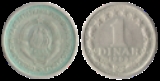
The
dinar was the
currencyIn economics, currency refers to a generally accepted medium of exchange. These are usually the coins and banknotes of a particular government, which comprise the physical aspects of a nation's money supply...
of the three
YugoslavYugoslavia refers to three political entities that existed successively on the western part of the Balkans during most of the 20th century....
states: the
Kingdom of YugoslaviaThe Kingdom of Yugoslavia was a state stretching from the Western Balkans to Central Europe which existed during the often-tumultuous interwar era of 1918–1941...
(formerly the Kingdom of Serbs, Croats and Slovenes), the
Socialist Federal Republic of YugoslaviaThe Socialist Federal Republic of Yugoslavia was the Yugoslav state that existed from the abolition of the Yugoslav monarchy until it was dissolved in 1992 amid the Yugoslav Wars. It was a socialist state and a federation made up of six socialist republics: Bosnia and Herzegovina, Croatia,...
and the Federal Republic of Yugoslavia between 1918 and 2003. The dinar was subdivided into 100
para (Cyrillic script: пара). There were eight distinct dinari, with
hyperinflationIn economics, hyperinflation is inflation that is very high or out of control. While the real values of the specific economic items generally stay the same in terms of relatively stable foreign currencies, in hyperinflationary conditions the general price level within a specific economy increases...
in the early 1990s causing five revaluations between 1990 and 1994. Six of the eight have been given distinguishing names and separate
ISO 4217ISO 4217 is a standard published by the International Standards Organization, which delineates currency designators, country codes , and references to minor units in three tables:* Table A.1 – Current currency & funds code list...
codes.
History
Reforms of the Yugoslav dinar
| Date |
Conversion Rate |
| November 29, 1944 |
20 |
| January 1, 1966 |
100 |
| January 1, 1990 |
10,000 |
| July 1, 1992 |
10 |
| October 1, 1993 |
1,000,000 |
| January 1, 1994 |
1,000,000,000 |
| January 24, 1994 |
~13 million |
1920-1941; Serbian dinar
Until 1918, the
dinarThe dinar is the currency of Serbia. An earlier currency also called dinar was used in Serbia between 1868 and 1918. The earliest use of the dinar date to 1214. Today's Serbian dinar is a continuation of the last Yugoslav dinar...
was the currency of
SerbiaSerbia , officially the Republic of Serbia , is a landlocked country located at the crossroads of Central and Southeast Europe, covering the southern part of the Carpathian basin and the central part of the Balkans...
. It then became the currency of the Kingdom of Serbs, Croats and Slovenes, circulating alongside the
kroneThe krone was a short-lived, provisional currency used in parts of the then newly formed Kingdom of Serbs, Croats, and Slovenes which had previously been part of the Austro-Hungarian Empire.-History:...
in
CroatiaCroatia , officially the Republic of Croatia , is a unitary democratic parliamentary republic in Europe at the crossroads of the Mitteleuropa, the Balkans, and the Mediterranean. Its capital and largest city is Zagreb. The country is divided into 20 counties and the city of Zagreb. Croatia covers ...
,
SloveniaSlovenia , officially the Republic of Slovenia , is a country in Central and Southeastern Europe touching the Alps and bordering the Mediterranean. Slovenia borders Italy to the west, Croatia to the south and east, Hungary to the northeast, and Austria to the north, and also has a small portion of...
and
Bosnia and HerzegovinaBosnia and Herzegovina , sometimes called Bosnia-Herzegovina or simply Bosnia, is a country in Southern Europe, on the Balkan Peninsula. Bordered by Croatia to the north, west and south, Serbia to the east, and Montenegro to the southeast, Bosnia and Herzegovina is almost landlocked, except for the...
, with 1 dinar = 4 kronen. The first coins and banknotes bearing the name of the Kingdom of Serbs, Croats and Slovenes were issued in 1920, until which time Serbian coins and banknotes circulated. In 1929, the name of the country changed to Yugoslavia and this was reflected on the currency.
In 1931, an exchange rate of 56.4 dinara = 1
U.S. DollarThe United States dollar , also referred to as the American dollar, is the official currency of the United States of America. It is divided into 100 smaller units called cents or pennies....
was set, which changed to 44 dinara in 1933. In 1937, a tourist exchange rate of 250 dinara = 1
British poundThe pound sterling , commonly called the pound, is the official currency of the United Kingdom, its Crown Dependencies and the British Overseas Territories of South Georgia and the South Sandwich Islands, British Antarctic Territory and Tristan da Cunha. It is subdivided into 100 pence...
was established.
World War II (1941-1945)
In 1941, Yugoslavia was
invadedThe Invasion of Yugoslavia , also known as the April War , was the Axis Powers' attack on the Kingdom of Yugoslavia which began on 6 April 1941 during World War II...
and split up, with the dinar remaining currency in
Nedić's SerbiaSerbia under German occupation refers to an administrative area in occupied Yugoslavia established by Nazi Germany following the invasion and dismantling of Yugoslavia in April of 1941...
as
Serbian dinarThe dinar is the currency of Serbia. An earlier currency also called dinar was used in Serbia between 1868 and 1918. The earliest use of the dinar date to 1214. Today's Serbian dinar is a continuation of the last Yugoslav dinar...
). The
kunaThe kuna was the currency of the Independent State of Croatia in the period between 1941 and 1945 during World War II. The word "kuna" means "marten" in Croatian and the same word is used for the current Croatian kuna currency. This kuna was subdivided into 100 banica...
was introduced in
CroatiaCroatia , officially the Republic of Croatia , is a unitary democratic parliamentary republic in Europe at the crossroads of the Mitteleuropa, the Balkans, and the Mediterranean. Its capital and largest city is Zagreb. The country is divided into 20 counties and the city of Zagreb. Croatia covers ...
and
Bosnia and HerzegovinaBosnia and Herzegovina , sometimes called Bosnia-Herzegovina or simply Bosnia, is a country in Southern Europe, on the Balkan Peninsula. Bordered by Croatia to the north, west and south, Serbia to the east, and Montenegro to the southeast, Bosnia and Herzegovina is almost landlocked, except for the...
(
Independent State of CroatiaThe Independent State of Croatia was a World War II puppet state of Nazi Germany, established on a part of Axis-occupied Yugoslavia. The NDH was founded on 10 April 1941, after the invasion of Yugoslavia by the Axis powers. All of Bosnia and Herzegovina was annexed to NDH, together with some parts...
) at par with the dinar, whilst the
Bulgarian levThe lev is the currency of Bulgaria. It is divided in 100 stotinki . In archaic Bulgarian the word "lev" meant "lion".It is speculated that Bulgaria, as a member of the European Union will adopt the Euro in 2015 .- First lev, 1881–1952 :...
,
Italian liraThe lira was the currency of Italy between 1861 and 2002. Between 1999 and 2002, the Italian lira was officially a “national subunit” of the euro...
and
German ReichsmarkThe Reichsmark was the currency in Germany from 1924 until June 20, 1948. The Reichsmark was subdivided into 100 Reichspfennig.-History:...
circulated in those part of Yugoslavia occupied by these countries.
1944-1965; Federation dinar
In 1944, as Yugoslavia began to be reconstituted, the Yugoslav dinar replaced the
Serbian dinarThe dinar is the currency of Serbia. An earlier currency also called dinar was used in Serbia between 1868 and 1918. The earliest use of the dinar date to 1214. Today's Serbian dinar is a continuation of the last Yugoslav dinar...
,
Independent State of Croatia kunaThe kuna was the currency of the Independent State of Croatia in the period between 1941 and 1945 during World War II. The word "kuna" means "marten" in Croatian and the same word is used for the current Croatian kuna currency. This kuna was subdivided into 100 banica...
and other occupation currencies, with the rates of exchanged being 1 Yugoslav dinar = 20 Serbian dinara = 40 kuna. In May 1945, a peg of 50 dinara = 1 U.S. dollar was established but was not maintained.
1966-1989; Hard dinar, YUD
On January 1, 1966, the first of five revaluations took place, at a ratio of 100 to 1. This currency was never very stable, suffering from an inflation rate of 15 to 25 percent per year
http://www.rogershermansociety.org/yugoslavia.htm. In the late 1980s the inflation rate accelerated, causing the currency to be revalued at the beginning of 1990.
1990-1992; Convertible dinar, YUN
The second revaluation took place on January 1, 1990, at a ratio of 10,000 to 1. During this period, the constituent republics began to leave the
Socialist Federal Republic of YugoslaviaThe Socialist Federal Republic of Yugoslavia was the Yugoslav state that existed from the abolition of the Yugoslav monarchy until it was dissolved in 1992 amid the Yugoslav Wars. It was a socialist state and a federation made up of six socialist republics: Bosnia and Herzegovina, Croatia,...
. Four of the six republics declared independence and issued their own currencies shortly after. This was the last dinar that bore the
coat of armsThe emblem of the Socialist Federal Republic of Yugoslavia featured six torches, surrounded by wheat with a red star at its top, and burning together in one flame; this represented the brotherhood and unity of the six federal republics forming Yugoslavia: SR Bosnia and Herzegovina, SR Croatia, SR...
and the name of the "Socialist Federal Republic of Yugoslavia" in multiple languages.
| Country |
Currency |
Date Adopted |
Value |
Bosnia and HerzegovinaBosnia and Herzegovina , sometimes called Bosnia-Herzegovina or simply Bosnia, is a country in Southern Europe, on the Balkan Peninsula. Bordered by Croatia to the north, west and south, Serbia to the east, and Montenegro to the southeast, Bosnia and Herzegovina is almost landlocked, except for the...
|
Dinar The Bosnia and Herzegovina dinar was the independent currency of Bosnia and Herzegovina between 1992 and 1998, used in those areas under Bosniak control. No subdivisions were issued.-History:...
|
1992-07 |
1 dinar of 1992 |
CroatiaCroatia , officially the Republic of Croatia , is a unitary democratic parliamentary republic in Europe at the crossroads of the Mitteleuropa, the Balkans, and the Mediterranean. Its capital and largest city is Zagreb. The country is divided into 20 counties and the city of Zagreb. Croatia covers ...
|
Dinar The dinar was the currency of Croatia between December 23, 1991, and May 30, 1994. The ISO 4217 code was HRD.-History:The Croatian dinar replaced the 1990 version of Yugoslav dinar at par. It was a transitional currency introduced following Croatia's declaration of independence. During its...
|
1991-12-23 |
1 dinar of 1990 |
| Macedonia Macedonia , officially the Republic of Macedonia , is a country located in the central Balkan peninsula in Southeast Europe. It is one of the successor states of the former Yugoslavia, from which it declared independence in 1991...
|
DenarThe denar is the currency of the Republic of Macedonia. It is subdivided into 100 deni . The name denar comes from the name of the ancient Roman monetary unit, the denarius...
|
1992-04-26 |
1 dinar of 1990 |
SloveniaSlovenia , officially the Republic of Slovenia , is a country in Central and Southeastern Europe touching the Alps and bordering the Mediterranean. Slovenia borders Italy to the west, Croatia to the south and east, Hungary to the northeast, and Austria to the north, and also has a small portion of...
|
TolarThe tolar was the currency of Slovenia from 1991 until the introduction of the euro on 1 January 2007. It was subdivided into 100 stotins...
|
1991-10-08 |
1 dinar of 1990 |
Serbian enclaves in Croatia and Bosnia and Herzegovina also issued currencies in dinar, equivalent to and revalued together with the Yugoslav dinar. These were the
Krajina dinarThe dinar was the currency in Republic of Serbian Krajina between 1992 and 1994.-History:There were three distinct dinars. The first was introduced in July 1992 in parallel with the new Yugoslav dinar of that year, to which it was equal...
and the
Republika Srpska dinarThe dinar was the currency of the Republika Srpska between 1992 and 1998, during and following the Bosnian War. There were two distinct currencies issued by the National Bank of the Republika Srpska. The first was introduced in 1992 in conjunction with the Yugoslav dinar of that year, to which it...
.
1992-1993; Reformed dinar, YUR
The third revaluation took place on July 1, 1992, at a ratio of 10 to 1.
HyperinflationIn economics, hyperinflation is inflation that is very high or out of control. While the real values of the specific economic items generally stay the same in terms of relatively stable foreign currencies, in hyperinflationary conditions the general price level within a specific economy increases...
began to occur during this currency's period of circulation. This dinar was issued in the then Federal Republic of Yugoslavia, which consisted of the remaining republics of
SerbiaSerbia , officially the Republic of Serbia , is a landlocked country located at the crossroads of Central and Southeast Europe, covering the southern part of the Carpathian basin and the central part of the Balkans...
and
MontenegroMontenegro Montenegrin: Crna Gora Црна Гора , meaning "Black Mountain") is a country located in Southeastern Europe. It has a coast on the Adriatic Sea to the south-west and is bordered by Croatia to the west, Bosnia and Herzegovina to the northwest, Serbia to the northeast and Albania to the...
. (This federation split in 2006 and Montenegro currently uses the Euro as its currency, though it
does not mint itThe international status and usage of the euro has grown since its launch in 1999. When the euro formally replaced 12 currencies on 1 January 2002, it inherited their use in territories such as Montenegro and they replaced minor currencies tied to the pre-euro currencies such as in Monaco...
.)
1993; October dinar, YUO
The fourth revaluation took place on October 1, 1993, at a ratio of 1 million to 1. This revaluation did not interrupt the hyperinflation and the currency lasted a mere three months.
1994; January dinar, YUG
The fifth revaluation took place on January 1, 1994, at a ratio of 1 billion (10
9) to 1. This currency suffered from the worst
hyperinflationIn economics, hyperinflation is inflation that is very high or out of control. While the real values of the specific economic items generally stay the same in terms of relatively stable foreign currencies, in hyperinflationary conditions the general price level within a specific economy increases...
of all the dinar and was replaced within one month.
1994-2003; Novi dinar, YUM
On January 24, 1994, the
novi dinar (nominative plural:
novi dinari, Cyrillic script: нови динар, нови динари; genitive plural:
novih dinara, Cyrillic: нових динара; novi means new) was introduced. This was not a revaluation of the dinar. Instead, the novi dinar was pegged at par to the
Deutsche MarkThe Deutsche Mark |mark]], abbreviated "DM") was the official currency of West Germany and Germany until the adoption of the euro in 2002. It is commonly called the "Deutschmark" in English but not in German. Germans often say "Mark" or "D-Mark"...
. On the day of the introduction of the novi dinar, the exchange rate of the previous dinar to the Deutsche Mark, and, hence, to the novi dinar, was approximately 1 DM = 13 million dinara. Despite not being pegged to the newest currency, the previous dinar did not fall further in value, remaining at about 12 million "1994" dinar to the novi dinar.
http://www.scc.rutgers.edu/serbian_digest/242/t242-6.htm The overall impact of the hyperinflation was that 1 novi dinar equalled approximately 1.2 third (hard) dinara from before 1990, 1.2 Federation dinara, or 2.4 pre-war dinara. The "novi" portion of the name was abandoned in 2000.
Replacement of the dinar
On November 6, 1999,
MontenegroMontenegro Montenegrin: Crna Gora Црна Гора , meaning "Black Mountain") is a country located in Southeastern Europe. It has a coast on the Adriatic Sea to the south-west and is bordered by Croatia to the west, Bosnia and Herzegovina to the northwest, Serbia to the northeast and Albania to the...
decided that, besides the Yugoslav dinar, the Deutsche Mark would also be an official currency. On November 13, 2000, the dinar was dropped and the Deutsche Mark (by that time defined in terms of the
euroThe euro is the official currency of the eurozone: 17 of the 27 member states of the European Union. It is also the currency used by the Institutions of the European Union. The eurozone consists of Austria, Belgium, Cyprus, Estonia, Finland, France, Germany, Greece, Ireland, Italy, Luxembourg,...
) became the only currency. In 2003, the end of Yugoslavia led to the dinar, by then only used in Serbia, being replaced at par by the
Serbian dinarThe dinar is the currency of Serbia. An earlier currency also called dinar was used in Serbia between 1868 and 1918. The earliest use of the dinar date to 1214. Today's Serbian dinar is a continuation of the last Yugoslav dinar...
.
1920 dinar
In 1920, the first coins were minted in the name of the Kingdom of Serbs, Croats and Slovenes. They were zinc 5 and 10 para and nickel-bronze 25 para. These were followed, in 1925, by nickel-bronze 50 para, 1 and 2 dinara. From 1931, coins were minted in the name of Yugoslavia, starting with silver 10 and 20 dinara, followed by silver 50 dinara in 1932. In 1938, aluminium-bronze 50 para, 1 and 2 dinara, nickel 10 dinara and reduced size, silver 20 and 50 dinara were introduced. These were the last coins issued before the
Second World WarWorld War II, or the Second World War , was a global conflict lasting from 1939 to 1945, involving most of the world's nations—including all of the great powers—eventually forming two opposing military alliances: the Allies and the Axis...
.
1944 dinar
In 1945, zinc 50 para, 1, 2 and 5 dinara were introduced, followed in 1953 by aluminium coins for the same denominations. In 1955, aluminium-bronze 10, 20 and 50 dinara were added.
1966 dinar
In 1966, brass 5, 10, 20 and 50 para, and cupro-nickel 1 dinar coins (dated 1965) were introduced. In 1971, nickel-brass 2 and 5 dinara were introduced, followed by cupro-nickel 10 dinara in 1976. Production of 5, 10 and 20 para coins ceased in 1981, with bronze 25 and 50 para being introduced the following year. Nickel-brass 20, 50 and 100 dinara were introduced in 1985 and production of all coins less than 10 dinara stopped the next year. In 1988, brass 10, 20, 50 and 100 dinara were introduced. These four coins were issued until 1989.
1990 dinar
In 1990, coins for 10, 20 and 50 para, 1, 2 and 5 dinara were introduced. The highest two denominations were minted in small numbers in 1992, the other denominations having ceased production in 1991.
1992 dinar
Coins were issued for this currency in 1992 in denominations of 1, 2, 5, 10 and 50 dinara. The 1, 2 and 5 dinara were bronze, whilst the 10 and 50 dinara were nickel-brass. The coins bore the state title "Yugoslavia" (Jugoslavija in the Latin alphabet and Југославија in
CyrillicThe Cyrillic script or azbuka is an alphabetic writing system developed in the First Bulgarian Empire during the 10th century AD at the Preslav Literary School...
) in its simplest form without any modifier.
1993 dinar
Coins were issued in 1993 in denominations of 1, 2, 5, 10 and 50 dinara struck in nickel-brass, and 100 dinara struck in brass. Brass 500 dinara coins were also struck but not issued, most being remelted. The design of these coins was similar to that of coins of the fifth dinar, except that the sixth dinar coins bore the state title "FR Yugoslavia" (SR Jugoslavija in Latin and СР Југославија in Cyrillic).
Novi dinar
In 1994, brass 1 and 5 para, and nickel-brass 10 and 50 para, and 1 novi dinar were introduced. In 2000 the word novi was dropped from the currency and new, brass 50 para, 1, 2 and 5 dinara coins were introduced.
See also
- Serbian dinar
The dinar is the currency of Serbia. An earlier currency also called dinar was used in Serbia between 1868 and 1918. The earliest use of the dinar date to 1214. Today's Serbian dinar is a continuation of the last Yugoslav dinar...
- Hyperinflation
In economics, hyperinflation is inflation that is very high or out of control. While the real values of the specific economic items generally stay the same in terms of relatively stable foreign currencies, in hyperinflationary conditions the general price level within a specific economy increases...
- Kingdom of Yugoslavia
The Kingdom of Yugoslavia was a state stretching from the Western Balkans to Central Europe which existed during the often-tumultuous interwar era of 1918–1941...
- Socialist Federal Republic of Yugoslavia
The Socialist Federal Republic of Yugoslavia was the Yugoslav state that existed from the abolition of the Yugoslav monarchy until it was dissolved in 1992 amid the Yugoslav Wars. It was a socialist state and a federation made up of six socialist republics: Bosnia and Herzegovina, Croatia,...
- Federal Republic of Yugoslavia
- Economy of the Socialist Federal Republic of Yugoslavia
Despite common origins, the economy of the Socialist Federal Republic of Yugoslavia was much different from economies of the Soviet Union and other Eastern European socialist countries, especially after the Yugoslav-Soviet break-up of 1948. The occupation and liberation struggle in World War II...
- Alija Sirotanović
Alija Sirotanović was a Yugoslav miner, Hero of Socialist Labour and perhaps the most famous of all Yugoslav udarniks...
External links