
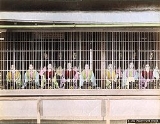
Yoshiwara was a famous
Akasenis Japanese slang and a collective term which was used to identify districts in Japan where prostitution and the sex industry flourished until 1958.Akasen means literally "red-line". The districts were the designated regions for state-regulated prostitution...
district (
red-light districtA red-light district is a part of an urban area where there is a concentration of prostitution and sex-oriented businesses, such as sex shops, strip clubs, adult theaters, etc...
) in
Edo, also romanized as Yedo or Yeddo, is the former name of the Japanese capital Tokyo, and was the seat of power for the Tokugawa shogunate which ruled Japan from 1603 to 1868...
, present-day
Tōkyō, ; officially , is one of the 47 prefectures of Japan. Tokyo is the capital of Japan, the center of the Greater Tokyo Area, and the largest metropolitan area of Japan. It is the seat of the Japanese government and the Imperial Palace, and the home of the Japanese Imperial Family...
,
JapanJapan is an island nation in East Asia. Located in the Pacific Ocean, it lies to the east of the Sea of Japan, China, North Korea, South Korea and Russia, stretching from the Sea of Okhotsk in the north to the East China Sea and Taiwan in the south...
.
In the early 17th century, there was widespread male and female
prostitutionProstitution is the act or practice of providing sexual services to another person in return for payment. The person who receives payment for sexual services is called a prostitute and the person who receives such services is known by a multitude of terms, including a "john". Prostitution is one of...
throughout the cities of Kyoto, Edo, and Osaka. To counter this, an order of
Tokugawa Hidetadawas the second shogun of the Tokugawa dynasty, who ruled from 1605 until his abdication in 1623. He was the third son of Tokugawa Ieyasu, the first shogun of the Tokugawa shogunate.-Early life :...
of the
Tokugawa shogunateThe Tokugawa shogunate, also known as the and the , was a feudal regime of Japan established by Tokugawa Ieyasu and ruled by the shoguns of the Tokugawa family. This period is known as the Edo period and gets its name from the capital city, Edo, which is now called Tokyo, after the name was...
restricted prostitution to designated city districts. These districts were
ShimabaraShimabara was a courtesans' district in Kyoto. It was established in 1640 for a brothel owned by Hara Saburoemon, and was closed in 1958, when prostitution was outlawed in Japan. The name Shimabara most likely refers to the large gate that resembled the gate of Shimabara castle in Bizen...
for
Kyōtois a city in the central part of the island of Honshū, Japan. It has a population close to 1.5 million. Formerly the imperial capital of Japan, it is now the capital of Kyoto Prefecture, as well as a major part of the Osaka-Kobe-Kyoto metropolitan area.-History:...
(1640),
ShinmachiShinmachi was a courtesan's district in Osaka, built between 1615 and 1623, and operating until its destruction in World War II. It was situated roughly two kilometers southwest of Nakanoshima...
for
Ōsakais a city in the Kansai region of Japan's main island of Honshu, a designated city under the Local Autonomy Law, the capital city of Osaka Prefecture and also the biggest part of Keihanshin area, which is represented by three major cities of Japan, Kyoto, Osaka and Kobe...
(1624–1644) and Yoshiwara for Edo (1617). The main reason for establishing these nightless cities was the Tokugawa shogunate's trying to prevent the nouveau riche chōnin (townsmen) from political intrigue.
History
The
Yoshiwara was created in the city of Edo, located near what is today known as
Nihonbashi, or Nihombashi, is a business district of Chūō, Tokyo, Japan which grew up around the bridge of the same name which has linked two sides of the Nihonbashi River at this site since the 17th century. The first wooden bridge was completed in 1603, and the current bridge made of stone dates from 1911...
, near the start of the busy
TōkaidōThe ' was the most important of the Five Routes of the Edo period, connecting Edo to Kyoto in Japan. Unlike the inland and less heavily travelled Nakasendō, the Tōkaidō travelled along the sea coast of eastern Honshū, hence the route's name....
that leads to western
Kyotois a city in the central part of the island of Honshū, Japan. It has a population close to 1.5 million. Formerly the imperial capital of Japan, it is now the capital of Kyoto Prefecture, as well as a major part of the Osaka-Kobe-Kyoto metropolitan area.-History:...
in western Japan. In 1656, due to the need for space as the city grew, the government decided to relocate Yoshiwara, and plans were made to move the district to its present location north of
Asakusais a district in Taitō, Tokyo, Japan, most famous for the Sensō-ji, a Buddhist temple dedicated to the bodhisattva Kannon. There are several other temples in Asakusa, as well as various festivals.- History :...
on the outskirts of the city.
The old Yoshiwara district burned down (along with much of the city) in the Meireki fire of 1657; it was rebuilt in the new location, when it was renamed
Shin Yoshiwara (New Yoshiwara), the old location being called
Moto Yoshiwara (Original Yoshiwara); eventually the "Shin" was dropped, and the new district became known simply as the Yoshiwara.
The Yoshiwara was home to some 1,750 women in the 18th century, with records of some 3,000 women from all over Japan at one time. The area had over 9,000 women, many of whom suffered from
syphilisSyphilis is a sexually transmitted infection caused by the spirochete bacterium Treponema pallidum subspecies pallidum. The primary route of transmission is through sexual contact; however, it may also be transmitted from mother to fetus during pregnancy or at birth, resulting in congenital syphilis...
, in 1893. These women were often indentured to the brothels by their parents between the ages of about seven to twelve. If the young girl was lucky, she would become an apprentice to a high ranking
courtesanA courtesan was originally a female courtier, which means a person who attends the court of a monarch or other powerful person.In feudal society, the court was the centre of government as well as the residence of the monarch, and social and political life were often completely mixed together...
. When the girl was old enough and had completed her training, she would become a courtesan herself and work her way up the ranks. The girls often had a contract to the brothel for only about five to ten years, but massive
debtA debt is an obligation owed by one party to a second party, the creditor; usually this refers to assets granted by the creditor to the debtor, but the term can also be used metaphorically to cover moral obligations and other interactions not based on economic value.A debt is created when a...
sometimes kept them in the brothels their entire lives.
One way out of Yoshiwara was for a rich man to buy her contract from the brothel and keep her as his personal wife or concubine. Another would be if she managed to be successful enough that she was able to buy her own freedom. This did not occur very often, though. Many women died of venereal diseases or from failed abortions before completing their contracts. A significant number served out their contracts and married a client, went into other employments (including other forms of prostitution), or returned to their family homes. In these cases, the advanced payments their parents received could be used to fund her dowry. (There was no stigma against marrying a former prostitute.)
Social classes were not strictly divided in Yoshiwara. A commoner with enough money would be served as an equal to a
samuraiis the term for the military nobility of pre-industrial Japan. According to translator William Scott Wilson: "In Chinese, the character 侍 was originally a verb meaning to wait upon or accompany a person in the upper ranks of society, and this is also true of the original term in Japanese, saburau...
. Though it was discouraged for a samurai to enter the Yoshiwara area, they often did so anyway. The only requirement on them was that all their weapons had to be left at the town's entrance gate. Also by law, the patrons of the brothels were only allowed to stay for a night and a day at a time. Like all official policies for Yoshiwara, this was rarely enforced.
Yoshiwara also became a strong commercial area. The fashions in the town changed frequently, creating a great demand for merchants and artisans. Traditionally the prostitutes were supposed to wear only simple blue robes, but this was rarely enforced. The high-ranking ladies often dressed in the highest fashion of the time, with bright colorful silk kimonos and expensive and elaborate hair decorations. Fashion was so important in Yoshiwara that it frequently dictated the fashion trends for the rest of Japan.
The area was damaged by an extensive
fireFire is the rapid oxidation of a material in the chemical process of combustion, releasing heat, light, and various reaction products. Slower oxidative processes like rusting or digestion are not included by this definition....
in 1913, then nearly wiped out by an
earthquakeAn earthquake is the result of a sudden release of energy in the Earth's crust that creates seismic waves. The seismicity, seismism or seismic activity of an area refers to the frequency, type and size of earthquakes experienced over a period of time...
in 1923. It remained in business, however, until prostitution was outlawed by the Japanese government in 1958 after
World War IIWorld War II, or the Second World War , was a global conflict lasting from 1939 to 1945, involving most of the world's nations—including all of the great powers—eventually forming two opposing military alliances: the Allies and the Axis...
.
Edo is now known as the city of Tokyo, Japan and prostitution is technically illegal, although this supposed illegality has been accomplished by applying a rather strained definition of the term (for example, the definition of "prostitution" for some reason does not extend to a "private agreement" reached between a woman and a man in a brothel). The area known as Yoshiwara, near Minowa station on the Hibiya Line, is now known as
Senzoku Yon-chō-me and still retains a large number of
soaplandA ' is a Japanglish and indicates a paradise for men in Japanese. It is said, since in Japan prostitution is officially prohibited by the government, that it is a type of brothel in Japan where male clients can engage in sexual activity with female prostitutes, although officially the clubs do...
s and other façades for sexual services.
People and services
People involved in ("the water trade") would include hōkan (comedians),
kabukiis classical Japanese dance-drama. Kabuki theatre is known for the stylization of its drama and for the elaborate make-up worn by some of its performers.The individual kanji characters, from left to right, mean sing , dance , and skill...
(popular theatre of the time), dancers, dandies, rakes, tea-shop girls,
KanōThe ' is one of the most famous schools of Japanese painting. The Kanō school of painting was the dominant style of painting until the Meiji period.It was founded by Kanō Masanobu , a contemporary of Sesshū and student of Shūbun...
(painters of the official school of painting), courtesans who resided in seirō (green houses) and geisha in their okiya houses.
The courtesans would consist of yūjo (women of pleasure/prostitutes), kamuro (young female students), shinzō (senior female students), hashi-jōro (lower-ranking courtesans), kōshi-jōro (high-ranking courtesans just below tayū), tayū (high-ranking courtesans),
oiranwere courtesans in Japan. The oiran were considered a type of "woman of pleasure" or prostitute. However, they are distinguished from the yūjo in that they were entertainers, and many became celebrities of their times outside the pleasure districts...
("castle-topplers", named that way for how quickly they could part a
daimyōis a generic term referring to the powerful territorial lords in pre-modern Japan who ruled most of the country from their vast, hereditary land holdings...
(lord) from his money), yarite (older chaperones for an oiran), and the yobidashi who replaced the tayū when they were priced out of the market.
In addition to courtesans, there were also
geisha, Geiko or Geigi are traditional, female Japanese entertainers whose skills include performing various Japanese arts such as classical music and dance.-Terms:...
/geiko, maiko (apprentice geishas), otoko geisha (male geishas), danna (patrons of a geisha), and okasan (geisha teahouse managers). The lines between geisha and courtesans were sharply drawn, however - a geisha was never to be sexually involved with a customer, though there were exceptions.
Yoshiwara today
Today, Yoshiwara roughly corresponds to . At first glance, Yoshiwara today looks very similar to many other neighborhoods of modern Tokyo. Still, it does retain legacies to its past as it contains commercial establishments engaged in the sex trade, although police cracked-down on the soaplands in 2007. The street grid pattern and the
templeA temple is a structure reserved for religious or spiritual activities, such as prayer and sacrifice, or analogous rites. A templum constituted a sacred precinct as defined by a priest, or augur. It has the same root as the word "template," a plan in preparation of the building that was marked out...
s and
shrineA shrine is a holy or sacred place, which is dedicated to a specific deity, ancestor, hero, martyr, saint, daemon or similar figure of awe and respect, at which they are venerated or worshipped. Shrines often contain idols, relics, or other such objects associated with the figure being venerated....
s from times past still exist.
In popular culture
- "Yoshiwara" is the name of the futuristic red-light district in the classic silent German film Metropolis
Metropolis is a 1927 German expressionist film in the science-fiction genre directed by Fritz Lang. Produced in Germany during a stable period of the Weimar Republic, Metropolis is set in a futuristic urban dystopia and makes use of this context to explore the social crisis between workers and...
(1927).
External links