

Yosa Buson

Encyclopedia
Japan
Japan is an island nation in East Asia. Located in the Pacific Ocean, it lies to the east of the Sea of Japan, China, North Korea, South Korea and Russia, stretching from the Sea of Okhotsk in the north to the East China Sea and Taiwan in the south...
ese poet
Poet
A poet is a person who writes poetry. A poet's work can be literal, meaning that his work is derived from a specific event, or metaphorical, meaning that his work can take on many meanings and forms. Poets have existed since antiquity, in nearly all languages, and have produced works that vary...
and painter
Painting
Painting is the practice of applying paint, pigment, color or other medium to a surface . The application of the medium is commonly applied to the base with a brush but other objects can be used. In art, the term painting describes both the act and the result of the action. However, painting is...
from the Edo period
Edo period
The , or , is a division of Japanese history which was ruled by the shoguns of the Tokugawa family, running from 1603 to 1868. The political entity of this period was the Tokugawa shogunate....
. Along with Matsuo Bashō
Matsuo Basho
, born , then , was the most famous poet of the Edo period in Japan. During his lifetime, Bashō was recognized for his works in the collaborative haikai no renga form; today, after centuries of commentary, he is recognized as a master of brief and clear haiku...
and Kobayashi Issa
Kobayashi Issa
, was a Japanese poet and lay Buddhist priest of the Jōdo Shinshū sect known for his haiku poems and journals. He is better known as simply , a pen name meaning Cup-of-tea...
, Buson is considered among the greatest poets of the Edo Period. Buson was born in the village of Kema in Settsu Province
Settsu Province
was a province of Japan, which today comprises the eastern part of Hyōgo Prefecture and the northern part of Osaka Prefecture. It was also referred to as or .Osaka and Osaka Castle were the main center of the province.-History:...
(now Kema-chō, Miyakojima Ward
Miyakojima-ku, Osaka
is one of 24 wards of Osaka, Japan.-External links:*...
in the city Osaka
Osaka
is a city in the Kansai region of Japan's main island of Honshu, a designated city under the Local Autonomy Law, the capital city of Osaka Prefecture and also the biggest part of Keihanshin area, which is represented by three major cities of Japan, Kyoto, Osaka and Kobe...
). His original family name was Taniguchi.
Around the age of 20, Buson moved to Edo
Edo
, also romanized as Yedo or Yeddo, is the former name of the Japanese capital Tokyo, and was the seat of power for the Tokugawa shogunate which ruled Japan from 1603 to 1868...
(now Tokyo
Tokyo
, ; officially , is one of the 47 prefectures of Japan. Tokyo is the capital of Japan, the center of the Greater Tokyo Area, and the largest metropolitan area of Japan. It is the seat of the Japanese government and the Imperial Palace, and the home of the Japanese Imperial Family...
) and learned poetry under the tutelage of the haikai
Haikai
Haikai is a poetic genre that includes a number of forms which embrace the aesthetics of haikai no renga, and what Bashō referred to as the "poetic spirit" , including haiku, renku , haibun, haiga and senryū ."Haikai" is sometimes used as an abbreviation for "haikai no...
master Hayano Hajin. After Hajin died, Buson moved to Shimōsa Province (modern day Ibaraki Prefecture
Ibaraki Prefecture
is a prefecture of Japan, located in the Kantō region on the main island of Honshu. The capital is Mito.-History:Ibaraki Prefecture was previously known as Hitachi Province...
). Following in the footsteps of his idol, Matsuo Bashō, Buson traveled through the wilds of northern Honshū
Honshu
is the largest island of Japan. The nation's main island, it is south of Hokkaido across the Tsugaru Strait, north of Shikoku across the Inland Sea, and northeast of Kyushu across the Kanmon Strait...
that had been the inspiration for Bashō's famous travel diary, Oku no Hosomichi
Oku no Hosomichi
, translated alternately as The Narrow Road to the Deep North and The Narrow Road to the Interior, is a major work by the Japanese poet Matsuo Bashō considered "one of the major texts of classical Japanese literature."...
(The Narrow Road to the Interior). He published his notes from the trip in 1744, marking the first time he published under the name Buson.
After traveling through various parts of Japan, including Tango
Tango Province
was an old province in the area that is today northern Kyoto Prefecture facing the Sea of Japan. It was sometimes called , with Tamba Province. Tango bordered on Tajima, Tamba, and Wakasa provinces....
(the northern part of modern Kyoto Prefecture
Kyoto Prefecture
is a prefecture of Japan located in the Kansai region of the island of Honshu. The capital is the city of Kyoto.- History :Until the Meiji Restoration, the area of Kyoto prefecture was known as Yamashiro....
) and Sanuki
Sanuki Province
was an old province of Japan on the island of Shikoku, with the same boundaries as modern Kagawa Prefecture. It was sometimes called .It faced the Inland Sea and bordered on Awa and Iyo Provinces. Across Naruto strait it bordered Awaji Province too. Administratively it was included as a part of...
(Kagawa Prefecture
Kagawa Prefecture
is a prefecture of Japan located on Shikoku island. The capital is Takamatsu.- History :Kagawa was formerly known as Sanuki Province.For a brief period between August 1876 and December 1888, Kagawa was made a part of Ehime Prefecture.-Battle of Yashima:...
in Shikoku
Shikoku
is the smallest and least populous of the four main islands of Japan, located south of Honshū and east of the island of Kyūshū. Its ancient names include Iyo-no-futana-shima , Iyo-shima , and Futana-shima...
), Buson settled down in the city of Kyoto
Kyoto
is a city in the central part of the island of Honshū, Japan. It has a population close to 1.5 million. Formerly the imperial capital of Japan, it is now the capital of Kyoto Prefecture, as well as a major part of the Osaka-Kobe-Kyoto metropolitan area.-History:...
at the age of 42. It is around this time that he began to write under the name of Yosa, which he took from his mother's birthplace (Yosa
Yosa District, Kyoto
is a district located in Kyoto, Japan., the district has an estimated population of 27,829 and a population density of 165 persons per square kilometer. The total area is 169.02 km2.- Mergers :...
in the province of Tango).
Buson married at the age of 45 and had one daughter, Kuno. From this point on, Buson remained in Kyoto, writing and teaching poetry at the Sumiya. In 1770, he assumed the haigō (俳号, haikai pen name
Pen name
A pen name, nom de plume, or literary double, is a pseudonym adopted by an author. A pen name may be used to make the author's name more distinctive, to disguise his or her gender, to distance an author from some or all of his or her works, to protect the author from retribution for his or her...
) of Yahantei (夜半亭, Midnight Studio), which had been the pen name of his teacher Hayano Hajin.
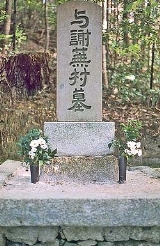
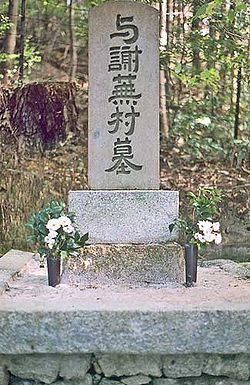
Buson died at the age of 68 and was buried at Konpuku-ji
Konpuku-ji
is a Zen Buddhist temple in Sakyō-ku, Kyoto, Japan.- History :In 864, as Ennin's dying wish, the Buddhist priest An'e built this temple and installed a statue of Kannon that had been made by Ennin himself. At first the temple was part of the Tendai sect, but eventually the temple fell into ruin...
in Kyoto.
Sample poem
- Sumizumi ni nokoru samusa ya umeUmePrunus mume, with the common names including Chinese plum and Japanese apricot, is an Asian tree species classified in the Armeniaca section of the genus Prunus. The flower, long a beloved subject in the traditional painting of East Asia, is usually translated as plum blossom. This distinct tree...
no hana
- In nooks and corners
- Cold remains:
- Flowers of the plum
External links
- Collaboration in the "Back to Bashō" Movement: The Susuki Mitsu Sequence of Buson's Yahantei School, by Cheryl Crowley in Simply Haiku v4n1, 2006