

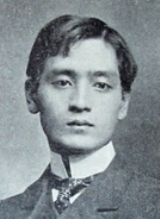
Yone Noguchi

Encyclopedia

Japanese people
The are an ethnic group originating in the Japanese archipelago and are the predominant ethnic group of Japan. Worldwide, approximately 130 million people are of Japanese descent; of these, approximately 127 million are residents of Japan. People of Japanese ancestry who live in other countries...
writer
Writer
A writer is a person who produces literature, such as novels, short stories, plays, screenplays, poetry, or other literary art. Skilled writers are able to use language to portray ideas and images....
of poetry, fiction, essays, and literary criticism in both English
English language
English is a West Germanic language that arose in the Anglo-Saxon kingdoms of England and spread into what was to become south-east Scotland under the influence of the Anglian medieval kingdom of Northumbria...
and Japanese
Japanese language
is a language spoken by over 130 million people in Japan and in Japanese emigrant communities. It is a member of the Japonic language family, which has a number of proposed relationships with other languages, none of which has gained wide acceptance among historical linguists .Japanese is an...
. He was the father of the sculptor Isamu Noguchi
Isamu Noguchi
was a prominent Japanese American artist and landscape architect whose artistic career spanned six decades, from the 1920s onward. Known for his sculpture and public works, Noguchi also designed stage sets for various Martha Graham productions, and several mass-produced lamps and furniture pieces,...
.
Early life
Noguchi was born in the town of TsushimaTsushima, Aichi
is a city located in Aichi Prefecture in the Chūbu region of Japan.As of April 1, 2011, the city has an estimated population of 66,448, with a household number of 25,398, and the density of 2,649.44 persons per km². The total area is 25.08 km²....
, near Nagoya. He attended Keio University
Keio University
,abbreviated as Keio or Keidai , is a Japanese university located in Minato, Tokyo. It is known as the oldest institute of higher education in Japan. Founder Fukuzawa Yukichi originally established it as a school for Western studies in 1858 in Edo . It has eleven campuses in Tokyo and Kanagawa...
but left before graduating to travel to San Francisco in 1893. There, Noguchi joined a newspaper run by Japanese exiles associated with the Freedom and People's Rights Movement
Freedom and People's Rights Movement
The was a Japanese political and social movement for democracy in 1880s....
and worked as a domestic servant. He spent some months studying at a preparatory school for Stanford and working as a journalist before determining, after a visit to the Oakland hillside home
Joaquin Miller Park
Joaquin Miller Park is a large open space park in the Oakland Hills owned and operated by the city of Oakland, California. It was named after early California writer and poet Joaquin Miller, who lived here in his house "The Hights", now preserved as the Joaquin Miller House.-Park:The park's are...
of Joaquin Miller
Joaquin Miller
Joaquin Miller was the pen name of the colorful American poet Cincinnatus Heine Miller , nicknamed the "Poet of the Sierras".-Early years and family:...
, his true vocation of poet. Miller welcomed and encouraged Noguchi and introduced him to other San Francisco Bay area
San Francisco Bay Area
The San Francisco Bay Area, commonly known as the Bay Area, is a populated region that surrounds the San Francisco and San Pablo estuaries in Northern California. The region encompasses metropolitan areas of San Francisco, Oakland, and San Jose, along with smaller urban and rural areas...
bohemians
Bohemianism
Bohemianism is the practice of an unconventional lifestyle, often in the company of like-minded people, with few permanent ties, involving musical, artistic or literary pursuits...
, including Gelett Burgess
Gelett Burgess
Frank Gelett Burgess was an artist, art critic, poet, author and humorist. An important figure in the San Francisco Bay Area literary renaissance of the 1890s, particularly through his iconoclastic little magazine, The Lark, he is best known as a writer of nonsense verse...
(who published Noguchi's first verses in his magazine, The Lark), Ina Coolbrith
Ina Coolbrith
Ina Donna Coolbrith was an American poet, writer, librarian, and a prominent figure in the San Francisco Bay Area literary community...
, Edwin Markham
Edwin Markham
Charles Edwin Anson Markham was an American poet. From 1923 to 1931 he was Poet Laureate of Oregon.-Life:Edwin Markham was born in Oregon City, Oregon and was the youngest of 10 children; his parents divorced shortly after his birth...
, Adeline Knapp
Adeline Knapp
Adeline E. Knapp was an American journalist, author, social activist, environmentalist and educator, who is today remembered largely for her tempestuous lesbian relationship with Charlotte Perkins Gilman. In her lifetime, Knapp was known as a fixture of the turn-of-the-century San Francisco Bay...
, Blanche Partington
Blanche Partington
Blanche Partington was a prominent San Francisco journalist and member of the San Francisco Bay Area literary and cultural scene...
, and Charles Warren Stoddard
Charles Warren Stoddard
Charles Warren Stoddard was an American author and editor.-Life and works:Charles Warren Stoddard was born in Rochester, New York on August 7, 1843. He was descended in a direct line from Anthony Stoddard of England, who settled at Boston, Massachusetts, in 1639...
. Noguchi weathered a plagiarism
Plagiarism
Plagiarism is defined in dictionaries as the "wrongful appropriation," "close imitation," or "purloining and publication" of another author's "language, thoughts, ideas, or expressions," and the representation of them as one's own original work, but the notion remains problematic with nebulous...
scandal in 1896 to publish two books of poetry in 1897, and remained an important fixture of the Bay Area literary scene until his departure for the East Coast
East Coast of the United States
The East Coast of the United States, also known as the Eastern Seaboard, refers to the easternmost coastal states in the United States, which touch the Atlantic Ocean and stretch up to Canada. The term includes the U.S...
in 1900.
Career
New York City
New York is the most populous city in the United States and the center of the New York Metropolitan Area, one of the most populous metropolitan areas in the world. New York exerts a significant impact upon global commerce, finance, media, art, fashion, research, technology, education, and...
. There, with the help of Leonie Gilmour
Léonie Gilmour
Léonie Gilmour was an American educator, editor, and journalist. She was the lover and editor of the writer Yone Noguchi and the mother of sculptor Isamu Noguchi and dancer Ailes Gilmour...
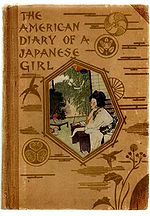
, he completed work on his first novel, The American Diary of a Japanese Girl
The American Diary of a Japanese Girl
The American Diary of a Japanese Girl is the first English novel published in the United States by a person of Japanese ancestry. Acquired for Frank Leslie's Illustrated Monthly Magazine by editor Ellery Sedgwick in 1901, it appeared in two excerpted installments in November and December of that...
, and a sequel, The American Letters of a Japanese Parlor-Maid. He then sailed to England, where he self-published and promoted his third book of poetry, From the Eastern Sea, and formed connections with leading literary figures like William Michael Rossetti
William Michael Rossetti
William Michael Rossetti was an English writer and critic.-Biography:Born in London, he was a son of immigrant Italian scholar Gabriele Rossetti, and the brother of Maria Francesca Rossetti, Dante Gabriel Rossetti and Christina Georgina Rossetti.He was one of the seven founder members of the...
, Laurence Binyon
Laurence Binyon
Robert Laurence Binyon was an English poet, dramatist and art scholar. His most famous work, For the Fallen, is well known for being used in Remembrance Sunday services....
, William Butler Yeats
William Butler Yeats
William Butler Yeats was an Irish poet and playwright, and one of the foremost figures of 20th century literature. A pillar of both the Irish and British literary establishments, in his later years he served as an Irish Senator for two terms...
, Thomas Hardy
Thomas Hardy
Thomas Hardy, OM was an English novelist and poet. While his works typically belong to the Naturalism movement, several poems display elements of the previous Romantic and Enlightenment periods of literature, such as his fascination with the supernatural.While he regarded himself primarily as a...
, Laurence Housman
Laurence Housman
Laurence Housman was an English playwright, writer and illustrator.-Early life:Laurence Housman was born in Bromsgrove, Worcestershire, one of seven children who included the poet A. E. Housman and writer Clemence Housman. In 1871 his mother died, and his father remarried, to a cousin...
, Arthur Symons
Arthur Symons
Arthur William Symons , was a British poet, critic and magazine editor.-Life:Born in Milford Haven, Wales, of Cornish parents, Symons was educated privately, spending much of his time in France and Italy...
and the young Arthur Ransome
Arthur Ransome
Arthur Michell Ransome was an English author and journalist, best known for writing the Swallows and Amazons series of children's books. These tell of school-holiday adventures of children, mostly in the Lake District and the Norfolk Broads. Many of the books involve sailing; other common subjects...
. His London success brought some attention on his return to New York in 1903, and he formed productive new friendships with American writers like Edmund Clarence Stedman
Edmund Clarence Stedman
Edmund Clarence Stedman , American poet, critic, and essayist was born at Hartford, Connecticut, United States.-Biography:...
, Zona Gale
Zona Gale
Zona Gale was an American author and playwright. She became the first woman to win the Pulitzer Prize for drama, in 1921.-Biography:Gale was born in Portage, Wisconsin, which she often used as a setting in her writing...
, and even Mary MacLane
Mary MacLane
Mary MacLane was a controversial Canadian-born American writer whose frank memoirs helped usher in the confessional style of autobiographical writing...
, but he continued to have difficulty publishing in the United States. This changed with the onset of the Russo-Japanese War
Russo-Japanese War
The Russo-Japanese War was "the first great war of the 20th century." It grew out of rival imperial ambitions of the Russian Empire and Japanese Empire over Manchuria and Korea...
in 1904, when Noguchi's writings on various aspects of Japanese culture were suddenly in great demand among magazine editors. He was able to publish a number of seminal articles at this time, including "A Proposal to American Poets," in which he advised American poets to "try Japanese hokku
Hokku
is the opening stanza of a Japanese orthodox collaborative linked poem, renga, or of its later derivative, renku . From the time of Matsuo Bashō , the hokku began to appear as an independent poem, and was also incorporated in haibun , and haiga...
."
Having (he thought) ended a brief, secret marriage to Leonie Gilmour
Léonie Gilmour
Léonie Gilmour was an American educator, editor, and journalist. She was the lover and editor of the writer Yone Noguchi and the mother of sculptor Isamu Noguchi and dancer Ailes Gilmour...
in the early months of 1904, Noguchi made plans to return to Japan, with the intention of marrying another romantic interest, Washington Post reporter Ethel Armes
Ethel Armes
Ethel Marie Armes was an American journalist and historian.Daughter of Col. George Augustus Armes and Lucy Hamilton Kerr, the daughter of John Bozman Kerr, Ethel was brought up in Washington, D.C. where she attended private schools and later worked as a reporter for the Washington Post...
. He returned to Japan in August 1904, and became a professor of English at his alma mater, Keio Gijuku, the following year, but his marriage plan was spoiled when it became known that Leonie Gilmour
Léonie Gilmour
Léonie Gilmour was an American educator, editor, and journalist. She was the lover and editor of the writer Yone Noguchi and the mother of sculptor Isamu Noguchi and dancer Ailes Gilmour...
had given birth to Noguchi's son (the future sculptor Isamu Noguchi
Isamu Noguchi
was a prominent Japanese American artist and landscape architect whose artistic career spanned six decades, from the 1920s onward. Known for his sculpture and public works, Noguchi also designed stage sets for various Martha Graham productions, and several mass-produced lamps and furniture pieces,...
) in Los Angeles. In 1907, Leonie and Isamu joined Noguchi in Tokyo, but the reunion proved short-lived, mainly because Noguchi had already acquired a Japanese wife before their arrival. He and Leonie separated for good in 1909, although Leonie and Isamu continued to live in Japan.
Noguchi continued to publish extensively in English after his return to Japan, becoming a leading interpreter of Japanese culture to Westerners, and of Western culture to the Japanese. His 1909 poem collection, The Pilgrimage, was widely admired, as was a 1913 collection of essays, Through the Torii. In 1913, he made his second trip to England to lecture at Magdalen College, Oxford
Magdalen College, Oxford
Magdalen College is one of the constituent colleges of the University of Oxford in England. As of 2006 the college had an estimated financial endowment of £153 million. Magdalen is currently top of the Norrington Table after over half of its 2010 finalists received first-class degrees, a record...
at the invitation of poet laureate, Robert Bridges
Robert Bridges
Robert Seymour Bridges, OM, was a British poet, and poet laureate from 1913 to 1930.-Personal and professional life:...
. He was hailed in the pages of Poetry magazine as a pioneering modernist, thanks to his early advocacy of free verse
Free verse
Free verse is a form of poetry that refrains from consistent meter patterns, rhyme, or any other musical pattern.Poets have explained that free verse, despite its freedom, is not free. Free Verse displays some elements of form...
and association with modernist writers like Yeats, Ezra Pound
Ezra Pound
Ezra Weston Loomis Pound was an American expatriate poet and critic and a major figure in the early modernist movement in poetry...
, Richard Aldington
Richard Aldington
Richard Aldington , born Edward Godfree Aldington, was an English writer and poet.Aldington was best known for his World War I poetry, the 1929 novel, Death of a Hero, and the controversy arising from his 1955 Lawrence of Arabia: A Biographical Inquiry...
, and John Gould Fletcher
John Gould Fletcher
John Gould Fletcher was an Imagist poet and author. He was born in Little Rock, Arkansas to a socially prominent family. After attending Phillips Academy, Andover Fletcher went on to Harvard University from 1903 to 1907, when he dropped out shortly after his father's death.Fletcher lived in...
. In 1919, he made a transcontinental lecture tour of America. By the early 1920s, however, his work had fallen once again into critical disfavor, and he subsequently devoted his English efforts to studies of Ukiyoe, while beginning a somewhat belated career as a Japanese language poet. All of his later books were published in Japan, for Noguchi encountered stiff resistance from American publishers in the 1930s, despite the support of a few sympathetic editors like Marianne Moore
Marianne Moore
Marianne Moore was an American Modernist poet and writer noted for her irony and wit.- Life :Moore was born in Kirkwood, Missouri, in the manse of the Presbyterian church where her maternal grandfather, John Riddle Warner, served as pastor. She was the daughter of mechanical engineer and inventor...
.
Late Life
Noguchi's politics usually followed prevailing Japanese tendencies. In the 1920s, following the leftist turn of Taishō democracyTaisho period
The , or Taishō era, is a period in the history of Japan dating from July 30, 1912 to December 25, 1926, coinciding with the reign of the Taishō Emperor. The health of the new emperor was weak, which prompted the shift in political power from the old oligarchic group of elder statesmen to the Diet...
, he published in leftist magazines like Kaizo, but the 1930s, he followed the country's turn to the right. Partly as a result of his friendship with leading Indian intellectuals like Rabindranath Tagore
Rabindranath Tagore
Rabindranath Tagore , sobriquet Gurudev, was a Bengali polymath who reshaped his region's literature and music. Author of Gitanjali and its "profoundly sensitive, fresh and beautiful verse", he became the first non-European Nobel laureate by earning the 1913 Prize in Literature...
, Sarojini Naidu
Sarojini Naidu
Sarojini Naidu , also known by the sobriquet The Nightingale of India, was a child prodigy, Indian independence activist and poet...
, and Rash Behari Bose
Rash Behari Bose
Rashbehari Bose was a revolutionary leader against the British Raj in India and was one of the key organisers of the Ghadar conspiracy and later, the Indian National Army.-Early life:...
, Noguchi was sent to India in 1935 to help gain support for Japanese objectives in East Asia, but by the time of the infamous exchange of letters between Noguchi and Tagore in 1938, there seemed little hope of gaining international understanding for Japan's increasingly militant imperialism. During the Second World War, Noguchi supported the Japanese cause, advocating a no-holds-barred assault on the Western countries he had once admired. After the war, he succeeded in reconciling with his estranged son Isamu before dying of stomach cancer on July 13, 1947.
Critical evaluations
Critical evaluations of Noguchi, while varying drastically, have frequently stressed the enigmatic character of his work. Arthur SymonsArthur Symons
Arthur William Symons , was a British poet, critic and magazine editor.-Life:Born in Milford Haven, Wales, of Cornish parents, Symons was educated privately, spending much of his time in France and Italy...
referred to him as a "scarcely to be apprehended personality." Arthur Ransome
Arthur Ransome
Arthur Michell Ransome was an English author and journalist, best known for writing the Swallows and Amazons series of children's books. These tell of school-holiday adventures of children, mostly in the Lake District and the Norfolk Broads. Many of the books involve sailing; other common subjects...
called him "a poet whose poems are so separate that a hundred of them do not suffice for his expression." Ezra Pound
Ezra Pound
Ezra Weston Loomis Pound was an American expatriate poet and critic and a major figure in the early modernist movement in poetry...
, on first reading The Pilgrimage in 1911 wrote that "His poems seem to be rather beautiful. I don't quite know what to think about them." Nishiwaki Junzaburo
Nishiwaki Junzaburo
was a contemporary Japanese poet and literary critic, active in Shōwa period Japan.-Early life:Nishiwaki was born in Ojiya in Niigata prefecture, where his father was a banker. He came to Tokyo intending to become a painter and studied under the famous Fujishima Takeji and Kuroda Seiki but had to...
wrote, "Most of his earlier poems have always seemed to me so terrific, so bewildering, as to startle me out of reason or system."
Noguchi may be considered a cross-cultural
Cross-cultural
cross-cultural may refer to*cross-cultural studies, a comparative tendency in various fields of cultural analysis*cross-cultural communication, a field of study that looks at how people from differing cultural backgrounds communicate...
, transnational
International
----International mostly means something that involves more than one country. The term international as a word means involvement of, interaction between or encompassing more than one nation, or generally beyond national boundaries...
, or cosmopolitan writer. His work may also be considered, albeit somewhat more problematically, within the national literatures of Japan
Japan
Japan is an island nation in East Asia. Located in the Pacific Ocean, it lies to the east of the Sea of Japan, China, North Korea, South Korea and Russia, stretching from the Sea of Okhotsk in the north to the East China Sea and Taiwan in the south...
and the United States (see Japanese literature
Japanese literature
Early works of Japanese literature were heavily influenced by cultural contact with China and Chinese literature, often written in Classical Chinese. Indian literature also had an influence through the diffusion of Buddhism in Japan...
, American literature
American literature
American literature is the written or literary work produced in the area of the United States and its preceding colonies. For more specific discussions of poetry and theater, see Poetry of the United States and Theater in the United States. During its early history, America was a series of British...
). Noguchi has recently gained attention in Asian American studies
Asian American Studies
Asian American Studies is an academic discipline which studies the experience of people of Asian ancestry in America. Closely related to other Ethnic Studies disciplines such as African American Studies, Latino/a Studies, and Native American Studies, Asian American Studies critically examines the...
due to the increasing interest in transnationalism
Transnationalism
Transnationalism is a social movement and scholarly research agenda grown out of the heightened interconnectivity between people and the receding economic and social significance of boundaries among nation states....
.
Yone Noguchi is played by Nakamura Shido in the film Leonie
Leonie (film)
Leonie is a 2010 film directed by Hisako Matsui and starring Emily Mortimer and Shido Nakamura. The film is based on the life of Léonie Gilmour, the American lover and editorial assistant of Japanese writer Yone Noguchi and mother of sculptor Isamu Noguchi and dancer Ailes Gilmour...
(2010).
Books in English by Yone Noguchi
- Seen & Unseen, or, Monologues of a Homeless Snail (1897, 1920)
- The Voice of the Valley (1897)
- The American Diary of a Japanese GirlThe American Diary of a Japanese GirlThe American Diary of a Japanese Girl is the first English novel published in the United States by a person of Japanese ancestry. Acquired for Frank Leslie's Illustrated Monthly Magazine by editor Ellery Sedgwick in 1901, it appeared in two excerpted installments in November and December of that...
(1902, 1904, 1912, 2007 http://www.temple.edu/tempress/titles/1876_reg.html) - From the Eastern Sea (pamphlet) (1903)
- From the Eastern Sea (1903, 1903, 1905, 1910)
- The American Letters of a Japanese Parlor Maid (1905)
- Japan of Sword and Love (1905)
- The Summer Cloud (1906)
- Ten Kiogen in English (1907)
- The Pilgrimage (1909, 1912)
- Kamakura (1910)
- Lafcadio Hearn in Japan (1910, 1911)
- The Spirit of Japanese Poetry (1914)
- The Story of Yone Noguchi (1914, 1915)
- Through the Torii (1914, 1922)
- The Spirit of Japanese Art (1915)
- Japanese Hokkus (1920)
- Japan and America (1921)
- Hiroshige (1921)
- Selected Poems of Yone Noguchi (1921)
- Korin (1922)
- Utamaro (1924)
- Hokusai (1925)
- Harunobu (1927)
- Sharaku (1932)
- The Ukiyoye Primitives (1933)
- Hiroshige (1934)
- Hiroshige and Japanese Landscapes (1934)
- The Ganges Calls Me (1938)
- Harunobu (1940)
- Hiroshige (1940)
- Emperor Shomu and the Shosoin (1941).
- Collected English Letters, ed. Ikuko Atsumi (1975).
- Selected English Writings of Yone Noguchi: An East-West Literary Assimilation, ed. Yoshinobu Hakutani, 2 v. (1990–1992).
- Collected English Works of Yone Noguchi: Poems, Novels and Literary Essays, ed. Shunsuke Kamei, 6 v. (2007)http://www.aplink.co.jp/synapse/4-86166-036-X.html
Contributions to Periodicals
Noguchi contributed to numerous periodicals in the United States, Japan, England, and India, including: The Academy, Blackwood's, The Bookman (London)The Bookman (London)
The Bookman was a monthly magazine published in London from 1891 until 1934 by Hodder & Stoughton. It was a catalogue of their current publications that also contained reviews, advertising and illustrations....
, The Bookman (New York)
The Bookman (New York)
The Bookman was a literary journal established in 1895 by Dodd, Mead and Company. It drew its name from the phrase, "I am a Bookman," by James Russell Lowell; the phrase regularly appeared on the cover and title page of the bound edition. It was purchased in 1918 by the George H. Doran Company. In...
, The Calcutta Review
Calcutta Review
The Calcutta Review is a bi-annual periodical, now published by the Calcutta University press, featuring scholarly articles from a variety of disciplines.-History:...
, The Chap-Book
The Chap-Book
The Chap-Book was an American literary magazine between 1894 and 1898. It is often classified as one of the "little magazines" of the 1890s....
, Chūōkōron
Chuokoron
is a monthly Japanese literary magazine is a monthly Japanese literary magazine is a monthly Japanese literary magazine is a monthly Japanese literary magazine is a monthly Japanese literary magazine is a monthly Japanese literary magazine is a monthly Japanese literary magazine is a monthly...
, The Conservator, The Dial
The Dial
The Dial was an American magazine published intermittently from 1840 to 1929. In its first form, from 1840 to 1844, it served as the chief publication of the Transcendentalists. In the 1880s it was revived as a political magazine...
, The Double-Dealer, The Egoist
The Egoist (periodical)
The Egoist was a London literary magazine published from 1914 to 1919, during which time it published important early modernist poetry and fiction. In its manifesto, it claimed to "recognise no taboos," and published a number of controversial works, such as parts of Ulysses...
, The Graphic
The Graphic
The Graphic was a British weekly illustrated newspaper, first published on 4 December 1869 by William Luson Thomas's company Illustrated Newspapers Limited....
, The Japan Times
The Japan Times
The Japan Times is an English language newspaper published in Japan. Unlike its competitors, the Daily Yomiuri and the International Herald Tribune/Asahi Shimbun, it is not affiliated with a Japanese language media organization...
, Kaizō
Kaizo (magazine)
Kaizō was a Japanese general-interest magazine that started publication during the Taishō period and printed many articles of socialist content...
, The Lark, Leslie's Monthly, Mainichi Shinbun, The Modern Review (Calcutta)
Modern Review (Calcutta)
Modern Review was the name of a monthly magazine published in Calcutta since 1907.Founded by Ramananda Chatterjee, the Modern Review soon emerged as an important forum for the Indian Nationalist intelligentsia. It carried essays on politics, economics, sociology, as well as poems, stories,...
, Myōjō
Myojo
' was the title of a monthly literary magazine first published in Japan between February 1900 and November 1908.The name Myōjō can be translates as either Bright Star or Morning Star. It was the organ of a poetry circle called Shinshisha which had been founded by Yosano Tekkan in 1899...
, The Nation (London), The Nation
The Nation
The Nation is the oldest continuously published weekly magazine in the United States. The periodical, devoted to politics and culture, is self-described as "the flagship of the left." Founded on July 6, 1865, It is published by The Nation Company, L.P., at 33 Irving Place, New York City.The Nation...
(New York), The Philistine, Poetry Magazine, Poet Lore
Poet Lore
Poet Lore is an English-language literary magazine based in Bethesda, Maryland. Established in 1889, Poet Lore is the oldest continuously published poetry magazine in the United States....
, The Poetry Review, The Reader Magazine, Sunset Magazine, T'ien Hsia Monthly, T.P.'s Weekly, Taiyō
Taiyo
Taiyō is the Japanese word for sun. It can also refer to:* a male Japanese firstname* Taiyō Kea, a Japanese professional wrestler* Taiyo Yakuhin or Taiyo Pharmaceutical Industry, a pharmaceutical product manufacturing company located in Takayama, Gifu, Japan* Taiyō Whales, one of the previous names...
, Teikoku Bungaku
Teikoku Bungaku
Teikoku Bungaku was a literature magazine from 1895 to 1920 published by Japanese writers, Inoue Tetsujiro, Ueda Kazutoshi, Takayama Chogyu and Ueda Bin.See also: Japanese literature...
, The Visva-Bharati Quarterly, The Westminster Gazette
Westminster Gazette
The Westminster Gazette was an influential Liberal newspaper based in London. It was known for publishing sketches and short stories, including early works by Raymond Chandler, Anthony Hope and Saki, and travel writing by Rupert Brooke. One of its editors was caricaturist and political cartoonist...
, and Yomiuri Shinbun.
External links
- Yone Noguchi page at Ehime University
- Yone Noguchi, Japan, and English Language Verse
- Short radio episode The Falls from The Story of Yone Noguchi Told by Himself, 1915. California Legacy ProjectCalifornia Legacy ProjectThe California Legacy Project began in 2000 as a project at Santa Clara University in Santa Clara, CA and later partnered with Heyday Books in Berkeley, CA. The project uses a research team of SCU interns to create radio scripts for the radio anthology "Your California Legacy" on KAZU 90.3 FM,...
.