
The
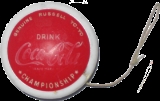
yo-yo in its simplest form is an object consisting of an
axleAn axle is a central shaft for a rotating wheel or gear. On wheeled vehicles, the axle may be fixed to the wheels, rotating with them, or fixed to its surroundings, with the wheels rotating around the axle. In the former case, bearings or bushings are provided at the mounting points where the axle...
connected to two disks, and a length of
twineTwine is a light string or strong thread composed of two or more smaller strands or yarns twisted together. More generally, the term can be applied to any thin cord....
(usually called a
stringGenerally, string is a flexible piece of rope or twine which is used to tie, bind, or hang other objects.Examples of string use include:* For flying kites* string figures, designs formed by weaving string around one's fingers...
) looped around the axle, similar to a slender
spoolSpool can mean one of the following:*Spool, a usually low-flanged or unflanged cylinder on which thread, wire, cable, paper, film, or tape is wound for distribution or use....
. It is played by holding the free end of the string (usually by inserting one finger in a
slip knotA slip knot is one of two different classes of knot. The most common are knots which attach a line to an object and tighten when tension is applied to the free end of the line...
) allowing gravity or the force of a throw to spin the yo-yo and unwind the string, then allowing the yo-yo's spin to wind itself back to one's hand; Often called "yo-yoing". First made popular in the 1920s, yo-yoing remains a popular pastime of many generations and cultures.
In the simplest play, the string is intended to be wound on the spool by hand; The yo-yo is thrown downwards, hits the end of the string, then winds up the string toward the hand, and finally the yo-yo is grabbed, ready to be thrown again. Many other tricks exist, most based on the basic
sleeperThe Sleeper, or throwdown is one of the most common yo-yo tricks. It is considered required state before many other tricks can be performed...
trick.
One of the most famous tricks on the yo-yo is "walk the dog". This is done by throwing a strong sleeper and allowing the yo-yo to roll across the floor, before tugging it back to the hand.
English historical names for the yo-yo include
bandalore (from French) and
quiz. French historical terms include
bandalore,
incroyable,
de Coblenz,
emigrette, and
joujou de Normandie (
joujou meaning little toy).
History
The earliest surviving yo-yo dates to 500 BC and was made using
terra cottaTerracotta, Terra cotta or Terra-cotta is a clay-based unglazed ceramic, although the term can also be applied to glazed ceramics where the fired body is porous and red in color...
skin disks. A
GreekAncient Greek is the stage of the Greek language in the periods spanning the times c. 9th–6th centuries BC, , c. 5th–4th centuries BC , and the c. 3rd century BC – 6th century AD of ancient Greece and the ancient world; being predated in the 2nd millennium BC by Mycenaean Greek...
vase painting from this period shows a boy playing yo-yo (see right). Greek records from the period describe toys made out of wood, metal, or painted terra cotta (fired clay). The terra cotta disks were used to ceremonially offer the toys of youth to certain gods when a child came of age—discs of other materials were used for actual play.
Origin of name and the Filipino yo-yo
Webster’s Collegiate Dictionary states that the word "yo-yo" derives from the northern Philippine
Ilokano languageIlokano or Ilocano is the third most-spoken language of the Republic of the Philippines....
word "yóyo".
Many other sources including Panati's
Extraordinary Origins of Everyday Things say that "yo-yo" was a
TagalogTagalog is an Austronesian language spoken as a first language by a third of the population of the Philippines and as a second language by most of the rest. It is the first language of the Philippine region IV and of Metro Manila...
word supposedly meaning "come-come" or "return". Debate exists over whether or not the yo-yo was used as a weapon in the Philippines.
Lucky Meisenheimer, author of "Lucky's Collectors Guide to 20th Century Yo-Yos - History and Values", characterizes this as popular but fabricated.
The allegation was nevertheless used in a Diet Mountain Dew ad from 2008 as part of the drink's "Surprising Facts" ad campaign.
In the Filipino design, one continuous piece of string, double the desired length, is twisted around itself to produce a loop at one end which is fitted around the axle. Also termed a
looped slip-string, this seemingly minor modification allows for a far greater variety and sophistication of motion, thanks to increased stability and suspension of movement during free spin.
The principal distinction between the Filipino design and more primitive yo-yos is in the way the yo-yo is strung. In older (and some remaining inexpensive) yo-yo designs, the string is tied to the axle using a knot. With this technique, the yo-yo just goes back-and-forth; it returns easily, but it is impossible to make it sleep.
Surprisingly, this innovation in the string design is useful even for off-string yo-yo play, in which the yo-yo is not attached to the string at all. The looped winding ensures that the free end of the string has no bulges, splices, or other deformities, which can cause the string to jam uncontrollably in off-string play.
Birth of the modern yo-yo
James L. Haven and Charles Hettrick of Cincinnati, Ohio, USA, received the first
United StatesThe United States of America is a federal constitutional republic comprising fifty states and a federal district...
patentA patent is a form of intellectual property. It consists of a set of exclusive rights granted by a sovereign state to an inventor or their assignee for a limited period of time in exchange for the public disclosure of an invention....
on "...an improved construction of the toy, commonly called a bandelore..." in 1866.
However, the yo-yo would remain in relative obscurity until 1928 when a
Filipino AmericanFilipino Americans are Americans of Filipino ancestry. Filipino Americans, often shortened to "Fil-Ams", or "Pinoy",Filipinos in what is now the United States were first documented in the 16th century, with small settlements beginning in the 18th century...
named
Pedro FloresPedro Flores is widely considered as the first yo-yo maker in the US and with his Flores yo-yo created the start of an international craze.-Early history:Pedro Flores was born in Vintar, Ilocos Norte, Philippines and came to the United States in 1915...
opened the
Yo-yo Manufacturing Company in
Santa Barbara, CaliforniaSanta Barbara is the county seat of Santa Barbara County, California, United States. Situated on an east-west trending section of coastline, the longest such section on the West Coast of the United States, the city lies between the steeply-rising Santa Ynez Mountains and the Pacific Ocean...
. The business started with a dozen handmade toys; by November 1929, Flores was operating two additional factories in
Los AngelesLos Angeles , with a population at the 2010 United States Census of 3,792,621, is the most populous city in California, USA and the second most populous in the United States, after New York City. It has an area of , and is located in Southern California...
and Hollywood, which altogether employed 600 workers and produced 300,000 units daily.
The Duncan era
Shortly thereafter (
ca. 1929), an entrepreneur named
Donald DuncanDonald F. Duncan, Sr. was an American entrepreneur and inventor, and founder of the Duncan Toys Company.Donald Duncan is most commonly associated with the Yo-Yo, the commercial success and iconic status they enjoyed during the 20th century in the United States and the world being largely the...
recognized the potential of this new fad and purchased the Flores Yo-yo Corporation and all its assets, including the Flores name, which was transferred to the new company in 1932. Duncan's first yo-yo thereafter was the Duncan O-BOY. Duncan is reputed to have paid more than $250,000, a fortune by
depression eraThe Great Depression was a severe worldwide economic depression in the decade preceding World War II. The timing of the Great Depression varied across nations, but in most countries it started in about 1929 and lasted until the late 1930s or early 1940s...
standards. It turned out to be a sound investment, making many times this amount in the years to follow.
In 1946, the
Duncan Toys CompanyThe Duncan Toys Company is an American toy manufacturer based in Middlefield, Ohio, best known for its Yo-yo line. The company was founded in 1929 by Donald Duncan. In 1968, it became a division of Flambeau, Inc..- Yo-yo Product Line :...
opened a yo-yo factory in
Luck, WisconsinLuck is a village in Polk County, Wisconsin, United States. The population was 1,210 at the 2000 census.-Geography:Luck is located at ....
, prompting the town to dub itself 'Yo-yo Capital of the World'.
The Duncan yo-yo was inducted into the
National Toy Hall of FameThe National Toy Hall of Fame is an American hall of fame that recognizes the contributions of toys and games that have sustained their popularity for many years...
at
The StrongThe Strong is an interactive, collections-based educational institution in Rochester, New York, USA, devoted to the study and exploration of play...
in
Rochester, New YorkRochester is a city in Monroe County, New York, south of Lake Ontario in the United States. Known as The World's Image Centre, it was also once known as The Flour City, and more recently as The Flower City...
, in 1999.
1960s resurgence
Declining sales after the
Second World WarWorld War II, or the Second World War , was a global conflict lasting from 1939 to 1945, involving most of the world's nations—including all of the great powers—eventually forming two opposing military alliances: the Allies and the Axis...
prompted Duncan to launch a comeback campaign for his trademarked "Yo-Yo" in 1962 with a series of
televisionTelevision is a telecommunication medium for transmitting and receiving moving images that can be monochrome or colored, with accompanying sound...
advertisementsAdvertising is a form of communication used to persuade an audience to take some action with respect to products, ideas, or services. Most commonly, the desired result is to drive consumer behavior with respect to a commercial offering, although political and ideological advertising is also common...
. The media blitz was met with unprecedented success; thanks in great part to the introduction of the Duncan Butterfly, the yo-yo was more accessible to the beginner than ever.
This success would be short-lived, however, and in a landmark
trademarkA trademark, trade mark, or trade-mark is a distinctive sign or indicator used by an individual, business organization, or other legal entity to identify that the products or services to consumers with which the trademark appears originate from a unique source, and to distinguish its products or...
case in 1965, a federal court's appeals ruled in favor of the Royal Tops Company, determining that
yo-yo had become a part of common speech and that Duncan no longer had exclusive rights to the term. As a result of the expenses incurred by this legal battle as well as other financial pressures, the Duncan family sold the company name and associated trademarks in 1968 to Flambeau, Inc, who had manufactured Duncan's plastic models since 1955. , Flambeau Plastics continues to run the company.
The rise of the ball bearing
The 1970s and 1980s saw a number of innovations in yo-yo technology, primarily dealing with the connection between the string and the axle. In 1978, dentist and yo-yo celebrity Tom Kuhn patented the “No Jive 3-in-1” yo-yo, creating the world's first "take-apart" yo-yo, which enabled yo-yo players to change the axle.
In 1980, Michael Caffrey patented what would later become the Yomega Brain, a yo-yo with a centrifugal clutch transaxle. Designed with a free-spinning plastic sleeve linkage, "The Brain" could spin much longer than previous fixed-axle designs. In addition, the axle was "clutched" with spring-loaded weights which would pull away from the axle at higher speeds and grab again at lower speeds. The result is an automatic return of the yo-yo when speed drops below a given threshold.
Swedish bearing company
SKFSKF, Svenska Kullagerfabriken AB , later AB SKF, is a Swedish bearing company founded in 1907, supplying bearings, seals, lubrication and lubrication systems, maintenance products, mechatronics products, power transmission products and related services globally.-History:The company was founded on...
briefly manufactured novelty yo-yos with ball bearings in 1984.
Tom Kuhn introduced the SB-2 yo-yo that had an aluminum transaxle, making it the first successful ball-bearing yo-yo .
In all transaxle yo-yos, ball bearings significantly reduce friction when the yo-yo is spinning, enabling longer and more complex tricks. Subsequent yo-yoers used this ability to their advantage, creating new tricks that had not been possible with fixed-axle designs.
1990s technological renaissance
The 1990s saw a resurgence of the popularity of the yo-yo and yo-yo culture.
Continued development of yo-yo technology is evident in the widespread sale of the Yomega Brain, based on Michael Caffrey's design, and the Playmaxx Pro-yo, a take-apart fixed axle yo-yo.
In 1990, Tom Kuhn released the SB-2 yo-yo (short for Silver Bullet 2), a high-performance ball bearing transaxle made with aluminum. This marked a major breakthrough for the modern yo-yo, as it was the first ball bearing yo-yo that actually worked. This ensured extremely long spin times and the ability to return as well. This yo-yo, (along with his many other accomplishments in the yo-yo world), eventually brought him the title "Father of the modern yo-yo," receiving the "Donald F. Duncan Family Award for Industry Excellence" in 1998. He was the first to receive this award.
In the late 1990s, Yomega partnered with HPK Marketing and helped fuel the yo-yo boom that spread across the globe. From this partnership, Team High Performance was born, a group of skilled demonstrators that toured the world. In this period, Yomegas were heavily marketed in Japan, where
Bandaiis a Japanese toy making and video game company, as well as the producer of a large number of plastic model kits. It is the world's third-largest producer of toys . Some ex-Bandai group companies produce anime and tokusatsu programs...
produced several yo-yos under the Yomega name which were sometimes different from those sold in the US.
At the turn of the century, 1999–2000, Yomega partnered with McDonald's and distributed a large number of Yomega X-Brain and Firestorm yo-yos at outlets throughout the US.
Another development around this time included the use of different materials such as billet machined Aluminum as seen in the ‘Dif-e-Yo’ Range.
Online Community
Many yo-yo enthusiasts are members of the online yo-yo community. Using social media sites such as YouTube, Facebook, Twitter, and yo-yo store forums, players discuss news topics, trade tricks, and trade yo-yo collectables. The most popular forums are attached to yo-yo stores such as
YoYoNation.com,
YoYoExpert.com, and
YoYoGuy.com. Many yo-yo manufactures also have their own blogs or forums such as
YoYoFactory.com,
OneDropDesigns.com,
Yo-Yo.com and
Yomega.com. Recently there has also been a rise of personal news and review blogs on the subject of yo-yos. A popular yo-yo culture website is
YoYoSkills.com, a personal blog dedicated to collecting and publishing news pertinent to the yo-yo community
Yo-yo contests
A yo-yo competition normally consists of two parts, a set of
compulsory tricks and a
freestyle, where points are scored for each and the winner is the yo-yoer who scores the most points. Compulsory tricks (also known as a trick ladder) are a set of tricks that have been chosen before the contest, and the competitor must successfully complete each trick on their first or second attempt to score points. The freestyle is when the yo-ist performs a routine to their choice of music in front of a panel of judges, and is judged based on difficulty of the tricks, synchronization with the music and artistic performance.
The
World Yo-Yo ContestThe World Yo-Yo Contest is a contest of yo-yo competitors from around the worldhosted by Gregory Cohen and YoYoGuy.com. As of 2006, 19 countries fed into the World Yo-Yo Contest from their respective national yo-yo contests. Also in 2006, almost 700 people were in attendance...
is held every year in Orlando, Florida and is hosted by
YoYoGuy.com during early August or late July. This contest takes the winners from national yo-yo contests around the world and pits them against each other. Japanese players in particular have risen to the top of the yo-yo world. The eleven-time, double-handed world champion Shinji Saito—considered the best in the world—is Japanese. Countries such as the United States, Brazil, Japan and the UK hold competitions at the national and regional levels. In addition, national yo-yo contests, without regionals, are held every year by Mexico, Taiwan, Singapore, Hong Kong, Korea, France, Germany, Switzerland, The Czech Republic, Hungary, and Australia.
The
International Yo-Yo Open was held annually in August at South Street Seaport in New York City from 2007 to 2009, but is "on hiatus" in 2010. This contest is hosted by YoYoNation.com and aims to showcase the best yo-yo players in the world. In the inaugural 2007 contest, there were over 8,500 people in attendance and the event received almost 30 million media impressions. Besides US contests, European contests are becoming better and better. Hungary and the Czech Republic are the leaders of European yoyoing. In Prague (Czech Rep.) the
european championship is held, and in Sopron(Hungary) the
Sopron International Yo-Yo Contest Hosted by
sleeper.hu
The
TV TimesTVTimes is a television listings magazine published in the United Kingdom by IPC Media, a subsidiary of Time Warner. It is known for its access to television actors and their programmes. In 2006 it was refreshed for a more modern look, increasing its emphasis on big star interviews and soaps...
world yo-yo championship was held in the United Kingdom in 1974 with heats across the United Kingdom and a final in London in 1975, the championship was sponsored by the Louis Marx toy company with the 'Lumar' brand of yo-yo. The competition was judged by a celebrity panel in each city and also Lumar demonstrator and European yo-yo champion Don Robertson. The winner of the final was
Simon HarrisSimon Harris , is predominantly known as the owner and founder of the record label Music of Life and writer/producer of most of its extensive catalog of songs, although he is also an influential DJ, award winning producer, remixer of several Grammy Award winning artists and pioneer of electronic...
(intermediate category). The championship was not repeated.
Contest divisions
Currently there are nine yo-yo divisions to compete in:
- 1A-The player uses a long sleeping yo-yo to perform string tricks which usually require the manipulation of the string.
- 2A-The player uses two yo-yos simultaneously to perform reciprocating or looping tricks. This tends to be the most visually entertaining style with some players incorporating acrobatics into their routines.
- 3A-The player uses two long spinning yo-yos to perform tricks that involve manipulation of the string.
- 4A-The player uses an offstring yo-yo, often releasing the yo-yo into the air and attempting to catch it on the string.
- 5A-The player uses a yo-yo with a counterweight on the other end of the string rather than having it attached to a finger.
- AP-This is Artistic Performance where the yoist uses any type of yo-yo or other prop in order to perform a freestyle.
- CB-This is the Combined Division held only at the world competition, where players have to compete and demonstrate skill in multiple styles.
- 1S-The player must perform 25 string tricks to the regulation standards and can only miss one trick.
- 2S-The player must perform 25 looping tricks to regulation standards and can only miss one trick.
Competitors usually bring a number of yo-yos to the performance stage with them to allow for mid-routine replacements in the case of knots/jams (common with string tricks), string breakage (common with looping tricks), or drops (common with offstring tricks).
Top 3 Players as of 2011:
(results Taken From the World Yo-Yo Contest)
1st. Marcus Koh
2nd. Sebastian Brock
3rd. Gentry Stein
Popular Literature
David Sutherland's comic children's story
Alma and the Magic Yo-Yo is based on an imaginary yoyo competition, the Hollywood Yoyo Universathon.
2010 World Yo-Yo Contest Results for 1A
1st. Jensen Kimmitt
2nd. Hiroyuki Suzuki aka Mickey
3rd. Christopher Chia
2011 World Yo-Yo Contest Results for 1A
1st. Marcus Koh
2nd. Sebastian Brock
3rd. Gentry Stein
Sleeping
Keeping a yo-yo spinning while remaining at the end of its uncoiled string is known as
sleepingThe Sleeper, or throwdown is one of the most common yo-yo tricks. It is considered required state before many other tricks can be performed...
. Sleeping is the basis for nearly all yo-yo tricks other than looping, the player first putting the yo-yo in a "sleep" before throwing the yo-yo around using its string. Most modern yo-yos have a transaxle or ball bearing to assist this, but if it is a fixed axle yo-yo, the tension must be loose enough to allow this. The two main ways to do this are (1), allow the yo-yo to sit at the bottom of the string to unwind, or (2) perform lariat or UFO to loosen the tension
(see yo-yo basics for video demonstration of throw down, sleeper, and UFO using a responsive yo-yo).
In competition, mastery of sleeping is the basis for the 1A division. Inexpensive fixed-axle yo-yos usually spin between 10–20 seconds, while expensive ball bearing yo-yos (such as the dark magic) can spin about 1–4 minutes depending on the throw , the world record sleep times were 3m51.540s for fixed-axle and 21m15.170s for transaxle yo-yos.
Looping
Looping is a yo-yo technique which emphasizes keeping the body of the yo-yo in constant motion, without sleeping.
Yo-yos optimized for looping have weight concentrated in their centers so they may easily rotate about the string's axis without their mass contributing to a resistance due to a gyroscopic effect.
In yo-yo competitions, looping plays a strong role in the 2A division. Looping both to the inside and outside of the hand with the yo-yo.
Off-string
In the "off-string" technique, the yo-yo's string is not tied directly to the yo-yo's axle, and the yo-yo is usually launched into the air by performing a "forward pass" to be caught again on the string.
However, some players can 'throw down' off-string yo-yos and catch it on the string just as it leaves the end of the string by pivoting the string around a finger as it unwinds, so that the yo-yo is caught on the string. This is exactly the opposite of a "forward pass", but with the same result.
Yo-yos optimized for off-string tricks have flared designs, like the butterfly shape, which makes it easier to land on the string, and often have soft rubber rings on the edges, so minimum damage is inflicted on the yo-yo, the player, or anyone who happens to be standing nearby, should a trick go wrong.
Yo-yo competitions have the 4A division for off-string tricks.
Off-string Tricks include: Main Pass, Flea Bounce, and Eli hops
Freehand
In
freehand(5A) tricks, the yo-yo's string is not tied to the player's hand, instead ending in a counterweight. The counterweight is then thrown from hand to hand and used as an additional element in the trick.
Developed in 1999 by
Steve BrownSteve Brown is an award winning competitive yo-yo player, competition judge, and yo-yo designer currently based out of Cleveland Heights, Ohio. In 2001, the National Yo-Yo League named him as one of eight National Yo-Yo masters. He has designed multiple yo-yos, including the "Cherry Bomb" for Team...
, as of 2008 freehand is considered to be the fastest-growing style of yo-yo play. Steve Brown was awarded a patent on his freehand yo-yo system, which was assigned to Flambeau Products (
Duncan'sThe Duncan Toys Company is an American toy manufacturer based in Middlefield, Ohio, best known for its Yo-yo line. The company was founded in 1929 by Donald Duncan. In 1968, it became a division of Flambeau, Inc..- Yo-yo Product Line :...
parent company).
In yo-yo competitions, counterweight yo-yos are emphasized in the 5A division.
Yo-yo shapes
Yo-yo bodies come in a number of form factors or "silhouettes," each designed with specific advantages in mind. However, there are three popular configurations.
Imperial
The Imperial shape is often considered the original yo-yo shape, and is very commonly recognized. It is sometimes called a sculpted design. The shape's design is helpful in performing looping tricks. It was first produced by Pedro Flores, who is also the first person to mass-produce yo-yo. Duncan bought the rights to the design in 1929.
Modified
The modified shape is a very popular design for looping style tricks. This shape is also known as a flywheel or modern shape. It usually has a hollowed face (sometimes covered with paper or plastic) with extra material left in the rim. The modified shape yo-yo is also used for string tricks because of the long spin times due to its shape.
Butterfly
Duncan released its first wooden butterfly yo-yo. Wayne Lundberg, the inventor, was one of the demonstrators. The butterfly looks a bit like the separated halves of a standard yo-yo that have been reconnected back-to-back. The wider string gap to make it easier to catch the yo-yo body on the string. Although the butterfly shape is good for 'string tricks,' it is not good for 'looping' tricks, because the winged shape of the body does not allow it to easily flip while looping. This shape is similar to a small
DiaboloThe diabolo is a juggling prop consisting of a spool which is whirled and tossed on a string tied to two sticks held one in each hand. A huge variety of tricks are possible using the sticks, string, and various body parts...
, sometimes called a Chinese yo-yo.
Newer shapes
Introduced to the "yo-yoing community" only within the past few years, many yo-yos are being produced with wide-gaps, H-shapes, and dimples. Wide-gap yo-yos are not exclusive to any one yo-yo manufacturer and as their name suggests, have a wider gap. The wide gap allows more layers of string to be stacked in the yo-yo, and tricks using string slack or lacerations. The drawback for this shape is that the yo-yo does not return to the player's hand unless bound through the use of a front or under mount. H-shaped yo-yos are much like the butterfly-shaped, but the center (toward the bearing/axle) is offset to a smaller diameter to add to circumferential weight and allow for easy "grinding" tricks. Utilizing the technology of a golf ball, dimples are found in Roo-Yo (Italian yo-yo manufacturer) yo-yos and reduce air friction.
Other shapes
There are, of course, many other shapes. Other less popular shapes are: Humphrey, Ball, Slimline, Russell Style (Bulge Face), Puck, Satellite, Coaster and Riveted Disk.
Weight distribution
Each silhouette may have more weight distributed at either the center of the yo-yo or the edge. More weight towards the rim will make the yo-yo more stable for string tricks; more weight towards the center will make the yo-yo easier to turn and therefore better for looping tricks.
Heavier yo-yos will have more angular momentum when spinning at a given speed, and thus will spin freely for a longer period.
Body
Most modern yo-yos are made from a
"take-apart" design, designed to be taken easily apart and reassembled by the player. This design was first created by Tom Kuhn. This enables the replacement of yo-yo components, including the string, renewable friction sources, or even trans-axle components.
In order to increase spin times, extra weight was added to the outermost portion of the yo-yo. The first to do this was Dale Oliver (Spintastics Skill Toys, Inc) with the addition of steel rings when he brought out the Tigershark yo-yo early in 1998.
Some take-apart designs allow the player to reconfigure the yo-yo's halves. In the Tom Kuhn No Jive 3-In-1, the halves may be attached in three different configurations, resulting in a traditional, butterfly, or "pagoda" silhouette. In the Yo-yo Factory FlyMaster, the body has two different "shells" to convert to and from an off-string yo-yo.
Another innovation to the yo-yo is the ability to adjust the gap between the two halves of the yo-yo, in order to increase or decrease response. In most designs, this is accomplished by twisting the yo-yo halves, but some designs (such as the Tom Kuhn Silver Bullet) can be disassembled for adjustment without twisting. This second option eliminates the possibility of the yo-yo coming out of adjustment during play.
- John Jerome McAvoy, Jr. was awarded patents for the gap-adjustable yo-yo: patent #5389029 on February 14, 1995, and #6066024 on May 23, 2000.
- In 1998, HSPIN launched the Handquake series of yo-yos, which sported an adjustable gap by using shims of 0.1-0.5mm thickness. By adding or removing shims, the gap could be widened or shrunk by +/- 1mm.
- Harry Baier (creator of the "Mondial" yo-yo) and the Flambeau Products Company (owner of Duncan) were awarded patent #6162109 on December 19, 2000 for a gap-adjustable yo-yo which has discrete positions for specific gap widths. This patent was first implemented in the CameYo Mondial before being bought by Duncan.
- YoYoFactory's productline of Speed Dial yo-yo's feature "Fully Adjustable Starburst Technology" which allow the gap to be adjusted using a dial on the yo-yo. This allows for a more discrete response setting that stays the same after the yo-yo is taken apart and put back together.
Axle/bearing differentiation
The basic innovation since the 1990s is the
transaxle, a system where the string is not directly connected to the axle that connects the two halves of the yo-yo.
- Fixed axle yo-yos are represented by the original yo-yo design popularized in the first half of the 20th century, where the axle is directly connected to the string and halves of the yo-yo body. In order to enable the throwing of a "sleeper", the player must ensure the string is not wound too tightly around the axle, because it must freely spin in order to accomplish this move. Yo-yos designed for "looping" tricks tend to be fixed-axle yo-yos.
- Some more exotic fixed-axle yo-yos have axles made from low-friction materials such as ceramic alloys—this allows for easier "sleeping," which is essential for string tricks.
- The majority of trick yo-yos sold are Bearing transaxle yo-yos. In these transaxle yo-yos the string is not connected to the axle directly, but rather it is wrapped about a ballrace bearing. The bearing, in turn, surrounds the true axle of the yo-yo. In this way, the body of the yo-yo may spin freely about the string's point of contact.
- There are transaxle systems which do not use a ball bearing, such as the Duncan ProFire and Yomega Fireball. These use a low-friction metal or plastic collar around the axle.
- The clutch transaxle, innovated by Yomega with the Yomega Brain, is a transaxle that can be engaged or disengaged.
- the Yomega Brain is a centrifugal clutch transaxle-- when spinning at a sufficiently high speed, counterweights inside the yo-yo body disengage the axle, automatically allowing the yo-yo to "sleep." Conversely, when the speed slows below the threshold, the yo-yo will return automatically.
- Other clutch transaxles feature a manual switch which can engage or disengage the axle.
Friction sources
With the innovation of the transaxle, the notion of a yo-yo's
response has become important to players. The "response" is a qualitative estimate of how easily the yo-yo will exit a "sleep" and return to the hand of the player.
- A starburst is a series of bumps molded onto the inner surface of each half of the yo-yo. The bumps form a star pattern, radiating out from the axle that protrudes into the yo-yo's gap where it can snag upon the string. Because the starburst is an integral part of the yo-yo body, the yo-yo's responsiveness cannot be easily adjusted. Depending upon the material the yo-yo is made from, some starbursts can last the life of the yo-yo, but on many plastic yo-yos, the friction between the string and the yo-yo can eventually wear away the starburst.
- A Reverse starburst is an arrayed pattern of grooves or recesses that are engraved or molded into the inner faces of the yo-yo. Because they do not protrude into the gap, they are claimed to offer a smoother response system that is less likely to wear away due to string friction. Reverse stabursts were invented and patented by the Playmaxx company.
- An O-ring response system is a rubber ring embedded in a recessed groove in the inside side wall of each half of the yo-yo body, surrounding the axle. Because it is made of a weaker material than the body, it wears down and is designed to be replaceable.
- Silicone
Silicones are inert, synthetic compounds with a variety of forms and uses. Typically heat-resistant and rubber-like, they are used in sealants, adhesives, lubricants, medical applications , cookware, and insulation....
, like the O-ring, is a rubber component recessed into the side of the yo-yo around the axle. However, using silicone results in a far less responsive yo-yo than would a rubber O-ring, and so silicone is typically used in higher level unresponsive play.
- Friction stickers, popularized by Duncan, are O-shaped stickers that affix to the inside wall of each half of the yo-yo body, and are slightly tacky to the touch. They are made to be replaceable. Many brands of friction stickers are now produced. Each give a unique feeling to the yo-yo. They are commonly made out of silicone, rubber, or a cloth material.
- Brake Pads, the friction sticker's predecessor, are made of cork rubber and the first patented sticker response system. It was used mainly in the Turbo Bumble Bee and other Playmaxx ball bearing products. The Playmaxx company was later renamed Proyo and was bought by Duncan. Duncan still produces some of the models using brake pads.
- Hybrid, a combination of O-ring and Starburst, O-ring and a friction sticker, starburst and a friction sticker, and so on. This is mostly found in butterfly shaped yo-yos. Mostly used by Yoyojam, the most popular example being the Dark Magic, or the Hitman.
Hubstacks
Hubstacks are bearings added to the hub (the outside) of a yo-yo and covered with some form of side cap to allow it to be held while it spins. With the side cap bearing you can hold the yo-yo in many different planes and perform different styles of tricks which are difficult, or impossible in some cases, to be performed with conventional yo-yos. "Hubstacks" is the preferred name from YoYoFactory and is most commonly used, however other yo-yo makers have other terms such as bearing caps (Anyyoyo), synergy caps (Yoyojam), and jimmy hats (Werrd). One of the problems associated with side bearings is the tendency for the bearings to fall off. YoYoFactory currently has a patented design that uses rubber rings to hold the bearing by its seat onto the side hubs, keeping the bearing on the yo-yo.
Performance accessories
A number of yo-yo accessories are available as "after-market" modifications—players buy items separately from the yo-yo to augment performance over the original model shipped from the factory.
- Ceramic bearings tend to spin longer and be more durable.
- Dif-E-Yo Konkave bearings are tapered inward on perimeter, to force the string into the center of the axle to prevent the string from rubbing on the sides of the yo-yo.
- Center-Trak bearings are very similar to Konkave, except they have a flat center, and a sharp edge slope.
- Friction stickers different "grips" other than the ones shipped with the yo-yo, are available as a separate purchase to customize the user's style of play.
- Brake Pads Similar to friction stickers, however they break down quicker and can only be used in specific yo-yos.
- High-tensile, Slick Strings, generally made from polyester and cotton, are added by some players to improve sleep times (thinner string touches less of the yo-yo gap) and for better looping (low friction string performs "faster" and will not break as easily).
- Weight rings are affixed to the yo-yo's rim to increase the weight and percentage of mass at the yo-yo's rim, thus improving sleep time.
Modifications
Some yo-yoers have their yo-yo modified (or modded) by themselves or by a yo-yo 'Modder' to achieve desired performance. Some of the most popular mods are:
- Satining, sanding the outside of the yo-yo with high grit sandpaper to improve grinds.
- Beadblasting, usually only done on metal yo-yos, is abrasive blasting the yo-yo with glass beads to slightly pit the surface improving grinds.
- Mediablasting, When other forms of media are used other than beads as a surface on yoyos. One popular example is using baking soda in a process called sodablasting.
- Siliconing, is filling the friction sticker recess with silicone to change the response of the yo-yo.
- Shmooving, cutting small shallow grooves into the face of the yo-yo, where the string rubs, to reduce friction and increase sleep times.
- Dyeing, is dyeing yo-yo to change its color or add a design.
- Anodizing, only done on aluminium and titanium yo-yos, changes the color of an aluminium or titanium yo-yo and increases durability slightly.
- Recessing, when part of the inner wall surrounding the bearing is lower than the surrounding inner wall of the yoyo. This reduces response.
- Bearingization, when a bearing is added to a yoyo that does not normally accept ball bearings like adding a Yomega Maverick bearing to a Yomega Fireball
Exotic materials
Originally manufacturing yo-yos from wood, yo-yo technology improved in the 1960s when the industry switched to plastic. Benefits of a plastic yo-yo include the uniform weight distribution only possible with plastic, as the natural variations in wood density are undesirable for an even spin.
- new metals – contemporary releases of high-end Yo-yos may be constructed of metal, normally aluminum, steel, titanium, and very rarely, magnesium, gold, copper, and tungsten alloys.
- exotic plastics – the "Milk," by manufacturer Born Crucial; the "Silk," by manufacturer Alchemy; and the "Gung Fu," by manufacturer Death by Yo Yo, are made almost entirely from the low-friction plastic Delrin.
- exotic woods – The "jamboo" manufactured by "Yoyojam" is a free-spin, ball-bearing yo-yo made of bamboo.
Physical mechanism
The operation of a yo-yo comes from
rotational inertiaIn classical mechanics, moment of inertia, also called mass moment of inertia, rotational inertia, polar moment of inertia of mass, or the angular mass, is a measure of an object's resistance to changes to its rotation. It is the inertia of a rotating body with respect to its rotation...
causing the string to be wound in the opposite direction returning the yo-yo. When the string is connected to the shaft with a loop, the yo-yo will continue to spin at the end of the string instead of returning, unless the yo-yo is jerked slightly allowing the slack string to bind and allowing return.
Patents have been issued to create more complicated mechanisms to allow tension control and an adjustable mechanism.