

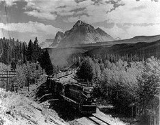
Yellowhead Pass

Encyclopedia
The Yellowhead Pass is a mountain pass
across the Continental Divide
of the Canadian Rockies
. It is located on the border between the Canadian provinces
of Alberta
and British Columbia
, and lies within Jasper National Park
and Mount Robson Provincial Park
.
Due to its modest elevation of 1131 metres (3,710.6 ft) and its gradual approaches, the pass was recommended by Sir Sandford Fleming
as a route across the Rocky Mountains
for the planned Canadian Pacific Railway
. This proposal was rejected in favour of a more direct and southerly route through the more difficult Kicking Horse Pass
, opened in 1886. However, both the Grand Trunk Pacific
and Canadian Northern Railway
s used the Yellowhead Pass for their main lines built circa 1910–1913, and the main line of their successor, the Canadian National Railway
, still follows the route. The pass is now also traversed by the Yellowhead Highway
.
It is believed that the pass was named for Pierre Bostonais (nicknamed Tête Jaune
, French for Yellow Head), an Iroquois
-Métis
trapper employed as a guide by the Hudson's Bay Company
. Bostonais led one of the first expeditions for the company to the interior of B.C. through the pass in 1820.
Mountain pass
A mountain pass is a route through a mountain range or over a ridge. If following the lowest possible route, a pass is locally the highest point on that route...
across the Continental Divide
Continental Divide
The Continental Divide of the Americas, or merely the Continental Gulf of Division or Great Divide, is the name given to the principal, and largely mountainous, hydrological divide of the Americas that separates the watersheds that drain into the Pacific Ocean from those river systems that drain...
of the Canadian Rockies
Canadian Rockies
The Canadian Rockies comprise the Canadian segment of the North American Rocky Mountains range. They are the eastern part of the Canadian Cordillera, extending from the Interior Plains of Alberta to the Rocky Mountain Trench of British Columbia. The southern end borders Idaho and Montana of the USA...
. It is located on the border between the Canadian provinces
Provinces and territories of Canada
The provinces and territories of Canada combine to make up the world's second-largest country by area. There are ten provinces and three territories...
of Alberta
Alberta
Alberta is a province of Canada. It had an estimated population of 3.7 million in 2010 making it the most populous of Canada's three prairie provinces...
and British Columbia
British Columbia
British Columbia is the westernmost of Canada's provinces and is known for its natural beauty, as reflected in its Latin motto, Splendor sine occasu . Its name was chosen by Queen Victoria in 1858...
, and lies within Jasper National Park
Jasper National Park
Jasper National Park is the largest national park in the Canadian Rockies, spanning 10,878 km² . It is located in the province of Alberta, north of Banff National Park and west of the City of Edmonton. The park includes the glaciers of the Columbia Icefield, hot springs, lakes, waterfalls and...
and Mount Robson Provincial Park
Mount Robson Provincial Park
Mount Robson Provincial Park is a large provincial park in the Canadian Rockies with an area of 2,249 km². The park is located entirely within British Columbia, bordering Jasper National Park in Alberta. The B.C. legislature created the park in 1913, the same year as the first ascent of Mount...
.
Due to its modest elevation of 1131 metres (3,710.6 ft) and its gradual approaches, the pass was recommended by Sir Sandford Fleming
Sandford Fleming
Sir Sandford Fleming, was a Scottish-born Canadian engineer and inventor, proposed worldwide standard time zones, designed Canada's first postage stamp, a huge body of surveying and map making, engineering much of the Intercolonial Railway and the Canadian Pacific Railway, and was a founding...
as a route across the Rocky Mountains
Rocky Mountains
The Rocky Mountains are a major mountain range in western North America. The Rocky Mountains stretch more than from the northernmost part of British Columbia, in western Canada, to New Mexico, in the southwestern United States...
for the planned Canadian Pacific Railway
Canadian Pacific Railway
The Canadian Pacific Railway , formerly also known as CP Rail between 1968 and 1996, is a historic Canadian Class I railway founded in 1881 and now operated by Canadian Pacific Railway Limited, which began operations as legal owner in a corporate restructuring in 2001...
. This proposal was rejected in favour of a more direct and southerly route through the more difficult Kicking Horse Pass
Kicking Horse Pass
Kicking Horse Pass is a high mountain pass across the Continental Divide of the Americas of the Canadian Rockies on the Alberta/British Columbia border, and lying within Yoho and Banff National Parks...
, opened in 1886. However, both the Grand Trunk Pacific
Grand Trunk Pacific Railway
The Grand Trunk Pacific Railway was a historical Canadian railway.A wholly owned subsidiary of the Grand Trunk Railway , the GTPR was constructed by GTR using loans provided by the Government of Canada. The company was formed in 1903 with a mandate to build west from Winnipeg, Manitoba to the...
and Canadian Northern Railway
Canadian Northern Railway
The Canadian Northern Railway is a historic Canadian transcontinental railway. At its demise in 1923, when it was merged into the Canadian National Railway , the CNoR owned a main line between Quebec City and Vancouver via Ottawa, Winnipeg, and Edmonton.-Manitoba beginnings:CNoR had its start in...
s used the Yellowhead Pass for their main lines built circa 1910–1913, and the main line of their successor, the Canadian National Railway
Canadian National Railway
The Canadian National Railway Company is a Canadian Class I railway headquartered in Montreal, Quebec. CN's slogan is "North America's Railroad"....
, still follows the route. The pass is now also traversed by the Yellowhead Highway
Yellowhead Highway
The Yellowhead Highway is a major east-west highway connecting the four western Canadian provinces of British Columbia, Alberta, Saskatchewan, and Manitoba. Although part of the Trans-Canada Highway system, the highway should not be confused with the more southerly, originally-designated...
.
It is believed that the pass was named for Pierre Bostonais (nicknamed Tête Jaune
Tête Jaune
Tête Jaune aka. Pierre Bostonais aka. Pierre Hastination an Iroquois-Métis trapper/furtrader/explorer who worked for the North West Company and Hudson's Bay Company during the 18th and 19th centuries...
, French for Yellow Head), an Iroquois
Iroquois
The Iroquois , also known as the Haudenosaunee or the "People of the Longhouse", are an association of several tribes of indigenous people of North America...
-Métis
Métis people (Canada)
The Métis are one of the Aboriginal peoples in Canada who trace their descent to mixed First Nations parentage. The term was historically a catch-all describing the offspring of any such union, but within generations the culture syncretised into what is today a distinct aboriginal group, with...
trapper employed as a guide by the Hudson's Bay Company
Hudson's Bay Company
The Hudson's Bay Company , abbreviated HBC, or "The Bay" is the oldest commercial corporation in North America and one of the oldest in the world. A fur trading business for much of its existence, today Hudson's Bay Company owns and operates retail stores throughout Canada...
. Bostonais led one of the first expeditions for the company to the interior of B.C. through the pass in 1820.