

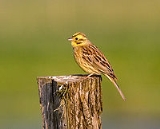
Yellowhammer

Encyclopedia
The Yellowhammer, Emberiza citrinella, is a passerine
bird
in the bunting
family Emberizidae. It is common in all sorts of open areas with some scrub or trees and form small flocks in winter.
The Yellowhammer is a robust 15.5–17 cm long bird, with a thick seed-eater's bill. The male has a bright yellow head, yellow underparts, and a heavily streaked brown back. The female is much duller, and more streaked below. The familiar, if somewhat monotonous, song of the cock is often described as A little bit of bread and no cheese.
Its natural diet consists of insect
s when feeding young, and otherwise seed
s. The nest is on the ground. 3-6 egg
s are laid, which show the hair-like markings characteristic of those of buntings.
and much of Asia
. In parts of Europe it is in serious decline; in the UK the species fell by 54% between 1970 and 2003. In Europe and Asia most birds are resident, but some far northern birds migrate
south in winter.
The Yellowhammer was introduced to New Zealand
in 1862 and is now common and widespread there.
Invertebrates - mainly, but not exclusively - taken through the breeding season:
They are more able to feed on the slower-moving invertebrates.
Passerine
A passerine is a bird of the order Passeriformes, which includes more than half of all bird species. Sometimes known as perching birds or, less accurately, as songbirds, the passerines form one of the most diverse terrestrial vertebrate orders: with over 5,000 identified species, it has roughly...
bird
Bird
Birds are feathered, winged, bipedal, endothermic , egg-laying, vertebrate animals. Around 10,000 living species and 188 families makes them the most speciose class of tetrapod vertebrates. They inhabit ecosystems across the globe, from the Arctic to the Antarctic. Extant birds range in size from...
in the bunting
Bunting (bird)
Buntings are a group of Eurasian and African passerine birds of the family Emberizidae.They are seed-eating birds with stubby, conical bills, and are the Old World equivalents of the species known in North America as sparrows...
family Emberizidae. It is common in all sorts of open areas with some scrub or trees and form small flocks in winter.
The Yellowhammer is a robust 15.5–17 cm long bird, with a thick seed-eater's bill. The male has a bright yellow head, yellow underparts, and a heavily streaked brown back. The female is much duller, and more streaked below. The familiar, if somewhat monotonous, song of the cock is often described as A little bit of bread and no cheese.
Its natural diet consists of insect
Insect
Insects are a class of living creatures within the arthropods that have a chitinous exoskeleton, a three-part body , three pairs of jointed legs, compound eyes, and two antennae...
s when feeding young, and otherwise seed
Seed
A seed is a small embryonic plant enclosed in a covering called the seed coat, usually with some stored food. It is the product of the ripened ovule of gymnosperm and angiosperm plants which occurs after fertilization and some growth within the mother plant...
s. The nest is on the ground. 3-6 egg
Egg (biology)
An egg is an organic vessel in which an embryo first begins to develop. In most birds, reptiles, insects, molluscs, fish, and monotremes, an egg is the zygote, resulting from fertilization of the ovum, which is expelled from the body and permitted to develop outside the body until the developing...
s are laid, which show the hair-like markings characteristic of those of buntings.
Range
It breeds across EuropeEurope
Europe is, by convention, one of the world's seven continents. Comprising the westernmost peninsula of Eurasia, Europe is generally 'divided' from Asia to its east by the watershed divides of the Ural and Caucasus Mountains, the Ural River, the Caspian and Black Seas, and the waterways connecting...
and much of Asia
Asia
Asia is the world's largest and most populous continent, located primarily in the eastern and northern hemispheres. It covers 8.7% of the Earth's total surface area and with approximately 3.879 billion people, it hosts 60% of the world's current human population...
. In parts of Europe it is in serious decline; in the UK the species fell by 54% between 1970 and 2003. In Europe and Asia most birds are resident, but some far northern birds migrate
Bird migration
Bird migration is the regular seasonal journey undertaken by many species of birds. Bird movements include those made in response to changes in food availability, habitat or weather. Sometimes, journeys are not termed "true migration" because they are irregular or in only one direction...
south in winter.
Habitat
It is most commonly found on lowland arable and mixed farmland, probably due to the greater availability of seeds. It nests in hedges, patches of scrub, and ditches, especially if these have a wide grass margin next to them, and a cereal crop next to the margin. Hedges of up to two metres tall are preferred, and they will not nest until it is in full leaf, building the nest next to the hedge if it is built before this. In winter, the flocks feed at good seed sites, such as newly-sown fields and over-wintered stubbles.The Yellowhammer was introduced to New Zealand
New Zealand
New Zealand is an island country in the south-western Pacific Ocean comprising two main landmasses and numerous smaller islands. The country is situated some east of Australia across the Tasman Sea, and roughly south of the Pacific island nations of New Caledonia, Fiji, and Tonga...
in 1862 and is now common and widespread there.
Diet
Seeds of:- Cereal, grasses (e.g. Meadow GrassPoaPoa is a genus of about 500 species of grasses, native to the temperate regions of both hemispheres. Common names include meadow-grass , bluegrass , tussock , and speargrass. "Poa" is Greek for fodder...
, FescueFescueFestuce is a genus of about 300 species of perennial tufted grasses, belonging to the grass family Poaceae . The genus has a cosmopolitan distribution, although the majority of the species are found in cool temperate areas...
, RyegrassRyegrassRyegrass is a genus of nine species of tufted grasses in the Pooideae subfamily of the Poaceae family. Also called tares , these plants are native to Europe, Asia and northern Africa, but are...
), Common Nettle, dockRumexThe docks and sorrels, genus Rumex L., are a genus of about 200 species of annual, biennial and perennial herbs in the buckwheat family Polygonaceae....
, knotgrass Polygonum avicularePolygonum avicularePolygonum aviculare or Common Knotgrass is a plant related to buckwheat and dock. It is also called birdweed, pigweed and lowgrass. It is an annual found in fields and wasteland, with white flowers from June to October....
, Fat Hen Chenopodium albumChenopodium albumChenopodium album is a fast-growing weedy annual plant in the genus Chenopodium.Though cultivated in some regions, the plant is elsewhere considered a weed...
, Common Chickweed Stellaria media, Mouse-ear CerastiumCerastiumCerastium is a genus of annual, winter annual, or perennial plants belonging to the family Caryophyllaceae. The around 100 species are commonly called Mouse-ear chickweed; different species are found nearly worldwide but the greatest concentration is mainly from the northern temperate areas of the...
, BrambleBrambleBrambles are thorny plants of the genus Rubus, in the rose family . Bramble fruit is the fruit of any such plant, including the blackberry and raspberry. The word comes from Germanic *bram-bezi, whence also German Brombeere , Dutch Braam and French framboise...
, Vetches, CloverCloverClover , or trefoil, is a genus of about 300 species of plants in the leguminous pea family Fabaceae. The genus has a cosmopolitan distribution; the highest diversity is found in the temperate Northern Hemisphere, but many species also occur in South America and Africa, including at high altitudes...
, Forget-me-notForget-me-notMyosotis is a genus of flowering plants in the family Boraginaceae that are commonly called Forget-me-nots. Its common name was calqued from the French, "ne m'oubliez pas" and first used in English in c. 1532. Similar names and variations are found in many languages.-Description:There are...
, Dandelion, Knapweed, Sow-thistle CicerbitaCicerbitaCicerbita is a genus of plants in the Asteraceae family.- Description :Cicerbita are mostly quite strong, perennial herbaceous plants. Their leaves are lyre-shaped or toothed pinnate with a terminal lobe which is clearly larger than the side lobes. Some species have only one pair of rather small...
, YarrowYarrowAchillea millefolium or yarrow is a flowering plant in the family Asteraceae, native to the Northern Hemisphere. In New Mexico and southern Colorado, it is called plumajillo, or "little feather", for the shape of the leaves. In antiquity, yarrow was known as herbal militaris, for its use in...
, Plantains PlantagoPlantagoPlantago is a genus of about 200 species of small, inconspicuous plants commonly called plantains. They share this name with the very dissimilar plantain, a kind of banana. Most are herbaceous plants, though a few are subshrubs growing to 60 cm tall. The leaves are sessile, but have a narrow...
Invertebrates - mainly, but not exclusively - taken through the breeding season:
- Springtails, mayfliesMayflyMayflies are insects which belong to the Order Ephemeroptera . They have been placed into an ancient group of insects termed the Palaeoptera, which also contains dragonflies and damselflies...
, grasshopperGrasshopperThe grasshopper is an insect of the suborder Caelifera in the order Orthoptera. To distinguish it from bush crickets or katydids, it is sometimes referred to as the short-horned grasshopper...
, cockroachCockroachCockroaches are insects of the order Blattaria or Blattodea, of which about 30 species out of 4,500 total are associated with human habitations...
, earwigs, bugs HemipteraHemipteraHemiptera is an order of insects most often known as the true bugs , comprising around 50,000–80,000 species of cicadas, aphids, planthoppers, leafhoppers, shield bugs, and others...
, lacewings, caddis flies, sawflies, spiders, woodlice, caterpillarCaterpillarCaterpillars are the larval form of members of the order Lepidoptera . They are mostly herbivorous in food habit, although some species are insectivorous. Caterpillars are voracious feeders and many of them are considered to be pests in agriculture...
s, fliesFlyTrue flies are insects of the order Diptera . They possess a pair of wings on the mesothorax and a pair of halteres, derived from the hind wings, on the metathorax...
, beetleBeetleColeoptera is an order of insects commonly called beetles. The word "coleoptera" is from the Greek , koleos, "sheath"; and , pteron, "wing", thus "sheathed wing". Coleoptera contains more species than any other order, constituting almost 25% of all known life-forms...
s, earthwormEarthwormEarthworm is the common name for the largest members of Oligochaeta in the phylum Annelida. In classical systems they were placed in the order Opisthopora, on the basis of the male pores opening posterior to the female pores, even though the internal male segments are anterior to the female...
s, snailSnailSnail is a common name applied to most of the members of the molluscan class Gastropoda that have coiled shells in the adult stage. When the word is used in its most general sense, it includes sea snails, land snails and freshwater snails. The word snail without any qualifier is however more often...
s
They are more able to feed on the slower-moving invertebrates.