

Yekaterinburg Metro

Encyclopedia
The Yekaterinburg Metro is a rapid transit
system that serves the city of Yekaterinburg
, Russia
.
 Yekaterinburg, formerly called Sverdlovsk, was always known as the informal capital of the Urals
, a natural divide between Europe and Asia, between Siberia and the European Russia. The city grew very rapidly because it was an important industrial centre and a transport hub. Plans for a rapid-transit system began in the late 1970s, and in 1980 construction began.
The city's uneven landscape, as well as its layout with a very dense city centre, prompted to combine deep and shallow stations. On 26 April 1991, the sixth Metro of Russia and the thirteenth and last Metro of the Soviet Union
, which had ceased to exist only a few months later, was finally opened to the public. However, the economic crisis of the early 1990s rocked the Metro very hard and the first stage encompassed only three stations. However, then Russian president Boris Yeltsin
diverted funds to complete its construction and by 1995 the Metro was doubled in length. Since then, only one extension has been built.
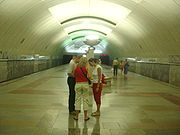
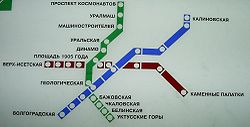 The Metro is a typical Soviet design, which when completed will form a triangle from three lines intersecting in the city centre. The eight stations comprise 12.7 kilometres (7.9 mi) of length and are split between deep and shallow. Of the latter, four are pillar-trispans and one is a single vault (built to Kharkov
technology). The deep-level stations include one pylon, one column and two Leningrad
-technology single vaults, although one was built to an indegious design making it appear as a single deck. Like all ex-Soviet Metros, the stations are elaborately decorated, although economic hardships prevented the full original designs to be implemented.
The Metro is served by one depot, Kalinovskoye, and 62 cars are assigned to it. The annual ridership is approximately 42.8 million people.
Rapid transit
A rapid transit, underground, subway, elevated railway, metro or metropolitan railway system is an electric passenger railway in an urban area with a high capacity and frequency, and grade separation from other traffic. Rapid transit systems are typically located either in underground tunnels or on...
system that serves the city of Yekaterinburg
Yekaterinburg
Yekaterinburg is a major city in the central part of Russia, the administrative center of Sverdlovsk Oblast. Situated on the eastern side of the Ural mountain range, it is the main industrial and cultural center of the Urals Federal District with a population of 1,350,136 , making it Russia's...
, Russia
Russia
Russia or , officially known as both Russia and the Russian Federation , is a country in northern Eurasia. It is a federal semi-presidential republic, comprising 83 federal subjects...
.
History
Ural Mountains
The Ural Mountains , or simply the Urals, are a mountain range that runs approximately from north to south through western Russia, from the coast of the Arctic Ocean to the Ural River and northwestern Kazakhstan. Their eastern side is usually considered the natural boundary between Europe and Asia...
, a natural divide between Europe and Asia, between Siberia and the European Russia. The city grew very rapidly because it was an important industrial centre and a transport hub. Plans for a rapid-transit system began in the late 1970s, and in 1980 construction began.
The city's uneven landscape, as well as its layout with a very dense city centre, prompted to combine deep and shallow stations. On 26 April 1991, the sixth Metro of Russia and the thirteenth and last Metro of the Soviet Union
Soviet Union
The Soviet Union , officially the Union of Soviet Socialist Republics , was a constitutionally socialist state that existed in Eurasia between 1922 and 1991....
, which had ceased to exist only a few months later, was finally opened to the public. However, the economic crisis of the early 1990s rocked the Metro very hard and the first stage encompassed only three stations. However, then Russian president Boris Yeltsin
Boris Yeltsin
Boris Nikolayevich Yeltsin was the first President of the Russian Federation, serving from 1991 to 1999.Originally a supporter of Mikhail Gorbachev, Yeltsin emerged under the perestroika reforms as one of Gorbachev's most powerful political opponents. On 29 May 1990 he was elected the chairman of...
diverted funds to complete its construction and by 1995 the Metro was doubled in length. Since then, only one extension has been built.
Timeline
| Segment | Date opened |
|---|---|
| Prospekt Kosmonavtov–Mashinostroiteley | April 26, 1991 |
| Mashinostroiteley–Uralskaya | December 22, 1992 |
| Uralskaya–Ploshchad 1905 Goda | December 22, 1994 |
| Ploshchad 1905 Goda–Geologicheskaya | December 30, 2002 |
| Geologicheskaya–Botanicheskaya | November 28, 2011 |
Operation
Kharkiv Metro
The Kharkiv Metro is the metro system that serves the city of Kharkiv , the second largest city in Ukraine. The metro was the second in Ukraine and the sixth in the USSR when it opened in 1975.-Lines and Stations:...
technology). The deep-level stations include one pylon, one column and two Leningrad
Saint Petersburg Metro
The Saint Petersburg Metro is the underground railway system in Saint Petersburg and Leningrad Oblast, Russia. It has been open since November 15, 1955.Formerly known as the V.I...
-technology single vaults, although one was built to an indegious design making it appear as a single deck. Like all ex-Soviet Metros, the stations are elaborately decorated, although economic hardships prevented the full original designs to be implemented.
The Metro is served by one depot, Kalinovskoye, and 62 cars are assigned to it. The annual ridership is approximately 42.8 million people.