


Yamato-e

Encyclopedia
Japanese painting
is one of the oldest and most highly refined of the Japanese visual arts, encompassing a wide variety of genres and styles. As with the history of Japanese arts in general, the long history of Japanese painting exhibits synthesis and competition between native Japanese aesthetics and adaptation of...
inspired by Tang Dynasty painting
Tang Dynasty painting
During the Tang Dynasty, as a golden age in Chinese civilization, Chinese painting developed dramatically, both in subject matter and technique. The advancements in technique and style that characterized Tang Dynasty painting had a lasting influenced in the art of other countries, especially in...
s and developed in the late Heian period
Heian period
The is the last division of classical Japanese history, running from 794 to 1185. The period is named after the capital city of Heian-kyō, or modern Kyōto. It is the period in Japanese history when Buddhism, Taoism and other Chinese influences were at their height...
. It is considered the classical Japanese style. From the Muromachi period
Muromachi period
The is a division of Japanese history running from approximately 1336 to 1573. The period marks the governance of the Muromachi or Ashikaga shogunate, which was officially established in 1338 by the first Muromachi shogun, Ashikaga Takauji, two years after the brief Kemmu restoration of imperial...
(15th century), the term Yamato-e has been used to distinguish work from contemporary Chinese style
Chinese painting
Chinese painting is one of the oldest continuous artistic traditions in the world. The earliest paintings were not representational but ornamental; they consisted of patterns or designs rather than pictures. Early pottery was painted with spirals, zigzags, dots, or animals...
paintings (kara-e), which were inspired by Song
Song Dynasty
The Song Dynasty was a ruling dynasty in China between 960 and 1279; it succeeded the Five Dynasties and Ten Kingdoms Period, and was followed by the Yuan Dynasty. It was the first government in world history to issue banknotes or paper money, and the first Chinese government to establish a...
and Yuan
Yuan Dynasty
The Yuan Dynasty , or Great Yuan Empire was a ruling dynasty founded by the Mongol leader Kublai Khan, who ruled most of present-day China, all of modern Mongolia and its surrounding areas, lasting officially from 1271 to 1368. It is considered both as a division of the Mongol Empire and as an...
era paintings.
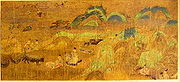
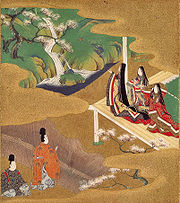
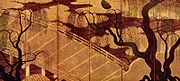
The Yamato-e often tell narrative themes with text along with them, show the beauty of nature, e.g. famous places (meisho-e 名所絵), and the four seasons (shiki-e 四季絵). The pictures are non-symbolic and have the objective of depicting the beauty in nature. The pictures are often on scrolls that can be hung on a wall (掛け物, kakemono
Kakemono
A , more commonly referred to as a , is a Japanese scroll painting or calligraphy mounted usually with silk fabric edges on a flexible backing, so that it can be rolled for storage....
) or handscrolls (emakimono
Emakimono
, often simply called , is a horizontal, illustrated narrative form created during the 11th to 16th centuries in Japan. Emakimono combines both text and pictures, and is drawn, painted, or stamped on a handscroll...
) that could be read from right to left with the accompanied story or on a folding screen (byoubu, 屏風) or panel (shouji, 障子). Although they received their name from the Yamato period
Yamato period
The is the period of Japanese history when the Japanese Imperial court ruled from modern-day Nara Prefecture, then known as Yamato Province.While conventionally assigned to the period 250–710 , the actual start of Yamato rule is disputed...
(大和), Yamato-e pictures rather stand for a style and are not restricted to a particular period. Although the most famous artists painted in sumi-e
Ink and wash painting
Ink and wash painting is an East Asian type of brush painting also known as ink wash painting. Only black ink — the same as used in East Asian calligraphy — is used, in various concentrations....
style in the Muromachi period
Muromachi period
The is a division of Japanese history running from approximately 1336 to 1573. The period marks the governance of the Muromachi or Ashikaga shogunate, which was officially established in 1338 by the first Muromachi shogun, Ashikaga Takauji, two years after the brief Kemmu restoration of imperial...
, this was not characteristic of early pictures.
Yamato-e had a great influence on the Rimpa
Rimpa school
, is one of the major historical schools of Japanese painting. It was created in 17th century Kyoto by Hon'ami Kōetsu and Tawaraya Sōtatsu...
(琳派) and ukiyo-e
Ukiyo-e
' is a genre of Japanese woodblock prints and paintings produced between the 17th and the 20th centuries, featuring motifs of landscapes, tales from history, the theatre, and pleasure quarters...
(浮世絵) styles, as well as the Nihonga
Nihonga
or literally "Japanese-style paintings" is a term used to describe paintings that have been made in accordance with traditional Japanese artistic conventions, techniques and materials...
(日本画).
Yamato-e artists
Famous artists include:- Kose KanaokaKose Kanaokawas a ninth century Japanese artist, who was a proponent of the artistic styles of the Tang dynasty of China. Though few of his works have survived, he is known to have painted landscapes and portraits. He also founded the Kose school of art, which is named for him. He made the first tonal...
- Tosa MitsuokiTosa Mitsuokiwas a Japanese painter.-Tosa Mitsuoki:Tosa Mitsuoki was the successor of the Tosa school after his father, Tosa Mitsunori . Mitsuoki brought the Tosa school to Kyoto after around 50 years in Sakai. When the school was settled in Sakai, Mitsunori painted for townsmen...
- Tosa MitsunobuTosa Mitsunobuwas a Japanese painter, the founder of the Tosa school of Japanese painting. Born into a family that had traditionally served as painters to the Imperial court, he was head of the court painting bureau from 1493 to 1496. In 1518 he was appointed chief artist to the Ashikaga shogunates.- External...