

Y-chromosomal Aaron

Encyclopedia
Y-chromosomal Aaron is the name given to the hypothesised most recent common ancestor of many of the patrilineal Jewish priestly caste known as Kohanim
(singular "Kohen", "Cohen", or Kohane). In the Torah
, this ancestor is identified as Aaron
, the brother of Moses
. The hypothetical most recent common ancestor was therefore jocularly dubbed "Y-chromosomal Aaron", in analogy to Y-chromosomal Adam
.
The original scientific research was based on the discovery that a majority of present-day Jewish Kohanim either share, or are only one step removed from, a pattern of values for 6 Y-STR
markers, which researchers named the Cohen Modal Haplotype (CMH). However it subsequently became clear that this six marker pattern was widespread in many communities where men had Y chromosome
s which fell into Haplogroup J
; the six-marker CMH was not specific just to Cohens, nor even just to Jews, but was a survival from the origins of Haplogroup J, about 30,000 years ago.
More recent research, using a larger number of Y-STR markers to gain higher resolution more specific genetic signatures, has indicated that about half of contemporary Jewish Kohanim, who share Y-chromosomal haplogroup J1c3 (also called J-P58), do indeed appear to be very closely related. A further approximately 15% of Kohanim fall into a second distinct group, sharing a different but similarly tightly related ancestry. This second group fall under haplogroup J2a
(J-M410). A number of other smaller lineage groups are also observed. Only one of these haplogroups could indicate ancestry from Aaron.
The J1e and J2a possible Cohen clusters (only one of them could indicate ancestry from Aaron), when including those tested who are of Sephardi background, have been estimated as descending from most recent common ancestors living 3,200 ± 1,100 and 4,200 ± 1,300 years ago respectively. Ashkenazis only have been estimated by the same article as descending from most recent common ancestors living 2,400 ± 800 and 3,800 ± 1,200 years ago respectively.
), tribal identity, and membership in the group that originally comprised the Jewish priesthood (Cohen or Kohen; plural: Cohanim or Kohanim), has been patrilineal. Modern Kohanim claim descent from a biblical person, Aaron
, brother of Moses
, in the direct lineage from Levi, the patriarch of the Tribe of Levi, great grandson of Abraham
, according to the tradition codified in the Tanakh
(שמות / Sh'mot/Exodus 6). DNA
testing is aiding scholars to trace the lineages found among modern Jewish populations, including contemporary Cohen families, to decipher origins of the people groups who were joined to the ancient Israelites and to identify genetic admixture
and genetic drift
.
For human beings, the normal number of chromosome
s is 46, of which 23 are inherited from each parent. Two chromosomes, the X chromosome
and Y chromosome
, determine sex. Women have two X chromosomes, one inherited from their mother, and one inherited from their father. Men have an X chromosome inherited from their mother, and the Y chromosome inherited from their father.
Males who share a common patrilineal ancestor also share a Y chromosome, diverging only with respect to accumulated mutation
s. Since Y-chromosomes are passed from father to son, all Kohanim men should theoretically have almost identical Y chromosomes; this can be tested with a genealogical DNA test
. As the rate that mutations accumulate on the Y chromosome is relatively constant, scientists can estimate the elapsed time since two men had a common ancestor. (See molecular clock
.) "The Samaritan M267 lineages differed from the classical Cohen modal haplotype at DYS391, carrying 11 rather than 10 repeats", as well as, have a completely different haplogroup, which should have been "J1". Samaritan Kohanim descend from a different patrilineal family line, having haplogroup E1b1b1a (M78) (formerly E3b1a).
by Prof. Karl Skorecki and collaborators from Haifa
, Israel
, in 1997. In their study, "Y chromosomes of Jewish priests," published in the journal Nature
, they found that the Kohanim appeared to share a different probability distribution compared to the rest of the Jewish population for the two Y-chromosome markers they tested (YAP
and DYS19). They also found that the probabilities appeared to be shared by both Sephardic and Ashkenazi Cohens, pointing to a common Cohen population origin before the Jewish diaspora
under the Roman empire.
In a subsequent study the next year (Thomas MG et al., 1998), the team increased the number of Y-STR
markers tested to six, as well as testing more SNP markers. Again, they found that a clear difference was observable between the Kohanim population and the general Jewish population, with many of the Cohen STR results clustered around a single pattern they named the Cohen Modal Haplotype:
Here, becoming increasingly specific, xDE is the proportion who were not in Haplogroups D
or E
(from the original paper); xDE,PR is the proportion who were not in haplogroups D, E, P
, Q
or R
; Hg J is the proportion who were in Haplogroup J
(from the slightly larger panel studied by Behar et al. (2003)); CMH.1 means "within one marker of the CMH-6"; and CMH is the proportion with a 6/6 match. The final two columns show the conditional proportions for CMH.1 and CMH, given membership of Haplogroup J.
The data shows that the Kohanim were more than twice as likely to belong to Haplogroup J than the average non-Cohen Jew. Of those who did belong to Haplogroup J, the Kohanim were more than twice as likely to have an STR pattern close to the CMH-6, suggesting a much more recent common ancestry for most of them compared to an average non-Cohen Jew of Haplogroup J.
Further study published in 2009 found new markers and better defined variant J1e* (now J1c3, also called J-P58*). This research demonstrates that 46.1% of Kohanim carry Y chromosomes belonging to a single paternal lineage (J-P58*) that likely originated in the Near East well before the dispersal of Jewish groups in the Diaspora. Support for a Near Eastern origin of this lineage comes from its high frequency in our sample of Bedouins, Yemenis (67%), and Jordanians (55%) and its precipitous drop in frequency as one moves away from Saudi Arabia and the Near East (Fig. 4). Moreover, there is a striking contrast between the relatively high frequency of J-58* in Jewish populations (»20%) and Kohanim (»46%) and its vanishingly low frequency in our sample of non- Jewish populations that hosted Jewish diaspora communities outside of the Near East.
Thomas, et al. dated the origin of the shared DNA to approximately 3,000 years ago (with variance arising from different generation lengths). The techniques used to find Y-chromosomal Aaron were first popularized in relation to the search for the patrilineal ancestor of all contemporary living human
s, Y-chromosomal Adam
.
or other religious convictions. There was also criticism that the paper's evidence was being overstated.
The detailed breakdown by 6-marker haplotype (the paper's online-only table B) suggests that at least some of these groups (eg E3b, R1b) contain more than one distinct Cohen lineage. It is possible that other lineages may also exist, but were not captured in the sample.
and J2
with no particular link to the Cohen ancestry. These haplogroups occur widely throughout the Middle East and beyond. Thus, while many Cohens have haplotypes close to the CMH, a greater number of such haplotypes worldwide belong to people with no likely Cohen connection at all.
Statistically the value of matching the CMH can be assessed using Bayes' theorem
, which in its odds
form can be written:

In words, this says that the odds in favour of Cohen ancestry C (i.e., the probability of having Cohen ancestry, divided by the probability of not having Cohen ancestry), having observed some piece of data D, is given by the odds one would assign given only one's initial information I, multiplied by the probability of having observed D if C is true, divided by the probability of having observed D if C is false.
(In fact, for convenience we shall work with the reciprocal of this equation, i.e. work in terms of odds against, rather than odds on).
The proportion of the whole male Jewish population that has Cohen ancestry has been estimated at 5%. So if we take that 5% as our initial estimate of the probability of shared Cohen ancestry, then on the basis of the data above:
Even a full 6/6 match for the 6 marker CMH thus cannot "prove" Cohen ancestry. It can only somewhat strengthen a previously existing belief. But for populations where the background probability assessment of shared Cohen ancestry must be vanishingly low, such as almost all non-Jews, even a full 6/6 match makes only a small difference. For individuals in such populations, the CMH likely indicates Haplogroup J, but a completely different ancestry to the Kohanim.

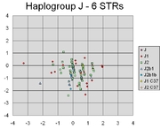
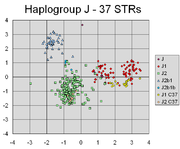 The discussion above applies to the published scientific papers. In principle, additional resolution could be obtained by determining the Cohen haplogroup more narrowly, and/or testing more Y-STR markers to determine whether there is an extended characteristic Cohen haplotype.
of haplogroup J, thus often identified as Y-Aaron.
Nevertheless, various opinions exist about which
Haplogroup the direct descendants of Biblical Aaron belong to.
Note, some lineages of subgroup J2
also, coincidentally, developed a similar set of genetic markers corresponding to the Cohen Modal Haplotype. Low frequencies of individuals with these lineages even exist among Jewish Kohanim, albeit they do not descend from Y-Aaron.
The subdivision of J2 which most closely matches the genetic signature of the J1 Cohens is subclade J2a4b (M67), a large fraction of members of which will also have a 6/6 match for the 6-marker CMH. However, this is an example of haplotype convergence
:
Basically the haplotype "distribution" within one lineage (Haplogroup) overlaps with the haplotype "distribution" of another lineage – it is like overlapping branches from two different trees.
The more likely reason for the match is convergence (coincidence) or sharing a common haplotype in the same lineage (Haplogroup). Convergence: Mutation is a random process and over thousands of years can occur in different lines so that by coincidence, different "lines" end up with "matching" haplotypes. This accidental agreement is called convergence of different genetic lines, which it is believed have been not been closely related for at least the last 10,000 years; the group in J2a4b (M67) who have the 6-marker CMH are devoid of any Cohen traditions in their families.
On the other hand, there are families in Haplogroup J2 who do have a Cohen religious tradition (as there are in several other haplogroups, including Haplogroup R1b). The haplotypes of these Haplotype J2 Kohanim cluster under J2a4h (L24), not the J2a4b (M67) clade. These J2 Kohanim typically have a 4/6 match for the 6-marker CMH (with DYS19=15 rather than 14, and DYS388=15 rather than 16). The J2 Cohens do not match the 12-marker J1-extended CMH. The important difference is the two SNP mutations, M172 and M267. These mutations are believed to be at least 10-15,000 years old; but they are equal co-inheritors of a patrilineal tradition which appears to date back well before the Diaspora. Some suggest that this group may, in fact, descend from the biblical Levi, but not Aaron.
As it happens, three of the four markers for which they do match the CMH-6 were the markers tested by Malaspina et al. (2001). This appears to explain the finding of that paper that "typing a limited number of Italian Cohanim (A. Novelletto unpublished obs.) for the STRs used here, we determined that the Cohen Modal Haplotype ('an important component in the sharing of Ashkenazic and Sephardic Israelite Y chromosomes', Thomas et al. 2000) does indeed belong to network 1.2" (i.e. the population having DYS413a,b<=18, which is the signature of the J2a4 subclades).
, based on further work by much of the same research team. It has not yet been peer group reviewed by other scientists or published in the open technical literature.
The next sequence of rows identify other 6-marker haplotypes in haplogroup J found to occur more than once in the sample of 145 Kohanim tested in Behar et al. (2003) (table B (web-only) in that paper). Probable extensions of these haplotypes to 12 markers are shown, where it has been possible to find corresponding clusters of Cohen-type names in publicly accessible DNA databases, together with the apparent sub-clade of haplogroup J. This is more possible for the apparently Ashkenazi clusters than for Sephardim, who are much less strongly represented in the databases.
Finally, for comparison, the 12-marker modal haplotypes for the haplogroups J1 and J2 are also shown. It is apparent that in both cases, their haplotype clusters are also centred very close to the Cohen modal haplotype. However, because of the much greater time that has elapsed since the mutations occurred that define the haplogroups, there has been much more time for Y-STR mutations to build up; so, although they have almost the same centre as the Cohen cluster, the J1 and J2 haplotype clusters are much more diffusely spread out. Thus although the CMH-6 is also very near to the most probable haplotype for both J1 and J2, its occurrence frequency is only about 1 to 8% amongst arbitrary members of haplogroup J with no particular Cohen connection.
News of 6/6 matches in the Lemba of Southern Africa
were seen as confirming a possible Jewish lineage (Thomas MG et al. 2000); possible links were discussed between the Jews and the Kurds;
and some suggested that 4/4 matches in non-Jewish Italians might be a genetic inheritance from Jewish slaves, deported by Emperor Titus
in large numbers after the fall of the Temple
in AD 70, some of whom were put to work building the Colosseum
in Rome.
Such speculation was to some extent tempered when it was realised that Haplogroups J1 and J2 represented at least two different lineages which could be associated with the CMH, (the Italians mostly belong to Haplogroup J2); and that
individuals with at least 5/6 matches for the original 6 marker Cohen Modal Haplotype occur widely across the Middle East, with significant frequencies in various Arab populations mainly with J1 Haplogroup, "that are not traditionally considered admixed with mainstream Jewish populations" -- notably Yemen
(34.2%), Oman
(22.8%), Negev
(21.9%), and Iraq
(19.2%); and amongst Muslim Kurds (22.1%), Bedouins (21.9%), and Armenians
(12.7%).
On the other hand, Jewish populations were found to have a "markedly higher" proportion of full 6/6 matches, according to the same (2005) meta-analysis, compared to these non-Jewish populations, where "individuals matching at only 5/6 markers are most commonly observed".
The authors nevertheless warn that "using the current CMH definition to a infer relation of individuals or groups to the Cohen or ancient Hebrew populations would produce many false-positive results," and note that "it is possible that the originally defined CMH represents a slight permutation of a more general Middle Eastern type that was established early on in the population prior to the divergence of haplogroup J. Under such conditions, parallel convergence
in divergent clades to the same STR haplotype would be possible."
Y-DNA patterns from around the Gulf of Oman were analysed in more detail by Cadenas et al. in 2007. The detailed data confirms that the main cluster of haplogroup J1 haplotypes from the Yemen appears to be some genetic distance different from the CMH-12 pattern typical of Eastern European Ashkenazi Cohens.
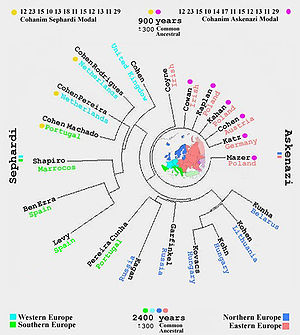
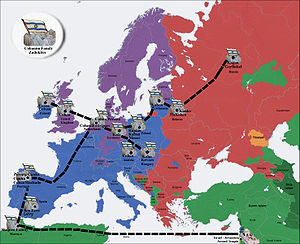 Dr. Karl Skorecki, the founder of CMH, reported during a Conference for Kohanim in Jerusalem 2007, that he and his research team have discovered not one but two Cohen Modal Haplotypes, which he called J1 and J2. “Pinchas the zealot mentioned in the Bible may be the origin of J2” said Skorecki. According to the observed mutations rates, certain J2 haplotypes found on FTDNA database projects share a common ancestor who lived 3100+/-200 years bp, as Skorecki revealed to the public. Below we can see the J2 Cohanim haplotype tree formed by 21 different traditional surnames related to Cohanim lineages in both Ashkenazi and Sephardic respective communities. - This is how Joseph Felsenstein`s scientific genetic computer software placed them, considering their haplotypes. Only one different Cohanim surname was used in this case to represent the closest haplotype found in each family that can best stand for the exclusive cluster below formed by these 21 haplotypes.
The left branch is the Sephardim branch. All J2 Kohanim families listed have a surname and tradition directly related to Sephardic Kohanim, as Askenazi Kohanim also carry in their respective communities. In this case illustrated above with table and graphic, Joseph Felsenstein`s methods for making coalescence statistically independent comparisons using 21 familiar markers haplotypes shows a well shaped, defined, and geographically distributed Kohanim Tree. Despite two thousand years since the destruction of the Second Temple, and the spread of the Jewish population into the Diaspora, the deadly Crusades, Kohanim families managed to survive the persecutions and kept their lineages intact, imprinted in their Y Chromosomes as a unique and common signature. This signature, distinctly reflecting the Kohanim ancestral haplotype, visibly identifies today and recognizes these 21 Jewish priest families, directly related to one common Kohanim ancestor who by some estimates lived 2400 ± 300 years ago. This is because both Askenazi and Sephardic Kohanim for thousands of years preserved their genealogical lineages since the Temple period. Of course they did not think in terms of the DNA, however, they have faithfully followed priestly Jewish tradition until present day. As a result this is exactly what the haplotype tree shows. Families which haplotypes sit on the tree next to each other on flat branches live (or lived) in close territories and more likely share a recent common ancestor, as the tree shows. The Kohanim Tree places the correspondent families in the branches based on respective mutations. DNA results confirmed, by positioning the families in their respective places of origin, that the geographical location is correctly connected in genetics according to the Jewish tradition and records found in each one of these 21 different Kohanim families. It formed two branches, Askenazi and Sephardic. The Sephardic Kohanim is the older lineage compared to Ashkenazi, though both of them are derived from the same common ancestor. The Shapiro family from Marrocos presented the oldest signature among all, passing from Sephardi branch in Spain, Portugal, and Netherlands and from there moving to Northern East Europe to Central and reaching Southern East Europe. As the history and records tells, correctly confirmed by DNA, Kohanim fled the Romans after destruction of the Temple and went to Marrocos, Spain/Portugal, to England, France, Germany. In the 14th century many fled to Poland, Ukraine, Belarus, Lithuania, Latvia.
s. Whereas the priestly Kohanim are considered descendants of Aaron
, who in turn was a descendant of Levi
, son of Jacob
, the Levites (a lower rank of the Temple) are considered descendants of Levi through other lineages. Levites should also therefore share common Y-chromosomal DNA.
The investigation of Levites found high frequencies of multiple distinct markers, suggestive of multiple origins for the majority of non-Aaronid Levite families. One marker, however, present in more than 50% of Eastern European (Ashkenazi) Jewish Levites points to a common male ancestor or very few male ancestors within the last 2000 years for many Levites of the Ashkenazi community. This common ancestor belonged to the haplogroup R1a1 which is typical of Eastern Europeans or West Asians, rather than the haplogroup J of the Cohen modal haplotype, and most likely lived at the time of the Ashkenazi settlement in Eastern Europe,, and thus was not really a Levite.
The E1b1b1 haplogroup (formerly known as E3b1) has been observed in all Jewish groups worldwide. It is considered to be the second most prevalent haplogroup among the Jewish population outside of the J haplogroups. According to one non-peer reviewed paper
it has also been observed in moderate numbers among individuals from Ashkenazi, Sephardic and Samaritan
communities having traditions of descending from the tribe of Levi, suggesting that the E1b1b1 men claiming to be Levites may have existed in Israel before the Diaspora of 70 CE.
community in the Middle East survives as a distinct religious and cultural sect and constitutes one of the oldest and smallest ethnic minorities in the world, numbering just less than 700 members. As a religious sect, reportedly, the Samaritans broke away from the mainstream Judaism around the fifth century BCE but according to Samaritan accounts it was the southern tribes that left the original worship set forth by Joshua. The Samaritans have maintained their religion and history to this day. Samaritans claim to descend from the Biblical Israelite tribes of Ephraim, Menashe and Levi.
Since the Samaritans maintain extensive and detailed genealogical records for the past 13–15 generations (approximately 400 years)and further back, it is possible to construct accurate pedigrees and specific maternal and paternal lineages. Y-Chromosome studies have shown that the majority of Samaritans belong to haplogroups J1 and J2, while the Samaritan Kohanim belong to haplogroup E1b1b1a (formerly known as E3b1a). However, the last member of the Samaritan High-Priestly family, which claimed descent from Eleazar
, the son of Aaron, died in 1623 or 1624. There was a time in later periods like the 17-18Th centuries that Samaritan sages by mistake wrote to European scholars that their priests are from Uziel b. Kehat. But Samaritan sources, chronicles and lists of lineage connecting the Samaritan Priests of the last 387 years since 1624 [The year that the Priestly Family from Phinhas was ceased] to Itamar b. Aaron the nephew of Moses, meaning that they are all from Aaronic origin. All Samaritan Priests of the present are linked to the father of the family that lived in the 14Th century 'Abed Ela b. Shalma that was the House of 'Abtaa from Itamar, son of Aaron. Since that date the priest has called himself "Ha-Kohen Ha-Lewi", which means the Priest-Levite, instead of "Ha-Kohen Ha-Gadol", a title which referred to the High-Priest as in previous times.
The biblical tradition of the Cohen family living among the Samaritans is found in 2 Kings 17:27-28, where it indicates that only one Israelite Cohen was sent back from exile from Assyria by the King of Assyria to teach those living in the Northern Kingdom of Israel (Samaria). This suggests why some Samaritans may claim association of haplogroup E3b1a with the biblical Kohanim. In the same period only 27,290 (Annals of Sargon)of the ten Northern Tribes were exiled to Assyria, the Assyrians relocated those non-Israelites to the region around Samaria, explaining why those claiming to be Leviim or Kohanim were actually Syrians, who appointed other non-Israelites as priests ("Kohanim") from their own people.
Thus far, no claims of ancestry of coming from the Levite tribe for male haplogroups outside of the "J" series can be scientifically substantiated because the mutation of haplogroups is so slow that no one coming from the family of Levi could have another haplogroup.
Kohen
A Kohen is the Hebrew word for priest. Jewish Kohens are traditionally believed and halachically required to be of direct patrilineal descent from the Biblical Aaron....
(singular "Kohen", "Cohen", or Kohane). In the Torah
Torah
Torah- A scroll containing the first five books of the BibleThe Torah , is name given by Jews to the first five books of the bible—Genesis , Exodus , Leviticus , Numbers and Deuteronomy Torah- A scroll containing the first five books of the BibleThe Torah , is name given by Jews to the first five...
, this ancestor is identified as Aaron
Aaron
In the Hebrew Bible and the Qur'an, Aaron : Ααρών ), who is often called "'Aaron the Priest"' and once Aaron the Levite , was the older brother of Moses, and a prophet of God. He represented the priestly functions of his tribe, becoming the first High Priest of the Israelites...
, the brother of Moses
Moses
Moses was, according to the Hebrew Bible and Qur'an, a religious leader, lawgiver and prophet, to whom the authorship of the Torah is traditionally attributed...
. The hypothetical most recent common ancestor was therefore jocularly dubbed "Y-chromosomal Aaron", in analogy to Y-chromosomal Adam
Y-chromosomal Adam
In human genetics, Y-chromosomal Adam is the theoretical most recent common ancestor from whom all living people are descended patrilineally . Many studies report that Y-chromosomal Adam lived as early as around 142,000 years ago and possibly as recently as 60,000 years ago...
.
The original scientific research was based on the discovery that a majority of present-day Jewish Kohanim either share, or are only one step removed from, a pattern of values for 6 Y-STR
Y-STR
A Y-STR is a short tandem repeat on the Y-chromosome. Y-STRs are often used in forensics, paternity, and genealogical DNA testing.-Nomenclature:Y-STRs are assigned names by the HUGO gene nomenclature committee....
markers, which researchers named the Cohen Modal Haplotype (CMH). However it subsequently became clear that this six marker pattern was widespread in many communities where men had Y chromosome
Y chromosome
The Y chromosome is one of the two sex-determining chromosomes in most mammals, including humans. In mammals, it contains the gene SRY, which triggers testis development if present. The human Y chromosome is composed of about 60 million base pairs...
s which fell into Haplogroup J
Haplogroup J (Y-DNA)
In human genetics, Haplogroup J is a Y-chromosome DNA haplogroup. It is one of the major male lines of all living men...
; the six-marker CMH was not specific just to Cohens, nor even just to Jews, but was a survival from the origins of Haplogroup J, about 30,000 years ago.
More recent research, using a larger number of Y-STR markers to gain higher resolution more specific genetic signatures, has indicated that about half of contemporary Jewish Kohanim, who share Y-chromosomal haplogroup J1c3 (also called J-P58), do indeed appear to be very closely related. A further approximately 15% of Kohanim fall into a second distinct group, sharing a different but similarly tightly related ancestry. This second group fall under haplogroup J2a
Haplogroup J2 (Y-DNA)
In human genetics, Haplogroup J2 is a Y-chromosome haplogroup which is a subdivision of haplogroup J. It is further divided into two complementary clades, J2a-M410 and J2b-M12.-Origins:...
(J-M410). A number of other smaller lineage groups are also observed. Only one of these haplogroups could indicate ancestry from Aaron.
The J1e and J2a possible Cohen clusters (only one of them could indicate ancestry from Aaron), when including those tested who are of Sephardi background, have been estimated as descending from most recent common ancestors living 3,200 ± 1,100 and 4,200 ± 1,300 years ago respectively. Ashkenazis only have been estimated by the same article as descending from most recent common ancestors living 2,400 ± 800 and 3,800 ± 1,200 years ago respectively.
Background
Although membership in the Jewish community has, since at least the second century CE, been passed maternally (see: Who is a Jew?Who is a Jew?
"Who is a Jew?" is a basic question about Jewish identity and considerations of Jewish self-identification. The question is based in ideas about Jewish personhood which themselves have cultural, religious, genealogical, and personal dimensions...
), tribal identity, and membership in the group that originally comprised the Jewish priesthood (Cohen or Kohen; plural: Cohanim or Kohanim), has been patrilineal. Modern Kohanim claim descent from a biblical person, Aaron
Aaron
In the Hebrew Bible and the Qur'an, Aaron : Ααρών ), who is often called "'Aaron the Priest"' and once Aaron the Levite , was the older brother of Moses, and a prophet of God. He represented the priestly functions of his tribe, becoming the first High Priest of the Israelites...
, brother of Moses
Moses
Moses was, according to the Hebrew Bible and Qur'an, a religious leader, lawgiver and prophet, to whom the authorship of the Torah is traditionally attributed...
, in the direct lineage from Levi, the patriarch of the Tribe of Levi, great grandson of Abraham
Abraham
Abraham , whose birth name was Abram, is the eponym of the Abrahamic religions, among which are Judaism, Christianity and Islam...
, according to the tradition codified in the Tanakh
Tanakh
The Tanakh is a name used in Judaism for the canon of the Hebrew Bible. The Tanakh is also known as the Masoretic Text or the Miqra. The name is an acronym formed from the initial Hebrew letters of the Masoretic Text's three traditional subdivisions: The Torah , Nevi'im and Ketuvim —hence...
(שמות / Sh'mot/Exodus 6). DNA
DNA
Deoxyribonucleic acid is a nucleic acid that contains the genetic instructions used in the development and functioning of all known living organisms . The DNA segments that carry this genetic information are called genes, but other DNA sequences have structural purposes, or are involved in...
testing is aiding scholars to trace the lineages found among modern Jewish populations, including contemporary Cohen families, to decipher origins of the people groups who were joined to the ancient Israelites and to identify genetic admixture
Admixture
Admixture can refer to:* Genetic admixture, the result of interbreeding between two or more previously isolated populations within a species.* Racial admixture, admixture between humans, also referred to as Miscegenation* Hybrid...
and genetic drift
Genetic drift
Genetic drift or allelic drift is the change in the frequency of a gene variant in a population due to random sampling.The alleles in the offspring are a sample of those in the parents, and chance has a role in determining whether a given individual survives and reproduces...
.
For human beings, the normal number of chromosome
Chromosome
A chromosome is an organized structure of DNA and protein found in cells. It is a single piece of coiled DNA containing many genes, regulatory elements and other nucleotide sequences. Chromosomes also contain DNA-bound proteins, which serve to package the DNA and control its functions.Chromosomes...
s is 46, of which 23 are inherited from each parent. Two chromosomes, the X chromosome
X chromosome
The X chromosome is one of the two sex-determining chromosomes in many animal species, including mammals and is common in both males and females. It is a part of the XY sex-determination system and X0 sex-determination system...
and Y chromosome
Y chromosome
The Y chromosome is one of the two sex-determining chromosomes in most mammals, including humans. In mammals, it contains the gene SRY, which triggers testis development if present. The human Y chromosome is composed of about 60 million base pairs...
, determine sex. Women have two X chromosomes, one inherited from their mother, and one inherited from their father. Men have an X chromosome inherited from their mother, and the Y chromosome inherited from their father.
Males who share a common patrilineal ancestor also share a Y chromosome, diverging only with respect to accumulated mutation
Mutation
In molecular biology and genetics, mutations are changes in a genomic sequence: the DNA sequence of a cell's genome or the DNA or RNA sequence of a virus. They can be defined as sudden and spontaneous changes in the cell. Mutations are caused by radiation, viruses, transposons and mutagenic...
s. Since Y-chromosomes are passed from father to son, all Kohanim men should theoretically have almost identical Y chromosomes; this can be tested with a genealogical DNA test
Genealogical DNA test
A genealogical DNA test examines the nucleotides at specific locations on a person's DNA for genetic genealogy purposes. The test results are not meant to have any informative medical value and do not determine specific genetic diseases or disorders ; they are intended only to give genealogical...
. As the rate that mutations accumulate on the Y chromosome is relatively constant, scientists can estimate the elapsed time since two men had a common ancestor. (See molecular clock
Molecular clock
The molecular clock is a technique in molecular evolution that uses fossil constraints and rates of molecular change to deduce the time in geologic history when two species or other taxa diverged. It is used to estimate the time of occurrence of events called speciation or radiation...
.) "The Samaritan M267 lineages differed from the classical Cohen modal haplotype at DYS391, carrying 11 rather than 10 repeats", as well as, have a completely different haplogroup, which should have been "J1". Samaritan Kohanim descend from a different patrilineal family line, having haplogroup E1b1b1a (M78) (formerly E3b1a).
Genetic studies
The Cohen hypothesis was first testedGenealogical DNA test
A genealogical DNA test examines the nucleotides at specific locations on a person's DNA for genetic genealogy purposes. The test results are not meant to have any informative medical value and do not determine specific genetic diseases or disorders ; they are intended only to give genealogical...
by Prof. Karl Skorecki and collaborators from Haifa
Haifa
Haifa is the largest city in northern Israel, and the third-largest city in the country, with a population of over 268,000. Another 300,000 people live in towns directly adjacent to the city including the cities of the Krayot, as well as, Tirat Carmel, Daliyat al-Karmel and Nesher...
, Israel
Israel
The State of Israel is a parliamentary republic located in the Middle East, along the eastern shore of the Mediterranean Sea...
, in 1997. In their study, "Y chromosomes of Jewish priests," published in the journal Nature
Nature (journal)
Nature, first published on 4 November 1869, is ranked the world's most cited interdisciplinary scientific journal by the Science Edition of the 2010 Journal Citation Reports...
, they found that the Kohanim appeared to share a different probability distribution compared to the rest of the Jewish population for the two Y-chromosome markers they tested (YAP
YAP
Yet Another Previewer is the name of two different document previewing applications, one for DVI and one for PostScript.-PostScript:...
and DYS19). They also found that the probabilities appeared to be shared by both Sephardic and Ashkenazi Cohens, pointing to a common Cohen population origin before the Jewish diaspora
Jewish diaspora
The Jewish diaspora is the English term used to describe the Galut גלות , or 'exile', of the Jews from the region of the Kingdom of Judah and Roman Iudaea and later emigration from wider Eretz Israel....
under the Roman empire.
In a subsequent study the next year (Thomas MG et al., 1998), the team increased the number of Y-STR
Y-STR
A Y-STR is a short tandem repeat on the Y-chromosome. Y-STRs are often used in forensics, paternity, and genealogical DNA testing.-Nomenclature:Y-STRs are assigned names by the HUGO gene nomenclature committee....
markers tested to six, as well as testing more SNP markers. Again, they found that a clear difference was observable between the Kohanim population and the general Jewish population, with many of the Cohen STR results clustered around a single pattern they named the Cohen Modal Haplotype:
| xDE | xDE,PR | Hg J | CMH.1 | CMH | CMH.1/HgJ | CMH/HgJ | ||
| Ashkenazi Cohanim (AC): | 98.5% | 96% | 87% | 69% | 45% | 79% | 52% | |
| Sephardic Cohanim (SC): | 100% | 88% | 75% | 61% | 56% | 81% | 75% | |
| Ashkenazi Jews (AI): | 82% | 62% | 37% | 15% | 13% | 40% | 35% | |
| Sephardic Jews (SI): | 85% | 63% | 37% | 14% | 10% | 38% | 27% |
Here, becoming increasingly specific, xDE is the proportion who were not in Haplogroups D
Haplogroup D (Y-DNA)
In human genetics, Haplogroup D is a Y-chromosome haplogroup. Both D and E lineages also exhibit the single-nucleotide polymorphism M168 which is present in all Y-chromosome haplogroups except A and B, as well as the YAP unique-event polymorphism, which is unique to Haplogroup...
or E
Haplogroup E (Y-DNA)
In human genetics, Haplogroup E is a human Y-chromosome DNA haplogroup. Haplogroup E is one of the two main branches of the older Haplogroup DE, the other main branch being haplogroup D. The E clade is divided into two subclades: E1 and E2 .-Origins:Underhill et al. proposed that haplogroup E...
(from the original paper); xDE,PR is the proportion who were not in haplogroups D, E, P
Haplogroup P (Y-DNA)
In human genetics, Haplogroup P is a Y-chromosome DNA haplogroup.This haplogroup contains the patrilineal ancestors of most Europeans and almost all of the indigenous peoples of the Americas...
, Q
Haplogroup Q (Y-DNA)
In human genetics, Haplogroup Q is a Y-chromosome DNA haplogroup.-Origins:Haplogroup Q is one of the two branches of haplogroup P . Haplogroup Q is believed to have arisen in Central Asia approximately 15,000 to 20,000 years ago. It has had multiple origins proposed...
or R
Haplogroup R (Y-DNA)
In human genetics, haplogroup R is a Y-chromosome DNA haplogroup very common throughout Europe, Central Asia and South Asia, and also common in parts of the Middle East and Africa...
; Hg J is the proportion who were in Haplogroup J
Haplogroup J (Y-DNA)
In human genetics, Haplogroup J is a Y-chromosome DNA haplogroup. It is one of the major male lines of all living men...
(from the slightly larger panel studied by Behar et al. (2003)); CMH.1 means "within one marker of the CMH-6"; and CMH is the proportion with a 6/6 match. The final two columns show the conditional proportions for CMH.1 and CMH, given membership of Haplogroup J.
The data shows that the Kohanim were more than twice as likely to belong to Haplogroup J than the average non-Cohen Jew. Of those who did belong to Haplogroup J, the Kohanim were more than twice as likely to have an STR pattern close to the CMH-6, suggesting a much more recent common ancestry for most of them compared to an average non-Cohen Jew of Haplogroup J.
Further study published in 2009 found new markers and better defined variant J1e* (now J1c3, also called J-P58*). This research demonstrates that 46.1% of Kohanim carry Y chromosomes belonging to a single paternal lineage (J-P58*) that likely originated in the Near East well before the dispersal of Jewish groups in the Diaspora. Support for a Near Eastern origin of this lineage comes from its high frequency in our sample of Bedouins, Yemenis (67%), and Jordanians (55%) and its precipitous drop in frequency as one moves away from Saudi Arabia and the Near East (Fig. 4). Moreover, there is a striking contrast between the relatively high frequency of J-58* in Jewish populations (»20%) and Kohanim (»46%) and its vanishingly low frequency in our sample of non- Jewish populations that hosted Jewish diaspora communities outside of the Near East.
Thomas, et al. dated the origin of the shared DNA to approximately 3,000 years ago (with variance arising from different generation lengths). The techniques used to find Y-chromosomal Aaron were first popularized in relation to the search for the patrilineal ancestor of all contemporary living human
Human
Humans are the only living species in the Homo genus...
s, Y-chromosomal Adam
Y-chromosomal Adam
In human genetics, Y-chromosomal Adam is the theoretical most recent common ancestor from whom all living people are descended patrilineally . Many studies report that Y-chromosomal Adam lived as early as around 142,000 years ago and possibly as recently as 60,000 years ago...
.
Responses
The finding led to excitement in religious circles, with some seeing it as providing some "proof" of the historical veracity of part of the BibleBible
The Bible refers to any one of the collections of the primary religious texts of Judaism and Christianity. There is no common version of the Bible, as the individual books , their contents and their order vary among denominations...
or other religious convictions. There was also criticism that the paper's evidence was being overstated.
Cohens in other haplogroups
Behar's 2003 data points to the following Haplogroup distribution for Ashkenazi Cohens (AC) and Sephardic Cohens (SC) as a whole:| Hg: | E3b Haplogroup E3b (Y-DNA) In human genetics, Y Haplogroup E1b1b previously known as E3b is one of the major paternal lines of humanity, linking from father-to-son back to a common male ancestor. In other words it is a major Y-chromosome haplogroup, a sub-group of the macro haplogroup E, which is defined by the single... |
G2c Haplogroup G2c (Y-DNA) In human genetics, Haplogroup G2c is a Y-chromosome haplogroup and is defined by the presence of the M377 mutation. It is a branch of Haplogroup G, which in turn is defined by the presence of the M201 mutation.... |
H Haplogroup H (Y-DNA) In human genetics, Haplogroup H is a Y-chromosome haplogroup.This haplogroup is found at a high frequency in South Asia. It is generally rare outside of the South Asia but is common among the Romani people, particularly the H-M82 subgroup.-Origins:... |
I1b | J Haplogroup J (Y-DNA) In human genetics, Haplogroup J is a Y-chromosome DNA haplogroup. It is one of the major male lines of all living men... |
K2 | Q Haplogroup Q (Y-DNA) In human genetics, Haplogroup Q is a Y-chromosome DNA haplogroup.-Origins:Haplogroup Q is one of the two branches of haplogroup P . Haplogroup Q is believed to have arisen in Central Asia approximately 15,000 to 20,000 years ago. It has had multiple origins proposed... |
R1a1 | R1b Haplogroup R1b (Y-DNA) The point of origin of R1b is thought to lie in Eurasia, most likely in Western Asia. T. Karafet et al. estimated the age of R1, the parent of R1b, as 18,500 years before present.... |
Total | |
|---|---|---|---|---|---|---|---|---|---|---|---|
| AC | 3 | 0 | 1 | 0 | 67 | 2 | 0 | 1 | 2 | 76 | |
| 4% | 1½% | 88% | 2½% | 1½% | 2½% | 100% | |||||
| SC | 3 | 1 | 0 | 1 | 52 | 2 | 2 | 3 | 4 | 68 | |
| 4½% | 1½% | 1½% | 76% | 3% | 3% | 4½% | 6% | 100% |
The detailed breakdown by 6-marker haplotype (the paper's online-only table B) suggests that at least some of these groups (eg E3b, R1b) contain more than one distinct Cohen lineage. It is possible that other lineages may also exist, but were not captured in the sample.
Does a CMH prove Cohen ancestry?
One source of early confusion was a widespread popular notion that only Cohens or only Jews could have the Cohen Modal Haplotype. It is now clear that this is not the case. The Cohen Modal Haplotype (CMH), whilst notably frequent amongst Cohens, is also far from unusual in the general populations of haplogroups J1Haplogroup J1 (Y-DNA)
In human genetics, Y DNA haplogroup J1, also known as J-M267, is a sub-haplogroup of Y DNA haplogroup J, along with its sibling clade Y DNA haplogroup J2. Men with this type of Y DNA share a common paternal ancestry, which is demonstrated and defined by the presence of the SNP mutation referred to...
and J2
Haplogroup J2 (Y-DNA)
In human genetics, Haplogroup J2 is a Y-chromosome haplogroup which is a subdivision of haplogroup J. It is further divided into two complementary clades, J2a-M410 and J2b-M12.-Origins:...
with no particular link to the Cohen ancestry. These haplogroups occur widely throughout the Middle East and beyond. Thus, while many Cohens have haplotypes close to the CMH, a greater number of such haplotypes worldwide belong to people with no likely Cohen connection at all.
Statistically the value of matching the CMH can be assessed using Bayes' theorem
Bayes' theorem
In probability theory and applications, Bayes' theorem relates the conditional probabilities P and P. It is commonly used in science and engineering. The theorem is named for Thomas Bayes ....
, which in its odds
Odds
The odds in favor of an event or a proposition are expressed as the ratio of a pair of integers, which is the ratio of the probability that an event will happen to the probability that it will not happen...
form can be written:
In words, this says that the odds in favour of Cohen ancestry C (i.e., the probability of having Cohen ancestry, divided by the probability of not having Cohen ancestry), having observed some piece of data D, is given by the odds one would assign given only one's initial information I, multiplied by the probability of having observed D if C is true, divided by the probability of having observed D if C is false.
(In fact, for convenience we shall work with the reciprocal of this equation, i.e. work in terms of odds against, rather than odds on).
The proportion of the whole male Jewish population that has Cohen ancestry has been estimated at 5%. So if we take that 5% as our initial estimate of the probability of shared Cohen ancestry, then on the basis of the data above:
- Not belonging to haplogroups D or E improves the odds for a Sephardic Jew from 19/1 against to (19/1)*(0.85/1.00) = 16.2/1 against (a 5.8% probability)
- Not belonging to haplogroups D,E,P,Q or R takes the odds to (19/1)*(0.63/0.88) = 13.6/1 against (6.8% probability).
- Membership of Haplogroup J improves the odds to (19/1)*(0.37/0.75) = 9.4/1 against (9.6% probability).
- Being within the CMH.1 group takes the odds to (19/1)*(0.14/0.61) = 4.4/1 against (18.7% probability).
- A full 6/6 match takes the odds to (19/1)*(0.10/0.56) = 3.4/1. (22.7% probability).
Even a full 6/6 match for the 6 marker CMH thus cannot "prove" Cohen ancestry. It can only somewhat strengthen a previously existing belief. But for populations where the background probability assessment of shared Cohen ancestry must be vanishingly low, such as almost all non-Jews, even a full 6/6 match makes only a small difference. For individuals in such populations, the CMH likely indicates Haplogroup J, but a completely different ancestry to the Kohanim.
Higher resolution
Haplogroup placement
The largest population of Kohanim which most closely match the 6-marker CMH cluster are believed to belong to subgroup J1Haplogroup J1 (Y-DNA)
In human genetics, Y DNA haplogroup J1, also known as J-M267, is a sub-haplogroup of Y DNA haplogroup J, along with its sibling clade Y DNA haplogroup J2. Men with this type of Y DNA share a common paternal ancestry, which is demonstrated and defined by the presence of the SNP mutation referred to...
of haplogroup J, thus often identified as Y-Aaron.
Nevertheless, various opinions exist about which
Haplogroup the direct descendants of Biblical Aaron belong to.
Note, some lineages of subgroup J2
Haplogroup J2 (Y-DNA)
In human genetics, Haplogroup J2 is a Y-chromosome haplogroup which is a subdivision of haplogroup J. It is further divided into two complementary clades, J2a-M410 and J2b-M12.-Origins:...
also, coincidentally, developed a similar set of genetic markers corresponding to the Cohen Modal Haplotype. Low frequencies of individuals with these lineages even exist among Jewish Kohanim, albeit they do not descend from Y-Aaron.
The subdivision of J2 which most closely matches the genetic signature of the J1 Cohens is subclade J2a4b (M67), a large fraction of members of which will also have a 6/6 match for the 6-marker CMH. However, this is an example of haplotype convergence
Haplotype convergence
Haplotype Convergence is a term used in the study of DNA.Basically the haplotype, , distribution within one DNA lineage overlaps with the haplotype distribution of another lineage - its like overlapping branches from two different trees.The more likely reason for a match is convergence or because...
:
Basically the haplotype "distribution" within one lineage (Haplogroup) overlaps with the haplotype "distribution" of another lineage – it is like overlapping branches from two different trees.
The more likely reason for the match is convergence (coincidence) or sharing a common haplotype in the same lineage (Haplogroup). Convergence: Mutation is a random process and over thousands of years can occur in different lines so that by coincidence, different "lines" end up with "matching" haplotypes. This accidental agreement is called convergence of different genetic lines, which it is believed have been not been closely related for at least the last 10,000 years; the group in J2a4b (M67) who have the 6-marker CMH are devoid of any Cohen traditions in their families.
On the other hand, there are families in Haplogroup J2 who do have a Cohen religious tradition (as there are in several other haplogroups, including Haplogroup R1b). The haplotypes of these Haplotype J2 Kohanim cluster under J2a4h (L24), not the J2a4b (M67) clade. These J2 Kohanim typically have a 4/6 match for the 6-marker CMH (with DYS19=15 rather than 14, and DYS388=15 rather than 16). The J2 Cohens do not match the 12-marker J1-extended CMH. The important difference is the two SNP mutations, M172 and M267. These mutations are believed to be at least 10-15,000 years old; but they are equal co-inheritors of a patrilineal tradition which appears to date back well before the Diaspora. Some suggest that this group may, in fact, descend from the biblical Levi, but not Aaron.
As it happens, three of the four markers for which they do match the CMH-6 were the markers tested by Malaspina et al. (2001). This appears to explain the finding of that paper that "typing a limited number of Italian Cohanim (A. Novelletto unpublished obs.) for the STRs used here, we determined that the Cohen Modal Haplotype ('an important component in the sharing of Ashkenazic and Sephardic Israelite Y chromosomes', Thomas et al. 2000) does indeed belong to network 1.2" (i.e. the population having DYS413a,b<=18, which is the signature of the J2a4 subclades).
More detailed Cohen haplotypes
In the table below, the first line gives the original 6 marker Cohen Modal Haplotype (CMH-6), which was the basis for the original published papers. The second gives an extended 12 marker haplotype (CMH-12) informally released by the private company Family Tree DNA (FTDNA)FamilyTreeDNA
Family Tree DNA is a commercial genetic genealogy company based in Houston, Texas with its partner laboratory, Arizona Research Labs, housed at the University of Arizona. Family Tree DNA offers analysis of autosomal DNA, YDNA, and mtDNA to individuals for genealogical purposes based on DNA samples...
, based on further work by much of the same research team. It has not yet been peer group reviewed by other scientists or published in the open technical literature.
The next sequence of rows identify other 6-marker haplotypes in haplogroup J found to occur more than once in the sample of 145 Kohanim tested in Behar et al. (2003) (table B (web-only) in that paper). Probable extensions of these haplotypes to 12 markers are shown, where it has been possible to find corresponding clusters of Cohen-type names in publicly accessible DNA databases, together with the apparent sub-clade of haplogroup J. This is more possible for the apparently Ashkenazi clusters than for Sephardim, who are much less strongly represented in the databases.
Finally, for comparison, the 12-marker modal haplotypes for the haplogroups J1 and J2 are also shown. It is apparent that in both cases, their haplotype clusters are also centred very close to the Cohen modal haplotype. However, because of the much greater time that has elapsed since the mutations occurred that define the haplogroups, there has been much more time for Y-STR mutations to build up; so, although they have almost the same centre as the Cohen cluster, the J1 and J2 haplotype clusters are much more diffusely spread out. Thus although the CMH-6 is also very near to the most probable haplotype for both J1 and J2, its occurrence frequency is only about 1 to 8% amongst arbitrary members of haplogroup J with no particular Cohen connection.
| Hg | Clade or cluster | Y-STR Y-STR A Y-STR is a short tandem repeat on the Y-chromosome. Y-STRs are often used in forensics, paternity, and genealogical DNA testing.-Nomenclature:Y-STRs are assigned names by the HUGO gene nomenclature committee.... 393 |
DYS 390 |
DYS 19 |
DYS 391 |
DYS 385a |
DYS 385b |
DYS 426 |
DYS 388 |
DYS 439 |
DYS 389i |
DYS 392 |
DYS 389ii |
AC | SC | Some DNA matches |
|
|---|---|---|---|---|---|---|---|---|---|---|---|---|---|---|---|---|---|
| CMH-6 | 12 | 23 | 14 | 10 | 16 | 11 | |||||||||||
| J1 | CMH-12 | 12 | 23 | 14 | 10 | 13 | 15 | 11 | 16 | 12 | 13 | 11 | 30 | 47% | 52% | 8EZ7F | |
| J2 | J2a4h (L24,L25) | 12 | 23 | 15 | 10 | 14 | 17 | 11 | 16 | 12 | 14 | 11 | 30 | 13% | 0 | XWPTP | |
| J2 | J2a4h (L24,L25) | 12 | 23 | 15 | 10 | 14 | 17 | 11 | 15 | 12 | 13 | 11 | 29 | 5% | 0 | 645CH | |
| J2 | J2b2e (M241) | 12 | 24 | 15 | 10 | 15 | 17 | 11 | 15 | 12 | 12 | 11 | 29 | 11% | 0 | F6FSU | |
| J2 | J2a4h1a ? | 12 | 24 | 15 | 9 | 16 | 13 | 11 | 29 | 0 | 6% | ||||||
| J1 | J1 "388=13" | 12 | 23 | 14 | 10 | 13 | 11 | 0 | 6% | ||||||||
| J1 | modal | 12 | 23 | 14 | 10 | 13 | 15 | 11 | 16 | 11 | 13 | 11 | 30 | ||||
| J2 | modal | 12 | 23 | 14 | 10 | 13 | 15 | 11 | 15 | 11 | 13 | 11 | 30 | ||||
| J2 | J2a1b (M67) | 12 | 23 | 14 | 10 | 13 | 17 | 11 | 16 | 11 | 13 | 11 | 30 | ||||
Other carriers of the DNA
Following the discovery of the very high prevalence of 6/6 CMH matches amongst Cohens, others were quick to look for it, and often to see it as a signpost for possible Jewish ancestry, though the chromosome itself is not exclusive to Jews.News of 6/6 matches in the Lemba of Southern Africa
Southern Africa
Southern Africa is the southernmost region of the African continent, variably defined by geography or geopolitics. Within the region are numerous territories, including the Republic of South Africa ; nowadays, the simpler term South Africa is generally reserved for the country in English.-UN...
were seen as confirming a possible Jewish lineage (Thomas MG et al. 2000); possible links were discussed between the Jews and the Kurds;
and some suggested that 4/4 matches in non-Jewish Italians might be a genetic inheritance from Jewish slaves, deported by Emperor Titus
Titus
Titus , was Roman Emperor from 79 to 81. A member of the Flavian dynasty, Titus succeeded his father Vespasian upon his death, thus becoming the first Roman Emperor to come to the throne after his own father....
in large numbers after the fall of the Temple
First Jewish-Roman War
The First Jewish–Roman War , sometimes called The Great Revolt , was the first of three major rebellions by the Jews of Judaea Province , against the Roman Empire...
in AD 70, some of whom were put to work building the Colosseum
Colosseum
The Colosseum, or the Coliseum, originally the Flavian Amphitheatre , is an elliptical amphitheatre in the centre of the city of Rome, Italy, the largest ever built in the Roman Empire...
in Rome.
Such speculation was to some extent tempered when it was realised that Haplogroups J1 and J2 represented at least two different lineages which could be associated with the CMH, (the Italians mostly belong to Haplogroup J2); and that
individuals with at least 5/6 matches for the original 6 marker Cohen Modal Haplotype occur widely across the Middle East, with significant frequencies in various Arab populations mainly with J1 Haplogroup, "that are not traditionally considered admixed with mainstream Jewish populations" -- notably Yemen
Yemen
The Republic of Yemen , commonly known as Yemen , is a country located in the Middle East, occupying the southwestern to southern end of the Arabian Peninsula. It is bordered by Saudi Arabia to the north, the Red Sea to the west, and Oman to the east....
(34.2%), Oman
Oman
Oman , officially called the Sultanate of Oman , is an Arab state in southwest Asia on the southeast coast of the Arabian Peninsula. It is bordered by the United Arab Emirates to the northwest, Saudi Arabia to the west, and Yemen to the southwest. The coast is formed by the Arabian Sea on the...
(22.8%), Negev
Negev
The Negev is a desert and semidesert region of southern Israel. The Arabs, including the native Bedouin population of the region, refer to the desert as al-Naqab. The origin of the word Neghebh is from the Hebrew root denoting 'dry'...
(21.9%), and Iraq
Iraq
Iraq ; officially the Republic of Iraq is a country in Western Asia spanning most of the northwestern end of the Zagros mountain range, the eastern part of the Syrian Desert and the northern part of the Arabian Desert....
(19.2%); and amongst Muslim Kurds (22.1%), Bedouins (21.9%), and Armenians
Armenians
Armenian people or Armenians are a nation and ethnic group native to the Armenian Highland.The largest concentration is in Armenia having a nearly-homogeneous population with 97.9% or 3,145,354 being ethnic Armenian....
(12.7%).
On the other hand, Jewish populations were found to have a "markedly higher" proportion of full 6/6 matches, according to the same (2005) meta-analysis, compared to these non-Jewish populations, where "individuals matching at only 5/6 markers are most commonly observed".
The authors nevertheless warn that "using the current CMH definition to a infer relation of individuals or groups to the Cohen or ancient Hebrew populations would produce many false-positive results," and note that "it is possible that the originally defined CMH represents a slight permutation of a more general Middle Eastern type that was established early on in the population prior to the divergence of haplogroup J. Under such conditions, parallel convergence
Haplotype convergence
Haplotype Convergence is a term used in the study of DNA.Basically the haplotype, , distribution within one DNA lineage overlaps with the haplotype distribution of another lineage - its like overlapping branches from two different trees.The more likely reason for a match is convergence or because...
in divergent clades to the same STR haplotype would be possible."
Y-DNA patterns from around the Gulf of Oman were analysed in more detail by Cadenas et al. in 2007. The detailed data confirms that the main cluster of haplogroup J1 haplotypes from the Yemen appears to be some genetic distance different from the CMH-12 pattern typical of Eastern European Ashkenazi Cohens.
J2 Kohanim haplotype tree
| Cohen | Family | J2 | 12 | 23 | 15 | 10 | 14 | 17 | 11 | 15 | 12 | 13 | 11 | 29 |
| Kahan | Family | J2 | 12 | 23 | 15 | 10 | 14 | 17 | 11 | 15 | 12 | 13 | 11 | 29 |
| Mazer | Family | J2 | 12 | 23 | 15 | 10 | 14 | 17 | 11 | 15 | 12 | 13 | 11 | 29 |
| Kaplan | Family | J2 | 12 | 23 | 15 | 10 | 14 | 17 | 11 | 15 | 12 | 13 | 11 | 29 |
| Katz | Family | J2 | 12 | 23 | 15 | 10 | 14 | 17 | 11 | 15 | 12 | 13 | 11 | 29 |
| Cowan | Family | J2 | 12 | 23 | 15 | 10 | 14 | 17 | 11 | 15 | 12 | 13 | 11 | 29 |
| Coyne | Family | J2 | 12 | 23 | 15 | 10 | 14 | 17 | 11 | 16 | 12 | 13 | 11 | 29 |
| HaKohen | Family | J2 | 12 | 23 | 15 | 10 | 13 | 16 | 11 | 15 | 12 | 13 | 11 | 29 |
| CohenPereira | Family | J2 | 12 | 23 | 15 | 10 | 13 | 18 | 11 | 15 | 12 | 13 | 11 | 29 |
| CohenRodrigues | Family | J2 | 12 | 23 | 15 | 10 | 13 | 18 | 11 | 15 | 12 | 13 | 11 | 29 |
| CohenMachado | Family | J2 | 12 | 23 | 15 | 10 | 13 | 18 | 11 | 15 | 12 | 13 | 11 | 29 |
| Shapiro | Family | J2 | 12 | 23 | 15 | 9 | 13 | 17 | 11 | 16 | 12 | 13 | 11 | 29 |
| Ben Ezra | Family | J2 | 12 | 23 | 15 | 10 | 13 | 15 | 11 | 14 | 13 | 13 | 11 | 29 |
| Levy | Family | J2 | 12 | 23 | 15 | 10 | 14 | 17 | 11 | 15 | 12 | 14 | 11 | 31 |
| Pereira Cunha | Family | J2 | 12 | 23 | 13 | 10 | 14 | 16 | 11 | 15 | 12 | 13 | 11 | 29 |
| Garfinkel | Family | J2 | 12 | 23 | 15 | 10 | 14 | 16 | 11 | 15 | 12 | 13 | 11 | 29 |
| Kagan | Family | J2 | 12 | 23 | 16 | 10 | 14 | 18 | 11 | 15 | 12 | 13 | 11 | 30 |
| Kovacs | Family | J2 | 12 | 23 | 15 | 11 | 14 | 19 | 11 | 15 | 12 | 13 | 11 | 29 |
| Kohn | Family | J2 | 12 | 23 | 15 | 11 | 14 | 19 | 11 | 15 | 12 | 13 | 11 | 29 |
| Kohen | Family | J2 | 12 | 23 | 15 | 11 | 14 | 18 | 11 | 15 | 12 | 13 | 11 | 29 |
| Kunha | Family | J2 | 12 | 23 | 15 | 11 | 14 | 16 | 11 | 15 | 12 | 13 | 11 | 29 |
The left branch is the Sephardim branch. All J2 Kohanim families listed have a surname and tradition directly related to Sephardic Kohanim, as Askenazi Kohanim also carry in their respective communities. In this case illustrated above with table and graphic, Joseph Felsenstein`s methods for making coalescence statistically independent comparisons using 21 familiar markers haplotypes shows a well shaped, defined, and geographically distributed Kohanim Tree. Despite two thousand years since the destruction of the Second Temple, and the spread of the Jewish population into the Diaspora, the deadly Crusades, Kohanim families managed to survive the persecutions and kept their lineages intact, imprinted in their Y Chromosomes as a unique and common signature. This signature, distinctly reflecting the Kohanim ancestral haplotype, visibly identifies today and recognizes these 21 Jewish priest families, directly related to one common Kohanim ancestor who by some estimates lived 2400 ± 300 years ago. This is because both Askenazi and Sephardic Kohanim for thousands of years preserved their genealogical lineages since the Temple period. Of course they did not think in terms of the DNA, however, they have faithfully followed priestly Jewish tradition until present day. As a result this is exactly what the haplotype tree shows. Families which haplotypes sit on the tree next to each other on flat branches live (or lived) in close territories and more likely share a recent common ancestor, as the tree shows. The Kohanim Tree places the correspondent families in the branches based on respective mutations. DNA results confirmed, by positioning the families in their respective places of origin, that the geographical location is correctly connected in genetics according to the Jewish tradition and records found in each one of these 21 different Kohanim families. It formed two branches, Askenazi and Sephardic. The Sephardic Kohanim is the older lineage compared to Ashkenazi, though both of them are derived from the same common ancestor. The Shapiro family from Marrocos presented the oldest signature among all, passing from Sephardi branch in Spain, Portugal, and Netherlands and from there moving to Northern East Europe to Central and reaching Southern East Europe. As the history and records tells, correctly confirmed by DNA, Kohanim fled the Romans after destruction of the Temple and went to Marrocos, Spain/Portugal, to England, France, Germany. In the 14th century many fled to Poland, Ukraine, Belarus, Lithuania, Latvia.
Y-chromosomal Levi
A similar investigation was made with men who consider themselves LeviteLevite
In Jewish tradition, a Levite is a member of the Hebrew tribe of Levi. When Joshua led the Israelites into the land of Canaan, the Levites were the only Israelite tribe that received cities but were not allowed to be landowners "because the Lord the God of Israel himself is their inheritance"...
s. Whereas the priestly Kohanim are considered descendants of Aaron
Aaron
In the Hebrew Bible and the Qur'an, Aaron : Ααρών ), who is often called "'Aaron the Priest"' and once Aaron the Levite , was the older brother of Moses, and a prophet of God. He represented the priestly functions of his tribe, becoming the first High Priest of the Israelites...
, who in turn was a descendant of Levi
Levi
Levi/Levy was, according to the Book of Genesis, the third son of Jacob and Leah, and the founder of the Israelite Tribe of Levi ; however Peake's commentary suggests this as postdiction, an eponymous metaphor providing an aetiology of the connectedness of the tribe to others in the Israelite...
, son of Jacob
Jacob
Jacob "heel" or "leg-puller"), also later known as Israel , as described in the Hebrew Bible, the Talmud, the New Testament and the Qur'an was the third patriarch of the Hebrew people with whom God made a covenant, and ancestor of the tribes of Israel, which were named after his descendants.In the...
, the Levites (a lower rank of the Temple) are considered descendants of Levi through other lineages. Levites should also therefore share common Y-chromosomal DNA.
The investigation of Levites found high frequencies of multiple distinct markers, suggestive of multiple origins for the majority of non-Aaronid Levite families. One marker, however, present in more than 50% of Eastern European (Ashkenazi) Jewish Levites points to a common male ancestor or very few male ancestors within the last 2000 years for many Levites of the Ashkenazi community. This common ancestor belonged to the haplogroup R1a1 which is typical of Eastern Europeans or West Asians, rather than the haplogroup J of the Cohen modal haplotype, and most likely lived at the time of the Ashkenazi settlement in Eastern Europe,, and thus was not really a Levite.
The E1b1b1 haplogroup (formerly known as E3b1) has been observed in all Jewish groups worldwide. It is considered to be the second most prevalent haplogroup among the Jewish population outside of the J haplogroups. According to one non-peer reviewed paper
it has also been observed in moderate numbers among individuals from Ashkenazi, Sephardic and Samaritan
Samaritan
The Samaritans are an ethnoreligious group of the Levant. Religiously, they are the adherents to Samaritanism, an Abrahamic religion closely related to Judaism...
communities having traditions of descending from the tribe of Levi, suggesting that the E1b1b1 men claiming to be Levites may have existed in Israel before the Diaspora of 70 CE.
Samaritan Kohanim
The SamaritanSamaritan
The Samaritans are an ethnoreligious group of the Levant. Religiously, they are the adherents to Samaritanism, an Abrahamic religion closely related to Judaism...
community in the Middle East survives as a distinct religious and cultural sect and constitutes one of the oldest and smallest ethnic minorities in the world, numbering just less than 700 members. As a religious sect, reportedly, the Samaritans broke away from the mainstream Judaism around the fifth century BCE but according to Samaritan accounts it was the southern tribes that left the original worship set forth by Joshua. The Samaritans have maintained their religion and history to this day. Samaritans claim to descend from the Biblical Israelite tribes of Ephraim, Menashe and Levi.
Since the Samaritans maintain extensive and detailed genealogical records for the past 13–15 generations (approximately 400 years)and further back, it is possible to construct accurate pedigrees and specific maternal and paternal lineages. Y-Chromosome studies have shown that the majority of Samaritans belong to haplogroups J1 and J2, while the Samaritan Kohanim belong to haplogroup E1b1b1a (formerly known as E3b1a). However, the last member of the Samaritan High-Priestly family, which claimed descent from Eleazar
Eleazar
Eleazar , was a priest in the Hebrew Bible, the second Kohen Gadol - succeeding his father Aaron. He was a nephew of Moses.-Life:...
, the son of Aaron, died in 1623 or 1624. There was a time in later periods like the 17-18Th centuries that Samaritan sages by mistake wrote to European scholars that their priests are from Uziel b. Kehat. But Samaritan sources, chronicles and lists of lineage connecting the Samaritan Priests of the last 387 years since 1624 [The year that the Priestly Family from Phinhas was ceased] to Itamar b. Aaron the nephew of Moses, meaning that they are all from Aaronic origin. All Samaritan Priests of the present are linked to the father of the family that lived in the 14Th century 'Abed Ela b. Shalma that was the House of 'Abtaa from Itamar, son of Aaron. Since that date the priest has called himself "Ha-Kohen Ha-Lewi", which means the Priest-Levite, instead of "Ha-Kohen Ha-Gadol", a title which referred to the High-Priest as in previous times.
The biblical tradition of the Cohen family living among the Samaritans is found in 2 Kings 17:27-28, where it indicates that only one Israelite Cohen was sent back from exile from Assyria by the King of Assyria to teach those living in the Northern Kingdom of Israel (Samaria). This suggests why some Samaritans may claim association of haplogroup E3b1a with the biblical Kohanim. In the same period only 27,290 (Annals of Sargon)of the ten Northern Tribes were exiled to Assyria, the Assyrians relocated those non-Israelites to the region around Samaria, explaining why those claiming to be Leviim or Kohanim were actually Syrians, who appointed other non-Israelites as priests ("Kohanim") from their own people.
Thus far, no claims of ancestry of coming from the Levite tribe for male haplogroups outside of the "J" series can be scientifically substantiated because the mutation of haplogroups is so slow that no one coming from the family of Levi could have another haplogroup.