

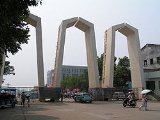
Xiangtan

Encyclopedia
Xiangtan is a city in China
's Hunan
Province that is located on the lower reaches of Xiang river
. The hometowns of several founding leaders of the Chinese Communist Party, including Mao Zedong
, Liu Shaoqi
, and Peng Dehuai
are in the Xiangtan Municipal District, as well as the hometowns of Qing Dynasty
painter Qi Baishi
and scholar-general Zeng Guofan
.
It has 2,748,552 inhabitants at the 2010 census whom 1,779,960 live in the built up area (2 urban districts plus Xiangtan
county). With adjoining 4 Zhuzhou
urban districts being agglomerated, the joint built up areas is home to 2,586,948 inhabitants.
indicates that people inhabited the Xiangtan area in the 3rd millennium BC. Shang Dynasty
bronzewares have been found in the region, as well as tombs from the Warring States Period
. During the Three Kingdoms Period, the kingdom of Eastern Wu
built a city in the west of modern Xiangtan City and organized the Hengyang Commandery around it. In AD 749
, the Tang Dynasty
organized the area as Xiangtan County, centered at modern Yisu River . By the time of the Northern Song Dynasty, Xiangtan's good access to both land and water trade routes had established it as the major commercial center of the region.
and Qing Dynasty
upon an economic foundation of trading in rice
and traditional Chinese medicinal ingredients, and was sometimes referred to as "Little Nanjing
" or "Golden Xiangtan". Prior to the Second Opium War
, Xiangtan was a central transfer point for import and export goods going to and from ports in Canton
, Shanghai
, and Wuhan
, and had approximately 200,000 inhabitants.
, while "Tan" is a Chinese term that means "deep pool", specifically one produced by a moving current or waterfall; "Tan" in rivers generally are places where the current eddies
. One reasoning is that the city was built by a large eddy in a bend of the Xiang River, and was thus called "Xiang-Tan". Another more likely story says the name originated in the Xiangzhou Eddy, today called the Zhao Eddy . The Zhao Eddy is an ancient whirlpool located in a deep section of the Xiang River near the traditional border between Xiangtan and Changsha, and is named for King Zhao of Zhou
, who is said to have died there.
(市 shi), and 1 county (县 xian) :
Xiangtan is famous for its production of Lotus seed
and Soy sauce
. People in Xiangtan like to chew areca nut , though the area itself doesn't grow them. Most raw areca nut fruits are from Hainan
and processed locally. The history of consuming areca nut dates back to 400 years ago, when people chewing it for pandemic prevention. Nowadays, it is quite common to see people chewing areca nut in Hunan Province. In 2003, the sales revenue of areca nut industry in Xiangtan has reached ¥800 million.
.
, Xiangtan to visit the birthplace of Mao Zedong
, the former chairman of the Chinese Communist Party and the leader of the People's Republic of China from 1949-1971.
was born and trained here. Xiangtan Stadium was the home to Bayi Football Team
of the Chinese Football Association Jia League
(now Chinese Super League
) from 2002 to 2003.
Note: Institutions without full-time bachelor programs are not listed.
South El Monte, USA Bien Hoa
, Vietnam
Lutsk
, Ukraine
León
, Spain
China
Chinese civilization may refer to:* China for more general discussion of the country.* Chinese culture* Greater China, the transnational community of ethnic Chinese.* History of China* Sinosphere, the area historically affected by Chinese culture...
's Hunan
Hunan
' is a province of South-Central China, located to the south of the middle reaches of the Yangtze River and south of Lake Dongting...
Province that is located on the lower reaches of Xiang river
Xiang River
The Xiang River , in older transliterations as the Siang River or Hsiang River, is a river in southern China...
. The hometowns of several founding leaders of the Chinese Communist Party, including Mao Zedong
Mao Zedong
Mao Zedong, also transliterated as Mao Tse-tung , and commonly referred to as Chairman Mao , was a Chinese Communist revolutionary, guerrilla warfare strategist, Marxist political philosopher, and leader of the Chinese Revolution...
, Liu Shaoqi
Liu Shaoqi
Liu Shaoqi was a Chinese revolutionary, statesman, and theorist. He was Chairman of the People's Republic of China, China's head of state, from 27 April 1959 to 31 October 1968, during which he implemented policies of economic reconstruction in China...
, and Peng Dehuai
Peng Dehuai
Peng Dehuai was a prominent military leader of the Communist Party of China, and China's Defence Minister from 1954 to 1959. Peng was an important commander during the Second Sino-Japanese War, the Chinese civil war and was also the commander-in-chief of People's Volunteer Army in the Korean War...
are in the Xiangtan Municipal District, as well as the hometowns of Qing Dynasty
Qing Dynasty
The Qing Dynasty was the last dynasty of China, ruling from 1644 to 1912 with a brief, abortive restoration in 1917. It was preceded by the Ming Dynasty and followed by the Republic of China....
painter Qi Baishi
Qi Baishi
Qi Baishi was an influential Chinese painter.Born to a peasant family from Xiangtan, Hunan, Qi became a carpenter at 14, and learned to paint by himself. After he turned 40, he traveled, visiting various scenic spots in China...
and scholar-general Zeng Guofan
Zeng Guofan
Zeng Guofan was an eminent Han Chinese official, military general, and devout Confucian scholar of the late Qing Dynasty in China....
.
It has 2,748,552 inhabitants at the 2010 census whom 1,779,960 live in the built up area (2 urban districts plus Xiangtan
Xiangtan
Xiangtan is a city in China's Hunan Province that is located on the lower reaches of Xiang river. The hometowns of several founding leaders of the Chinese Communist Party, including Mao Zedong, Liu Shaoqi, and Peng Dehuai are in the Xiangtan Municipal District, as well as the hometowns of Qing...
county). With adjoining 4 Zhuzhou
Zhuzhou
Zhuzhou , formerly Jianning, is a city in Hunan Province, China, southeast of Changsha beside the Xiangjiang River. It is part of the "ChangZhuTan Golden Triangle"...
urban districts being agglomerated, the joint built up areas is home to 2,586,948 inhabitants.
Pre-Ming Dynasty
Relics from Daxi cultureDaxi culture
The Daxi culture was a Neolithic culture centered in the Three Gorges region, around the middle Yangtze River, China. The culture ranged from western Hubei to eastern Sichuan and the Pearl River Delta. The site at Daxi, located in the Qutang Gorge around Wushan, Chongqing, was discovered by Nels...
indicates that people inhabited the Xiangtan area in the 3rd millennium BC. Shang Dynasty
Shang Dynasty
The Shang Dynasty or Yin Dynasty was, according to traditional sources, the second Chinese dynasty, after the Xia. They ruled in the northeastern regions of the area known as "China proper" in the Yellow River valley...
bronzewares have been found in the region, as well as tombs from the Warring States Period
Warring States Period
The Warring States Period , also known as the Era of Warring States, or the Warring Kingdoms period, covers the Iron Age period from about 475 BC to the reunification of China under the Qin Dynasty in 221 BC...
. During the Three Kingdoms Period, the kingdom of Eastern Wu
Eastern Wu
Eastern Wu, also known as Sun Wu, was one the three states competing for control of China during the Three Kingdoms period after the fall of the Han Dynasty. It was based in the Jiangnan region of China...
built a city in the west of modern Xiangtan City and organized the Hengyang Commandery around it. In AD 749
749
Year 749 was a common year starting on Wednesday of the Julian calendar. The denomination 749 for this year has been used since the early medieval period, when the Anno Domini calendar era became the prevalent method in Europe for naming years.- Europe :* June – Aistulf succeeds his...
, the Tang Dynasty
Tang Dynasty
The Tang Dynasty was an imperial dynasty of China preceded by the Sui Dynasty and followed by the Five Dynasties and Ten Kingdoms Period. It was founded by the Li family, who seized power during the decline and collapse of the Sui Empire...
organized the area as Xiangtan County, centered at modern Yisu River . By the time of the Northern Song Dynasty, Xiangtan's good access to both land and water trade routes had established it as the major commercial center of the region.
Ming and Qing Dynasties
Xiangtan prospered throughout the Ming DynastyMing Dynasty
The Ming Dynasty, also Empire of the Great Ming, was the ruling dynasty of China from 1368 to 1644, following the collapse of the Mongol-led Yuan Dynasty. The Ming, "one of the greatest eras of orderly government and social stability in human history", was the last dynasty in China ruled by ethnic...
and Qing Dynasty
Qing Dynasty
The Qing Dynasty was the last dynasty of China, ruling from 1644 to 1912 with a brief, abortive restoration in 1917. It was preceded by the Ming Dynasty and followed by the Republic of China....
upon an economic foundation of trading in rice
Rice
Rice is the seed of the monocot plants Oryza sativa or Oryza glaberrima . As a cereal grain, it is the most important staple food for a large part of the world's human population, especially in East Asia, Southeast Asia, South Asia, the Middle East, and the West Indies...
and traditional Chinese medicinal ingredients, and was sometimes referred to as "Little Nanjing
Nanjing
' is the capital of Jiangsu province in China and has a prominent place in Chinese history and culture, having been the capital of China on several occasions...
" or "Golden Xiangtan". Prior to the Second Opium War
Second Opium War
The Second Opium War, the Second Anglo-Chinese War, the Second China War, the Arrow War, or the Anglo-French expedition to China, was a war pitting the British Empire and the Second French Empire against the Qing Dynasty of China, lasting from 1856 to 1860...
, Xiangtan was a central transfer point for import and export goods going to and from ports in Canton
Guangzhou
Guangzhou , known historically as Canton or Kwangchow, is the capital and largest city of the Guangdong province in the People's Republic of China. Located in southern China on the Pearl River, about north-northwest of Hong Kong, Guangzhou is a key national transportation hub and trading port...
, Shanghai
Shanghai
Shanghai is the largest city by population in China and the largest city proper in the world. It is one of the four province-level municipalities in the People's Republic of China, with a total population of over 23 million as of 2010...
, and Wuhan
Wuhan
Wuhan is the capital of Hubei province, People's Republic of China, and is the most populous city in Central China. It lies at the east of the Jianghan Plain, and the intersection of the middle reaches of the Yangtze and Han rivers...
, and had approximately 200,000 inhabitants.
Name Origin
The name "Xiangtan" is derived from local geography, though there are several explanations for its origin which vary somewhat in details. In any case, "Xiang" refers to the Xiang RiverXiang River
The Xiang River , in older transliterations as the Siang River or Hsiang River, is a river in southern China...
, while "Tan" is a Chinese term that means "deep pool", specifically one produced by a moving current or waterfall; "Tan" in rivers generally are places where the current eddies
Eddy (fluid dynamics)
In fluid dynamics, an eddy is the swirling of a fluid and the reverse current created when the fluid flows past an obstacle. The moving fluid creates a space devoid of downstream-flowing fluid on the downstream side of the object...
. One reasoning is that the city was built by a large eddy in a bend of the Xiang River, and was thus called "Xiang-Tan". Another more likely story says the name originated in the Xiangzhou Eddy, today called the Zhao Eddy . The Zhao Eddy is an ancient whirlpool located in a deep section of the Xiang River near the traditional border between Xiangtan and Changsha, and is named for King Zhao of Zhou
King Zhao of Zhou
King Zhao of Zhou or King Chao of Chou was the fourth sovereign of the Chinese Zhou Dynasty. The dates of his reign are 995-977 BC or 977/75-957 ....
, who is said to have died there.
Geography and climate
Xiangtan has a humid subtropical climate with long, hot summers, and cool to cold, cloudy, damp winters with occasional flurries. The average annual average temperature is from 16.7°C to 17.4°C, and 4.1°C in January and 29.7°C in July.Administrative divisions
The city of Xiangtan has direct jurisdiction over 2 districts (区 qu), 2 county-level citiesCounty-level city
A county-level city is a county-level administrative division of mainland China. County-level cities are usually governed by prefecture-level divisions, but a few are governed directly by province-level divisions....
(市 shi), and 1 county (县 xian) :
- Yuetang-quYuetang DistrictYuetang District is a district of Hunan, China. It is under the administration of Xiangtan city.-References:*...
(岳塘区) - Yuhu-quYuhu DistrictYuhu District is a district of Hunan, China. It is under the administration of Xiangtan city.-References:*...
(雨湖区) - Shaoshan-shiShaoshanShaoshan is a county-level city in Xiangtan, Hunan Province, noted as the birthplace of Mao Zedong, founder of the People's Republic of China. Shaoshan was an important base during the Chinese Communist Revolution....
(韶山市) - Xiangxiang-shiXiangxiangXiangxiang is a county-level city in Xiangtan, Hunan Province.It has an area of 2011 square kilometers and a population of 900,000.It is the home of late Qing general Zeng Guofan. The late leader of China, Mao Zedong attended high school here....
(湘乡市) - Xiangtan-xianXiangtan CountyXiangtan County is a county of Hunan, China. It is under the administration of Xiangtan city.-References:*...
(湘潭县)
Economy
In 2006, Xiangtan's nominal GDP was ¥42.2 billion (US$6.2 billion), a year-on-year growth of 13.2% from the previous year. Its per capita GDP was ¥15,455 (US$2,265).Xiangtan is famous for its production of Lotus seed
Lotus seed
Lotus seeds or lotus nuts are the seeds of plants in the genus Nelumbo, particularly the species Nelumbo nucifera. The seeds are of great importance to East Asian cuisine and are used extensively in traditional Chinese medicine and in Chinese desserts. The seeds are most commonly sold in the...
and Soy sauce
Soy sauce
Soy sauce is a condiment produced by fermenting soybeans with Aspergillus oryzae or Aspergillus sojae molds, along with water and salt...
. People in Xiangtan like to chew areca nut , though the area itself doesn't grow them. Most raw areca nut fruits are from Hainan
Hainan
Hainan is the smallest province of the People's Republic of China . Although the province comprises some two hundred islands scattered among three archipelagos off the southern coast, of its land mass is Hainan Island , from which the province takes its name...
and processed locally. The history of consuming areca nut dates back to 400 years ago, when people chewing it for pandemic prevention. Nowadays, it is quite common to see people chewing areca nut in Hunan Province. In 2003, the sales revenue of areca nut industry in Xiangtan has reached ¥800 million.
Transportation
Xiangtan is well connected by roads, river and rail. There is shuttle bus connecting Changsha Huanghua International AirportChangsha Huanghua International Airport
Changsha Huanghua International Airport is the airport serving Changsha, Hunan province, People's Republic of China, as well as nearby cities such as Zhuzhou and Xiangtan. Located about of the city centee in the town of Huanghua in Changsha County, the airport has two terminal buildings and is...
.
Tourism
Many people continue to visit ShaoshanShaoshan
Shaoshan is a county-level city in Xiangtan, Hunan Province, noted as the birthplace of Mao Zedong, founder of the People's Republic of China. Shaoshan was an important base during the Chinese Communist Revolution....
, Xiangtan to visit the birthplace of Mao Zedong
Mao Zedong
Mao Zedong, also transliterated as Mao Tse-tung , and commonly referred to as Chairman Mao , was a Chinese Communist revolutionary, guerrilla warfare strategist, Marxist political philosopher, and leader of the Chinese Revolution...
, the former chairman of the Chinese Communist Party and the leader of the People's Republic of China from 1949-1971.
Sport
There is good tennis training tradition in Xiangtan, and professional female tennis player Peng ShuaiPeng Shuai
Peng Shuai is a Chinese professional female tennis player. She won a gold medal at the 2010 Asian Games, defeating Akgul Amanmuradova in the final...
was born and trained here. Xiangtan Stadium was the home to Bayi Football Team
Bayi Football Team
Bayi Football Team was a football team under the sport branch of the People's Liberation Army in China between 1951 and 2003.The Club's full name is The People's Liberation Army Bayi Football Club...
of the Chinese Football Association Jia League
Chinese Football Association Jia League
The China League One is the second tier professional league for Chinese football clubs. The league is under the auspices of the Chinese Football Association. Above the League One is Chinese Super League....
(now Chinese Super League
Chinese Super League
The Chinese Football Association Super League , commonly known as Chinese Super League or CSL, currently known as the Pirelli Chinese Football Association Super League for sponsorship reasons, is the highest tier of professional association football in China, operating under the auspices of the...
) from 2002 to 2003.
Colleges and universities
- Xiangtan UniversityXiangtan UniversityXiangtan University, or XTU , is a university located in Xiangtan, Hunan. It was founded in 1958 and is organized into 22 Schools and Departments.-External links:*...
(湘潭大学) - Hunan University of Science and TechnologyHunan University of Science and TechnologyHunan University of Science and Technology is an institution of higher learning in Xiangtan, Hunan Province of the People's Republic of China. It is under the jointly jurisdiction of central government and provincial government, and is mainly administered by Hunan Province...
(湖南科技大学) - Hunan Institute of EngineeringHunan Institute of EngineeringHunan Institute of Engineering is located in Xiangtan, Hunan. It was founded in 1951 and is organized in 16 Schools and Departments.- History :...
(湖南工程学院)
Note: Institutions without full-time bachelor programs are not listed.
Notable inhabitants
Xiangtan is the birthplace of:- Mao ZedongMao ZedongMao Zedong, also transliterated as Mao Tse-tung , and commonly referred to as Chairman Mao , was a Chinese Communist revolutionary, guerrilla warfare strategist, Marxist political philosopher, and leader of the Chinese Revolution...
- Peng DehuaiPeng DehuaiPeng Dehuai was a prominent military leader of the Communist Party of China, and China's Defence Minister from 1954 to 1959. Peng was an important commander during the Second Sino-Japanese War, the Chinese civil war and was also the commander-in-chief of People's Volunteer Army in the Korean War...
- Qi BaishiQi BaishiQi Baishi was an influential Chinese painter.Born to a peasant family from Xiangtan, Hunan, Qi became a carpenter at 14, and learned to paint by himself. After he turned 40, he traveled, visiting various scenic spots in China...
- Zeng GuofanZeng GuofanZeng Guofan was an eminent Han Chinese official, military general, and devout Confucian scholar of the late Qing Dynasty in China....
- James SoongJames SoongJames Soong Chu-yu , is a politician in the Republic of China on Taiwan. He founded and chairs the People First Party, a smaller and more conservative party in the Kuomintang -led Pan-Blue Coalition....
Sister cities
Hikone, JapanJapan
Japan is an island nation in East Asia. Located in the Pacific Ocean, it lies to the east of the Sea of Japan, China, North Korea, South Korea and Russia, stretching from the Sea of Okhotsk in the north to the East China Sea and Taiwan in the south...
South El Monte, USA Bien Hoa
Bien Hoa
Biên Hòa is a city in Dong Nai province, Vietnam, about east of Ho Chi Minh City , to which Bien Hoa is linked by Vietnam Highway 1.- Demographics :In 1989 the estimated population was over 300,000. In 2005, the population wss 541,495...
, Vietnam
Vietnam
Vietnam – sometimes spelled Viet Nam , officially the Socialist Republic of Vietnam – is the easternmost country on the Indochina Peninsula in Southeast Asia. It is bordered by China to the north, Laos to the northwest, Cambodia to the southwest, and the South China Sea –...
Lutsk
Lutsk
Lutsk is a city located by the Styr River in northwestern Ukraine. It is the administrative center of the Volyn Oblast and the administrative center of the surrounding Lutskyi Raion within the oblast...
, Ukraine
Ukraine
Ukraine is a country in Eastern Europe. It has an area of 603,628 km², making it the second largest contiguous country on the European continent, after Russia...
León
León, Spain
León is the capital of the province of León in the autonomous community of Castile and León, situated in the northwest of Spain. Its city population of 136,985 makes it the largest municipality in the province, accounting for more than one quarter of the province's population...
, Spain
Spain
Spain , officially the Kingdom of Spain languages]] under the European Charter for Regional or Minority Languages. In each of these, Spain's official name is as follows:;;;;;;), is a country and member state of the European Union located in southwestern Europe on the Iberian Peninsula...