


Xerox Star

Encyclopedia
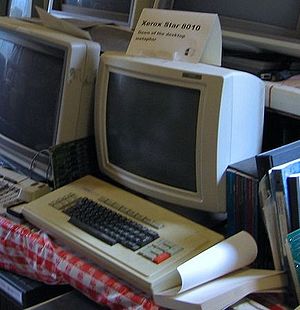
Workstation
A workstation is a high-end microcomputer designed for technical or scientific applications. Intended primarily to be used by one person at a time, they are commonly connected to a local area network and run multi-user operating systems...
, officially known as the Xerox 8010 Information System, was introduced by Xerox
Xerox
Xerox Corporation is an American multinational document management corporation that produced and sells a range of color and black-and-white printers, multifunction systems, photo copiers, digital production printing presses, and related consulting services and supplies...
Corporation in 1981. It was the first commercial system to incorporate various technologies that today have become commonplace in personal computers, including a bitmapped
Raster graphics
In computer graphics, a raster graphics image, or bitmap, is a data structure representing a generally rectangular grid of pixels, or points of color, viewable via a monitor, paper, or other display medium...
display, a window-based graphical user interface
Graphical user interface
In computing, a graphical user interface is a type of user interface that allows users to interact with electronic devices with images rather than text commands. GUIs can be used in computers, hand-held devices such as MP3 players, portable media players or gaming devices, household appliances and...
, icons
Icon (computing)
A computer icon is a pictogram displayed on a computer screen and used to navigate a computer system or mobile device. The icon itself is a small picture or symbol serving as a quick, intuitive representation of a software tool, function or a data file accessible on the system. It functions as an...
, folders, mouse, Ethernet
Ethernet
Ethernet is a family of computer networking technologies for local area networks commercially introduced in 1980. Standardized in IEEE 802.3, Ethernet has largely replaced competing wired LAN technologies....
networking
Computer network
A computer network, often simply referred to as a network, is a collection of hardware components and computers interconnected by communication channels that allow sharing of resources and information....
, file server
File server
In computing, a file server is a computer attached to a network that has the primary purpose of providing a location for shared disk access, i.e. shared storage of computer files that can be accessed by the workstations that are attached to the computer network...
s, print server
Print server
A print server, or printer server, is a device that connects printers to client computers over a network. It can accept print jobs from the computers and send the jobs to the appropriate printers....
s and e-mail
E-mail
Electronic mail, commonly known as email or e-mail, is a method of exchanging digital messages from an author to one or more recipients. Modern email operates across the Internet or other computer networks. Some early email systems required that the author and the recipient both be online at the...
.
The name "Star" technically refers only to the software sold with the system for the office automation
Office Automation
Office automation refers to the varied computer machinery and software used to digitally create, collect, store, manipulate, and relay office information needed for accomplishing basic tasks. Raw data storage, electronic transfer, and the management of electronic business information comprise the...
market. The 8010 workstations were also sold with LISP
Lisp
A lisp is a speech impediment, historically also known as sigmatism. Stereotypically, people with a lisp are unable to pronounce sibilants , and replace them with interdentals , though there are actually several kinds of lisp...
- and Smalltalk
Smalltalk
Smalltalk is an object-oriented, dynamically typed, reflective programming language. Smalltalk was created as the language to underpin the "new world" of computing exemplified by "human–computer symbiosis." It was designed and created in part for educational use, more so for constructionist...
-based software, for the smaller research and software development
Software development
Software development is the development of a software product...
market.
The Xerox Alto
The Xerox Star systems concept owes much to the Xerox AltoXerox Alto
The Xerox Alto was one of the first computers designed for individual use , making it arguably what is now called a personal computer. It was developed at Xerox PARC in 1973...
, an experimental workstation designed by the Xerox Palo Alto Research Center (PARC). Although by 1979 nearly 1000 Ethernet-linked Altos were in use at Xerox and another 500 at collaborating universities and government offices, it was never intended to be a commercial product. While Xerox had started in 1977 a development project which worked to incorporate those innovations into a commercial product, their concept was an integrated document preparation system, centered around the (then expensive) laser printing technology and oriented towards large corporations and their trading partners. When that system was announced in 1981, the cost was about $75,000 for a basic system, and $16,000 for each additional workstation.
The Xerox Star development process
The Star was developed at Xerox's Systems Development Department (SDD) in El SegundoEl Segundo, California
El Segundo is a city in Los Angeles County, California, United States. Located on the Santa Monica Bay, it was incorporated on January 18, 1917, and is one of the Beach Cities of Los Angeles County and part of the South Bay Cities Council of Governments...
, California, which had been established in 1977 under the direction of Don Massaro. A section of SDD ("SDD North") was located in Palo Alto, California, and included some people borrowed from PARC. SDD's mission was to design the "Office of the Future", a new system that would incorporate the best features of the Alto, was easy to use and could automate many office tasks.
The development team was headed by David Liddle
David Liddle
David Liddle is co-founder of Interval Research Corporation, consulting professor of computer science at Stanford University, and credited with heading development of the groundbreaking Xerox Star computer system. He has served on the board of many corporations. He was chair of the board of...
, and would eventually grow to more than 200 developers. A good part of the first year was taken up by meetings and planning, the result of which was an extensive and detailed functional specification (known internally as the "Red Book"). This became the bible for all development tasks. It defined the interface and enforced consistency in all modules and tasks. All changes to the functional specification had to be approved by a review team which rigorously maintained standards.
One group in Palo Alto worked on the underlying operating system interface to the hardware and programming tools. Teams in El Segundo and Palo Alto collaborated on development of the user interface and user applications.
The staff relied heavily on the very technologies that they were working on—file sharing, print servers and e-mail. They were even connected to the Internet
Internet
The Internet is a global system of interconnected computer networks that use the standard Internet protocol suite to serve billions of users worldwide...
, known as the Arpanet
ARPANET
The Advanced Research Projects Agency Network , was the world's first operational packet switching network and the core network of a set that came to compose the global Internet...
at that time, which allowed them to communicate between El Segundo and Palo Alto.
The Star was implemented in the Mesa programming language
Mesa programming language
Mesa was an innovative programming language developed in the late 1970s at the Xerox Palo Alto Research Center in Palo Alto, California, United States. The language was named after the mesas of the American Southwest, referring to its design intent to be a "high-level" programming language.Mesa is...
, a direct precursor to Modula-2
Modula-2
Modula-2 is a computer programming language designed and developed between 1977 and 1980 by Niklaus Wirth at ETH Zurich as a revision of Pascal to serve as the sole programming language for the operating system and application software for the personal workstation Lilith...
and Modula-3
Modula-3
In computer science, Modula-3 is a programming language conceived as a successor to an upgraded version of Modula-2 known as Modula-2+. While it has been influential in research circles it has not been adopted widely in industry...
. Mesa was not object-oriented, but tools and programming techniques were developed which allowed pseudo object-oriented design and programming. Mesa required programmers to create two files for every module, a definition module which specified data structures and procedures for each object and one or more implementation module that has the actual code for the procedures.
The Star team used a sophisticated integrated development environment
Integrated development environment
An integrated development environment is a software application that provides comprehensive facilities to computer programmers for software development...
known internally as Tajo and externally as Xerox Development Environment
Xerox Development Environment
The Xerox Development Environment was one of the first Integrated development environments . It was first implemented on the Xerox Alto in 1977.-External links:* *...
or XDE. Tajo had many similarities with the Smalltalk-80 environment, but it had many additional tools. For example, the DF version control system
Revision control
Revision control, also known as version control and source control , is the management of changes to documents, programs, and other information stored as computer files. It is most commonly used in software development, where a team of people may change the same files...
, which required programmers to check out modules before they could be changed. Any change in a module which would force dependent modules to change were closely tracked and documented. Changes to lower level modules required various levels of approval.
The software development process was intense. It involved a lot of prototyping and user testing. The software engineers
Software engineering
Software Engineering is the application of a systematic, disciplined, quantifiable approach to the development, operation, and maintenance of software, and the study of these approaches; that is, the application of engineering to software...
had to develop new network protocols
Communications protocol
A communications protocol is a system of digital message formats and rules for exchanging those messages in or between computing systems and in telecommunications...
and data-encoding schemes when those used in PARC's research environment proved inadequate.
Initially, all development was done on Alto workstations. These were not well suited to the extreme burdens placed by the software. Even the processor intended for the product proved inadequate and involved a last minute hardware redesign. Many software redesigns, rewrites, and late additions had to be made, some based on results from user testing, some based on marketing considerations, and some based on systems considerations.
A Japanese language
Japanese language
is a language spoken by over 130 million people in Japan and in Japanese emigrant communities. It is a member of the Japonic language family, which has a number of proposed relationships with other languages, none of which has gained wide acceptance among historical linguists .Japanese is an...
version of the system was produced in conjunction with Fuji Xerox
Fuji Xerox
is a joint venture partnership between the Japanese photographic firm Fuji Photo Film Co. and the American document management company Xerox to develop, produce and sell xerographic and document-related products and services in the Asia-Pacific region...
(code named "J-Star") as well as full support for international customers.
In the end, there were many features from the Star Functional Specification that had to be left at the table. The product had to get to market and the last several months before release focused on reliability and performance.
User interface
WYSIWYG
WYSIWYG is an acronym for What You See Is What You Get. The term is used in computing to describe a system in which content displayed onscreen during editing appears in a form closely corresponding to its appearance when printed or displayed as a finished product...
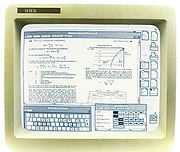
was considered paramount. Text would be displayed as black on a white background, just like paper, and the printer would replicate the screen using InterPress
InterPress
InterPress is a page description language developed at Xerox PARC, based on the Forth programming language and an earlier graphics language called JaM...
, a page description language developed at PARC.
The user would see a desktop that contained documents and folders, with different icons representing different types of documents. Clicking any icon would open a window. Users would not start programs first (e.g. a text editor, graphics program or spreadsheet software), they would simply open the file and the appropriate application would appear.
The Star user interface was based on the concept of objects. For example in a word processing document, there would be page objects, paragraph objects, sentence objects, word objects and character objects. The user could select objects by clicking on them with the mouse, and press dedicated special keys on the keyboard to invoke standard object functions — Open, Delete, Copy and Move — in a uniform way. There was also a "Show Properties" key used to display settings, called property sheets, for the particular object (e.g. font size for a character object). These general conventions greatly simplified the menu structure of all the programs.
Object integration was designed into the system from the start. For example a chart object created in the graphing module could be inserted into any type of document. This type of capability eventually became available as part of the Operating System
Operating system
An operating system is a set of programs that manage computer hardware resources and provide common services for application software. The operating system is the most important type of system software in a computer system...
on the Apple Lisa
Apple Lisa
The Apple Lisa—also known as the Lisa—is a :personal computer designed by Apple Computer, Inc. during the early 1980s....
and became part of Microsoft Windows
Microsoft Windows
Microsoft Windows is a series of operating systems produced by Microsoft.Microsoft introduced an operating environment named Windows on November 20, 1985 as an add-on to MS-DOS in response to the growing interest in graphical user interfaces . Microsoft Windows came to dominate the world's personal...
with the introduction of OLE (Object Linking and Embedding
Object Linking and Embedding
Object Linking and Embedding is a technology developed by Microsoft that allows embedding and linking to documents and other objects. For developers, it brought OLE Control eXtension , a way to develop and use custom user interface elements...
) in 1990. This philosophy was also later used on the OpenDoc
OpenDoc
OpenDoc was a multi-platform software componentry framework standard for compound documents, intended as an alternative to Microsoft's Object Linking and Embedding ....
software platform in the mid-to-late nineties.
Hardware
Initially, the Star software was to run on a new series of virtual-memory processors, described in a PARC technical report called, "Wildflower: An Architecture for a Personal Computer", by Butler Lampson. The machines had names that always began with the letter 'D'.The first of these machines was the Dolphin, built with TTL
Transistor-transistor logic
Transistor–transistor logic is a class of digital circuits built from bipolar junction transistors and resistors. It is called transistor–transistor logic because both the logic gating function and the amplifying function are performed by transistors .TTL is notable for being a widespread...
technology. The complexity of the software eventually overwhelmed its limited configuration; at one point in Star's development, it would take more than half an hour to reboot the system.
The next Star workstation hardware was known as a Dandelion (often shortened to "Dlion"). It had a microprogrammed
Microcode
Microcode is a layer of hardware-level instructions and/or data structures involved in the implementation of higher level machine code instructions in many computers and other processors; it resides in special high-speed memory and translates machine instructions into sequences of detailed...
CPU, based on the AMD Am2900
AMD Am2900
Am2900 is a family of integrated circuits created in 1975 by Advanced Micro Devices . They were constructed with bipolar devices, in a bit-slice topology, and were designed to be used as modular components each representing a different aspect of a computer control unit...
bitslice microprocessor technology, that implemented a virtual machine
Virtual machine
A virtual machine is a "completely isolated guest operating system installation within a normal host operating system". Modern virtual machines are implemented with either software emulation or hardware virtualization or both together.-VM Definitions:A virtual machine is a software...
for the Mesa programming language
Mesa programming language
Mesa was an innovative programming language developed in the late 1970s at the Xerox Palo Alto Research Center in Palo Alto, California, United States. The language was named after the mesas of the American Southwest, referring to its design intent to be a "high-level" programming language.Mesa is...
. An enhanced version of the Dandelion (with more microcode space) was dubbed the "Dandetiger".
The base Dandelion system had 384 kB
Kilobyte
The kilobyte is a multiple of the unit byte for digital information. Although the prefix kilo- means 1000, the term kilobyte and symbol KB have historically been used to refer to either 1024 bytes or 1000 bytes, dependent upon context, in the fields of computer science and information...
memory
Computer storage
Computer data storage, often called storage or memory, refers to computer components and recording media that retain digital data. Data storage is one of the core functions and fundamental components of computers....
(expandable to 1.5MB), a 10 MB, 29 MB or 40 MB 8" hard drive, an 8" floppy drive, mouse and an Ethernet
Ethernet
Ethernet is a family of computer networking technologies for local area networks commercially introduced in 1980. Standardized in IEEE 802.3, Ethernet has largely replaced competing wired LAN technologies....
connection. The performance of this machine, which sold for $20,000, was about 850 in the Dhrystone
Dhrystone
Dhrystone is a synthetic computing benchmark program developed in 1984 by Reinhold P. Weicker intended to be representative of system programming. The Dhrystone grew to become representative of general processor performance...
benchmark — comparable to that of a VAX-11/750
VAX-11
The VAX-11 was a family of minicomputers developed and manufactured by Digital Equipment Corporation using processors implementing the VAX instruction set architecture . The VAX-11/780 was the first VAX computer.- VAX-11/780 :...
, which cost five times as much. The 17 in CRT
Cathode ray tube
The cathode ray tube is a vacuum tube containing an electron gun and a fluorescent screen used to view images. It has a means to accelerate and deflect the electron beam onto the fluorescent screen to create the images. The image may represent electrical waveforms , pictures , radar targets and...
display (black and white, 1024×809 pixels with 38.7 Hz refresh) was large by standards at the time. It was meant to be able to display two 8.5×11 in pages side by side in actual size. An interesting feature of the display was that the overscan area (the borders) of it could be programmed with a 16×16 pattern. This was used to extend the root window pattern to all the edges of the monitor, a feature that is not available even today on most video cards.
The next design, the Dorado, used an ECL
Emitter coupled logic
In electronics, emitter-coupled logic , is a logic family that achieves high speed by using an overdriven BJT differential amplifier with single-ended input, whose emitter current is limited to avoid the slow saturation region of transistor operation....
processor. It was four times faster than the Dandelion on standard benchmarks, and therefore competitive with the fastest super minicomputers of the day. It was used for research but was impractical as a product.
A network router called Dicentra was also based on this design.
Marketing and commercial reception
Commodore VIC-20
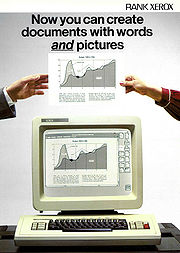
The VIC-20 is an 8-bit home computer which was sold by Commodore Business Machines. The VIC-20 was announced in 1980, roughly three years after Commodore's first personal computer, the PET...
cost around $300 .
Later incarnations of the Star would allow users to purchase a single unit with a laser printer
Laser printer
A laser printer is a common type of computer printer that rapidly produces high quality text and graphics on plain paper. As with digital photocopiers and multifunction printers , laser printers employ a xerographic printing process, but differ from analog photocopiers in that the image is produced...
, but even so only about 25,000 units were sold, leading many to consider the Xerox Star to be a commercial failure.
The workstation was originally designed to run the Star software for performing office tasks, but it was also sold with different software for other markets. These other configurations included an Interlisp workstation, Smalltalk workstation, and a server.
Some have said that the Star was ahead of its time, that few outside of a small circle of developers really understood the potential of the system, considering that IBM
IBM
International Business Machines Corporation or IBM is an American multinational technology and consulting corporation headquartered in Armonk, New York, United States. IBM manufactures and sells computer hardware and software, and it offers infrastructure, hosting and consulting services in areas...
introduced their 8088-based IBM PC
IBM PC
The IBM Personal Computer, commonly known as the IBM PC, is the original version and progenitor of the IBM PC compatible hardware platform. It is IBM model number 5150, and was introduced on August 12, 1981...
running the comparatively primitive PC-DOS
PC-DOS
IBM PC DOS is a DOS system for the IBM Personal Computer and compatibles, manufactured and sold by IBM from the 1980s to the 2000s....
the same year that the Star was brought to market. However, comparison with the IBM PC may be irrelevant: well before it was launched, buyers in the Word Processing industry were aware of the 8086-based IBM Displaywriter, the full-page portrait black-on-white Xerox 850 page display system and the 120 page-per-minute Xerox 9700 laser printer. Furthermore, the design principles of Smalltalk and modeless working had been extensively discussed in the August 1981 issue of BYTE magazine, so Xerox PARC
Xerox PARC
PARC , formerly Xerox PARC, is a research and co-development company in Palo Alto, California, with a distinguished reputation for its contributions to information technology and hardware systems....
's standing and the potential of the Star can scarcely have been lost on its target (office systems) market, who would never have expected IBM to position a mass-market PC to threaten far more profitable dedicated WP systems. Unfortunately, the influential niche market of pioneering players in electronic publishing
Electronic publishing
Electronic publishing or ePublishing includes the digital publication of e-books and electronic articles, and the development of digital libraries and catalogues. Electronic publishing has become common in scientific publishing where it has been argued that peer-reviewed scientific journals are in...
such as Longman
Longman
Longman was a publishing company founded in London, England in 1724. It is now an imprint of Pearson Education.-Beginnings:The Longman company was founded by Thomas Longman , the son of Ezekiel Longman , a gentleman of Bristol. Thomas was apprenticed in 1716 to John Osborn, a London bookseller, and...
were already aligning their production processes towards generic markup language
Markup language
A markup language is a modern system for annotating a text in a way that is syntactically distinguishable from that text. The idea and terminology evolved from the "marking up" of manuscripts, i.e. the revision instructions by editors, traditionally written with a blue pencil on authors' manuscripts...
s such as SGML (forerunner of HTML and XML) whereby authors using inexpensive offline systems could describe document structure, making their manuscripts ready for transfer to computer to film
Computer to film
Computer to Film is a print workflow involving the printing from a computer, straight to film. This film is then burned onto a lithographic plate, using a plate burner. The plate is then put on an offset printing press to make a product...
systems that offered far higher resolution than the then-current maximum of 360 dpi laser printing technologies.
Another possible reason given for the lack of success of the Star was the corporate structure of Xerox itself. A longtime copier company, Xerox played to their strengths. They already had one significant failure under their belt in making their acquisition of Scientific Data Systems
Scientific Data Systems
Scientific Data Systems, or SDS, was an American computer company founded in September 1961 by Max Palevsky, a veteran of Packard Bell and Bendix, along with eleven other computer scientists. SDS was an early adopter of integrated circuits in computer design and the first to employ silicon...
pay off. It is said that there were internal jealousies between the old line copier systems divisions that were responsible for bulk of Xerox's revenues and the new upstart division. Their marketing efforts were seen by some as half-hearted or unfocused. Furthermore, the most technically savvy sales representatives that might have sold office automation equipment were paid large commissions on leases of laser printer equipment costing up to a half-million dollars. No commission structure for 'decentralized' systems could compete. The multi-lingual technical documentation market was also a major opportunity, but this required cross-border collaboration for which few sales organisations were ready at this time.
Probably most significantly, strategic planners at the Xerox Systems Group (XSG) did not feel that they could compete against other workstation manufacturers such as Apollo Computer
Apollo Computer
Apollo Computer, Inc., founded 1980 in Chelmsford, Massachusetts by William Poduska and others, developed and produced Apollo/Domain workstations in the 1980s. Along with Symbolics and Sun Microsystems, Apollo was one of the first vendors of graphical workstations in the 1980s...
or Symbolics
Symbolics
Symbolics refers to two companies: now-defunct computer manufacturer Symbolics, Inc., and a privately held company that acquired the assets of the former company and continues to sell and maintain the Open Genera Lisp system and the Macsyma computer algebra system.The symbolics.com domain was...
. The Xerox name alone was considered their greatest asset, but it did not produce customers.
Finally, by today's standards, the system would be considered very slow, in part due to the limited hardware of the era, and in part due to a poorly implemented file system; saving a large file could take minutes. Crashes could be followed by an hours-long process called "file scavenging", signaled by the appearance of the diagnostic code '7511' in the top left corner of the screen.
In the end the Star's unsatisfactory commercial reception probably came down to price, performance in demonstrations, and weakness of sales channels. To give credit to Xerox, they did try many things in an attempt to jumpstart sales. The next release of Star was on a different, more efficient hardware platform, Daybreak
Xerox Daybreak
Xerox Daybreak is a workstation computer marketed by Xerox from 1985 to 1989. It ran the ViewPoint GUI and was used extensively throughout Xerox until being replaced by Suns and PCs...
, using a new, faster processor, and accompanied by significant rewriting of the Star software, renamed ViewPoint, to improve performance. The new system, dubbed the Xerox 6085 PCS , was released in 1985. The new hardware provided 1MB to 4MB of memory, a 10MB to 80MB hard disk, a 15" or 19" display, a 5.25" floppy drive, a mouse, Ethernet connector and a price of a little over $6,000.
The Xerox 6085 could be sold along with an attached laser printer as a standalone system. Also offered was a PC compatibility mode via an 80186-based expansion board. Users could transfer files between the ViewPoint system and PC-based software, albeit with some difficulty because the file formats were not compatible with any on the PC. But even with a significantly reduced price, it was still a Rolls Royce
Rolls-Royce (car)
This a list of Rolls-Royce motor cars and includes vehicles produced by:*Rolls-Royce Limited *Rolls-Royce Motors , which was owned by Vickers between 1980 and 1998, and after that by Volkswagen...
in the world of inexpensive $2,000 personal computers.
In 1989, Viewpoint 2.0 introduced many new applications related to desktop publishing
Desktop publishing
Desktop publishing is the creation of documents using page layout software on a personal computer.The term has been used for publishing at all levels, from small-circulation documents such as local newsletters to books, magazines and newspapers...
. Eventually, Xerox jettisoned the integrated hardware/software workstation offered by Viewpoint and offered a software-only product called GlobalView
GlobalView
GlobalView was an integrated “desktop environment” including word-processing, desktop-publishing, and simple calculation and database functionality, developed at Xerox Parc as a way to run the software originally developed for their Xerox Alto and Xerox Star specialized workstations on an IBM...
, providing the Star interface and technology on an IBM PC compatible platform. The initial release required the installation of a MESA CPU add-on board. The final release of GlobalView 2.1 ran as an emulator on top of Sun Solaris, Microsoft Windows 3.1, Windows 95
Windows 95
Windows 95 is a consumer-oriented graphical user interface-based operating system. It was released on August 24, 1995 by Microsoft, and was a significant progression from the company's previous Windows products...
or Windows 98
Windows 98
Windows 98 is a graphical operating system by Microsoft. It is the second major release in the Windows 9x line of operating systems. It was released to manufacturing on 15 May 1998 and to retail on 25 June 1998. Windows 98 is the successor to Windows 95. Like its predecessor, it is a hybrid...
and was released in 1996.
Legacy
Even though the Star product failed in the marketplace, it raised expectations and laid important groundwork for the computers of today. Many of the innovations behind the Star, such as WYSIWYG editing, EthernetEthernet
Ethernet is a family of computer networking technologies for local area networks commercially introduced in 1980. Standardized in IEEE 802.3, Ethernet has largely replaced competing wired LAN technologies....
, and network services such as Directory, Print, File, and internetwork routing have become commonplace in computers of today.
Members of the Apple Lisa
Apple Lisa
The Apple Lisa—also known as the Lisa—is a :personal computer designed by Apple Computer, Inc. during the early 1980s....
engineering team saw Star at its introduction at the National Computer Conference (NCC '81) and returned to Cupertino where they converted their desktop manager to an icon-based interface modeled on the Star. Among the developers of the Gypsy
Gypsy (software)
Gypsy was the first document preparation system based on a mouse and graphical user interface to take advantage of those technologies to virtually eliminate modes. Its operation would be familiar to any user of a modern personal computer...
editor, Larry Tesler
Larry Tesler
Larry Tesler is a computer scientist working in the field of human-computer interaction. Tesler has worked at Xerox PARC, Apple Computer, Amazon.com, and Yahoo!...
left Xerox to join Apple in 1980 and Charles Simonyi
Charles Simonyi
Charles Simonyi is a Hungarian-American computer software executive who, as head of Microsoft's application software group, oversaw the creation of Microsoft's flagship Office suite of applications. He now heads his own company, Intentional Software, with the aim of developing and marketing his...
left to join Microsoft
Microsoft
Microsoft Corporation is an American public multinational corporation headquartered in Redmond, Washington, USA that develops, manufactures, licenses, and supports a wide range of products and services predominantly related to computing through its various product divisions...
in 1981 (whereupon Bill Gates
Bill Gates
William Henry "Bill" Gates III is an American business magnate, investor, philanthropist, and author. Gates is the former CEO and current chairman of Microsoft, the software company he founded with Paul Allen...
spent $100,000 on a Xerox Star and laser printer), and several other defectors from PARC followed Simonyi to Microsoft in 1983.
Star, Viewpoint and GlobalView
GlobalView
GlobalView was an integrated “desktop environment” including word-processing, desktop-publishing, and simple calculation and database functionality, developed at Xerox Parc as a way to run the software originally developed for their Xerox Alto and Xerox Star specialized workstations on an IBM...
were the first commercial computing environments to offer support for most natural language
Natural language
In the philosophy of language, a natural language is any language which arises in an unpremeditated fashion as the result of the innate facility for language possessed by the human intellect. A natural language is typically used for communication, and may be spoken, signed, or written...
s, including full-featured word processing, leading to their adoption by the Voice of America
Voice of America
Voice of America is the official external broadcast institution of the United States federal government. It is one of five civilian U.S. international broadcasters working under the umbrella of the Broadcasting Board of Governors . VOA provides a wide range of programming for broadcast on radio...
and other United States foreign affairs agencies as well as a number of multinational corporations.
The list of products that were inspired or influenced by the user interface of the Star include the Apple Lisa
Apple Lisa
The Apple Lisa—also known as the Lisa—is a :personal computer designed by Apple Computer, Inc. during the early 1980s....
, Apple's Macintosh
Macintosh
The Macintosh , or Mac, is a series of several lines of personal computers designed, developed, and marketed by Apple Inc. The first Macintosh was introduced by Apple's then-chairman Steve Jobs on January 24, 1984; it was the first commercially successful personal computer to feature a mouse and a...
, GEM
Graphical Environment Manager
GEM was a windowing system created by Digital Research, Inc. for use with the CP/M operating system on the Intel 8088 and Motorola 68000 microprocessors...
from Digital Research
Digital Research
Digital Research, Inc. was the company created by Dr. Gary Kildall to market and develop his CP/M operating system and related products. It was the first large software company in the microcomputer world...
(the DR-DOS
DR-DOS
DR-DOS is an MS-DOS-compatible operating system for IBM PC-compatible personal computers, originally developed by Gary Kildall's Digital Research and derived from Concurrent PC DOS 6.0, which was an advanced successor of CP/M-86...
company), Microsoft Windows
Microsoft Windows
Microsoft Windows is a series of operating systems produced by Microsoft.Microsoft introduced an operating environment named Windows on November 20, 1985 as an add-on to MS-DOS in response to the growing interest in graphical user interfaces . Microsoft Windows came to dominate the world's personal...
, Atari ST
Atari ST
The Atari ST is a home/personal computer that was released by Atari Corporation in 1985 and commercially available from that summer into the early 1990s. The "ST" officially stands for "Sixteen/Thirty-two", which referred to the Motorola 68000's 16-bit external bus and 32-bit internals...
, BTRON
BTRON
Business TRON , is a computer operating system with a graphical user interface built upon Central TRON , itself a subproject of The Real-time Operating system Nucleus...
from TRON Project
TRON Project
TRON is an open real-time operating system kernel design, and is an acronym for "The Real-time Operating system Nucleus". The project was started by Prof. Dr. Ken Sakamura of the University of Tokyo in 1984...
, Commodore
Commodore International
Commodore is the commonly used name for Commodore Business Machines , the U.S.-based home computer manufacturer and electronics manufacturer headquartered in West Chester, Pennsylvania, which also housed Commodore's corporate parent company, Commodore International Limited...
's Amiga
Amiga
The Amiga is a family of personal computers that was sold by Commodore in the 1980s and 1990s. The first model was launched in 1985 as a high-end home computer and became popular for its graphical, audio and multi-tasking abilities...
, Elixir Desktop
Elixir Desktop
- Elixir Desktop :Elixir Desktop was a graphical user interface environment created in the mid to late 1980s by Elixir Technologies Corporation. The Elixir Desktop married the user interface metaphors of the Xerox Star 8010 with the GEM graphics environment from Digital Research Inc. running on an...
, Metaphor Computer Systems
Metaphor Computer Systems
Metaphor Computer Systems was a Xerox PARC spin-off that created an advanced workstation, database gateway, a unique graphical office interface, and software applications that communicate. The Metaphor machine was one of the first commercial workstations to offer a complete hardware/software...
, Interleaf
Interleaf
Founded in 1981, Interleaf was a company that created software products for the technical publishing creation and distribution process. Its initial product was the first commercial document processor that integrated text and graphics editing, producing WYSIWYG output at near-typeset quality...
, IBM OS/2
OS/2
OS/2 is a computer operating system, initially created by Microsoft and IBM, then later developed by IBM exclusively. The name stands for "Operating System/2," because it was introduced as part of the same generation change release as IBM's "Personal System/2 " line of second-generation personal...
, OPEN LOOK
OPEN LOOK
OPEN LOOK is a graphical user interface specification for UNIX workstations. It was originally defined in the late 1980s by Sun Microsystems and AT&T.-History:...
(co-developed by Xerox), SunView
SunView
SunView was a windowing system from Sun Microsystems developed in the early 1980s. It was included as part of SunOS, Sun's UNIX implementation; unlike later UNIX windowing systems, much of it was implemented in the system kernel...
, KDE
KDE
KDE is an international free software community producing an integrated set of cross-platform applications designed to run on Linux, FreeBSD, Microsoft Windows, Solaris and Mac OS X systems...
, Ventura Publisher and NEXTSTEP
NEXTSTEP
NeXTSTEP was the object-oriented, multitasking operating system developed by NeXT Computer to run on its range of proprietary workstation computers, such as the NeXTcube...
. Adobe Systems
Adobe Systems
Adobe Systems Incorporated is an American computer software company founded in 1982 and headquartered in San Jose, California, United States...
PostScript
PostScript
PostScript is a dynamically typed concatenative programming language created by John Warnock and Charles Geschke in 1982. It is best known for its use as a page description language in the electronic and desktop publishing areas. Adobe PostScript 3 is also the worldwide printing and imaging...
was based on InterPress
InterPress
InterPress is a page description language developed at Xerox PARC, based on the Forth programming language and an earlier graphics language called JaM...
. Ethernet
Ethernet
Ethernet is a family of computer networking technologies for local area networks commercially introduced in 1980. Standardized in IEEE 802.3, Ethernet has largely replaced competing wired LAN technologies....
was further refined by 3Com
3Com
3Com was a pioneering digital electronics manufacturer best known for its computer network infrastructure products. The company was co-founded in 1979 by Robert Metcalfe, Howard Charney, Bruce Borden, and Greg Shaw...
, and has become the standard networking protocol.
Some people feel that Apple, Microsoft, and others plagiarized the GUI
Gui
Gui or guee is a generic term to refer to grilled dishes in Korean cuisine. These most commonly have meat or fish as their primary ingredient, but may in some cases also comprise grilled vegetables or other vegetarian ingredients. The term derives from the verb, "gupda" in Korean, which literally...
and other innovations from the Xerox Star, and believe that Xerox didn't properly protect its intellectual property. The truth is more complicated. Many patent disclosures were in fact submitted for the innovations in the Star; however, at the time the 1975 Xerox Consent Decree, an FTC
FTC
FTC may refer to:- Organizations :* Federal Trade Commission, a US agency for consumer protection* Ferencvárosi TC, a Hungarian sports club* Financial Training Center Limited, a training institution in Tanzania...
antitrust
Antitrust
The United States antitrust law is a body of laws that prohibits anti-competitive behavior and unfair business practices. Antitrust laws are intended to encourage competition in the marketplace. These competition laws make illegal certain practices deemed to hurt businesses or consumers or both,...
action, placed restrictions on what the company was able to patent
Patent
A patent is a form of intellectual property. It consists of a set of exclusive rights granted by a sovereign state to an inventor or their assignee for a limited period of time in exchange for the public disclosure of an invention....
. In addition, when the Star disclosures were being prepared, the Xerox patent attorneys were busy with several other new technologies such as laser printing. Finally, patents on software, particularly those relating to user interfaces, were an untested legal area at that time.
Xerox did go to trial to protect the Star user interface. In 1989, after Apple sued Microsoft
Apple Computer, Inc. v. Microsoft Corp.
Apple Computer, Inc. v. Microsoft Corporation, 35 F.3d 1435 was a copyright infringement lawsuit in which Apple Computer, Inc. sought to prevent Microsoft Corporation and Hewlett-Packard from using visual graphical user interface elements that were similar to those in Apple's Lisa and Macintosh...
for copyright infringement of its Macintosh user interface in Windows, Xerox filed a similar lawsuit
Lawsuit
A lawsuit or "suit in law" is a civil action brought in a court of law in which a plaintiff, a party who claims to have incurred loss as a result of a defendant's actions, demands a legal or equitable remedy. The defendant is required to respond to the plaintiff's complaint...
against Apple; however, it was thrown out because a three year statute of limitations
Statute of limitations
A statute of limitations is an enactment in a common law legal system that sets the maximum time after an event that legal proceedings based on that event may be initiated...
had passed. (Apple eventually lost its lawsuit in 1994, losing all claims to the user interface).
External links
- The first GUIs - Chapter 2. History: A Brief History of User Interfaces
- Star graphics: An object-oriented implementation
- Traits: An approach to multiple-inheritance subclassing
- The design of Star's records processing: data processing for the noncomputer professional
- The Xerox "Star": A Retrospective.
- The Xerox "Star": A Retrospective. (with full-size screenshots)
- Dave Curbow's Xerox Star Historical Documents (at the Digibarn)
- The Digibarn's pages on the Xerox Star 8010 Information System
- Xerox Star 1981
- HCI Review of the Xerox Star
- GUI of Xerox Star