

X86 architecture

Encyclopedia

Intel 8086
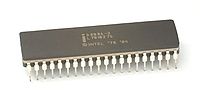
The 8086 is a 16-bit microprocessor chip designed by Intel between early 1976 and mid-1978, when it was released. The 8086 gave rise to the x86 architecture of Intel's future processors...
CPU
Central processing unit
The central processing unit is the portion of a computer system that carries out the instructions of a computer program, to perform the basic arithmetical, logical, and input/output operations of the system. The CPU plays a role somewhat analogous to the brain in the computer. The term has been in...
. The 8086 was launched in 1978 as a fully 16-bit extension of Intel's 8-bit based 8080 microprocessor and also introduced segmentation to overcome the 16-bit addressing barrier of such designs. The term x86 derived from the fact that early successors to the 8086 also had names ending in "86". Many additions and extensions have been added to the x86 instruction set over the years, almost consistently with full backward compatibility
Backward compatibility
In the context of telecommunications and computing, a device or technology is said to be backward or downward compatible if it can work with input generated by an older device...
. The architecture has been implemented in processors from Intel
Intel Corporation
Intel Corporation is an American multinational semiconductor chip maker corporation headquartered in Santa Clara, California, United States and the world's largest semiconductor chip maker, based on revenue. It is the inventor of the x86 series of microprocessors, the processors found in most...
, Cyrix
Cyrix
Cyrix Corporation was a microprocessor developer that was founded in 1988 in Richardson, Texas as a specialist supplier of high-performance math coprocessors for 286 and 386 microprocessors. The company was founded by former Texas Instruments staff members and had a long but troubled relationship...
, AMD
Advanced Micro Devices
Advanced Micro Devices, Inc. or AMD is an American multinational semiconductor company based in Sunnyvale, California, that develops computer processors and related technologies for commercial and consumer markets...
, VIA
VIA Technologies
VIA Technologies is a Taiwanese manufacturer of integrated circuits, mainly motherboard chipsets, CPUs, and memory, and is part of the Formosa Plastics Group. It is the world's largest independent manufacturer of motherboard chipsets...
, and many others.
The term is not synonymous with IBM PC compatibility
IBM PC compatible
IBM PC compatible computers are those generally similar to the original IBM PC, XT, and AT. Such computers used to be referred to as PC clones, or IBM clones since they almost exactly duplicated all the significant features of the PC architecture, facilitated by various manufacturers' ability to...
as this implies a multitude of other hardware; embedded system
Embedded system
An embedded system is a computer system designed for specific control functions within a larger system. often with real-time computing constraints. It is embedded as part of a complete device often including hardware and mechanical parts. By contrast, a general-purpose computer, such as a personal...
s as well as general-purpose computers used x86 chips before the PC-compatible market started, some of them before the IBM PC
IBM PC
The IBM Personal Computer, commonly known as the IBM PC, is the original version and progenitor of the IBM PC compatible hardware platform. It is IBM model number 5150, and was introduced on August 12, 1981...
itself.
As the term became common after the introduction of the 80386, it usually implies binary compatibility with the 32-bit instruction set
Instruction set
An instruction set, or instruction set architecture , is the part of the computer architecture related to programming, including the native data types, instructions, registers, addressing modes, memory architecture, interrupt and exception handling, and external I/O...
of the 80386. This may sometimes be emphasized as x86-32
IA-32
IA-32 , also known as x86-32, i386 or x86, is the CISC instruction-set architecture of Intel's most commercially successful microprocessors, and was first implemented in the Intel 80386 as a 32-bit extension of x86 architecture...
to distinguish it either from the original 16-bit "x86-16" or from the 64-bit x86-64
X86-64
x86-64 is an extension of the x86 instruction set. It supports vastly larger virtual and physical address spaces than are possible on x86, thereby allowing programmers to conveniently work with much larger data sets. x86-64 also provides 64-bit general purpose registers and numerous other...
. Although most x86 processors used in new personal computer
Personal computer
A personal computer is any general-purpose computer whose size, capabilities, and original sales price make it useful for individuals, and which is intended to be operated directly by an end-user with no intervening computer operator...
s and server
Server (computing)
In the context of client-server architecture, a server is a computer program running to serve the requests of other programs, the "clients". Thus, the "server" performs some computational task on behalf of "clients"...
s have 64-bit capabilities, to avoid compatibility problems with older computers or systems, the term x86-64 (or x64) is often used to denote 64-bit software, with the term x86 implying only 32-bit.
Although the 8086 was primarily developed for embedded systems and small single-user computers, largely as a response to the successful 8080-compatible Zilog Z80
Zilog Z80
The Zilog Z80 is an 8-bit microprocessor designed by Zilog and sold from July 1976 onwards. It was widely used both in desktop and embedded computer designs as well as for military purposes...
, the x86 line soon grew in features and processing power. Today, x86 is ubiquitous in both stationary and portable personal computers and has replaced midrange computer
Midrange computer
Midrange computers, or midrange systems, are a class of computer systems which fall in between mainframe computers and microcomputers.The class emerged in the 1960s and machines were generally known at the time as minicomputers - especially models from Digital Equipment Corporation , Data General,...
s and RISC-based
Reduced instruction set computer
Reduced instruction set computing, or RISC , is a CPU design strategy based on the insight that simplified instructions can provide higher performance if this simplicity enables much faster execution of each instruction. A computer based on this strategy is a reduced instruction set computer...
processors in a majority of servers and workstation
Workstation
A workstation is a high-end microcomputer designed for technical or scientific applications. Intended primarily to be used by one person at a time, they are commonly connected to a local area network and run multi-user operating systems...
s as well. A large amount of software
Computer software
Computer software, or just software, is a collection of computer programs and related data that provide the instructions for telling a computer what to do and how to do it....
, including operating system
Operating system
An operating system is a set of programs that manage computer hardware resources and provide common services for application software. The operating system is the most important type of system software in a computer system...
s (OSs) such as DOS
DOS
DOS, short for "Disk Operating System", is an acronym for several closely related operating systems that dominated the IBM PC compatible market between 1981 and 1995, or until about 2000 if one includes the partially DOS-based Microsoft Windows versions 95, 98, and Millennium Edition.Related...
, Windows
Microsoft Windows
Microsoft Windows is a series of operating systems produced by Microsoft.Microsoft introduced an operating environment named Windows on November 20, 1985 as an add-on to MS-DOS in response to the growing interest in graphical user interfaces . Microsoft Windows came to dominate the world's personal...
, Linux
Linux
Linux is a Unix-like computer operating system assembled under the model of free and open source software development and distribution. The defining component of any Linux system is the Linux kernel, an operating system kernel first released October 5, 1991 by Linus Torvalds...
, BSD, Solaris, and Mac OS X
Mac OS X
Mac OS X is a series of Unix-based operating systems and graphical user interfaces developed, marketed, and sold by Apple Inc. Since 2002, has been included with all new Macintosh computer systems...
supports x86-based hardware.
Modern x86 is relatively uncommon in embedded systems, however, and small low power applications (using tiny batteries) as well as low-cost microprocessor markets, such as home appliance
Home appliance
Home appliances are electrical/mechanical machines which accomplish some household functions, such as cooking or cleaning. Home appliances can be classified into:*Major appliances, or White goods*Small appliances, or Brown goods...
s and toys, lack any significant x86 presence. Simple 8-bit and 16-bit based architectures are common here, although the x86-compatible VIA C7
VIA C7
The VIA C7 is an x86 central processing unit designed by Centaur Technology and sold by VIA Technologies.- Product history :The C7 delivers a number of improvements to the older VIA C3 cores but is nearly identical to the latest VIA C3 Nehemiah core. The C7 was officially launched in May 2005,...
, VIA Nano
VIA Nano
The VIA Nano is a 64-bit CPU for personal computers. The VIA Nano was released by VIA Technologies in 2008 after five years of development by its CPU division, Centaur Technology...
, AMD
Advanced Micro Devices
Advanced Micro Devices, Inc. or AMD is an American multinational semiconductor company based in Sunnyvale, California, that develops computer processors and related technologies for commercial and consumer markets...
's Geode
Geode (processor)
Geode is a series of x86-compatible system-on-a-chip microprocessors and I/O companions produced by AMD, targeted at the embedded computing market....
, Athlon Neo, and Intel Atom
Intel Atom
Intel Atom is the brand name for a line of ultra-low-voltage x86 and x86-64 CPUs from Intel, designed in 45 nm CMOS and used mainly in netbooks, nettops, embedded application ranging from health care to advanced robotics and Mobile Internet devices...
are examples of 32- and 64-bit designs used in some relatively low power and low cost segments.
There have been several attempts, also within Intel itself, to break the market dominance of the "inelegant" x86 architecture that descended directly from the first simple 8-bit microprocessors. Examples of this are the iAPX 432 (alias Intel 8800), the Intel 960, Intel 860 and Intel and Hewlett Packard Itanium
Itanium
Itanium is a family of 64-bit Intel microprocessors that implement the Intel Itanium architecture . Intel markets the processors for enterprise servers and high-performance computing systems...
architecture. However, the continuous refinement of x86 microarchitecture
Microarchitecture
In computer engineering, microarchitecture , also called computer organization, is the way a given instruction set architecture is implemented on a processor. A given ISA may be implemented with different microarchitectures. Implementations might vary due to different goals of a given design or...
s, circuitry
Electronic circuit
An electronic circuit is composed of individual electronic components, such as resistors, transistors, capacitors, inductors and diodes, connected by conductive wires or traces through which electric current can flow...
, and semiconductor manufacturing would prove it hard to replace x86 in many segments. AMD's 64 bit extension of x86 (which Intel eventually responded to with a compatible design) and the scalability of x86 chips such as the eight-core Intel Xeon and 12-core AMD Opteron is underlining x86 as an example of how continuous refinement of established industry standards can resist the competition from completely new architectures.
Note: In the following text, all instances of use of the prefixes kilo/mega/giga/tera are to be understood in the binary (powers-of-1024) sense. See the article on the IEC prefixes (kibi/mebi/gibi/tebi) for details.
Chronology
The table below lists brands of common consumer targeted processors implementing the x86 instruction setInstruction set
An instruction set, or instruction set architecture , is the part of the computer architecture related to programming, including the native data types, instructions, registers, addressing modes, memory architecture, interrupt and exception handling, and external I/O...
, grouped by generations that highlight important points in x86 history. Note: CPU generations are not strict: each generation is roughly marked by significantly improved or commercially successful processor microarchitecture
Microarchitecture
In computer engineering, microarchitecture , also called computer organization, is the way a given instruction set architecture is implemented on a processor. A given ISA may be implemented with different microarchitectures. Implementations might vary due to different goals of a given design or...
designs.
| Generation | First introduced | Prominent consumer CPU brands | Linear/physical address space | Notable (new) features |
|---|---|---|---|---|
| 1 | 1978 | Intel 8086 Intel 8086 The 8086 is a 16-bit microprocessor chip designed by Intel between early 1976 and mid-1978, when it was released. The 8086 gave rise to the x86 architecture of Intel's future processors... , Intel 8088 Intel 8088 The Intel 8088 microprocessor was a variant of the Intel 8086 and was introduced on July 1, 1979. It had an 8-bit external data bus instead of the 16-bit bus of the 8086. The 16-bit registers and the one megabyte address range were unchanged, however... and clones |
16-bit / 20-bit (segmented) | first x86 microprocessors |
| 1982 | Intel 80186 Intel 80186 The 80188 is a version with an 8-bit external data bus, instead of 16-bit. This makes it less expensive to connect to peripherals. The 80188 is otherwise very similar to the 80186. It has a throughput of 1 million instructions per second.... , Intel 80188 and clones, NEC V20 NEC V20 The NEC V20 was a processor made by NEC that was a reverse-engineered, pin-compatible version of the Intel 8088 with an instruction set compatible with the Intel 80186... /V30 |
hardware for fast address Memory address A digital computer's memory, more specifically main memory, consists of many memory locations, each having a memory address, a number, analogous to a street address, at which computer programs store and retrieve, machine code or data. Most application programs do not directly read and write to... calculations, fast mul/div etc. |
||
| 2 | Intel 80286 Intel 80286 The Intel 80286 , introduced on 1 February 1982, was a 16-bit x86 microprocessor with 134,000 transistors. Like its contemporary simpler cousin, the 80186, it could correctly execute most software written for the earlier Intel 8086 and 8088... and clones |
16-bit (30-bit virtual) / 24-bit (segmented) | MMU Memory management unit A memory management unit , sometimes called paged memory management unit , is a computer hardware component responsible for handling accesses to memory requested by the CPU... , for protected mode Protected mode In computing, protected mode, also called protected virtual address mode, is an operational mode of x86-compatible central processing units... and a larger address space Address space In computing, an address space defines a range of discrete addresses, each of which may correspond to a network host, peripheral device, disk sector, a memory cell or other logical or physical entity.- Overview :... |
|
| 3 (IA-32 IA-32 IA-32 , also known as x86-32, i386 or x86, is the CISC instruction-set architecture of Intel's most commercially successful microprocessors, and was first implemented in the Intel 80386 as a 32-bit extension of x86 architecture... ) |
1985 | Intel 80386 Intel 80386 The Intel 80386, also known as the i386, or just 386, was a 32-bit microprocessor introduced by Intel in 1985. The first versions had 275,000 transistors and were used as the central processing unit of many workstations and high-end personal computers of the time... and clones, AMD Am386 |
32-bit (46-bit virtual) / 32-bit | 32-bit 32-bit The range of integer values that can be stored in 32 bits is 0 through 4,294,967,295. Hence, a processor with 32-bit memory addresses can directly access 4 GB of byte-addressable memory.... instruction set Instruction set An instruction set, or instruction set architecture , is the part of the computer architecture related to programming, including the native data types, instructions, registers, addressing modes, memory architecture, interrupt and exception handling, and external I/O... , MMU with paging |
| 4 (FPU Floating point unit A floating-point unit is a part of a computer system specially designed to carry out operations on floating point numbers. Typical operations are addition, subtraction, multiplication, division, and square root... ) |
1989 | Intel486 and clones, AMD Am486/Am5x86 | risc-like pipelining, integrated x87 X87 x87 is a floating point-related subset of the x86 architecture instruction set. It originated as an extension of the 8086 instruction set in the form of optional floating point coprocessors that worked in tandem with corresponding x86 CPUs. These microchips had names ending in "87"... FPU Floating point unit A floating-point unit is a part of a computer system specially designed to carry out operations on floating point numbers. Typical operations are addition, subtraction, multiplication, division, and square root... (80-bit), on-chip cache CPU cache A CPU cache is a cache used by the central processing unit of a computer to reduce the average time to access memory. The cache is a smaller, faster memory which stores copies of the data from the most frequently used main memory locations... |
|
| 4/5 | 1997 | IDT Integrated Device Technology Integrated Device Technology, Inc. is a publicly traded corporation headquartered in San Jose, California, that designs, manufactures, and markets low-power, high-performance mixed-signal semiconductor solutions for the advanced communications, computing, and consumer industries. The company... /Centaur Centaur Technology Centaur Technology is an x86 CPU design company, now a wholly owned subsidiary of VIA Technologies, a member of the Formosa Plastics Group, Taiwan's largest industrial conglomerate.-History:... -C6 WinChip The WinChip series was a low-power Socket 7-based x86 processor designed by Centaur Technology and marketed by its parent company IDT.-Design:The design of the WinChip was quite different from other processors of the time... , Cyrix III Cyrix III Cyrix III is an x86-compatible Socket 370 CPU. VIA Technologies launched the processor in February 2000. VIA had recently purchased both Centaur Technology and Cyrix. Cyrix III was to be based upon a core from one of the two companies.- Joshua :... -Samuel, VIA C3 VIA C3 The VIA C3 is a family of x86 central processing units for personal computers designed by Centaur Technology and sold by VIA Technologies. The different CPU cores are built following the design methodology of Centaur Technology.-Samuel 2 and Ezra cores:... -Samuel2 / VIA C3-Ezra (2001), VIA C7 VIA C7 The VIA C7 is an x86 central processing unit designed by Centaur Technology and sold by VIA Technologies.- Product history :The C7 delivers a number of improvements to the older VIA C3 cores but is nearly identical to the latest VIA C3 Nehemiah core. The C7 was officially launched in May 2005,... (2005) |
In-order, integrated FPU, some models with on-chip L2 cache, MMX, SSE | |
| 5 | 1993 | Pentium, Pentium MMX, Cyrix 5x86, Rise Rise Technology Rise Technology, was a short lived microprocessor manufacturer that produced the Intel x86 MMX compatible mP6 processor.The Santa Clara, California based company was started by David Lin in 1993 with funding from 15 Taiwanese investors, including UMC, ACER and VIA Technologies... mP6 MP6 This article is about the mP6 microprocessor. The Rise mP6 was a superpipelined and superscalar microprocessor designed by Rise Technology to compete with the Intel Pentium line.-History:... |
superscalar Superscalar A superscalar CPU architecture implements a form of parallelism called instruction level parallelism within a single processor. It therefore allows faster CPU throughput than would otherwise be possible at a given clock rate... , 64-bit 64-bit 64-bit is a word size that defines certain classes of computer architecture, buses, memory and CPUs, and by extension the software that runs on them. 64-bit CPUs have existed in supercomputers since the 1970s and in RISC-based workstations and servers since the early 1990s... databus, faster FPU, MMX (2x 32-bit) |
|
| 5/6 | 1996 | AMD K5 AMD K5 The K5 was AMD's first x86 processor to be developed entirely in-house. Introduced in March 1996, its primary competition was Intel's Pentium microprocessor. The K5 was an ambitious design, closer to a Pentium Pro than a Pentium regarding technical solutions and internal architecture... , Nx586 (1994) |
μ-op translation | |
| 6 | 1995 | Pentium Pro Pentium Pro The Pentium Pro is a sixth-generation x86 microprocessor developed and manufactured by Intel introduced in November 1, 1995 . It introduced the P6 microarchitecture and was originally intended to replace the original Pentium in a full range of applications... , Cyrix 6x86 Cyrix 6x86 The Cyrix 6x86 is a sixth-generation, 32-bit 80x86-compatible microprocessor designed by Cyrix and manufactured by IBM and SGS-Thomson. It was originally released in 1996.-Architecture:... , Cyrix MII, Cyrix III Cyrix III Cyrix III is an x86-compatible Socket 370 CPU. VIA Technologies launched the processor in February 2000. VIA had recently purchased both Centaur Technology and Cyrix. Cyrix III was to be based upon a core from one of the two companies.- Joshua :... -Joshua (2000) |
as above / 36-bit physical (PAE Physical Address Extension In computing, Physical Address Extension is a feature to allow x86 processors to access a physical address space larger than 4 gigabytes.... ) |
μ-op translation, conditional move instructions, Out-of-order Out-of-order execution In computer engineering, out-of-order execution is a paradigm used in most high-performance microprocessors to make use of instruction cycles that would otherwise be wasted by a certain type of costly delay... , register renaming Register renaming In computer architecture, register renaming refers to a technique used to avoid unnecessary serialization of program operations imposed by the reuse of registers by those operations.-Problem definition:... , speculative execution Speculative execution Speculative execution in computer systems is doing work, the result of which may not be needed. This performance optimization technique is used in pipelined processors and other systems.-Main idea:... , PAE Physical Address Extension In computing, Physical Address Extension is a feature to allow x86 processors to access a physical address space larger than 4 gigabytes.... (Pentium Pro), in-package L2 cache (Pentium Pro) |
| 1997 | AMD K6 AMD K6 The K6 microprocessor was launched by AMD in 1997. The main advantage of this particular microprocessor is that it was designed to fit into existing desktop designs for Pentium branded CPUs. It was marketed as a product which could perform as well as its Intel Pentium II equivalent but at a... /-2/3 AMD K6-2 The K6-2 was an x86 microprocessor introduced by AMD on May 28, 1998, and available in speeds ranging from 266 to 550 MHz. An enhancement of the original K6, the K6-2 introduced AMD's 3D-Now! SIMD instruction set, featured a larger 64 KiB Level 1 cache , and an upgraded system-bus interface... , Pentium II Pentium II The Pentium II brand refers to Intel's sixth-generation microarchitecture and x86-compatible microprocessors introduced on May 7, 1997. Containing 7.5 million transistors, the Pentium II featured an improved version of the first P6-generation core of the Pentium Pro, which contained 5.5 million... /III Pentium III The Pentium III brand refers to Intel's 32-bit x86 desktop and mobile microprocessors based on the sixth-generation P6 microarchitecture introduced on February 26, 1999. The brand's initial processors were very similar to the earlier Pentium II-branded microprocessors... |
L3-cache support, 3DNow! 3DNow! 3DNow! is an extension to the x86 instruction set developed by Advanced Micro Devices . It adds single instruction multiple data instructions to the base x86 instruction set, enabling it to perform simple vector processing, which improves the performance of many graphic-intensive applications... , SSE Streaming SIMD Extensions In computing, Streaming SIMD Extensions is a SIMD instruction set extension to the x86 architecture, designed by Intel and introduced in 1999 in their Pentium III series processors as a reply to AMD's 3DNow! . SSE contains 70 new instructions, most of which work on single precision floating point... (2x 64-bit) |
||
| 2003 | Pentium M Pentium M The Pentium M brand refers to a family of mobile single-core x86 microprocessors introduced in March 2003 , and forming a part of the Intel Carmel notebook platform under the then new Centrino brand... , Intel Core Intel Core Yonah was the code name for Intel's first generation of 65 nm process mobile microprocessors, based on the Banias/Dothan-core Pentium M microarchitecture. SIMD performance has been improved through the addition of SSE3 instructions and improvements to SSE and SSE2 implementations, while integer... (2006) |
optimized for low power Thermal Design Power The thermal design power , sometimes called thermal design point, refers to the maximum amount of power the cooling system in a computer is required to dissipate. For example, a laptop's CPU cooling system may be designed for a 20 watt TDP, which means that it can dissipate up to 20 watts of heat... |
||
| 7 | 1999 | Athlon Athlon Athlon is the brand name applied to a series of x86-compatible microprocessors designed and manufactured by Advanced Micro Devices . The original Athlon was the first seventh-generation x86 processor and, in a first, retained the initial performance lead it had over Intel's competing processors... , Athlon XP |
superscalar FPU, wide design (up to three x86 instr./clock) | |
| 2000 | Pentium 4 Pentium 4 Pentium 4 was a line of single-core desktop and laptop central processing units , introduced by Intel on November 20, 2000 and shipped through August 8, 2008. They had a 7th-generation x86 microarchitecture, called NetBurst, which was the company's first all-new design since the introduction of the... |
deeply pipelined, high frequency, SSE2 SSE2 SSE2, Streaming SIMD Extensions 2, is one of the Intel SIMD processor supplementary instruction sets first introduced by Intel with the initial version of the Pentium 4 in 2001. It extends the earlier SSE instruction set, and is intended to fully supplant MMX. Intel extended SSE2 to create SSE3... , hyper-threading Hyper-threading Hyper-threading is Intel's term for its simultaneous multithreading implementation in its Atom, Intel Core i3/i5/i7, Itanium, Pentium 4 and Xeon CPUs.... |
||
| 7/8 | 2000 | Transmeta Crusoe Transmeta Crusoe The Crusoe is a family of x86-compatible microprocessors developed by Transmeta. Crusoe was notable for its method of achieving x86 compatibility. Instead of the instruction set architecture being implemented in hardware, or translated by specialized hardware, the Crusoe runs a software abstraction... , Efficeon Efficeon The Efficeon processor is Transmeta's second-generation 256-bit VLIW design which employs a software engine to convert code written for x86 processors to the native instruction set of the chip... |
VLIW Very long instruction word Very long instruction word or VLIW refers to a CPU architecture designed to take advantage of instruction level parallelism . A processor that executes every instruction one after the other may use processor resources inefficiently, potentially leading to poor performance... design with x86 emulator Emulator In computing, an emulator is hardware or software or both that duplicates the functions of a first computer system in a different second computer system, so that the behavior of the second system closely resembles the behavior of the first system... , on-die memory controller |
|
| 2004 | Pentium 4 Prescott | 64-bit / 40-bit physical in first AMD implementation. | very deeply pipelined, very high frequency, SSE3 SSE3 SSE3, Streaming SIMD Extensions 3, also known by its Intel code name Prescott New Instructions , is the third iteration of the SSE instruction set for the IA-32 architecture. Intel introduced SSE3 in early 2004 with the Prescott revision of their Pentium 4 CPU... , 64-bit capability (integer CPU) is available only in LGA 775 sockets |
|
| 2006 | Intel Core 2 Intel Core 2 Core 2 is a brand encompassing a range of Intel's consumer 64-bit x86-64 single-, dual-, and quad-core microprocessors based on the Core microarchitecture. The single- and dual-core models are single-die, whereas the quad-core models comprise two dies, each containing two cores, packaged in a... |
64-bit (integer CPU), low power, multi-core, lower clock frequency, SSE4 SSE4 SSE4 is a CPU instruction set used in the Intel Core microarchitecture and AMD K10 . It was announced on 27 September 2006 at the Fall 2006 Intel Developer Forum, with vague details in a white paper; more precise details of 47 instructions became available at the Spring 2007 Intel Developer Forum... (Penryn) |
||
| 2008 | VIA Nano VIA Nano The VIA Nano is a 64-bit CPU for personal computers. The VIA Nano was released by VIA Technologies in 2008 after five years of development by its CPU division, Centaur Technology... |
Out-of-order Out-of-order execution In computer engineering, out-of-order execution is a paradigm used in most high-performance microprocessors to make use of instruction cycles that would otherwise be wasted by a certain type of costly delay... , superscalar, 64-bit (integer CPU), hardware-based encryption, very low power, adaptive power management Power management Power management is a feature of some electrical appliances, especially copiers, computers and computer peripherals such as monitors and printers, that turns off the power or switches the system to a low-power state when inactive. In computing this is known as PC power management and is built... |
||
| 8 (x86-64 X86-64 x86-64 is an extension of the x86 instruction set. It supports vastly larger virtual and physical address spaces than are possible on x86, thereby allowing programmers to conveniently work with much larger data sets. x86-64 also provides 64-bit general purpose registers and numerous other... ) |
2003 | Athlon 64 Athlon 64 The Athlon 64 is an eighth-generation, AMD64-architecture microprocessor produced by AMD, released on September 23, 2003. It is the third processor to bear the name Athlon, and the immediate successor to the Athlon XP... , Opteron Opteron Opteron is AMD's x86 server and workstation processor line, and was the first processor which supported the AMD64 instruction set architecture . It was released on April 22, 2003 with the SledgeHammer core and was intended to compete in the server and workstation markets, particularly in the same... |
x86-64 instruction set X86-64 x86-64 is an extension of the x86 instruction set. It supports vastly larger virtual and physical address spaces than are possible on x86, thereby allowing programmers to conveniently work with much larger data sets. x86-64 also provides 64-bit general purpose registers and numerous other... (CPU Central processing unit The central processing unit is the portion of a computer system that carries out the instructions of a computer program, to perform the basic arithmetical, logical, and input/output operations of the system. The CPU plays a role somewhat analogous to the brain in the computer. The term has been in... main integer core), on-die memory controller, hypertransport HyperTransport HyperTransport , formerly known as Lightning Data Transport , is a technology for interconnection of computer processors. It is a bidirectional serial/parallel high-bandwidth, low-latency point-to-point link that was introduced on April 2, 2001... |
|
| 8/9 | 2007 | AMD Phenom Phenom (processor) Phenom is the 64-bit AMD desktop processor line based on the K10 microarchitecture, in what AMD calls family 10h processors, sometimes incorrectly called "K10h". Triple-core versions belong to the Phenom 8000 series and quad cores to the AMD Phenom X4 9000 series... |
as above / 48-bit physical for AMD Phenom | monolithic quad-core, SSE4a, HyperTransport 3 or QuickPath, native memory controller, on-die L3 cache, modular |
| 2008 | Intel Core Intel Core Yonah was the code name for Intel's first generation of 65 nm process mobile microprocessors, based on the Banias/Dothan-core Pentium M microarchitecture. SIMD performance has been improved through the addition of SSE3 instructions and improvements to SSE and SSE2 implementations, while integer... i3/i5/i7, AMD Phenom II |
|||
| Intel Atom Intel Atom Intel Atom is the brand name for a line of ultra-low-voltage x86 and x86-64 CPUs from Intel, designed in 45 nm CMOS and used mainly in netbooks, nettops, embedded application ranging from health care to advanced robotics and Mobile Internet devices... |
In-order but highly pipelined, very-low-power, on some models: 64-bit (integer CPU), on-die GPU | |||
| 2011 | AMD Bobcat Bobcat (processor) Bobcat is the latest x86 processor core from AMD aimed at low-power / low-cost market.It was revealed during a speech from AMD executive vice-president Henri Richard in Computex 2007 and was put into production Q1 2011. One of the major supporters was executive vice-president Mario A... , Llano AMD Fusion AMD Fusion is the marketing name for a series of APUs by AMD. There are two flavors of Fusion currently available, one with its CPU logic based on the Bobcat core and the other its CPU logic based on the 10h core. In both cases the GPU logic is HD6xxx, which itself is based on the mobile variant of... |
Out-of-order Out-of-order execution In computer engineering, out-of-order execution is a paradigm used in most high-performance microprocessors to make use of instruction cycles that would otherwise be wasted by a certain type of costly delay... , 64-bit (integer CPU), on-die GPU, low power (Bobcat) |
||
| 9 (GPU Graphics processing unit A graphics processing unit or GPU is a specialized circuit designed to rapidly manipulate and alter memory in such a way so as to accelerate the building of images in a frame buffer intended for output to a display... ) |
2011 | Intel Sandy Bridge Sandy Bridge (microarchitecture) Sandy Bridge is the codename for a microarchitecture developed by Intel beginning in 2005 for central processing units in computers to replace the Nehalem microarchitecture... /Ivy Bridge, AMD Bulldozer and Trinity Bulldozer (processor) Bulldozer is the codename Advanced Micro Devices has given to one of the next-generation CPU cores after the K10 microarchitecture for the company's M-SPACE design methodology, with the core specifically aimed at 10-watt to 125-watt TDP computing products. Bulldozer is a completely new design... |
SSE5 SSE5 The SSE5 was an instruction set extension proposed by AMD on August 30, 2007 as a supplement to the 128-bit SSE core instructions in the AMD64 architecture.... /AVX Advanced Vector Extensions Advanced Vector Extensions is an extension to the x86 instruction set architecture for microprocessors from Intel and AMD proposed by Intel in March 2008 and first supported by Intel with the Westmere processor shipping in Q1 2011 and now by AMD with the Bulldozer processor shipping in Q3 2011.AVX... (4x 64-bit), highly modular design, integrated on-die GPU Graphics processing unit A graphics processing unit or GPU is a specialized circuit designed to rapidly manipulate and alter memory in such a way so as to accelerate the building of images in a frame buffer intended for output to a display... |
|
| 2013 | Intel Larrabee | very wide vector unit, LRBni instructions (8x 64-bit) | ||
| 2014 | Intel Haswell | FMA3 FMA instruction set The FMA instruction set is the name of a future extension to the 128-bit SIMD instructions in the X86 microprocessor instruction set to perform fused multiply–add operations... instructions, DDR4 |
Background
The x86 architecture first appeared as the Intel 8086Intel 8086
The 8086 is a 16-bit microprocessor chip designed by Intel between early 1976 and mid-1978, when it was released. The 8086 gave rise to the x86 architecture of Intel's future processors...
CPU
Central processing unit
The central processing unit is the portion of a computer system that carries out the instructions of a computer program, to perform the basic arithmetical, logical, and input/output operations of the system. The CPU plays a role somewhat analogous to the brain in the computer. The term has been in...
released in 1978, a fully 16-bit design based on the earlier 8-bit based 8008 and 8080. Although not binary compatible, it was designed to allow assembly language
Assembly language
An assembly language is a low-level programming language for computers, microprocessors, microcontrollers, and other programmable devices. It implements a symbolic representation of the machine codes and other constants needed to program a given CPU architecture...
programs written for these processors (as well as the contemporary 8085) to be mechanically translated into equivalent 8086 assembly
X86 assembly language
x86 assembly language is a family of backward-compatible assembly languages, which provide some level of compatibility all the way back to the Intel 8008. x86 assembly languages are used to produce object code for the x86 class of processors, which includes Intel's Core series and AMD's Phenom and...
. This made the new processor a tempting software migration path for many customers. However, the 16-bit external databus of the 8086 implied fairly significant hardware redesign, as well as other complications and expenses. To address this obstacle, Intel introduced the almost identical 8088
Intel 8088
The Intel 8088 microprocessor was a variant of the Intel 8086 and was introduced on July 1, 1979. It had an 8-bit external data bus instead of the 16-bit bus of the 8086. The 16-bit registers and the one megabyte address range were unchanged, however...
, basically an 8086 with an 8-bit external databus that permitted simpler printed circuit board
Printed circuit board
A printed circuit board, or PCB, is used to mechanically support and electrically connect electronic components using conductive pathways, tracks or signal traces etched from copper sheets laminated onto a non-conductive substrate. It is also referred to as printed wiring board or etched wiring...
s and demanded fewer (1-bit wide) DRAM
Dram
Dram or DRAM may refer to:As a unit of measure:* Dram , an imperial unit of mass and volume* Armenian dram, a monetary unit* Dirham, a unit of currency in several Arab nationsOther uses:...
chips; it was also more easily interfaced to already established (i.e. low-cost) 8-bit system and peripheral chips. Among other, non-technical factors, this contributed to IBM's decision to build a home computer
Home computer
Home computers were a class of microcomputers entering the market in 1977, and becoming increasingly common during the 1980s. They were marketed to consumers as affordable and accessible computers that, for the first time, were intended for the use of a single nontechnical user...
/ personal computer
Personal computer
A personal computer is any general-purpose computer whose size, capabilities, and original sales price make it useful for individuals, and which is intended to be operated directly by an end-user with no intervening computer operator...
around the 8088, despite a presence of 16-bit microprocessors from Motorola, Zilog, and National Semiconductor (as well as several established 8-bit processors, which was also considered). The resulting IBM PC
IBM PC
The IBM Personal Computer, commonly known as the IBM PC, is the original version and progenitor of the IBM PC compatible hardware platform. It is IBM model number 5150, and was introduced on August 12, 1981...
subsequently took over from Z80-based CP/M
CP/M
CP/M was a mass-market operating system created for Intel 8080/85 based microcomputers by Gary Kildall of Digital Research, Inc...
systems, Apple II
Apple II
The Apple II is an 8-bit home computer, one of the first highly successful mass-produced microcomputer products, designed primarily by Steve Wozniak, manufactured by Apple Computer and introduced in 1977...
s, and other popular computers, and became a dominant de-facto standard for personal computers, thus enabling the 8088 and its successors to dominate this large branch of the microprocessor market.
iAPX 432 and the 80286
Another factor was that the advanced but non-compatible 32-bit Intel 8800 (alias iAPX 432) failed in the marketplace around the time the original IBM-PC was launched; the new and fast 80286 actually contributed to the disappointment in the performance of the semi-contemporary 8800 in early 1982. (The 80186, launched in parallel with the 80286, was intended for embedded systems, and would therefore have had a large market anyway.) The market failure of the 32-bit 8800 was a significant impetus for Intel to continue to develop more advanced 8086-compatible processors instead, such as the 80386 (a 32-bit extension of the well performing 80286).Other manufacturers
At various times, companies such as IBMIBM
International Business Machines Corporation or IBM is an American multinational technology and consulting corporation headquartered in Armonk, New York, United States. IBM manufactures and sells computer hardware and software, and it offers infrastructure, hosting and consulting services in areas...
, NEC
NEC
, a Japanese multinational IT company, has its headquarters in Minato, Tokyo, Japan. NEC, part of the Sumitomo Group, provides information technology and network solutions to business enterprises, communications services providers and government....
, AMD, TI
Texas Instruments
Texas Instruments Inc. , widely known as TI, is an American company based in Dallas, Texas, United States, which develops and commercializes semiconductor and computer technology...
, STM
STMicroelectronics
STMicroelectronics is an Italian-French electronics and semiconductor manufacturer headquartered in Geneva, Switzerland.While STMicroelectronics corporate headquarters and the headquarters for EMEA region are based in Geneva, the holding company, STMicroelectronics N.V. is registered in Amsterdam,...
, Fujitsu
Fujitsu
is a Japanese multinational information technology equipment and services company headquartered in Tokyo, Japan. It is the world's third-largest IT services provider measured by revenues....
, OKI
Oki Electric Industry
, commonly referred to as OKI, OKI Electric or the OKI Group, is a Japanese company manufacturing and selling info-telecom and printer products. Headquartered in Tokyo, Japan, OKI operates in over 120 countries around the world....
, Siemens
Siemens AG
Siemens AG is a German multinational conglomerate company headquartered in Munich, Germany. It is the largest Europe-based electronics and electrical engineering company....
, Cyrix
Cyrix
Cyrix Corporation was a microprocessor developer that was founded in 1988 in Richardson, Texas as a specialist supplier of high-performance math coprocessors for 286 and 386 microprocessors. The company was founded by former Texas Instruments staff members and had a long but troubled relationship...
, Intersil
Intersil
Intersil Corporation is an American company that specializes in the design, development and manufacturing of high-performance analog semiconductors for four high-growth markets — Communications, Computing, High End Consumer and Industrial.-Company history:...
, C&T
Chips and Technologies
Chips and Technologies was the first fabless semiconductor company, a model developed by its founder Gordon Campbell. Founded by Dado Banatao.Its first product was an EGA IBM compatible graphics chip...
, NexGen
NexGen
NexGen was a private semiconductor company that designed x86 microprocessors until it was purchased by AMD in 1996.Like competitor Cyrix, NexGen was a fabless design house that designed its chips but relied on other companies for production...
, and UMC
United Microelectronics Corporation
UMC was founded as Taiwan's first semiconductor company in 1980 as a spin-off of the government-sponsored Industrial Technology Research Institute .-Overview:...
started to design and/or manufacture x86 processors
Central processing unit
The central processing unit is the portion of a computer system that carries out the instructions of a computer program, to perform the basic arithmetical, logical, and input/output operations of the system. The CPU plays a role somewhat analogous to the brain in the computer. The term has been in...
intended for personal computers as well as embedded systems. Such x86 implementations are seldom plain copies but often employ different internal microarchitecture
Microarchitecture
In computer engineering, microarchitecture , also called computer organization, is the way a given instruction set architecture is implemented on a processor. A given ISA may be implemented with different microarchitectures. Implementations might vary due to different goals of a given design or...
s as well as different solutions at the electronic and physical levels. Quite naturally, early compatible chips were 16-bit, while 32-bit designs appeared much later. For the personal computer
Personal computer
A personal computer is any general-purpose computer whose size, capabilities, and original sales price make it useful for individuals, and which is intended to be operated directly by an end-user with no intervening computer operator...
market, real quantities started to appear around 1990 with i386 and i486 compatible processors, often named similarly to Intel's original chips. Other companies, which designed or manufactured x86 or x87
X87
x87 is a floating point-related subset of the x86 architecture instruction set. It originated as an extension of the 8086 instruction set in the form of optional floating point coprocessors that worked in tandem with corresponding x86 CPUs. These microchips had names ending in "87"...
processors, include ITT Corporation
ITT Corporation
ITT Corporation is a global diversified manufacturing company based in the United States. ITT participates in global markets including water and fluids management, defense and security, and motion and flow control...
, National Semiconductor
National Semiconductor
National Semiconductor was an American semiconductor manufacturer, that specialized in analog devices and subsystems,formerly headquartered in Santa Clara, California, USA. The products of National Semiconductor included power management circuits, display drivers, audio and operational amplifiers,...
, ULSI System Technology, and Weitek
Weitek
Weitek Corporation was a chip-design company that originally concentrated on floating point units for a number of commercial CPU designs. During the early to mid-1980s, Weitek designs could be found powering a number of high-end designs and parallel processing supercomputers...
.
Following the fully pipelined i486, Intel
Intel Corporation
Intel Corporation is an American multinational semiconductor chip maker corporation headquartered in Santa Clara, California, United States and the world's largest semiconductor chip maker, based on revenue. It is the inventor of the x86 series of microprocessors, the processors found in most...
introduced the Pentium brand name (which, unlike numbers, could be trademarked) for their new line of superscalar
Superscalar
A superscalar CPU architecture implements a form of parallelism called instruction level parallelism within a single processor. It therefore allows faster CPU throughput than would otherwise be possible at a given clock rate...
x86 designs. With the x86 naming scheme now legally cleared, IBM
IBM
International Business Machines Corporation or IBM is an American multinational technology and consulting corporation headquartered in Armonk, New York, United States. IBM manufactures and sells computer hardware and software, and it offers infrastructure, hosting and consulting services in areas...
partnered with Cyrix
Cyrix
Cyrix Corporation was a microprocessor developer that was founded in 1988 in Richardson, Texas as a specialist supplier of high-performance math coprocessors for 286 and 386 microprocessors. The company was founded by former Texas Instruments staff members and had a long but troubled relationship...
to produce the 5x86
Cyrix Cx5x86
Released in August 1995, four months before the more famous Cyrix 6x86, the Cyrix 5x86 was one of the fastest CPUs ever produced for Socket 3 computer systems...
and then the very efficient 6x86 (M1) and 6x86MX (MII
MII
A Mii is a personalized digital avatar for Nintendo's Wii and Nintendo 3DS video game consoles.Mii, or MII, may also refer to:*1002, the year or the number, in Roman numerals*Major Industry Identifier, part of ISO/IEC 7812...
) lines of Cyrix designs, which were the first x86 chips implementing register renaming
Register renaming
In computer architecture, register renaming refers to a technique used to avoid unnecessary serialization of program operations imposed by the reuse of registers by those operations.-Problem definition:...
to enable speculative execution
Speculative execution
Speculative execution in computer systems is doing work, the result of which may not be needed. This performance optimization technique is used in pipelined processors and other systems.-Main idea:...
. AMD meanwhile designed and manufactured the advanced but delayed 5k86 (K5
AMD K5
The K5 was AMD's first x86 processor to be developed entirely in-house. Introduced in March 1996, its primary competition was Intel's Pentium microprocessor. The K5 was an ambitious design, closer to a Pentium Pro than a Pentium regarding technical solutions and internal architecture...
), which, internally, was heavily based on AMD's earlier 29K RISC design; similar to NexGen
NexGen
NexGen was a private semiconductor company that designed x86 microprocessors until it was purchased by AMD in 1996.Like competitor Cyrix, NexGen was a fabless design house that designed its chips but relied on other companies for production...
's Nx586, it used a strategy where dedicated pipeline stages decode x86 instructions into uniform and easily handled micro-operation
Micro-operation
In computer central processing units, micro-operations are detailed low-level instructions used in some designs to implement complex machine instructions .Various forms of μops have long been the basis for traditional microcode routines used to simplify the implementation of a...
s, a method that has remained the basis for most x86 designs to this day.
Some early versions of these chips had heat dissipation problems. The 6x86 was also affected by a few minor compatibility issues, the Nx586 lacked a floating point unit
Floating point unit
A floating-point unit is a part of a computer system specially designed to carry out operations on floating point numbers. Typical operations are addition, subtraction, multiplication, division, and square root...
(FPU) and (the then crucial) pin-compatibility, while the K5
AMD K5
The K5 was AMD's first x86 processor to be developed entirely in-house. Introduced in March 1996, its primary competition was Intel's Pentium microprocessor. The K5 was an ambitious design, closer to a Pentium Pro than a Pentium regarding technical solutions and internal architecture...
had somewhat disappointing performance when it was (eventually) launched. A low customer awareness of alternatives to the Pentium line further contributed to these designs being comparatively unsuccessful, despite the fact that the K5
AMD K5
The K5 was AMD's first x86 processor to be developed entirely in-house. Introduced in March 1996, its primary competition was Intel's Pentium microprocessor. The K5 was an ambitious design, closer to a Pentium Pro than a Pentium regarding technical solutions and internal architecture...
had very good Pentium compatibility and the 6x86 was significantly faster than the Pentium on integer code. AMD later managed to establish itself as a serious contender with the K6
AMD K6
The K6 microprocessor was launched by AMD in 1997. The main advantage of this particular microprocessor is that it was designed to fit into existing desktop designs for Pentium branded CPUs. It was marketed as a product which could perform as well as its Intel Pentium II equivalent but at a...
line of processors, which gave way to the highly successful Athlon
Athlon
Athlon is the brand name applied to a series of x86-compatible microprocessors designed and manufactured by Advanced Micro Devices . The original Athlon was the first seventh-generation x86 processor and, in a first, retained the initial performance lead it had over Intel's competing processors...
and Opteron
Opteron
Opteron is AMD's x86 server and workstation processor line, and was the first processor which supported the AMD64 instruction set architecture . It was released on April 22, 2003 with the SledgeHammer core and was intended to compete in the server and workstation markets, particularly in the same...
. There were also other contenders, such as Centaur Technology
Centaur Technology
Centaur Technology is an x86 CPU design company, now a wholly owned subsidiary of VIA Technologies, a member of the Formosa Plastics Group, Taiwan's largest industrial conglomerate.-History:...
(formerly IDT
Integrated Device Technology
Integrated Device Technology, Inc. is a publicly traded corporation headquartered in San Jose, California, that designs, manufactures, and markets low-power, high-performance mixed-signal semiconductor solutions for the advanced communications, computing, and consumer industries. The company...
), Rise Technology
Rise Technology
Rise Technology, was a short lived microprocessor manufacturer that produced the Intel x86 MMX compatible mP6 processor.The Santa Clara, California based company was started by David Lin in 1993 with funding from 15 Taiwanese investors, including UMC, ACER and VIA Technologies...
, and Transmeta
Transmeta
Transmeta Corporation was a US-based corporation that licensed low power semiconductor intellectual property. Transmeta originally produced very long instruction word code morphing microprocessors, with a focus on reducing power consumption in electronic devices. It was founded in 1995 by Bob...
. VIA Technologies
VIA Technologies
VIA Technologies is a Taiwanese manufacturer of integrated circuits, mainly motherboard chipsets, CPUs, and memory, and is part of the Formosa Plastics Group. It is the world's largest independent manufacturer of motherboard chipsets...
' energy efficient C3
VIA C3
The VIA C3 is a family of x86 central processing units for personal computers designed by Centaur Technology and sold by VIA Technologies. The different CPU cores are built following the design methodology of Centaur Technology.-Samuel 2 and Ezra cores:...
and C7
VIA C7
The VIA C7 is an x86 central processing unit designed by Centaur Technology and sold by VIA Technologies.- Product history :The C7 delivers a number of improvements to the older VIA C3 cores but is nearly identical to the latest VIA C3 Nehemiah core. The C7 was officially launched in May 2005,...
processors, which were designed by Centaur
Centaur Technology
Centaur Technology is an x86 CPU design company, now a wholly owned subsidiary of VIA Technologies, a member of the Formosa Plastics Group, Taiwan's largest industrial conglomerate.-History:...
, have been sold for many years. Centaur's newest design, the VIA Nano
VIA Nano
The VIA Nano is a 64-bit CPU for personal computers. The VIA Nano was released by VIA Technologies in 2008 after five years of development by its CPU division, Centaur Technology...
, is their first processor with superscalar
Superscalar
A superscalar CPU architecture implements a form of parallelism called instruction level parallelism within a single processor. It therefore allows faster CPU throughput than would otherwise be possible at a given clock rate...
and speculative execution
Speculative execution
Speculative execution in computer systems is doing work, the result of which may not be needed. This performance optimization technique is used in pipelined processors and other systems.-Main idea:...
. It was, perhaps interestingly, introduced at about the same time as Intel's first "in-order" processor since the P5
P5 (microarchitecture)
The original Pentium microprocessor was introduced on March 22, 1993. Its microarchitecture, deemed P5, was Intel's fifth-generation and first superscalar x86 microarchitecture. As a direct extension of the 80486 architecture, it included dual integer pipelines, a faster FPU, wider data bus,...
Pentium, the Intel Atom
Intel Atom
Intel Atom is the brand name for a line of ultra-low-voltage x86 and x86-64 CPUs from Intel, designed in 45 nm CMOS and used mainly in netbooks, nettops, embedded application ranging from health care to advanced robotics and Mobile Internet devices...
.
Extensions of word size
The instruction set architecture has twice been extended to a larger word size. In 1985, Intel released the 32-bit 80386 (later known as i386) which gradually replaced the earlier 16-bit chips in computers (although typically not in embedded systemEmbedded system
An embedded system is a computer system designed for specific control functions within a larger system. often with real-time computing constraints. It is embedded as part of a complete device often including hardware and mechanical parts. By contrast, a general-purpose computer, such as a personal...
s) during the following years; this extended programming model was originally referred to as the i386 architecture (like its first implementation) but Intel later dubbed it IA-32
IA-32
IA-32 , also known as x86-32, i386 or x86, is the CISC instruction-set architecture of Intel's most commercially successful microprocessors, and was first implemented in the Intel 80386 as a 32-bit extension of x86 architecture...
when introducing its (unrelated) IA-64 architecture. In 1999-2003, AMD
Advanced Micro Devices
Advanced Micro Devices, Inc. or AMD is an American multinational semiconductor company based in Sunnyvale, California, that develops computer processors and related technologies for commercial and consumer markets...
extended this 32-bit architecture to 64 bits and referred to it as x86-64
X86-64
x86-64 is an extension of the x86 instruction set. It supports vastly larger virtual and physical address spaces than are possible on x86, thereby allowing programmers to conveniently work with much larger data sets. x86-64 also provides 64-bit general purpose registers and numerous other...
in early documents and later as AMD64. Intel soon adopted AMD's architectural extensions under the name IA-32e which was later renamed EM64T and finally Intel 64. Among these five names, the original x86-64 is probably the most commonly used, although Microsoft
Microsoft
Microsoft Corporation is an American public multinational corporation headquartered in Redmond, Washington, USA that develops, manufactures, licenses, and supports a wide range of products and services predominantly related to computing through its various product divisions...
and Sun Microsystems
Sun Microsystems
Sun Microsystems, Inc. was a company that sold :computers, computer components, :computer software, and :information technology services. Sun was founded on February 24, 1982...
also use the term x64..
Basic properties of the architecture
The x86 architecture is a variable instruction length, primarily two-address "CISCComplex instruction set computer
A complex instruction set computer , is a computer where single instructions can execute several low-level operations and/or are capable of multi-step operations or addressing modes within single instructions...
" design with emphasis on backward compatibility
Backward compatibility
In the context of telecommunications and computing, a device or technology is said to be backward or downward compatible if it can work with input generated by an older device...
. The instruction set is not typical CISC, however, but basically an extended and orthogonalized version of the simple eight-bit 8008 and 8080 architectures. Byte-addressing is supported and words are stored in memory with little-endian
Endianness
In computing, the term endian or endianness refers to the ordering of individually addressable sub-components within the representation of a larger data item as stored in external memory . Each sub-component in the representation has a unique degree of significance, like the place value of digits...
byte order. Memory access to unaligned addresses is allowed for all supported word sizes. The largest native size for integer arithmetic and memory addresses (or offsets) is 16, 32, or 64 bits depending on architecture generation (newer processors include direct support for smaller integers as well). Multiple scalar values can be handled simultaneously via the SIMD unit present in later generations, as described below. Immediate addressing offsets and immediate data may be expressed as 8-bit quantities for the frequently occurring cases or contexts where a -128..127 range is enough. Typical instructions are therefore 2 or 3 bytes in length (although some are much longer, and some are single-byte).
To further conserve encoding space, most registers are expressed in opcodes using three bits, and at most one operand to an instruction can be a memory location (some highly orthogonal "CISC" designs, such as the PDP-11
PDP-11
The PDP-11 was a series of 16-bit minicomputers sold by Digital Equipment Corporation from 1970 into the 1990s, one of a succession of products in the PDP series. The PDP-11 replaced the PDP-8 in many real-time applications, although both product lines lived in parallel for more than 10 years...
, may use two). However, this memory operand may also be the destination (or a combined source and destination), while the other operand, the source, can be either register or immediate. Among other factors, this contributes to a code footprint that rivals eight-bit machines and enables efficient use of instruction cache memory. The relatively small number of general registers (also inherited from its 8-bit ancestors) has made register-relative addressing (using small immediate offsets) an important method of accessing operands, especially on the stack. Much work has therefore been invested in making such accesses as fast as register accesses, i.e. a one cycle instruction throughput, in most circumstances where the accessed data is available in the top-level cache.
Floating point and SIMD
A dedicated floating point processor with 80-bit internal registers, the 8087, was developed for the original 8086. This chip subsequently developed into the extended 80387, and later processors incorporated a backward compatible version of this functionality on the same chip as the main processor. In addition to this, modern x86 designs also contain a SIMDSIMD
Single instruction, multiple data , is a class of parallel computers in Flynn's taxonomy. It describes computers with multiple processing elements that perform the same operation on multiple data simultaneously...
-unit (see SSE
Streaming SIMD Extensions
In computing, Streaming SIMD Extensions is a SIMD instruction set extension to the x86 architecture, designed by Intel and introduced in 1999 in their Pentium III series processors as a reply to AMD's 3DNow! . SSE contains 70 new instructions, most of which work on single precision floating point...
below) where instructions can work in parallel on (one or two) 128-bit words, each containing 2 or 4 floating point numbers (each 64 or 32 bits wide respectively), or alternatively, 2, 4, 8 or 16 integers (each 64, 32, 16 or 8 bits wide respectively). The wide SIMD registers means that existing x86 processors can load or store up to 128 bits of memory data in a single instruction and also perform bitwise operations (although not integer arithmetic) on full 128-bits quantities in parallel. Planned x86 processors will have 256-bit SIMD operations (including 256-bit memory load and store).
Current implementations
During executionExecution (computers)
Execution in computer and software engineering is the process by which a computer or a virtual machine carries out the instructions of a computer program. The instructions in the program trigger sequences of simple actions on the executing machine...
, current x86 processors employ a few extra decoding steps to split most instructions into smaller pieces (micro-operations). These are then handed to a control unit that buffers and schedules them in compliance with x86-semantics so that they can be executed, partly in parallel, by one of several (more or less specialized) execution units. These modern x86 designs are thus superscalar
Superscalar
A superscalar CPU architecture implements a form of parallelism called instruction level parallelism within a single processor. It therefore allows faster CPU throughput than would otherwise be possible at a given clock rate...
, and also capable of out of order and speculative execution
Speculative execution
Speculative execution in computer systems is doing work, the result of which may not be needed. This performance optimization technique is used in pipelined processors and other systems.-Main idea:...
(via register renaming
Register renaming
In computer architecture, register renaming refers to a technique used to avoid unnecessary serialization of program operations imposed by the reuse of registers by those operations.-Problem definition:...
), which means they may execute multiple (partial or complete) x86 instructions simultaneously, and not necessarily in the same order as given in the instruction stream.
When introduced, this approach was sometimes referred to as a "RISC core" or as "RISC translation", partly for marketing reasons, but also because these micro-operations share some properties with certain types of RISC instructions. However, traditional microcode
Microcode
Microcode is a layer of hardware-level instructions and/or data structures involved in the implementation of higher level machine code instructions in many computers and other processors; it resides in special high-speed memory and translates machine instructions into sequences of detailed...
(used since the 1950s) also inherently shares many of the same properties; the new approach differs mainly in that the translation to micro-operations now occurs asynchronously. Not having to synchronize the execution units with the decode steps opens up possibilities for more analysis of the (buffered) code stream, and therefore permits detection of operations that can be performed in parallel, simultaneously feeding more than one execution unit.
The latest processors also do the opposite when appropriate; they combine certain x86 sequences (such as a compare followed by a conditional jump) into a more complex micro-op which fits the execution model better and thus can be executed faster or with less machine resources involved.
Another way to try to improve performance is to cache the decoded micro-operations, so the processor can directly access the decoded micro-operations from a special cache, instead of decoding them again. The Execution Trace Cache found in Intel's NetBurst Microarchitecture (Pentium 4) is so far the only widespread example of this technique.
Transmeta
Transmeta
Transmeta Corporation was a US-based corporation that licensed low power semiconductor intellectual property. Transmeta originally produced very long instruction word code morphing microprocessors, with a focus on reducing power consumption in electronic devices. It was founded in 1995 by Bob...
use a completely different method in their x86 compatible CPUs. They use just-in-time
Just-in-time compilation
In computing, just-in-time compilation , also known as dynamic translation, is a method to improve the runtime performance of computer programs. Historically, computer programs had two modes of runtime operation, either interpreted or static compilation...
translation to convert x86 instructions to the CPU's native instructions. Transmeta argues that their approach allows for more power efficient designs since the CPU can forgo the complicated decode step of more traditional x86 implementations.
Segmentation
Minicomputers during the late 1970s were running up against the 16-bit 64-KBKilobyte
The kilobyte is a multiple of the unit byte for digital information. Although the prefix kilo- means 1000, the term kilobyte and symbol KB have historically been used to refer to either 1024 bytes or 1000 bytes, dependent upon context, in the fields of computer science and information...
address limit, as memory had become cheaper. Some minicomputers like the PDP-11
PDP-11
The PDP-11 was a series of 16-bit minicomputers sold by Digital Equipment Corporation from 1970 into the 1990s, one of a succession of products in the PDP series. The PDP-11 replaced the PDP-8 in many real-time applications, although both product lines lived in parallel for more than 10 years...
used complex bank-switching schemes, or, in the case of Digital's VAX
VAX
VAX was an instruction set architecture developed by Digital Equipment Corporation in the mid-1970s. A 32-bit complex instruction set computer ISA, it was designed to extend or replace DEC's various Programmed Data Processor ISAs...
, redesigned much more expensive processors which could directly handle 32-bit addressing and data. The original 8086, developed from the simple 8080
Intel 8080
The Intel 8080 was the second 8-bit microprocessor designed and manufactured by Intel and was released in April 1974. It was an extended and enhanced variant of the earlier 8008 design, although without binary compatibility...
microprocessor and primarily aiming at very small and inexpensive computers and other specialized devices, instead adopted simple segment registers which increased the memory address width by only 4 bits. By multiplying a 64-KB address by 16, the 20-bit address could address a total of one megabyte
Megabyte
The megabyte is a multiple of the unit byte for digital information storage or transmission with two different values depending on context: bytes generally for computer memory; and one million bytes generally for computer storage. The IEEE Standards Board has decided that "Mega will mean 1 000...
(1,048,576 bytes) which was quite a large amount for a small computer at the time. The concept of segment registers was not new to many mainframes which used segment registers to quickly swap to different tasks. In practice, on the x86 it was (is) a much-criticized implementation which greatly complicated many common programming tasks and compilers. However, the architecture soon allowed linear 32-bit addressing (starting with the 80386 in late 1985) but major actors (such as Microsoft
Microsoft
Microsoft Corporation is an American public multinational corporation headquartered in Redmond, Washington, USA that develops, manufactures, licenses, and supports a wide range of products and services predominantly related to computing through its various product divisions...
) took many years to convert their 16-bit based systems. The 80386 (and 80486) was therefore largely used as a fast (but still 16-bit based) 8086 for many years.
Data and/or code could be managed within "near" 16-bit segments within this 1 MB
Megabyte
The megabyte is a multiple of the unit byte for digital information storage or transmission with two different values depending on context: bytes generally for computer memory; and one million bytes generally for computer storage. The IEEE Standards Board has decided that "Mega will mean 1 000...
address space, or a compiler could operate in a "far" mode using 32-bit
segment:offset pairs reaching (only) 1 MB. While that would also prove to be quite limiting by the mid-1980s, it was working for the emerging PC market, and made it very simple to translate software from the older 8008Intel 8008
The Intel 8008 was an early byte-oriented microprocessor designed and manufactured by Intel and introduced in April 1972. It was an 8-bit CPU with an external 14-bit address bus that could address 16KB of memory...
, 8080
Intel 8080
The Intel 8080 was the second 8-bit microprocessor designed and manufactured by Intel and was released in April 1974. It was an extended and enhanced variant of the earlier 8008 design, although without binary compatibility...
, 8085
Intel 8085
The Intel 8085 is an 8-bit microprocessor introduced by Intel in 1977. It was binary-compatible with the more-famous Intel 8080 but required less supporting hardware, thus allowing simpler and less expensive microcomputer systems to be built....
, and Z80 to the newer processor. In 1985, the 16-bit segment addressing model was effectively factored out by the introduction of 32-bit offset registers, in the 386
Intel 80386
The Intel 80386, also known as the i386, or just 386, was a 32-bit microprocessor introduced by Intel in 1985. The first versions had 275,000 transistors and were used as the central processing unit of many workstations and high-end personal computers of the time...
design.
In real mode
Real mode
Real mode, also called real address mode, is an operating mode of 80286 and later x86-compatible CPUs. Real mode is characterized by a 20 bit segmented memory address space and unlimited direct software access to all memory, I/O addresses and peripheral hardware...
, segmentation is achieved by shifting the segment address left by 4 bits and adding an offset in order to receive a final 20-bit address. For example, if DS is A000h and SI is 5677h, DS:SI will point at the absolute address DS × 10h + SI = A5677h. Thus the total address space in real mode is 220 bytes, or 1 MB
Megabyte
The megabyte is a multiple of the unit byte for digital information storage or transmission with two different values depending on context: bytes generally for computer memory; and one million bytes generally for computer storage. The IEEE Standards Board has decided that "Mega will mean 1 000...
, quite an impressive figure for 1978. All memory addresses consist of both a segment and offset; every type of access (code, data, or stack) has a default segment register associated with it (for data the register is usually DS, for code it is CS, and for stack it is SS). For data accesses, the segment register can be explicitly specified (using a segment override prefix) to use any of the four segment registers.
In this scheme, two different segment/offset pairs can point at a single absolute location. Thus, if DS is A111h and SI is 4567h, DS:SI will point at the same A5677h as above. This scheme makes it impossible to use more than four segments at once. CS and SS are vital for the correct functioning of the program, so that only DS and ES can be used to point to data segments outside the program (or, more precisely, outside the currently-executing segment of the program) or the stack.
In protected mode
Protected mode
In computing, protected mode, also called protected virtual address mode, is an operational mode of x86-compatible central processing units...
, a segment register no longer contains the physical address of the beginning of a segment, but contain a "selector" that points to a system-level structure called a segment descriptor. A segment descriptor contains the physical address of the beginning of the segment, the length of the segment, and access permissions to that segment. The offset is checked against the length of the segment, with offsets referring to locations outside the segment causing an exception. Offsets referring to locations inside the segment are combined with the physical address of the beginning of the segment to get the physical address corresponding to that offset.
The segmented nature can make programming and compiler design difficult because the use of near and far pointers affects performance.
Addressing modes
Addressing modes for 16-bit x86 processors can be summarized by this formula:
Addressing modes for 32-bit address size on 32-bit or 64-bit x86 processors can be summarized by this formula:

Addressing modes for 64-bit code on 64-bit x86 processors can be summarized by these formulas:

and

The second type of addressing in 64-bit code (relative to RIP, the instruction pointer) makes implementation of position-independent code
Position-independent code
In computing, position-independent code or position-independent executable is machine instruction code that executes properly regardless of where in memory it resides...
easier (as used in shared libraries in some operating systems).
The 8086 had 64 KB of 8-bit (or alternatively 32 K-word of 16-bit) I/O
I/O
I/O may refer to:* Input/output, a system of communication for information processing systems* Input-output model, an economic model of flow prediction between sectors...
space, and a 64 KB (one segment) stack
Stack (data structure)
In computer science, a stack is a last in, first out abstract data type and linear data structure. A stack can have any abstract data type as an element, but is characterized by only three fundamental operations: push, pop and stack top. The push operation adds a new item to the top of the stack,...
in memory supported by hardware
Hardware
Hardware is a general term for equipment such as keys, locks, hinges, latches, handles, wire, chains, plumbing supplies, tools, utensils, cutlery and machine parts. Household hardware is typically sold in hardware stores....
. Only words (2 bytes) can be pushed to the stack. The stack grows downwards (toward numerically lower addresses), its bottom being pointed by SS:SP. There are 256 interrupt
Interrupt
In computing, an interrupt is an asynchronous signal indicating the need for attention or a synchronous event in software indicating the need for a change in execution....
s, which can be invoked by both hardware and software. The interrupts can cascade, using the stack to store the return address
Return statement
In computer programming, a return statement causes execution to leave the current subroutine and resume at the point in the code immediately after where the subroutine was called, known as its return address. The return address is saved, usually on the process's call stack, as part of the operation...
.
x86 registers
For a description of the general notion of a CPU register, see Processor registerProcessor register
In computer architecture, a processor register is a small amount of storage available as part of a CPU or other digital processor. Such registers are addressed by mechanisms other than main memory and can be accessed more quickly...
.
16-bit
The original Intel 8086Intel 8086
The 8086 is a 16-bit microprocessor chip designed by Intel between early 1976 and mid-1978, when it was released. The 8086 gave rise to the x86 architecture of Intel's future processors...
and 8088
Intel 8088
The Intel 8088 microprocessor was a variant of the Intel 8086 and was introduced on July 1, 1979. It had an 8-bit external data bus instead of the 16-bit bus of the 8086. The 16-bit registers and the one megabyte address range were unchanged, however...
have fourteen 16-bit
Bit
A bit is the basic unit of information in computing and telecommunications; it is the amount of information stored by a digital device or other physical system that exists in one of two possible distinct states...
registers. Four of them (AX, BX, CX, DX) are general-purpose registers (GPRs; although each may have an additional purpose: for example only CX can be used as a counter with the loop instruction). Each can be accessed as two separate bytes (thus BX's high byte can be accessed as BH and low byte as BL). There are two pointer registers: SP which points to the top of the stack and BP (base pointer) which is used to point at some other place in the stack, typically above the local variables. Two registers (SI and DI) are for array indexing.
Four segment registers (CS, DS, SS and ES) are used to form a memory address. The FLAGS register
FLAGS register (computing)
The FLAGS register is the status register in Intel x86 microprocessors that contains the current state of the processor. This register is 16 bits wide. Its successors, the EFLAGS and RFLAGS registers, are 32 bits and 64 bits wide, respectively...
contains flag
Flag (computing)
In computer programming, flag can refer to one or more bits that are used to store a binary value or code that has an assigned meaning, but can refer to uses of other data types...
s such as carry flag
Carry flag
In computer processors the carry flag is a single bit in a system status register used to indicate when an arithmetic carry or borrow has been generated out of the most significant ALU bit position...
, overflow flag
Overflow flag
In computer processors, the overflow flag is usually a single bit in a system status register used to indicate when an arithmetic overflow has occurred in an operation, indicating that the signed two's-complement result would not fit in the number of bits used for the operation...
and zero flag
Zero flag
The Zero Flag is a single bit flag that is a central feature on most conventional CPU architectures . It is often stored in a dedicated register, typically called status register or flag register, along with other flags...
. Finally, the instruction pointer (IP) points to the next instruction that will be fetched from memory and then executed. This register cannot be directly accessed (read or write) by a program.
In the Intel 80286
Intel 80286
The Intel 80286 , introduced on 1 February 1982, was a 16-bit x86 microprocessor with 134,000 transistors. Like its contemporary simpler cousin, the 80186, it could correctly execute most software written for the earlier Intel 8086 and 8088...
, three special registers hold descriptor table addresses (GDTR, LDTR, IDTR
Interrupt descriptor table
The Interrupt Descriptor Table is a data structure used by the x86 architecture to implement an interrupt vector table. The IDT is used by the processor to determine the correct response to interrupts and exceptions....
), and a fourth task register (TR).
32-bit
With the advent of the 32-bit 80386 processor, the 16-bit general-purpose registers, base registers, index registers, instruction pointer, and FLAGS register, but not the segment registers, were expanded to 32 bits. This is represented by prefixing an "E" (for Extended) to the register names in x86 assembly language. Thus, the AX register corresponds to the lowest 16 bits of the new 32-bit EAX register, SI corresponds to the lowest 16 bits of ESI, and so on. The general-purpose registers, base registers, and index registers can all be used as the base in addressing modes, and all of those registers except for the stack pointer can be used as the index in addressing modes.Two new segment registers (FS and GS) were added. With a greater number of registers, instructions and operands, the machine code
Machine code
Machine code or machine language is a system of impartible instructions executed directly by a computer's central processing unit. Each instruction performs a very specific task, typically either an operation on a unit of data Machine code or machine language is a system of impartible instructions...
format was expanded. To provide backward compatibility, segments with executable code can be marked as containing either 16-bit or 32-bit instructions. Special prefixes allow inclusion of 32-bit instructions in a 16-bit segment or vice versa.
With the 80486 a floating-point processing unit (FPU) was added, with eight 80-bit wide registers: st(0) to st(7).
With the Pentium II, eight 64-bit MMX integer registers were added (MMX0 to MMX7, which share lower bits with the 80-bit-wide FPU stack). With the Pentium III, a 32-bit Streaming SIMD Extensions
Streaming SIMD Extensions
In computing, Streaming SIMD Extensions is a SIMD instruction set extension to the x86 architecture, designed by Intel and introduced in 1999 in their Pentium III series processors as a reply to AMD's 3DNow! . SSE contains 70 new instructions, most of which work on single precision floating point...
(SSE) control/status register (MXCSR) and eight 128-bit SSE floating point registers (XMM0 to XMM7) were added.
64-bit
Starting with the AMD Opteron processor, the x86 architecture extended the 32-bit registers into 64-bit registers in a way similar to how the 16 to 32-bit protected mode extension was done (RAX, RBX, RCX, RDX, RSI, RDI, RBP, RSP, RFLAGS, RIP), and eight additional 64-bit general registers (R8-R15) were also introduced in the creation of x86-64X86-64
x86-64 is an extension of the x86 instruction set. It supports vastly larger virtual and physical address spaces than are possible on x86, thereby allowing programmers to conveniently work with much larger data sets. x86-64 also provides 64-bit general purpose registers and numerous other...
. However, these extensions are only usable in 64-bit mode, which is one of the two modes only available in long mode
Long mode
In the x86-64 computer architecture, long mode is the mode where a 64-bit application can access 64-bit instructions and registers...
. The addressing modes were not dramatically changed from 32-bit mode, except that addressing was extended to 64 bits, virtual addresses are now sign extended to 64 bits in order to disallow mode bits in virtual addresses which have proven troublesome in other architectures that had their physical memory address architecture extended into addressing areas that have been used for mode bits, and other selector details were dramatically reduced. In addition, an addressing mode was added to allow memory references relative to RIP (the instruction pointer), to ease the implementation of position-independent code
Position-independent code
In computing, position-independent code or position-independent executable is machine instruction code that executes properly regardless of where in memory it resides...
, used in shared libraries in some operating systems.
Miscellaneous/special purpose
x86 processors (starting with the 80386) also include various special/miscellaneous registers such as control registerControl register
A control register is a processor register which changes or controls the general behavior of a CPU or other digital device. Common tasks performed by control registers include interrupt control, switching the addressing mode, paging control, and coprocessor control.-CR0:The CR0 register is 32 bits...
s (CR0 through 4, CR8 for 64-bit only), debug register
Debug register
On the x86 architecture, a debug register is a register used by a processor for program debugging. There are six debug registers, named DR0...DR7, with DR4 and DR5 as obsolete synonyms for DR6 and DR7...
s (DR0 through 3, plus 6 and 7), test register
Test register
A test register, in the Intel 80486 processor, is a register used by the processor, usually to do a self-test. Most of these registers are undocumented, and used by specialized software. The test registers were named TR3 to TR7. Regular programs don't usually require these registers to work...
s (TR3 through 7; 80486 only), descriptor registers (GDTR, LDTR, IDTR
Interrupt descriptor table
The Interrupt Descriptor Table is a data structure used by the x86 architecture to implement an interrupt vector table. The IDT is used by the processor to determine the correct response to interrupts and exceptions....
), a task register (TR), and model-specific registers (MSRs, appearing with the Pentium).
Purpose
Although the main registers (with the exception of the instruction pointer) are "general-purpose" and can be used for anything, it was envisioned that they be used for the following purposes:- AX/EAX/RAX: accumulator
- BX/EBX/RBX: base index (ex: arrays)
- CX/ECX/RCX: counter
- DX/EDX/RDX: data/general
- SI/ESI/RSI: "source index" for stringString (computer science)In formal languages, which are used in mathematical logic and theoretical computer science, a string is a finite sequence of symbols that are chosen from a set or alphabet....
operations. - DI/EDI/RDI: "destination index" for string operations.
- SP/ESP/RSP: stack pointer for top address of the stack.
- BP/EBP/RBP: stack base pointer for holding the address of the current stack frame.
- IP/EIP/RIP: instruction pointer. Holds the program counterProgram counterThe program counter , commonly called the instruction pointer in Intel x86 microprocessors, and sometimes called the instruction address register, or just part of the instruction sequencer in some computers, is a processor register that indicates where the computer is in its instruction sequence...
, the current instruction address.
Segment registers:
- CS: code segment
- DS: data segment
- SS: stack segment
- ES: extra segment
- FS: ? segment
- GS: ? segment
No particular purposes were envisioned for the other 8 registers available only in 64-bit mode.
Some instructions compiled and executed more efficiently when using these registers for their designed purpose. For example, using AL as an accumulator
Accumulator (computing)
In a computer's central processing unit , an accumulator is a register in which intermediate arithmetic and logic results are stored. Without a register like an accumulator, it would be necessary to write the result of each calculation to main memory, perhaps only to be read right back again for...
and adding an immediate byte value to it produces the efficient add to AL opcode
Opcode
In computer science engineering, an opcode is the portion of a machine language instruction that specifies the operation to be performed. Their specification and format are laid out in the instruction set architecture of the processor in question...
of 04h, whilst using the BL register produces the generic and longer add to register opcode of 80C3h. Another example is double precision division and multiplication that works specifically with the AX and DX registers.
Modern compilers benefited from the introduction of the sib byte ("scaled index byte") that allows registers to be treated uniformly (minicomputer
Minicomputer
A minicomputer is a class of multi-user computers that lies in the middle range of the computing spectrum, in between the largest multi-user systems and the smallest single-user systems...
-like). Some special instructions lost priority in the hardware design and became slower than equivalent small code sequences. A notable example is the LODSW instruction.
Structure
General Purpose Registers (A, B, C and D)| 64 | 56 | 48 | 40 | 32 | 24 | 16 | 8 |
|---|---|---|---|---|---|---|---|
| R?X | |||||||
| E?X | |||||||
| ?X | |||||||
| ?H | ?L | ||||||
Segment Registers (C, D, S, E, F and G)
| 16 | 8 |
|---|---|
| ?S | |
Pointer Registers (S and B)
| 64 | 56 | 48 | 40 | 32 | 24 | 16 | 8 |
|---|---|---|---|---|---|---|---|
| R?P | |||||||
| E?P | |||||||
| ?P | |||||||
| ?PL | |||||||
Note: The ?PL registers are only available in 64-bit mode.
Index Registers (S and D)
| 64 | 56 | 48 | 40 | 32 | 24 | 16 | 8 |
|---|---|---|---|---|---|---|---|
| R?I | |||||||
| E?I | |||||||
| ?I | |||||||
| ?IL | |||||||
Note: The ?IL registers are only available in 64-bit mode.
Instruction Pointer Register (I)
| 64 | 56 | 48 | 40 | 32 | 24 | 16 | 8 |
|---|---|---|---|---|---|---|---|
| R?P | |||||||
| E?P | |||||||
| ?P | |||||||
64-bit mode-only General Purpose Registers (R8, R9, R10, R11, R12, R13, R14, R15)
| 64 | 56 | 48 | 40 | 32 | 24 | 16 | 8 |
|---|---|---|---|---|---|---|---|
| ? | |||||||
| ?D | |||||||
| ?W | |||||||
| ?B | |||||||
Real mode
Real mode is an operating mode of 8086 and later x86-compatible CPUsCentral processing unit
The central processing unit is the portion of a computer system that carries out the instructions of a computer program, to perform the basic arithmetical, logical, and input/output operations of the system. The CPU plays a role somewhat analogous to the brain in the computer. The term has been in...
. Real mode is characterized by a 20 bit segmented memory address space (meaning that only 1 MB
Megabyte
The megabyte is a multiple of the unit byte for digital information storage or transmission with two different values depending on context: bytes generally for computer memory; and one million bytes generally for computer storage. The IEEE Standards Board has decided that "Mega will mean 1 000...
of memory can be addressed), direct software access to BIOS
BIOS
In IBM PC compatible computers, the basic input/output system , also known as the System BIOS or ROM BIOS , is a de facto standard defining a firmware interface....
routines and peripheral hardware, and no concept of memory protection
Memory protection
Memory protection is a way to control memory access rights on a computer, and is a part of most modern operating systems. The main purpose of memory protection is to prevent a process from accessing memory that has not been allocated to it. This prevents a bug within a process from affecting...
or multitasking
Computer multitasking
In computing, multitasking is a method where multiple tasks, also known as processes, share common processing resources such as a CPU. In the case of a computer with a single CPU, only one task is said to be running at any point in time, meaning that the CPU is actively executing instructions for...
at the hardware level. All x86 CPUs in the 80286 series and later start up in real mode at power-on; 80186 CPUs and earlier had only one operational mode, which is equivalent to real mode in later chips.
In order to use more than 64 KB of memory, the segment registers must be used. This created great complications for compiler implementors who introduced odd pointer modes such as "near", "far" and "huge" to leverage the implicit nature of segmented architecture to different degrees, with some pointers containing 16-bit offsets within implied segments and other pointers containing segment addresses and offsets within segments.
Protected mode
In addition to real mode, the Intel 80286 supports protected mode, expanding addressable physical memory to 16 MBMegabyte
The megabyte is a multiple of the unit byte for digital information storage or transmission with two different values depending on context: bytes generally for computer memory; and one million bytes generally for computer storage. The IEEE Standards Board has decided that "Mega will mean 1 000...
and addressable virtual memory
Virtual memory
In computing, virtual memory is a memory management technique developed for multitasking kernels. This technique virtualizes a computer architecture's various forms of computer data storage , allowing a program to be designed as though there is only one kind of memory, "virtual" memory, which...
to 1 GB
Gigabyte
The gigabyte is a multiple of the unit byte for digital information storage. The prefix giga means 109 in the International System of Units , therefore 1 gigabyte is...
, and providing protected memory, which prevents programs from corrupting one another. This is done by using the segment registers only for storing an index to a segment table. There were two such tables, the Global Descriptor Table
Global Descriptor Table
The Global Descriptor Table or GDT is a data structure used by Intel x86-family processors starting with the 80286 in order to define the characteristics of the various memory areas used during program execution, including the base address, the size and access privileges like executability and...
(GDT) and the Local Descriptor Table
Local Descriptor Table
The Local Descriptor Table is a memory table used in the x86 architecture in protected mode and containing memory segment descriptors: start in linear memory, size, executability, writability, access privilege, actual presence in memory, etc....
(LDT), each holding up to 8192 segment descriptors, each segment giving access to 64 KB of memory. The segment table provided a 24-bit base address
Base address
In computing, a base address is an address serving as a reference point for other addresses.In computers using relative addressing scheme, to obtain an absolute address, the relevant base address is taken and offset is added to it....
, which can be added to the desired offset to create an absolute address. Each segment can be assigned one of four ring
Ring (computer security)
In computer science, hierarchical protection domains, often called protection rings, are a mechanism to protect data and functionality from faults and malicious behaviour . This approach is diametrically opposite to that of capability-based security.Computer operating systems provide different...
levels used for hardware-based computer security
Computer security
Computer security is a branch of computer technology known as information security as applied to computers and networks. The objective of computer security includes protection of information and property from theft, corruption, or natural disaster, while allowing the information and property to...
.
The Intel 80386
Intel 80386
The Intel 80386, also known as the i386, or just 386, was a 32-bit microprocessor introduced by Intel in 1985. The first versions had 275,000 transistors and were used as the central processing unit of many workstations and high-end personal computers of the time...
introduced support in protected mode for paging
Paging
In computer operating systems, paging is one of the memory-management schemes by which a computer can store and retrieve data from secondary storage for use in main memory. In the paging memory-management scheme, the operating system retrieves data from secondary storage in same-size blocks called...
, a mechanism making it possible to use paged virtual memory
Virtual memory
In computing, virtual memory is a memory management technique developed for multitasking kernels. This technique virtualizes a computer architecture's various forms of computer data storage , allowing a program to be designed as though there is only one kind of memory, "virtual" memory, which...
.
Paging is used extensively by modern multitasking operating systems. Linux
Linux
Linux is a Unix-like computer operating system assembled under the model of free and open source software development and distribution. The defining component of any Linux system is the Linux kernel, an operating system kernel first released October 5, 1991 by Linus Torvalds...
, 386BSD
386BSD
386BSD, sometimes called "Jolix", was a free Unix-like operating system based on BSD, first released in 1992. It ran on PC compatible computer systems based on the Intel 80386 microprocessor...
and Windows NT
Windows NT
Windows NT is a family of operating systems produced by Microsoft, the first version of which was released in July 1993. It was a powerful high-level-language-based, processor-independent, multiprocessing, multiuser operating system with features comparable to Unix. It was intended to complement...
were developed for the 386 because it was the first Intel architecture CPU to support paging and 32-bit segment offsets. The 386 architecture became the basis of all further development in the x86 series.
x86 processors that support protected mode boot into real mode
Real mode
Real mode, also called real address mode, is an operating mode of 80286 and later x86-compatible CPUs. Real mode is characterized by a 20 bit segmented memory address space and unlimited direct software access to all memory, I/O addresses and peripheral hardware...
for backward compatibility with the older 8086 class of processors. Upon power-on (a.k.a. booting
Booting
In computing, booting is a process that begins when a user turns on a computer system and prepares the computer to perform its normal operations. On modern computers, this typically involves loading and starting an operating system. The boot sequence is the initial set of operations that the...
), the processor initializes in real mode, and then begins executing instructions. Operating system boot code, which might be stored in ROM
Read-only memory
Read-only memory is a class of storage medium used in computers and other electronic devices. Data stored in ROM cannot be modified, or can be modified only slowly or with difficulty, so it is mainly used to distribute firmware .In its strictest sense, ROM refers only...
, may place the processor into the protected mode
Protected mode
In computing, protected mode, also called protected virtual address mode, is an operational mode of x86-compatible central processing units...
to enable paging and other features. The instruction set in protected mode is backward compatible with the one used in real mode.
Virtual 8086 mode
There is also a sub-mode of operation in 32-bit protected mode, called virtual 8086 modeVirtual 8086 mode
In the 80386 microprocessor and later, virtual 8086 mode allows the execution of real mode applications that are incapable of running directly in protected mode while the processor is running a protected mode operating system.VM86 mode uses a segmentation scheme identical to that of real mode In...
. This is basically a special hybrid operating mode that allows real mode programs and operating systems to run while under the control of a protected mode supervisor operating system. This allows for a great deal of flexibility in running both protected mode programs and real mode programs simultaneously. This mode is exclusively available for the 32-bit version of protected mode; virtual 8086 mode does not exist in the 16-bit version of protected mode, or in long mode.
Long mode
By 2002, it was obvious that the 32-bit address space of the x86 architecture was limiting its performance in applications requiring large data sets. A 32-bit address space would allow the processor to directly address only 4 GB of data, a size surpassed by applications such as video processingVideo editing software
Video editing software, is application software which handles the post-production video editing of digital video sequences on a computer non-linear editing systems...
and database engine
Database engine
A database engine is the underlying software component that a database management system uses to create, read, update and delete data from a database....
s, while using the 64-bit address, one can directly address 16,777,216 TB
TB
-Music:*Tenor and bass, a score for male chorus*The Beatles, the English rock band, the most lauded and successful group in the history of modern music**The Beatles , the tenth album by the above band, also known as the White Album...
(or 16 billion GB) of data, although most 64-bit architectures don't support access to the full 64-bit address space (AMD64, for example, supports only 48 bits, split into 4 paging levels, from a 64-bit address).
AMD developed the extension of the 32-bit x86 architecture to 64-bit
64-bit
64-bit is a word size that defines certain classes of computer architecture, buses, memory and CPUs, and by extension the software that runs on them. 64-bit CPUs have existed in supercomputers since the 1970s and in RISC-based workstations and servers since the early 1990s...
that is currently used in x86 processors, initially calling it x86-64, later renaming it AMD64. The Opteron
Opteron
Opteron is AMD's x86 server and workstation processor line, and was the first processor which supported the AMD64 instruction set architecture . It was released on April 22, 2003 with the SledgeHammer core and was intended to compete in the server and workstation markets, particularly in the same...
, Athlon 64
Athlon 64
The Athlon 64 is an eighth-generation, AMD64-architecture microprocessor produced by AMD, released on September 23, 2003. It is the third processor to bear the name Athlon, and the immediate successor to the Athlon XP...
, Turion 64, and later Sempron
Sempron
Sempron has been the marketing name used by AMD for several different budget desktop CPUs, using several different technologies and CPU socket formats. The Sempron replaced the AMD Duron processor and competes against Intel's Celeron series of processors...
families of processors use this architecture. The success of the AMD64 line of processors coupled with the lukewarm reception of the IA-64 architecture forced Intel to release its own implementation of the AMD64 instruction set. Intel had previously implemented support for AMD64 but opted not to enable it in hopes that AMD would not bring AMD64 to market before Itanium's new IA-64 instruction set was widely adopted. It branded its implementation of AMD64 as EM64T, and later re-branded it Intel 64.
In its literature and product version names, Microsoft and Sun refer to AMD64/Intel 64 collectively as x64 in the Windows and Solaris operating systems respectively. Linux
Linux
Linux is a Unix-like computer operating system assembled under the model of free and open source software development and distribution. The defining component of any Linux system is the Linux kernel, an operating system kernel first released October 5, 1991 by Linus Torvalds...
distributions refer to it either as "x86-64", its variant "x86_64", or "amd64". BSD
Berkeley Software Distribution
Berkeley Software Distribution is a Unix operating system derivative developed and distributed by the Computer Systems Research Group of the University of California, Berkeley, from 1977 to 1995...
systems use "amd64" while Mac OS X
Mac OS X
Mac OS X is a series of Unix-based operating systems and graphical user interfaces developed, marketed, and sold by Apple Inc. Since 2002, has been included with all new Macintosh computer systems...
uses "x86_64".
Long mode is mostly an extension of the 32-bit instruction set, but unlike the 16–to–32-bit transition, many instructions were dropped in the 64 bit mode. This does not affect actual binary backward compatibility (which would execute legacy code in other modes that retain support for those instructions), but it changes the way assembler and compilers for new code have to work.
This was the first time that a major extension of the x86 architecture was initiated and originated by a manufacturer other than Intel. It was also the first time that Intel accepted technology of this nature from an outside source.
Floating point unit
Early x86 processors could be extended with floating-point hardware in the form of a series of floating point numerical co-processors with names like 8087, 80287 and 80387. With very few exceptions, the 80486 and subsequent x86 processors then integrated this x87 functionality on chip which made the x87 instructions a de factoDe facto
De facto is a Latin expression that means "concerning fact." In law, it often means "in practice but not necessarily ordained by law" or "in practice or actuality, but not officially established." It is commonly used in contrast to de jure when referring to matters of law, governance, or...
integral part of the x86 instruction set.
Each x87 register, known as ST(0) through ST(7), is 80 bits wide and stores numbers in the IEEE floating-point standard
IEEE floating-point standard
IEEE 754–1985 was an industry standard for representingfloating-pointnumbers in computers, officially adopted in 1985 and superseded in 2008 byIEEE 754-2008. During its 23 years, it was the most widely used format for...
double extended precision format. These registers are organized as a stack with ST(0) as the top. This was done in order to conserve opcode space, and the registers are therefore randomly accessible only for either operand in a register-to-register arithmetic instruction; ST0 must always be one of the two operands, either the source or the destination, regardless of whether the other operand is ST(x) or a memory operand.
MMX
MMX is a SIMDSIMD
Single instruction, multiple data , is a class of parallel computers in Flynn's taxonomy. It describes computers with multiple processing elements that perform the same operation on multiple data simultaneously...
instruction set designed by Intel, introduced in 1997 for the Pentium MMX microprocessor. The MMX instruction set was developed from a similar concept first used on the Intel i860
Intel i860
The Intel i860 was a RISC microprocessor from Intel, first released in 1989. The i860 was one of Intel's first attempts at an entirely new, high-end instruction set since the failed Intel i432 from the 1980s...
. It is supported on most subsequent IA-32 processors by Intel and other vendors. MMX is typically used for video processing (in "multimedia" applications for instance).
MMX added 8 new "registers" to the architecture, known as MM0 through MM7 (henceforth referred to as MMn). In reality, these new "registers" were just aliases for the existing x87 FPU stack registers. Hence, anything that was done to the floating point stack would also affect the MMX registers. Unlike the FP stack, these MMn registers were fixed, not relative, and therefore they were randomly accessible. The instruction set did not adopt the stack-like semantics so that existing operating systems could still correctly save and restore the register state when multitasking without modifications.
Each of the MMn registers are 64-bit integers. However, one of the main concepts of the MMX instruction set is the concept of packed data types, which means instead of using the whole register for a single 64-bit integer (quadword), one may use it to contain two 32-bit integers (doubleword
Integer (computer science)
In computer science, an integer is a datum of integral data type, a data type which represents some finite subset of the mathematical integers. Integral data types may be of different sizes and may or may not be allowed to contain negative values....
), four 16-bit integers (word
Integer (computer science)
In computer science, an integer is a datum of integral data type, a data type which represents some finite subset of the mathematical integers. Integral data types may be of different sizes and may or may not be allowed to contain negative values....
) or eight 8-bit integers (byte
Integer (computer science)
In computer science, an integer is a datum of integral data type, a data type which represents some finite subset of the mathematical integers. Integral data types may be of different sizes and may or may not be allowed to contain negative values....
). Also the MMX's 64-bit MMn registers are aliased to the FPU stack, and each of the floating point registers are 80 bits wide, meaning that the upper 16 bits of the floating point registers are unused in MMX. These bits are set to all ones by any MMX instruction, which correspond to the floating point representation of NaN
NaN
In computing, NaN is a value of the numeric data type representing an undefined or unrepresentable value, especially in floating-point calculations...
s or infinities.
3DNow!
In 1997 AMD introduced 3DNow! The introduction of this technology coincided with the rise of 3D3D computer graphics
3D computer graphics are graphics that use a three-dimensional representation of geometric data that is stored in the computer for the purposes of performing calculations and rendering 2D images...
entertainment applications and was designed to improve the CPU's vector processing performance of graphic-intensive applications. 3D video game developers and 3D graphics hardware vendors use 3DNow! to enhance their performance on AMD's K6
AMD K6
The K6 microprocessor was launched by AMD in 1997. The main advantage of this particular microprocessor is that it was designed to fit into existing desktop designs for Pentium branded CPUs. It was marketed as a product which could perform as well as its Intel Pentium II equivalent but at a...
and Athlon
Athlon
Athlon is the brand name applied to a series of x86-compatible microprocessors designed and manufactured by Advanced Micro Devices . The original Athlon was the first seventh-generation x86 processor and, in a first, retained the initial performance lead it had over Intel's competing processors...
series of processors.
3DNow! was designed to be the natural evolution of MMX from integers to floating point. As such, it uses exactly the same register naming convention as MMX, that is MM0 through MM7. The only difference is that instead of packing integers into these registers, two single precision floating point numbers are packed into each register. The advantage of aliasing the FPU registers is that the same instruction and data structures used to save the state of the FPU registers can also be used to save 3DNow! register states. Thus no special modifications are required to be made to operating systems which would otherwise not know about them.
SSE
In 1999, Intel introduced the Streaming SIMD Extensions (SSE) instruction setInstruction set
An instruction set, or instruction set architecture , is the part of the computer architecture related to programming, including the native data types, instructions, registers, addressing modes, memory architecture, interrupt and exception handling, and external I/O...
, following in 2000 with SSE2. The first addition allowed offloading of basic floating-point operations from the x87 stack and the second made MMX almost obsolete and allowed the instructions to be realistically targeted by conventional compilers. Introduced in 2004 along with the Prescott revision of the Pentium 4
Pentium 4
Pentium 4 was a line of single-core desktop and laptop central processing units , introduced by Intel on November 20, 2000 and shipped through August 8, 2008. They had a 7th-generation x86 microarchitecture, called NetBurst, which was the company's first all-new design since the introduction of the...
processor, SSE3 added specific memory and thread-handling instructions to boost the performance of Intel's HyperThreading technology. AMD licensed the SSE3 instruction set and implemented most of the SSE3 instructions for its revision E and later Athlon 64 processors. The Athlon 64 does not support HyperThreading and lacks those SSE3 instructions used only for HyperThreading.
SSE discarded all legacy connections to the FPU stack. This also meant that this instruction set discarded all legacy connections to previous generations of SIMD instruction sets like MMX. But it freed the designers up, allowing them to use larger registers, not limited by the size of the FPU registers. The designers created eight 128-bit registers, named XMM0 through XMM7. (Note: in AMD64
X86-64
x86-64 is an extension of the x86 instruction set. It supports vastly larger virtual and physical address spaces than are possible on x86, thereby allowing programmers to conveniently work with much larger data sets. x86-64 also provides 64-bit general purpose registers and numerous other...
, the number of SSE XMM registers has been increased from 8 to 16.) However, the downside was that operating systems had to have an awareness of this new set of instructions in order to be able to save their register states. So Intel created a slightly modified version of Protected mode, called Enhanced mode which enables the usage of SSE instructions, whereas they stay disabled in regular Protected mode. An OS that is aware of SSE will activate Enhanced mode, whereas an unaware OS will only enter into traditional Protected mode.
SSE is a SIMD instruction set that works only on floating point values, like 3DNow!. However, unlike 3DNow! it severs all legacy connection to the FPU stack. Because it has larger registers than 3DNow!, SSE can pack twice the number of single precision floats into its registers. The original SSE was limited to only single-precision numbers, like 3DNow!. The SSE2 introduced the capability to pack double precision
Double precision
In computing, double precision is a computer number format that occupies two adjacent storage locations in computer memory. A double-precision number, sometimes simply called a double, may be defined to be an integer, fixed point, or floating point .Modern computers with 32-bit storage locations...
numbers too, which 3DNow! had no possibility of doing since a double precision number is 64-bit in size which would be the full size of a single 3DNow! MMn register. At 128 bits, the SSE XMMn registers could pack two double precision floats into one register. Thus SSE2 is much more suitable for scientific calculations than either SSE1 or 3DNow!, which were limited to only single precision. SSE3 does not introduce any additional registers.
Physical Address Extension (PAE)
Physical Address ExtensionPhysical Address Extension
In computing, Physical Address Extension is a feature to allow x86 processors to access a physical address space larger than 4 gigabytes....
or PAE was first added in the Intel Pentium Pro
Pentium Pro
The Pentium Pro is a sixth-generation x86 microprocessor developed and manufactured by Intel introduced in November 1, 1995 . It introduced the P6 microarchitecture and was originally intended to replace the original Pentium in a full range of applications...
, to allow an additional 4 bits of physical addressing in 32-bit protected mode. The size of memory in Protected mode is usually limited to 4 GB
Gigabyte
The gigabyte is a multiple of the unit byte for digital information storage. The prefix giga means 109 in the International System of Units , therefore 1 gigabyte is...
. Through tricks in the processor's page and segment memory management systems, x86 operating systems may be able to access more than 32-bits of address space, even without the switchover to the 64-bit paradigm. This mode does not change the length of segment offsets or linear addresses; those are still only 32 bits.
x64
In April 2003, AMD released the first x86 processor with 64-bit physical memory address registers capable of addressing much more than 4 GBGigabyte
The gigabyte is a multiple of the unit byte for digital information storage. The prefix giga means 109 in the International System of Units , therefore 1 gigabyte is...
of memory using the new x86-64
X86-64
x86-64 is an extension of the x86 instruction set. It supports vastly larger virtual and physical address spaces than are possible on x86, thereby allowing programmers to conveniently work with much larger data sets. x86-64 also provides 64-bit general purpose registers and numerous other...
extension (also known as x64). Intel introduced its first x86-64 processor in July 2004.
x86-64 had been preceded by another architecture employing 64-bit memory addressing: Intel introduced Itanium
Itanium
Itanium is a family of 64-bit Intel microprocessors that implement the Intel Itanium architecture . Intel markets the processors for enterprise servers and high-performance computing systems...
in 2001 for the high-performance computing market. However, Itanium was incompatible with x86 and is less widely used today. x86-64 also introduced the NX bit
NX bit
The NX bit, which stands for No eXecute, is a technology used in CPUs to segregate areas of memory for use by either storage of processor instructions or for storage of data, a feature normally only found in Harvard architecture processors...
, which offers some protection against security bugs caused by buffer overruns.
Virtualization
Until recently, the x86 architecture did not meet the Popek and Goldberg requirementsPopek and Goldberg virtualization requirements
The Popek and Goldberg virtualization requirements are a set of conditions sufficient for a computer architecture to support system virtualization efficiently. They were introduced by Gerald J. Popek and Robert P. Goldberg in their 1974 article "Formal Requirements for Virtualizable Third...
- a specification for virtualization created in 1974 by Gerald J. Popek
Gerald J. Popek
Gerald John "Jerry" Popek was an American computer scientist, known for his research on operating systems and virtualization.With Robert P...
and Robert P. Goldberg. Nevertheless, there are several commercial x86 virtualization
X86 virtualization
In computing, x86 virtualization is the facility that allows multiple operating systems to simultaneously share x86 processor resources in a safe and efficient manner, a facility generically known as hardware virtualization...
products, such as VMware
VMware
VMware, Inc. is a company providing virtualization software founded in 1998 and based in Palo Alto, California, USA. The company was acquired by EMC Corporation in 2004, and operates as a separate software subsidiary ....
vSphere, VMware
VMware
VMware, Inc. is a company providing virtualization software founded in 1998 and based in Palo Alto, California, USA. The company was acquired by EMC Corporation in 2004, and operates as a separate software subsidiary ....
Workstation, Parallels
Parallels Workstation
Parallels Workstation is the first commercial software product released by Parallels, Inc., a developer of desktop and server virtualization software...
, Microsoft Hyper-V Server, and Microsoft Virtual PC. Among the open source
Open source
The term open source describes practices in production and development that promote access to the end product's source materials. Some consider open source a philosophy, others consider it a pragmatic methodology...
virtualization projects, most notable are QEMU
QEMU
QEMU is a processor emulator that relies on dynamic binary translation to achieve a reasonable speed while being easy to port on new host CPU architectures....
/KQEMU, VirtualBox
VirtualBox
Oracle VM VirtualBox is an x86 virtualization software package, originally created by software company Innotek GmbH, purchased by Sun Microsystems, and now developed by Oracle Corporation as part of its family of virtualization products...
, and Xen
Xen
Xen is a virtual-machine monitor providing services that allow multiple computer operating systems to execute on the same computer hardware concurrently....
.
Intel and AMD have introduced x86 processors with hardware-based virtualization extensions that overcome the classical virtualization limitations of the x86 architecture. These extensions are known as Intel VT (code named "Vanderpool") and AMD-V (code named "Pacifica").
This is expected to change as the technology matures.
See also
- ItaniumItaniumItanium is a family of 64-bit Intel microprocessors that implement the Intel Itanium architecture . Intel markets the processors for enterprise servers and high-performance computing systems...
- PowerPCPowerPCPowerPC is a RISC architecture created by the 1991 Apple–IBM–Motorola alliance, known as AIM...
- Input/Output Base AddressInput/Output Base AddressIn the x86 architecture, an input/output base address is a base address of an I/O port. In other words, this is the first address of a range of consecutive I/O port addresses that device uses....
- Interrupt requestInterrupt requestThe computing phrase "interrupt request" is used to refer to either the act of interrupting the bus lines used to signal an interrupt, or the interrupt input lines on a Programmable Interrupt Controller...
- x86 assembly languageX86 assembly languagex86 assembly language is a family of backward-compatible assembly languages, which provide some level of compatibility all the way back to the Intel 8008. x86 assembly languages are used to produce object code for the x86 class of processors, which includes Intel's Core series and AMD's Phenom and...
- x86 instruction listingsX86 instruction listingsThe x86 instruction set has been extended several times, introducing wider registers and datatypes and/or new functionality.-x86 integer instructions:...
- List of AMD microprocessors
- List of Intel microprocessors
- List of VIA microprocessors
- List of x86 manufacturers
- MicroarchitectureMicroarchitectureIn computer engineering, microarchitecture , also called computer organization, is the way a given instruction set architecture is implemented on a processor. A given ISA may be implemented with different microarchitectures. Implementations might vary due to different goals of a given design or...