

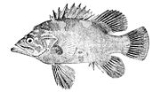
Wreckfish

Encyclopedia
The wreckfish are a family, Polyprionide, of perciform fishes.
They are deep-water marine fishes and can be found on the ocean bottom, where they inhabit caves and shipwrecks (thus their common name). Their scientific name is from Greek
poly meaning "many" and prion meaning "saw", a references to their prominent spiny fins. They stay together in schools of at least 5.
The fish is commonly known as chernia in Spanish-speaking Latin America.
's Iron Chef America
and then on the 20 september 2011 episode of Chopped Champions.
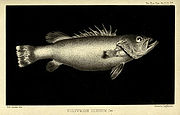
They are deep-water marine fishes and can be found on the ocean bottom, where they inhabit caves and shipwrecks (thus their common name). Their scientific name is from Greek
Greek language
Greek is an independent branch of the Indo-European family of languages. Native to the southern Balkans, it has the longest documented history of any Indo-European language, spanning 34 centuries of written records. Its writing system has been the Greek alphabet for the majority of its history;...
poly meaning "many" and prion meaning "saw", a references to their prominent spiny fins. They stay together in schools of at least 5.
The fish is commonly known as chernia in Spanish-speaking Latin America.
In popular culture
Wreckfish was the secret ingredient on the 1 May 2011 episode of the Food NetworkFood Network
Food Network is a television specialty channel that airs both one-time and recurring programs about food and cooking. Scripps Networks Interactive owns 70 percent of the network, with Tribune Company controlling the remaining 30 percent....
's Iron Chef America
Iron Chef America
Iron Chef America: The Series is an American cooking show based on Fuji Television's Iron Chef, and is the second American adaptation of the series, following the failed Iron Chef USA. The show is produced by Food Network, which also carried a dubbed version of the original Iron Chef. Like the...
and then on the 20 september 2011 episode of Chopped Champions.
Species
There are six species in two genera:| Genus | Species Binomial name and Author | Species Common name |
|---|---|---|
| Polyprion |
P. americanus | Atlantic wreckfish Atlantic wreckfish The Atlantic wreckfish, Polyprion americanus, is a marine, bathydemersal, and oceanodromous fish in the family Polyprionidae. It is found in the Eastern and Western Atlantic Ocean, Western Indian Ocean, and in the Southwest Pacific Ocean... |
| P. moeone | Bass groper Bass groper The bass groper, Polyprion moeone, is a wreckfish of the genus Polyprion, found around southern Australia, and New Zealand, at depths of between 30 and 800 m on rocky reefs on the upper continental shelf... |
|
| P. oxygeneios | Hapuku Hapuku The hāpuku, hapuka or whapuku, Polyprion oxygeneios, is a wreckfish of the family Polyprionidae, found around southern Australia, Chile, Tristan da Cunha, and New Zealand at depths of between 30 and 800 m... |
|
| P. yanezi | ||
| Stereolepis |
S. doederleini | |
| S. gigas | Giant sea bass Giant sea bass The giant sea bass is a fish native to the northern Pacific Ocean. Despite its conspicuous size and curious nature, relatively little is known about its biology or behavior.... |
|