


Wood engraving

Encyclopedia
Printmaking
Printmaking is the process of making artworks by printing, normally on paper. Printmaking normally covers only the process of creating prints with an element of originality, rather than just being a photographic reproduction of a painting. Except in the case of monotyping, the process is capable...
where the "matrix" worked by the artist is a block of wood. It is a variety of woodcut
Woodcut
Woodcut—occasionally known as xylography—is a relief printing artistic technique in printmaking in which an image is carved into the surface of a block of wood, with the printing parts remaining level with the surface while the non-printing parts are removed, typically with gouges...
and so a relief printing technique, where ink is applied to the face of the block and printed by using relatively low pressure. A normal engraving
Engraving
Engraving is the practice of incising a design on to a hard, usually flat surface, by cutting grooves into it. The result may be a decorated object in itself, as when silver, gold, steel, or glass are engraved, or may provide an intaglio printing plate, of copper or another metal, for printing...
, like an etching
Etching
Etching is the process of using strong acid or mordant to cut into the unprotected parts of a metal surface to create a design in intaglio in the metal...
, has a metal plate as a matrix and is printed by the intaglio
Intaglio
Intaglio are techniques in art in which an image is created by cutting, carving or engraving into a flat surface and may also refer to objects made using these techniques:* Intaglio , a group of printmaking techniques with an incised image...
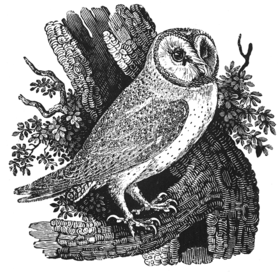
method. In wood engraving the technique for working the block is different from woodcut, using an engraver's burin to create very thin delicate lines, and often having large dark areas in the composition, though by no means always. Wood engraving traditionally utilizes the end grain of wood as a medium for engraving, while in the older technique of woodcut the softer side grain is used.
The technique of wood engraving developed at the end of the 18th century and the beginning of the 19th century, with the works of Thomas Bewick
Thomas Bewick
Thomas Bewick was an English wood engraver and ornithologist.- Early life and apprenticeship :Bewick was born at Cherryburn House in the village of Mickley, in the parish of Ovingham, Northumberland, England, near Newcastle upon Tyne on 12 August 1753...
. Bewick generally made his engraving in harder woods than are now normally used, and would engrave the end of a block instead of the side. Finding a knife not suitable for working against the grain in harder woods, Bewick used the engraving tool the burin, which has a V-shaped cutting tip. Engraving on wood in this manner produced highly detailed images, which are distinct in style from those produced by engraving on copper plates. Since wood engraving is a relief process (ink is applied to the raised surface of the block) while metal engraving is an intaglio technique
Intaglio (printmaking)
Intaglio is a family of printmaking techniques in which the image is incised into a surface, known as the matrix or plate, and the incised line or area holds the ink. Normally, copper or zinc plates are used as a surface, and the incisions are created by etching, engraving, drypoint, aquatint or...
, wood engravings deteriorated much less quickly than copper-plate engravings and had a distinctive white-on-black character. Wood-engraved blocks could be used on conventional print presses
Printing press
A printing press is a device for applying pressure to an inked surface resting upon a print medium , thereby transferring the ink...
, which were themselves making rapid mechanical improvements during the first quarter of the 19th century. Cut to be type-high, the blocks were composited within the page layout along with the movable type, and thousands of copies of such an illustrated page could be printed with almost no deterioration of the illustration blocks. As a result of Bewick's innovation and improvements in the printing press, illustrations of art, nature, technical processes, famous people, foreign lands and many other subjects became more widely available.
Following the achievements of Bewick, wood engraving was used to great effect by 19th century artists such as Edward Calvert, and its heyday lasted until the early and mid 20th century when remarkable achievements were made by Eric Gill, Eric Ravilious and others. Though less widely used now, the technique is still prized in the early 21st century as a high-quality specialist technique of book illustration, and is promoted by the Society of Wood Engravers who hold an annual exhibition in London and other regional British venues.
History
From the beginning of the nineteenth century Bewick's techniques gradually came into wider use, especially in Britain. Besides its use for interpreting details of light and shade, the method found another use from the 1820s onwards as a means of reproducing freehand line drawings. This was in many ways an unnatural application, since the engravers were obliged to cut away almost all the surface of the block in order to leave printable the black lines of the artist's drawing; nonetheless, it became by far the most common use of wood engraving. Examples include the cartoons of PunchPunch (magazine)
Punch, or the London Charivari was a British weekly magazine of humour and satire established in 1841 by Henry Mayhew and engraver Ebenezer Landells. Historically, it was most influential in the 1840s and 50s, when it helped to coin the term "cartoon" in its modern sense as a humorous illustration...
magazine, the pictures in the Illustrated London News
Illustrated London News
The Illustrated London News was the world's first illustrated weekly newspaper; the first issue appeared on Saturday 14 May 1842. It was published weekly until 1971 and then increasingly less frequently until publication ceased in 2003.-History:...
and Sir John Tenniel's illustrations to Lewis Carroll
Lewis Carroll
Charles Lutwidge Dodgson , better known by the pseudonym Lewis Carroll , was an English author, mathematician, logician, Anglican deacon and photographer. His most famous writings are Alice's Adventures in Wonderland and its sequel Through the Looking-Glass, as well as the poems "The Hunting of the...
's works, the latter engraved by the firm of Dalziel Brothers.
Until 1860, artists working for engraving had to paint or draw directly on the surface of the block and the original artwork was actually destroyed by the engraver. In that year, however, the engraver Thomas Bolton invented a process for transferring a photograph onto the block.
At about the same time, French engravers developed a modified technique (partly a return to that of Bewick) in which cross-hatching (one set of parallel lines crossing another at an angle) was almost entirely eliminated; instead, all gradations of tone were rendered by white lines of varying thickness and closeness, sometimes broken into dots for the darkest areas. This technique can be seen in the engravings from Gustave Doré
Gustave Doré
Paul Gustave Doré was a French artist, engraver, illustrator and sculptor. Doré worked primarily with wood engraving and steel engraving.-Biography:...
's drawings.
Towards the end of the century, a combination of Bolton's 'photo on wood' process and the increased technical virtuosity initiated by the French school gave wood engraving a new application as a means of reproducing drawings in water-colour wash (as opposed to line drawings) and actual photographs. This is exemplified in the illustrations to The Strand Magazine during the 1890s. With the new century, improvements in the half-tone process rendered this kind of reproductive engraving obsolete, although in a less sophisticated form it survived in advertisements and trade catalogues until about 1930. With this change, wood engraving was left free to develop as a creative form in its own right, a movement prefigured in the late 1800s by such artists as Joseph Crawhall II
Joseph Crawhall II
Joseph Crawhall II was born at West House, Newcastle.Crawhall, like his father , a Newcastle ropemaker, was interested in writing and water-colour painting. He went on to produce many books, illustrated by himself. His first was entitled The Compleatest Angling Booke That Ever was Writ...
and the Beggarstaff Brothers
Beggarstaff, J. & W.
The Beggarstaff Brothers, officially known as Beggarstaff, J. & W., was the appellation under which the British illustrators, William Nicholson and James Pryde, published their celebrated posters....
.
Technique
Wood engraving blocks are typically made of boxwood or other hardwoods such as lemonwood or cherry. They are expensive to purchase because end-grain wood must be a section through the trunk or large bough of a tree. Some modern wood engravers use substitutes made of PVC or resin, mounted on MDF, which produce similarly detailed results of a slightly different character.The block is manipulated on a "sandbag" (a sand-filled circular leather cushion), enabling curved or undulating lines to be produced with minimal manipulation of the actual tool being used.
Wood engravers use a range of specialist tools. The lozenge graver is similar to the burin used by copper engravers of Bewick's day, and comes in different sizes; there are also various sizes of V-shaped graver used for hatching. Other more flexible tools include the spitsticker, which will produce fine undulating lines; the round scorper, which is excellent for textures involving curves; and the flat scorper which is useful for clearing larger areas.
Wood engraving is generally a black-and-white technique. However there are a handful of wood engravers who also work in colour, using three or four blocks of primary colours, a similar principle to the four-colour process in modern printing. To do this, the printmaker must register the blocks (have a system to make sure that they are all printed in exactly the same place on the page).
Notable wood engravers
In rough chronological order:- Thomas BewickThomas BewickThomas Bewick was an English wood engraver and ornithologist.- Early life and apprenticeship :Bewick was born at Cherryburn House in the village of Mickley, in the parish of Ovingham, Northumberland, England, near Newcastle upon Tyne on 12 August 1753...
- Edward Calvert
- Honoré DaumierHonoré DaumierHonoré Daumier was a French printmaker, caricaturist, painter, and sculptor, whose many works offer commentary on social and political life in France in the 19th century....
- Adolph Menzel
- Gustave DoréGustave DoréPaul Gustave Doré was a French artist, engraver, illustrator and sculptor. Doré worked primarily with wood engraving and steel engraving.-Biography:...
- Félix Vallotton
- Thomas NastThomas NastThomas Nast was a German-born American caricaturist and editorial cartoonist who is considered to be the "Father of the American Cartoon". He was the scourge of Boss Tweed and the Tammany Hall machine...
- Eduard Magnus JakobsonEduard Magnus JakobsonEduard Magnus Jakobson was an Estonian wood engraver and a Baptist missionary...
- William Biscombe GardnerWilliam Biscombe GardnerWilliam Biscombe Gardner was an English painter and engraver. Working in both watercolour and oils, he exhibited widely in London in the late 19th century at venues such as the Royal Academy and the Grosvenor Gallery...
- Timothy ColeTimothy ColeTimothy Cole was an American wood engraver born in London, England, his family emigrated to the United States in 1858.He established himself in Chicago, where in the great fire of 1871 he lost everything he possessed...
- H.W. Peckwell (artist)H.W. Peckwell (artist)Henry W. Peckwell was an American artist. He was best known for his work as a wood engraver, for publications such as Scribner's Magazine and Harper's Magazine.-Personal:...
- Arthur ComfortArthur ComfortArthur Comfort was a master wood engraver at The Graphic in London and art teacher in Halifax.-Life:Comfort was born in London, England on November 11, 1864, where he attended the Graphic School of Wood Engraving, and afterwards worked as an engraver for almost 15 years at The Graphic, a national...
- Eric GillEric GillArthur Eric Rowton Gill was a British sculptor, typeface designer, stonecutter and printmaker, who was associated with the Arts and Crafts movement...
- Greta HopkinsonGreta HopkinsonGreta Hopkinson, wood sculptor and contemporary of Gertrude Hermes , is now largely unknown but her work deserves recognition for its focus on liberating the tactile, sensual qualities inherent in wood.-Biography:...
- Iain MacnabIain MacnabIain MacNab of Barachastlain was a Scottish wood-engraver and painter. As a prominent teacher he was influential in the development of the British school of wood-engraving. His pictures are noted for clarity of form and composition....
- Gwen RaveratGwen RaveratGwendolen Mary "Gwen" Raverat née Darwin was a celebrated English wood engraving artist who co-founded the Society of Wood Engravers in England.- Biography :...
- Hans Alexander Mueller
- Paul Nash (artist)Paul Nash (artist)Paul Nash was a British landscape painter, surrealist and war artist, as well as a book-illustrator, writer and designer of applied art. He was the older brother of the artist John Nash.-Early life:...
- John Nash (artist)John Nash (artist)John Northcote Nash CBE RA was a British painter of landscape and still-life, wood-engraver and illustrator, particularly of botanic works.-Biography:...
- Rockwell KentRockwell KentRockwell Kent was an American painter, printmaker, illustrator, and writer.- Biography :Rockwell Kent was born in Tarrytown, New York, the same year as fellow American artists George Bellows and Edward Hopper...
- Paul LandacrePaul LandacrePaul Hambleton Landacre was one of the outstanding printmakers of the modern era. His distinguished body of work was largely responsible for elevating the wood engraving to an art form in twentieth-century America...
- Nicolas EekmanNicolas EekmanNicolas Mathieu Eekman , born Nikolaas Mathijs Eekman, is a Belgian figurative painter of Flemish descent, also known in France, in Belgium and in the Netherlands as Nico Eekman, Nic Eekman and under the pseudonym Ekma.He is also recognised for his drawings, watercolours and engravings.He...
- David Jones (poet)David Jones (poet)David Jones CH was both a painter and one of the first generation British modernist poets. As a painter he worked chiefly in watercolor, painting portraits and animal, landscape, legendary and religious subjects. He was also a wood-engraver and designer of inscriptions. As a writer he was...
- Agnes Miller ParkerAgnes Miller ParkerAgnes Miller Parker was a Scottish engraver and illustrator.Halsby and Harris, in The Dictionary of Scottish Painters suggest that Parker's early paintings, as well as those of her husband, reflect the short-lived group of artists known as Vorticists, active in London in the 1920s. The main body...
- John Buckland WrightJohn Buckland WrightJohn Buckland Wright was an illustrator and engraver from Dunedin, New Zealand.-External links:** — University of Otago Library-References:* A check-list of the book illustrations of John Buckland Wright by Anthony Reid,...
- Clare LeightonClare LeightonClare Veronica Hope Leighton was an English/American artist, writer and illustrator, best known for her wood engravings.Clare Leighton was born in London on 12 April 1898, the daughter of Robert Leighton and Marie Connor Leighton , both authors...
- Reynolds StoneReynolds StoneAlan Reynolds Stone CBE RDI was a noted English engraver, designer, typographer and painter of the 20th century.Much of his work was done in the field of printing and publishing, as a designer of typefaces, book jackets and bookplates. In 1949 he redesigned the famous clock logo of The Times...
- Alexander WeygersAlexander WeygersAlexander G. Weygers, , was a polymath American artist who is best known as a sculptor, painter, print maker, philosopher, and author. He was born in Java, Indonesia, to Dutch parents...
- Fritz EichenbergFritz EichenbergFritz Eichenberg was a German-American illustrator who worked primarily in wood engraving. His best-known works were concerned with religion, social justice and nonviolence....
- Blair Hughes-Stanton
- Eric RaviliousEric RaviliousEric William Ravilious was an English painter, designer, book illustrator and wood engraver.-Career:Ravilious studied at Eastbourne School of Art, and at the Royal College of Art, where he studied under Paul Nash and became close friends with Edward Bawden.He began his working life as a muralist,...
- Lynd WardLynd WardLynd Kendall Ward was an American artist and storyteller, and son of Methodist minister and prominent political organizer Harry F. Ward. He illustrated some 200 juvenile and adult books...
- John DePolJohn DepolJohn DePol the noted New York wood engraver, left behind a remarkable body of work.He was perhaps best known for his illustrations of the Benjamin Franklin keepsakes over a period of over 25 years....
- Don RicoDon RicoDonato Francisco Rico II was an American paperback novelist, screenwriter, and comic book writer-artist, who co-created the Marvel Comics characters Jann of the Jungle, with artist Jay Scott Pike, and Leopard Girl, with artist Al Hartley. His pen names include Dan Rico, Donella St...
- Garrick PalmerGarrick PalmerGarrick Salisbury Palmer is an English painter, wood engraver, photographer and teacher. He is a Fellow of the Royal Society of Painter-Printmakers , the Society of Wood Engravers Associate of the Royal Engravers, the Royal Society of Painter-Etchers and Engravers , and the Royal Society of...
- Vija CelminsVija CelminsVija Celmins is an American artist.-Early life:Vija Celmins immigrated to the United States with her family from Latvia when she was ten years old. She and her family settled in Indiana...
- Barry MoserBarry MoserBarry Moser is a renowned artist, most famous as a printmaker and illustrator of numerous works of literature.Born in Chattanooga, Tennessee, in 1940, Moser studied at the Baylor School, Auburn University, and the University of Tennessee at Chattanooga, and did graduate work at the University of...
- John SteinsJohn SteinsJohn Steins, former Mayor of Dawson City, is an artist and printmaker who lives in Dawson City, Yukon. He is a wood engraver and makes plate etchings. The son of renowned artist Ilgvars Steins, he worked in advertising as a young man in Toronto before moving northwest in 1974...
- Gaylord SchanilecGaylord SchanilecGaylord Schanilec is a notable American wood engraver. Working out of his studio in Stockholm, Wisconsin Schanilec has used traditional wood engraving processes to create illustrations for hundreds of works....
- Andy EnglishAndy EnglishAndy English is an English wood engraving artist and educator who pioneered the use the of the Internet to teach a wider audience about wood engraving and how to do it.-Biography:...
- Barbara Howard, RCABarbara Howard, RCAHelen Barbara Howard, RCA was a Canadian painter, wood engraver, draughtsperson, bookbinder and designer who produced work consistently throughout her life, from her graduation in 1951 from the Ontario College of Art until her unexpected death in 2002.Her work is represented in many permanent...
(Canada) - Rosemary Feit CoveyRosemary Feit CoveyRosemary Feit Covey is an American printmaker, whose work focuses on wood engraving.She was born in Johannesburg, South Africa and studied at Cornell University and the Maryland Institute College of Art...
- Simon BrettSimon BrettSimon Brett is a prolific writer of whodunnits. The son of a chartered surveyor, he was educated at Dulwich College and Wadham College, Oxford, where he got a first-class honours degree in English...
- Leonard BaskinLeonard BaskinLeonard Baskin was an American sculptor, book-illustrator, wood-engraver, printmaker, graphic artist, writer and teacher.-Life and work:...
- John LawrenceJohn Lawrence (illustrator)John Lawrence is an eminent English illustrator and wood engraver. He has twice won The Francis Williams Award for illustration , and twice been runner-up for the Kurt Emil - Maschler Award...
- Manuel Vermeire