
All Topics  
Wood Pigeon

 
Wood Pigeon

   Email Print
   Bookmark   Link


Wood Pigeon


The Wood-Pigeon (Columba palumbus) is a member of the dove
Dove

Pigeons and doves constitute the family Columbidae within the order Columbiformes, which include some 300 species of near passerine Aves....
 and pigeons family Columbidae. It is locally known in south east England as the Culver.

he colder northern and eastern parts of its Europe
Europe

Europe is, conventionally, one of the world's seven continents. Comprising the westernmost peninsula of Eurasia, Europe is generally divided from Asia to its east by the water divide of the Ural Mountains, the Ural , the Caspian Sea, and by the Caucasus Mountains to the southeast....
an and western Asia
Asia

Asia is the world's largest and most populous continent. It covers 8.6% of the Earth's total surface area and, with over 4 billion people, it contains more than 60% of the world's current human population....
tic range the Wood Pigeon is a migrant, but in southern and western Europe it is a well distributed and often abundant resident.

three Western European Columba
Columba (genus)

The large bird genus Columba comprises a group of medium to large stout-bodied dove, often referred to as the typical pigeons. The term columba is the Latinized form of the Ancient Greek ???????? ?a diver?, from ???????? , ?to dive, plunge headlong, swim?....
 pigeons, Wood Pigeon, Stock Pigeon
Stock Pigeon

The Stock Pigeon or Stock Dove is a member of the family Columbidae, doves and pigeons.In the northern part of its European and western Asiatic range the Stock Pigeon is a migrant, elsewhere it is a well distributed and often plentiful resident....
, and Rock Pigeon
Rock Pigeon

The Rock Pigeon , or Rock Dove, is a member of the bird family Columbidae . In common usage, this bird is often simply referred to as the "pigeon"....
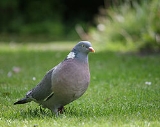
, though superficially alike, have very distinctive characteristics; the Wood Pigeon may be identified at once by its larger size at 38–43 cm, and the white on its neck and wing.


Discussion
Ask a question about 'Wood Pigeon'
Start a new discussion about 'Wood Pigeon'
Answer questions from other users
Full Discussion Forum


Encyclopedia


The Wood-Pigeon (Columba palumbus) is a member of the dove
Dove

Pigeons and doves constitute the family Columbidae within the order Columbiformes, which include some 300 species of near passerine Aves....
 and pigeons family Columbidae. It is locally known in south east England as the Culver.

Distribution

In the colder northern and eastern parts of its Europe
Europe

Europe is, conventionally, one of the world's seven continents. Comprising the westernmost peninsula of Eurasia, Europe is generally divided from Asia to its east by the water divide of the Ural Mountains, the Ural , the Caspian Sea, and by the Caucasus Mountains to the southeast....
an and western Asia
Asia

Asia is the world's largest and most populous continent. It covers 8.6% of the Earth's total surface area and, with over 4 billion people, it contains more than 60% of the world's current human population....
tic range the Wood Pigeon is a migrant, but in southern and western Europe it is a well distributed and often abundant resident.

Description

The three Western European Columba
Columba (genus)

The large bird genus Columba comprises a group of medium to large stout-bodied dove, often referred to as the typical pigeons. The term columba is the Latinized form of the Ancient Greek ???????? ?a diver?, from ???????? , ?to dive, plunge headlong, swim?....
 pigeons, Wood Pigeon, Stock Pigeon
Stock Pigeon

The Stock Pigeon or Stock Dove is a member of the family Columbidae, doves and pigeons.In the northern part of its European and western Asiatic range the Stock Pigeon is a migrant, elsewhere it is a well distributed and often plentiful resident....
, and Rock Pigeon
Rock Pigeon

The Rock Pigeon , or Rock Dove, is a member of the bird family Columbidae . In common usage, this bird is often simply referred to as the "pigeon"....
, though superficially alike, have very distinctive characteristics; the Wood Pigeon may be identified at once by its larger size at 38–43 cm, and the white on its neck and wing. It is otherwise a basically grey bird, with a pinkish breast.

Juvenile birds do not have the white patches on either side of the neck. When they are about 6 months old (about 3 months out of the nest) they gain a small white patch on both sides of the neck, which gradually enlarge until they are fully formed when the bird is about 6–8 months old (approx. ages only). Juvenile birds also have a greyer beak and an overall lighter grey appearance than adult birds.

Behaviour

Its flight is quick, performed by regular beats, with an occasional sharp flick of the wings, characteristic of pigeons in general. It takes off with a loud clattering. It perches well, and in its nuptial display walks along a horizontal branch with swelled neck, lowered wings, and fanned tail. During the display flight the bird climbs, the wings are smartly cracked like a whiplash, and the bird glides down on stiff wings. The noise in climbing flight is caused by the whipcracks on the downstroke rather than the wings striking together. The Wood Pigeon is gregarious, often forming very large flocks outside the breeding season.

Breeding

It breeds in trees in woods, parks and gardens, laying two white eggs in a simple stick nest which hatch after 17 to 19 days. Wood pigeons seem to have a preference for trees near roadways and rivers. The nests are vulnerable to attack, particularly by crow
Crow

The true crows are large passerine birds that form the genus Corvus in the family Corvidae. Ranging in size from the relatively small dove-sized jackdaws to the Common Raven of the Holarctic region and Thick-billed Raven of the highlands of Ethiopia, the 40 or so members of this genus occur on all temperate continents and several offsh...
s, the more so early in the year when the leaf cover is not fully formed. The young usually fly at 33 to 34 days; however if the nest is disturbed some young may be able to survive having left the nest as early as 20 days from hatching.

Food

Most of its food is vegetable, taken from open fields or gardens and lawns; young shoots and seedlings are favoured, and it will take grain. This species can be an agricultural pest, and it is often shot, being a legal quarry species in most European countries. It is wary in rural areas, but often quite tame where it is not persecuted.

Call

The call is a characteristic cooing .

Subspecies

  • Azores Wood Pigeon Columba palumbus azorica Hartert, 1905
  • Asian Wood Pigeon Columba palumbus casiotis (Bonaparte, 1854)
  • North African Wood Pigeon Columba palumbus excelsa (Bonaparte 1856)
  • Iranian Wood Pigeon Columba palumbus iranica (Zarudny, 1910)
  • Madeiran Wood Pigeon
    Madeiran Wood Pigeon

    The Madeiran Wood Pigeon was an Endemic subspecies of the Wood Pigeon for Madeira .The Madeiran Wood Pigeon closely resembled the mainland Wood Pigeon of Europe, but the plumage was somewhat darker, especially on the upperparts and under wing-coverts....
     Columba palumbus maderensis Tschusi, 1904
    Extinction

    In biology and ecology, extinction is the death of every member of a species or group of taxon. The moment of extinction is generally considered to be the death of the last individual of that species ....
  • European Wood Pigeon Columba palumbus palumbus Linnaeus, 1758

External links

  • on the Internet Bird Collection