
All Topics  
Wodaabe


   Email Print
   Bookmark   Link


Wodaabe


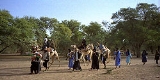
The Wodaabe (or Bororo) are a small subgroup of the Fulani ethnic group
Ethnic group

An ethnic group is a group of humans whose members identify with each other, through a common heritage that is real or presumed.Ethnic identity is further marked by the recognition from others of a group's distinctiveness and the recognition of common culture, linguistic, religion, human behaviour or Race traits, real or presumed, as indic...
. They are traditionally nomad
Nomad

Nomadic people, , also known as nomads, are communities of people who move from one place to another, rather than Settler in one location....
ic cattle-herders and traders in the Sahel
Sahel

File:Sahel Map-Africa rough.pngFile:AT0713 map.pngThe Sahel or Sahel Belt is a semi-arid tropical and subtropical grasslands, savannas, and shrublands ecoregion in Africa, which forms the transition between the Sahara to the north and the slightly less arid savanna belt to the south, known as the Sudan ....
, with migrations stretching from southern Niger
Niger

Niger , officially the Republic of Niger, is a landlocked country in Western Africa, named after the Niger River. It borders Nigeria and Benin to the south, Burkina Faso and Mali to the west, Algeria and Libya to the north and Chad to the east....
, through northern Nigeria
Nigeria

Nigeria, officially the Federal Republic of Nigeria, is a federation constitutional republic comprising States of Nigeria and one Federal Capital Territory, Nigeria....
, northeastern Cameroon
Cameroon

The Republic of Cameroon is a unitary state of central and western Africa. It is bordered by Nigeria to the west; Chad to the northeast; the Central African Republic to the east; and Equatorial Guinea, Gabon, and the Republic of the Congo to the south....
, and the western region of the Central African Republic
Central African Republic

The Central African Republic , is a landlocked country in Central Africa. It borders Chad in the north, Sudan in the east, the Republic of the Congo and the Democratic Republic of the Congo in the south, and Cameroon in the west....
. The number of Wodaabe was estimated in 1983 to be 45,000. They are known for their beauty (both men and women), elaborate attire and rich cultural ceremonies.

The Wodaabe speak the Fula language
Fula language

The Fula language is a language of West Africa, spoken by the Fula people from Senegambia and Guinea to Cameroon and Sudan. It is also spoken as the first language by the Tukulor in the Senegal River Valley and as a second language by peoples in other areas....
 and don't use a written language. In the Fula language, wo?a means "taboo
Taboo

A taboo is a strong social prohibition against words, objects, actions, or discussions that are considered undesirable or offensive by a group, culture, society, or community....
", and Wo?aa?e means "people of the taboo".


Discussion
Ask a question about 'Wodaabe'
Start a new discussion about 'Wodaabe'
Answer questions from other users
Full Discussion Forum


Recent Posts


Encyclopedia


The Wodaabe (or Bororo) are a small subgroup of the Fulani ethnic group
Ethnic group

An ethnic group is a group of humans whose members identify with each other, through a common heritage that is real or presumed.Ethnic identity is further marked by the recognition from others of a group's distinctiveness and the recognition of common culture, linguistic, religion, human behaviour or Race traits, real or presumed, as indic...
. They are traditionally nomad
Nomad

Nomadic people, , also known as nomads, are communities of people who move from one place to another, rather than Settler in one location....
ic cattle-herders and traders in the Sahel
Sahel

File:Sahel Map-Africa rough.pngFile:AT0713 map.pngThe Sahel or Sahel Belt is a semi-arid tropical and subtropical grasslands, savannas, and shrublands ecoregion in Africa, which forms the transition between the Sahara to the north and the slightly less arid savanna belt to the south, known as the Sudan ....
, with migrations stretching from southern Niger
Niger

Niger , officially the Republic of Niger, is a landlocked country in Western Africa, named after the Niger River. It borders Nigeria and Benin to the south, Burkina Faso and Mali to the west, Algeria and Libya to the north and Chad to the east....
, through northern Nigeria
Nigeria

Nigeria, officially the Federal Republic of Nigeria, is a federation constitutional republic comprising States of Nigeria and one Federal Capital Territory, Nigeria....
, northeastern Cameroon
Cameroon

The Republic of Cameroon is a unitary state of central and western Africa. It is bordered by Nigeria to the west; Chad to the northeast; the Central African Republic to the east; and Equatorial Guinea, Gabon, and the Republic of the Congo to the south....
, and the western region of the Central African Republic
Central African Republic

The Central African Republic , is a landlocked country in Central Africa. It borders Chad in the north, Sudan in the east, the Republic of the Congo and the Democratic Republic of the Congo in the south, and Cameroon in the west....
. The number of Wodaabe was estimated in 1983 to be 45,000. They are known for their beauty (both men and women), elaborate attire and rich cultural ceremonies.

The Wodaabe speak the Fula language
Fula language

The Fula language is a language of West Africa, spoken by the Fula people from Senegambia and Guinea to Cameroon and Sudan. It is also spoken as the first language by the Tukulor in the Senegal River Valley and as a second language by peoples in other areas....
 and don't use a written language. In the Fula language, wo?a means "taboo
Taboo

A taboo is a strong social prohibition against words, objects, actions, or discussions that are considered undesirable or offensive by a group, culture, society, or community....
", and Wo?aa?e means "people of the taboo". "Wodaabe" is an Anglicisation
Anglicisation

Anglicisation or anglicization is a process of conversion of verbal or written elements of any other language into a more comprehensible English language for an English speaker....
 of Wo?aa?e.

The Wodaabe culture is one of the 186 cultures of the standard cross-cultural sample
Standard cross-cultural sample

The standard cross-cultural sample is a sample of 186 cultures, used by scholars engaged in cross-cultural studies....
 used by anthropologists to compare cultural traits.

Everyday life

The Wodaabe keep herds of long-horned Zebu
Zebu

Zebus , sometimes known as 'humped cattle' or 'indicus' cattle. They are a type of cattle better-adapted to tropics environments than the other domestic cattle, the Bos primigenius taurus or 'taurine' types....
 cattle. The dry season extends from October to May. Their annual travel during the wet season follows the rain from the south to the north. Groups of several dozen relatives, typically several brothers with their wives, children and elders, travel on foot, donkey or camel, and stay at each grazing spot for a couple of days. A large wooden bed is the most important possession of each family; when camping it is surrounded by some screens. The women also carry calabash
Calabash

The calabash or Bottle gourd is a vine grown for its fruit, which can either be harvested young and used as a vegetable or harvested mature, dried, and used as a bottle, utensil, or pipe....
es as a status symbol. These calabashes are passed down through the generations, and often provoke rivalry between women. The Wodaabe mostly live on milk and ground millet
Millet

The millets are a group of small-seeded species of cereal Crop or grains, widely grown around the world for food and fodder. They do not form a scientific classification group, but rather a functional or agronomic one....
, as well as yogurt, sweet tea and occasionally the meat of a goat or sheep.

Religion, morals and customs

Wodaabe religion is largely but loosely Islam
Islam

Islam is a Monotheism, Abrahamic religion originating with the teachings of the Prophets of Islam Muhammad, a 7th century Arab religious and political figure....
ic. Although there are varying degrees of orthodoxy exhibited, most adhere to at least some of the basic requirements of the religion.Some academics have called them nominal Muslims due to elements of "non-Islamic" cultural customs which sometimes contradict Islamic belief. Islam became a religion of importance among Wodaabe peoples during the 16th century when the great scholar al-Maghili
Muhammad al-Maghili

Muhammad ibn Abd al-Karim al-Maghili, commonly known as Muhammad al-Maghili was an Islamic scholar from Tlemcen, a Saharan city situated in modern-day Algeria....
 preached the teachings of Muhammad
Muhammad

Muhammad Patronymic#Arabic Abd Allah ibn Abd al Muttalib , is the founder of the Major religious groups of Islam and is regarded by Muslims as a Rasul and prophet of , the last and the greatest law-bearer in a series of prophets....
 to the elite of northern Nigeria. Al-Maghili was responsible for converting the ruling classes among Hausa
Hausa people

The Hausa are a Sahelian people chiefly located in the West Africa regions of northern Nigeria and southeastern Niger. There are also significant numbers found in regions of Sudan, Cameroon, Ghana, Cote d'Ivoire, and Chad and smaller communities scattered throughout West Africa and on the traditional Hajj route across the Sahara Desert and Sa...
, Fulani, and Tuareg
Tuareg

The Tuareg are a nomadic pastoralist people. They are the principal inhabitants of the Saharan interior of North Africa. They call themselves variously Kel Tamasheq or Kel Tamajaq , Imuhagh, Imazaghan or Imashaghen , or Kel Tagelmust, i.e., "People of the Veil"....
 peoples in the region.

The code of behavior of the Wodaabe emphasizes reserve and modesty (semteende), patience and fortitude (munyal), care and forethought (hakkilo), and loyalty (amana). They also place great emphasis on beauty and charm.

Parents are not allowed to talk directly to their two first born children, who will often be cared for by their grandparents. During daylight, husband and wife cannot hold hands or speak in a personal manner with each other.

Marriage

The Wodaabe are sexually liberal; unmarried girls may have sex whenever and with whomever they wish.

The Wodaabe practice polygamy
Polygamy

The term polygamy is used in related ways in social anthropology, sociobiology, and sociology. Polygamy can be defined as any "Types of marriages in which a person [has] more than one spouse."...
. The first marriage is typically arranged among members of the same lineage by parents when the couple are infants (called koogal); later additional "love marriages" (teegal) are also possible, when a woman leaves her husband and joins another one. A bride stays with her husband until she becomes pregnant after which she returns to her mother's home, where she will remain for the next three to four years. She will deliver the baby at her mother's home and then she becomes a boofeydo which literally means, "someone who has committed an error."

Beauty ideal and Gerewol festival

At the end of the rainy season in September, the Wodaabe travel to In-Gall
In-Gall

In-Gall is a town in the Agadez Department of northeast Niger, with a year-round population of less than 500.Known for its oasis and salt flats, In-Gall is the gathering point for the Cure Salee festival of Tuareg and Wodaabe pastoralists to celebrate the end of the rainy season each September....
 to gather salt and participate at the Cure Salée
Cure Salee

The Cure Salee, or "Festival of the Nomads" is a yearly gathering of the Tuareg and Wodaabe peoples in the northern Niger town of Ingall. Cure Sal?e marks the end of the rainy season, and usually occurs in the last two weeks of September....
 festival, a meeting of several nomadic tribes. Here the young Wodaabe men, with elaborate make-up, feathers and other adornments, perform dances and songs to impress women. The male beauty ideal of the Wodaabe stresses tallness, white eyes and teeth; the men will often roll their eyes and show their teeth to emphasize these characteristics. The Wodaabe clans will then join for their week-long Gerewol celebration, a contest where the young men's beauty is judged by young women.

Documentaries and popular culture

The 1989 documentary Wodaabe - Herdsmen of the Sun
Wodaabe - Herdsmen of the Sun

Wodaabe - Herdsmen of the Sun is a 1989 documentary film by Werner Herzog.The film explores the social rituals and cultural celebrations of the Saharan nomadic Wodaabe tribe....
 by Werner Herzog
Werner Herzog

Werner Herzog is an Academy Award-nominated German film director, screenwriter, actor, and opera director.He is often associated with the German New Wave movement , along with Rainer Werner Fassbinder, Margarethe von Trotta, Volker Schl?ndorff, Hans-J?rgen Syberberg, Wim Wenders and others....
 describes the Wodaabe.

The Niger-based band Etran Finatawa is composed of Wodaabe and Tuareg
Tuareg

The Tuareg are a nomadic pastoralist people. They are the principal inhabitants of the Saharan interior of North Africa. They call themselves variously Kel Tamasheq or Kel Tamajaq , Imuhagh, Imazaghan or Imashaghen , or Kel Tagelmust, i.e., "People of the Veil"....
 members and creates their unique style of "Nomad Blues" by combining modern arrangements and electric guitars with more traditional instruments and polyphonic Wodaabe singing. In 2005 they recorded an album and toured Europe.

Works cited


External links

  • , from Sahara with Michael Palin


Photos and videos

  • , National Geographic
  • Wodaabe dancer photos: ,
  • , by Amanda Jones
  • by Christine Nesbitt
  • Experience from Cure Salée festival and Wodaabé photos