
All Topics  
Windjammer

 
Windjammer

   Email Print
   Bookmark   Link


Windjammer


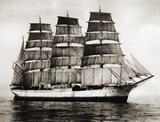
A windjammer was a type of sailing ship
Sailing ship

Sailing ship is now used to refer to any large wind-powered vessel. In technical terms, a ship was a sailing vessel with a full rigged ship of at least three masts, square rigged on all of them, making the sailing adjective redundant....
 with a large iron
Iron

Iron is a chemical element with the symbol Fe and atomic number 26. Iron is a Group 8 element and period 4 element. Iron is lustrous and silvery in color....
 or steel
Steel

Steel is an alloy consisting mostly of iron, with a carbon content between 0.2% and 2.14% by weight , depending on grade. Carbon is the most cost-effective alloying material for iron, but various other alloying elements are used such as manganese, chromium, vanadium, and tungsten....
 hull
Hull (watercraft)

A hull is the watertight body of a ship or boat. It is a central concept in floating vessels as it provides the buoyancy that keeps the vessel from sinking....
, built to carry cargo
Cargo

Cargo refers to goods or produce transported, generally for Commerce gain, by Cargo ship, Cargo airline, Train#Freight trains, van or truck. In modern times, containers are used in most intermodal freight transport long-haul cargo transport....
 in the late nineteenth century and early twentieth century. They were the grandest of cargo sailing ships, with between three and five large masts
Mast (sailing)

The mast of a sailing ship is a tall, vertical, or near vertical, spar, or arrangement of spars, which supports the sails. Large ships have several masts, with the size and configuration depending on the style of ship....
 and square sail
Sail

A sail is any type of surface intended to generate thrust by being placed in a wind—in essence a vertically-oriented wing. Sails are used in sailing....
s, giving them a characteristic profile. They frequently displaced several thousand tonne
Tonne

A tonne or metric ton , also referred to as a metric tonne, is a measurement of mass equal to 1,000 kilograms, or 2204.6226 pounds....
s, and were cheaper than their wooden hulled counterparts for three main reasons: iron was stronger, and thus could enable larger ship sizes and considerable economies of scale
Economies of scale

Economies of scale, in microeconomics, are the cost advantages that a business obtains due to expansion. They are factors that cause a producer?s average cost per unit to fall as output rises....
, iron hulls took up less space and allowed for more cargo to be carried, and iron hulls were cheaper to maintain than an equivalent wooden hull.


Discussion
Ask a question about 'Windjammer'
Start a new discussion about 'Windjammer'
Answer questions from other users
Full Discussion Forum


Encyclopedia


A windjammer was a type of sailing ship
Sailing ship

Sailing ship is now used to refer to any large wind-powered vessel. In technical terms, a ship was a sailing vessel with a full rigged ship of at least three masts, square rigged on all of them, making the sailing adjective redundant....
 with a large iron
Iron

Iron is a chemical element with the symbol Fe and atomic number 26. Iron is a Group 8 element and period 4 element. Iron is lustrous and silvery in color....
 or steel
Steel

Steel is an alloy consisting mostly of iron, with a carbon content between 0.2% and 2.14% by weight , depending on grade. Carbon is the most cost-effective alloying material for iron, but various other alloying elements are used such as manganese, chromium, vanadium, and tungsten....
 hull
Hull (watercraft)

A hull is the watertight body of a ship or boat. It is a central concept in floating vessels as it provides the buoyancy that keeps the vessel from sinking....
, built to carry cargo
Cargo

Cargo refers to goods or produce transported, generally for Commerce gain, by Cargo ship, Cargo airline, Train#Freight trains, van or truck. In modern times, containers are used in most intermodal freight transport long-haul cargo transport....
 in the late nineteenth century and early twentieth century. They were the grandest of cargo sailing ships, with between three and five large masts
Mast (sailing)

The mast of a sailing ship is a tall, vertical, or near vertical, spar, or arrangement of spars, which supports the sails. Large ships have several masts, with the size and configuration depending on the style of ship....
 and square sail
Sail

A sail is any type of surface intended to generate thrust by being placed in a wind—in essence a vertically-oriented wing. Sails are used in sailing....
s, giving them a characteristic profile. They frequently displaced several thousand tonne
Tonne

A tonne or metric ton , also referred to as a metric tonne, is a measurement of mass equal to 1,000 kilograms, or 2204.6226 pounds....
s, and were cheaper than their wooden hulled counterparts for three main reasons: iron was stronger, and thus could enable larger ship sizes and considerable economies of scale
Economies of scale

Economies of scale, in microeconomics, are the cost advantages that a business obtains due to expansion. They are factors that cause a producer?s average cost per unit to fall as output rises....
, iron hulls took up less space and allowed for more cargo to be carried, and iron hulls were cheaper to maintain than an equivalent wooden hull. The most common windjammer rig was the four-masted barque
Barque

A barque, barc, or bark is a type of sailing vessel....
, which was the ultimate result of science of aerodynamics and thousands of years of seamanship. The barque rig can outperform the schooner
Schooner

A schooner is a type of sailing ship characterized by the use of fore-and-aft rig sails on two or more mast s. Schooners were first used by the Netherlands in the 16th or 17th century, and further developed in North America from the early 18th century onwards....
 rig, can sail upwind better than full-riggers, and is easier to handle than full square rig. The usual cargo capacity was 2,000 to 5,000 tonnes. Windjammer cargo in general was bulk, such as lumber
Lumber

Lumber or timber is wood in any of its stages from logging through readiness for use as structural material for construction, or wood pulp for paper production....
, coal
Coal

Coal is a readily combustion black or brownish-black sedimentary rock. The harder forms, such as anthracite, can be regarded as metamorphic rock because of later exposure to elevated temperature and pressure....
, guano
Guano

Guano is the excrement of seabirds, bats, and Harbor Seal.Guano manure is an effective fertilizer and gunpowder ingredient due to its high levels of phosphorus and nitrogen and also its lack of odor....
 or grain
GRAIN

GRAIN is an international non-governmental organization based in Barcelona, Spain, which works toward sustainable agriculture. It was formed upon the realization that the genetic diversity of the world's food crops are being drastically eliminated....
. The largest windjammer ever built was the five-masted full-rigged ship Preussen, which had a displacement of 11,600 tonnes. She was also one of the fastest, regularly logging 16 knots (kn) average speed on transatlantic voyages.

Windjammers are often confused with clipper
Clipper

A clipper was a very fast sailing ship of the 19th century that had multiple Mast and a square rig. They were generally narrow for their length, could carry limited bulk freight, small by later 19th century standards, and had a large total sail area....
s, but they are two different breeds. A clipper is a sailing vessel optimized for speed; windjammers are optimized for cargo and handling. Most clippers were of composite construction, full rigged and had a cargo capacity of less than 1,000 tonnes; windjammers are of steel construction, usually barques and have far greater cargo capacities. The clippers had already begun to disappear when windjammers emerged.

Windjammers were mainly produced from the 1870s to the 1890s, when the steamships began to outpace them economically, due to their ability to keep a schedule regardless of the wind. Steel
Steel

Steel is an alloy consisting mostly of iron, with a carbon content between 0.2% and 2.14% by weight , depending on grade. Carbon is the most cost-effective alloying material for iron, but various other alloying elements are used such as manganese, chromium, vanadium, and tungsten....
 hulls also replaced iron hulls at around the same time. The windjammers usually had semi-mechanized rigging, steel profile masts and yards and steel cables as running rigging where plausible. Since the windjammer hull is hydrodynamically optimized for good hydrodynamics because of sail handling, they were (and are still) capable of attaining great speeds; most four-masted barques were able to cruise at 15 kn on plausible winds, some logged 18 kn regularly and Herzogin Cecilie
Herzogin Cecilie

Herzogin Cecilie was a German four mast barque , named after German Crown Princess Duchess Cecilie of Mecklenburg-Schwerin , spouse of Crown Prince Wilhelm of Prussia ....
 is known to have logged 21 kn. Their speed made them able to compete with steamers, which usually could barely do 8 kn, on ultra-long voyages. The crew of a windjammer was surprisingly small; they could be operated with as small a crew as 14, and a typical crew could be master, mate, boatswain (bosun), 15 seamen and 5 apprentices. The crew roster of Pamir
Pamir (ship)

Pamir was one of the famous Flying P-Liner sailing ships of the Germany shipping company F. Laeisz. She was the last commercial sailing ship to round Cape Horn, in 1949....
 on her last commercial voyage around Cape Horn
Cape Horn

Cape Horn island is the southernmost Headlands and bays of the Tierra del Fuego archipelago of southern Chile.Cape Horn is widely considered to be the most southerly point of South America, and marks the northern boundary of the Drake Passage; for many years it was a major milestone on the clipper route, by which sailing ships carried tr...
 in 1949 under the Finnish
Finland

Finland , officially the Republic of Finland , is a Nordic countries situated in the Fennoscandian region of northern Europe. It borders Sweden on the west, Russia on the east, and Norway on the north, while Estonia lies to its south across the Gulf of Finland....
 flag listed a total crew of 34:
Master
4 Officers (1st, 2nd, 3rd Mate and Bosun)
14 Able-Bodied Seamen
5 Ordinary Seamen
5 Deckboys
4 Cook/Assistant Cook/Steward/Assistant Steward
1 Donkeyman (Mechanic)
.
From 1916 to 1917, Imperial Germany operated the SMS Seeadler
SMS Seeadler (Windjammer)

SMS Seeadler was a three-master windjammer . She was one of the last sailing ships used in war when she served as an merchant raider with Imperial Germany....
 windjammer as one of the last sailing ships used in war.

Windjammers were used commercially (though recognised as a dying breed) until the 1950s. They occupied something of a niche in the transport of goods from remote ports where coal and water were not available, such as parts of Australia (carrying wool or grain) and remote islands (harvesting guano
Guano

Guano is the excrement of seabirds, bats, and Harbor Seal.Guano manure is an effective fertilizer and gunpowder ingredient due to its high levels of phosphorus and nitrogen and also its lack of odor....
). Windjammers were also used particularly for the transport of South American nitrates.

The largest windjammer in existence is the four-masted barque Moshulu
Moshulu

Moshulu is a four-masted steel barque built by William Hamilton on the River Clyde in Scotland in 1904, and currently a floating restaurant docked in Penn's Landing, Philadelphia....
, which is today a luxury restaurant ship in Philadelphia, PA, USA. The largest windjammer in sailing service is a Russia
Russia

Russia , or the Russian Federation , is a list of countries spanning more than one continent country extending over much of northern Eurasia....
n school ship
School ship

A training ship is a ship used to train students as sailors. The term is especially used for ships employed by navy to train future officers. Essentially there are two types: those used for training at sea and old hulks used to house classrooms....
, the four-masted barque Sedov
Sedov

The STS Sedov , formerly the Magdalene Vinnen II and the Kommodore Johnsen , is a 4-masted steel barque that for almost 80 years was the largest traditional sailing ship in operation....
.

A few windjammers among other Tall Ships can still be seen at international maritime events: SAIL Amsterdam
SAIL Amsterdam

SAIL Amsterdam is a large sea manifestation that is held every 5 years in Amsterdam, the Netherlands, when tall ships from all over the world visit the city to moor in its Eastern harbour, where people can then admire the ships for four days from the quay or on board ....
, the Kiel Week
Kiel Week

Kiel Week is an annual sailing event in Kiel, Germany. It is the largest sailing event in the world, and also one of the largest Volksfeste in Europe....
 and Hanse Sail
Hanse Sail

The Hanse Sail in Rostock is the largest maritime festival in Mecklenburg-Vorpommern and one of the largest in Germany.About two hundred sailing ships of all types and sizes from a vast variety of countries visit the coast off the city of Rostock every year during the second weekend of August....
.

See also

  • Columbia
    Sailing Ship Columbia

    The Sailing Ship Columbia is a full-scale replica of Columbia Rediviva, located at the Disneyland park in Anaheim, California. Its passengers embark on a scenic, 12-minute journey around the Rivers of America ....
  • Gorch Fock (1933)
    Gorch Fock (1933)

    The Gorch Fock I is a Germany three-mast barque, the first of a series built as school ships for the German Reichsmarine in 1933. As was taken as war reparation by the Soviet Union after World War II and baptized Tovarishch, the Germans built a replacement, the Gorch Fock , which is still in service....
  • Gorch Fock (1958)
    Gorch Fock (1958)

    The Gorch Fock is a tall ship of the Germany German Navy . She is the second ship of that name and a sister ship of the Gorch Fock built in 1933....
  • Herzogin Cecilie
    Herzogin Cecilie

    Herzogin Cecilie was a German four mast barque , named after German Crown Princess Duchess Cecilie of Mecklenburg-Schwerin , spouse of Crown Prince Wilhelm of Prussia ....
  • Kruzenshtern
    Kruzenshtern (ship)

    The Krusenstern or Kruzenshtern is a Russian four masted barque and tall ship that was built in 1926 in Bremerhaven-Weserm?nde, Germany, as shipyard number "S408" under the name Padua ....
  • Moshulu
    Moshulu

    Moshulu is a four-masted steel barque built by William Hamilton on the River Clyde in Scotland in 1904, and currently a floating restaurant docked in Penn's Landing, Philadelphia....
  • Pamir
    Pamir (ship)

    Pamir was one of the famous Flying P-Liner sailing ships of the Germany shipping company F. Laeisz. She was the last commercial sailing ship to round Cape Horn, in 1949....
  • Passat
    Passat (ship)

    Passat is a German four-masted steel barque and one of the Flying P-Liners, the famous sailing ships of the Germany shipping company F. Laeisz....
  • Peking
    Peking (ship)

    The Peking is a steel-hulled four-masted barque — the sister ship to the Passat . A so-called Flying P-Liner of the Germany company F....
  • Pommern
    Pommern (ship)

    The Pommern is a windjammer. She is a four-masted barque that was built 1903 in Glasgow at J. Reid & Co shipyard.She is one of the Flying P-Liners, the famous sailing ships of the German shipping company F....
  • Preußen
    Preußen (ship)

    The Preu?en was a Germany steel-hulled five masted full rigged ship windjammer built in 1902 for the famous Flying P-Liner and named after the Germany States of Germany of Prussia....
  • STS Sedov
    Sedov

    The STS Sedov , formerly the Magdalene Vinnen II and the Kommodore Johnsen , is a 4-masted steel barque that for almost 80 years was the largest traditional sailing ship in operation....
  • SMS Seeadler
    SMS Seeadler (Windjammer)

    SMS Seeadler was a three-master windjammer . She was one of the last sailing ships used in war when she served as an merchant raider with Imperial Germany....
  • Star of India
    Star of India (ship)

    Star of India was built in 1863 as Euterpe, a full-rigged iron windjammer ship in Ramsey, Isle of Man, Isle of Man. After a full career sailing from Great Britain to India then to New Zealand, she became a salmon hauler on the Alaska then to California route....


Sources

  • Stark, William F. The Last Time Around Cape Horn. The Historic 1949 Voyage of the Windjammer PAMIR. New York: Carroll & Graf Publishers, 2003. ISBN 0786712333
  • Villiers, Alan
    Alan Villiers

    Captain Alan John Villiers was an author, adventurer, photographer and Master Mariner.Born in Melbourne, Australia, he first went to sea at 15 and sailed all the world's oceans on board traditionally rigging vessels including the Full rigged ship Joseph Conrad ....
    . Voyaging With The Wind: An Introduction to Sailing Large Square Rigged Ships. London: National Maritime Museum, 1975.