

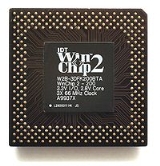
WinChip

Encyclopedia
The WinChip series was a low-power Socket 7
-based x86 processor
designed by Centaur Technology
and marketed by its parent company IDT
.
and die
area, IDT, using its experience from the RISC processor market, created a small and electrically efficient processor similar to the 80486
, because of its single pipeline and in-order execution microarchitecture
. It was of much simpler design than that of its competition, such as AMD K5
/K6
and Intel Pentium II
, which were superscalar
and based on dynamic translation to buffered micro-operation
s with advanced instruction reordering (out of order execution).
s of the time and the majority of software used in businesses. It was also designed to be a drop-in replacement for the more complex, and thus more expensive, processors it was competing with. This allowed IDT/Centaur to take advantage of an established system platform (Intel's Socket 7
).
s and adopted a 100 Mhz front side bus
to improve memory access and L2 cache performance. It also adopted the performance rating
concept, similar to how AMD and Cyrix
marketed their processors. This method of specifying processor performance helped consumers understand where the WinChip's performance fit in against Intel's competing products.
Another revision, the WinChip 2B, was also planned. This featured a die shrink to 0.25 μm, but was only shipped in limited numbers.
A third model, the WinChip 3, was planned as well. This was meant to receive a doubled L1 cache, but the W3 CPU never made it to market.
, and AMD K5/K6. It performed adequately, but only in applications that used little floating point
math. Its floating point performance was well below that of the Pentium, being similar to the Cyrix 6x86.
The WinChip 2 added a 3DNow!
processing unit to strengthen floating point performance, but its 3DNow! unit was not as fast as that in AMD K6-2. This successor targeted the Intel Pentium II, Cyrix MII
, and AMD K6-2
processors as competitors.
and the release of the Intel Celeron
processor signalled the end of the WinChip. In 1999, the Centaur Technology
division of IDT was sold to VIA
. Although VIA initially branded processors as "Cyrix," the company initially used technology similar to WinChip with its Cyrix III
line.


Socket 7
Socket 7 is a physical and electrical specification for an x86-style CPU socket on a personal computer motherboard. The socket supersedes the earlier Socket 5, and accepts P5 Pentium microprocessors manufactured by Intel, as well as compatibles made by Cyrix/IBM, AMD, IDT and others.Socket 7 was...
-based x86 processor
Central processing unit
The central processing unit is the portion of a computer system that carries out the instructions of a computer program, to perform the basic arithmetical, logical, and input/output operations of the system. The CPU plays a role somewhat analogous to the brain in the computer. The term has been in...
designed by Centaur Technology
Centaur Technology
Centaur Technology is an x86 CPU design company, now a wholly owned subsidiary of VIA Technologies, a member of the Formosa Plastics Group, Taiwan's largest industrial conglomerate.-History:...
and marketed by its parent company IDT
Integrated Device Technology
Integrated Device Technology, Inc. is a publicly traded corporation headquartered in San Jose, California, that designs, manufactures, and markets low-power, high-performance mixed-signal semiconductor solutions for the advanced communications, computing, and consumer industries. The company...
.
Design
The design of the WinChip was quite different from other processors of the time. Instead of a large gate countGate count
In microprocessor design, gate count refers to the number of gates build with transistor and other electronic devices, that are needed to implement a design. Even with today's process technology providing what was formerly considered impossible numbers of gates on a single chip, gate counts remain...
and die
Die (integrated circuit)
A die in the context of integrated circuits is a small block of semiconducting material, on which a given functional circuit is fabricated.Typically, integrated circuits are produced in large batches on a single wafer of electronic-grade silicon or other semiconductor through processes such as...
area, IDT, using its experience from the RISC processor market, created a small and electrically efficient processor similar to the 80486
Intel 80486
The Intel 80486 microprocessor was a higher performance follow up on the Intel 80386. Introduced in 1989, it was the first tightly pipelined x86 design as well as the first x86 chip to use more than a million transistors, due to a large on-chip cache and an integrated floating point unit...
, because of its single pipeline and in-order execution microarchitecture
Microarchitecture
In computer engineering, microarchitecture , also called computer organization, is the way a given instruction set architecture is implemented on a processor. A given ISA may be implemented with different microarchitectures. Implementations might vary due to different goals of a given design or...
. It was of much simpler design than that of its competition, such as AMD K5
AMD K5
The K5 was AMD's first x86 processor to be developed entirely in-house. Introduced in March 1996, its primary competition was Intel's Pentium microprocessor. The K5 was an ambitious design, closer to a Pentium Pro than a Pentium regarding technical solutions and internal architecture...
/K6
AMD K6
The K6 microprocessor was launched by AMD in 1997. The main advantage of this particular microprocessor is that it was designed to fit into existing desktop designs for Pentium branded CPUs. It was marketed as a product which could perform as well as its Intel Pentium II equivalent but at a...
and Intel Pentium II
Pentium II
The Pentium II brand refers to Intel's sixth-generation microarchitecture and x86-compatible microprocessors introduced on May 7, 1997. Containing 7.5 million transistors, the Pentium II featured an improved version of the first P6-generation core of the Pentium Pro, which contained 5.5 million...
, which were superscalar
Superscalar
A superscalar CPU architecture implements a form of parallelism called instruction level parallelism within a single processor. It therefore allows faster CPU throughput than would otherwise be possible at a given clock rate...
and based on dynamic translation to buffered micro-operation
Micro-operation
In computer central processing units, micro-operations are detailed low-level instructions used in some designs to implement complex machine instructions .Various forms of μops have long been the basis for traditional microcode routines used to simplify the implementation of a...
s with advanced instruction reordering (out of order execution).
Use
WinChip was, in general, designed to perform well with popular applications that didn't do many (if any) floating point calculations. This included operating systemOperating system
An operating system is a set of programs that manage computer hardware resources and provide common services for application software. The operating system is the most important type of system software in a computer system...
s of the time and the majority of software used in businesses. It was also designed to be a drop-in replacement for the more complex, and thus more expensive, processors it was competing with. This allowed IDT/Centaur to take advantage of an established system platform (Intel's Socket 7
Socket 7
Socket 7 is a physical and electrical specification for an x86-style CPU socket on a personal computer motherboard. The socket supersedes the earlier Socket 5, and accepts P5 Pentium microprocessors manufactured by Intel, as well as compatibles made by Cyrix/IBM, AMD, IDT and others.Socket 7 was...
).
Development
The WinChip 2A added fractional multiplierCPU multiplier
In computing, the clock multiplier measures the ratio of an internal CPU clock rate to the externally supplied clock. A CPU with a 10x multiplier will thus see 10 internal cycles for every external clock cycle...
s and adopted a 100 Mhz front side bus
Front side bus
A front-side bus is a computer communication interface often used in computers during the 1990s and 2000s.It typically carries data between the central processing unit and a memory controller hub, known as the northbridge....
to improve memory access and L2 cache performance. It also adopted the performance rating
PR rating
The PR system was developed by AMD in the mid-1990s as a method of comparing their x86 processors to those of rival Intel.-Branding:...
concept, similar to how AMD and Cyrix
Cyrix
Cyrix Corporation was a microprocessor developer that was founded in 1988 in Richardson, Texas as a specialist supplier of high-performance math coprocessors for 286 and 386 microprocessors. The company was founded by former Texas Instruments staff members and had a long but troubled relationship...
marketed their processors. This method of specifying processor performance helped consumers understand where the WinChip's performance fit in against Intel's competing products.
Another revision, the WinChip 2B, was also planned. This featured a die shrink to 0.25 μm, but was only shipped in limited numbers.
A third model, the WinChip 3, was planned as well. This was meant to receive a doubled L1 cache, but the W3 CPU never made it to market.
Performance
Although the small die size and low power-usage made the processor notably inexpensive to manufacture, it never gained much market share. WinChip C6 was a competitor to the Intel Pentium and Pentium MMX, Cyrix 6x86Cyrix 6x86
The Cyrix 6x86 is a sixth-generation, 32-bit 80x86-compatible microprocessor designed by Cyrix and manufactured by IBM and SGS-Thomson. It was originally released in 1996.-Architecture:...
, and AMD K5/K6. It performed adequately, but only in applications that used little floating point
Floating point
In computing, floating point describes a method of representing real numbers in a way that can support a wide range of values. Numbers are, in general, represented approximately to a fixed number of significant digits and scaled using an exponent. The base for the scaling is normally 2, 10 or 16...
math. Its floating point performance was well below that of the Pentium, being similar to the Cyrix 6x86.
The WinChip 2 added a 3DNow!
3DNow!
3DNow! is an extension to the x86 instruction set developed by Advanced Micro Devices . It adds single instruction multiple data instructions to the base x86 instruction set, enabling it to perform simple vector processing, which improves the performance of many graphic-intensive applications...
processing unit to strengthen floating point performance, but its 3DNow! unit was not as fast as that in AMD K6-2. This successor targeted the Intel Pentium II, Cyrix MII
Cyrix 6x86
The Cyrix 6x86 is a sixth-generation, 32-bit 80x86-compatible microprocessor designed by Cyrix and manufactured by IBM and SGS-Thomson. It was originally released in 1996.-Architecture:...
, and AMD K6-2
AMD K6-2
The K6-2 was an x86 microprocessor introduced by AMD on May 28, 1998, and available in speeds ranging from 266 to 550 MHz. An enhancement of the original K6, the K6-2 introduced AMD's 3D-Now! SIMD instruction set, featured a larger 64 KiB Level 1 cache , and an upgraded system-bus interface...
processors as competitors.
Verdict
The industry's move away from Socket 7Socket 7
Socket 7 is a physical and electrical specification for an x86-style CPU socket on a personal computer motherboard. The socket supersedes the earlier Socket 5, and accepts P5 Pentium microprocessors manufactured by Intel, as well as compatibles made by Cyrix/IBM, AMD, IDT and others.Socket 7 was...
and the release of the Intel Celeron
Celeron
Celeron is a brand name given by Intel Corp. to a number of different x86 computer microprocessor models targeted at budget personal computers....
processor signalled the end of the WinChip. In 1999, the Centaur Technology
Centaur Technology
Centaur Technology is an x86 CPU design company, now a wholly owned subsidiary of VIA Technologies, a member of the Formosa Plastics Group, Taiwan's largest industrial conglomerate.-History:...
division of IDT was sold to VIA
VIA Technologies
VIA Technologies is a Taiwanese manufacturer of integrated circuits, mainly motherboard chipsets, CPUs, and memory, and is part of the Formosa Plastics Group. It is the world's largest independent manufacturer of motherboard chipsets...
. Although VIA initially branded processors as "Cyrix," the company initially used technology similar to WinChip with its Cyrix III
Cyrix III
Cyrix III is an x86-compatible Socket 370 CPU. VIA Technologies launched the processor in February 2000. VIA had recently purchased both Centaur Technology and Cyrix. Cyrix III was to be based upon a core from one of the two companies.- Joshua :...
line.
Winchip C6 (0.35 µm)
- All models supported MMX
- The 88 mm² die was made using a 0.35 micron 4-layer metal CMOS technology.
- The 64 Kib L1 Cache of the WinChip C6 used a 32 KB 2-way set associative code cache and a 32 KB 2-way set associative data cache.
- The size of the unified L2 cacheCPU cacheA CPU cache is a cache used by the central processing unit of a computer to reduce the average time to access memory. The cache is a smaller, faster memory which stores copies of the data from the most frequently used main memory locations...
was dependent on the cache available on the used motherboard.Processor
ModelFrequency FSB Front side busA front-side bus is a computer communication interface often used in computers during the 1990s and 2000s.It typically carries data between the central processing unit and a memory controller hub, known as the northbridge....
Mult. CPU multiplierIn computing, the clock multiplier measures the ratio of an internal CPU clock rate to the externally supplied clock. A CPU with a 10x multiplier will thus see 10 internal cycles for every external clock cycle...
L1 cache CPU cacheA CPU cache is a cache used by the central processing unit of a computer to reduce the average time to access memory. The cache is a smaller, faster memory which stores copies of the data from the most frequently used main memory locations...
TDP Thermal Design PowerThe thermal design power , sometimes called thermal design point, refers to the maximum amount of power the cooling system in a computer is required to dissipate. For example, a laptop's CPU cooling system may be designed for a 20 watt TDP, which means that it can dissipate up to 20 watts of heat...
CPU core voltage CPU core voltageThe CPU core voltage is the power supply voltage supplied to the CPU , GPU, or other device containing a processing core...
Socket CPU socketA CPU socket or CPU slot is a mechanical component that provides mechanical and electrical connections between a microprocessor and a printed circuit board . This allows the CPU to be replaced without soldering....
Release date Part number(s) Introduction price WinChip 180 180 Mhz 60 MT/s 3 64 KiB KibibyteThe kibibyte is a multiple of the unit byte for quantities of digital information. The binary prefix kibi means 1024; therefore, 1 kibibyte is . The unit symbol for the kibibyte is KiB. The unit was established by the International Electrotechnical Commission in 1999 and has been accepted for use...
9.4 W 3.45—3.6 V Socket 5 Socket 5Socket 5 was created for the second generation of Intel P5 Pentium processors operating at speeds from 75 to 120 MHz as well as certain Pentium OverDrive and Pentium MMX processors with core voltage 3.3 V. Consisting of 320 pins, this was the first socket to use a staggered pin grid array, or...
Socket 7Socket 7Socket 7 is a physical and electrical specification for an x86-style CPU socket on a personal computer motherboard. The socket supersedes the earlier Socket 5, and accepts P5 Pentium microprocessors manufactured by Intel, as well as compatibles made by Cyrix/IBM, AMD, IDT and others.Socket 7 was...
Super Socket 7Super Socket 7The Super Socket 7, also referred to as Super 7, is an extension of the Socket 7 ZIF socket specification. It features a 100 MHz front-side bus, support for AGP, and a SPGA package. Super Socket was used by AMD K6-2 and K6-III processors, and some of the final Cyrix M-II processors...
CGPA 29613 October 1997 DS180GAEM $90 WinChip 200 200 Mhz 66 Mt/s 3 64 KiB 10.4 W 3.45—3.6 V Socket 5
Socket 7
Super Socket 7
CGPA 29613 October 1997 DS200GAEM $135 WinChip 225 225 Mhz 75 MT/s 3 64 KiB 12.3 W 3.45—3.6 V Socket 7
Super Socket 7
CGPA 29613 October 1997 PSME225GA WinChip 240 240 Mhz 60 MT/s 4 64 KiB 13.1 W 3.45—3.6 V Socket 5
Socket 7
Super Socket 7
CGPA 296November 1997? PSME240GA
WinChip 2 (0.35 µm)
- All models supported MMX and 3DNow!3DNow!3DNow! is an extension to the x86 instruction set developed by Advanced Micro Devices . It adds single instruction multiple data instructions to the base x86 instruction set, enabling it to perform simple vector processing, which improves the performance of many graphic-intensive applications...
- The 95 mm² die was made using a 0.35 micron 5-layer metal CMOS technology.
- The 64 Kib L1 Cache of the WinChip 2 used a 32 KB 2-way set associative code cache and a 32 KB 4-way set associative data cache.
- The size of the unified L2 cacheCPU cacheA CPU cache is a cache used by the central processing unit of a computer to reduce the average time to access memory. The cache is a smaller, faster memory which stores copies of the data from the most frequently used main memory locations...
was dependent on the cache available on the used motherboard.Processor
ModelFrequency FSB Front side busA front-side bus is a computer communication interface often used in computers during the 1990s and 2000s.It typically carries data between the central processing unit and a memory controller hub, known as the northbridge....
Mult. CPU multiplierIn computing, the clock multiplier measures the ratio of an internal CPU clock rate to the externally supplied clock. A CPU with a 10x multiplier will thus see 10 internal cycles for every external clock cycle...
L1 cache CPU cacheA CPU cache is a cache used by the central processing unit of a computer to reduce the average time to access memory. The cache is a smaller, faster memory which stores copies of the data from the most frequently used main memory locations...
TDP Thermal Design PowerThe thermal design power , sometimes called thermal design point, refers to the maximum amount of power the cooling system in a computer is required to dissipate. For example, a laptop's CPU cooling system may be designed for a 20 watt TDP, which means that it can dissipate up to 20 watts of heat...
CPU core voltage CPU core voltageThe CPU core voltage is the power supply voltage supplied to the CPU , GPU, or other device containing a processing core...
Socket CPU socketA CPU socket or CPU slot is a mechanical component that provides mechanical and electrical connections between a microprocessor and a printed circuit board . This allows the CPU to be replaced without soldering....
Release date Part number(s) Introduction price WinChip 2-200 200 Mhz 66 MT/s 3 64 KiB KibibyteThe kibibyte is a multiple of the unit byte for quantities of digital information. The binary prefix kibi means 1024; therefore, 1 kibibyte is . The unit symbol for the kibibyte is KiB. The unit was established by the International Electrotechnical Commission in 1999 and has been accepted for use...
8.8 W 3.45—3.6 V Socket 5 Socket 5Socket 5 was created for the second generation of Intel P5 Pentium processors operating at speeds from 75 to 120 MHz as well as certain Pentium OverDrive and Pentium MMX processors with core voltage 3.3 V. Consisting of 320 pins, this was the first socket to use a staggered pin grid array, or...
Socket 7Socket 7Socket 7 is a physical and electrical specification for an x86-style CPU socket on a personal computer motherboard. The socket supersedes the earlier Socket 5, and accepts P5 Pentium microprocessors manufactured by Intel, as well as compatibles made by Cyrix/IBM, AMD, IDT and others.Socket 7 was...
Super Socket 7Super Socket 7The Super Socket 7, also referred to as Super 7, is an extension of the Socket 7 ZIF socket specification. It features a 100 MHz front-side bus, support for AGP, and a SPGA package. Super Socket was used by AMD K6-2 and K6-III processors, and some of the final Cyrix M-II processors...
CGPA 2963DEE200GSA
3DFF200GSAWinChip 2-225 225 Mhz 75 MT/s 3 64 KiB 10.0 W 3.45—3.6 V Socket 7
Super Socket 7
CGPA 2963DEE225GSA WinChip 2-240 240 Mhz 60 MT/s 4 64 KiB 10.5 W 3.45—3.6 V Socket 5
Socket 7
Super Socket 7
CPGA 2963DEE240GSA WinChip 2-250 233 Mhz 83 MT/s 3 64 KiB 10.9 W 3.45—3.6 V Super Socket 7
CGPA 296?
WinChip 2A (0.35 µm)
- All models supported MMX and 3DNow!3DNow!3DNow! is an extension to the x86 instruction set developed by Advanced Micro Devices . It adds single instruction multiple data instructions to the base x86 instruction set, enabling it to perform simple vector processing, which improves the performance of many graphic-intensive applications...
- The 95 mm² die was made using a 0.35 micron 5-layer metal CMOS technology.
- The 64 Kib L1 Cache of the WinChip 2A used a 32 KB 2-way set associative code cache and a 32 KB 4-way set associative data cache. and 3DNow!3DNow!3DNow! is an extension to the x86 instruction set developed by Advanced Micro Devices . It adds single instruction multiple data instructions to the base x86 instruction set, enabling it to perform simple vector processing, which improves the performance of many graphic-intensive applications...
- The size of the unified L2 cacheCPU cacheA CPU cache is a cache used by the central processing unit of a computer to reduce the average time to access memory. The cache is a smaller, faster memory which stores copies of the data from the most frequently used main memory locations...
was dependent on the cache available on the used motherboard.Processor
ModelFrequency FSB Front side busA front-side bus is a computer communication interface often used in computers during the 1990s and 2000s.It typically carries data between the central processing unit and a memory controller hub, known as the northbridge....
Mult. CPU multiplierIn computing, the clock multiplier measures the ratio of an internal CPU clock rate to the externally supplied clock. A CPU with a 10x multiplier will thus see 10 internal cycles for every external clock cycle...
L1 cache CPU cacheA CPU cache is a cache used by the central processing unit of a computer to reduce the average time to access memory. The cache is a smaller, faster memory which stores copies of the data from the most frequently used main memory locations...
TDP Thermal Design PowerThe thermal design power , sometimes called thermal design point, refers to the maximum amount of power the cooling system in a computer is required to dissipate. For example, a laptop's CPU cooling system may be designed for a 20 watt TDP, which means that it can dissipate up to 20 watts of heat...
CPU core voltage CPU core voltageThe CPU core voltage is the power supply voltage supplied to the CPU , GPU, or other device containing a processing core...
Socket CPU socketA CPU socket or CPU slot is a mechanical component that provides mechanical and electrical connections between a microprocessor and a printed circuit board . This allows the CPU to be replaced without soldering....
Release date Part number(s) Introduction price WinChip 2A-200 200 Mhz 66 MT/s 3 64 KiB KibibyteThe kibibyte is a multiple of the unit byte for quantities of digital information. The binary prefix kibi means 1024; therefore, 1 kibibyte is . The unit symbol for the kibibyte is KiB. The unit was established by the International Electrotechnical Commission in 1999 and has been accepted for use...
12.0 W 3.45—3.6 V Socket 5 Socket 5Socket 5 was created for the second generation of Intel P5 Pentium processors operating at speeds from 75 to 120 MHz as well as certain Pentium OverDrive and Pentium MMX processors with core voltage 3.3 V. Consisting of 320 pins, this was the first socket to use a staggered pin grid array, or...
Socket 7Socket 7Socket 7 is a physical and electrical specification for an x86-style CPU socket on a personal computer motherboard. The socket supersedes the earlier Socket 5, and accepts P5 Pentium microprocessors manufactured by Intel, as well as compatibles made by Cyrix/IBM, AMD, IDT and others.Socket 7 was...
Super Socket 7Super Socket 7The Super Socket 7, also referred to as Super 7, is an extension of the Socket 7 ZIF socket specification. It features a 100 MHz front-side bus, support for AGP, and a SPGA package. Super Socket was used by AMD K6-2 and K6-III processors, and some of the final Cyrix M-II processors...
CGPA 296March 1999? 3DEE200GTA WinChip 2A-233 233 Mhz 66 MT/s 3.5 64 KiB 13.0 W 3.45—3.6 V Socket 5
Socket 7
Super Socket 7
CGPA 296March 1999? 3DEE233GTA WinChip 2A-266 233 Mhz 100 MT/s 2.33 64 KiB 14.0 W 3.45—3.6 V Super Socket 7
CGPA 296March 1999? 3DEE266GSA WinChip 2A-300 250 Mhz 100 MT/s 2.5 64 KiB 16.0 W 3.45—3.6 V Super Socket 7
CGPA 2963DEE300GSA
WinChip 2B (0.25 µm)
- All models supported MMX and 3DNow!3DNow!3DNow! is an extension to the x86 instruction set developed by Advanced Micro Devices . It adds single instruction multiple data instructions to the base x86 instruction set, enabling it to perform simple vector processing, which improves the performance of many graphic-intensive applications...
- The 58 mm² die was made using a 0.25 micron 5-layer metal CMOS technology.
- The 64 Kib L1 Cache of the WinChip 2B used a 32 KB 2-way set associative code cache and a 32 KB 4-way set associative data cache.
- The size of the unified L2 cacheCPU cacheA CPU cache is a cache used by the central processing unit of a computer to reduce the average time to access memory. The cache is a smaller, faster memory which stores copies of the data from the most frequently used main memory locations...
was dependent on the cache available on the used motherboard. - Dual-voltage CPUDual-voltage CPUA dual-voltage CPU uses a split-rail design to allow lower voltages to be used in the processor core while the external Input/Output voltages remain 3.3 volts for backwards compatibility....
: while the processor core operates at 2.8 Volt, the external Input/OutputInput/outputIn computing, input/output, or I/O, refers to the communication between an information processing system , and the outside world, possibly a human, or another information processing system. Inputs are the signals or data received by the system, and outputs are the signals or data sent from it...
(I/O) voltages remain 3.3 volts for backwards compatibility.Processor
ModelFrequency FSB Front side busA front-side bus is a computer communication interface often used in computers during the 1990s and 2000s.It typically carries data between the central processing unit and a memory controller hub, known as the northbridge....
Mult. CPU multiplierIn computing, the clock multiplier measures the ratio of an internal CPU clock rate to the externally supplied clock. A CPU with a 10x multiplier will thus see 10 internal cycles for every external clock cycle...
L1 cache CPU cacheA CPU cache is a cache used by the central processing unit of a computer to reduce the average time to access memory. The cache is a smaller, faster memory which stores copies of the data from the most frequently used main memory locations...
TDP Thermal Design PowerThe thermal design power , sometimes called thermal design point, refers to the maximum amount of power the cooling system in a computer is required to dissipate. For example, a laptop's CPU cooling system may be designed for a 20 watt TDP, which means that it can dissipate up to 20 watts of heat...
CPU core voltage CPU core voltageThe CPU core voltage is the power supply voltage supplied to the CPU , GPU, or other device containing a processing core...
Socket CPU socketA CPU socket or CPU slot is a mechanical component that provides mechanical and electrical connections between a microprocessor and a printed circuit board . This allows the CPU to be replaced without soldering....
Release date Part number(s) Introduction price WinChip 2B-200 200 Mhz 66 MT/s 3 64 KiB KibibyteThe kibibyte is a multiple of the unit byte for quantities of digital information. The binary prefix kibi means 1024; therefore, 1 kibibyte is . The unit symbol for the kibibyte is KiB. The unit was established by the International Electrotechnical Commission in 1999 and has been accepted for use...
6.3 W 2.7—2.9 V Socket 7 Socket 7Socket 7 is a physical and electrical specification for an x86-style CPU socket on a personal computer motherboard. The socket supersedes the earlier Socket 5, and accepts P5 Pentium microprocessors manufactured by Intel, as well as compatibles made by Cyrix/IBM, AMD, IDT and others.Socket 7 was...
Super Socket 7Super Socket 7The Super Socket 7, also referred to as Super 7, is an extension of the Socket 7 ZIF socket specification. It features a 100 MHz front-side bus, support for AGP, and a SPGA package. Super Socket was used by AMD K6-2 and K6-III processors, and some of the final Cyrix M-II processors...
PPGA 2963DFK200BTA WinChip 2B-233 200 Mhz 100 MT/s 2 64 KiB 6.3 W 2.7—2.9 V Super Socket 7
PPGA 296
WinChip 3 (0.25 µm)
- All models supported MMX and 3DNow!3DNow!3DNow! is an extension to the x86 instruction set developed by Advanced Micro Devices . It adds single instruction multiple data instructions to the base x86 instruction set, enabling it to perform simple vector processing, which improves the performance of many graphic-intensive applications...
- The 75 mm² die was made using a 0.25 micron 5-layer metal CMOS technology.
- The 128 Kib L1 Cache of the WinChip 3 used a 64 KB 2-way set associative code cache and a 64 KB 4-way set associative data cache.
- The size of the unified L2 cacheCPU cacheA CPU cache is a cache used by the central processing unit of a computer to reduce the average time to access memory. The cache is a smaller, faster memory which stores copies of the data from the most frequently used main memory locations...
was dependent on the cache available on the used motherboard.- Dual-voltage CPU
Dual-voltage CPUA dual-voltage CPU uses a split-rail design to allow lower voltages to be used in the processor core while the external Input/Output voltages remain 3.3 volts for backwards compatibility....
: while the processor core operates at 2.8 Volt, the external Input/OutputInput/outputIn computing, input/output, or I/O, refers to the communication between an information processing system , and the outside world, possibly a human, or another information processing system. Inputs are the signals or data received by the system, and outputs are the signals or data sent from it...
(I/O) voltages remain 3.3 volts for backwards compatibility.>Processor
ModelFrequency FSB Front side busA front-side bus is a computer communication interface often used in computers during the 1990s and 2000s.It typically carries data between the central processing unit and a memory controller hub, known as the northbridge....
Mult. CPU multiplierIn computing, the clock multiplier measures the ratio of an internal CPU clock rate to the externally supplied clock. A CPU with a 10x multiplier will thus see 10 internal cycles for every external clock cycle...
L1 cache CPU cacheA CPU cache is a cache used by the central processing unit of a computer to reduce the average time to access memory. The cache is a smaller, faster memory which stores copies of the data from the most frequently used main memory locations...
TDP Thermal Design PowerThe thermal design power , sometimes called thermal design point, refers to the maximum amount of power the cooling system in a computer is required to dissipate. For example, a laptop's CPU cooling system may be designed for a 20 watt TDP, which means that it can dissipate up to 20 watts of heat...
CPU core voltage CPU core voltageThe CPU core voltage is the power supply voltage supplied to the CPU , GPU, or other device containing a processing core...
Socket CPU socketA CPU socket or CPU slot is a mechanical component that provides mechanical and electrical connections between a microprocessor and a printed circuit board . This allows the CPU to be replaced without soldering....
Release date Part number(s) Introduction price WinChip 3-233 200 Mhz 66 MT/s 3 128 KiB KibibyteThe kibibyte is a multiple of the unit byte for quantities of digital information. The binary prefix kibi means 1024; therefore, 1 kibibyte is . The unit symbol for the kibibyte is KiB. The unit was established by the International Electrotechnical Commission in 1999 and has been accepted for use...
? W 2.7—2.9 V Socket 7 Socket 7Socket 7 is a physical and electrical specification for an x86-style CPU socket on a personal computer motherboard. The socket supersedes the earlier Socket 5, and accepts P5 Pentium microprocessors manufactured by Intel, as well as compatibles made by Cyrix/IBM, AMD, IDT and others.Socket 7 was...
Super Socket 7Super Socket 7The Super Socket 7, also referred to as Super 7, is an extension of the Socket 7 ZIF socket specification. It features a 100 MHz front-side bus, support for AGP, and a SPGA package. Super Socket was used by AMD K6-2 and K6-III processors, and some of the final Cyrix M-II processors...
CGPA 296WinChip 3-266 233 Mhz 66 MT/s 3.5 128 KiB 8.4 W 2.7—2.9 V Socket 7
Super Socket 7
CPGA 296Samples only FK233GDA WinChip 3-300 233 Mhz 100 MT/s 2.33 128 KiB 8.4 W 2.7—2.9 V Super Socket 7
CPGA 296Samples only FK300GDA WinChip 3-300 266 Mhz 66 MT/s 4 128 KiB 9.3 W 2.7—2.9 V Socket 7
Super Socket 7
CPGA 296WinChip 3-333 250 Mhz 100 MT/s 2.5 128 KiB 8.8 W 2.7—2.9 V Super Socket 7
CPGA 296WinChip 3-333 266 Mhz 100 MT/s 2.66 128 KiB 9.3 W 2.7—2.9 V Super Socket 7
CPGA 296 - Dual-voltage CPU