


William Wailes

Encyclopedia
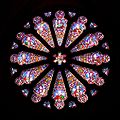
Stained glass
The term stained glass can refer to coloured glass as a material or to works produced from it. Throughout its thousand-year history, the term has been applied almost exclusively to the windows of churches and other significant buildings...
workshops.
Biographical
Wailes was born and grew up in Newcastle on Tyne, England’s centre of domestic glass and bottle manufacturing. His first business was as a grocer and tea merchant. However, his artistic talent and practical skills led him to set up a small kiln in the backyard of his premises. He made and fired small decorative enamels which were sold in his shop.In 1830 he went to Germany to study stained glass design and production under Mayer of Munich. In 1838 he set up his own stained glass studio to design and manufacture windows and in 1841 the business began producing its own glass.
Regardless of this, Wailes made a name for himself through the provision of windows for local churches. As his enterprise prospered, he employed more men, until there were 76 employees, who included in their number several designers who were to go on to establish their own factories. These included Francis Wilson Oliphant R.A. (1818–1859) and George Joseph Baguley (1824–1915). William Wailes was one of the twenty-five stained glass manufacturers that exhibited in the Crystal Palace Exhibition in 1851.
Wailes married (Elizabeth) and they had several children, including a son, William Thomas Wailes, who was to join his father in the business, as did his son-in-law, Thomas Rankine Strang, in 1861, when the firm became known as Wailes and Strang.
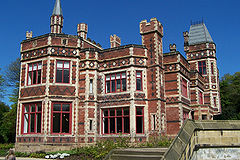
In 1860 Wailes bought the Saltwell Estate at Gateshead
Gateshead
Gateshead is a town in Tyne and Wear, England and is the main settlement in the Metropolitan Borough of Gateshead. Historically a part of County Durham, it lies on the southern bank of the River Tyne opposite Newcastle upon Tyne and together they form the urban core of Tyneside...
and set about improving it, building himself a decorative mansion and landscaping the grounds. Unfortunately, he ran into debt and 16 years later sold the property to the Gateshead Corporation. The estate became a public park known as Saltwell Park
Saltwell Park
Saltwell Park is a Victorian park situated in Gateshead, England. The major part of the park was designed by Edward Kemp. Also known as the "People's Park" and part of Gateshead's heritage since it opened to the public in 1876, the park is steeped in history...
an includes the house, Saltwell Towers. However Wailes continued to reside in his home until his death in 1881. William Thomas Wailes continued to manufacture stained glass until 1910.
William Wailes' glass
Style
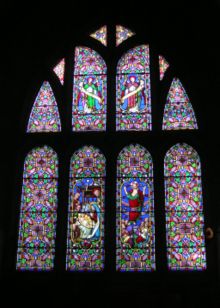
Although William Wailes employed a number of designers, the products of his workshop are often identifiable by type of glass and the particular colour combinations that prevailed. Wailes’ glass is often a little paler and more brightly coloured than many English workshops of the same date, being rather more like glass from Germany or LimogesLimoges
Limoges |Limousin]] dialect of Occitan) is a city and commune, the capital of the Haute-Vienne department and the administrative capital of the Limousin région in west-central France....
. There are certain distinctive colour combinations that occur repeatedly in the clothing of figures in Wailes’ windows- mauve lined with bright red, yellow lined with bright blue, red lined with acid green. Many of Wailes window contain a great deal of pink glass.
Although Wailes was seen as a Gothic Revival artist, and was able to fill windows with ornate foliate patterns that have the quality of brightly painted manuscripts rather than ancient glass, his figures were elegantly classicising and decidedly staid of demeanour. Figures in Wailes’ windows communicate in a series of stereotypical hand gestures. Moreover, the details of faces are applied in a very painterly manner, as against the almost calligraphic manner with which some of the 19th century artists such as John Hardman
Hardman & Co.
Hardman & Co., otherwise John Hardman Trading Co., Ltd., founded 1838, began manufacturing stained glass in 1844 and became one of the world's leading manufacturers of stained glass and ecclesiastical fittings...
imitated ancient windows. The painterly manner is in fact typical of that employed by Mayer of Munich, with whom Wailes trained.

William Wailes’ major commission.
While most of the work of Wailes’ workshop is to be found in the North of England, other commissions came from further afield. The most significant window glazed by the firm, and one of the prize commissions of the industry was the glazing of the West window of Gloucester CathedralGloucester Cathedral
Gloucester Cathedral, or the Cathedral Church of St Peter and the Holy and Indivisible Trinity, in Gloucester, England, stands in the north of the city near the river. It originated in 678 or 679 with the foundation of an abbey dedicated to Saint Peter .-Foundations:The foundations of the present...
, an enormous window of c.1430 in the Perpendicular Gothic style, of nine lights and four tiers, complementing, at the other end of the building, the largest ancient window in the world. The East window (which is as big as a tennis court) fortunately had retained much of its 14th century glass, comprising many tiers of figures.
Wailes’ West window is a stupendous achievement, and not just because of the technicalities involved in glazing such a vast area. It makes no attempt to imitate the style or content of the East window. The content of the West window, like that of so many other commissions, was probably stipulated by a committee. Because the window was so very large there was room for a large number of narratives and lots of figures.
Picture of the Wailes window http://www.photo.net/photodb/photo?photo_id=4290044
The window comprises nine vertical sections called lights which are divided by mullions into three lots of three. The window rises in three stages, the first and the third being approximately half as tall as the middle one, the whole being surmounted by many smaller vertical tracery lights, which Wailes predictably filled with singing angels neatly arranged in robes of violet, bright red and arsenic green.
Wailes' design divides the window main part into four rather than three stages, each one containing three complex narrative scenes which are each made successfully to span three lights. The central section which shows the Nativity of Christ with the Baptism of Christ in the Jordan by John the Baptist
John the Baptist
John the Baptist was an itinerant preacher and a major religious figure mentioned in the Canonical gospels. He is described in the Gospel of Luke as a relative of Jesus, who led a movement of baptism at the Jordan River...
(one below the other) is a particularly successful composition, considering that it contains two very significant narrative incidents which visually harmonise, yet remain discrete scenes. While each of the twelve individual pictures work as a unit, the visual composition of the total window is skilfully arranged as to present as an integrated work of art. This has been achieved by the skilled placement of the 116 figures and the equally skilful disposition of colour.
Churches containing stained glass by William Wailes
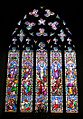
- St Lawrence, Waltham, Kent – East window, Crucifixion, Resurrection and Ascension, 1847.
- St Andrew’s, Bradfield – 12 windows with stories from the Gospels, 1848
- Chichester CathedralChichester CathedralThe Cathedral Church of the Holy Trinity, otherwise called Chichester Cathedral, is the seat of the Anglican Bishop of Chichester. It is located in Chichester, in Sussex, England...
- 5 light window of Christ and the four Gospel writers. 1849 - Ss Peter and Paul, Great MissendenGreat MissendenGreat Missenden is a large village in the Misbourne Valley in the Chiltern Hills in Buckinghamshire, England, situated between the towns of Amersham and Wendover. It closely adjoins the villages of Little Missenden and Prestwood. The narrow High Street is bypassed by the main A413 London to...
– East window, with angels and banners, 1850 and Chancel window 1865. - St Botolph, FarnboroughFarnborough, WarwickshireFarnborough is a village and civil parish in Warwickshire, England. The village has a church, St. Botolphs, village hall and public house, The Inn at Farnborough.-References:*Warwickshire Towns & Villages, by Geoff Allen ISBN 1-85058-642-X...
- East Window 1856. - St Mary'sSt Mary's Church, ThatchamThe St Mary's Church is a Church of England parish church at Thatcham in the English county of Berkshire. The church, is dedicated to the Virgin Mary.- History :...
, ThatchamThatchamThatcham is a town in Berkshire, England 3 miles east of Newbury and 15 miles west of Reading. It covers about and has a population of 23,000 people . This number has grown rapidly over the last few decades from 5,000 in 1951 and 7,500 in 1961.It lies on the River Kennet, the Kennet and Avon...
– East window of the Feeding of the Five Thousand, 1858. - All Saints', HursleyHursleyHursley is a village and civil parish in Hampshire, England with a population of around 800 in 2005. It is located roughly mid-way between Romsey and Winchester on the A3090...
– A very important commission of a complete cycle of 21 windows, showing The Crucifixion at the East end, with the ResurrectionResurrectionResurrection refers to the literal coming back to life of the biologically dead. It is used both with respect to particular individuals or the belief in a General Resurrection of the dead at the end of the world. The General Resurrection is featured prominently in Jewish, Christian, and Muslim...
and Presentation in the Temple. At the West is Christ in JudgementLast JudgmentThe Last Judgment, Final Judgment, Day of Judgment, Judgment Day, or The Day of the Lord in Christian theology, is the final and eternal judgment by God of every nation. The concept is found in all the Canonical gospels, particularly the Gospel of Matthew. It will purportedly take place after the...
. Along the South side are Apostles and Doctors of the Church, on the North are ProphetProphetIn religion, a prophet, from the Greek word προφήτης profitis meaning "foreteller", is an individual who is claimed to have been contacted by the supernatural or the divine, and serves as an intermediary with humanity, delivering this newfound knowledge from the supernatural entity to other people...
s and Ancestors of Christ. 1858. - Gloucester CathedralGloucester CathedralGloucester Cathedral, or the Cathedral Church of St Peter and the Holy and Indivisible Trinity, in Gloucester, England, stands in the north of the city near the river. It originated in 678 or 679 with the foundation of an abbey dedicated to Saint Peter .-Foundations:The foundations of the present...
– the West window – The life of Christ with stories from the Old Testament and New Testaments. 9 lights. 1859 - St George, BenendenBenendenBenenden is a village and civil parish in the Tunbridge Wells District of Kent, England. The parish is located on the Weald six miles to the west of Tenterden...
– East window of 5 lights, Crucifixion and Passion. 1861 - St Matthias, Richmond – Wheel window of 12 Apostles, 1862, and 7 small narrative windows.
- St Mary’s, ChilhamChilhamChilham is a parish in the English county of Kent. Visited by tourists worldwide, it is known for its beauty. Chilham has been a location for a number of films and television dramas...
- East window of 5 lights, Crucifixion and Resurrection with other scenes. 1864. For full description see Poor Man's BiblePoor Man's BibleThe term Poor Man's Bible has come into use in modern times to describe works of art within churches and cathedrals which either individually or collectively have been created to illustrate the teachings of the Bible for a largely illiterate population. These artworks may take the form of carvings,...
, - St John's, PiddinghoePiddinghoePiddinghoe is a village and civil parish in the Lewes District of East Sussex, England. It is located in the valley of the River Ouse between Lewes and Newhaven, five miles south of the former, downstream of Southease....
– 11 windows by Wailes and Strang, Gospel stories and Saints, 1882. http://www.roughwood.net/ChurchAlbum/EastSussex/Piddinghoe/PiddinghoeStJohn2004.htm - St John the Evangelist, Birtley, Co Durham. 2 windows in south nave. Nativity - 2 scenes: Annunciation & Visit of Shepherds, Resurrection - 2 scenes: Raising of Lazarus & Empty tomb. http://www.birtley-stjohns.org.uk
- Cathedral Church of St Mary, Newcastle upon TyneNewcastle upon TyneNewcastle upon Tyne is a city and metropolitan borough of Tyne and Wear, in North East England. Historically a part of Northumberland, it is situated on the north bank of the River Tyne...
- 3 windows, Great East Window, Lady Chapel and Blessed Sacrament Chapel, 1843. http://www.stmaryscathedral.org.uk - Church of St Editha, TamworthChurch of St Editha, TamworthThe Church of St Editha is an Anglican parish church and Grade I listed building in Tamworth, Staffordshire, England.-History:The church of St. Editha is the largest medieval parish church in Staffordshire...
- East window. - St Helen Witton Church, NorthwichSt Helen Witton Church, NorthwichSt Helen Witton Church, Northwich, is in the centre of the town of Northwich, Cheshire, England. It has been designated by English Heritage as a Grade I listed building. The church is now known as "St Helen's, Witton" or "Northwich Parish Church". It is an active Anglican parish church...
- East window. - The Cathedral of The Isles, Millport, Cumbrae, West window
- St. James the Less, Fradswell, Staffordshire.
- The First Presbyterian Church in Philadelphia houses five large windows highlighting the apse and depicting important events in the life of Jesus. The windows were imported and installed in 1872.
Other Early 19th century firms
- Thomas WillementThomas WillementThomas Willement, 1786–1871, was a British stained glass artist, called “the Father of Victorian Stained Glass”, active from 1811 to 1865.-Biographical:Willement was born on the 18th July 1786 at St Marylebone, London....
- William WarringtonWilliam WarringtonWilliam Warrington, , was an English maker of stained glass windows. His firm, operating from 1832 to 1875, was one of the earliest of the English Medieval revival and served clients such as Norwich and Peterborough Cathedrals...
- Charles Edmund ClutterbuckCharles Edmund ClutterbuckCharles Clutterbuck was a stained glass artist of Stratford, East London. He was originally a painter of miniatures and exhibited eight paintings at the Royal Academy. He began stained glass work in the 1840s. Examples of his work can be seen in many Churches in the South East of England...
- Hardman & Co.Hardman & Co.Hardman & Co., otherwise John Hardman Trading Co., Ltd., founded 1838, began manufacturing stained glass in 1844 and became one of the world's leading manufacturers of stained glass and ecclesiastical fittings...
- Augustus Welby Pugin
Context
- Stained glassStained glassThe term stained glass can refer to coloured glass as a material or to works produced from it. Throughout its thousand-year history, the term has been applied almost exclusively to the windows of churches and other significant buildings...
- Stained glass - British glass, 1811-1918
- Victorian EraVictorian eraThe Victorian era of British history was the period of Queen Victoria's reign from 20 June 1837 until her death on 22 January 1901. It was a long period of peace, prosperity, refined sensibilities and national self-confidence...
- Gothic Revival
- Poor Man's BiblePoor Man's BibleThe term Poor Man's Bible has come into use in modern times to describe works of art within churches and cathedrals which either individually or collectively have been created to illustrate the teachings of the Bible for a largely illiterate population. These artworks may take the form of carvings,...