

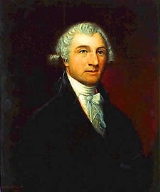
William Thornton

Encyclopedia
Dr. William Thornton was a British
-American
physician, inventor, painter and architect
who designed the United States Capitol
, an authentic polymath
. He also served as the first Architect of the Capitol
and first Superintendent of the United States Patent Office.
in the British Virgin Islands
, West Indies, in a Quaker community at Tortola
, where he was heir to sugar plantations. He was sent to England
at age five to be educated. Thornton was brought up strictly by his father's relations, Quakers and merchants, in and near the ancient castle town of Lancaster, in northern Lancashire, England. There was never any question of his pursuing the fine arts professionally—he was to be trained for a useful life, according to the Quaker ways. Thus, despite the fact that he had a sizeable income, young Thornton was apprenticed for a term of four years (1777–1781), to a practical physician and apothecary
in the Furness district of Lancashire (now Cumbria).
The earliest of Thornton's known writings, a journal he began during his apprenticeship, records almost as many entries for drawing and sketching as notes on medical treatments and nostrums. His subjects were most often flora
and fauna
, but he also did portraits, landscapes, historical scenes, and studies of machinery, such as the Franklin stove
, and managed to construct a camera obscura
. This pattern continued when he enrolled as a medical student in the University of Edinburgh
in 1781. The architecture of Edinburgh
, especially that of the New Town
that was being built, surely exerted considerable influence. More direct evidence of his interest in architecture is found in the landscapes and sketches of castles he drew while travelling about Scotland, notably in the Highlands
, during these years.
In 1783 Thornton went to London to continue his medical studies; characteristically, he also found time to attend lectures at the Royal Academy
. The following year he was off to the Continent, carrying a letter of introduction
to Benjamin Franklin
, written by his mentor and distant cousin Dr. John Coakley Lettsome. He received his medical degree in 1784 at the University of Aberdeen
.
Thornton then spent time in Paris
, before returning to Tortola in 1786. There, he saw his mother for the first time since boyhood, where he came face to face with the source of his income—half interest in a sugar plantation and ownership of some 70 slaves, the possession of which had begun to trouble him.
Eager to achieve fame (and undoubtedly some expiation) in the cause of anti-slavery
, he emigrated to the United States of America
in the fall of 1786, moving to Philadelphia. His unsuccessful efforts to lead a contingent of free black Americans
to join the small British settlement of London blacks
at the mouth of the Sierra Leone River
in West Africa
were looked on favorably by Philadelphia's Quaker establishment. Some leaders of the new republic—notably James Madison
, with whom he lodged at Mrs. Mary House's prominent boarding establishment in 1787 and 1788—were cognizant of Thornton's abolitionist activities. In 1788, he became an American citizen. Thornton married Anna Maria Brodeau
, daughter of a school teacher, in 1790.
 In 1789, after briefly practicing medicine
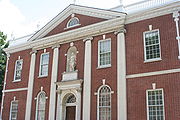
and pursuing an interest in steamboats, Thornton submitted a design to the architectural competition for the Library Company of Philadelphia's
new hall. His design won but was somewhat departed from during actual construction. Library Hall was described as the first building in the "modern [classical] style" to be erected in the new nation's leading city.
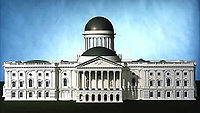
During his visit to Tortola between October 1790 and October 1792, Thornton learned of the design competitions for the U.S. Capitol and the President's House to be erected in the new Federal City on the banks of the Potomac. Because a design for the Capitol had not been chosen, he was allowed to compete upon his return to Philadelphia. Between July and November 1792 the Washington administration examined closely designs submitted by the French émigré architect Etienne Sulpice Hallet and Judge George Turner. Hallet and Turner had been summoned to the Federal City in August 1792 to present their ideas to the Commissioners of the District of Columbia and local landholders. Both were then encouraged to submit revisions of their designs to accommodate new conditions and requirements. At the beginning of November Turner's new designs were rejected.
 The painter John Trumbull
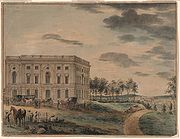
handed in William Thornton's still "unfinished" revised plan of the Capitol building on January 29, 1793, but the president's formal approbation was not recorded until April 2, 1793. Thornton was inspired by east front of the Louvre
, as well as the Pantheon
for the center portion of the design. After more drawings were prepared, enthusiastic praise of Thornton's design was echoed by Jefferson: "simple, noble, beautiful, excellently distributed." For his winning design, Thornton received a prize of $500 and a city lot.
The execution of the design was entrusted to the supervision of Étienne Sulpice Hallet
and James Hoban
. Hallet proceeded to make numerous revisions, including removing the rotunda under which Washington was to be enshrined upon his death. So, on September 12, 1794 the President appointed Thornton one of the three Commissioners of the Federal District in charge of laying out the new federal city and overseeing construction of the first government buildings, including the Capitol of which he became supervisor and remained in charge until 1802. Despite important changes and additions, especially by Latrobe and Bulfinch
, much of the design of the facade of the central portion of the Capitol is his.
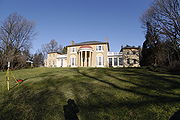
 As a consequence of winning the Capitol competition, Thornton was frequently asked to give ideas for public and residential buildings in the Federal City. He responded with designs on several occasions during his tenure as a commissioner, less so after 1802 when he took on the superintendency of the Patent Office.
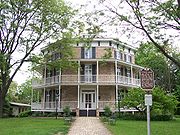
It was during this time he was asked to design a mansion for Colonel John Tayloe. The Tayloe House, also known as The Octagon House, in Washington, D.C., was erected between 1799 and 1800. It served as a temporary "Executive Mansion" after the 1814 burning of the White House by the British and the house's study was where President Madison
signed the Treaty of Ghent
ending the War of 1812
. In 1899 the building was acquired by the American Institute of Architects
, whose national headquarters now nestles behind it.
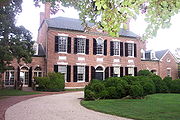
Around 1800, he designed Woodlawn
for Major Lawrence Lewis (nephew of George Washington
) and his wife, Eleanor (Nelly) Parke Custis
(granddaughter of Martha Washington
), on 2000 acres (8.1 km²) of Mount Vernon land. Sometime around 1808, he designed Tudor Place
for Thomas Peter and his wife, Martha Parke Custis (another granddaughter of Martha Washington).
including:
appointed Thornton the first Superintendent of the Patent Office. When Washington was burned
by the British in 1814, Thornton convinced them not to burn the Patent Office because of its importance to mankind. He held the position from June 1, 1802 until his death in 1828 in Washington, DC. During his tenure, he introduced innovations including the patent reissue practice, which survives to this day.
, who counted among their members former presidents Andrew Jackson
and John Quincy Adams
and many prominent men of the day, including well-known representatives of the military, government service, medical and other professions.
British people
The British are citizens of the United Kingdom, of the Isle of Man, any of the Channel Islands, or of any of the British overseas territories, and their descendants...
-American
Americans
The people of the United States, also known as simply Americans or American people, are the inhabitants or citizens of the United States. The United States is a multi-ethnic nation, home to people of different ethnic and national backgrounds...
physician, inventor, painter and architect
Architect
An architect is a person trained in the planning, design and oversight of the construction of buildings. To practice architecture means to offer or render services in connection with the design and construction of a building, or group of buildings and the space within the site surrounding the...
who designed the United States Capitol
United States Capitol
The United States Capitol is the meeting place of the United States Congress, the legislature of the federal government of the United States. Located in Washington, D.C., it sits atop Capitol Hill at the eastern end of the National Mall...
, an authentic polymath
Polymath
A polymath is a person whose expertise spans a significant number of different subject areas. In less formal terms, a polymath may simply be someone who is very knowledgeable...
. He also served as the first Architect of the Capitol
Architect of the Capitol
The Architect of the Capitol is the federal agency responsible for the maintenance, operation, development, and preservation of the United States Capitol Complex, and also the head of that agency. The Architect of the Capitol is in the legislative branch and is responsible to the United States...
and first Superintendent of the United States Patent Office.
Early life
From an early age William Thornton displayed interest and discernible talent in "the arts of design," to employ an 18th-century term that is particularly useful in assessing his career. Thornton was born on Jost Van DykeJost Van Dyke
At roughly 8 square kilometers, and about 3 square miles Jost Van Dyke is the smallest of the four main islands of the British Virgin Islands, the northern portion of the archipelago of the Virgin Islands, located in the Atlantic Ocean and Caribbean Sea. Jost Van Dyke lies about 8 km to the...
in the British Virgin Islands
British Virgin Islands
The Virgin Islands, often called the British Virgin Islands , is a British overseas territory and overseas territory of the European Union, located in the Caribbean to the east of Puerto Rico. The islands make up part of the Virgin Islands archipelago, the remaining islands constituting the U.S...
, West Indies, in a Quaker community at Tortola
Tortola
Tortola is the largest and most populated of the British Virgin Islands, a group of islands that form part of the archipelago of the Virgin Islands. Local tradition recounts that Christopher Columbus named it Tortola, meaning "land of the Turtle Dove". Columbus named the island Santa Ana...
, where he was heir to sugar plantations. He was sent to England
England
England is a country that is part of the United Kingdom. It shares land borders with Scotland to the north and Wales to the west; the Irish Sea is to the north west, the Celtic Sea to the south west, with the North Sea to the east and the English Channel to the south separating it from continental...
at age five to be educated. Thornton was brought up strictly by his father's relations, Quakers and merchants, in and near the ancient castle town of Lancaster, in northern Lancashire, England. There was never any question of his pursuing the fine arts professionally—he was to be trained for a useful life, according to the Quaker ways. Thus, despite the fact that he had a sizeable income, young Thornton was apprenticed for a term of four years (1777–1781), to a practical physician and apothecary
Apothecary
Apothecary is a historical name for a medical professional who formulates and dispenses materia medica to physicians, surgeons and patients — a role now served by a pharmacist and some caregivers....
in the Furness district of Lancashire (now Cumbria).
The earliest of Thornton's known writings, a journal he began during his apprenticeship, records almost as many entries for drawing and sketching as notes on medical treatments and nostrums. His subjects were most often flora
Flora
Flora is the plant life occurring in a particular region or time, generally the naturally occurring or indigenous—native plant life. The corresponding term for animals is fauna.-Etymology:...
and fauna
Fauna
Fauna or faunæ is all of the animal life of any particular region or time. The corresponding term for plants is flora.Zoologists and paleontologists use fauna to refer to a typical collection of animals found in a specific time or place, e.g. the "Sonoran Desert fauna" or the "Burgess shale fauna"...
, but he also did portraits, landscapes, historical scenes, and studies of machinery, such as the Franklin stove
Franklin stove
The Franklin stove is a metal-lined fireplace named after its inventor, Benjamin Franklin. It was invented in 1741.L.W. Labaree, W. Bell, W.B. Willcox, et al., eds., The Papers of Benjamin Franklin , vol. 2, page 419...
, and managed to construct a camera obscura
Camera obscura
The camera obscura is an optical device that projects an image of its surroundings on a screen. It is used in drawing and for entertainment, and was one of the inventions that led to photography. The device consists of a box or room with a hole in one side...
. This pattern continued when he enrolled as a medical student in the University of Edinburgh
University of Edinburgh
The University of Edinburgh, founded in 1583, is a public research university located in Edinburgh, the capital of Scotland, and a UNESCO World Heritage Site. The university is deeply embedded in the fabric of the city, with many of the buildings in the historic Old Town belonging to the university...
in 1781. The architecture of Edinburgh
Edinburgh
Edinburgh is the capital city of Scotland, the second largest city in Scotland, and the eighth most populous in the United Kingdom. The City of Edinburgh Council governs one of Scotland's 32 local government council areas. The council area includes urban Edinburgh and a rural area...
, especially that of the New Town
New Town, Edinburgh
The New Town is a central area of Edinburgh, the capital of Scotland. It is often considered to be a masterpiece of city planning, and is a UNESCO World Heritage Site...
that was being built, surely exerted considerable influence. More direct evidence of his interest in architecture is found in the landscapes and sketches of castles he drew while travelling about Scotland, notably in the Highlands
Scottish Highlands
The Highlands is an historic region of Scotland. The area is sometimes referred to as the "Scottish Highlands". It was culturally distinguishable from the Lowlands from the later Middle Ages into the modern period, when Lowland Scots replaced Scottish Gaelic throughout most of the Lowlands...
, during these years.
In 1783 Thornton went to London to continue his medical studies; characteristically, he also found time to attend lectures at the Royal Academy
Royal Academy
The Royal Academy of Arts is an art institution based in Burlington House on Piccadilly, London. The Royal Academy of Arts has a unique position in being an independent, privately funded institution led by eminent artists and architects whose purpose is to promote the creation, enjoyment and...
. The following year he was off to the Continent, carrying a letter of introduction
Letter of introduction
The letter of introduction, along with the visiting card, was an important part of polite social interaction in the 18th and 19th centuries. It remains important in formal situations, such as an ambassador presenting his credentials, and in certain business circles.In general, a person would not...
to Benjamin Franklin
Benjamin Franklin
Dr. Benjamin Franklin was one of the Founding Fathers of the United States. A noted polymath, Franklin was a leading author, printer, political theorist, politician, postmaster, scientist, musician, inventor, satirist, civic activist, statesman, and diplomat...
, written by his mentor and distant cousin Dr. John Coakley Lettsome. He received his medical degree in 1784 at the University of Aberdeen
University of Aberdeen
The University of Aberdeen, an ancient university founded in 1495, in Aberdeen, Scotland, is a British university. It is the third oldest university in Scotland, and the fifth oldest in the United Kingdom and wider English-speaking world...
.
Thornton then spent time in Paris
Paris
Paris is the capital and largest city in France, situated on the river Seine, in northern France, at the heart of the Île-de-France region...
, before returning to Tortola in 1786. There, he saw his mother for the first time since boyhood, where he came face to face with the source of his income—half interest in a sugar plantation and ownership of some 70 slaves, the possession of which had begun to trouble him.
Eager to achieve fame (and undoubtedly some expiation) in the cause of anti-slavery
Abolitionism
Abolitionism is a movement to end slavery.In western Europe and the Americas abolitionism was a movement to end the slave trade and set slaves free. At the behest of Dominican priest Bartolomé de las Casas who was shocked at the treatment of natives in the New World, Spain enacted the first...
, he emigrated to the United States of America
United States
The United States of America is a federal constitutional republic comprising fifty states and a federal district...
in the fall of 1786, moving to Philadelphia. His unsuccessful efforts to lead a contingent of free black Americans
Free Negro
A free Negro or free black is the term used prior to the abolition of slavery in the United States to describe African Americans who were not slaves. Almost all African Americans came to the United States as slaves, but from the earliest days of American slavery, slaveholders set men and women free...
to join the small British settlement of London blacks
Committee for the Relief of the Black Poor
The Committee for the Relief of the Black Poor was a charitable organization founded in London in 1786 to provide sustenance for distressed people of African and Asian origin...
at the mouth of the Sierra Leone River
Sierra Leone River
The Sierra Leone River is a river estuary on the Atlantic Ocean in Western Sierra Leone. It is formed by the Port Loko Creek and Rokel River and is between 4 and 10 miles wide and 25 miles long. It holds the major ports of Queen Elizabeth II Quay and Pepel. The estuary is also important for...
in West Africa
West Africa
West Africa or Western Africa is the westernmost region of the African continent. Geopolitically, the UN definition of Western Africa includes the following 16 countries and an area of approximately 5 million square km:-Flags of West Africa:...
were looked on favorably by Philadelphia's Quaker establishment. Some leaders of the new republic—notably James Madison
James Madison
James Madison, Jr. was an American statesman and political theorist. He was the fourth President of the United States and is hailed as the “Father of the Constitution” for being the primary author of the United States Constitution and at first an opponent of, and then a key author of the United...
, with whom he lodged at Mrs. Mary House's prominent boarding establishment in 1787 and 1788—were cognizant of Thornton's abolitionist activities. In 1788, he became an American citizen. Thornton married Anna Maria Brodeau
Anna Thornton
Anna Maria Brodeau Thornton was a prominent Washington, D.C., socialite, and the wife of architect William Thornton, who designed the first United States Capitol building...
, daughter of a school teacher, in 1790.
United States Capitol
Medicine
Medicine is the science and art of healing. It encompasses a variety of health care practices evolved to maintain and restore health by the prevention and treatment of illness....
and pursuing an interest in steamboats, Thornton submitted a design to the architectural competition for the Library Company of Philadelphia's
Library Company of Philadelphia
The Library Company of Philadelphia is a non-profit organization based in Philadelphia, Pennsylvania. Founded by Benjamin Franklin as a library, the Library Company of Philadelphia has accumulated one of the most significant collections of historically valuable manuscripts and printed material in...
new hall. His design won but was somewhat departed from during actual construction. Library Hall was described as the first building in the "modern [classical] style" to be erected in the new nation's leading city.
During his visit to Tortola between October 1790 and October 1792, Thornton learned of the design competitions for the U.S. Capitol and the President's House to be erected in the new Federal City on the banks of the Potomac. Because a design for the Capitol had not been chosen, he was allowed to compete upon his return to Philadelphia. Between July and November 1792 the Washington administration examined closely designs submitted by the French émigré architect Etienne Sulpice Hallet and Judge George Turner. Hallet and Turner had been summoned to the Federal City in August 1792 to present their ideas to the Commissioners of the District of Columbia and local landholders. Both were then encouraged to submit revisions of their designs to accommodate new conditions and requirements. At the beginning of November Turner's new designs were rejected.
John Trumbull
John Trumbull was an American artist during the period of the American Revolutionary War and was notable for his historical paintings...
handed in William Thornton's still "unfinished" revised plan of the Capitol building on January 29, 1793, but the president's formal approbation was not recorded until April 2, 1793. Thornton was inspired by east front of the Louvre
Louvre
The Musée du Louvre – in English, the Louvre Museum or simply the Louvre – is one of the world's largest museums, the most visited art museum in the world and a historic monument. A central landmark of Paris, it is located on the Right Bank of the Seine in the 1st arrondissement...
, as well as the Pantheon
Pantheon, Rome
The Pantheon ,Rarely Pantheum. This appears in Pliny's Natural History in describing this edifice: Agrippae Pantheum decoravit Diogenes Atheniensis; in columnis templi eius Caryatides probantur inter pauca operum, sicut in fastigio posita signa, sed propter altitudinem loci minus celebrata.from ,...
for the center portion of the design. After more drawings were prepared, enthusiastic praise of Thornton's design was echoed by Jefferson: "simple, noble, beautiful, excellently distributed." For his winning design, Thornton received a prize of $500 and a city lot.
The execution of the design was entrusted to the supervision of Étienne Sulpice Hallet
Étienne Sulpice Hallet
Étienne Sulpice Hallet was a French-born U.S. architect.Around 1789, Hallet went to the United States. There he became known as Stephen Hallet. He worked as Pierre L'Enfant's draftsman....
and James Hoban
James Hoban
James Hoban was an Irish architect, best known for designing The White House in Washington, D.C.-Life:James Hoban was born and raised in a thatched cottage on the Earl of Desart's estate in Cuffesgrange, near Callan in Co. Kilkenny...
. Hallet proceeded to make numerous revisions, including removing the rotunda under which Washington was to be enshrined upon his death. So, on September 12, 1794 the President appointed Thornton one of the three Commissioners of the Federal District in charge of laying out the new federal city and overseeing construction of the first government buildings, including the Capitol of which he became supervisor and remained in charge until 1802. Despite important changes and additions, especially by Latrobe and Bulfinch
Charles Bulfinch
Charles Bulfinch was an early American architect, and has been regarded by many as the first native-born American to practice architecture as a profession....
, much of the design of the facade of the central portion of the Capitol is his.
Other works
It was during this time he was asked to design a mansion for Colonel John Tayloe. The Tayloe House, also known as The Octagon House, in Washington, D.C., was erected between 1799 and 1800. It served as a temporary "Executive Mansion" after the 1814 burning of the White House by the British and the house's study was where President Madison
James Madison
James Madison, Jr. was an American statesman and political theorist. He was the fourth President of the United States and is hailed as the “Father of the Constitution” for being the primary author of the United States Constitution and at first an opponent of, and then a key author of the United...
signed the Treaty of Ghent
Treaty of Ghent
The Treaty of Ghent , signed on 24 December 1814, in Ghent , was the peace treaty that ended the War of 1812 between the United States of America and the United Kingdom of Great Britain and Ireland...
ending the War of 1812
War of 1812
The War of 1812 was a military conflict fought between the forces of the United States of America and those of the British Empire. The Americans declared war in 1812 for several reasons, including trade restrictions because of Britain's ongoing war with France, impressment of American merchant...
. In 1899 the building was acquired by the American Institute of Architects
American Institute of Architects
The American Institute of Architects is a professional organization for architects in the United States. Headquartered in Washington, D.C., the AIA offers education, government advocacy, community redevelopment, and public outreach to support the architecture profession and improve its public image...
, whose national headquarters now nestles behind it.
Around 1800, he designed Woodlawn
Woodlawn Plantation
Woodlawn Plantation is a historic home located in Fairfax County, Virginia, and was originally a part of Mount Vernon, George Washington's historic plantation estate....
for Major Lawrence Lewis (nephew of George Washington
George Washington
George Washington was the dominant military and political leader of the new United States of America from 1775 to 1799. He led the American victory over Great Britain in the American Revolutionary War as commander-in-chief of the Continental Army from 1775 to 1783, and presided over the writing of...
) and his wife, Eleanor (Nelly) Parke Custis
Eleanor Parke Custis Lewis
Eleanor Parke Custis Lewis , known as Nelly, was the granddaughter of Martha Washington and the step-granddaughter of George Washington.-Childhood:Nelly was the daughter of John Parke Custis and Eleanor Calvert Custis...
(granddaughter of Martha Washington
Martha Washington
Martha Dandridge Custis Washington was the wife of George Washington, the first president of the United States. Although the title was not coined until after her death, Martha Washington is considered to be the first First Lady of the United States...
), on 2000 acres (8.1 km²) of Mount Vernon land. Sometime around 1808, he designed Tudor Place
Tudor Place
Tudor Place is a mansion in Washington, D.C. that was originally the home of Thomas Peter and his wife, Martha Parke Custis Peter, the step-granddaughter of George Washington, who left her the $8,000 in his will that was used to purchase the property in 1805...
for Thomas Peter and his wife, Martha Parke Custis (another granddaughter of Martha Washington).
National Register
Many buildings designed by Thornton have been added to the National Register of Historic PlacesNational Register of Historic Places
The National Register of Historic Places is the United States government's official list of districts, sites, buildings, structures, and objects deemed worthy of preservation...
including:
- Library Company of PhiladelphiaLibrary Company of PhiladelphiaThe Library Company of Philadelphia is a non-profit organization based in Philadelphia, Pennsylvania. Founded by Benjamin Franklin as a library, the Library Company of Philadelphia has accumulated one of the most significant collections of historically valuable manuscripts and printed material in...
, 5th & Chestnut Sts., Philadelphia, PA; 1789 (demolished 1887; recreated as Library Hall, American Philosophical Society, 1954) - United States CapitolUnited States CapitolThe United States Capitol is the meeting place of the United States Congress, the legislature of the federal government of the United States. Located in Washington, D.C., it sits atop Capitol Hill at the eastern end of the National Mall...
, Washington, DC; 1793 - exempt - Prospect HillProspect Hill (Long Green, Maryland)Prospect Hill is a historic home located at Long Green, Baltimore County, Maryland, United States. It is a -story Federal style brick house, built between 1796 and 1798.Prospect Hill was listed on the National Register of Historic Places in 1973....
, NE of Long Green on Kanes Road, Baltimore, MD; 1796-1798 - added to registry in 1973 - Octagon HouseThe Octagon HouseThe Octagon House, also known as the Colonel John Tayloe III House, is located at 1799 New York Avenue, Northwest in the Foggy Bottom neighborhood of Washington, D.C.-History:...
, 1741 New York Avenue, NW, Washington, DC; 1799 - added in 1966 - WoodlawnWoodlawn PlantationWoodlawn Plantation is a historic home located in Fairfax County, Virginia, and was originally a part of Mount Vernon, George Washington's historic plantation estate....
, W of jct. of U.S. 1 and Rte. 235, Fairfax, VA, 1800-05 - added in 1970 - Tudor PlaceTudor PlaceTudor Place is a mansion in Washington, D.C. that was originally the home of Thomas Peter and his wife, Martha Parke Custis Peter, the step-granddaughter of George Washington, who left her the $8,000 in his will that was used to purchase the property in 1805...
, 1644 31st Street, NW, Washington, DC; 1816 - added in 1966
Superintendent of the Patent Office
Upon the abolition of the board in 1802, President JeffersonThomas Jefferson
Thomas Jefferson was the principal author of the United States Declaration of Independence and the Statute of Virginia for Religious Freedom , the third President of the United States and founder of the University of Virginia...
appointed Thornton the first Superintendent of the Patent Office. When Washington was burned
Burning of Washington
The Burning of Washington was an armed conflict during the War of 1812 between the United Kingdom of Great Britain and Ireland and the United States of America. On August 24, 1814, led by General Robert Ross, a British force occupied Washington, D.C. and set fire to many public buildings following...
by the British in 1814, Thornton convinced them not to burn the Patent Office because of its importance to mankind. He held the position from June 1, 1802 until his death in 1828 in Washington, DC. During his tenure, he introduced innovations including the patent reissue practice, which survives to this day.
Societies
During the 1820s, Thornton was a member of the prestigious society, Columbian Institute for the Promotion of Arts and SciencesColumbian Institute for the Promotion of Arts and Sciences
The Columbian Institute for the Promotion of Arts and Sciences was a literary and science institution in Washington, D.C., founded by Dr. Edward Cutbush , a naval surgeon...
, who counted among their members former presidents Andrew Jackson
Andrew Jackson
Andrew Jackson was the seventh President of the United States . Based in frontier Tennessee, Jackson was a politician and army general who defeated the Creek Indians at the Battle of Horseshoe Bend , and the British at the Battle of New Orleans...
and John Quincy Adams
John Quincy Adams
John Quincy Adams was the sixth President of the United States . He served as an American diplomat, Senator, and Congressional representative. He was a member of the Federalist, Democratic-Republican, National Republican, and later Anti-Masonic and Whig parties. Adams was the son of former...
and many prominent men of the day, including well-known representatives of the military, government service, medical and other professions.
Further reading
- Bordewich, Fergus M., "A Capitol Vision From a Self-Taught Architect", SmithsonianSmithsonian (magazine)Smithsonian is the official journal published by the Smithsonian Institution in Washington, D.C. The first issue was published in 1970.-History:...
magazine, December 2008
External links
- Thornton's designs of the U.S. Capitol
- Tudor Place
- Thornton's grave
- Biography of Thornton on Wikimedia Commons