

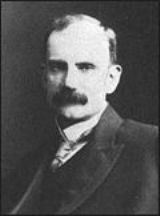
William Pember Reeves

Encyclopedia
The Hon. William Pember Reeves (b. 10 February 1857 in Lyttelton, New Zealand
, d. 16 May 1932 in London
) was a New Zealand
statesman
, historian
and poet
, who promoted social reform.
(who was a journalist and politician) and Ellen Reeves née Pember; they had migrated to Canterbury in 1857, arriving three weeks before he was born.
He was educated at a private “prep” school in Christchurch
, the local high school, and (1867–74) the Christ's College Grammar School
. Before entering politics, Reeves was a lawyer
and journalist
. He was editor of the Canterbury Times in 1885 and the Lyttelton Times (1889–1891).
Political career
He represented the Christchurch seat of St Albans
in Parliament
from 1887
to 1890, and then Christchurch
from 1890
to 1896, when he resigned to take up the Agent-generalship. He served as Minister of Labour (1891–96) during the premierships of John Ballance
and Richard Seddon
. As Minister he introduced the Industrial Conciliation and Arbitration Act 1894
and the Undesirable Immigrants Exclusion Bill, which, had it passed, would have barred poor and Asian immigrants from the country. His anti-foreigner stance earned him the nickname ‘Undesirable Bill’ Reeves.
London bound
In January 1896, he left New Zealand for London
, where he was Agent-General (1896–1905) and High Commissioner (1905–08). He then became Director of the London School of Economics
(1908–19). While in England
, Reeves became a friend of a number of left-wing intellectuals, such as George Bernard Shaw
, H. G. Wells
, and Sidney and Beatrice Webb
, all Fabian
and LSE members. He was also a member of the Coefficients dining club
of social reformers.
In later life, Reeves served as Chairman of the Board of the National Bank of New Zealand
(1917–31) and President of the Anglo-Hellenic League
(1913–25).
Some of Reeves's more influential writings include his history of New Zealand, The Long White Cloud (1898), and State Experiments in Australia and New Zealand (1902). He also published a number of poems, such as The Passing of the Forest and A Colonist in his Garden.
William Pember Reeves married, in 1885, the feminist Magdalen Stuart Robison
, who joined the Fabian Society
. They had one son (Fabian Pember Reeves, who died in the First World War) and two daughters, one of whom was the feminist writer
Amber Reeves
.
Reeves three times declined offers of a knighthood.
Lyttelton, New Zealand
Lyttelton is a port town on the north shore of Lyttelton Harbour close to Banks Peninsula, a suburb of Christchurch on the eastern coast of the South Island of New Zealand....
, d. 16 May 1932 in London
London
London is the capital city of :England and the :United Kingdom, the largest metropolitan area in the United Kingdom, and the largest urban zone in the European Union by most measures. Located on the River Thames, London has been a major settlement for two millennia, its history going back to its...
) was a New Zealand
New Zealand
New Zealand is an island country in the south-western Pacific Ocean comprising two main landmasses and numerous smaller islands. The country is situated some east of Australia across the Tasman Sea, and roughly south of the Pacific island nations of New Caledonia, Fiji, and Tonga...
statesman
Statesman
A statesman is usually a politician or other notable public figure who has had a long and respected career in politics or government at the national and international level. As a term of respect, it is usually left to supporters or commentators to use the term...
, historian
Historian
A historian is a person who studies and writes about the past and is regarded as an authority on it. Historians are concerned with the continuous, methodical narrative and research of past events as relating to the human race; as well as the study of all history in time. If the individual is...
and poet
Poet
A poet is a person who writes poetry. A poet's work can be literal, meaning that his work is derived from a specific event, or metaphorical, meaning that his work can take on many meanings and forms. Poets have existed since antiquity, in nearly all languages, and have produced works that vary...
, who promoted social reform.
Biography
Reeves' parents were William ReevesWilliam Reeves (journalist)
William Reeves was a New Zealand 19th century journalist and politician. He was the father of the author and politician the Hon. William Pember Reeves....
(who was a journalist and politician) and Ellen Reeves née Pember; they had migrated to Canterbury in 1857, arriving three weeks before he was born.
He was educated at a private “prep” school in Christchurch
Christchurch
Christchurch is the largest city in the South Island of New Zealand, and the country's second-largest urban area after Auckland. It lies one third of the way down the South Island's east coast, just north of Banks Peninsula which itself, since 2006, lies within the formal limits of...
, the local high school, and (1867–74) the Christ's College Grammar School
Christ's College, Canterbury
Christ's College, Christchurch is an independent, Anglican, secondary, day and boarding school for boys, located in the central city of Christchurch, New Zealand....
. Before entering politics, Reeves was a lawyer
Lawyer
A lawyer, according to Black's Law Dictionary, is "a person learned in the law; as an attorney, counsel or solicitor; a person who is practicing law." Law is the system of rules of conduct established by the sovereign government of a society to correct wrongs, maintain the stability of political...
and journalist
Journalist
A journalist collects and distributes news and other information. A journalist's work is referred to as journalism.A reporter is a type of journalist who researchs, writes, and reports on information to be presented in mass media, including print media , electronic media , and digital media A...
. He was editor of the Canterbury Times in 1885 and the Lyttelton Times (1889–1891).
Political career
He represented the Christchurch seat of St Albans
St Albans (New Zealand electorate)
St Albans was a parliamentary electorate in Christchurch, New Zealand from 1881 to 1890, then from 1946 to 1996.-Population centres:The electorate was centred on the Christchurch suburb of St Albans.-History:...
in Parliament
Parliament of New Zealand
The Parliament of New Zealand consists of the Queen of New Zealand and the New Zealand House of Representatives and, until 1951, the New Zealand Legislative Council. The House of Representatives is often referred to as "Parliament".The House of Representatives usually consists of 120 Members of...
from 1887
New Zealand general election, 1887
The New Zealand general election of 1887 was held on 26 September to elect 95 MPs to the tenth session of the New Zealand Parliament. The Māori vote was held on 7 September. 175,410 votes were cast....
to 1890, and then Christchurch
Christchurch (New Zealand electorate)
Christchurch was a parliamentary electorate in Christchurch, New Zealand. It existed three times. Originally it was the Town of Christchurch from 1853 to 1860. From the 1860–61 election to the 1871 election, it existed as City of Christchurch. It then existed from the 1875–76 election until the...
from 1890
New Zealand general election, 1890
The New Zealand general election of 1890 was one of New Zealand's most significant. It marked the beginning of party politics in New Zealand with the formation of the First Liberal government, which was to enact major welfare, labour and electoral reforms, including giving the vote to women.It was...
to 1896, when he resigned to take up the Agent-generalship. He served as Minister of Labour (1891–96) during the premierships of John Ballance
John Ballance
John Ballance served as the 14th Premier of New Zealand at the end of the 19th century, and was the founder of the Liberal Party .-Early life:...
and Richard Seddon
Richard Seddon
Richard John Seddon , sometimes known as King Dick, is to date the longest serving Prime Minister of New Zealand. He is regarded by some, including historian Keith Sinclair, as one of New Zealand's greatest political leaders....
. As Minister he introduced the Industrial Conciliation and Arbitration Act 1894
Industrial Conciliation and Arbitration Act 1894
The Industrial Conciliation and Arbitration Act 1894 was a piece of industrial relations legislation passed by the Parliament of New Zealand in 1894. Enacted by the First Liberal Government of New Zealand, it was the world's first compulsory system of state arbitration...
and the Undesirable Immigrants Exclusion Bill, which, had it passed, would have barred poor and Asian immigrants from the country. His anti-foreigner stance earned him the nickname ‘Undesirable Bill’ Reeves.
London bound
In January 1896, he left New Zealand for London
London
London is the capital city of :England and the :United Kingdom, the largest metropolitan area in the United Kingdom, and the largest urban zone in the European Union by most measures. Located on the River Thames, London has been a major settlement for two millennia, its history going back to its...
, where he was Agent-General (1896–1905) and High Commissioner (1905–08). He then became Director of the London School of Economics
London School of Economics
The London School of Economics and Political Science is a public research university specialised in the social sciences located in London, United Kingdom, and a constituent college of the federal University of London...
(1908–19). While in England
England
England is a country that is part of the United Kingdom. It shares land borders with Scotland to the north and Wales to the west; the Irish Sea is to the north west, the Celtic Sea to the south west, with the North Sea to the east and the English Channel to the south separating it from continental...
, Reeves became a friend of a number of left-wing intellectuals, such as George Bernard Shaw
George Bernard Shaw
George Bernard Shaw was an Irish playwright and a co-founder of the London School of Economics. Although his first profitable writing was music and literary criticism, in which capacity he wrote many highly articulate pieces of journalism, his main talent was for drama, and he wrote more than 60...
, H. G. Wells
H. G. Wells
Herbert George Wells was an English author, now best known for his work in the science fiction genre. He was also a prolific writer in many other genres, including contemporary novels, history, politics and social commentary, even writing text books and rules for war games...
, and Sidney and Beatrice Webb
Beatrice Webb
Martha Beatrice Webb, Lady Passfield was an English sociologist, economist, socialist and social reformer. Although her husband became Baron Passfield in 1929, she refused to be known as Lady Passfield...
, all Fabian
Fabian Society
The Fabian Society is a British socialist movement, whose purpose is to advance the principles of democratic socialism via gradualist and reformist, rather than revolutionary, means. It is best known for its initial ground-breaking work beginning late in the 19th century and continuing up to World...
and LSE members. He was also a member of the Coefficients dining club
Coefficients (dining club)
The Coefficients was a dining club founded in 1902 at a dinner given by the Fabian campaigners Sidney and Beatrice Webb. It was a forum for the meeting of British socialist reformers and imperialists of the Edwardian era...
of social reformers.
In later life, Reeves served as Chairman of the Board of the National Bank of New Zealand
National Bank of New Zealand
The National Bank of New Zealand often referred to as The National Bank is one of New Zealand's largest banks. Throughout much of its history, the National Bank has provided banking services to mainly rural, personal, and small business customers. Its owner is ANZ National Bank Limited, the New...
(1917–31) and President of the Anglo-Hellenic League
Anglo-Hellenic League
The Anglo-Hellenic League is an organisation supporting and promoting Anglo-Greek relations and understanding. It was founded in 1913 in London and it carries out charitable and cultural work...
(1913–25).
Some of Reeves's more influential writings include his history of New Zealand, The Long White Cloud (1898), and State Experiments in Australia and New Zealand (1902). He also published a number of poems, such as The Passing of the Forest and A Colonist in his Garden.
William Pember Reeves married, in 1885, the feminist Magdalen Stuart Robison
Maud Pember Reeves
Maud Pember Reeves was a feminist, writer and member of the Fabian Society. She spent most of her life in New Zealand and Britain....
, who joined the Fabian Society
Fabian Society
The Fabian Society is a British socialist movement, whose purpose is to advance the principles of democratic socialism via gradualist and reformist, rather than revolutionary, means. It is best known for its initial ground-breaking work beginning late in the 19th century and continuing up to World...
. They had one son (Fabian Pember Reeves, who died in the First World War) and two daughters, one of whom was the feminist writer
Writer
A writer is a person who produces literature, such as novels, short stories, plays, screenplays, poetry, or other literary art. Skilled writers are able to use language to portray ideas and images....
Amber Reeves
Amber Reeves
Amber Blanco White [née Amber Reeves] was a British feminist writer and scholar.-Early life:Reeves was born in Christchurch, New Zealand,the eldest of three children...
.
Reeves three times declined offers of a knighthood.
External links
- Biography in the 1966 Encyclopaedia of New Zealand
- The Passing of the Forest at the New Zealand Electronic Text Centre