

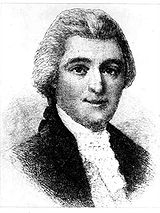
William Blount

Encyclopedia
William Blount, was a United States
statesman. He was a delegate to the Constitutional Convention for North Carolina
, the first and only governor of the Southwest Territory
, and Democratic-Republican Senator from Tennessee
(1796–1797). He played a major role in establishing the state of Tennessee. He was the first U.S. Senator to be expelled
from the Senate for treason
and the only Senator expelled outside of the Civil War
.
, in Bertie County
into a family of distinguished merchants and planters
who owned extensive properties along the banks of the Pamlico River
.
During the Revolutionary War, Blount accepted appointment as the regimental paymaster for the 3rd North Carolina Regiment
. Although a regimental paymaster was not a commissioned officer with command responsibility on the battlefield, Blount served under a warrant on the regimental staff and drew the same pay and allowances as a captain. He also participated in the regiment's march north in the late spring of 1777 when it joined Washington
's main army in defense of Philadelphia against Sir William Howe
's Royal forces. Blount and his comrades had participated in one of the key battles of the war. By demonstrating Washington's willingness to fight and the Continental Army
's recuperative powers, the battle convinced France
that the Americans were in the war to the end and directly influenced France's decision to support the Revolution openly.
After the battle, Blount returned home to become chief paymaster of state forces and later deputy paymaster general for North Carolina. For the next three years he remained intimately involved in the demanding task of recruiting and reequipping forces to be used in support both of Washington's main army in the north and of separate military operations in defense of the southern tier of states.
The fall of Charleston, South Carolina
, to British
forces under Sir Henry Clinton
in May 1780 exposed North Carolina to invasion. The state again faced the difficult task of raising new units, this time to counter a force of British, Hessian, and Loyalist
troops under General Charles Cornwallis. Blount not only helped organize these citizen-soldiers but also took to the field with them. His North Carolina unit served under General Horatio Gates
, who hastily engaged Cornwallis in a bloody battle at Camden, South Carolina
. On August 16, Gates deployed his units his continentals to the right, the North Carolina and Virginia
militia
on his left flank and ordered an advance. The American soldiers were exhausted from weeks of marching and insufficient rations. Furthermore, the militia elements had only recently joined with the regulars, and disciplined teamwork between the two components had not yet been achieved. Such teamwork was especially necessary before hastily assembled militia units could be expected to perform the intricate infantry maneuvers of 18th century linear warfare. While the Continentals easily advanced against the enemy, the militia quickly lost their cohesion in the smoke and confusion, and their lines crumbled before the counterattacking British. Cornwallis then shifted all his forces against the continentals. In less than an hour Gates' army had been lost. This second defeat in the South, the result of inadequate preparations, provided the young Blount a lesson that would stand him in good stead in later years. It also marked the end of Blount's active military career.
) by President George Washington in 1790. Blount governed from the home of William Cobb, Rocky Mount
, located in current Piney Flats, Tennessee
. After concluding the Treaty of Holston
, he announced that the territorial capital would move to newly founded Knoxville
. Blount named Knoxville after the first Secretary of War, Henry Knox
. After moving to Knoxville, construction began on his mansion, known as Blount Mansion, in 1792. The mansion still stands in downtown Knoxville and is a popular museum
.
Indians to aid the British
in conquering the Spanish
territory of West Florida
. A letter he wrote alluding to the plan fell into the hands of President
John Adams
, who turned it over to the Senate on July 3, 1797. Four days later, on July 7, the United States House of Representatives
voted to impeach
Blount and on July 8 the Senate voted 25 to 1 to expel him from the Senate. The Senate began an impeachment trial on December 17, 1798, but dropped charges two months later on the grounds that no further action could be taken beyond his expulsion. That set an important precedent for the future with regard to the limitations on actions which could be taken by Congress
against its members and former members.
A personal letter from George Washington
to James McHenry
on July 7th reveals a certain sentiment regarding this event:
"...I hope that [Blount] will receive all the punishment which the Constitution
and the Laws of this country can inflict and, thereafter, be held in detestation by all good men."
The episode did not seem to hamper Blount's career in Tennessee. In 1798 he was elected to the Tennessee State Senate and rose to the speakership. He died two years later at Knoxville, where he is buried in the cemetery of the First Presbyterian Church.
. The mansion is a National Historic Landmark
.
Blount County, Tennessee
, is named after Blount, as is the town of Blountville, Tennessee. Grainger County, Tennessee, and Maryville, Tennessee
, are both named after his wife, Mary Grainger Blount. William Blount High School, William Blount Middle School, and Mary Blount Elementary School are named after Blount and his wife. (Blount County, Alabama
, is named after his younger half-brother Willie Blount
, later governor of Tennessee). Raleigh, North Carolina
, has a street named after Blount going though the center of its downtown. Blount Street in Madison, Wisconsin
is also named in his honor.
Blount was the father of William Grainger Blount
(1784–1827), Tennessee state representative
and U.S. Representative from Tennessee, 1815-1819. He was half-brother of Willie Blount
(1767–1835), Governor of Tennessee, 1809-1815. He was brother to Thomas Blount (1759–1812), Revolutionary War veteran and U.S. Representative from North Carolina, 1793–1799, 1805–1809 and 1811-1812.
United States
The United States of America is a federal constitutional republic comprising fifty states and a federal district...
statesman. He was a delegate to the Constitutional Convention for North Carolina
North Carolina
North Carolina is a state located in the southeastern United States. The state borders South Carolina and Georgia to the south, Tennessee to the west and Virginia to the north. North Carolina contains 100 counties. Its capital is Raleigh, and its largest city is Charlotte...
, the first and only governor of the Southwest Territory
Southwest Territory
The Territory South of the River Ohio, more commonly known as the Southwest Territory, was an organized incorporated territory of the United States that existed from May 26, 1790, until June 1, 1796, when it was admitted to the United States as the State of Tennessee.The Southwest Territory was...
, and Democratic-Republican Senator from Tennessee
Tennessee
Tennessee is a U.S. state located in the Southeastern United States. It has a population of 6,346,105, making it the nation's 17th-largest state by population, and covers , making it the 36th-largest by total land area...
(1796–1797). He played a major role in establishing the state of Tennessee. He was the first U.S. Senator to be expelled
Expulsion from the United States Congress
Expulsion is the most serious form of disciplinary action that can be taken against a Member of Congress. Article I, Section 5 of the United States Constitution provides that "Each House [of Congress] may determine the Rules of its proceedings, punish its members for disorderly behavior, and, with...
from the Senate for treason
Treason
In law, treason is the crime that covers some of the more extreme acts against one's sovereign or nation. Historically, treason also covered the murder of specific social superiors, such as the murder of a husband by his wife. Treason against the king was known as high treason and treason against a...
and the only Senator expelled outside of the Civil War
American Civil War
The American Civil War was a civil war fought in the United States of America. In response to the election of Abraham Lincoln as President of the United States, 11 southern slave states declared their secession from the United States and formed the Confederate States of America ; the other 25...
.
Early life and Revolutionary War
Blount was born near Windsor, North CarolinaWindsor, North Carolina
Windsor is a town in Bertie County, North Carolina, United States. The population was 2,283 at the 2000 census. It is the county seat of Bertie County...
, in Bertie County
Bertie County, North Carolina
-External links:**...
into a family of distinguished merchants and planters
Plantations in the American South
Plantations were an important aspect of the history of the American South, particularly the antebellum .-Planter :The owner of a plantation was called a planter...
who owned extensive properties along the banks of the Pamlico River
Pamlico Sound
Pamlico Sound in North Carolina, is the largest lagoon along the U.S. East Coast, being long and 24 to 48 km wide. It is a body of water separated from the Atlantic Ocean by the Outer Banks, a row of low, sandy barrier islands, including Cape Hatteras. The Neuse and Pamlico rivers flow in...
.
During the Revolutionary War, Blount accepted appointment as the regimental paymaster for the 3rd North Carolina Regiment
3rd North Carolina Regiment
The 3rd North Carolina Regiment was raised, on January 16, 1776, at Wilmington, North Carolina for service with the Continental Army. The regiment would see action at the Battle of Brandywine, Battle of Germantown, Battle of Monmouth and the Siege of Charleston. The regiment would be captured by...
. Although a regimental paymaster was not a commissioned officer with command responsibility on the battlefield, Blount served under a warrant on the regimental staff and drew the same pay and allowances as a captain. He also participated in the regiment's march north in the late spring of 1777 when it joined Washington
George Washington
George Washington was the dominant military and political leader of the new United States of America from 1775 to 1799. He led the American victory over Great Britain in the American Revolutionary War as commander-in-chief of the Continental Army from 1775 to 1783, and presided over the writing of...
's main army in defense of Philadelphia against Sir William Howe
William Howe
William Howe may refer to:* William Howe, 5th Viscount Howe , British general during American Revolutionary War* William Howe , patented Howe Truss for covered bridges* William Dean Howe , Canadian Member of Parliament...
's Royal forces. Blount and his comrades had participated in one of the key battles of the war. By demonstrating Washington's willingness to fight and the Continental Army
Continental Army
The Continental Army was formed after the outbreak of the American Revolutionary War by the colonies that became the United States of America. Established by a resolution of the Continental Congress on June 14, 1775, it was created to coordinate the military efforts of the Thirteen Colonies in...
's recuperative powers, the battle convinced France
France
The French Republic , The French Republic , The French Republic , (commonly known as France , is a unitary semi-presidential republic in Western Europe with several overseas territories and islands located on other continents and in the Indian, Pacific, and Atlantic oceans. Metropolitan France...
that the Americans were in the war to the end and directly influenced France's decision to support the Revolution openly.
After the battle, Blount returned home to become chief paymaster of state forces and later deputy paymaster general for North Carolina. For the next three years he remained intimately involved in the demanding task of recruiting and reequipping forces to be used in support both of Washington's main army in the north and of separate military operations in defense of the southern tier of states.
The fall of Charleston, South Carolina
Charleston, South Carolina
Charleston is the second largest city in the U.S. state of South Carolina. It was made the county seat of Charleston County in 1901 when Charleston County was founded. The city's original name was Charles Towne in 1670, and it moved to its present location from a location on the west bank of the...
, to British
United Kingdom
The United Kingdom of Great Britain and Northern IrelandIn the United Kingdom and Dependencies, other languages have been officially recognised as legitimate autochthonous languages under the European Charter for Regional or Minority Languages...
forces under Sir Henry Clinton
Henry Clinton (American War of Independence)
General Sir Henry Clinton KB was a British army officer and politician, best known for his service as a general during the American War of Independence. First arriving in Boston in May 1775, from 1778 to 1782 he was the British Commander-in-Chief in North America...
in May 1780 exposed North Carolina to invasion. The state again faced the difficult task of raising new units, this time to counter a force of British, Hessian, and Loyalist
Loyalist (American Revolution)
Loyalists were American colonists who remained loyal to the Kingdom of Great Britain during the American Revolutionary War. At the time they were often called Tories, Royalists, or King's Men. They were opposed by the Patriots, those who supported the revolution...
troops under General Charles Cornwallis. Blount not only helped organize these citizen-soldiers but also took to the field with them. His North Carolina unit served under General Horatio Gates
Horatio Gates
Horatio Lloyd Gates was a retired British soldier who served as an American general during the Revolutionary War. He took credit for the American victory at the Battle of Saratoga – Benedict Arnold, who led the attack, was finally forced from the field when he was shot in the leg – and...
, who hastily engaged Cornwallis in a bloody battle at Camden, South Carolina
Camden, South Carolina
Camden is the fourth oldest city in the U.S. state of South Carolina and is also the county seat of Kershaw County, South Carolina, United States. The population was an estimated 7,103 in 2009...
. On August 16, Gates deployed his units his continentals to the right, the North Carolina and Virginia
Virginia
The Commonwealth of Virginia , is a U.S. state on the Atlantic Coast of the Southern United States. Virginia is nicknamed the "Old Dominion" and sometimes the "Mother of Presidents" after the eight U.S. presidents born there...
militia
Militia
The term militia is commonly used today to refer to a military force composed of ordinary citizens to provide defense, emergency law enforcement, or paramilitary service, in times of emergency without being paid a regular salary or committed to a fixed term of service. It is a polyseme with...
on his left flank and ordered an advance. The American soldiers were exhausted from weeks of marching and insufficient rations. Furthermore, the militia elements had only recently joined with the regulars, and disciplined teamwork between the two components had not yet been achieved. Such teamwork was especially necessary before hastily assembled militia units could be expected to perform the intricate infantry maneuvers of 18th century linear warfare. While the Continentals easily advanced against the enemy, the militia quickly lost their cohesion in the smoke and confusion, and their lines crumbled before the counterattacking British. Cornwallis then shifted all his forces against the continentals. In less than an hour Gates' army had been lost. This second defeat in the South, the result of inadequate preparations, provided the young Blount a lesson that would stand him in good stead in later years. It also marked the end of Blount's active military career.
Governor of Southwest Territory
Blount was appointed Governor of the Territory South of the Ohio River (the Southwest TerritorySouthwest Territory
The Territory South of the River Ohio, more commonly known as the Southwest Territory, was an organized incorporated territory of the United States that existed from May 26, 1790, until June 1, 1796, when it was admitted to the United States as the State of Tennessee.The Southwest Territory was...
) by President George Washington in 1790. Blount governed from the home of William Cobb, Rocky Mount
Rocky Mount, Tennessee
Rocky Mount, in Piney Flats, Tennessee, was the first territorial capital of the Southwest Territory.The property of William Cobb, the original residence at Rocky Mount served as the territorial capital from 1790 to 1792...
, located in current Piney Flats, Tennessee
Piney Flats, Tennessee
Piney Flats is an unincorporated community in Sullivan County in the U.S. state of Tennessee. It is part of the Kingsport–Bristol –Bristol Metropolitan Statistical Area, which is a component of the Johnson City–Kingsport–Bristol, TN-VA Combined Statistical Area –...
. After concluding the Treaty of Holston
Treaty of Holston
The Treaty of Holston was a treaty between the United States government and the Cherokee signed on July 2, 1791 and proclaimed on February 7, 1792...
, he announced that the territorial capital would move to newly founded Knoxville
Knoxville, Tennessee
Founded in 1786, Knoxville is the third-largest city in the U.S. state of Tennessee, U.S.A., behind Memphis and Nashville, and is the county seat of Knox County. It is the largest city in East Tennessee, and the second-largest city in the Appalachia region...
. Blount named Knoxville after the first Secretary of War, Henry Knox
Henry Knox
Henry Knox was a military officer of the Continental Army and later the United States Army, and also served as the first United States Secretary of War....
. After moving to Knoxville, construction began on his mansion, known as Blount Mansion, in 1792. The mansion still stands in downtown Knoxville and is a popular museum
Museum
A museum is an institution that cares for a collection of artifacts and other objects of scientific, artistic, cultural, or historical importance and makes them available for public viewing through exhibits that may be permanent or temporary. Most large museums are located in major cities...
.
Blount's political offices
- Member of North Carolina state house of commonsNorth Carolina General AssemblyThe North Carolina General Assembly is the state legislature of the U.S. state of North Carolina. The General Assembly drafts and legislates the state laws of North Carolina, also known as the General Statutes...
1780–1784, and briefly, its SpeakerSpeaker of the North Carolina House of RepresentativesThe Speaker of the North Carolina House of Representatives is the presiding officer of one of the houses of the North Carolina General Assembly. The Speaker is elected by the members of the house when they convene for their regular session in January of each odd-numbered year... - Member of the Continental CongressContinental CongressThe Continental Congress was a convention of delegates called together from the Thirteen Colonies that became the governing body of the United States during the American Revolution....
in 1782–1783 and 1786–1787 - Delegate to the Philadelphia ConventionPhiladelphia ConventionThe Constitutional Convention took place from May 14 to September 17, 1787, in Philadelphia, Pennsylvania, to address problems in governing the United States of America, which had been operating under the Articles of Confederation following independence from...
that framed the U.S. Constitution in 1787 (and signer of the document) - North Carolina state senator 1788–1790
- Governor of the Southwest TerritorySouthwest TerritoryThe Territory South of the River Ohio, more commonly known as the Southwest Territory, was an organized incorporated territory of the United States that existed from May 26, 1790, until June 1, 1796, when it was admitted to the United States as the State of Tennessee.The Southwest Territory was...
, appointed by President George WashingtonGeorge WashingtonGeorge Washington was the dominant military and political leader of the new United States of America from 1775 to 1799. He led the American victory over Great Britain in the American Revolutionary War as commander-in-chief of the Continental Army from 1775 to 1783, and presided over the writing of...
in 1790, where he brought George Roulstone to RogersvilleRogersville, TennesseeRogersville is a town in Hawkins County, Tennessee, United States. It was settled in 1775 by the grandparents of Davy Crockett and is the second-oldest town in the state. It is named for its founder, Joseph Rogers....
to print Tennessee's first newspaper, The Knoxville GazetteThe Knoxville GazetteThe Knoxville Gazette was the first newspaper published in the U.S. state of Tennessee and the third published west of the Appalachian Mountains. Established by George Roulstone at the urging of Southwest Territory governor William Blount, the paper's first edition appeared on November 5, 1791... - Superintendent of Indian Affairs for the Southern Department 1790–1796
- Chairman of the convention which framed the first State constitution of Tennessee 1796
- U.S. Senator from Tennessee 1796–1797
- Tennessee state senator 1798–1800
U.S. Senate
While serving as U.S. Senator, Blount's affairs took a sharp turn for the worse. In 1797 his land speculations in western lands led him into serious financial difficulties. That same year, he apparently concocted a plan to incite the Creek and CherokeeCherokee
The Cherokee are a Native American people historically settled in the Southeastern United States . Linguistically, they are part of the Iroquoian language family...
Indians to aid the British
Kingdom of Great Britain
The former Kingdom of Great Britain, sometimes described as the 'United Kingdom of Great Britain', That the Two Kingdoms of Scotland and England, shall upon the 1st May next ensuing the date hereof, and forever after, be United into One Kingdom by the Name of GREAT BRITAIN. was a sovereign...
in conquering the Spanish
Spain
Spain , officially the Kingdom of Spain languages]] under the European Charter for Regional or Minority Languages. In each of these, Spain's official name is as follows:;;;;;;), is a country and member state of the European Union located in southwestern Europe on the Iberian Peninsula...
territory of West Florida
West Florida
West Florida was a region on the north shore of the Gulf of Mexico, which underwent several boundary and sovereignty changes during its history. West Florida was first established in 1763 by the British government; as its name suggests it largely consisted of the western portion of the region...
. A letter he wrote alluding to the plan fell into the hands of President
President of the United States
The President of the United States of America is the head of state and head of government of the United States. The president leads the executive branch of the federal government and is the commander-in-chief of the United States Armed Forces....
John Adams
John Adams
John Adams was an American lawyer, statesman, diplomat and political theorist. A leading champion of independence in 1776, he was the second President of the United States...
, who turned it over to the Senate on July 3, 1797. Four days later, on July 7, the United States House of Representatives
United States House of Representatives
The United States House of Representatives is one of the two Houses of the United States Congress, the bicameral legislature which also includes the Senate.The composition and powers of the House are established in Article One of the Constitution...
voted to impeach
Impeachment
Impeachment is a formal process in which an official is accused of unlawful activity, the outcome of which, depending on the country, may include the removal of that official from office as well as other punishment....
Blount and on July 8 the Senate voted 25 to 1 to expel him from the Senate. The Senate began an impeachment trial on December 17, 1798, but dropped charges two months later on the grounds that no further action could be taken beyond his expulsion. That set an important precedent for the future with regard to the limitations on actions which could be taken by Congress
United States Congress
The United States Congress is the bicameral legislature of the federal government of the United States, consisting of the Senate and the House of Representatives. The Congress meets in the United States Capitol in Washington, D.C....
against its members and former members.
A personal letter from George Washington
George Washington
George Washington was the dominant military and political leader of the new United States of America from 1775 to 1799. He led the American victory over Great Britain in the American Revolutionary War as commander-in-chief of the Continental Army from 1775 to 1783, and presided over the writing of...
to James McHenry
James McHenry
James McHenry was an early American statesman. McHenry was a signer of the United States Constitution from Maryland and the namesake of Fort McHenry...
on July 7th reveals a certain sentiment regarding this event:
"...I hope that [Blount] will receive all the punishment which the Constitution
Constitution
A constitution is a set of fundamental principles or established precedents according to which a state or other organization is governed. These rules together make up, i.e. constitute, what the entity is...
and the Laws of this country can inflict and, thereafter, be held in detestation by all good men."
The episode did not seem to hamper Blount's career in Tennessee. In 1798 he was elected to the Tennessee State Senate and rose to the speakership. He died two years later at Knoxville, where he is buried in the cemetery of the First Presbyterian Church.
Legacy
In 1792, while governor of the Southwest Territory, Blount built the William Blount Mansion in KnoxvilleKnoxville, Tennessee
Founded in 1786, Knoxville is the third-largest city in the U.S. state of Tennessee, U.S.A., behind Memphis and Nashville, and is the county seat of Knox County. It is the largest city in East Tennessee, and the second-largest city in the Appalachia region...
. The mansion is a National Historic Landmark
National Historic Landmark
A National Historic Landmark is a building, site, structure, object, or district, that is officially recognized by the United States government for its historical significance...
.
Blount County, Tennessee
Blount County, Tennessee
Blount County is a U.S. county located in the U.S. state of Tennessee. Its population was 123,010 at the United States Census, 2010. The county seat is at Maryville, which is also the county's largest city....
, is named after Blount, as is the town of Blountville, Tennessee. Grainger County, Tennessee, and Maryville, Tennessee
Maryville, Tennessee
Maryville is the county seat of Blount County, Tennessee, in the Southeastern United States. The city is located south of Knoxville. Maryville's population was 27,258 at the 2010 census. It is included in the Knoxville Metropolitan Area. Maryville has received a number of accolades for its...
, are both named after his wife, Mary Grainger Blount. William Blount High School, William Blount Middle School, and Mary Blount Elementary School are named after Blount and his wife. (Blount County, Alabama
Blount County, Alabama
Blount County is a county located in the U.S. state of Alabama. As of the 2010 United States Census, the population was 57,322. Its county seat is Oneonta.Blount County is a dry county.-History:...
, is named after his younger half-brother Willie Blount
Willie Blount
Willie Blount served as Governor of Tennessee from 1809 to 1815. He was the younger half-brother of William Blount, representative of North Carolina to the Continental Congress and governor of the Southwest Territory....
, later governor of Tennessee). Raleigh, North Carolina
Raleigh, North Carolina
Raleigh is the capital and the second largest city in the state of North Carolina as well as the seat of Wake County. Raleigh is known as the "City of Oaks" for its many oak trees. According to the U.S. Census Bureau, the city's 2010 population was 403,892, over an area of , making Raleigh...
, has a street named after Blount going though the center of its downtown. Blount Street in Madison, Wisconsin
Madison, Wisconsin
Madison is the capital of the U.S. state of Wisconsin and the county seat of Dane County. It is also home to the University of Wisconsin–Madison....
is also named in his honor.
Blount was the father of William Grainger Blount
William Grainger Blount
William Grainger Blount was a statesman from Tennessee, the son of William Blount and the nephew of Thomas Blount. He was born near New Bern, North Carolina in Craven County and attended the New Bern Academy....
(1784–1827), Tennessee state representative
Tennessee House of Representatives
The Tennessee House of Representatives is the lower house of the Tennessee General Assembly, the state legislature of the U.S. state of Tennessee.-Constitutional requirements:...
and U.S. Representative from Tennessee, 1815-1819. He was half-brother of Willie Blount
Willie Blount
Willie Blount served as Governor of Tennessee from 1809 to 1815. He was the younger half-brother of William Blount, representative of North Carolina to the Continental Congress and governor of the Southwest Territory....
(1767–1835), Governor of Tennessee, 1809-1815. He was brother to Thomas Blount (1759–1812), Revolutionary War veteran and U.S. Representative from North Carolina, 1793–1799, 1805–1809 and 1811-1812.
Sources
- National Archive & Records Administration
- William Blout's Biography in Soldier-Statesmen of the Constitution a publication of the United States Army Center of Military History
- United States Senate
External links
- Blount Mansion
- William Blount Papers at the Newberry Library