


Wilhelm Schickard

Encyclopedia

Polymath
A polymath is a person whose expertise spans a significant number of different subject areas. In less formal terms, a polymath may simply be someone who is very knowledgeable...
who designed a calculating machine
Calculating machine
A calculating machine is a machine designed to come up with calculations or, in other words, computations. One noted machine was the Victorian British scientist Charles Babbage's Difference Engine , designed in the 1840s but never completed in the inventor's lifetime...
in 1623, twenty years before the Pascaline of Blaise Pascal
Blaise Pascal
Blaise Pascal , was a French mathematician, physicist, inventor, writer and Catholic philosopher. He was a child prodigy who was educated by his father, a tax collector in Rouen...
. Unfortunately a fire destroyed the machine as it was being built in 1624 and Schickard decided to abandon his project. Unknown to the world for more than three centuries it was rediscovered in 1957 and therefore had no impact on the development of mechanical calculators (see Pascal versus Schickard).
Life

Herrenberg
Herrenberg is a town in the middle of Baden-Württemberg, about 30 kmsouth of Stuttgart and 20 km from Tübingen. After Sindelfingen, Böblingen, and Leonberg, it is the fourth largest town in the district of Böblingen...
and educated at the University of Tübingen
Tübingen
Tübingen is a traditional university town in central Baden-Württemberg, Germany. It is situated south of the state capital, Stuttgart, on a ridge between the Neckar and Ammer rivers.-Geography:...
, receiving his first degree, B.A. in 1609 and M.A. in 1611. He studied theology and oriental languages at Tübingen until 1613. In 1613 he became a Lutheran minister continuing his work with the church until 1619 when he was appointed professor of Hebrew at the University of Tübingen.
Schickard was a universal scientist and taught biblical languages such as Aramaic as well as Hebrew at Tübingen. In 1631 he was appointed professor of astronomy at the University of Tübingen. His research was broad and included astronomy, mathematics and surveying. He invented many machines such as one for calculating astronomical dates and one for Hebrew grammar. He made significant advances in mapmaking, producing maps that were far more accurate than previously available.
He was, among his other skills, a renowned wood and copperplate engraver
Engraving
Engraving is the practice of incising a design on to a hard, usually flat surface, by cutting grooves into it. The result may be a decorated object in itself, as when silver, gold, steel, or glass are engraved, or may provide an intaglio printing plate, of copper or another metal, for printing...
.
Wilhelm Schickard died of the bubonic plague
Bubonic plague
Plague is a deadly infectious disease that is caused by the enterobacteria Yersinia pestis, named after the French-Swiss bacteriologist Alexandre Yersin. Primarily carried by rodents and spread to humans via fleas, the disease is notorious throughout history, due to the unrivaled scale of death...
in Tübingen
Tübingen
Tübingen is a traditional university town in central Baden-Württemberg, Germany. It is situated south of the state capital, Stuttgart, on a ridge between the Neckar and Ammer rivers.-Geography:...
, on 23 or 24 October 1635. In 1651, Giovanni Riccioli named the lunar crater Schickard
Schickard (crater)
Schickard is a lunar impact crater of the form called a walled plain. It lies in the southwest sector of the Moon, near the lunar limb. As a result the crater appears oblong due to foreshortening. Attached to the northern rim is the lesser crater Lehmann, and to the northeast is the even smaller...
after him.
Political theory
In 1625 Schickard, a Christian HebraistChristian Hebraist
A Christian Hebraist is a scholar of Hebrew who comes from a Christian family background/belief, or is a Jewish adherent of Christianity. The main area of study is that commonly known as the Old Testament to Christians , but Christians have occasionally taken an interest in the Talmud, and...
, published an influential treatise, Mishpat ha-melek, Jus regium Hebraeorum (Title in both Hebrew and Latin: The King's Law) in which he uses the Talmud
Talmud
The Talmud is a central text of mainstream Judaism. It takes the form of a record of rabbinic discussions pertaining to Jewish law, ethics, philosophy, customs and history....
and rabbinical literature to analyze ancient Hebrew political theory. Schickard argues that the Bible
Bible
The Bible refers to any one of the collections of the primary religious texts of Judaism and Christianity. There is no common version of the Bible, as the individual books , their contents and their order vary among denominations...
supports monarchy.
Calculating machine
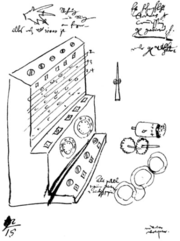
Stepped Reckoner
The Step Reckoner was a digital mechanical calculator invented by German mathematician Gottfried Wilhelm Leibniz around 1672 and completed in 1694. The name comes from the translation of the German term for its operating mechanism; staffelwalze meaning 'stepped drum'...
by more than half a century.
Schickard's letters to Johannes Kepler
Johannes Kepler
Johannes Kepler was a German mathematician, astronomer and astrologer. A key figure in the 17th century scientific revolution, he is best known for his eponymous laws of planetary motion, codified by later astronomers, based on his works Astronomia nova, Harmonices Mundi, and Epitome of Copernican...
show how to use the machine for calculating astronomical tables. The machine could add and subtract six-digit numbers, and indicated an overflow of this capacity by ringing a bell; to add more complex calculations, a set of Napier's bones
Napier's bones
Napier's bones is an abacus created by John Napier for calculation of products and quotients of numbers that was based on Arab mathematics and lattice multiplication used by Matrakci Nasuh in the Umdet-ul Hisab and Fibonacci writing in the Liber Abaci. Also called Rabdology...
were mounted on it. Schickard's letters mention that the original machine was destroyed in a fire while still incomplete. Kepler used another one of Napier's inventions for his calculations (much more appropriate for computing planets' orbits than his Napier's bones): the logarithm tables; Because of this, Kepler dedicated his Ephemeris to John Napier.
The designs were lost until 1957; a working replica was constructed in 1961, unfortunately it showed a problem with its carry mechanism that could damage the machine in an operation that needed to propagate a carry consecutively (like adding 1 to 9,999).
Schickard's machine was not programmable - the first design for a programmable computer came roughly 200 years later, and was provided by Charles Babbage
Charles Babbage
Charles Babbage, FRS was an English mathematician, philosopher, inventor and mechanical engineer who originated the concept of a programmable computer...
. The first working program-controlled machine was completed more than three centuries later, by Konrad Zuse
Konrad Zuse
Konrad Zuse was a German civil engineer and computer pioneer. His greatest achievement was the world's first functional program-controlled Turing-complete computer, the Z3, which became operational in May 1941....
, who created the Z3 in 1941.
The Institute for Computer Science at the University of Tübingen is called the Wilhelm-Schickard-Institut für Informatik in his honor.