

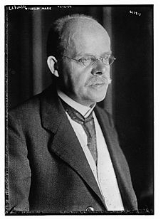
Wilhelm Marx

Encyclopedia
Wilhelm Marx was a German lawyer, Catholic politician and a member of the Centre Party
. He was Chancellor of the German Reich twice, from 1923 to 1925 and again from 1926 to 1928, and also served briefly as minister president of Prussia
in 1925, during the Weimar Republic
.
to a teacher, Marx passed his Abitur
at the Marzellengymnasium
in 1881. He then studied jurisprudence
at the University of Bonn
. As student he became a member of K.St.V. Arminia. After his degree in law, he worked as an assessor
in both Cologne and Waldbröl
and later in the land registry in Simmern
. From 1894 Marx worked as a judge in Elberfeld
. Ten years later, he returned to Cologne and Düsseldorf
, where he had the highest rank possible in Prussia
for a Catholic who was also active in the Centre Party
.
Marx married Johanna Verkoyen in 1891 and they had four children.
's) candidate in the 1925 presidential election
. But in the runoff he was defeated by Paul von Hindenburg
, as Ernst Thälmann
the Communist
candidate also stood and split the vote.
Marx took an active part in the Catholic Centre Party
. In 1899, he presided the Zentrums-Verein in Elberfeld
; in 1908 he became chairman of the Centre Party
in Düsseldorf
.
From 1899 to 1918 Marx was a member of the Landtag
of Prussia
. From 1910 he was a member of the Reichstag
, where he became a member of the executive committee of the Centre Party
faction. There, he specialised in the field of school and culture politics.
During World War I
he expressed his opinion against annexation and for a peace resolution. Thus, he was elected into the Nationalversammlung
of Weimar
. He supported the Treaty of Versailles
during the occupation of the Rhineland
in 1923 because he thought that if Germany did not accept it, the Rhineland would be separated from Prussia
. Marx also tried to unify the Centre Party
and to support the government, using his style of politics and an appeal to Catholicism.
When the cabinet of Gustav Stresemann
failed in 1923, Marx became chancellor, leading the tenth German cabinet since 1919. His first term lasted 13 months, his second term lasted 25 months. In this time, he presided over four cabinets, the first two being civic minority governments, later joined by the DNVP. His foreign minister was Gustav Stresemann
, whose politics led to a toleration by the SPD
. During Marx's terms, he managed to stabilise the German economy after the hyperinflation
of 1923 by introducing a new currency. By the end of 1924, the state of emergency could be repealed. The cabinets led by Marx also accepted the Dawes Plan
. In his second term, Germany joined the League of Nations
, and Marx managed to unseat General Hans von Seeckt
, who wanted to make the army a "state within the state". On the other hand, during his terms the Reichswehr
secretly cooperated with the Soviet Russian army to circumvent the Treaty of Versailles .
In 1925 Marx also became minister president of Prussia
, and in 1926 he was minister of justice in the cabinet of his successor, Hans Luther
. He was a member of the Reichstag
up to 1932. During the Nazi
period, and after World War II
, he lived in Bonn, where he died.
Changes
Changes
Changes
Centre Party (Germany)
The German Centre Party was a Catholic political party in Germany during the Kaiserreich and the Weimar Republic. Formed in 1870, it battled the Kulturkampf which the Prussian government launched to reduce the power of the Catholic Church...
. He was Chancellor of the German Reich twice, from 1923 to 1925 and again from 1926 to 1928, and also served briefly as minister president of Prussia
Prussia
Prussia was a German kingdom and historic state originating out of the Duchy of Prussia and the Margraviate of Brandenburg. For centuries, the House of Hohenzollern ruled Prussia, successfully expanding its size by way of an unusually well-organized and effective army. Prussia shaped the history...
in 1925, during the Weimar Republic
Weimar Republic
The Weimar Republic is the name given by historians to the parliamentary republic established in 1919 in Germany to replace the imperial form of government...
.
Life
Born in CologneCologne
Cologne is Germany's fourth-largest city , and is the largest city both in the Germany Federal State of North Rhine-Westphalia and within the Rhine-Ruhr Metropolitan Area, one of the major European metropolitan areas with more than ten million inhabitants.Cologne is located on both sides of the...
to a teacher, Marx passed his Abitur
Abitur
Abitur is a designation used in Germany, Finland and Estonia for final exams that pupils take at the end of their secondary education, usually after 12 or 13 years of schooling, see also for Germany Abitur after twelve years.The Zeugnis der Allgemeinen Hochschulreife, often referred to as...
at the Marzellengymnasium
Dreikönigsgymnasium
The Dreikönigsgymnasium is a regular public Gymnasium located in Cologne, Germany. Founded in 1450 it is the oldest school in Cologne and one of the oldest in Germany.-Alumni:...
in 1881. He then studied jurisprudence
Jurisprudence
Jurisprudence is the theory and philosophy of law. Scholars of jurisprudence, or legal theorists , hope to obtain a deeper understanding of the nature of law, of legal reasoning, legal systems and of legal institutions...
at the University of Bonn
University of Bonn
The University of Bonn is a public research university located in Bonn, Germany. Founded in its present form in 1818, as the linear successor of earlier academic institutions, the University of Bonn is today one of the leading universities in Germany. The University of Bonn offers a large number...
. As student he became a member of K.St.V. Arminia. After his degree in law, he worked as an assessor
Assessor
An assessor may be:* Assessor , the assistant to a judge or magistrate* Assessor , a senior officer of the University of Oxford* Assessor , an expert who calculates the value of property...
in both Cologne and Waldbröl
Waldbröl
Waldbröl is a town is in the southern part of the Oberbergischer Kreis , in North Rhine-Westphalia, Germany.-Geographical location:The city lies on the slopes of the Nutscheid and is part of the Naturpark Bergisches Land...
and later in the land registry in Simmern
Simmern
Simmern is a town of 8,000 inhabitants in Rhineland-Palatinate, Germany, the district seat of the Rhein-Hunsrück-Kreis, and the seat of the like-named Verbandsgemeinde...
. From 1894 Marx worked as a judge in Elberfeld
Elberfeld
Elberfeld is a municipal subdivision of the German city of Wuppertal; it was an independent town until 1929.-History:The first official mentioning of the geographic area on the banks of today's Wupper River as "elverfelde" was in a document of 1161...
. Ten years later, he returned to Cologne and Düsseldorf
Düsseldorf
Düsseldorf is the capital city of the German state of North Rhine-Westphalia and centre of the Rhine-Ruhr metropolitan region.Düsseldorf is an important international business and financial centre and renowned for its fashion and trade fairs. Located centrally within the European Megalopolis, the...
, where he had the highest rank possible in Prussia
Prussia
Prussia was a German kingdom and historic state originating out of the Duchy of Prussia and the Margraviate of Brandenburg. For centuries, the House of Hohenzollern ruled Prussia, successfully expanding its size by way of an unusually well-organized and effective army. Prussia shaped the history...
for a Catholic who was also active in the Centre Party
Centre Party (Germany)
The German Centre Party was a Catholic political party in Germany during the Kaiserreich and the Weimar Republic. Formed in 1870, it battled the Kulturkampf which the Prussian government launched to reduce the power of the Catholic Church...
.
Marx married Johanna Verkoyen in 1891 and they had four children.
Politics
He served as Chancellor of Germany from 1923 to 1925 and again from 1926 to 1928, and was the Centre Party's (and, in the second round, the entire Weimar CoalitionWeimar Coalition
The Weimar Coalition is the name given to the coalition of the Social Democratic Party of Germany , the German Democratic Party , and the Catholic Centre Party, who together had a large majority of the delegates to the Constituent Assembly that met at Weimar in 1919, and were the principal groups...
's) candidate in the 1925 presidential election
German presidential election, 1925
The presidential election of 1925 was the first direct election to the office of President of the Reich , Germany's head of state during the 1919-1933 Weimar Republic. The first President, Friedrich Ebert, died on 28 February, 1925...
. But in the runoff he was defeated by Paul von Hindenburg
Paul von Hindenburg
Paul Ludwig Hans Anton von Beneckendorff und von Hindenburg , known universally as Paul von Hindenburg was a Prussian-German field marshal, statesman, and politician, and served as the second President of Germany from 1925 to 1934....
, as Ernst Thälmann
Ernst Thälmann
Ernst Thälmann was the leader of the Communist Party of Germany during much of the Weimar Republic. He was arrested by the Gestapo in 1933 and held in solitary confinement for eleven years, before being shot in Buchenwald on Adolf Hitler's orders in 1944...
the Communist
Communist Party of Germany
The Communist Party of Germany was a major political party in Germany between 1918 and 1933, and a minor party in West Germany in the postwar period until it was banned in 1956...
candidate also stood and split the vote.
Marx took an active part in the Catholic Centre Party
Centre Party (Germany)
The German Centre Party was a Catholic political party in Germany during the Kaiserreich and the Weimar Republic. Formed in 1870, it battled the Kulturkampf which the Prussian government launched to reduce the power of the Catholic Church...
. In 1899, he presided the Zentrums-Verein in Elberfeld
Elberfeld
Elberfeld is a municipal subdivision of the German city of Wuppertal; it was an independent town until 1929.-History:The first official mentioning of the geographic area on the banks of today's Wupper River as "elverfelde" was in a document of 1161...
; in 1908 he became chairman of the Centre Party
Centre Party (Germany)
The German Centre Party was a Catholic political party in Germany during the Kaiserreich and the Weimar Republic. Formed in 1870, it battled the Kulturkampf which the Prussian government launched to reduce the power of the Catholic Church...
in Düsseldorf
Düsseldorf
Düsseldorf is the capital city of the German state of North Rhine-Westphalia and centre of the Rhine-Ruhr metropolitan region.Düsseldorf is an important international business and financial centre and renowned for its fashion and trade fairs. Located centrally within the European Megalopolis, the...
.
From 1899 to 1918 Marx was a member of the Landtag
Landtag
A Landtag is a representative assembly or parliament in German-speaking countries with some legislative authority.- Name :...
of Prussia
Prussia
Prussia was a German kingdom and historic state originating out of the Duchy of Prussia and the Margraviate of Brandenburg. For centuries, the House of Hohenzollern ruled Prussia, successfully expanding its size by way of an unusually well-organized and effective army. Prussia shaped the history...
. From 1910 he was a member of the Reichstag
Reichstag (German Empire)
The Reichstag was the parliament of the North German Confederation , and of the German Reich ....
, where he became a member of the executive committee of the Centre Party
Centre Party (Germany)
The German Centre Party was a Catholic political party in Germany during the Kaiserreich and the Weimar Republic. Formed in 1870, it battled the Kulturkampf which the Prussian government launched to reduce the power of the Catholic Church...
faction. There, he specialised in the field of school and culture politics.
During World War I
World War I
World War I , which was predominantly called the World War or the Great War from its occurrence until 1939, and the First World War or World War I thereafter, was a major war centred in Europe that began on 28 July 1914 and lasted until 11 November 1918...
he expressed his opinion against annexation and for a peace resolution. Thus, he was elected into the Nationalversammlung
Nationalversammlung
Nationalversammlung may refer to*Deutsche Nationalversammlung von 1848-1849 in Frankfurt am Main, see Frankfurt Parliament** also Preußische Nationalversammlung von 1848 for Prussia...
of Weimar
Weimar
Weimar is a city in Germany famous for its cultural heritage. It is located in the federal state of Thuringia , north of the Thüringer Wald, east of Erfurt, and southwest of Halle and Leipzig. Its current population is approximately 65,000. The oldest record of the city dates from the year 899...
. He supported the Treaty of Versailles
Treaty of Versailles
The Treaty of Versailles was one of the peace treaties at the end of World War I. It ended the state of war between Germany and the Allied Powers. It was signed on 28 June 1919, exactly five years after the assassination of Archduke Franz Ferdinand. The other Central Powers on the German side of...
during the occupation of the Rhineland
Rhineland
Historically, the Rhinelands refers to a loosely-defined region embracing the land on either bank of the River Rhine in central Europe....
in 1923 because he thought that if Germany did not accept it, the Rhineland would be separated from Prussia
Prussia
Prussia was a German kingdom and historic state originating out of the Duchy of Prussia and the Margraviate of Brandenburg. For centuries, the House of Hohenzollern ruled Prussia, successfully expanding its size by way of an unusually well-organized and effective army. Prussia shaped the history...
. Marx also tried to unify the Centre Party
Centre Party (Germany)
The German Centre Party was a Catholic political party in Germany during the Kaiserreich and the Weimar Republic. Formed in 1870, it battled the Kulturkampf which the Prussian government launched to reduce the power of the Catholic Church...
and to support the government, using his style of politics and an appeal to Catholicism.
When the cabinet of Gustav Stresemann
Gustav Stresemann
was a German politician and statesman who served as Chancellor and Foreign Minister during the Weimar Republic. He was co-laureate of the Nobel Peace Prize in 1926.Stresemann's politics defy easy categorization...
failed in 1923, Marx became chancellor, leading the tenth German cabinet since 1919. His first term lasted 13 months, his second term lasted 25 months. In this time, he presided over four cabinets, the first two being civic minority governments, later joined by the DNVP. His foreign minister was Gustav Stresemann
Gustav Stresemann
was a German politician and statesman who served as Chancellor and Foreign Minister during the Weimar Republic. He was co-laureate of the Nobel Peace Prize in 1926.Stresemann's politics defy easy categorization...
, whose politics led to a toleration by the SPD
Social Democratic Party of Germany
The Social Democratic Party of Germany is a social-democratic political party in Germany...
. During Marx's terms, he managed to stabilise the German economy after the hyperinflation
Hyperinflation
In economics, hyperinflation is inflation that is very high or out of control. While the real values of the specific economic items generally stay the same in terms of relatively stable foreign currencies, in hyperinflationary conditions the general price level within a specific economy increases...
of 1923 by introducing a new currency. By the end of 1924, the state of emergency could be repealed. The cabinets led by Marx also accepted the Dawes Plan
Dawes Plan
The Dawes Plan was an attempt in 1924, following World War I for the Triple Entente to collect war reparations debt from Germany...
. In his second term, Germany joined the League of Nations
League of Nations
The League of Nations was an intergovernmental organization founded as a result of the Paris Peace Conference that ended the First World War. It was the first permanent international organization whose principal mission was to maintain world peace...
, and Marx managed to unseat General Hans von Seeckt
Hans von Seeckt
Johannes Friedrich "Hans" von Seeckt was a German military officer noted for his organization of the German Army during the Weimar Republic.-Early life:...
, who wanted to make the army a "state within the state". On the other hand, during his terms the Reichswehr
Reichswehr
The Reichswehr formed the military organisation of Germany from 1919 until 1935, when it was renamed the Wehrmacht ....
secretly cooperated with the Soviet Russian army to circumvent the Treaty of Versailles .
In 1925 Marx also became minister president of Prussia
Prussia
Prussia was a German kingdom and historic state originating out of the Duchy of Prussia and the Margraviate of Brandenburg. For centuries, the House of Hohenzollern ruled Prussia, successfully expanding its size by way of an unusually well-organized and effective army. Prussia shaped the history...
, and in 1926 he was minister of justice in the cabinet of his successor, Hans Luther
Hans Luther
Hans Luther was a German politician and Chancellor of Germany.-Biography:Born in Berlin, Luther started in politics in 1907 by becoming the town councillor in Magdeburg. He continued on becoming secretary of the German Städtetag in 1913 and then mayor of Essen in 1918...
. He was a member of the Reichstag
Reichstag (Weimar Republic)
The Reichstag was the parliament of Weimar Republic .German constitution commentators consider only the Reichstag and now the Bundestag the German parliament. Another organ deals with legislation too: in 1867-1918 the Bundesrat, in 1919–1933 the Reichsrat and from 1949 on the Bundesrat...
up to 1932. During the Nazi
Nazi Germany
Nazi Germany , also known as the Third Reich , but officially called German Reich from 1933 to 1943 and Greater German Reich from 26 June 1943 onward, is the name commonly used to refer to the state of Germany from 1933 to 1945, when it was a totalitarian dictatorship ruled by...
period, and after World War II
World War II
World War II, or the Second World War , was a global conflict lasting from 1939 to 1945, involving most of the world's nations—including all of the great powers—eventually forming two opposing military alliances: the Allies and the Axis...
, he lived in Bonn, where he died.
First cabinet (November 1923 - May 1924)
- Dr. Wilhelm Marx (ZCentre Party (Germany)The German Centre Party was a Catholic political party in Germany during the Kaiserreich and the Weimar Republic. Formed in 1870, it battled the Kulturkampf which the Prussian government launched to reduce the power of the Catholic Church...
) - Chancellor - Dr. Karl JarresKarl JarresKarl Jarres was a politician of the German People's Party during the Weimar Republic. Jarres was born in the city of Remscheid. Rhenish Prussia, and after legal studies in Bonn as a young adult, pursued an administrative career...
(DVPGerman People's PartyThe German People's Party was a national liberal party in Weimar Germany and a successor to the National Liberal Party of the German Empire.-Ideology:...
) - Vice-Chancellor and Minister of the Interior - Dr. Gustav StresemannGustav Stresemannwas a German politician and statesman who served as Chancellor and Foreign Minister during the Weimar Republic. He was co-laureate of the Nobel Peace Prize in 1926.Stresemann's politics defy easy categorization...
(DVP) - Foreign MinisterForeign Minister of GermanyThe Federal Minister for Foreign Affairs is the head of the Federal Foreign Office and a member of the Cabinet of Germany. The current office holder is Guido Westerwelle... - Dr. Erich Emminger (BVPBavarian People's PartyThe Bavarian People's Party was the Bavarian branch of the Centre Party, which broke off from the rest of the party in 1919 to pursue a more conservative, more Catholic, more Bavarian particularist course...
) - Minister of Justice - Dr. Hans LutherHans LutherHans Luther was a German politician and Chancellor of Germany.-Biography:Born in Berlin, Luther started in politics in 1907 by becoming the town councillor in Magdeburg. He continued on becoming secretary of the German Städtetag in 1913 and then mayor of Essen in 1918...
- Minister of Finance - Eduard Hamm (DDP) - Minister of Economics
- Gerhard Graf von Kanitz - Minister of Food
- Dr. Heinrich Brauns (Z) - Minister of Labour
- Dr. Otto Geßler (DDP) - Minister of Defence
- Dr. Rudolf Oeser (DDP) - Minister of Transportation
- Dr. Anton Höfle (Z) - Postal Minister and temporary Minister of Occupied Territories
Changes
- April 15, 1924 - Kurt Joel succeeded Emminger as Minister of Justice.
Second cabinet (June 1924 - December 1924)
- Dr. Wilhelm Marx (Z) - Chancellor
- Dr. Karl JarresKarl JarresKarl Jarres was a politician of the German People's Party during the Weimar Republic. Jarres was born in the city of Remscheid. Rhenish Prussia, and after legal studies in Bonn as a young adult, pursued an administrative career...
(DVP) - Vice-Chancellor and Minister of the Interior - Dr. Gustav StresemannGustav Stresemannwas a German politician and statesman who served as Chancellor and Foreign Minister during the Weimar Republic. He was co-laureate of the Nobel Peace Prize in 1926.Stresemann's politics defy easy categorization...
(DVP) - Foreign MinisterForeign Minister of GermanyThe Federal Minister for Foreign Affairs is the head of the Federal Foreign Office and a member of the Cabinet of Germany. The current office holder is Guido Westerwelle... - Dr. Kurt Joel - Minister of Justice
- Dr. Hans LutherHans LutherHans Luther was a German politician and Chancellor of Germany.-Biography:Born in Berlin, Luther started in politics in 1907 by becoming the town councillor in Magdeburg. He continued on becoming secretary of the German Städtetag in 1913 and then mayor of Essen in 1918...
- Minister of Finance - Eduard Hamm (DDP) - Minister of Economics
- Gerhard Graf von Kanitz - Minister of Food
- Dr. Heinrich Brauns (Z) - Minister of Labour
- Dr. Otto Geßler (DDP) - Minister of Defence
- Dr. Rudolf Oeser (DDP) - Minister of Transportation
- Dr. Anton Höfle (Z) - Postal Minister and temporary Minister of Occupied Territories
Changes
- October 11, 1924 - Dr. Rudolf Krohne (DVP) succeeded Oeser as Minister of Transport.
Third cabinet (May 1926 - December 1926)
- Dr. Wilhelm Marx (Z) - Chancellor
- Dr. Gustav StresemannGustav Stresemannwas a German politician and statesman who served as Chancellor and Foreign Minister during the Weimar Republic. He was co-laureate of the Nobel Peace Prize in 1926.Stresemann's politics defy easy categorization...
(DVP) - Foreign MinisterForeign Minister of GermanyThe Federal Minister for Foreign Affairs is the head of the Federal Foreign Office and a member of the Cabinet of Germany. The current office holder is Guido Westerwelle... - Dr. Wilhelm KülzWilhelm KülzWilhelm Külz was a German politician . In 1926 he was interior minister of the Weimar Republic. After 1945 he took actively part in establishing the LDPD...
(DDP) - Minister of the Interior - Dr. Johannes Bell (Z) - Minister of Justice and temporary Minister of Occupied Territories
- Dr. Peter Reinhold (DDP) - Minister of Finance
- Dr. Julius CurtiusJulius CurtiusJulius Curtius was Foreign Minister of Germany from October, 1929 to October 1931. Curtius was a member of the national-liberal German People's Party and worked closely with Heinrich Brüning to revise the Treaty of Versailles in Germany's favor. However, Curtius was not a member of Brüning's inner...
(DVP) - Minister of Economics - Dr. Heinrich Haslinde (Z) - Minister of Food
- Dr. Heinrich Brauns (Z) - Minister of Labour
- Dr. Otto Geßler (DDP) - Minister of Defence
- Dr. Rudolf Krohne (DVP) - Minister of Transportation
- Karl Stingl (BVP) - Postal Minister
Fourth cabinet (January 1927 - June 1928)
- Dr. Wilhelm Marx (Z) - Chancellor and temporary Minister of Occupied Territories
- Oskar HergtOskar HergtOskar Hergt was a German nationalist politician, who served simultaneously as Minister of Justice and vice-chancellor from 28 January 1927 to 12 June 1928. Hergt attended the prestigious Domgymnasium Naumburg before reading law at Würzburg, Munich and Berlin...
(DNVP) - Vice-Chancellor and Minister of Justice - Dr. Gustav StresemannGustav Stresemannwas a German politician and statesman who served as Chancellor and Foreign Minister during the Weimar Republic. He was co-laureate of the Nobel Peace Prize in 1926.Stresemann's politics defy easy categorization...
(DVP) - Foreign MinisterForeign Minister of GermanyThe Federal Minister for Foreign Affairs is the head of the Federal Foreign Office and a member of the Cabinet of Germany. The current office holder is Guido Westerwelle... - Walter von Keudell (DNVP) - Minister of the Interior
- Dr. Heinrich KöhlerHeinrich KöhlerFranz Heinrich Köhler was a German politician who served as the fifth and eighth State President of Baden and the eleventh Minister of Finance in the Weimar Republic. He was a member of the Centre Party, and later the CDU...
(Z) - Minister of Finance - Dr. Julius CurtiusJulius CurtiusJulius Curtius was Foreign Minister of Germany from October, 1929 to October 1931. Curtius was a member of the national-liberal German People's Party and worked closely with Heinrich Brüning to revise the Treaty of Versailles in Germany's favor. However, Curtius was not a member of Brüning's inner...
(DVP) - Minister of Economics - Dr. Martin Schiele (DNVP) - Minister of Food
- Dr. Heinrich Brauns (Z) - Minister of Labour
- Dr. Otto Geßler - Minister of Defence
- Dr. Wilhelm Koch (DNVP) - Minister of Transportation
- Dr. Georg Schätzel (BVP) - Postal Minister
Changes
- January 19 1928 - Wilhelm GroenerWilhelm GroenerKarl Eduard Wilhelm Groener was a German soldier and politician.-Biography:He was born in Ludwigsburg in the Kingdom of Württemberg, the son of a regimental paymaster. He entered the Württemberg Army in 1884, and attended the War Academy from 1893 to 1897, whereupon he was appointed to the General...
succeeded Geßler as Minister of Defence.