

Wilhelm Marr

Encyclopedia
Wilhelm Marr was a German
agitator and publicist, who coined the term "antisemitism" (1879).
as the only son of an actor and stage director. He went to a primary school in Hannover, then to a high school in Braunschweig
. In Hamburg
and Bremen
he was an apprentice in commerce, then he joined his father in Vienna
, who had been engaged by the Burgtheater
. There he worked as an employee in two Jewish firms. He later claimed that he had unjustly lost his job.
In 1841 he went to Zurich
, where he became acquainted with political émigrés (like Georg Herwegh
, Julius Fröbel
, and August Follen), most of them members of the democratic or liberal leftist movements of the early 19th century.
In 1843 Marr was expelled from Zurich under the accusation that he had furthered communist activities. He turned to Lausanne
, where he joined Hermann Döleke and Julius Standau, the founders of the secret Léman
-Bund, which belonged to the "Junges Deutschland" (Young German Movement). Marr eventually became the head of the secret society and began to lean towards anarchism
and atheism
, founded another secret society, the "Schweizerischer Arbeiterbund" (Swiss Worker's Union) and edited the "Blätter der Gegenwart für soziales Leben" (Present-Day Papers for Social Life, 1844/45). In 1845 he was expelled from Lausanne, too, and went to Hamburg. There he became a political journalist and published the satirical magazine "Mephistopheles" (1847/48-1852). He belonged to the leftists of the radical-democratic "party" and was a delegate to the National Assembly
in Frankfurt after the March-Revolution of 1848
. After the ultimate failure of the revolution he - like so many other former revolutionaries - became a proponent of the idea of German unification under Prussian leadership.
In 1852 Marr went abroad, to Costa Rica
, where he tried to make a living as a businessman. Lacking success he returned to Hamburg, worked again as a journalist, and in 1854 he married Georgine Johanna Bertha Callenbach, daughter of a Jewish businessman who had renounced his faith. The couple was divorced in 1873. In 1874 Marr remarried the Jewish Helene Sophia Emma Maria Behrend, who died within the same year. In 1875 there was a third marriage, with Jenny Therese Kornick (whose parents lived in a Christian-Jewish mixed marriage), who bore him a son. In 1877 this marriage was divorced, too; Marr's last wife was Clara Maria Kelch, daughter of a Hamburg working man.
Marr's speeches and articles showed first indications of antisemitism in 1848. He was influenced by the Burschenschaft
movement of the early nineteenth century, which developed out of frustration among German students with the failure of the Congress of Vienna
to create a unified state out of all the territories inhabited by the German people. The latter rejected the participation of Jewish and other non-German minorities as members, "unless they prove that they are anxious to develop within themselves a Christian
-German spirit" (a decision of the "Burschenschaft Congress of 1818"). While they were opposed to the participation of Jews in their movement, like Heinrich von Treitschke
later, they did allow for the possibility of the Jewish (and other) minorities participating in the German state if they were to abandon all signs of ethnic and religious distinctiveness and assimilate into the German Volk.
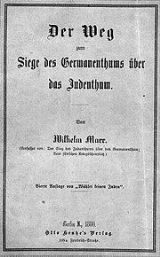
 Marr took these philosophies one step further by rejecting the premise of assimilation as a means for Jews to become Germans. In his pamphlet Der Weg zum Siege des Germanenthums über das Judenthum (The Way to Victory of Germanicism over Judaism, 1879) he introduced the idea that Germans and Jews were locked in a longstanding conflict, the origins of which he attributed to race — and that the Jews were winning. He argued that Jewish emancipation
resulting from German liberalism
had allowed the Jews to control German finance and industry. Furthermore, since this conflict was based on the different qualities of the Jewish and German races, it could not be resolved even by the total assimilation
of the Jewish population. According to him, the struggle between Jews and Germans would only be resolved by the victory of one and the ultimate death of the other. A Jewish victory, he concluded, would result in finis Germaniae (the end of the German people). To prevent this from happening, in 1879 Marr founded the League of Antisemites (Antisemiten-Liga), the first German organization committed specifically to combating the alleged threat to Germany posed by the Jews and advocating their forced removal from the country.
Although he had introduced the pseudo-scientific racial component into the debate over Jews in Germany, it is unlikely that he was influenced by the earlier theories of Arthur de Gobineau
(author of An Essay on the Inequality of Human Races, 1853), who was only translated into German in 1898, a quarter of a century after Marr's pamphlet appeared. It is, however, highly probable that Marr was able to read Gobineau in French. Furthermore, Marr himself was very vague about what constituted race and, in turn, the racial differences between Jews and Germans, though this became a feature of Nazi
racial "science". It remained for later racial thinkers to postulate specific differences: these included Eugen Dühring
, who suggested that it was blood, and Houston Stewart Chamberlain
, an influential race theorist and husband of Eva Wagner, Richard Wagner
's daughter, who suggested phrenology
as a means of distinguishing races.
On the other hand, it does seem likely that Marr was influenced by Ernst Haeckel
, a professor who popularized the notion of Social Darwinism
among Germany's educated classes.
Despite his influence, Marr's ideas were not immediately adopted by German nationalists. The Pan-German League, founded in 1891, originally allowed for the membership of Jews, provided they were fully assimilated into German culture. It was only in 1912, eight years after Marr's death, that the League declared racism as an underlying principle. Nevertheless, Marr was a major link in the evolving chain of German racism that erupted into genocide
during the Nazi era.
he "openly requested the Jews' pardon for having erred in isolating the problem". He published in Hamburg a final essay entitled Testament of an Antisemite in which he explained the history of his thinking, asserting that he had originally been a "philo-Semite", having rejected "the miserable Romantic madness of Germanism". He complained that modern anti-Semitism was becoming merged with German mysticism and nationalism. Marr condemned 'the beer drinking leaders, the gay "Heil" shouters of modern anti-Semitism' and crude prejudice against Jewish writers and thinkers.
Germany
Germany , officially the Federal Republic of Germany , is a federal parliamentary republic in Europe. The country consists of 16 states while the capital and largest city is Berlin. Germany covers an area of 357,021 km2 and has a largely temperate seasonal climate...
agitator and publicist, who coined the term "antisemitism" (1879).
Life
Marr was born in MagdeburgMagdeburg
Magdeburg , is the largest city and the capital city of the Bundesland of Saxony-Anhalt, Germany. Magdeburg is situated on the Elbe River and was one of the most important medieval cities of Europe....
as the only son of an actor and stage director. He went to a primary school in Hannover, then to a high school in Braunschweig
Braunschweig
Braunschweig , is a city of 247,400 people, located in the federal-state of Lower Saxony, Germany. It is located north of the Harz mountains at the farthest navigable point of the Oker river, which connects to the North Sea via the rivers Aller and Weser....
. In Hamburg
Hamburg
-History:The first historic name for the city was, according to Claudius Ptolemy's reports, Treva.But the city takes its modern name, Hamburg, from the first permanent building on the site, a castle whose construction was ordered by the Emperor Charlemagne in AD 808...
and Bremen
Bremen
The City Municipality of Bremen is a Hanseatic city in northwestern Germany. A commercial and industrial city with a major port on the river Weser, Bremen is part of the Bremen-Oldenburg metropolitan area . Bremen is the second most populous city in North Germany and tenth in Germany.Bremen is...
he was an apprentice in commerce, then he joined his father in Vienna
Vienna
Vienna is the capital and largest city of the Republic of Austria and one of the nine states of Austria. Vienna is Austria's primary city, with a population of about 1.723 million , and is by far the largest city in Austria, as well as its cultural, economic, and political centre...
, who had been engaged by the Burgtheater
Burgtheater
The Burgtheater , originally known as K.K. Theater an der Burg, then until 1918 as the K.K. Hofburgtheater, is the Austrian National Theatre in Vienna and one of the most important German language theatres in the world.The Burgtheater was created in 1741 and has become known as "die Burg" by the...
. There he worked as an employee in two Jewish firms. He later claimed that he had unjustly lost his job.
In 1841 he went to Zurich
Zürich
Zurich is the largest city in Switzerland and the capital of the canton of Zurich. It is located in central Switzerland at the northwestern tip of Lake Zurich...
, where he became acquainted with political émigrés (like Georg Herwegh
Georg Herwegh
Georg Friedrich Rudolph Theodor Herwegh was a German revolutionary poet.-Biography:He was born in Stuttgart on 31 May 1817, the son of an innkeeper...
, Julius Fröbel
Julius Fröbel
Julius Fröbel was a journalist, diplomat and author. He was active in Western Europe, the United States and South America at different times in his life.-Biography:...
, and August Follen), most of them members of the democratic or liberal leftist movements of the early 19th century.
In 1843 Marr was expelled from Zurich under the accusation that he had furthered communist activities. He turned to Lausanne
Lausanne
Lausanne is a city in Romandy, the French-speaking part of Switzerland, and is the capital of the canton of Vaud. The seat of the district of Lausanne, the city is situated on the shores of Lake Geneva . It faces the French town of Évian-les-Bains, with the Jura mountains to its north-west...
, where he joined Hermann Döleke and Julius Standau, the founders of the secret Léman
Lake Geneva
Lake Geneva or Lake Léman is a lake in Switzerland and France. It is one of the largest lakes in Western Europe. 59.53 % of it comes under the jurisdiction of Switzerland , and 40.47 % under France...
-Bund, which belonged to the "Junges Deutschland" (Young German Movement). Marr eventually became the head of the secret society and began to lean towards anarchism
Anarchism
Anarchism is generally defined as the political philosophy which holds the state to be undesirable, unnecessary, and harmful, or alternatively as opposing authority in the conduct of human relations...
and atheism
Atheism
Atheism is, in a broad sense, the rejection of belief in the existence of deities. In a narrower sense, atheism is specifically the position that there are no deities...
, founded another secret society, the "Schweizerischer Arbeiterbund" (Swiss Worker's Union) and edited the "Blätter der Gegenwart für soziales Leben" (Present-Day Papers for Social Life, 1844/45). In 1845 he was expelled from Lausanne, too, and went to Hamburg. There he became a political journalist and published the satirical magazine "Mephistopheles" (1847/48-1852). He belonged to the leftists of the radical-democratic "party" and was a delegate to the National Assembly
Frankfurt Parliament
The Frankfurt Assembly was the first freely elected parliament for all of Germany. Session was held from May 18, 1848 to May 31, 1849 in the Paulskirche at Frankfurt am Main...
in Frankfurt after the March-Revolution of 1848
Revolutions of 1848 in the German states
The Revolutions of 1848 in the German states, also called the March Revolution – part of the Revolutions of 1848 that broke out in many countries of Europe – were a series of loosely coordinated protests and rebellions in the states of the German Confederation, including the Austrian Empire...
. After the ultimate failure of the revolution he - like so many other former revolutionaries - became a proponent of the idea of German unification under Prussian leadership.
In 1852 Marr went abroad, to Costa Rica
Costa Rica
Costa Rica , officially the Republic of Costa Rica is a multilingual, multiethnic and multicultural country in Central America, bordered by Nicaragua to the north, Panama to the southeast, the Pacific Ocean to the west and the Caribbean Sea to the east....
, where he tried to make a living as a businessman. Lacking success he returned to Hamburg, worked again as a journalist, and in 1854 he married Georgine Johanna Bertha Callenbach, daughter of a Jewish businessman who had renounced his faith. The couple was divorced in 1873. In 1874 Marr remarried the Jewish Helene Sophia Emma Maria Behrend, who died within the same year. In 1875 there was a third marriage, with Jenny Therese Kornick (whose parents lived in a Christian-Jewish mixed marriage), who bore him a son. In 1877 this marriage was divorced, too; Marr's last wife was Clara Maria Kelch, daughter of a Hamburg working man.
Marr's speeches and articles showed first indications of antisemitism in 1848. He was influenced by the Burschenschaft
Burschenschaft
German Burschenschaften are a special type of Studentenverbindungen . Burschenschaften were founded in the 19th century as associations of university students inspired by liberal and nationalistic ideas.-History:-Beginnings 1815–c...
movement of the early nineteenth century, which developed out of frustration among German students with the failure of the Congress of Vienna
Congress of Vienna
The Congress of Vienna was a conference of ambassadors of European states chaired by Klemens Wenzel von Metternich, and held in Vienna from September, 1814 to June, 1815. The objective of the Congress was to settle the many issues arising from the French Revolutionary Wars, the Napoleonic Wars,...
to create a unified state out of all the territories inhabited by the German people. The latter rejected the participation of Jewish and other non-German minorities as members, "unless they prove that they are anxious to develop within themselves a Christian
Christian
A Christian is a person who adheres to Christianity, an Abrahamic, monotheistic religion based on the life and teachings of Jesus of Nazareth as recorded in the Canonical gospels and the letters of the New Testament...
-German spirit" (a decision of the "Burschenschaft Congress of 1818"). While they were opposed to the participation of Jews in their movement, like Heinrich von Treitschke
Heinrich von Treitschke
Heinrich Gotthard von Treitschke was a nationalist German historian and political writer during the time of the German Empire.-Early life and teaching career:...
later, they did allow for the possibility of the Jewish (and other) minorities participating in the German state if they were to abandon all signs of ethnic and religious distinctiveness and assimilate into the German Volk.
Theories
Jewish Emancipation
Jewish emancipation was the external and internal process of freeing the Jewish people of Europe, including recognition of their rights as equal citizens, and the formal granting of citizenship as individuals; it occurred gradually between the late 18th century and the early 20th century...
resulting from German liberalism
Liberalism
Liberalism is the belief in the importance of liberty and equal rights. Liberals espouse a wide array of views depending on their understanding of these principles, but generally, liberals support ideas such as constitutionalism, liberal democracy, free and fair elections, human rights,...
had allowed the Jews to control German finance and industry. Furthermore, since this conflict was based on the different qualities of the Jewish and German races, it could not be resolved even by the total assimilation
Cultural assimilation
Cultural assimilation is a socio-political response to demographic multi-ethnicity that supports or promotes the assimilation of ethnic minorities into the dominant culture. The term assimilation is often used with regard to immigrants and various ethnic groups who have settled in a new land. New...
of the Jewish population. According to him, the struggle between Jews and Germans would only be resolved by the victory of one and the ultimate death of the other. A Jewish victory, he concluded, would result in finis Germaniae (the end of the German people). To prevent this from happening, in 1879 Marr founded the League of Antisemites (Antisemiten-Liga), the first German organization committed specifically to combating the alleged threat to Germany posed by the Jews and advocating their forced removal from the country.
Although he had introduced the pseudo-scientific racial component into the debate over Jews in Germany, it is unlikely that he was influenced by the earlier theories of Arthur de Gobineau
Arthur de Gobineau
Joseph Arthur Comte de Gobineau was a French aristocrat, novelist and man of letters who became famous for developing the theory of the Aryan master race in his book An Essay on the Inequality of the Human Races...
(author of An Essay on the Inequality of Human Races, 1853), who was only translated into German in 1898, a quarter of a century after Marr's pamphlet appeared. It is, however, highly probable that Marr was able to read Gobineau in French. Furthermore, Marr himself was very vague about what constituted race and, in turn, the racial differences between Jews and Germans, though this became a feature of Nazi
Nazism
Nazism, the common short form name of National Socialism was the ideology and practice of the Nazi Party and of Nazi Germany...
racial "science". It remained for later racial thinkers to postulate specific differences: these included Eugen Dühring
Eugen Dühring
Eugen Karl Dühring was a German philosopher and economist, a socialist who was a strong critic of Marxism.-Life and works:...
, who suggested that it was blood, and Houston Stewart Chamberlain
Houston Stewart Chamberlain
Houston Stewart Chamberlain was a British-born German author of books on political philosophy, natural science and the German composer Richard Wagner. He later became a German citizen. Chamberlain married Wagner's daughter, Eva, some years after Wagner's death...
, an influential race theorist and husband of Eva Wagner, Richard Wagner
Richard Wagner
Wilhelm Richard Wagner was a German composer, conductor, theatre director, philosopher, music theorist, poet, essayist and writer primarily known for his operas...
's daughter, who suggested phrenology
Phrenology
Phrenology is a pseudoscience primarily focused on measurements of the human skull, based on the concept that the brain is the organ of the mind, and that certain brain areas have localized, specific functions or modules...
as a means of distinguishing races.
On the other hand, it does seem likely that Marr was influenced by Ernst Haeckel
Ernst Haeckel
The "European War" became known as "The Great War", and it was not until 1920, in the book "The First World War 1914-1918" by Charles à Court Repington, that the term "First World War" was used as the official name for the conflict.-Research:...
, a professor who popularized the notion of Social Darwinism
Social Darwinism
Social Darwinism is a term commonly used for theories of society that emerged in England and the United States in the 1870s, seeking to apply the principles of Darwinian evolution to sociology and politics...
among Germany's educated classes.
Despite his influence, Marr's ideas were not immediately adopted by German nationalists. The Pan-German League, founded in 1891, originally allowed for the membership of Jews, provided they were fully assimilated into German culture. It was only in 1912, eight years after Marr's death, that the League declared racism as an underlying principle. Nevertheless, Marr was a major link in the evolving chain of German racism that erupted into genocide
Genocide
Genocide is defined as "the deliberate and systematic destruction, in whole or in part, of an ethnic, racial, religious, or national group", though what constitutes enough of a "part" to qualify as genocide has been subject to much debate by legal scholars...
during the Nazi era.
Late Renunciation of Antisemitism
Toward the end of his life Marr came to renounce anti-semitism, arguing that social upheaval in Germany had been the result of the Industrial Revolution and conflict between political movements. According to Moshe ZimmermannMoshe Zimmermann
Moshe Zimmermann is an Israeli historian and publicist. Since 1986 he is director of the “Richard-Koebner-Center for German History“ at the Hebrew University of Jerusalem...
he "openly requested the Jews' pardon for having erred in isolating the problem". He published in Hamburg a final essay entitled Testament of an Antisemite in which he explained the history of his thinking, asserting that he had originally been a "philo-Semite", having rejected "the miserable Romantic madness of Germanism". He complained that modern anti-Semitism was becoming merged with German mysticism and nationalism. Marr condemned 'the beer drinking leaders, the gay "Heil" shouters of modern anti-Semitism' and crude prejudice against Jewish writers and thinkers.
Works
- Pillen. Eigens präpariert für deutsche und andere Michel, 1844
- Katechismus eines Republikaners der Zukunft, 1845
- Das junge Deutschland in der Schweiz. Ein Beitrag zur Geschichte der geheimen Verbindungen unserer Tage, 1846
- Anarchie oder Autorität? 1852
- Reise durch Central-Amerika, 1852
- Messias Lassalle und seine Hamburger Jünger. Eine Abfertigung, 1863
- Der Ausschluß Oesterreichs aus Deutschland ist eine politische Widersinnigkeit, 1866
- Selbständigkeit und Hoheitsrecht der freien Stadt Hamburg sind ein Anachronismus geworden, 1866
- Des Weltunterganges Posaunenstoß, lieblich begleitet und allen Gläubigen gewidment, 1867
- Es muß alles Soldat werden! oder die Zukunft des Norddeutschen Bundes. Ein Phantasiegemälde, 1867
- Nach Jerusalem mit dem Papst.Eine Bergpredigt, 1867
- Religiöse Streifzüge eines philosophischen Touristen, 1876
- Der Sieg des Judenthums über das Germanenthum – Vom nichtconfessionellen Standpunkt aus betrachtet. Bern: Rudolph Costenoble, 1879. - English translation: Rohringer, Gerhard. Victory of Judaism over Germanism - Considered from a Nonreligious Perspective. 2009
- Jeiteles teutonicus. Harfenklänge aus dem vermauschelten Deutschland von Marr dem Zweiten, 1879
- Vom jüdischen Kriegsschauplatz. Eine Streitschrift, 1879
- Wählet keinen Juden! Der Weg zum Siege des Germanenthums über das Judenthum. Ein Mahnwort an die Wähler nichtjüdischen Stammes aller Confessionen. Berlin: Hentze, 1880
- Der Judenkrieg, seine Fehler und wie er zu organisieren ist. 2. Theil von ""Der Sieg des Judenthums über das Germanenthum", 1880
- Goldene Ratten und rothe Mäuse, 1880
- Oeffnet die Augen, Ihr deutschen Zeitungsleser. Ein unentbehrliches Büchlein für jeden deutschen Zeitungsleser, 1880
- Lessing contra Sem. Allen "Rabbinern" der Juden- und Christenheit, allen Toleranz-Duselheimern aller Parteien, allen Pharisäern und "Schriftgelehrten" tolerantest gewidmet, 1885