


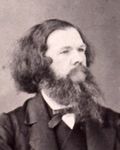
Wilhelm Bleek

Encyclopedia
Berlin
Berlin is the capital city of Germany and is one of the 16 states of Germany. With a population of 3.45 million people, Berlin is Germany's largest city. It is the second most populous city proper and the seventh most populous urban area in the European Union...
– August 17, 1875) was a German
Germany
Germany , officially the Federal Republic of Germany , is a federal parliamentary republic in Europe. The country consists of 16 states while the capital and largest city is Berlin. Germany covers an area of 357,021 km2 and has a largely temperate seasonal climate...
linguist
Linguistics
Linguistics is the scientific study of human language. Linguistics can be broadly broken into three categories or subfields of study: language form, language meaning, and language in context....
. His work included A Comparative Grammar of South African Languages and his great project jointly executed with Lucy Lloyd
Lucy Lloyd
Lucy Catherine Lloyd was the creator along with Wilhelm Bleek of the 19th century archive of |xam and !kun texts-Early life:...
: The Bleek and Lloyd Archive of ǀxam and !kun
!Kung language
!Kung or !Xun, also called Ju, is a dialect continuum spoken in Namibia, Botswana, and Angola by the !Kung people. Together with the ǂHoan language, it forms the Kx'a language family...
texts.
Biography
Wilhelm Heinrich Immanuel Bleek was born in BerlinBerlin
Berlin is the capital city of Germany and is one of the 16 states of Germany. With a population of 3.45 million people, Berlin is Germany's largest city. It is the second most populous city proper and the seventh most populous urban area in the European Union...
on 8 March 1827. He was the eldest son of Friedrich Bleek, Professor of Theology
Theology
Theology is the systematic and rational study of religion and its influences and of the nature of religious truths, or the learned profession acquired by completing specialized training in religious studies, usually at a university or school of divinity or seminary.-Definition:Augustine of Hippo...
at Berlin University and then at the University of Bonn
University of Bonn
The University of Bonn is a public research university located in Bonn, Germany. Founded in its present form in 1818, as the linear successor of earlier academic institutions, the University of Bonn is today one of the leading universities in Germany. The University of Bonn offers a large number...
, and Augusta Charlotte Marianne Henriette Sethe. He graduated from the University of Bonn in 1851 with a doctorate
Doctorate
A doctorate is an academic degree or professional degree that in most countries refers to a class of degrees which qualify the holder to teach in a specific field, A doctorate is an academic degree or professional degree that in most countries refers to a class of degrees which qualify the holder...
in linguistics, after a period in Berlin where he went to study Hebrew and where he first became interested in African languages. Bleek's thesis featured an attempt to link North African and Khoikhoi
Khoikhoi
The Khoikhoi or Khoi, in standardised Khoekhoe/Nama orthography spelled Khoekhoe, are a historical division of the Khoisan ethnic group, the native people of southwestern Africa, closely related to the Bushmen . They had lived in southern Africa since the 5th century AD...
(or what were then called Hottentot) languages – the thinking at the time being that all African languages were connected. After graduating in Bonn, Bleek returned to Berlin and worked with a zoologist, Dr Wilhelm K H Peters
Wilhelm Peters
Wilhelm Karl Hartwich Peters was a German naturalist and explorer.He was assistant to Johannes Peter Müller and later curator of the Berlin Zoological Museum. In September 1842 he travelled to Mozambique via Angola. He returned to Berlin with an enormous collection of natural history specimens...
, editing vocabularies
Vocabulary
A person's vocabulary is the set of words within a language that are familiar to that person. A vocabulary usually develops with age, and serves as a useful and fundamental tool for communication and acquiring knowledge...
of East African languages. His interest in African languages was further developed during 1852 and 1853 by learning Egyptian
Egyptian Arabic
Egyptian Arabic is the language spoken by contemporary Egyptians.It is more commonly known locally as the Egyptian colloquial language or Egyptian dialect ....
from Professor Karl Richard Lepsius
Karl Richard Lepsius
Karl Richard Lepsius was a pioneering Prussian Egyptologist and linguist and pioneer of modern archaeology.-Background:...
, whom he met in Berlin in 1852.
Bleek was appointed official linguist to Dr William Balfour Baikie
William Balfour Baikie
William Balfour Baikie was a Scottish explorer, naturalist and philologist.-Biography:Baikie was born at Kirkwall, Orkney, eldest son of Captain John Baikie, R.N. He studied medicine at Edinburgh, and, on obtaining his M.D. degree, joined the Royal Navy in 1848...
's Niger
Niger
Niger , officially named the Republic of Niger, is a landlocked country in Western Africa, named after the Niger River. It borders Nigeria and Benin to the south, Burkina Faso and Mali to the west, Algeria and Libya to the north and Chad to the east...
Tshadda Expedition in 1854. Ill-health (a tropical fever
Tropical disease
Tropical diseases are diseases that are prevalent in or unique to tropical and subtropical regions. The diseases are less prevalent in temperate climates, due in part to the occurrence of a cold season, which controls the insect population by forcing hibernation. Insects such as mosquitoes and...
) forced his return to England where he met George Grey
George Edward Grey
Sir George Grey, KCB was a soldier, explorer, Governor of South Australia, twice Governor of New Zealand, Governor of Cape Colony , the 11th Premier of New Zealand and a writer.-Early life and exploration:...
and John William Colenso
John William Colenso
John William Colenso , first Anglican bishop of Natal, mathematician, theologian, Biblical scholar and social activist.-Biography:Colenso was born at St Austell, Cornwall, on 24 January 1814...
, the Anglican Bishop of Natal, who invited Bleek to join him in Natal in 1855 to help compile a Zulu
Zulu language
Zulu is the language of the Zulu people with about 10 million speakers, the vast majority of whom live in South Africa. Zulu is the most widely spoken home language in South Africa as well as being understood by over 50% of the population...
grammar. After completing Colenso's project, Bleek travelled to Cape Town
Cape Town
Cape Town is the second-most populous city in South Africa, and the provincial capital and primate city of the Western Cape. As the seat of the National Parliament, it is also the legislative capital of the country. It forms part of the City of Cape Town metropolitan municipality...
in 1856 to become Sir George Grey's official interpreter as well as to catalogue his private library. Grey had philological interests and was Bleek's patron during his time as Governor of the Cape. The two had a good professional and personal relationship based on an admiration that appears to have been mutual. Bleek was widely respected as a philologist, particularly in the Cape. While working for Grey he continued with his philological research and contributed to various publications during the late 1850s. Bleek requested examples of African literature
African literature
African literature refers to literature of and from Africa. As George Joseph notes on the first page of his chapter on African literature in Understanding Contemporary Africa, while the European perception of literature generally refers to written letters, the African concept includes oral...
from missionaries and travellers, such as the Revd W Kronlein who provided Bleek with Namaqua
Namaqua
Nama are an African ethnic group of South Africa, Namibia and Botswana. They traditionally speak the Nama language of the Khoe-Kwadi language family, although many Nama now speak Afrikaans. The Nama are the largest group of the Khoikhoi people, most of whom have largely disappeared as a group,...
texts in 1861.
In 1859 Bleek briefly returned to Europe
Europe
Europe is, by convention, one of the world's seven continents. Comprising the westernmost peninsula of Eurasia, Europe is generally 'divided' from Asia to its east by the watershed divides of the Ural and Caucasus Mountains, the Ural River, the Caspian and Black Seas, and the waterways connecting...
in an effort to improve his poor health but returned to the Cape and his research soon after. In 1861 Bleek met his future wife, Jemima Lloyd, at the boarding house where he lived in Cape Town (run by a Mrs Roesch), while she was waiting for a passage to England, and they developed a relationship through correspondence. She returned to Cape Town from England the following year.
Bleek married Jemima Lloyd on 22 November 1862. The Bleeks first lived at The Hill in Mowbray
Mowbray, Cape Town
Mowbray is one of the Southern Suburbs of Cape Town, South Africa. Its original name was Driekoppen .-Geography:Mowbray is bounded on the west by the M3 freeway, beyond which lies Devil's Peak, and on the north by the N2 freeway, beyond which lies the suburb of Observatory...
but moved in 1875 to Charlton House. Jemima's sister, Lucy Lloyd
Lucy Lloyd
Lucy Catherine Lloyd was the creator along with Wilhelm Bleek of the 19th century archive of |xam and !kun texts-Early life:...
, joined the household after the couple's wedding in 1862.
When Grey was appointed Governor of New Zealand, he presented his collection to the South African Public Library on condition that Bleek be its curator
Curator
A curator is a manager or overseer. Traditionally, a curator or keeper of a cultural heritage institution is a content specialist responsible for an institution's collections and involved with the interpretation of heritage material...
, a position he occupied from 1862 until his death in 1875. In addition to this work, Bleek supported himself and his family by writing regularly for Het Volksblad throughout the 1860s and publishing the first part of his A Comparative Grammar of South African Languages in London in 1862. The second part was also published in London in 1869 with the first chapter appearing in manuscript form in Cape Town in 1865. Unfortunately, much of Bleek's working life in the Cape, like that of Lucy Lloyd
Lucy Lloyd
Lucy Catherine Lloyd was the creator along with Wilhelm Bleek of the 19th century archive of |xam and !kun texts-Early life:...
after him, was characterised by extreme financial hardship which made his research even more difficult to continue with.
Bushmen
Bleek's first contact with BushmenBushmen
The indigenous people of Southern Africa, whose territory spans most areas of South Africa, Zimbabwe, Lesotho, Mozambique, Swaziland, Botswana, Namibia, and Angola, are variously referred to as Bushmen, San, Sho, Barwa, Kung, or Khwe...
was with prisoners at Robben Island
Robben Island
Robben Island is an island in Table Bay, 6.9 km west of the coast of Bloubergstrand, Cape Town, South Africa. The name is Dutch for "seal island". Robben Island is roughly oval in shape, 3.3 km long north-south, and 1.9 km wide, with an area of 5.07 km². It is flat and only a...
and the Cape Town Gaol and House of Correction, in 1857. He conducted interviews with a few of these prisoners, which he used in later publications. These people all came from the Burgersdorp
Burgersdorp
Burgersdorp is a small town in the Ukhahlamba District Municipality of the Eastern Cape province of South Africa.The Afrikaner Bond political party was founded in Burgersdorp in 1881.-Rail:The first rail connection to Burgersdorp was opened on 19 March 1885...
and Colesberg
Colesberg
Colesberg is a town with 17,354 inhabitants in the Northern Cape province of South Africa, located on the main road from Cape Town to Johannesburg....
regions and variations of one similar-sounding 'Bushman' language. Bleek was particularly keen to learn more about this Bushman
Khoisan languages
The Khoisan languages are the click languages of Africa which do not belong to other language families. They include languages indigenous to southern and eastern Africa, though some, such as the Khoi languages, appear to have moved to their current locations not long before the Bantu expansion...
language and compare it to examples of Bushman vocabulary and language earlier noted by Lichtenstein and obtained from missionaries at the turn of the 19th century.
In 1863 Resident Magistrate Louis Anthing introduced the first ǀxam-speakers to Bleek. He brought three men to Cape Town from the Kenhardt district to stand trial for attacks on farmers (the prosecution was eventually waived by the Attorney General
Attorney General
In most common law jurisdictions, the attorney general, or attorney-general, is the main legal advisor to the government, and in some jurisdictions he or she may also have executive responsibility for law enforcement or responsibility for public prosecutions.The term is used to refer to any person...
). In 1866 two Bushman prisoners from the Achterveldt near Calvinia were transferred from the Breakwater prison to the Cape Town prison, making it easier for Bleek to meet them. With their help, Bleek compiled a list of words and sentences and an alphabetical vocabulary. Most of these words and sentences were provided by Adam Kleinhardt (see Bleek I-1, UCT A1.4.1).
In 1870 Bleek and Lloyd
Lucy Lloyd
Lucy Catherine Lloyd was the creator along with Wilhelm Bleek of the 19th century archive of |xam and !kun texts-Early life:...
, by now working together on the project to learn Bushman language and record personal narratives and folklore, became aware of the presence of a group of 28 ǀXam prisoners (Bushmen from the central interior of southern Africa
Southern Africa
Southern Africa is the southernmost region of the African continent, variably defined by geography or geopolitics. Within the region are numerous territories, including the Republic of South Africa ; nowadays, the simpler term South Africa is generally reserved for the country in English.-UN...
) at the Breakwater Convict Station and received permission to relocate one prisoner to their home in Mowbray so as to learn his language. The prison chaplain, Revd Fisk, was in charge of the selection of this individual – a young man named |a!kunta. But because of his youth, |a!kunta was unfamiliar with much of his people's folklore and an older man named ||kabbo was then permitted to accompany him. ||kabbo became Bleek and Lloyd's first real teacher, a title by which he later regarded himself. Over time, members of ||kabbo's family and other families lived with Bleek and Lloyd in Mowbray, and were interviewed by them. Many of the |xam-speakers interviewed by Bleek and Lloyd were related to one another. Bleek and Lloyd learned and wrote down their language, first as lists of words and phrases and then as stories and narratives about their lives, history, folklore and remembered beliefs and customs.
Bleek, along with Lloyd, made an effort to record as much anthropological and ethnographic information as possible. This included genealogies, places of origin, and the customs and daily life of the informants. Photographs and measurements (some as specified by Thomas Huxley
Thomas Huxley
Thomas Henry Huxley PC FRS was an English biologist, known as "Darwin's Bulldog" for his advocacy of Charles Darwin's theory of evolution....
's global ethnographic project, see Godby 1996) were also taken of all their informants in accordance with the norms of scientific research of the time in those fields. More intimate and personal painted portraits were also commissioned of some of the xam teacher
Teacher
A teacher or schoolteacher is a person who provides education for pupils and students . The role of teacher is often formal and ongoing, carried out at a school or other place of formal education. In many countries, a person who wishes to become a teacher must first obtain specified professional...
s.
Although Bleek and Lloyd
Lucy Lloyd
Lucy Catherine Lloyd was the creator along with Wilhelm Bleek of the 19th century archive of |xam and !kun texts-Early life:...
interviewed other individuals during 1875 and 1876 (Lloyd doing this alone after Bleek's death), most of their time was spent interviewing only six individual |xam contributors. Bleek wrote a series of reports on the language and the literature and folklore of the |xam-speakers he interviewed, which he sent to the Cape Secretary for Native Affairs. This was first in an attempt to gain funding to continue with his studies and then also to make Her Majesty's Colonial Government aware of the need to preserve Bushman folklore as an important part of the nation's heritage and traditions. In this endeavour Bleek must surely have been influenced by Louis Anthing.
Death
Bleek died in Mowbray on 17 August 1875, aged 48, and was buried in WynbergWynberg, Cape Town
Wynberg is a southern suburb of the City of Cape Town in Western Cape, South Africa. It is situated between Plumstead and Kenilworth, and is a main transport hub for the Southern Suburbs of Cape Town.- Geography :...
Anglican cemetery in Cape Town along with his two infant children, who had died before him. His all-important work recording the |Xam language and literature was continued and expanded by Lucy Lloyd
Lucy Lloyd
Lucy Catherine Lloyd was the creator along with Wilhelm Bleek of the 19th century archive of |xam and !kun texts-Early life:...
, fully supported by his wife Jemima. In his obituary in the South African Mail of 25 August 1875, he was lauded in the following terms: 'As a comparative philologist he stood in the foremost rank, and as an investigator and authority on the South African languages, he was without peer.