

Wicket

Encyclopedia
In the sport of cricket
the word wicket has several distinct meanings:
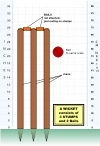 Most of the time, the wicket is one of the two sets of three stumps
and two bails
at either end of the pitch
. The wicket is guarded by a batsman who, with his bat
, attempts to prevent the ball
from hitting the wicket.
The origin of the word is from the standard definition of wicket
as a small gate. Historically, cricket wickets had only two stumps and one bail and looked like a gate. The third (middle) stump was introduced in 1775.
The size and shape of the wicket has changed several times during the last 300 years and its dimensions and placing is now determined by Law 8 in the Laws of Cricket
, thus:
For a batsman to be dismissed by being bowled
, run out
, stumped
or hit wicket
, his wicket needs to be put down. What this means is defined by Law 28 of the Laws of cricket
. The wicket is put down if a bail
is completely removed from the top of the stumps, or a stump is struck out of the ground by the ball
, the striker's bat, the striker's person (or by any part of his clothing or equipment becoming detached from his person), a fielder
(with his hand or arm, and provided that the ball is held in the hand or hands so used, or in the hand of the arm so used). A 2010 amendment to the Laws clarified the rare circumstance where a bat breaks during the course of a shot and the detached debris breaks the wicket; the wicket has been put down in this circumstance. The wicket is also put down if a fielder pulls a stump out of the ground in the same manner.
If one bail is off, removing the remaining bail or striking or pulling any of the three stumps out of the ground is sufficient to put the wicket down. A fielder may remake the wicket, if necessary, in order to put it down to have an opportunity of running out a batsman.
If however both bails are off, a fielder must remove one of the three stumps out of the ground with the ball, or pull it out of the ground with a hand or arm, provided that the ball is held in the hand or hands so used, or in the hand of the arm so used.
If the umpires
have agreed to dispense with bails, because, for example, it is too windy for the bails to remain on the stumps, the decision as to whether the wicket has been put down is one for the umpire concerned to decide. After a decision to play without bails, the wicket has been put down if the umpire concerned is satisfied that the wicket has been struck by the ball, by the striker's bat, person, or items of his clothing or equipment separated from his person as described above, or by a fielder with the hand holding the ball or with the arm of the hand holding the ball.
, is referred to as a specifically numbered wicket when discriminating it from other partnerships in the innings
.
itself. According to the Laws of Cricket
, this usage is incorrect, but it is in common usage and commonly understood by cricket followers. This usage probably derives from the days when the outfield was kept short by grazing sheep on it and the playing surface, which was specially prepared, was protected from them by a light wicker fence around it. Since many regular grounds had resident bat-makers it is quite possible that the branches cut off from the willow wood used for the bats formed all or part of this fence.
The term sticky wicket
refers to a situation in which the pitch has become damp, typically due to rain or high humidity. This makes the path of the ball more unpredictable thus making the job of defending the stumps that much more difficult. The full phrase is thought to have originally been "to bat on a sticky wicket." Such pitches were commonplace at all levels of the game (i.e. up to Test Match level) until the late 1950s.
and roque
are sometimes referred to as wickets, especially in American English
. These arches descend from the ancestral game of ground billiards (which may also be related to cricket), and were formerly called the hoop, arch or port. The port remained a prominent feature of indoor table billiards until well into the 18th century.
Cricket
Cricket is a bat-and-ball game played between two teams of 11 players on an oval-shaped field, at the centre of which is a rectangular 22-yard long pitch. One team bats, trying to score as many runs as possible while the other team bowls and fields, trying to dismiss the batsmen and thus limit the...
the word wicket has several distinct meanings:
Definitions of wicket
Stump (cricket)
Stump is a term used in the sport of cricket where it has three different meanings:# part of the wicket# a manner of dismissing a batsman# the end of the day's play .-Part of the wicket:...
and two bails
Bail (cricket)
In the sport of cricket, a bail is one of the two smaller sticks placed on top of the three stumps to form a wicket. The bails are used to determine when the wicket is broken, which in turn is one of the critical factors in determining whether a batsman is out bowled, stumped, run out or hit wicket...
at either end of the pitch
Cricket pitch
In the game of cricket, the cricket pitch consists of the central strip of the cricket field between the wickets - 1 chain or 22 yards long and 10 feet wide. The surface is very flat and normally covered with extremely short grass though this grass is soon removed by wear at the ends of the...
. The wicket is guarded by a batsman who, with his bat
Cricket bat
A cricket bat is a specialised piece of equipment used by batsmen in the sport of cricket to hit the ball. It is usually made of willow wood. Its use is first mentioned in 1624....
, attempts to prevent the ball
Cricket ball
A cricket ball is a hard, solid leather ball used to play cricket. Constructed of cork and leather, a cricket ball is heavily regulated by cricket law at first class level...
from hitting the wicket.
The origin of the word is from the standard definition of wicket
Wicket gate
A wicket gate is a small gate or door, particularly one built into a larger one. The cricket term "wicket" comes from this usage. The term wicket gate is also used in English to refer to automatic ticket barriers or older staffed ticket gates on Japan's railway network...
as a small gate. Historically, cricket wickets had only two stumps and one bail and looked like a gate. The third (middle) stump was introduced in 1775.
The size and shape of the wicket has changed several times during the last 300 years and its dimensions and placing is now determined by Law 8 in the Laws of Cricket
Laws of cricket
The laws of cricket are a set of rules established by the Marylebone Cricket Club which describe the laws of cricket worldwide, to ensure uniformity and fairness. There are currently 42 laws, which outline all aspects of how the game is played from how a team wins a game, how a batsman is...
, thus:
- Law 8: The wickets. The wicket consists of three wooden stumps that are 28 inches (71.1 cm) tall. The stumps are placed along the batting crease with equal distances between each stump. They are positioned so they are 9 inches (22.9 cm) wide. Two wooden bails are placed on top of the stumps. The bails must not project more than 0.5 inches (1.3 cm) above the stumps, and must, for men's cricket, be 4+5/16 in long. There are also specified lengths for the barrel and spigots of the bail. There are different specifications for the wickets and bails for junior cricket. The umpires may dispense with the bails if conditions are unfit (e.g., if it is windy they might fall off by themselves). Further details on the specifications of the wickets are contained in Appendix A to the laws.
Dismissing a batsman
Wicket also refers to the event of a batsman getting out. The batsman is said to have lost his wicket. If dismissed by a bowler, the bowler is said to have taken his wicket. The number of wickets taken is the primary measure of a bowler's ability.For a batsman to be dismissed by being bowled
Bowled
Bowled is a method of dismissing a batsman in the sport of cricket. This method of dismissal is covered by Law 30 of the Laws of cricket.A batsman is out bowled if his wicket is put down by a ball delivered by the bowler...
, run out
Run out
Run out is a method of dismissal in the sport of cricket. It is governed by Law 38 of the Laws of cricket.-The rules:A batsman is out Run out if at any time while the ball is in play no part of his bat or person is grounded behind the popping crease and his wicket is fairly put down by the opposing...
, stumped
Stump (cricket)
Stump is a term used in the sport of cricket where it has three different meanings:# part of the wicket# a manner of dismissing a batsman# the end of the day's play .-Part of the wicket:...
or hit wicket
Hit wicket
Hit wicket is a method of dismissal in the sport of cricket. This method of dismissal is governed by Law 35 of the laws of cricket. The striker is out "hit wicket" if, after the bowler has entered his delivery stride and while the ball is in play, his wicket is put down by his bat or his person...
, his wicket needs to be put down. What this means is defined by Law 28 of the Laws of cricket
Laws of cricket
The laws of cricket are a set of rules established by the Marylebone Cricket Club which describe the laws of cricket worldwide, to ensure uniformity and fairness. There are currently 42 laws, which outline all aspects of how the game is played from how a team wins a game, how a batsman is...
. The wicket is put down if a bail
Bail (cricket)
In the sport of cricket, a bail is one of the two smaller sticks placed on top of the three stumps to form a wicket. The bails are used to determine when the wicket is broken, which in turn is one of the critical factors in determining whether a batsman is out bowled, stumped, run out or hit wicket...
is completely removed from the top of the stumps, or a stump is struck out of the ground by the ball
Cricket ball
A cricket ball is a hard, solid leather ball used to play cricket. Constructed of cork and leather, a cricket ball is heavily regulated by cricket law at first class level...
, the striker's bat, the striker's person (or by any part of his clothing or equipment becoming detached from his person), a fielder
Fielding (cricket)
Fielding in the sport of cricket is the action of fielders in collecting the ball after it is struck by the batsman, in such a way as to either limit the number of runs that the batsman scores or get the batsman out by catching the ball in flight or running the batsman out.Cricket fielding position...
(with his hand or arm, and provided that the ball is held in the hand or hands so used, or in the hand of the arm so used). A 2010 amendment to the Laws clarified the rare circumstance where a bat breaks during the course of a shot and the detached debris breaks the wicket; the wicket has been put down in this circumstance. The wicket is also put down if a fielder pulls a stump out of the ground in the same manner.
If one bail is off, removing the remaining bail or striking or pulling any of the three stumps out of the ground is sufficient to put the wicket down. A fielder may remake the wicket, if necessary, in order to put it down to have an opportunity of running out a batsman.
If however both bails are off, a fielder must remove one of the three stumps out of the ground with the ball, or pull it out of the ground with a hand or arm, provided that the ball is held in the hand or hands so used, or in the hand of the arm so used.
If the umpires
Umpire (cricket)
In cricket, an umpire is a person who has the authority to make judgements on the cricket field, according to the Laws of Cricket...
have agreed to dispense with bails, because, for example, it is too windy for the bails to remain on the stumps, the decision as to whether the wicket has been put down is one for the umpire concerned to decide. After a decision to play without bails, the wicket has been put down if the umpire concerned is satisfied that the wicket has been struck by the ball, by the striker's bat, person, or items of his clothing or equipment separated from his person as described above, or by a fielder with the hand holding the ball or with the arm of the hand holding the ball.
Partnership
The sequence of time over which two particular batsmen bat together, a partnershipPartnership (cricket)
In the sport of cricket, two batsmen always bat in partnership, although only one is on strike at any time. The partnership between two batsmen will come to an end when one of them is dismissed or retires, or the innings comes to a close In the sport of cricket, two batsmen always bat in...
, is referred to as a specifically numbered wicket when discriminating it from other partnerships in the innings
Innings
An inning, or innings, is a fixed-length segment of a game in any of a variety of sports – most notably cricket and baseball during which one team attempts to score while the other team attempts to prevent the first from scoring. In cricket, the term innings is both singular and plural and is...
.
- The first wicket partnership is from the start of the innings until one of the first two batsmen gets out.
- The second wicket partnership is from when the third batsman gets in until a second batsman gets out.
- etc...
- The tenth wicket or last wicket partnership is from when the eleventh (last) batsman gets in until a tenth (last) batsman gets out.
Winning by number of wickets
A team can win a match by a certain number of wickets. This means that they were batting last, and reached the winning target with a certain number of batsmen still not dismissed. A team's innings ends when ten batsmen are dismissed, so, for example, if the side scored the required number of runs to win with only three batsmen dismissed, they are said to have won by seven wickets.The pitch
The word wicket is also sometimes used to refer to the cricket pitchCricket pitch
In the game of cricket, the cricket pitch consists of the central strip of the cricket field between the wickets - 1 chain or 22 yards long and 10 feet wide. The surface is very flat and normally covered with extremely short grass though this grass is soon removed by wear at the ends of the...
itself. According to the Laws of Cricket
Laws of cricket
The laws of cricket are a set of rules established by the Marylebone Cricket Club which describe the laws of cricket worldwide, to ensure uniformity and fairness. There are currently 42 laws, which outline all aspects of how the game is played from how a team wins a game, how a batsman is...
, this usage is incorrect, but it is in common usage and commonly understood by cricket followers. This usage probably derives from the days when the outfield was kept short by grazing sheep on it and the playing surface, which was specially prepared, was protected from them by a light wicker fence around it. Since many regular grounds had resident bat-makers it is quite possible that the branches cut off from the willow wood used for the bats formed all or part of this fence.
The term sticky wicket
Sticky wicket
Sticky wicket is a metaphor used to describe a difficult circumstance; it originates from difficult circumstances in the sport of cricket.-Origins:...
refers to a situation in which the pitch has become damp, typically due to rain or high humidity. This makes the path of the ball more unpredictable thus making the job of defending the stumps that much more difficult. The full phrase is thought to have originally been "to bat on a sticky wicket." Such pitches were commonplace at all levels of the game (i.e. up to Test Match level) until the late 1950s.
In other sports
The arches used in croquetCroquet
Croquet is a lawn game, played both as a recreational pastime and as a competitive sport. It involves hitting plastic or wooden balls with a mallet through hoops embedded into the grass playing court.-History:...
and roque
Roque
Roque is an American variant of croquet played on a hard, smooth surface. Popular in the first quarter of the 20th century and billed "the Game of the Century" by its enthusiasts, it was an Olympic sport in the 1904 Summer Games, replacing croquet from the previous games.-Roque court and...
are sometimes referred to as wickets, especially in American English
American English
American English is a set of dialects of the English language used mostly in the United States. Approximately two-thirds of the world's native speakers of English live in the United States....
. These arches descend from the ancestral game of ground billiards (which may also be related to cricket), and were formerly called the hoop, arch or port. The port remained a prominent feature of indoor table billiards until well into the 18th century.