

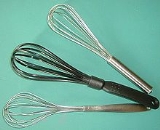
Whisk

Encyclopedia

Plastic
A plastic material is any of a wide range of synthetic or semi-synthetic organic solids used in the manufacture of industrial products. Plastics are typically polymers of high molecular mass, and may contain other substances to improve performance and/or reduce production costs...
for use with nonstick cookware. Whisks are also made from bamboo
Bamboo
Bamboo is a group of perennial evergreens in the true grass family Poaceae, subfamily Bambusoideae, tribe Bambuseae. Giant bamboos are the largest members of the grass family....
.
Whisks are commonly used to whip egg whites into a firm foam to make meringue
Meringue
Meringue is a type of dessert made from whipped egg whites and sugar, occasionally some recipes may call for adding an acid such as cream of tartar or a small amount of vinegar and a binding agent such as cornstarch found in icing sugar which may be added in addition to the corn starch which...
, or to whip cream
Cream
Cream is a dairy product that is composed of the higher-butterfat layer skimmed from the top of milk before homogenization. In un-homogenized milk, over time, the lighter fat rises to the top. In the industrial production of cream this process is accelerated by using centrifuges called "separators"...
into whipped cream
Whipped cream
Whipped cream is cream that has been beaten by a mixer, whisk, or fork until it is light and fluffy. Whipped cream is often sweetened and sometimes flavored with vanilla, in which case it may be called Chantilly cream or crème Chantilly ....
.
A makeshift whisk may be constructed by taking two fork
Fork
As a piece of cutlery or kitchenware, a fork is a tool consisting of a handle with several narrow tines on one end. The fork, as an eating utensil, has been a feature primarily of the West, whereas in East Asia chopsticks have been more prevalent...
s and placing them together so the tines interlock and make a cage. This is far more effective than a single fork at incorporating air into a mixture.
Whisks have differently-shaped loops depending on their intended functions:
- The most common shape is that of a wide teardrop, termed a balloon whisk. Balloon whisks are best suited to mixing in bowls, as their curved edges conform to a bowl's concave sides.
- With longer, narrower wire loops, the French whisk has a more cylindrical profile, suiting it to deep, straight-sided pans.
- A flat whisk, sometimes referred to as a Roux whisk, has the loops arranged in a flat successive pattern. It is useful for working in shallow vessels like skillets (in which a rouxRouxRoux is a cooked mixture of wheat flour and fat, traditionally butter. It is the thickening agent of three of the mother sauces of classical French cooking: sauce béchamel, sauce velouté and sauce espagnole. Clarified butter, vegetable oils, or lard are commonly used fats. It is used as a...
is normally prepared). - A gravy whisk commonly has one main loop with another wire coiled around it.
- Similarly, a twirl whisk has one single wire that is spiralled into a balloon shape.
- Ball whisks have no loops whatsoever. Instead, a group of individual wires comes out of the handle, each tipped with a metal ball. The heavy balls are cap* than traditional looped varieties. Manufacturers of ball whisks also purport that their shape allows for better aeration.
Additionally, a mechanical device known as a rotary whisk consists of 2 sets of beaters that are joined together with a hand-operated crank and handle.
Although the modern whisk may have only appeared at the end of the 19th century, evidence of whisk-like tools exist even further back in history. A bundle of twigs fastened together make an effective whisk; often the wood used would lend a certain fragrance to the dish. An 18th century Shaker recipe calls to “Cut a handful of peach
Peach
The peach tree is a deciduous tree growing to tall and 6 in. in diameter, belonging to the subfamily Prunoideae of the family Rosaceae. It bears an edible juicy fruit called a peach...
twigs which are filled with sap at this season of the year. Clip the ends and bruise them and beat the cake batter with them. This will impart a delicate peach flavor to the cake.”