

Wheelwright

Encyclopedia
Wheel
A wheel is a device that allows heavy objects to be moved easily through rotating on an axle through its center, facilitating movement or transportation while supporting a load, or performing labor in machines. Common examples found in transport applications. A wheel, together with an axle,...
s. The word is the combination of "wheel" and the archaic word "wright
Wright
Wright is an occupational surname originating in England. The term Wright comes from the circa 700 AD Old English word "wryhta" or "wyrhta", meaning worker or shaper of wood. Later it became any occupational worker , and is used as a British family name...
", which comes from the Old English word "wryhta", meaning a worker or maker. This occupational name eventually became the English surname
Surname
A surname is a name added to a given name and is part of a personal name. In many cases, a surname is a family name. Many dictionaries define "surname" as a synonym of "family name"...
Wheelwright.
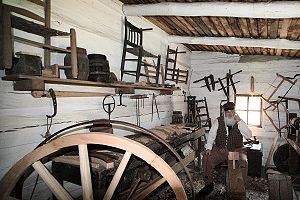
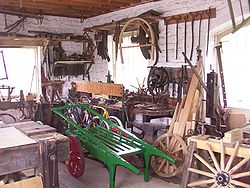
Historically, these tradesmen made wheels for carts and wagons by first constructing the hub, the spokes and the rim/fellows segments, and assembling them all into a unit working from the center of the wheel outwards. Most wheels were made from wood
Wood
Wood is a hard, fibrous tissue found in many trees. It has been used for hundreds of thousands of years for both fuel and as a construction material. It is an organic material, a natural composite of cellulose fibers embedded in a matrix of lignin which resists compression...
, but other materials have been used, such as bone
Bone
Bones are rigid organs that constitute part of the endoskeleton of vertebrates. They support, and protect the various organs of the body, produce red and white blood cells and store minerals. Bone tissue is a type of dense connective tissue...
and horn
Horn (anatomy)
A horn is a pointed projection of the skin on the head of various animals, consisting of a covering of horn surrounding a core of living bone. True horns are found mainly among the ruminant artiodactyls, in the families Antilocapridae and Bovidae...
, for decorative or other purposes. Around the middle of the 19th century, iron strakes were replaced by a solid iron
Iron
Iron is a chemical element with the symbol Fe and atomic number 26. It is a metal in the first transition series. It is the most common element forming the planet Earth as a whole, forming much of Earth's outer and inner core. It is the fourth most common element in the Earth's crust...
tyre custom made by a blacksmith
Blacksmith
A blacksmith is a person who creates objects from wrought iron or steel by forging the metal; that is, by using tools to hammer, bend, and cut...
, who first measured each wheel to ensure proper fit. Strakes were lengths of iron that were nailed to the outside of wheels to hold wooden wheels together. Strakes were replaced around the mid-19th century by more dependable iron tires that were fastened to the wooden wheel by both the tight fit of the tire/band as well as tire-bolts. Tire-bolts were less likely than tyre-nails to break off because they were flush with the wheel's outer surface. During the second half of the 19th century, the use of pre-manufactured iron hubs, and other factory-made wood, iron and rubber wheel parts became increasingly common.
In modern times, wheelwrights continue to make and repair a wide variety of wheels, including those made from wood and banded by iron tyres. The word wheelwright remains a term usually used for someone who makes and repairs wheels for horse drawn vehicles, even though it is sometimes used to refer to someone who repairs wheels, wheel alignment, rims, drums
Drum brake
A drum brake is a brake in which the friction is caused by a set of shoes or pads that press against a rotating drum-shaped part called a brake drum....
, discs
Disc brake
The disc brake or disk brake is a device for slowing or stopping the rotation of a wheel while it is in motion.A brake disc is usually made of cast iron, but may in some cases be made of composites such as reinforced carbon–carbon or ceramic matrix composites. This is connected to the wheel and/or...
and wire spoke
Spoke
A spoke is one of some number of rods radiating from the center of a wheel , connecting the hub with the round traction surface....
s on modern vehicles such as automobile
Automobile
An automobile, autocar, motor car or car is a wheeled motor vehicle used for transporting passengers, which also carries its own engine or motor...
s, bus
Bus
A bus is a road vehicle designed to carry passengers. Buses can have a capacity as high as 300 passengers. The most common type of bus is the single-decker bus, with larger loads carried by double-decker buses and articulated buses, and smaller loads carried by midibuses and minibuses; coaches are...
es and truck
Truck
A truck or lorry is a motor vehicle designed to transport cargo. Trucks vary greatly in size, power, and configuration, with the smallest being mechanically similar to an automobile...
s. Wheels for horse-drawn vehicles continue to be constructed and repaired for use by people who use horse-drawn vehicle
Horse-drawn vehicle
A horse-drawn vehicle is a mechanized piece of equipment pulled by one horse or by a team of horses. These vehicles typically had two or four wheels and were used to carry passengers and/or a load...
s for farming, equine (horse
Horse
The horse is one of two extant subspecies of Equus ferus, or the wild horse. It is a single-hooved mammal belonging to the taxonomic family Equidae. The horse has evolved over the past 45 to 55 million years from a small multi-toed creature into the large, single-toed animal of today...
) competitions, and presentations of historical events such as reenactments and living history
Living history
Living history is an activity that incorporates historical tools, activities and dress into an interactive presentation that seeks to give observers and participants a sense of stepping back in time. Although it does not necessarily seek to reenact a specific event in history, living history is...
.
External Links
- "An Old Craftman Preserves." Popular Mechanics, October 1947, p. 144-145.