


Whale song

Encyclopedia
Whale sounds are the sound
s made by whale
s and which are used for different kinds of communication
.
The word "song
" is used to describe the pattern of regular and predictable sounds made by some species of whales, notably the Humpback Whale
. This is included with or in comparison with music
, and male humpback whales have been described as "inveterate composers" of songs that are "'strikingly similar' to human musical traditions". Male Humpback whales sing only on calving grounds and only in the mating period and humpback songs are similar, almost identical, within a single population. It has been suggested that humpback songs communicate male fitness to female whales. The click sounds made by Sperm whale
s and dolphins are not strictly song, but the clicking sequences have been suggested to be individualized rhythmic sequences that communicate the identity of a single whale to other whales in its group and allows the groups to coordinate foraging activities.
The mechanisms used to produce sound vary from one family of cetaceans to another. Marine mammal
s, such as whale
s, dolphin
s, and porpoise
s, are much more dependent on sound for communication and sensation than are land mammals, because other senses are of limited effectiveness in water. Sight
is less effective for marine mammals because of the way water absorbs light
. Smell
also is limited, as molecule
s diffuse more slowly in water than in air, which makes smelling less effective. However, the speed of sound
is roughly four times greater in water than in the atmosphere at sea level
. Because sea mammals are so dependent on hearing to communicate and feed, environmentalists and cetologists
are concerned that they are being harmed by the increased ambient noise in the world's oceans caused by ship
s, sonar
and marine seismic surveys.
. The vocal cords within the larynx open and close as necessary to separate the stream of air into discrete pockets of air. These pockets are shaped by the throat
, tongue
, and lip
s into the desired sound, allowing humans to speak
.
Cetacean sound production differs markedly from this mechanism. The precise mechanism differs in the two major suborders of cetaceans: the Odontoceti (toothed whales—including dolphins) and the Mysticeti (baleen whale
s—including the largest whales, such as the Blue Whale
).
whereas collections of clicks and whistles are used for communication. Though a large pod of dolphins will produce a wide range of different noises, very little is known about the meaning of the sound. Frankel quotes one researcher who says listening to a school of odontocetes is like listening to a group of children at a school playground.
The multiple sounds odontocetes make are produced by passing air through a structure in the head called the phonic lips. This structure functions like the human nasal cavity. As the air passes through this narrow passage, the phonic lip membranes are sucked together, causing the surrounding tissue to vibrate. These vibrations can, as with the vibrations in the human larynx, be consciously controlled with great sensitivity. The vibrations pass through the tissue of the head to the melon
, which shapes and directs the sound into a beam of sound useful in echolocation. Every toothed whale except the sperm whale
has two sets of phonic lips and is thus capable of making two sounds independently. Once the air has passed the phonic lips it enters the vestibular sac
. From there, the air may be recycled back into the lower part of the nasal complex, ready to be used for sound creation again, or passed out through the blowhole.
The French
name for phonic lips, museau de singe, translates literally as "monkey's muzzle," which the phonic lip structure is supposed to resemble. New cranial analysis using computed axial and single photon emission computed tomography
scans in 2004 showed, at least in the case of bottlenose dolphin
s, that air might be supplied to the nasal complex from the lungs by the palatopharyngeal sphincter, enabling the sound creation process to continue for as long as the dolphin is able to hold its breath.
s (formally called mysticetes) do not have phonic lip structure. Instead, they have a larynx that appears to play a role in sound production, but it lacks vocal cords and scientists remain uncertain as to the exact mechanism. The process, however, cannot be completely analogous to humans, because whales do not have to exhale in order to produce sound. It is likely that they recycle air around the body for this purpose. Cranial sinuses may also be used to create the sounds, but again researchers are currently unclear how.
to 31 kHz. A list of typical levels is shown in the table below.
, the simpler sounds of other whales have a year-round use. While toothed whales are capable of using echolocation to detect the size and nature of objects, this capability has never been demonstrated in baleen whales. Further, unlike some fish such as shark
s, a whale's sense of smell is not highly developed. Thus, given the poor visibility of aquatic environments and that sound travels so well in water, sounds audible to humans may play a role in navigation. For instance, the depth of water or the existence of a large obstruction ahead may be detected by loud noises made by baleen whales.
The singing of whale songs for aesthetic
enjoyment, personal satisfaction, or 'for art's sake', is "an untestable question in scientific terms."
, are known to produce a series of repetitious sounds at varying frequencies. This is known as whale song. Marine biologist Philip Clapham describes the song as "probably the most complex in the animal kingdom".
Male humpback whales perform these vocalizations only during the mating season, and so it is believed the purpose of songs is to aid sexual selection. Whether the songs are a competitive behavior between males seeking the same mate, a means of defining territory or a "flirting" behavior from a male to a female is not known and the subject of ongoing research. Males have been observed singing while simultaneously acting as an "escort" whale in the immediate vicinity of a female. Singing has also been recorded in competitive groups of whales that are composed of one female and multiple males.
Interest in whale song was aroused by researchers Roger Payne
and Scott McVay after the songs were brought to their attention by a Bermudian named Frank Watlington who was working for the US government at the SOFAR station listening for Russian submarines with underwater hydrophones off the coast of the island.
The songs follow a distinct hierarchical structure. The base units of the song (sometimes loosely called the "notes") are single uninterrupted emissions of sound that last up to a few seconds. These sounds vary in frequency from 20 Hz to 10 kHz (the typical human range of hearing is 20 Hz to 20 kHz). The units may be frequency modulated
(i. e., the pitch of the sound may go up, down, or stay the same during the note) or amplitude modulated
(get louder or quieter). However the adjustment of bandwidth on a spectrogram representation of the song reveals the essentially pulsed
nature of the FM sounds.
A collection of four or six units is known as a sub-phrase
, lasting perhaps ten seconds (see also phrase (music)
). A collection of two sub-phrases is a phrase. A whale will typically repeat the same phrase over and over for two to four minutes. This is known as a theme. A collection of themes is known as a song. The whale will repeat the same song, which last up to 30 or so minutes, over and over again over the course of hours or even days. This "Russian doll" hierarchy of sounds has captured the imagination of scientists.
All the whales in an area sing virtually the same song at any point in time and the song is constantly and slowly evolving over time. For example, over the course of a month a particular unit that started as an "upsweep" (increasing in frequency) might slowly flatten to become a constant note. Another unit may get steadily louder. The pace of evolution of a whale's song also changes—some years the song may change quite rapidly, whereas in other years little variation may be recorded.
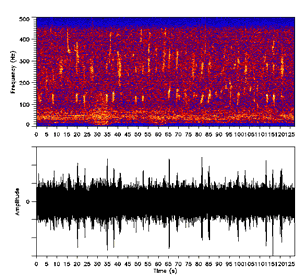 Whales occupying the same geographical areas (which can be as large as entire ocean basins) tend to sing similar songs, with only slight variations. Whales from non-overlapping regions sing entirely different songs.
As the song evolves, it appears that old patterns are not revisited. An analysis of 19 years of whale songs found that while general patterns in song could be spotted, the same combination never recurred.
Humpback whales may also make stand-alone sounds that do not form part of a song, particularly during courtship rituals. Finally, humpbacks make a third class of sound called the feeding call. This is a long sound (5 to 10 s duration) of near constant frequency. Humpbacks generally feed cooperatively by gathering in groups, swimming underneath shoals of fish and all lunging up vertically through the fish and out of the water together. Prior to these lunges, whales make their feeding call. The exact purpose of the call is not known, but research suggests that fish know what it means. When the sound was played back to them, a group of herring responded to the sound by moving away from the call, even though no whale was present.
Some scientists have proposed that Humpback Whale songs may serve an echolocative
purpose, but this has been subject to disagreement.
Most baleen whales make sounds at about 15–20 hertz
. However, marine biologists
, led by Mary Ann Daher, at the Woods Hole Oceanographic Institution
reported in New Scientist
in December 2004 that she had been tracking a whale in the North Pacific for 12 years that was "singing" at 52 Hz. The scientists are unable to explain this dramatic difference from the norm; however, they believe the whale is baleen and unlikely to be a new species, suggesting that currently known species may have a wider vocal range than previously thought.
In 2009, researchers found that blue whale
song has been deepening in its tonal frequency since the 1960s. While noise pollution
has increased ambient ocean noise by over 12 decibels since the mid-20th century, researcher Mark McDonald indicated that higher pitches would be expected if the whales were straining to be heard.
Most other whales and dolphins produce sounds of varying degrees of complexity. Of particular interest is the Beluga (the "sea canary") which produces an immense variety of whistles, clicks and pulses.
Researchers use hydrophone
s (often adapted from their original military use in tracking submarines) to ascertain the exact location of the origin of whale noises. Their methods allow them also to detect how far through an ocean a sound travels. Research by Dr. Christopher Clark of Cornell University
conducted using military data showed that whale noises travel for thousands of kilometres. As well as providing information about song production, the data allows researchers to follow the migratory path of whales throughout the "singing" (mating) season. One important finding is that whales in a process called the Lombard effect
adjust their song to compensate for background noise pollution
.
Prior to the introduction of human noise production, Clark says the noises may have travelled right from one side of an ocean to the other, agreeing with a thirty-year-old concept blaming large-scale shipping. His research indicates that ambient noise from boats is doubling with each decade. This has the effect of reducing the range at which whale noises can be heard. Environmentalist
s fear that such boat activity is putting undue stress on the animals as well as making it difficult to find a mate.
Sound
Sound is a mechanical wave that is an oscillation of pressure transmitted through a solid, liquid, or gas, composed of frequencies within the range of hearing and of a level sufficiently strong to be heard, or the sensation stimulated in organs of hearing by such vibrations.-Propagation of...
s made by whale
Whale
Whale is the common name for various marine mammals of the order Cetacea. The term whale sometimes refers to all cetaceans, but more often it excludes dolphins and porpoises, which belong to suborder Odontoceti . This suborder also includes the sperm whale, killer whale, pilot whale, and beluga...
s and which are used for different kinds of communication
Animal communication
Animal communication is any behavior on the part of one animal that has an effect on the current or future behaviour of another animal. The study of animal communication, is sometimes called Zoosemiotics has played an important part in the...
.
The word "song
Song
In music, a song is a composition for voice or voices, performed by singing.A song may be accompanied by musical instruments, or it may be unaccompanied, as in the case of a cappella songs...
" is used to describe the pattern of regular and predictable sounds made by some species of whales, notably the Humpback Whale
Humpback Whale
The humpback whale is a species of baleen whale. One of the larger rorqual species, adults range in length from and weigh approximately . The humpback has a distinctive body shape, with unusually long pectoral fins and a knobbly head. It is an acrobatic animal, often breaching and slapping the...
. This is included with or in comparison with music
Music
Music is an art form whose medium is sound and silence. Its common elements are pitch , rhythm , dynamics, and the sonic qualities of timbre and texture...
, and male humpback whales have been described as "inveterate composers" of songs that are "'strikingly similar' to human musical traditions". Male Humpback whales sing only on calving grounds and only in the mating period and humpback songs are similar, almost identical, within a single population. It has been suggested that humpback songs communicate male fitness to female whales. The click sounds made by Sperm whale
Sperm Whale
The sperm whale, Physeter macrocephalus, is a marine mammal species, order Cetacea, a toothed whale having the largest brain of any animal. The name comes from the milky-white waxy substance, spermaceti, found in the animal's head. The sperm whale is the only living member of genus Physeter...
s and dolphins are not strictly song, but the clicking sequences have been suggested to be individualized rhythmic sequences that communicate the identity of a single whale to other whales in its group and allows the groups to coordinate foraging activities.
The mechanisms used to produce sound vary from one family of cetaceans to another. Marine mammal
Marine mammal
Marine mammals, which include seals, whales, dolphins, and walruses, form a diverse group of 128 species that rely on the ocean for their existence. They do not represent a distinct biological grouping, but rather are unified by their reliance on the marine environment for feeding. The level of...
s, such as whale
Whale
Whale is the common name for various marine mammals of the order Cetacea. The term whale sometimes refers to all cetaceans, but more often it excludes dolphins and porpoises, which belong to suborder Odontoceti . This suborder also includes the sperm whale, killer whale, pilot whale, and beluga...
s, dolphin
Dolphin
Dolphins are marine mammals that are closely related to whales and porpoises. There are almost forty species of dolphin in 17 genera. They vary in size from and , up to and . They are found worldwide, mostly in the shallower seas of the continental shelves, and are carnivores, mostly eating...
s, and porpoise
Porpoise
Porpoises are small cetaceans of the family Phocoenidae; they are related to whales and dolphins. They are distinct from dolphins, although the word "porpoise" has been used to refer to any small dolphin, especially by sailors and fishermen...
s, are much more dependent on sound for communication and sensation than are land mammals, because other senses are of limited effectiveness in water. Sight
Visual perception
Visual perception is the ability to interpret information and surroundings from the effects of visible light reaching the eye. The resulting perception is also known as eyesight, sight, or vision...
is less effective for marine mammals because of the way water absorbs light
Light
Light or visible light is electromagnetic radiation that is visible to the human eye, and is responsible for the sense of sight. Visible light has wavelength in a range from about 380 nanometres to about 740 nm, with a frequency range of about 405 THz to 790 THz...
. Smell
Olfaction
Olfaction is the sense of smell. This sense is mediated by specialized sensory cells of the nasal cavity of vertebrates, and, by analogy, sensory cells of the antennae of invertebrates...
also is limited, as molecule
Molecule
A molecule is an electrically neutral group of at least two atoms held together by covalent chemical bonds. Molecules are distinguished from ions by their electrical charge...
s diffuse more slowly in water than in air, which makes smelling less effective. However, the speed of sound
Speed of sound
The speed of sound is the distance travelled during a unit of time by a sound wave propagating through an elastic medium. In dry air at , the speed of sound is . This is , or about one kilometer in three seconds or approximately one mile in five seconds....
is roughly four times greater in water than in the atmosphere at sea level
Sea level
Mean sea level is a measure of the average height of the ocean's surface ; used as a standard in reckoning land elevation...
. Because sea mammals are so dependent on hearing to communicate and feed, environmentalists and cetologists
Cetology
Cetology is the branch of marine mammal science that studies the approximately eighty species of whales, dolphins, and porpoise in the scientific order Cetacea...
are concerned that they are being harmed by the increased ambient noise in the world's oceans caused by ship
Ship
Since the end of the age of sail a ship has been any large buoyant marine vessel. Ships are generally distinguished from boats based on size and cargo or passenger capacity. Ships are used on lakes, seas, and rivers for a variety of activities, such as the transport of people or goods, fishing,...
s, sonar
Sonar
Sonar is a technique that uses sound propagation to navigate, communicate with or detect other vessels...
and marine seismic surveys.
Production of sound
Humans produce sound by expelling air through the larynxLarynx
The larynx , commonly called the voice box, is an organ in the neck of amphibians, reptiles and mammals involved in breathing, sound production, and protecting the trachea against food aspiration. It manipulates pitch and volume...
. The vocal cords within the larynx open and close as necessary to separate the stream of air into discrete pockets of air. These pockets are shaped by the throat
Throat
In vertebrate anatomy, the throat is the anterior part of the neck, in front of the vertebral column. It consists of the pharynx and larynx...
, tongue
Tongue
The tongue is a muscular hydrostat on the floors of the mouths of most vertebrates which manipulates food for mastication. It is the primary organ of taste , as much of the upper surface of the tongue is covered in papillae and taste buds. It is sensitive and kept moist by saliva, and is richly...
, and lip
Lip
Lips are a visible body part at the mouth of humans and many animals. Lips are soft, movable, and serve as the opening for food intake and in the articulation of sound and speech...
s into the desired sound, allowing humans to speak
Human voice
The human voice consists of sound made by a human being using the vocal folds for talking, singing, laughing, crying, screaming, etc. Its frequency ranges from about 60 to 7000 Hz. The human voice is specifically that part of human sound production in which the vocal folds are the primary...
.
Cetacean sound production differs markedly from this mechanism. The precise mechanism differs in the two major suborders of cetaceans: the Odontoceti (toothed whales—including dolphins) and the Mysticeti (baleen whale
Baleen whale
The Baleen whales, also called whalebone whales or great whales, form the Mysticeti, one of two suborders of the Cetacea . Baleen whales are characterized by having baleen plates for filtering food from water, rather than having teeth. This distinguishes them from the other suborder of cetaceans,...
s—including the largest whales, such as the Blue Whale
Blue Whale
The blue whale is a marine mammal belonging to the suborder of baleen whales . At in length and or more in weight, it is the largest known animal to have ever existed....
).
Odontocete whale sound production
Toothed whales do not make the long, low-frequency sounds known as the whale song. Instead, they produce rapid bursts of high-frequency clicks and whistles. Single clicks are generally used for echolocationAnimal echolocation
Echolocation, also called biosonar, is the biological sonar used by several kinds of animals.Echolocating animals emit calls out to the environment and listen to the echoes of those calls that return from various objects near them. They use these echoes to locate and identify the objects...
whereas collections of clicks and whistles are used for communication. Though a large pod of dolphins will produce a wide range of different noises, very little is known about the meaning of the sound. Frankel quotes one researcher who says listening to a school of odontocetes is like listening to a group of children at a school playground.
The multiple sounds odontocetes make are produced by passing air through a structure in the head called the phonic lips. This structure functions like the human nasal cavity. As the air passes through this narrow passage, the phonic lip membranes are sucked together, causing the surrounding tissue to vibrate. These vibrations can, as with the vibrations in the human larynx, be consciously controlled with great sensitivity. The vibrations pass through the tissue of the head to the melon
Melon (whale)
The melon is an ovoid-shaped, fatty organ found in the forehead of all toothed whales , including dolphins and porpoises and believed to be used in echolocation....
, which shapes and directs the sound into a beam of sound useful in echolocation. Every toothed whale except the sperm whale
Sperm Whale
The sperm whale, Physeter macrocephalus, is a marine mammal species, order Cetacea, a toothed whale having the largest brain of any animal. The name comes from the milky-white waxy substance, spermaceti, found in the animal's head. The sperm whale is the only living member of genus Physeter...
has two sets of phonic lips and is thus capable of making two sounds independently. Once the air has passed the phonic lips it enters the vestibular sac
Vestibular system
The vestibular system, which contributes to balance in most mammals and to the sense of spatial orientation, is the sensory system that provides the leading contribution about movement and sense of balance. Together with the cochlea, a part of the auditory system, it constitutes the labyrinth of...
. From there, the air may be recycled back into the lower part of the nasal complex, ready to be used for sound creation again, or passed out through the blowhole.
The French
French language
French is a Romance language spoken as a first language in France, the Romandy region in Switzerland, Wallonia and Brussels in Belgium, Monaco, the regions of Quebec and Acadia in Canada, and by various communities elsewhere. Second-language speakers of French are distributed throughout many parts...
name for phonic lips, museau de singe, translates literally as "monkey's muzzle," which the phonic lip structure is supposed to resemble. New cranial analysis using computed axial and single photon emission computed tomography
Single photon emission computed tomography
Single-photon emission computed tomography is a nuclear medicine tomographic imaging technique using gamma rays. It is very similar to conventional nuclear medicine planar imaging using a gamma camera. However, it is able to provide true 3D information...
scans in 2004 showed, at least in the case of bottlenose dolphin
Bottlenose Dolphin
Bottlenose dolphins, the genus Tursiops, are the most common and well-known members of the family Delphinidae, the family of oceanic dolphins. Recent molecular studies show the genus contains two species, the common bottlenose dolphin and the Indo-Pacific bottlenose dolphin , instead of one...
s, that air might be supplied to the nasal complex from the lungs by the palatopharyngeal sphincter, enabling the sound creation process to continue for as long as the dolphin is able to hold its breath.
Mysticete whale sound production
Baleen whaleBaleen whale
The Baleen whales, also called whalebone whales or great whales, form the Mysticeti, one of two suborders of the Cetacea . Baleen whales are characterized by having baleen plates for filtering food from water, rather than having teeth. This distinguishes them from the other suborder of cetaceans,...
s (formally called mysticetes) do not have phonic lip structure. Instead, they have a larynx that appears to play a role in sound production, but it lacks vocal cords and scientists remain uncertain as to the exact mechanism. The process, however, cannot be completely analogous to humans, because whales do not have to exhale in order to produce sound. It is likely that they recycle air around the body for this purpose. Cranial sinuses may also be used to create the sounds, but again researchers are currently unclear how.
Mysticete whale sound levels
The frequency of baleen whale sounds ranges from 10 HzHertz
The hertz is the SI unit of frequency defined as the number of cycles per second of a periodic phenomenon. One of its most common uses is the description of the sine wave, particularly those used in radio and audio applications....
to 31 kHz. A list of typical levels is shown in the table below.
| Source | Broadband Broadband The term broadband refers to a telecommunications signal or device of greater bandwidth, in some sense, than another standard or usual signal or device . Different criteria for "broad" have been applied in different contexts and at different times... source level (dB re 1  Pa at 1m) Pa at 1m) |
|---|---|
| Fin whale Fin Whale The fin whale , also called the finback whale, razorback, or common rorqual, is a marine mammal belonging to the suborder of baleen whales. It is the second longest whale and the sixth largest living animal after the blue whale, bowhead whale, and right whales, growing to nearly 27 metres long... moans |
155–186 |
| Blue whale Blue Whale The blue whale is a marine mammal belonging to the suborder of baleen whales . At in length and or more in weight, it is the largest known animal to have ever existed.... moans |
155–188 |
| Gray whale Gray Whale The gray whale, Eschrichtius robustus, is a baleen whale that migrates between feeding and breeding grounds yearly. It reaches a length of about , a weight of , and lives 50–70 years. The common name of the whale comes from the gray patches and white mottling on its dark skin. Gray whales were... moans |
142–185 |
| Bowhead whale Bowhead Whale The bowhead whale is a baleen whale of the right whale family Balaenidae in suborder Mysticeti. A stocky dark-colored whale without a dorsal fin, it can grow to in length. This thick-bodied species can weigh to , second only to the blue whale, although the bowhead's maximum length is less than... tonals, moans and song |
128–189 |
Purpose of whale-created sounds
While the complex sounds of the Humpback whale (and some blue whales) are believed to be primarily used in sexual selectionSexual selection
Sexual selection, a concept introduced by Charles Darwin in his 1859 book On the Origin of Species, is a significant element of his theory of natural selection...
, the simpler sounds of other whales have a year-round use. While toothed whales are capable of using echolocation to detect the size and nature of objects, this capability has never been demonstrated in baleen whales. Further, unlike some fish such as shark
Shark
Sharks are a type of fish with a full cartilaginous skeleton and a highly streamlined body. The earliest known sharks date from more than 420 million years ago....
s, a whale's sense of smell is not highly developed. Thus, given the poor visibility of aquatic environments and that sound travels so well in water, sounds audible to humans may play a role in navigation. For instance, the depth of water or the existence of a large obstruction ahead may be detected by loud noises made by baleen whales.
The singing of whale songs for aesthetic
Aesthetics
Aesthetics is a branch of philosophy dealing with the nature of beauty, art, and taste, and with the creation and appreciation of beauty. It is more scientifically defined as the study of sensory or sensori-emotional values, sometimes called judgments of sentiment and taste...
enjoyment, personal satisfaction, or 'for art's sake', is "an untestable question in scientific terms."
Song of the Humpback Whale
Two groups of whales, the Humpback Whale and the subspecies of Blue Whale found in the Indian OceanIndian Ocean
The Indian Ocean is the third largest of the world's oceanic divisions, covering approximately 20% of the water on the Earth's surface. It is bounded on the north by the Indian Subcontinent and Arabian Peninsula ; on the west by eastern Africa; on the east by Indochina, the Sunda Islands, and...
, are known to produce a series of repetitious sounds at varying frequencies. This is known as whale song. Marine biologist Philip Clapham describes the song as "probably the most complex in the animal kingdom".
Male humpback whales perform these vocalizations only during the mating season, and so it is believed the purpose of songs is to aid sexual selection. Whether the songs are a competitive behavior between males seeking the same mate, a means of defining territory or a "flirting" behavior from a male to a female is not known and the subject of ongoing research. Males have been observed singing while simultaneously acting as an "escort" whale in the immediate vicinity of a female. Singing has also been recorded in competitive groups of whales that are composed of one female and multiple males.
Interest in whale song was aroused by researchers Roger Payne
Roger Payne
Roger Searle Payne is a biologist and environmentalist famous for the 1967 discovery of Whale song among Humpback whales. Payne later became an important figure in the worldwide campaign to end commercial whaling.Payne studied at Harvard University and Cornell...
and Scott McVay after the songs were brought to their attention by a Bermudian named Frank Watlington who was working for the US government at the SOFAR station listening for Russian submarines with underwater hydrophones off the coast of the island.
The songs follow a distinct hierarchical structure. The base units of the song (sometimes loosely called the "notes") are single uninterrupted emissions of sound that last up to a few seconds. These sounds vary in frequency from 20 Hz to 10 kHz (the typical human range of hearing is 20 Hz to 20 kHz). The units may be frequency modulated
Frequency modulation
In telecommunications and signal processing, frequency modulation conveys information over a carrier wave by varying its instantaneous frequency. This contrasts with amplitude modulation, in which the amplitude of the carrier is varied while its frequency remains constant...
(i. e., the pitch of the sound may go up, down, or stay the same during the note) or amplitude modulated
Amplitude modulation
Amplitude modulation is a technique used in electronic communication, most commonly for transmitting information via a radio carrier wave. AM works by varying the strength of the transmitted signal in relation to the information being sent...
(get louder or quieter). However the adjustment of bandwidth on a spectrogram representation of the song reveals the essentially pulsed
Pulse (signal processing)
In signal processing, the term pulse has the following meanings:#A rapid, transient change in the amplitude of a signal from a baseline value to a higher or lower value, followed by a rapid return to the baseline value....
nature of the FM sounds.
A collection of four or six units is known as a sub-phrase
Phrase
In everyday speech, a phrase may refer to any group of words. In linguistics, a phrase is a group of words which form a constituent and so function as a single unit in the syntax of a sentence. A phrase is lower on the grammatical hierarchy than a clause....
, lasting perhaps ten seconds (see also phrase (music)
Phrase (music)
In music and music theory, phrase and phrasing are concepts and practices related to grouping consecutive melodic notes, both in their composition and performance...
). A collection of two sub-phrases is a phrase. A whale will typically repeat the same phrase over and over for two to four minutes. This is known as a theme. A collection of themes is known as a song. The whale will repeat the same song, which last up to 30 or so minutes, over and over again over the course of hours or even days. This "Russian doll" hierarchy of sounds has captured the imagination of scientists.
All the whales in an area sing virtually the same song at any point in time and the song is constantly and slowly evolving over time. For example, over the course of a month a particular unit that started as an "upsweep" (increasing in frequency) might slowly flatten to become a constant note. Another unit may get steadily louder. The pace of evolution of a whale's song also changes—some years the song may change quite rapidly, whereas in other years little variation may be recorded.
As the song evolves, it appears that old patterns are not revisited. An analysis of 19 years of whale songs found that while general patterns in song could be spotted, the same combination never recurred.
Humpback whales may also make stand-alone sounds that do not form part of a song, particularly during courtship rituals. Finally, humpbacks make a third class of sound called the feeding call. This is a long sound (5 to 10 s duration) of near constant frequency. Humpbacks generally feed cooperatively by gathering in groups, swimming underneath shoals of fish and all lunging up vertically through the fish and out of the water together. Prior to these lunges, whales make their feeding call. The exact purpose of the call is not known, but research suggests that fish know what it means. When the sound was played back to them, a group of herring responded to the sound by moving away from the call, even though no whale was present.
Some scientists have proposed that Humpback Whale songs may serve an echolocative
Animal echolocation
Echolocation, also called biosonar, is the biological sonar used by several kinds of animals.Echolocating animals emit calls out to the environment and listen to the echoes of those calls that return from various objects near them. They use these echoes to locate and identify the objects...
purpose, but this has been subject to disagreement.
Other whale sounds
Humpback whales have also been found to make a range of other social sounds to communicate such as "grunts", "groans", "thwops", "snorts" and "barks".Most baleen whales make sounds at about 15–20 hertz
Hertz
The hertz is the SI unit of frequency defined as the number of cycles per second of a periodic phenomenon. One of its most common uses is the description of the sine wave, particularly those used in radio and audio applications....
. However, marine biologists
Marine biology
Marine biology is the scientific study of organisms in the ocean or other marine or brackish bodies of water. Given that in biology many phyla, families and genera have some species that live in the sea and others that live on land, marine biology classifies species based on the environment rather...
, led by Mary Ann Daher, at the Woods Hole Oceanographic Institution
Woods Hole Oceanographic Institution
The Woods Hole Oceanographic Institution is a private, nonprofit research and higher education facility dedicated to the study of all aspects of marine science and engineering and to the education of marine researchers. Established in 1930, it is the largest independent oceanographic research...
reported in New Scientist
New Scientist
New Scientist is a weekly non-peer-reviewed English-language international science magazine, which since 1996 has also run a website, covering recent developments in science and technology for a general audience. Founded in 1956, it is published by Reed Business Information Ltd, a subsidiary of...
in December 2004 that she had been tracking a whale in the North Pacific for 12 years that was "singing" at 52 Hz. The scientists are unable to explain this dramatic difference from the norm; however, they believe the whale is baleen and unlikely to be a new species, suggesting that currently known species may have a wider vocal range than previously thought.
In 2009, researchers found that blue whale
Blue Whale
The blue whale is a marine mammal belonging to the suborder of baleen whales . At in length and or more in weight, it is the largest known animal to have ever existed....
song has been deepening in its tonal frequency since the 1960s. While noise pollution
Noise pollution
Noise pollution is excessive, displeasing human, animal or machine-created environmental noise that disrupts the activity or balance of human or animal life...
has increased ambient ocean noise by over 12 decibels since the mid-20th century, researcher Mark McDonald indicated that higher pitches would be expected if the whales were straining to be heard.
Most other whales and dolphins produce sounds of varying degrees of complexity. Of particular interest is the Beluga (the "sea canary") which produces an immense variety of whistles, clicks and pulses.
Human interaction
Though some observers suggest that undue fascination has been placed on the whales' songs simply because the animals are under the sea, most marine mammal scientists believe that sound plays a particularly vital role in the development and well-being of cetaceans.Researchers use hydrophone
Hydrophone
A hydrophone is a microphone designed to be used underwater for recording or listening to underwater sound. Most hydrophones are based on a piezoelectric transducer that generates electricity when subjected to a pressure change...
s (often adapted from their original military use in tracking submarines) to ascertain the exact location of the origin of whale noises. Their methods allow them also to detect how far through an ocean a sound travels. Research by Dr. Christopher Clark of Cornell University
Cornell University
Cornell University is an Ivy League university located in Ithaca, New York, United States. It is a private land-grant university, receiving annual funding from the State of New York for certain educational missions...
conducted using military data showed that whale noises travel for thousands of kilometres. As well as providing information about song production, the data allows researchers to follow the migratory path of whales throughout the "singing" (mating) season. One important finding is that whales in a process called the Lombard effect
Lombard effect
thumb|250 px|[[Great tit]]s sing at a higher frequency in [[noise pollution|noise polluted]] urban surroundings than quieter ones to help overcome the [[auditory masking]] that would otherwise impair other birds hearing their [[bird vocalization|song]]...
adjust their song to compensate for background noise pollution
Noise pollution
Noise pollution is excessive, displeasing human, animal or machine-created environmental noise that disrupts the activity or balance of human or animal life...
.
Prior to the introduction of human noise production, Clark says the noises may have travelled right from one side of an ocean to the other, agreeing with a thirty-year-old concept blaming large-scale shipping. His research indicates that ambient noise from boats is doubling with each decade. This has the effect of reducing the range at which whale noises can be heard. Environmentalist
Environmentalist
An environmentalist broadly supports the goals of the environmental movement, "a political and ethical movement that seeks to improve and protect the quality of the natural environment through changes to environmentally harmful human activities"...
s fear that such boat activity is putting undue stress on the animals as well as making it difficult to find a mate.
Media
Selected discography
- Songs of the Humpback Whale (SWR 118) was originally released in 1970 by CRM Records from recordings made by Roger PayneRoger PayneRoger Searle Payne is a biologist and environmentalist famous for the 1967 discovery of Whale song among Humpback whales. Payne later became an important figure in the worldwide campaign to end commercial whaling.Payne studied at Harvard University and Cornell...
, Frank Watlington and others. The LP was later re-released by Capitol RecordsCapitol RecordsCapitol Records is a major United States based record label, formerly located in Los Angeles, but operating in New York City as part of Capitol Music Group. Its former headquarters building, the Capitol Tower, is a major landmark near the corner of Hollywood and Vine...
, published in a flexible format in the National Geographic Society magazine, Volume 155, Number 1, in January 1979 and released on CD by BGO-Beat Goes On in 2001.
- Deep Voices: The Second Whale Record (Capitol Records ST-11598) was released on LP in 1977 from additional recordings made by Roger PayneRoger PayneRoger Searle Payne is a biologist and environmentalist famous for the 1967 discovery of Whale song among Humpback whales. Payne later became an important figure in the worldwide campaign to end commercial whaling.Payne studied at Harvard University and Cornell...
, and re-released on CD in 1995 by Living Music. It includes recordings of humpbacks, blues, and rights.
- Northern Whales (MGE 19) was released by Music Gallery Editions from recordings made by Pierre Ouellet, John Ford, and others affiliated with Interspecies Music and Communication Research. It includes recordings of belugas, narwhals, orca, and bearded seals.
- Sounds of the Earth: Humpback Whales (Oreade Music) was released on CD in 1999.
- Rapture of the Deep: Humpback Whale Singing (Compass Recordings) was released on CD in 2001.
- Songlines: Songs of the East Australian Humpback whales. was released in 2009.
See also
- BioacousticsBioacousticsBioacoustics is a cross-disciplinary science that combines biology and acoustics. Usually it refers to the investigation of sound production, dispersion through elastic media, and reception in animals, including humans. This involves neurophysiological and anatomical basis of sound production and...
- BiomusicBiomusicBiomusic is a form of experimental music which deals with sounds created or performed by non-humans. The definition is also sometimes extended to included sounds made by humans in a directly biological way...
- Underwater acousticsUnderwater acousticsUnderwater acoustics is the study of the propagation of sound in water and the interaction of the mechanical waves that constitute sound with the water and its boundaries. The water may be in the ocean, a lake or a tank. Typical frequencies associated with underwater acoustics are between 10 Hz and...
- Vocal learningVocal learningVocal learning is the ability of animals to modify vocal signals in form as a result of experience with those of other individuals. This can lead to signals that are either similar or dissimilar to the model...
External links
- Voices in the Sea has Whale and Dolphin sounds and interpretive videos
- Cornell University's Bioacoustics Research Program
- Whale Songs at the Avant Garde Project has FLAC files made from high-quality LP transcriptions available for free download.
- Perspectives in Ocean Science Listening to Whales, John Hildebrand, Scripps Institution of Oceanography
- The British Library Sound Archive contains over 150,000 recordings of animal sounds and natural atmospheres from around the world.
- Songlines: Songs of the East Australian Humpback whales.
- Recording of the bearded seal's "spiralling trill," one of the most phenomenal vocalizations of the underwater kindgdom: http://www.birds.cornell.edu/brp/listen-to-project-sounds/bearded-seal