

West Norwood Cemetery

Encyclopedia
West Norwood Cemetery is a 40 acres (16.2 ha) cemetery
in West Norwood
in London
, England
. It was also known as the South Metropolitan Cemetery.
One of the first private landscaped cemeteries in London, it is one of the Magnificent Seven
cemeteries of London, and is a site of major historical, architectural and ecological interest.
Its grounds are a mixture of historic monumental cemetery and modern lawn cemetery, but it also has catacombs
, cremation
plots and a columbarium for cinery ashes. The cemetery's crematorium still operates, and cremation plots are still available, but all the conventional burial plots have been allocated and hence it is closed to new burials pending further agreement under current burial legislation.
, (SE27). The local authority are the current owners. The site, with some of its neighbouring streets, forms part of a conservation area
.
metropolitan lawn cemeteries of the Victorian era
, and its extensive Gothic Revival architecture
qualifies it as one of the significant cemeteries in Europe.
Lambeth have recognised it as a site of nature conservation value
within the Borough in addition to its outstanding value as a site of national historic and cultural interest. English Heritage
have placed it on the National Register of Historic Parks and Gardens
, describing it as the first cemetery to be designed in the Gothic Revival style.
The entrance gate is set within railings, painted a historically accurate 'spice' brown. Railings and walls were kept high in order to dispel fears of body snatchers.
There is second entrance nearby, normally kept locked, in Norwood High Street which is close to West Norwood railway station
.
It is a mixture of cleared, manicured, and mature landscaping, and includes Anglican and unconsecrated burial grounds, a crematorium, memorial gardens, columbarium
, recordia, chapel
, vaults and catacombs on top of a gently rolling hill, with views across South London. The larger plots on the central higher ground and by the main drives were originally sold as prime locations and are the site of some of the grander Anglican monuments and mausolea
, while the Greek Orthodox necropolis in the North East contains a high density of neoclassical architecture
.
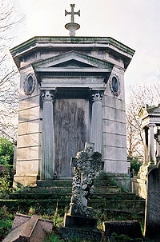
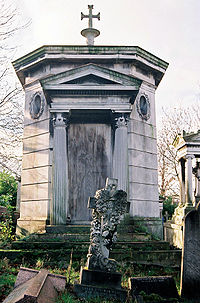
Many of these mausolea are listed, such as the Grade II mausoleum for Sir Henry Doulton
's family, constructed appropriately of pottery and terrcotta. As a contrast, just a few yards to the west of the crematorium is the very simple headstone to Isabella Mary Mayson Beeton, aka Mrs Beeton
, the Victorian cookery writer.
 The cemetery was consecrated in 1837 and, by 2000, there had been 164,000 burials in 42,000 plots, plus 34,000 cremation
s and several thousand interments in its catacombs
(see also Catacombs of London
).
As early as 1711, Sir Christopher Wren advocated the creation of burial grounds on the outskirts of town, "inclosed with a strong Brick Wall, and having a walk round, and two cross walks, decently planted with Yew-trees". In 1830, George Frederick Carden, editor of The Penny Magazine, successfully petitioned Parliament
about the parlous state of London's over-full church burial yards. Over time they passed a number of laws that effectively halted burials in London's churchyards, moving them 'to places where they would be less prejudicial to the health of the inhabitants'.
In 1836, a specific Parliamentary statute
enabled the South Metropolitan Cemetery Company to purchase land from the estate of the late Lord Thurlow in what was then called Lower Norwood
and create the second of the 'Magnificent Seven
' cemeteries.
The new cemetery was consecrated by the Bishop of Winchester
on 7 December 1837, receiving its first burial soon after. Until 1877, the consecrated grounds were overseen by the Diocese of Winchester
, and then Rochester
, before coming under the authority of Southwark
from 1905.
Architect
William Tite
was a director
of the cemetery company and designed the landscaping, some monuments, and was eventually interred there himself.
This was the first cemetery in the UK to be designed in the new Gothic
style. It offered a rural setting in open countryside, as it lay outside London at that time. Its design and location attracted the attention of wealthy - and aspirational - Victorians, who commissioned many fine mausoleums and memorials for their burial plots and vaults.
The cemetery was built on the site of the ancient Great North Wood
, from which Norwood took its name. Although many trees had been cleared, a number of mature specimens were included in Tite's original landscaping. A tree survey of the cemetery in 2005 identified one oak which is thought to date from 1540-1640. Fourteen more oaks, a maple and an ash tree were identified that predate the foundation of the cemetery in 1836. In the first years of the cemetery's operation, these were joined by coniferous trees and evergreen holm oaks.
The site originally included two Gothic chapels at the crest of the hill, which dominated the local landscape. A consecrated chapel faced west; its entrance was flanked with two octagonal towers, and cloisters spanning over the Anglican catacombs. To the north was a Dissenters' chapel, with its north entrance flanked by cloisters over its unconsecrated catacombs.
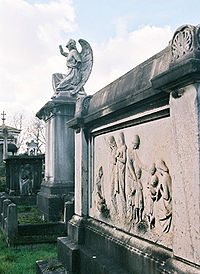 In 1842, a section of the cemetery was acquired by London's Greek community for a Greek Orthodox cemetery, and this soon filled with many fine monuments and large mausoleums, memorialising the history of Anglo-Hellenic families. Grade II*-listed St Stephen's Chapel within the Greek section is sometimes attributed to architect John Oldrid Scott
. The Greek necropolis is overseen by the trustees of the Cathedral of Saint Sophia.
Another enclosure in the south-east corner was acquired by St Mary-at-Hill
in the City of London
for its own parish burials.
. After the war, the Episcopal chapel was levelled, to be replaced by a memorial garden over its catacombs.
The main office at the front of the cemetery was also damaged by another flying bomb; it was rebuilt after the war in a style more sympathetic to its gothic surroundings.
Between 1978 and 1993, the cemetery achieved several levels of official recognition by being included in the West Norwood Conservation Area, while the entrance arch, the fine railings by Bramah
and 64 monuments were listed as Grade II and II* - more listed monuments than any other cemetery.
However, space for new burials had largely been exhausted during in the inter-war years, and, deprived of this regular source of income, the cemetery company was unable to properly afford its upkeep or the repair of buildings damaged by wartime bombing. Lambeth Council compulsorily purchased the cemetery in 1965, and controversially extinguished past rights and claimed ownership over the existing graves. Lambeth changed some of the character of the grounds through "lawn conversion", removing at least 10,000 monuments (including some of the listed monuments) and restarted new burials, reselling existing plots for re-use.
Consistory Court
cases fought in the Southwark Diocese
in 1995 and 1997 found this to be illegal. It brought about the cessation of new burials and forced the restoration of a handful of the damaged or removed monuments. In addition it required Lambeth to publish an index of cleared plots, so that the descendants of historic owners can request restitution of their family's plot.
As a consequence of the courts' findings, Lambeth now operates the cemetery in accordance with a scheme of management under the joint control of all interested parties that includes Lambeth, the Diocese, the Friends of West Norwood Cemetery and conservation bodies such as English Heritage
.
After the war, the Dissenter's chapel was rebuilt in a more modern style as a crematorium, recordia and columbarium over the dissenter's catacombs and furnaces. Its equipment has been updated several times, and it cremators are still used on a daily basis.
in the form of a Cross of Sacrifice
is the first memorial a visitor encounters, between the main gate and the inner gate. The Commonwealth War Graves Commission
lists 136 Commonwealth burials of the Great War and 52 of World War II
, plus 18 cremations. There is also one Belgian war burial and two Greek civilian victims of the RMS Lusitania
. There are many Anglo-Indian Army officers buried in various parts of the cemetery. Spencer John Bent
, Victoria Cross
recipient for action in World War I
, is commemorated in a garden of remembrance.
More than 200 people in the cemetery are recorded in the Dictionary of National Biography
. The Friends of West Norwood Cemetery have recorded and compiled biographies for many more of these with:
There are also many notables of the time, such as Sir Henry Tate
, sugar magnate and founder of London's Tate Gallery
, Arthur Anderson
, co-founder of the Peninsular & Oriental Steam Navigation Company, Paul Julius Baron von Reuter
, founder of the news agency
, and the Revd. Charles Spurgeon
, Baptist
preacher, Isabella Beeton (the famous cookery writer), who died at 28 in childbirth, Lloyd Jones (socialist)
, Co-operative Society activist, to name but a few.
The Greek diaspora
is well represented, including the Ralli family
, Panayis Vagliano
, Rodocanachi family
, and Princess Eugenie Palaeologue
.
. It is one of the two cemeteries located south of the river Thames (the other being Nunhead Cemetery
).
Cemetery
A cemetery is a place in which dead bodies and cremated remains are buried. The term "cemetery" implies that the land is specifically designated as a burying ground. Cemeteries in the Western world are where the final ceremonies of death are observed...
in West Norwood
West Norwood
West Norwood is a place in the London Borough of Lambeth.It is primarily a residential suburb of south London but with some light industry near Knights Hill in the south....
in London
London
London is the capital city of :England and the :United Kingdom, the largest metropolitan area in the United Kingdom, and the largest urban zone in the European Union by most measures. Located on the River Thames, London has been a major settlement for two millennia, its history going back to its...
, England
England
England is a country that is part of the United Kingdom. It shares land borders with Scotland to the north and Wales to the west; the Irish Sea is to the north west, the Celtic Sea to the south west, with the North Sea to the east and the English Channel to the south separating it from continental...
. It was also known as the South Metropolitan Cemetery.
One of the first private landscaped cemeteries in London, it is one of the Magnificent Seven
Magnificent Seven, London
The "Magnificent Seven" is an informal term applied to seven large cemeteries in London. They were established in the 19th century to alleviate overcrowding in existing parish burial grounds.-Background:...
cemeteries of London, and is a site of major historical, architectural and ecological interest.
Its grounds are a mixture of historic monumental cemetery and modern lawn cemetery, but it also has catacombs
Catacombs
Catacombs, human-made subterranean passageways for religious practice. Any chamber used as a burial place can be described as a catacomb, although the word is most commonly associated with the Roman empire...
, cremation
Cremation
Cremation is the process of reducing bodies to basic chemical compounds such as gasses and bone fragments. This is accomplished through high-temperature burning, vaporization and oxidation....
plots and a columbarium for cinery ashes. The cemetery's crematorium still operates, and cremation plots are still available, but all the conventional burial plots have been allocated and hence it is closed to new burials pending further agreement under current burial legislation.
Location
The Main gate is located on Norwood Road near the junction with Robson Road, where Norwood Road forks into Norwood High Street and Knights' Hill. It is in the London Borough of LambethLondon Borough of Lambeth
The London Borough of Lambeth is a London borough in south London, England and forms part of Inner London. The local authority is Lambeth London Borough Council.-Origins:...
, (SE27). The local authority are the current owners. The site, with some of its neighbouring streets, forms part of a conservation area
Conservation area
A conservation areas is a tract of land that has been awarded protected status in order to ensure that natural features, cultural heritage or biota are safeguarded...
.
Site
Reckoned to hold the finest collection of sepulchral monuments in London, it features 69 Grade II and Grade II* listed buildings and structures, including a dedicated Greek Orthodox necropolis with 18 listed mausoleums and monuments. It is one of the Magnificent SevenMagnificent Seven, London
The "Magnificent Seven" is an informal term applied to seven large cemeteries in London. They were established in the 19th century to alleviate overcrowding in existing parish burial grounds.-Background:...
metropolitan lawn cemeteries of the Victorian era
Victorian era
The Victorian era of British history was the period of Queen Victoria's reign from 20 June 1837 until her death on 22 January 1901. It was a long period of peace, prosperity, refined sensibilities and national self-confidence...
, and its extensive Gothic Revival architecture
Gothic Revival architecture
The Gothic Revival is an architectural movement that began in the 1740s in England...
qualifies it as one of the significant cemeteries in Europe.
Lambeth have recognised it as a site of nature conservation value
Site of Nature Conservation Interest
Site of Nature Conservation Interest is a designation used in many parts of the United Kingdom to protect areas of importance for wildlife and geology at a county scale...
within the Borough in addition to its outstanding value as a site of national historic and cultural interest. English Heritage
English Heritage
English Heritage . is an executive non-departmental public body of the British Government sponsored by the Department for Culture, Media and Sport...
have placed it on the National Register of Historic Parks and Gardens
National Register of Historic Parks and Gardens
In England, the Register of Historic Parks and Gardens of special historic interest in England provides a listing and classification system for historic parks and gardens similar to that used for listed buildings. The register is managed by English Heritage under the provisions of the National...
, describing it as the first cemetery to be designed in the Gothic Revival style.
The entrance gate is set within railings, painted a historically accurate 'spice' brown. Railings and walls were kept high in order to dispel fears of body snatchers.
There is second entrance nearby, normally kept locked, in Norwood High Street which is close to West Norwood railway station
West Norwood railway station
West Norwood railway station is in the London Borough of Lambeth in West Norwood, south London. The station, and all trains serving it, is operated by Southern, and it is in Travelcard Zone 3. Services from Platform 1 go to London Victoria and London Bridge via Tulse Hill...
.
It is a mixture of cleared, manicured, and mature landscaping, and includes Anglican and unconsecrated burial grounds, a crematorium, memorial gardens, columbarium
Columbarium
A columbarium is a place for the respectful and usually public storage of cinerary urns . The term comes from the Latin columba and originally referred to compartmentalized housing for doves and pigeons .The Columbarium of Pomponius Hylas is a particularly fine ancient Roman example, rich in...
, recordia, chapel
Chapel
A chapel is a building used by Christians as a place of fellowship and worship. It may be part of a larger structure or complex, such as a church, college, hospital, palace, prison or funeral home, located on board a military or commercial ship, or it may be an entirely free-standing building,...
, vaults and catacombs on top of a gently rolling hill, with views across South London. The larger plots on the central higher ground and by the main drives were originally sold as prime locations and are the site of some of the grander Anglican monuments and mausolea
Mausoleum
A mausoleum is an external free-standing building constructed as a monument enclosing the interment space or burial chamber of a deceased person or persons. A monument without the interment is a cenotaph. A mausoleum may be considered a type of tomb or the tomb may be considered to be within the...
, while the Greek Orthodox necropolis in the North East contains a high density of neoclassical architecture
Neoclassical architecture
Neoclassical architecture was an architectural style produced by the neoclassical movement that began in the mid-18th century, manifested both in its details as a reaction against the Rococo style of naturalistic ornament, and in its architectural formulas as an outgrowth of some classicizing...
.
Many of these mausolea are listed, such as the Grade II mausoleum for Sir Henry Doulton
Henry Doulton
Sir Henry Doulton was an English businessman, inventor and manufacturer of pottery, instrumental in developing the firm of Royal Doulton....
's family, constructed appropriately of pottery and terrcotta. As a contrast, just a few yards to the west of the crematorium is the very simple headstone to Isabella Mary Mayson Beeton, aka Mrs Beeton
Mrs Beeton
Isabella Mary Beeton , universally known as Mrs Beeton, was the English author of Mrs Beeton's Book of Household Management, and is one of the most famous cookery writers.-Background:...
, the Victorian cookery writer.
History
Cremation
Cremation is the process of reducing bodies to basic chemical compounds such as gasses and bone fragments. This is accomplished through high-temperature burning, vaporization and oxidation....
s and several thousand interments in its catacombs
Catacombs
Catacombs, human-made subterranean passageways for religious practice. Any chamber used as a burial place can be described as a catacomb, although the word is most commonly associated with the Roman empire...
(see also Catacombs of London
Catacombs of London
The catacombs of London are a series of subterranean spaces in London, United Kingdom. The city's high water table limits subterreanean construction....
).
As early as 1711, Sir Christopher Wren advocated the creation of burial grounds on the outskirts of town, "inclosed with a strong Brick Wall, and having a walk round, and two cross walks, decently planted with Yew-trees". In 1830, George Frederick Carden, editor of The Penny Magazine, successfully petitioned Parliament
Parliament of the United Kingdom
The Parliament of the United Kingdom of Great Britain and Northern Ireland is the supreme legislative body in the United Kingdom, British Crown dependencies and British overseas territories, located in London...
about the parlous state of London's over-full church burial yards. Over time they passed a number of laws that effectively halted burials in London's churchyards, moving them 'to places where they would be less prejudicial to the health of the inhabitants'.
In 1836, a specific Parliamentary statute
Statute
A statute is a formal written enactment of a legislative authority that governs a state, city, or county. Typically, statutes command or prohibit something, or declare policy. The word is often used to distinguish law made by legislative bodies from case law, decided by courts, and regulations...
enabled the South Metropolitan Cemetery Company to purchase land from the estate of the late Lord Thurlow in what was then called Lower Norwood
West Norwood
West Norwood is a place in the London Borough of Lambeth.It is primarily a residential suburb of south London but with some light industry near Knights Hill in the south....
and create the second of the 'Magnificent Seven
Magnificent Seven, London
The "Magnificent Seven" is an informal term applied to seven large cemeteries in London. They were established in the 19th century to alleviate overcrowding in existing parish burial grounds.-Background:...
' cemeteries.
The new cemetery was consecrated by the Bishop of Winchester
Bishop of Winchester
The Bishop of Winchester is the head of the Church of England diocese of Winchester, with his cathedra at Winchester Cathedral in Hampshire.The bishop is one of five Church of England bishops to be among the Lords Spiritual regardless of their length of service. His diocese is one of the oldest and...
on 7 December 1837, receiving its first burial soon after. Until 1877, the consecrated grounds were overseen by the Diocese of Winchester
Diocese of Winchester
The Diocese of Winchester forms part of the Province of Canterbury of the Church of England.Founded in 676, it is one of the oldest and largest of the dioceses in England.The area of the diocese incorporates:...
, and then Rochester
Diocese of Rochester
The Diocese of Rochester is a Church of England diocese in South-East England and forms part of the Province of Canterbury. It is an ancient diocese, having been established in 604; only the neighbouring Diocese of Canterbury is older in the Church of England....
, before coming under the authority of Southwark
Anglican Diocese of Southwark
The Diocese of Southwark is one of the 44 dioceses of the Church of England, part of the worldwide Anglican Communion. The Diocese forms part of the Province of Canterbury in England. It was formed on May 1, 1905 from part of the Diocese of Rochester...
from 1905.
Architect
Architect
An architect is a person trained in the planning, design and oversight of the construction of buildings. To practice architecture means to offer or render services in connection with the design and construction of a building, or group of buildings and the space within the site surrounding the...
William Tite
William Tite
Sir William Tite, CB was an English architect who served as President of the Royal Institute of British Architects. He was particularly associated with various London buildings, with railway stations and cemetery projects....
was a director
Board of directors
A board of directors is a body of elected or appointed members who jointly oversee the activities of a company or organization. Other names include board of governors, board of managers, board of regents, board of trustees, and board of visitors...
of the cemetery company and designed the landscaping, some monuments, and was eventually interred there himself.
This was the first cemetery in the UK to be designed in the new Gothic
Gothic Revival architecture
The Gothic Revival is an architectural movement that began in the 1740s in England...
style. It offered a rural setting in open countryside, as it lay outside London at that time. Its design and location attracted the attention of wealthy - and aspirational - Victorians, who commissioned many fine mausoleums and memorials for their burial plots and vaults.
The cemetery was built on the site of the ancient Great North Wood
Great North Wood
The Great North Wood was a natural oak forest that covered most of the area of raised ground starting some four miles south of central London, covering the Sydenham Ridge and the southern reaches of the River Effra and its tributaries...
, from which Norwood took its name. Although many trees had been cleared, a number of mature specimens were included in Tite's original landscaping. A tree survey of the cemetery in 2005 identified one oak which is thought to date from 1540-1640. Fourteen more oaks, a maple and an ash tree were identified that predate the foundation of the cemetery in 1836. In the first years of the cemetery's operation, these were joined by coniferous trees and evergreen holm oaks.
The site originally included two Gothic chapels at the crest of the hill, which dominated the local landscape. A consecrated chapel faced west; its entrance was flanked with two octagonal towers, and cloisters spanning over the Anglican catacombs. To the north was a Dissenters' chapel, with its north entrance flanked by cloisters over its unconsecrated catacombs.
Enclosures
John Oldrid Scott
John Oldrid Scott was an English architect.He was the son of Sir George Gilbert Scott and Caroline née Oldrid. His brother George Gilbert Scott Junior and nephew Sir Giles Gilbert Scott, were also prominent architects. He married Mary Ann Stevens in 1868, eldest daughter of the Reverend Thomas...
. The Greek necropolis is overseen by the trustees of the Cathedral of Saint Sophia.
Another enclosure in the south-east corner was acquired by St Mary-at-Hill
St Mary-at-Hill
St. Mary-at-Hill is a Church of England church on Lovat Lane, a cobbled street off Eastcheap in the ward of Billingsgate, London, England. Rebuilt many times, St Mary-at-Hill was originally founded in the 12th Century, where it was first known as "St. Mary de Hull" or " St...
in the City of London
City of London
The City of London is a small area within Greater London, England. It is the historic core of London around which the modern conurbation grew and has held city status since time immemorial. The City’s boundaries have remained almost unchanged since the Middle Ages, and it is now only a tiny part of...
for its own parish burials.
More recent history
The chapels were both damaged by a V-1 flying bomb during World War IIWorld War II
World War II, or the Second World War , was a global conflict lasting from 1939 to 1945, involving most of the world's nations—including all of the great powers—eventually forming two opposing military alliances: the Allies and the Axis...
. After the war, the Episcopal chapel was levelled, to be replaced by a memorial garden over its catacombs.
The main office at the front of the cemetery was also damaged by another flying bomb; it was rebuilt after the war in a style more sympathetic to its gothic surroundings.
Between 1978 and 1993, the cemetery achieved several levels of official recognition by being included in the West Norwood Conservation Area, while the entrance arch, the fine railings by Bramah
Joseph Bramah
Joseph Bramah , born Stainborough Lane Farm, Wentworth, Yorkshire, England, was an inventor and locksmith. He is best known for having invented the hydraulic press...
and 64 monuments were listed as Grade II and II* - more listed monuments than any other cemetery.
However, space for new burials had largely been exhausted during in the inter-war years, and, deprived of this regular source of income, the cemetery company was unable to properly afford its upkeep or the repair of buildings damaged by wartime bombing. Lambeth Council compulsorily purchased the cemetery in 1965, and controversially extinguished past rights and claimed ownership over the existing graves. Lambeth changed some of the character of the grounds through "lawn conversion", removing at least 10,000 monuments (including some of the listed monuments) and restarted new burials, reselling existing plots for re-use.
Consistory Court
Consistory court
The consistory court is a type of ecclesiastical court, especially within the Church of England. They were established by a charter of King William I of England, and still exist today, although since about the middle of the 19th century consistory courts have lost much of their subject-matter...
cases fought in the Southwark Diocese
Anglican Diocese of Southwark
The Diocese of Southwark is one of the 44 dioceses of the Church of England, part of the worldwide Anglican Communion. The Diocese forms part of the Province of Canterbury in England. It was formed on May 1, 1905 from part of the Diocese of Rochester...
in 1995 and 1997 found this to be illegal. It brought about the cessation of new burials and forced the restoration of a handful of the damaged or removed monuments. In addition it required Lambeth to publish an index of cleared plots, so that the descendants of historic owners can request restitution of their family's plot.
As a consequence of the courts' findings, Lambeth now operates the cemetery in accordance with a scheme of management under the joint control of all interested parties that includes Lambeth, the Diocese, the Friends of West Norwood Cemetery and conservation bodies such as English Heritage
English Heritage
English Heritage . is an executive non-departmental public body of the British Government sponsored by the Department for Culture, Media and Sport...
.
Crematorium
While the Anglican catacombs were a popular place for interment, those below the Dissenter's chapel remained largely empty. With the rise of the cremation movement the Cemetery Company identified this as a new source of revenue, and chose to rebuild part of the Dissenters' chapel in 1915 as a crematory with access from the main hall or and from the west. A Tousoil Fradet & Cie gas cremator was installed in the crematory hall, with its regenerator installed in a vacant portion of the catacombs below. A short length of track led from the hall into the crematory for the use of a metal 'introducer' bier. This furnace was augmented over the next few years by two more cremators, designed by the cemetery superintendent Lockwood and the engineering company of Youngs. This equipment was located entirely underground, and utilised the original Bramah hydraulic lift of the catacombs to lower the coffin, where a 'marshalling yard' of narrow gauge railway track allowed the bier to be moved to the correct furnace.After the war, the Dissenter's chapel was rebuilt in a more modern style as a crematorium, recordia and columbarium over the dissenter's catacombs and furnaces. Its equipment has been updated several times, and it cremators are still used on a daily basis.
Interments and memorials
A War MemorialWar memorial
A war memorial is a building, monument, statue or other edifice to celebrate a war or victory, or to commemorate those who died or were injured in war.-Historic usage:...
in the form of a Cross of Sacrifice
Cross of Sacrifice
The Cross of Sacrifice was designed by Sir Reginald Blomfield for the Imperial War Graves Commission and is usually present in Commonwealth war cemeteries containing 40 or more graves. It is normally a freestanding four point limestone Latin cross in one of three sizes ranging in height from 18 to...
is the first memorial a visitor encounters, between the main gate and the inner gate. The Commonwealth War Graves Commission
Commonwealth War Graves Commission
The Commonwealth War Graves Commission is an intergovernmental organisation of six independent member states whose principal function is to mark, record and maintain the graves, and places of commemoration, of Commonwealth of Nations military service members who died in the two World Wars...
lists 136 Commonwealth burials of the Great War and 52 of World War II
World War II
World War II, or the Second World War , was a global conflict lasting from 1939 to 1945, involving most of the world's nations—including all of the great powers—eventually forming two opposing military alliances: the Allies and the Axis...
, plus 18 cremations. There is also one Belgian war burial and two Greek civilian victims of the RMS Lusitania
RMS Lusitania
RMS Lusitania was a British ocean liner designed by Leonard Peskett and built by John Brown and Company of Clydebank, Scotland. The ship entered passenger service with the Cunard Line on 26 August 1907 and continued on the line's heavily-traveled passenger service between Liverpool, England and New...
. There are many Anglo-Indian Army officers buried in various parts of the cemetery. Spencer John Bent
Spencer John Bent
Spencer John Bent VC, MM was an English recipient of the Victoria Cross, the highest and most prestigious award for gallantry in the face of the enemy that can be awarded to British and Commonwealth forces....
, Victoria Cross
Victoria Cross
The Victoria Cross is the highest military decoration awarded for valour "in the face of the enemy" to members of the armed forces of various Commonwealth countries, and previous British Empire territories....
recipient for action in World War I
World War I
World War I , which was predominantly called the World War or the Great War from its occurrence until 1939, and the First World War or World War I thereafter, was a major war centred in Europe that began on 28 July 1914 and lasted until 11 November 1918...
, is commemorated in a garden of remembrance.
More than 200 people in the cemetery are recorded in the Dictionary of National Biography
Dictionary of National Biography
The Dictionary of National Biography is a standard work of reference on notable figures from British history, published from 1885...
. The Friends of West Norwood Cemetery have recorded and compiled biographies for many more of these with:
- a large number of inventors, engineers, architects, and builders, such as Sir Hiram Maxim, inventor of the automatic machine gun, Sir Henry BessemerHenry BessemerSir Henry Bessemer was an English engineer, inventor, and businessman. Bessemer's name is chiefly known in connection with the Bessemer process for the manufacture of steel.-Anthony Bessemer:...
, engineer and inventor of the famous steel process, James Henry GreatheadJames Henry GreatheadJames Henry Greathead was an engineer renowned for his work on the London Underground railway.-Early life:Greathead was born in Grahamstown, South Africa; of English descent, Greathead's grandfather had emigrated to South Africa in 1820. He was educated at St Andrew's College, Grahamstown, and the...
who tunnelled much of the London UndergroundLondon UndergroundThe London Underground is a rapid transit system serving a large part of Greater London and some parts of Buckinghamshire, Hertfordshire and Essex in England...
, William BurgesWilliam Burges (architect)William Burges was an English architect and designer. Amongst the greatest of the Victorian art-architects, Burges sought in his work an escape from 19th century industrialisation and a return to the values, architectural and social, of an imagined mediaeval England...
and Sir William TiteWilliam TiteSir William Tite, CB was an English architect who served as President of the Royal Institute of British Architects. He was particularly associated with various London buildings, with railway stations and cemetery projects....
, gothic architects
- many artists and entertainers, including: David RobertsDavid Roberts (painter)David Roberts RA was a Scottish painter. He is especially known for a prolific series of detailed lithograph prints of Egypt and the Near East that he produced during the 1840s from sketches he made during long tours of the region . These, and his large oil paintings of similar subjects, made him...
, artist, William Collingwood SmithWilliam Collingwood SmithWilliam Collingwood Smith , was a noted English watercolourist.William's father worked for the Admiralty and was a musician and amateur artist. William had no formal training in art, but had studied under James Duffield Harding. Initially he painted in oils, but later became a proficient...
, painter, Joseph BarnbyJoseph BarnbySir Joseph Barnby , English musical composer and conductor, son of Thomas Barnby, an organist, was born at York. He was a chorister at York Minster from the age of seven, was educated at the Royal Academy of Music under Cipriani Potter and Charles Lucas, and was appointed in 1862 organist of St...
, composer and resident conductor at the Royal Albert HallRoyal Albert HallThe Royal Albert Hall is a concert hall situated on the northern edge of the South Kensington area, in the City of Westminster, London, England, best known for holding the annual summer Proms concerts since 1941....
, Katti LannerKatti LannerKatti Lanner was a Viennese ballet dancer and choreographer....
, ballet dancer, and actors E. J. LonnenE. J. LonnenE. J. Lonnen was an English actor and comedian known for his performances in musical burlesques and musicals, particularly at the Gaiety Theatre, London at the end of the Victorian era.-Biography:...
, Patsy SmartPatsy SmartPatsy Smart was an English actress who is best remembered for her performance as Miss Roberts in the 1970s ITV television drama Upstairs, Downstairs....
, Maria ZambacoMaria ZambacoMaria Zambaco was born Marie Terpsithea Cassavetti , was an artist and model favoured by the Pre-Raphaelites....
and Mary BroughMary BroughMary Bessie Brough was an English actress in theatre, silent films and early talkies, including several Aldwych farces....
.
- many notable medics, such as: Dr William MarsdenWilliam Marsden (surgeon)William Marsden was an English surgeon whose main achievements are the founding of two presently well-known hospitals, the Royal Free Hospital and the Royal Marsden Hospital ....
, founder of the Royal Free HospitalRoyal Free HospitalThe Royal Free Hospital is a major teaching hospital in Hampstead, London, England and part of the Royal Free Hampstead NHS Trust....
and The Royal Marsden HospitalThe Royal Marsden NHS Foundation TrustThe Royal Marsden Hospital is a specialist cancer treatment hospital in London, England. It is an NHS Foundation Trust, and operates facilities on two sites:*The Chelsea site in Brompton, next to the Royal Brompton Hospital, on Fulham Road...
, Dr Gideon MantellGideon MantellGideon Algernon Mantell MRCS FRS was an English obstetrician, geologist and palaeontologist...
, the geologist and pioneering palaeontologist, and Sister Eliza Roberts, (Florence NightingaleFlorence NightingaleFlorence Nightingale OM, RRC was a celebrated English nurse, writer and statistician. She came to prominence for her pioneering work in nursing during the Crimean War, where she tended to wounded soldiers. She was dubbed "The Lady with the Lamp" after her habit of making rounds at night...
's principal nurse during the Crimean War)
- many sportsmen, including C. W. AlcockC. W. AlcockCharles William Alcock was an influential English sportsman and administrator. He was a major instigator in the development of both international football and cricket, as well as being the creator of the FA Cup....
, founder of Test cricketTest cricketTest cricket is the longest form of the sport of cricket. Test matches are played between national representative teams with "Test status", as determined by the International Cricket Council , with four innings played between two teams of 11 players over a period of up to a maximum five days...
and the FA CupFA CupThe Football Association Challenge Cup, commonly known as the FA Cup, is a knockout cup competition in English football and is the oldest association football competition in the world. The "FA Cup" is run by and named after The Football Association and usually refers to the English men's...
, Georg HackenschmidtGeorg HackenschmidtGeorg Karl Julius Hackenschmidt was an early 20th-century Estonian strongman and professional wrestler, and the first free-style heavyweight champion of the world. He launched his professional career in Russia and lived most of his life in London, England, where he gained the nickname of 'The...
, Anglo-Estonian professional wrestler.
There are also many notables of the time, such as Sir Henry Tate
Henry Tate
Sir Henry Tate, 1st Baronet was an English sugar merchant and philanthropist, noted for establishing the Tate Gallery, London.-Life and career:...
, sugar magnate and founder of London's Tate Gallery
Tate Gallery
The Tate is an institution that houses the United Kingdom's national collection of British Art, and International Modern and Contemporary Art...
, Arthur Anderson
Arthur Anderson (businessman)
Arthur Anderson was a Scottish businessman and Liberal politician. He was co-founder of the Peninsular and Oriental Steam Navigation Company .-Career:...
, co-founder of the Peninsular & Oriental Steam Navigation Company, Paul Julius Baron von Reuter
Paul Reuter
Paul Julius Freiherr von Reuter was a German entrepreneur and later naturalized British citizen...
, founder of the news agency
Reuters
Reuters is a news agency headquartered in New York City. Until 2008 the Reuters news agency formed part of a British independent company, Reuters Group plc, which was also a provider of financial market data...
, and the Revd. Charles Spurgeon
Charles Spurgeon
Charles Haddon Spurgeon was a large British Particular Baptist preacher who remains highly influential among Christians of different denominations, among whom he is still known as the "Prince of Preachers"...
, Baptist
Baptist
Baptists comprise a group of Christian denominations and churches that subscribe to a doctrine that baptism should be performed only for professing believers , and that it must be done by immersion...
preacher, Isabella Beeton (the famous cookery writer), who died at 28 in childbirth, Lloyd Jones (socialist)
Lloyd Jones (socialist)
Lloyd Jones socialist, union activist, advocate of co-operation, journalist and writer was born in Bandon, County Cork in 1811...
, Co-operative Society activist, to name but a few.
The Greek diaspora
Greek diaspora
The Greek diaspora, also known as Hellenic Diaspora or Diaspora of Hellenism, is a term used to refer to the communities of Greek people living outside the traditional Greek homelands, but more commonly in southeast Europe and Asia Minor...
is well represented, including the Ralli family
Ralli Brothers
The five Ralli brothers, Zannis a.k.a. John , Augustus ,Pandia a.k.a. Zeus ,Toumazis , and...
, Panayis Vagliano
Panayis Athanase Vagliano
Panayis Athanase Vagliano a.k.a. Panaghis Athanassiou Vallianos, was a merchant and shipowner, acclaimed as the 'father of modern Greek shipping'....
, Rodocanachi family
Michel Emmanuel Rodocanachi
Michel Emmanuel Rodocanachi was an influential Greek trader and banker of London.Rodocanachi's parents were wealthy merchants in their home at Chios, related to the influential Vlasto and Mavrogordato families...
, and Princess Eugenie Palaeologue
Palaiologos
Palaiologos , often latinized as Palaeologus, was a Byzantine Greek noble family, which produced the last ruling dynasty of the Byzantine Empire. After the Fourth Crusade, members of the family fled to the neighboring Empire of Nicaea, where Michael VIII Palaiologos became co-emperor in 1259,...
.
Gallery
West Norwood Cemetery is one of the Magnificent SevenMagnificent Seven, London
The "Magnificent Seven" is an informal term applied to seven large cemeteries in London. They were established in the 19th century to alleviate overcrowding in existing parish burial grounds.-Background:...
. It is one of the two cemeteries located south of the river Thames (the other being Nunhead Cemetery
Nunhead Cemetery
Nunhead Cemetery is one of the Magnificent Seven cemeteries in London, England. It is perhaps the least famous and celebrated of them.. The cemetery is located in the Nunhead area of southern London and was originally known as All Saints' Cemetery. Nunhead Cemetery was consecrated in 1840 and...
).
Cemeteries nearby
- This cemetery 51.432977°N 0.098117°W
- Camberwell Old CemeteryCamberwell CemeteriesThe two Camberwell cemeteries are within close proximity to one another in Honor Oak, South London, England. Both have noteworthy burials and architecture...
51.4508°N 0.0585°W
- Camberwell New CemeteryCamberwell CemeteriesThe two Camberwell cemeteries are within close proximity to one another in Honor Oak, South London, England. Both have noteworthy burials and architecture...
51.4542°N 0.0477°W - Nunhead CemeteryNunhead CemeteryNunhead Cemetery is one of the Magnificent Seven cemeteries in London, England. It is perhaps the least famous and celebrated of them.. The cemetery is located in the Nunhead area of southern London and was originally known as All Saints' Cemetery. Nunhead Cemetery was consecrated in 1840 and...
51.4636°N 0.0528°W
- Lambeth CemeteryLambeth CemeteryLambeth Cemetery, Blackshaw Road, Tooting, London SW17 0BY is in Tooting in the London Borough of Wandsworth. It is one of three cemeteries now owned by the London Borough of Lambeth .-History:Like Streatham, Lambeth Cemetery was developed...
51.427554°N 0.181996°W - Streatham Cemetery 51.433455°N 0.174450°W
Transport
The cemetery is easily reached with public transport:- Bus: 2, 68, 196, 315, 322, 432, 468 all have stops nearby
- Train: West Norwood railway station is close by.
- Underground: Brixton station is the nearest, still being a few miles away (but a nice walk)
Further reading
- Fenn, Colin R & James Slattery-Kavanagh, West Norwood Cemetery's Greek Necropolis: An Illustrated Guide, FOWNC, 2011, ISBN 1873520786.
- Manning, Geoffrey, The listed structures in West Norwood Cemetery, Norwood Society, 1989, ISBN 0 9515384 0 3.
- Friends of West Norwood Cemetery (FoWNC), Norwood Cemetery - An Introductory Guide, 2008, ISBN 978 1 873520 65 9.
- Flanagan, Robert, West Norwood Cemetery's Sportsmen, FoWNC, 1995
- Flanagan, Robert, West Norwood Cemetery - Music Hall, FoWNC, 1998
- Flanagan, Robert, West Norwood Cemetery's Musicians, FoWNC, 1998
- Graham, Paul, West Norwood Cemetery: Dickens Connections, FoWNC, 1995
- Meller, Hugh & Brian Parsons, London Cemeteries: an illustrated guide and gazetteer, The History Press, 2008, ISBN 9780750946223.
- Beach, Darren, London's Cemeteries, Metro Guides, 2006, ISBN 1 902910 23 0.
External links
- Victorian London Cemeteries
- Lambeth cemeteries
- Friends of West Norwood Cemetery
- National Federation of Cemetery Friends
- West Norwood Cemetery Catacombs
- Association of Significant Cemeteries in Europe
- Collection of photos (London Cemetery Project)=> this link seems to be dead
- Hansard December 2000 Description of cemetery given to Parliament by the Friends
- Recent information and photos of West Norwood Cemetery including pictures of the 2007 open day. (hosted by Gothic London and sponsored by Dark Destiny)
- English Heritage Survey of London: volume 26 West Norwood incl. drawings of Dodd, Tate, Gilbart & Ralli mausolea
- Norwood graves. More than a thousand listed at www.findagrave.com
- http://www.homestead.com/askjeane Cemetery photography of London including West Norwood cemetery and catacombs.