

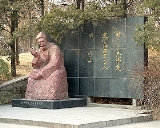
Wen Yiduo

Encyclopedia
Wen Yiduo born Wén Jiāhuá (聞家驊), courtesy name
s Yǒusān (友三), Youshan (友山), was a Chinese
poet and scholar.
. In 1922, he traveled to the United States
to study fine arts and literature
at the Art Institute of Chicago
. It was during this time that his first collection of poetry, Hongzhu (紅燭, "Red Candle"), was published. In 1925, he traveled back to China
and took a university teaching post. In 1928, his second collection, Sishui (死水, "Dead Water"), was published. His poetry is influenced by Western models. In the same year he joined the Crescent Moon Society
and wrote essays on poetry, mostly stressing that poetry should have "formal properties". He also began to publish the results of his classical Chinese literature
research.
At the outbreak of the Second Sino-Japanese War
, he moved to Kunming
, Yunnan
, and continued to teach in National Southwestern Associated University
. He became politically active in 1944 in support of the China Democratic League
and continued to be so until his death. His outspoken nature led to his assassination
by secret agents of Kuomintang
, right after eulogizing his friend Li Gongpu's funeral in 1946.
His grave can be found at the Yunnan Normal University
campus in Kunming
.
Chinese style name
A Chinese style name, sometimes also known as a courtesy name , is a given name to be used later in life. After 20 years of age, the zì is assigned in place of one's given name as a symbol of adulthood and respect...
s Yǒusān (友三), Youshan (友山), was a Chinese
Chinese people
The term Chinese people may refer to any of the following:*People with Han Chinese ethnicity ....
poet and scholar.
Biography
Wen was born in Xishui County, Hubei. After receiving a traditional education he went on to continue studying at the Tsinghua UniversityTsinghua University
Tsinghua University , colloquially known in Chinese as Qinghua, is a university in Beijing, China. The school is one of the nine universities of the C9 League. It was established in 1911 under the name "Tsinghua Xuetang" or "Tsinghua College" and was renamed the "Tsinghua School" one year later...
. In 1922, he traveled to the United States
United States
The United States of America is a federal constitutional republic comprising fifty states and a federal district...
to study fine arts and literature
Literature
Literature is the art of written works, and is not bound to published sources...
at the Art Institute of Chicago
Art Institute of Chicago
The School of the Art Institute of Chicago is one of America's largest accredited independent schools of art and design, located in the Loop in Chicago, Illinois. It is associated with the museum of the same name, and "The Art Institute of Chicago" or "Chicago Art Institute" often refers to either...
. It was during this time that his first collection of poetry, Hongzhu (紅燭, "Red Candle"), was published. In 1925, he traveled back to China
China
Chinese civilization may refer to:* China for more general discussion of the country.* Chinese culture* Greater China, the transnational community of ethnic Chinese.* History of China* Sinosphere, the area historically affected by Chinese culture...
and took a university teaching post. In 1928, his second collection, Sishui (死水, "Dead Water"), was published. His poetry is influenced by Western models. In the same year he joined the Crescent Moon Society
Crescent Moon Society
The Crescent Moon Society was a Chinese literary society founded by the poet Xu Zhimo in 1923, which operated until 1931. It was named after The Crescent Moon, a poem by Rabindranath Tagore...
and wrote essays on poetry, mostly stressing that poetry should have "formal properties". He also began to publish the results of his classical Chinese literature
Chinese literature
Chinese literature extends thousands of years, from the earliest recorded dynastic court archives to the mature fictional novels that arose during the Ming Dynasty to entertain the masses of literate Chinese...
research.
At the outbreak of the Second Sino-Japanese War
Second Sino-Japanese War
The Second Sino-Japanese War was a military conflict fought primarily between the Republic of China and the Empire of Japan. From 1937 to 1941, China fought Japan with some economic help from Germany , the Soviet Union and the United States...
, he moved to Kunming
Kunming
' is the capital and largest city of Yunnan Province in Southwest China. It was known as Yunnan-Fou until the 1920s. A prefecture-level city, it is the political, economic, communications and cultural centre of Yunnan, and is the seat of the provincial government...
, Yunnan
Yunnan
Yunnan is a province of the People's Republic of China, located in the far southwest of the country spanning approximately and with a population of 45.7 million . The capital of the province is Kunming. The province borders Burma, Laos, and Vietnam.Yunnan is situated in a mountainous area, with...
, and continued to teach in National Southwestern Associated University
National Southwestern Associated University
When the Second Sino-Japanese War broke out between China and Japan in 1937, Peking University, Tsinghua University and Nankai University, merged to form Changsha Temporary University in Changsha, and later National Southwestern Associated University in Kunming...
. He became politically active in 1944 in support of the China Democratic League
China Democratic League
The China Democratic League is one of the eight legally recognised political parties in the People's Republic of China.The party was established in 1939 and took its present name in 1944. At its formation, it was a coalition of three pro-democracy parties and three pressure groups...
and continued to be so until his death. His outspoken nature led to his assassination
Assassination
To carry out an assassination is "to murder by a sudden and/or secret attack, often for political reasons." Alternatively, assassination may be defined as "the act of deliberately killing someone, especially a public figure, usually for hire or for political reasons."An assassination may be...
by secret agents of Kuomintang
Kuomintang
The Kuomintang of China , sometimes romanized as Guomindang via the Pinyin transcription system or GMD for short, and translated as the Chinese Nationalist Party is a founding and ruling political party of the Republic of China . Its guiding ideology is the Three Principles of the People, espoused...
, right after eulogizing his friend Li Gongpu's funeral in 1946.
His grave can be found at the Yunnan Normal University
Yunnan Normal University
Yunnan Normal University is located in Kunming, the capital city of Yunnan Province. Established in 1938 as the National Normal College of Southwestern Union University based on Beijing University, Tsinghua University, and Nankai University, it was named as National Kunming Normal College in 1946...
campus in Kunming
Kunming
' is the capital and largest city of Yunnan Province in Southwest China. It was known as Yunnan-Fou until the 1920s. A prefecture-level city, it is the political, economic, communications and cultural centre of Yunnan, and is the seat of the provincial government...
.
Further reading
- Chinese Writers on Writing featuring Wen Yiduo. Ed. Arthur SzeArthur SzeArthur Sze is a second-generation Chinese American poet.-Background:Sze was educated at the University of California, Berkeley, and is the author of eight books of poetry...
. (Trinity University Press, 2010).