
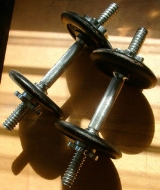
Weight training is a common type of
strength trainingStrength training is the use of resistance to muscular contraction to build the strength, anaerobic endurance, and size of skeletal muscles. There are many different methods of strength training, the most common being the use of gravity or elastic/hydraulic forces to oppose muscle contraction...
for developing the
strengthPhysical strength is the ability of a person or animal to exert force on physical objects using muscles. Increasing physical strength is the goal of strength training.-Overview:...
and size of
skeletal muscleSkeletal muscle is a form of striated muscle tissue existing under control of the somatic nervous system- i.e. it is voluntarily controlled. It is one of three major muscle types, the others being cardiac and smooth muscle...
s. It uses the weight force of gravity (in the form of weighted bars, dumbbells or weight stacks) to oppose the force generated by muscle through concentric or eccentric contraction. Weight training uses a variety of specialized equipment to target specific muscle groups and types of movement.
Weight training differs from
bodybuildingBodybuilding is a form of body modification involving intensive muscle hypertrophy. An individual who engages in this activity is referred to as a bodybuilder. In competitive and professional bodybuilding, bodybuilders display their physiques to a panel of judges, who assign points based on their...
, Olympic weightlifting,
powerliftingPowerlifting is a strength sport. It resembles the sport of Olympic weightlifting, as both disciplines involve lifting weights in three attempts. Powerlifting evolved from a sport known as 'odd lifts' which followed the same three attempt format but used a wide variety of events akin to Strongman...
, and
strongmanIn the 19th century, the term strongman referred to an exhibitor of strength or circus performers of similar ilk who displayed feats of strength such as the bent press , supporting large amounts of...
, which are
sportA Sport is all forms of physical activity which, through casual or organised participation, aim to use, maintain or improve physical fitness and provide entertainment to participants. Sport may be competitive, where a winner or winners can be identified by objective means, and may require a degree...
s rather than forms of exercise. Weight training, however, is often part of the athlete's training regimen.
Weight training versus other types of exercise
Strength training is an inclusive term that describes all exercises devoted toward increasing
physical strengthPhysical strength is the ability of a person or animal to exert force on physical objects using muscles. Increasing physical strength is the goal of strength training.-Overview:...
. Weight training is a type of strength training that uses weights rather than
elasticResistance training has two different meanings. A broader meaning that refers to any training that uses a resistance to the force of muscular contraction , and elastic or hydraulic resistance, which refers to a specific type of strength training that uses elastic or hydraulic tension to provide...
,
Eccentric TrainingEccentric training is the lowering phase of an exercise. For example, in a biceps curl the action of lowering the dumbbell back down from the lift is the eccentric phase of that exercise — as long as the dumbbell is lowered slowly rather than letting it drop....
or
muscularIsometric exercise or isometrics are a type of strength training in which the joint angle and muscle length do not change during contraction...
resistance to increase strength.
Endurance trainingEndurance training is the deliberate act of exercising to increase stamina and endurance. Exercises for endurance tends to be aerobic in nature versus anaerobic movements. Aerobic exercise develops slow twitch muscles...
is associated with
aerobic exerciseAerobic exercise is physical exercise of relatively low intensity that depends primarily on the aerobic energy-generating process. Aerobic literally means "living in air", and refers to the use of oxygen to adequately meet energy demands during exercise via aerobic metabolism...
while
flexibilityFlexibility or limberness refers to the absolute range of movement in a joint or series of joints, and length in muscles that cross the joints. Flexibility is variable between individuals, particularly in terms of differences in muscle length of multi-joint muscles...
training is associated with stretching exercise like
yogaAsana is a body position, typically associated with the practice of Yoga, originally identified as a mastery of sitting still, with the spine as a conduit of biodynamic union...
or
pilatesPilates is a physical fitness system developed in the early 20th century by Joseph Pilates in Germany, the UK and the USA. As of 2005, there were 11 million people practicing the discipline regularly and 14,000 instructors in the United States....
.
Weight training is often used as a synonym for strength training, but is actually a specific type within the more inclusive category.
History of weight training
The genealogy of lifting can be traced back to the beginning of recorded history where man's fascination with physical abilities can be found among numerous ancient writings. Progressive resistance training dates back at least to
Ancient GreeceAncient Greece is a civilization belonging to a period of Greek history that lasted from the Archaic period of the 8th to 6th centuries BC to the end of antiquity. Immediately following this period was the beginning of the Early Middle Ages and the Byzantine era. Included in Ancient Greece is the...
, when legend has it that wrestler
Milo of CrotonMilo of Croton was a 6th century BC wrestler from the Magna Graecian city of Croton in southern Italy who enjoyed a brilliant wrestling career and won many victories in the most important athletic festivals of ancient Greece...
trained by carrying a newborn
calfCalves are the young of domestic cattle. Calves are reared to become adult cattle, or are slaughtered for their meat, called veal.-Terminology:...
on his back every day until it was fully grown. Another Greek, the physician
GalenAelius Galenus or Claudius Galenus , better known as Galen of Pergamon , was a prominent Roman physician, surgeon and philosopher...
, described strength training exercises using the
halteresHalteres were a type of dumbbells used in Ancient Greece. In ancient Greek sports, halteres were used as lifting weights, and also as weights in their version of the long jump, which was probably a set of three jumps. Halteres were held in both hands to allow an athlete to jump a greater distance;...
(an early form of dumbbell) in the 2nd century.
Ancient Greek sculptures also depict lifting feats. The weights were generally stones, but later gave way to dumbbells. The dumbbell was joined by the barbell in the later half of the 19th century. Early barbells had hollow globes that could be filled with
sandSand is a naturally occurring granular material composed of finely divided rock and mineral particles.The composition of sand is highly variable, depending on the local rock sources and conditions, but the most common constituent of sand in inland continental settings and non-tropical coastal...
or
lead shotLead shot is a collective term for small balls of lead. These were the original projectiles for muskets and early rifles, but today lead shot is fired primarily from shotguns. It is also used for a variety of other purposes...
, but by the end of the century these were replaced by the plate-loading barbell commonly used today.
Another early device was the Indian club, which came from ancient Persia where it was called the "meels". It subsequently became popular during the 19th century, and has recently made a comeback in the form of the clubbell.
The 1960s saw the gradual introduction of
exercise machineAn exercise machine is any machine used for physical exercise. These range from simple spring-like devices to computerized electromechanical rides to recirculating-stream swimming pools...
s into the still-rare strength training
gymThe word γυμνάσιον was used in Ancient Greece, that mean a locality for both physical and intellectual education of young men...
s of the time. Weight training became increasingly popular in the 1970s, following the release of the bodybuilding movie
Pumping IronPumping Iron is a 1977 docudrama about the world of bodybuilding, focusing on the 1975 IFBB Mr. Universe and Mr. Olympia competitions and the 100 days leading up to them. The film was inspired by a book of the same name, written by Charles Gaines and George Butler...
, and the subsequent popularity of
Arnold SchwarzeneggerArnold Alois Schwarzenegger is an Austrian-American former professional bodybuilder, actor, businessman, investor, and politician. Schwarzenegger served as the 38th Governor of California from 2003 until 2011....
. Since the late 1990s increasing numbers of women have taken up weight training, influenced by programs like
Body for LifeBody for Life is a 12-week nutrition and exercise program, and also an annual physique transformation competition. It was created by Bill Phillips, a former competitive bodybuilder and owner of EAS, a manufacturer of nutritional supplements. It has been popularized by a bestselling book of the...
; currently nearly one in five U.S. women engages in weight training on a regular basis.
Basic principles
The basic principles of weight training are essentially identical to those of strength training, and involve a manipulation of the number of repetitions (reps), sets, tempo, exercise types, and weight moved to cause desired increases in strength, endurance, and size. The specific combinations of reps, sets, exercises, and weights depends on the aims of the individual performing the exercise; sets with fewer reps can be performed with heavier weights.
In addition to the basic principles of
strength training, a further consideration added by weight training is the equipment used. Types of equipment include
barbellA barbell is a piece of exercise equipment used in weight training, weightlifting and powerlifting. Barbells range in length from to although bars above 7' in length are used primarily by powerlifters and aren't commonplace...
s, dumbbells, pulleys and stacks in the form of
weight machineA weight machine is an exercise machine used for weight training that uses gravity as the primary source of resistance and a combination of simple machines to convey that resistance to the person using the machine...
s, and the body's own weight in the case of
chin-upThe chin-up is a strength training exercise. The verb chinning means to do them. People frequently do this exercise with the intention of strengthening muscles such as the latissimus dorsi and biceps, which extend the shoulder and flex the elbow, respectively.It is a form of pull-up in which the...
s and
push-upsFor the 2004 single by Freestylers, see Push UpA push-up, or in British English a press-up, is a common calisthenics exercise performed in a prone position by raising and lowering the body using the arms...
. Different types of weights will give different types of resistance, and often the same absolute weight can have different relative weights depending on the type of equipment used. For example, lifting 10 kilograms using a dumbbell sometimes requires more force than moving 10 kilograms on a weight stack if certain pulley arrangements are used. In other cases, the weight stack may require more force than the equivalent dumbbell weight due to additional torque or resistance in the machine.
Weight training also requires the use of '
good formForm is a specific way of performing a movement, often a strength training exercise, to avoid injury, prevent cheating and increase strength.-'Proper form':Exercises or drills in sport have a recognized way of performing the movements that have two purposes:...
', performing the movements with the appropriate muscle group, and not transferring the weight to different body parts in order to move greater weight (called 'cheating'). Failure to use good form during a training set can result in injury or a failure to meet training goals; since the desired muscle group is not challenged sufficiently, the threshold of overload is never reached and the muscle does not gain in strength.
Comparison to other types of strength training
The benefits of weight training overall are comparable to most other types of strength training: increased muscle, tendon and ligament strength, bone density, flexibility, tone, metabolic rate, and postural support. There are benefits and limitations to weight training as compared to other types of strength training.
Weight training versus resistance training
Resistance trainingResistance training has two different meanings. A broader meaning that refers to any training that uses a resistance to the force of muscular contraction , and elastic or hydraulic resistance, which refers to a specific type of strength training that uses elastic or hydraulic tension to provide...
involves the application of elastic or hydraulic resistance to muscle contraction rather than gravity. Weight training provides the majority of the resistance at the beginning, initiation joint angle of the movement, when the muscle must overcome the inertia of the weight's mass. After this point the overall resistance alters depending on the angle of the joint. In comparison, hydraulic resistance provides a fixed amount of resistance throughout the range of motion, depending on the speed of the movement. Elastic resistance provides the greatest resistance at the end of the motion, when the elastic element is stretched to the greatest extent.
Weight training versus isometric training
Isometric exerciseIsometric exercise or isometrics are a type of strength training in which the joint angle and muscle length do not change during contraction...
provides a fixed amount of resistance based on the force output of the muscle. This strengthens the muscle at the specific joint angle at which the isometric exercise occurs, with some lesser gains in strength also occurring at proximal joint angles. In comparison, weight training strengthens the muscle throughout the
range of motionRange of motion , is the distance that a movable object may normally travel while properly attached to another object. It is also called range of travel, particularly when talking about mechanical devices and in mechanical engineering fields...
the
jointA joint is the location at which two or more bones make contact. They are constructed to allow movement and provide mechanical support, and are classified structurally and functionally.-Classification:...
is trained in, causing an increase in physical strength from the initiating through to terminating joint angle.
Weight training and bodybuilding
Although weight training is similar to bodybuilding, they have different objectives. Bodybuilders use weight training to develop their muscles for size, shape, and symmetry regardless of any increase in strength for competition in bodybuilding contests; they train to maximize their muscular size and develop extremely low levels of
body fatIn histology, adipose tissue or body fat or fat depot or just fat is loose connective tissue composed of adipocytes. It is technically composed of roughly only 80% fat; fat in its solitary state exists in the liver and muscles. Adipose tissue is derived from lipoblasts...
. In contrast, many weight trainers train to improve their strength and anaerobic endurance while not giving special attention to reducing body fat far below normal.
The bodybuilding community has been the source of many of weight training's principles, techniques, vocabulary, and customs. Weight training does allow tremendous flexibility in exercises and weights which can allow bodybuilders to target specific muscles and muscle groups, as well as attain specific goals. Not all bodybuilding is undertaken to compete in bodybuilding contests, and, in fact the vast majority of bodybuilders never compete, but bodybuild for their own personal reasons.
Safety
Weight training is a safe form of exercise when the movements are slow, controlled, and carefully defined. However, as with any form of exercise, improper execution and the failure to take appropriate precautions can result in injury.
Maintaining proper form
When the exercise becomes difficult towards the end of a set, there is a temptation to cheat, i.e., to use poor form to recruit other muscle groups to assist the effort. This may shift the effort to weaker muscles that cannot handle the weight. For example, the
squatIn strength training, the squat is a compound, full body exercise that trains primarily the muscles of the thighs, hips and buttocks, quads , hamstrings, as well as strengthening the bones, ligaments and insertion of the tendons throughout the lower body...
and the
deadliftThe deadlift is a weight training exercise where a loaded barbell is lifted off the ground from a stabilized, bent over position. It is one of the three canonical powerlifting exercises, along with the squat and bench press.-Overview:...
are used to exercise the largest muscles in the body—the
legThe human leg is the entire lower extremity or limb of the human body, including the foot, thigh and even the hip or gluteal region; however, the precise definition in human anatomy refers only to the section of the lower limb extending from the knee to the ankle.Legs are used for standing,...
and buttock muscles—so they require substantial weight. Beginners are tempted to round their back while performing these exercises. The relaxation of the spinal erectors which allows the lower back to round can cause shearing in the vertebrae of the lumbar spine, potentially damaging the spinal discs.
Stretching and warm-up
Weight trainers commonly spend 5 to 20 minutes
warming upA warm-up is usually performed before participating in technical sports or exercising. A warm-up generally consists of a gradual increase in intensity in physical activity , a joint mobility exercise, stretching and a sport related activity. For example, before running or playing an intense sport...
their muscles before starting a workout. It's common to stretch the entire body to increase overall
flexibilityFlexibility or limberness refers to the absolute range of movement in a joint or series of joints, and length in muscles that cross the joints. Flexibility is variable between individuals, particularly in terms of differences in muscle length of multi-joint muscles...
; however, many people stretch just the area being worked that day.
Warm up sets are also important. For example the same lifter working on his chest would also be advised to complete at least two warm up sets prior to hitting his "core tonnage." Core tonnage refers to the heavier lifts that actually strain your muscles. For example if the lifter's main sets were at 205 lbs, 225 lbs and 235 lbs on the bench, then a warmup of 5 reps of 135 and 5 reps of 185 would be advisable. When properly warmed up the lifter will then have more strength and stamina since the blood has begun to flow to the muscle groups.
Breathing
Breathing shallowly or holding one's breath while working out limits the oxygen supply to the muscles and the brain, decreasing performance and, under extreme stress, risking a
black-outSyncope , the medical term for fainting, is precisely defined as a transient loss of consciousness and postural tone characterized by rapid onset, short duration, and spontaneous recovery due to global cerebral hypoperfusion that most often results from hypotension.Many forms of syncope are...
or a
strokeA stroke, previously known medically as a cerebrovascular accident , is the rapidly developing loss of brain function due to disturbance in the blood supply to the brain. This can be due to ischemia caused by blockage , or a hemorrhage...
by
aneurysmAn aneurysm or aneurism is a localized, blood-filled balloon-like bulge in the wall of a blood vessel. Aneurysms can commonly occur in arteries at the base of the brain and an aortic aneurysm occurs in the main artery carrying blood from the left ventricle of the heart...
. Some people advise weight trainers to conscientiously "exhale on effort" and to inhale when lowering the weight. This technique ensures that the trainer breathes through the most difficult part of the exercise, where one would reflexively hold one's breath.
Other coaches advise trainees to perform the
valsalva maneuverThe Valsalva maneuver or Valsalva manoeuvre is performed by moderately forceful attempted exhalation against a closed airway, usually done by closing one's mouth and pinching one's nose shut...
during exercises which place a load on the spine, since the risk of a stroke by aneurysm is astronomically lower than the risk of an orthopedic injury caused by inadequate rigidity of the torso.
Weight training is a common type of
strength trainingStrength training is the use of resistance to muscular contraction to build the strength, anaerobic endurance, and size of skeletal muscles. There are many different methods of strength training, the most common being the use of gravity or elastic/hydraulic forces to oppose muscle contraction...
for developing the
strengthPhysical strength is the ability of a person or animal to exert force on physical objects using muscles. Increasing physical strength is the goal of strength training.-Overview:...
and size of
skeletal muscleSkeletal muscle is a form of striated muscle tissue existing under control of the somatic nervous system- i.e. it is voluntarily controlled. It is one of three major muscle types, the others being cardiac and smooth muscle...
s. It uses the weight force of gravity (in the form of weighted bars, dumbbells or weight stacks) to oppose the force generated by muscle through concentric or eccentric contraction. Weight training uses a variety of specialized equipment to target specific muscle groups and types of movement.
Weight training differs from
bodybuildingBodybuilding is a form of body modification involving intensive muscle hypertrophy. An individual who engages in this activity is referred to as a bodybuilder. In competitive and professional bodybuilding, bodybuilders display their physiques to a panel of judges, who assign points based on their...
, Olympic weightlifting,
powerliftingPowerlifting is a strength sport. It resembles the sport of Olympic weightlifting, as both disciplines involve lifting weights in three attempts. Powerlifting evolved from a sport known as 'odd lifts' which followed the same three attempt format but used a wide variety of events akin to Strongman...
, and
strongmanIn the 19th century, the term strongman referred to an exhibitor of strength or circus performers of similar ilk who displayed feats of strength such as the bent press , supporting large amounts of...
, which are
sportA Sport is all forms of physical activity which, through casual or organised participation, aim to use, maintain or improve physical fitness and provide entertainment to participants. Sport may be competitive, where a winner or winners can be identified by objective means, and may require a degree...
s rather than forms of exercise. Weight training, however, is often part of the athlete's training regimen.
Weight training versus other types of exercise
Strength training is an inclusive term that describes all exercises devoted toward increasing
physical strengthPhysical strength is the ability of a person or animal to exert force on physical objects using muscles. Increasing physical strength is the goal of strength training.-Overview:...
. Weight training is a type of strength training that uses weights rather than
elasticResistance training has two different meanings. A broader meaning that refers to any training that uses a resistance to the force of muscular contraction , and elastic or hydraulic resistance, which refers to a specific type of strength training that uses elastic or hydraulic tension to provide...
,
Eccentric TrainingEccentric training is the lowering phase of an exercise. For example, in a biceps curl the action of lowering the dumbbell back down from the lift is the eccentric phase of that exercise — as long as the dumbbell is lowered slowly rather than letting it drop....
or
muscularIsometric exercise or isometrics are a type of strength training in which the joint angle and muscle length do not change during contraction...
resistance to increase strength.
Endurance trainingEndurance training is the deliberate act of exercising to increase stamina and endurance. Exercises for endurance tends to be aerobic in nature versus anaerobic movements. Aerobic exercise develops slow twitch muscles...
is associated with
aerobic exerciseAerobic exercise is physical exercise of relatively low intensity that depends primarily on the aerobic energy-generating process. Aerobic literally means "living in air", and refers to the use of oxygen to adequately meet energy demands during exercise via aerobic metabolism...
while
flexibilityFlexibility or limberness refers to the absolute range of movement in a joint or series of joints, and length in muscles that cross the joints. Flexibility is variable between individuals, particularly in terms of differences in muscle length of multi-joint muscles...
training is associated with stretching exercise like
yogaAsana is a body position, typically associated with the practice of Yoga, originally identified as a mastery of sitting still, with the spine as a conduit of biodynamic union...
or
pilatesPilates is a physical fitness system developed in the early 20th century by Joseph Pilates in Germany, the UK and the USA. As of 2005, there were 11 million people practicing the discipline regularly and 14,000 instructors in the United States....
.
Weight training is often used as a synonym for strength training, but is actually a specific type within the more inclusive category.
History of weight training
The genealogy of lifting can be traced back to the beginning of recorded history
where man's fascination with physical abilities can be found among numerous ancient writings. Progressive resistance training dates back at least to
Ancient GreeceAncient Greece is a civilization belonging to a period of Greek history that lasted from the Archaic period of the 8th to 6th centuries BC to the end of antiquity. Immediately following this period was the beginning of the Early Middle Ages and the Byzantine era. Included in Ancient Greece is the...
, when legend has it that wrestler
Milo of CrotonMilo of Croton was a 6th century BC wrestler from the Magna Graecian city of Croton in southern Italy who enjoyed a brilliant wrestling career and won many victories in the most important athletic festivals of ancient Greece...
trained by carrying a newborn
calfCalves are the young of domestic cattle. Calves are reared to become adult cattle, or are slaughtered for their meat, called veal.-Terminology:...
on his back every day until it was fully grown. Another Greek, the physician
GalenAelius Galenus or Claudius Galenus , better known as Galen of Pergamon , was a prominent Roman physician, surgeon and philosopher...
, described strength training exercises using the
halteresHalteres were a type of dumbbells used in Ancient Greece. In ancient Greek sports, halteres were used as lifting weights, and also as weights in their version of the long jump, which was probably a set of three jumps. Halteres were held in both hands to allow an athlete to jump a greater distance;...
(an early form of dumbbell) in the 2nd century.
Ancient Greek sculptures also depict lifting feats. The weights were generally stones, but later gave way to dumbbells. The dumbbell was joined by the barbell in the later half of the 19th century. Early barbells had hollow globes that could be filled with
sandSand is a naturally occurring granular material composed of finely divided rock and mineral particles.The composition of sand is highly variable, depending on the local rock sources and conditions, but the most common constituent of sand in inland continental settings and non-tropical coastal...
or
lead shotLead shot is a collective term for small balls of lead. These were the original projectiles for muskets and early rifles, but today lead shot is fired primarily from shotguns. It is also used for a variety of other purposes...
, but by the end of the century these were replaced by the plate-loading barbell commonly used today.
Another early device was the Indian club, which came from ancient Persia where it was called the "meels". It subsequently became popular during the 19th century, and has recently made a comeback in the form of the clubbell.
The 1960s saw the gradual introduction of
exercise machineAn exercise machine is any machine used for physical exercise. These range from simple spring-like devices to computerized electromechanical rides to recirculating-stream swimming pools...
s into the still-rare strength training
gymThe word γυμνάσιον was used in Ancient Greece, that mean a locality for both physical and intellectual education of young men...
s of the time. Weight training became increasingly popular in the 1970s, following the release of the bodybuilding movie
Pumping IronPumping Iron is a 1977 docudrama about the world of bodybuilding, focusing on the 1975 IFBB Mr. Universe and Mr. Olympia competitions and the 100 days leading up to them. The film was inspired by a book of the same name, written by Charles Gaines and George Butler...
, and the subsequent popularity of
Arnold SchwarzeneggerArnold Alois Schwarzenegger is an Austrian-American former professional bodybuilder, actor, businessman, investor, and politician. Schwarzenegger served as the 38th Governor of California from 2003 until 2011....
. Since the late 1990s increasing numbers of women have taken up weight training, influenced by programs like
Body for LifeBody for Life is a 12-week nutrition and exercise program, and also an annual physique transformation competition. It was created by Bill Phillips, a former competitive bodybuilder and owner of EAS, a manufacturer of nutritional supplements. It has been popularized by a bestselling book of the...
; currently nearly one in five U.S. women engages in weight training on a regular basis.
Basic principles
The basic principles of weight training are essentially identical to those of strength training, and involve a manipulation of the number of repetitions (reps), sets, tempo, exercise types, and weight moved to cause desired increases in strength, endurance, and size. The specific combinations of reps, sets, exercises, and weights depends on the aims of the individual performing the exercise; sets with fewer reps can be performed with heavier weights.
In addition to the basic principles of
strength training, a further consideration added by weight training is the equipment used. Types of equipment include
barbellA barbell is a piece of exercise equipment used in weight training, weightlifting and powerlifting. Barbells range in length from to although bars above 7' in length are used primarily by powerlifters and aren't commonplace...
s, dumbbells, pulleys and stacks in the form of
weight machineA weight machine is an exercise machine used for weight training that uses gravity as the primary source of resistance and a combination of simple machines to convey that resistance to the person using the machine...
s, and the body's own weight in the case of
chin-upThe chin-up is a strength training exercise. The verb chinning means to do them. People frequently do this exercise with the intention of strengthening muscles such as the latissimus dorsi and biceps, which extend the shoulder and flex the elbow, respectively.It is a form of pull-up in which the...
s and
push-upsFor the 2004 single by Freestylers, see Push UpA push-up, or in British English a press-up, is a common calisthenics exercise performed in a prone position by raising and lowering the body using the arms...
. Different types of weights will give different types of resistance, and often the same absolute weight can have different relative weights depending on the type of equipment used. For example, lifting 10 kilograms using a dumbbell sometimes requires more force than moving 10 kilograms on a weight stack if certain pulley arrangements are used. In other cases, the weight stack may require more force than the equivalent dumbbell weight due to additional torque or resistance in the machine.
Weight training also requires the use of '
good formForm is a specific way of performing a movement, often a strength training exercise, to avoid injury, prevent cheating and increase strength.-'Proper form':Exercises or drills in sport have a recognized way of performing the movements that have two purposes:...
', performing the movements with the appropriate muscle group, and not transferring the weight to different body parts in order to move greater weight (called 'cheating'). Failure to use good form during a training set can result in injury or a failure to meet training goals; since the desired muscle group is not challenged sufficiently, the threshold of overload is never reached and the muscle does not gain in strength.
Comparison to other types of strength training
The benefits of weight training overall are comparable to most other types of strength training: increased muscle, tendon and ligament strength, bone density, flexibility, tone, metabolic rate, and postural support. There are benefits and limitations to weight training as compared to other types of strength training.
Weight training versus resistance training
Resistance trainingResistance training has two different meanings. A broader meaning that refers to any training that uses a resistance to the force of muscular contraction , and elastic or hydraulic resistance, which refers to a specific type of strength training that uses elastic or hydraulic tension to provide...
involves the application of elastic or hydraulic resistance to muscle contraction rather than gravity. Weight training provides the majority of the resistance at the beginning, initiation joint angle of the movement, when the muscle must overcome the inertia of the weight's mass. After this point the overall resistance alters depending on the angle of the joint. In comparison, hydraulic resistance provides a fixed amount of resistance throughout the range of motion, depending on the speed of the movement. Elastic resistance provides the greatest resistance at the end of the motion, when the elastic element is stretched to the greatest extent.
Weight training versus isometric training
Isometric exerciseIsometric exercise or isometrics are a type of strength training in which the joint angle and muscle length do not change during contraction...
provides a fixed amount of resistance based on the force output of the muscle. This strengthens the muscle at the specific joint angle at which the isometric exercise occurs, with some lesser gains in strength also occurring at proximal joint angles.
In comparison, weight training strengthens the muscle throughout the
range of motionRange of motion , is the distance that a movable object may normally travel while properly attached to another object. It is also called range of travel, particularly when talking about mechanical devices and in mechanical engineering fields...
the
jointA joint is the location at which two or more bones make contact. They are constructed to allow movement and provide mechanical support, and are classified structurally and functionally.-Classification:...
is trained in, causing an increase in physical strength from the initiating through to terminating joint angle.
Weight training and bodybuilding
Although weight training is similar to bodybuilding, they have different objectives. Bodybuilders use weight training to develop their muscles for size, shape, and symmetry regardless of any increase in strength for competition in bodybuilding contests; they train to maximize their muscular size and develop extremely low levels of
body fatIn histology, adipose tissue or body fat or fat depot or just fat is loose connective tissue composed of adipocytes. It is technically composed of roughly only 80% fat; fat in its solitary state exists in the liver and muscles. Adipose tissue is derived from lipoblasts...
. In contrast, many weight trainers train to improve their strength and anaerobic endurance while not giving special attention to reducing body fat far below normal.
The bodybuilding community has been the source of many of weight training's principles, techniques, vocabulary, and customs. Weight training does allow tremendous flexibility in exercises and weights which can allow bodybuilders to target specific muscles and muscle groups, as well as attain specific goals. Not all bodybuilding is undertaken to compete in bodybuilding contests, and, in fact the vast majority of bodybuilders never compete, but bodybuild for their own personal reasons.
Safety
Weight training is a safe form of exercise when the movements are slow, controlled, and carefully defined. However, as with any form of exercise, improper execution and the failure to take appropriate precautions can result in injury.
Maintaining proper form
When the exercise becomes difficult towards the end of a set, there is a temptation to cheat, i.e., to use poor form to recruit other muscle groups to assist the effort. This may shift the effort to weaker muscles that cannot handle the weight. For example, the
squatIn strength training, the squat is a compound, full body exercise that trains primarily the muscles of the thighs, hips and buttocks, quads , hamstrings, as well as strengthening the bones, ligaments and insertion of the tendons throughout the lower body...
and the
deadliftThe deadlift is a weight training exercise where a loaded barbell is lifted off the ground from a stabilized, bent over position. It is one of the three canonical powerlifting exercises, along with the squat and bench press.-Overview:...
are used to exercise the largest muscles in the body—the
legThe human leg is the entire lower extremity or limb of the human body, including the foot, thigh and even the hip or gluteal region; however, the precise definition in human anatomy refers only to the section of the lower limb extending from the knee to the ankle.Legs are used for standing,...
and buttock muscles—so they require substantial weight. Beginners are tempted to round their back while performing these exercises. The relaxation of the spinal erectors which allows the lower back to round can cause shearing in the vertebrae of the lumbar spine, potentially damaging the spinal discs.
Stretching and warm-up
Weight trainers commonly spend 5 to 20 minutes
warming upA warm-up is usually performed before participating in technical sports or exercising. A warm-up generally consists of a gradual increase in intensity in physical activity , a joint mobility exercise, stretching and a sport related activity. For example, before running or playing an intense sport...
their muscles before starting a workout. It's common to stretch the entire body to increase overall
flexibilityFlexibility or limberness refers to the absolute range of movement in a joint or series of joints, and length in muscles that cross the joints. Flexibility is variable between individuals, particularly in terms of differences in muscle length of multi-joint muscles...
; however, many people stretch just the area being worked that day.
Warm up sets are also important. For example the same lifter working on his chest would also be advised to complete at least two warm up sets prior to hitting his "core tonnage." Core tonnage refers to the heavier lifts that actually strain your muscles. For example if the lifter's main sets were at 205 lbs, 225 lbs and 235 lbs on the bench, then a warmup of 5 reps of 135 and 5 reps of 185 would be advisable. When properly warmed up the lifter will then have more strength and stamina since the blood has begun to flow to the muscle groups.
Breathing
Breathing shallowly or holding one's breath while working out limits the oxygen supply to the muscles and the brain, decreasing performance and, under extreme stress, risking a
black-outSyncope , the medical term for fainting, is precisely defined as a transient loss of consciousness and postural tone characterized by rapid onset, short duration, and spontaneous recovery due to global cerebral hypoperfusion that most often results from hypotension.Many forms of syncope are...
or a
strokeA stroke, previously known medically as a cerebrovascular accident , is the rapidly developing loss of brain function due to disturbance in the blood supply to the brain. This can be due to ischemia caused by blockage , or a hemorrhage...
by
aneurysmAn aneurysm or aneurism is a localized, blood-filled balloon-like bulge in the wall of a blood vessel. Aneurysms can commonly occur in arteries at the base of the brain and an aortic aneurysm occurs in the main artery carrying blood from the left ventricle of the heart...
. Some people advise weight trainers to conscientiously "exhale on effort" and to inhale when lowering the weight. This technique ensures that the trainer breathes through the most difficult part of the exercise, where one would reflexively hold one's breath.
Other coaches advise trainees to perform the
valsalva maneuverThe Valsalva maneuver or Valsalva manoeuvre is performed by moderately forceful attempted exhalation against a closed airway, usually done by closing one's mouth and pinching one's nose shut...
during exercises which place a load on the spine, since the risk of a stroke by aneurysm is astronomically lower than the risk of an orthopedic injury caused by inadequate rigidity of the torso.
Weight training is a common type of
strength trainingStrength training is the use of resistance to muscular contraction to build the strength, anaerobic endurance, and size of skeletal muscles. There are many different methods of strength training, the most common being the use of gravity or elastic/hydraulic forces to oppose muscle contraction...
for developing the
strengthPhysical strength is the ability of a person or animal to exert force on physical objects using muscles. Increasing physical strength is the goal of strength training.-Overview:...
and size of
skeletal muscleSkeletal muscle is a form of striated muscle tissue existing under control of the somatic nervous system- i.e. it is voluntarily controlled. It is one of three major muscle types, the others being cardiac and smooth muscle...
s. It uses the weight force of gravity (in the form of weighted bars, dumbbells or weight stacks) to oppose the force generated by muscle through concentric or eccentric contraction. Weight training uses a variety of specialized equipment to target specific muscle groups and types of movement.
Weight training differs from
bodybuildingBodybuilding is a form of body modification involving intensive muscle hypertrophy. An individual who engages in this activity is referred to as a bodybuilder. In competitive and professional bodybuilding, bodybuilders display their physiques to a panel of judges, who assign points based on their...
, Olympic weightlifting,
powerliftingPowerlifting is a strength sport. It resembles the sport of Olympic weightlifting, as both disciplines involve lifting weights in three attempts. Powerlifting evolved from a sport known as 'odd lifts' which followed the same three attempt format but used a wide variety of events akin to Strongman...
, and
strongmanIn the 19th century, the term strongman referred to an exhibitor of strength or circus performers of similar ilk who displayed feats of strength such as the bent press , supporting large amounts of...
, which are
sportA Sport is all forms of physical activity which, through casual or organised participation, aim to use, maintain or improve physical fitness and provide entertainment to participants. Sport may be competitive, where a winner or winners can be identified by objective means, and may require a degree...
s rather than forms of exercise. Weight training, however, is often part of the athlete's training regimen.
Weight training versus other types of exercise
Strength training is an inclusive term that describes all exercises devoted toward increasing
physical strengthPhysical strength is the ability of a person or animal to exert force on physical objects using muscles. Increasing physical strength is the goal of strength training.-Overview:...
. Weight training is a type of strength training that uses weights rather than
elasticResistance training has two different meanings. A broader meaning that refers to any training that uses a resistance to the force of muscular contraction , and elastic or hydraulic resistance, which refers to a specific type of strength training that uses elastic or hydraulic tension to provide...
,
Eccentric TrainingEccentric training is the lowering phase of an exercise. For example, in a biceps curl the action of lowering the dumbbell back down from the lift is the eccentric phase of that exercise — as long as the dumbbell is lowered slowly rather than letting it drop....
or
muscularIsometric exercise or isometrics are a type of strength training in which the joint angle and muscle length do not change during contraction...
resistance to increase strength.
Endurance trainingEndurance training is the deliberate act of exercising to increase stamina and endurance. Exercises for endurance tends to be aerobic in nature versus anaerobic movements. Aerobic exercise develops slow twitch muscles...
is associated with
aerobic exerciseAerobic exercise is physical exercise of relatively low intensity that depends primarily on the aerobic energy-generating process. Aerobic literally means "living in air", and refers to the use of oxygen to adequately meet energy demands during exercise via aerobic metabolism...
while
flexibilityFlexibility or limberness refers to the absolute range of movement in a joint or series of joints, and length in muscles that cross the joints. Flexibility is variable between individuals, particularly in terms of differences in muscle length of multi-joint muscles...
training is associated with stretching exercise like
yogaAsana is a body position, typically associated with the practice of Yoga, originally identified as a mastery of sitting still, with the spine as a conduit of biodynamic union...
or
pilatesPilates is a physical fitness system developed in the early 20th century by Joseph Pilates in Germany, the UK and the USA. As of 2005, there were 11 million people practicing the discipline regularly and 14,000 instructors in the United States....
.
Weight training is often used as a synonym for strength training, but is actually a specific type within the more inclusive category.
History of weight training
The genealogy of lifting can be traced back to the beginning of recorded history
where man's fascination with physical abilities can be found among numerous ancient writings. Progressive resistance training dates back at least to
Ancient GreeceAncient Greece is a civilization belonging to a period of Greek history that lasted from the Archaic period of the 8th to 6th centuries BC to the end of antiquity. Immediately following this period was the beginning of the Early Middle Ages and the Byzantine era. Included in Ancient Greece is the...
, when legend has it that wrestler
Milo of CrotonMilo of Croton was a 6th century BC wrestler from the Magna Graecian city of Croton in southern Italy who enjoyed a brilliant wrestling career and won many victories in the most important athletic festivals of ancient Greece...
trained by carrying a newborn
calfCalves are the young of domestic cattle. Calves are reared to become adult cattle, or are slaughtered for their meat, called veal.-Terminology:...
on his back every day until it was fully grown. Another Greek, the physician
GalenAelius Galenus or Claudius Galenus , better known as Galen of Pergamon , was a prominent Roman physician, surgeon and philosopher...
, described strength training exercises using the
halteresHalteres were a type of dumbbells used in Ancient Greece. In ancient Greek sports, halteres were used as lifting weights, and also as weights in their version of the long jump, which was probably a set of three jumps. Halteres were held in both hands to allow an athlete to jump a greater distance;...
(an early form of dumbbell) in the 2nd century.
Ancient Greek sculptures also depict lifting feats. The weights were generally stones, but later gave way to dumbbells. The dumbbell was joined by the barbell in the later half of the 19th century. Early barbells had hollow globes that could be filled with
sandSand is a naturally occurring granular material composed of finely divided rock and mineral particles.The composition of sand is highly variable, depending on the local rock sources and conditions, but the most common constituent of sand in inland continental settings and non-tropical coastal...
or
lead shotLead shot is a collective term for small balls of lead. These were the original projectiles for muskets and early rifles, but today lead shot is fired primarily from shotguns. It is also used for a variety of other purposes...
, but by the end of the century these were replaced by the plate-loading barbell commonly used today.
Another early device was the Indian club, which came from ancient Persia where it was called the "meels". It subsequently became popular during the 19th century, and has recently made a comeback in the form of the clubbell.
The 1960s saw the gradual introduction of
exercise machineAn exercise machine is any machine used for physical exercise. These range from simple spring-like devices to computerized electromechanical rides to recirculating-stream swimming pools...
s into the still-rare strength training
gymThe word γυμνάσιον was used in Ancient Greece, that mean a locality for both physical and intellectual education of young men...
s of the time. Weight training became increasingly popular in the 1970s, following the release of the bodybuilding movie
Pumping IronPumping Iron is a 1977 docudrama about the world of bodybuilding, focusing on the 1975 IFBB Mr. Universe and Mr. Olympia competitions and the 100 days leading up to them. The film was inspired by a book of the same name, written by Charles Gaines and George Butler...
, and the subsequent popularity of
Arnold SchwarzeneggerArnold Alois Schwarzenegger is an Austrian-American former professional bodybuilder, actor, businessman, investor, and politician. Schwarzenegger served as the 38th Governor of California from 2003 until 2011....
. Since the late 1990s increasing numbers of women have taken up weight training, influenced by programs like
Body for LifeBody for Life is a 12-week nutrition and exercise program, and also an annual physique transformation competition. It was created by Bill Phillips, a former competitive bodybuilder and owner of EAS, a manufacturer of nutritional supplements. It has been popularized by a bestselling book of the...
; currently nearly one in five U.S. women engages in weight training on a regular basis.
Basic principles
The basic principles of weight training are essentially identical to those of strength training, and involve a manipulation of the number of repetitions (reps), sets, tempo, exercise types, and weight moved to cause desired increases in strength, endurance, and size. The specific combinations of reps, sets, exercises, and weights depends on the aims of the individual performing the exercise; sets with fewer reps can be performed with heavier weights.
In addition to the basic principles of
strength training, a further consideration added by weight training is the equipment used. Types of equipment include
barbellA barbell is a piece of exercise equipment used in weight training, weightlifting and powerlifting. Barbells range in length from to although bars above 7' in length are used primarily by powerlifters and aren't commonplace...
s, dumbbells, pulleys and stacks in the form of
weight machineA weight machine is an exercise machine used for weight training that uses gravity as the primary source of resistance and a combination of simple machines to convey that resistance to the person using the machine...
s, and the body's own weight in the case of
chin-upThe chin-up is a strength training exercise. The verb chinning means to do them. People frequently do this exercise with the intention of strengthening muscles such as the latissimus dorsi and biceps, which extend the shoulder and flex the elbow, respectively.It is a form of pull-up in which the...
s and
push-upsFor the 2004 single by Freestylers, see Push UpA push-up, or in British English a press-up, is a common calisthenics exercise performed in a prone position by raising and lowering the body using the arms...
. Different types of weights will give different types of resistance, and often the same absolute weight can have different relative weights depending on the type of equipment used. For example, lifting 10 kilograms using a dumbbell sometimes requires more force than moving 10 kilograms on a weight stack if certain pulley arrangements are used. In other cases, the weight stack may require more force than the equivalent dumbbell weight due to additional torque or resistance in the machine.
Weight training also requires the use of '
good formForm is a specific way of performing a movement, often a strength training exercise, to avoid injury, prevent cheating and increase strength.-'Proper form':Exercises or drills in sport have a recognized way of performing the movements that have two purposes:...
', performing the movements with the appropriate muscle group, and not transferring the weight to different body parts in order to move greater weight (called 'cheating'). Failure to use good form during a training set can result in injury or a failure to meet training goals; since the desired muscle group is not challenged sufficiently, the threshold of overload is never reached and the muscle does not gain in strength.
Comparison to other types of strength training
The benefits of weight training overall are comparable to most other types of strength training: increased muscle, tendon and ligament strength, bone density, flexibility, tone, metabolic rate, and postural support. There are benefits and limitations to weight training as compared to other types of strength training.
Weight training versus resistance training
Resistance trainingResistance training has two different meanings. A broader meaning that refers to any training that uses a resistance to the force of muscular contraction , and elastic or hydraulic resistance, which refers to a specific type of strength training that uses elastic or hydraulic tension to provide...
involves the application of elastic or hydraulic resistance to muscle contraction rather than gravity. Weight training provides the majority of the resistance at the beginning, initiation joint angle of the movement, when the muscle must overcome the inertia of the weight's mass. After this point the overall resistance alters depending on the angle of the joint. In comparison, hydraulic resistance provides a fixed amount of resistance throughout the range of motion, depending on the speed of the movement. Elastic resistance provides the greatest resistance at the end of the motion, when the elastic element is stretched to the greatest extent.
Weight training versus isometric training
Isometric exerciseIsometric exercise or isometrics are a type of strength training in which the joint angle and muscle length do not change during contraction...
provides a fixed amount of resistance based on the force output of the muscle. This strengthens the muscle at the specific joint angle at which the isometric exercise occurs, with some lesser gains in strength also occurring at proximal joint angles.
In comparison, weight training strengthens the muscle throughout the
range of motionRange of motion , is the distance that a movable object may normally travel while properly attached to another object. It is also called range of travel, particularly when talking about mechanical devices and in mechanical engineering fields...
the
jointA joint is the location at which two or more bones make contact. They are constructed to allow movement and provide mechanical support, and are classified structurally and functionally.-Classification:...
is trained in, causing an increase in physical strength from the initiating through to terminating joint angle.
Weight training and bodybuilding
Although weight training is similar to bodybuilding, they have different objectives. Bodybuilders use weight training to develop their muscles for size, shape, and symmetry regardless of any increase in strength for competition in bodybuilding contests; they train to maximize their muscular size and develop extremely low levels of
body fatIn histology, adipose tissue or body fat or fat depot or just fat is loose connective tissue composed of adipocytes. It is technically composed of roughly only 80% fat; fat in its solitary state exists in the liver and muscles. Adipose tissue is derived from lipoblasts...
. In contrast, many weight trainers train to improve their strength and anaerobic endurance while not giving special attention to reducing body fat far below normal.
The bodybuilding community has been the source of many of weight training's principles, techniques, vocabulary, and customs. Weight training does allow tremendous flexibility in exercises and weights which can allow bodybuilders to target specific muscles and muscle groups, as well as attain specific goals. Not all bodybuilding is undertaken to compete in bodybuilding contests, and, in fact the vast majority of bodybuilders never compete, but bodybuild for their own personal reasons.
Safety
Weight training is a safe form of exercise when the movements are slow, controlled, and carefully defined. However, as with any form of exercise, improper execution and the failure to take appropriate precautions can result in injury.
Maintaining proper form
When the exercise becomes difficult towards the end of a set, there is a temptation to cheat, i.e., to use poor form to recruit other muscle groups to assist the effort. This may shift the effort to weaker muscles that cannot handle the weight. For example, the
squatIn strength training, the squat is a compound, full body exercise that trains primarily the muscles of the thighs, hips and buttocks, quads , hamstrings, as well as strengthening the bones, ligaments and insertion of the tendons throughout the lower body...
and the
deadliftThe deadlift is a weight training exercise where a loaded barbell is lifted off the ground from a stabilized, bent over position. It is one of the three canonical powerlifting exercises, along with the squat and bench press.-Overview:...
are used to exercise the largest muscles in the body—the
legThe human leg is the entire lower extremity or limb of the human body, including the foot, thigh and even the hip or gluteal region; however, the precise definition in human anatomy refers only to the section of the lower limb extending from the knee to the ankle.Legs are used for standing,...
and buttock muscles—so they require substantial weight. Beginners are tempted to round their back while performing these exercises. The relaxation of the spinal erectors which allows the lower back to round can cause shearing in the vertebrae of the lumbar spine, potentially damaging the spinal discs.
Stretching and warm-up
Weight trainers commonly spend 5 to 20 minutes
warming upA warm-up is usually performed before participating in technical sports or exercising. A warm-up generally consists of a gradual increase in intensity in physical activity , a joint mobility exercise, stretching and a sport related activity. For example, before running or playing an intense sport...
their muscles before starting a workout. It's common to stretch the entire body to increase overall
flexibilityFlexibility or limberness refers to the absolute range of movement in a joint or series of joints, and length in muscles that cross the joints. Flexibility is variable between individuals, particularly in terms of differences in muscle length of multi-joint muscles...
; however, many people stretch just the area being worked that day.
Warm up sets are also important. For example the same lifter working on his chest would also be advised to complete at least two warm up sets prior to hitting his "core tonnage." Core tonnage refers to the heavier lifts that actually strain your muscles. For example if the lifter's main sets were at 205 lbs, 225 lbs and 235 lbs on the bench, then a warmup of 5 reps of 135 and 5 reps of 185 would be advisable. When properly warmed up the lifter will then have more strength and stamina since the blood has begun to flow to the muscle groups.
Breathing
Breathing shallowly or holding one's breath while working out limits the oxygen supply to the muscles and the brain, decreasing performance and, under extreme stress, risking a
black-outSyncope , the medical term for fainting, is precisely defined as a transient loss of consciousness and postural tone characterized by rapid onset, short duration, and spontaneous recovery due to global cerebral hypoperfusion that most often results from hypotension.Many forms of syncope are...
or a
strokeA stroke, previously known medically as a cerebrovascular accident , is the rapidly developing loss of brain function due to disturbance in the blood supply to the brain. This can be due to ischemia caused by blockage , or a hemorrhage...
by
aneurysmAn aneurysm or aneurism is a localized, blood-filled balloon-like bulge in the wall of a blood vessel. Aneurysms can commonly occur in arteries at the base of the brain and an aortic aneurysm occurs in the main artery carrying blood from the left ventricle of the heart...
. Some people advise weight trainers to conscientiously "exhale on effort" and to inhale when lowering the weight. This technique ensures that the trainer breathes through the most difficult part of the exercise, where one would reflexively hold one's breath.
Other coaches advise trainees to perform the
valsalva maneuverThe Valsalva maneuver or Valsalva manoeuvre is performed by moderately forceful attempted exhalation against a closed airway, usually done by closing one's mouth and pinching one's nose shut...
during exercises which place a load on the spine, since the risk of a stroke by aneurysm is astronomically lower than the risk of an orthopedic injury caused by inadequate rigidity of the torso.
[ ]
Weight training is a common type of strength trainingStrength training is the use of resistance to muscular contraction to build the strength, anaerobic endurance, and size of skeletal muscles. There are many different methods of strength training, the most common being the use of gravity or elastic/hydraulic forces to oppose muscle contraction...
for developing the strengthPhysical strength is the ability of a person or animal to exert force on physical objects using muscles. Increasing physical strength is the goal of strength training.-Overview:...
and size of skeletal muscleSkeletal muscle is a form of striated muscle tissue existing under control of the somatic nervous system- i.e. it is voluntarily controlled. It is one of three major muscle types, the others being cardiac and smooth muscle...
s. It uses the weight force of gravity (in the form of weighted bars, dumbbells or weight stacks) to oppose the force generated by muscle through concentric or eccentric contraction. Weight training uses a variety of specialized equipment to target specific muscle groups and types of movement.
Weight training differs from bodybuildingBodybuilding is a form of body modification involving intensive muscle hypertrophy. An individual who engages in this activity is referred to as a bodybuilder. In competitive and professional bodybuilding, bodybuilders display their physiques to a panel of judges, who assign points based on their...
, Olympic weightlifting, powerliftingPowerlifting is a strength sport. It resembles the sport of Olympic weightlifting, as both disciplines involve lifting weights in three attempts. Powerlifting evolved from a sport known as 'odd lifts' which followed the same three attempt format but used a wide variety of events akin to Strongman...
, and strongmanIn the 19th century, the term strongman referred to an exhibitor of strength or circus performers of similar ilk who displayed feats of strength such as the bent press , supporting large amounts of...
, which are sportA Sport is all forms of physical activity which, through casual or organised participation, aim to use, maintain or improve physical fitness and provide entertainment to participants. Sport may be competitive, where a winner or winners can be identified by objective means, and may require a degree...
s rather than forms of exercise. Weight training, however, is often part of the athlete's training regimen.
Weight training versus other types of exercise
Strength training is an inclusive term that describes all exercises devoted toward increasing physical strengthPhysical strength is the ability of a person or animal to exert force on physical objects using muscles. Increasing physical strength is the goal of strength training.-Overview:...
. Weight training is a type of strength training that uses weights rather than elasticResistance training has two different meanings. A broader meaning that refers to any training that uses a resistance to the force of muscular contraction , and elastic or hydraulic resistance, which refers to a specific type of strength training that uses elastic or hydraulic tension to provide...
, Eccentric TrainingEccentric training is the lowering phase of an exercise. For example, in a biceps curl the action of lowering the dumbbell back down from the lift is the eccentric phase of that exercise — as long as the dumbbell is lowered slowly rather than letting it drop....
or muscularIsometric exercise or isometrics are a type of strength training in which the joint angle and muscle length do not change during contraction...
resistance to increase strength. Endurance trainingEndurance training is the deliberate act of exercising to increase stamina and endurance. Exercises for endurance tends to be aerobic in nature versus anaerobic movements. Aerobic exercise develops slow twitch muscles...
is associated with aerobic exerciseAerobic exercise is physical exercise of relatively low intensity that depends primarily on the aerobic energy-generating process. Aerobic literally means "living in air", and refers to the use of oxygen to adequately meet energy demands during exercise via aerobic metabolism...
while flexibilityFlexibility or limberness refers to the absolute range of movement in a joint or series of joints, and length in muscles that cross the joints. Flexibility is variable between individuals, particularly in terms of differences in muscle length of multi-joint muscles...
training is associated with stretching exercise like yogaAsana is a body position, typically associated with the practice of Yoga, originally identified as a mastery of sitting still, with the spine as a conduit of biodynamic union...
or pilatesPilates is a physical fitness system developed in the early 20th century by Joseph Pilates in Germany, the UK and the USA. As of 2005, there were 11 million people practicing the discipline regularly and 14,000 instructors in the United States....
. Weight training is often used as a synonym for strength training, but is actually a specific type within the more inclusive category.
History of weight training
The genealogy of lifting can be traced back to the beginning of recorded history where man's fascination with physical abilities can be found among numerous ancient writings. Progressive resistance training dates back at least to Ancient GreeceAncient Greece is a civilization belonging to a period of Greek history that lasted from the Archaic period of the 8th to 6th centuries BC to the end of antiquity. Immediately following this period was the beginning of the Early Middle Ages and the Byzantine era. Included in Ancient Greece is the...
, when legend has it that wrestler Milo of CrotonMilo of Croton was a 6th century BC wrestler from the Magna Graecian city of Croton in southern Italy who enjoyed a brilliant wrestling career and won many victories in the most important athletic festivals of ancient Greece...
trained by carrying a newborn calfCalves are the young of domestic cattle. Calves are reared to become adult cattle, or are slaughtered for their meat, called veal.-Terminology:...
on his back every day until it was fully grown. Another Greek, the physician GalenAelius Galenus or Claudius Galenus , better known as Galen of Pergamon , was a prominent Roman physician, surgeon and philosopher...
, described strength training exercises using the halteresHalteres were a type of dumbbells used in Ancient Greece. In ancient Greek sports, halteres were used as lifting weights, and also as weights in their version of the long jump, which was probably a set of three jumps. Halteres were held in both hands to allow an athlete to jump a greater distance;...
(an early form of dumbbell) in the 2nd century.
Ancient Greek sculptures also depict lifting feats. The weights were generally stones, but later gave way to dumbbells. The dumbbell was joined by the barbell in the later half of the 19th century. Early barbells had hollow globes that could be filled with sandSand is a naturally occurring granular material composed of finely divided rock and mineral particles.The composition of sand is highly variable, depending on the local rock sources and conditions, but the most common constituent of sand in inland continental settings and non-tropical coastal...
or lead shotLead shot is a collective term for small balls of lead. These were the original projectiles for muskets and early rifles, but today lead shot is fired primarily from shotguns. It is also used for a variety of other purposes...
, but by the end of the century these were replaced by the plate-loading barbell commonly used today.
Another early device was the Indian club, which came from ancient Persia where it was called the "meels". It subsequently became popular during the 19th century, and has recently made a comeback in the form of the clubbell.
The 1960s saw the gradual introduction of exercise machineAn exercise machine is any machine used for physical exercise. These range from simple spring-like devices to computerized electromechanical rides to recirculating-stream swimming pools...
s into the still-rare strength training gymThe word γυμνάσιον was used in Ancient Greece, that mean a locality for both physical and intellectual education of young men...
s of the time. Weight training became increasingly popular in the 1970s, following the release of the bodybuilding movie Pumping IronPumping Iron is a 1977 docudrama about the world of bodybuilding, focusing on the 1975 IFBB Mr. Universe and Mr. Olympia competitions and the 100 days leading up to them. The film was inspired by a book of the same name, written by Charles Gaines and George Butler...
, and the subsequent popularity of Arnold SchwarzeneggerArnold Alois Schwarzenegger is an Austrian-American former professional bodybuilder, actor, businessman, investor, and politician. Schwarzenegger served as the 38th Governor of California from 2003 until 2011....
. Since the late 1990s increasing numbers of women have taken up weight training, influenced by programs like Body for LifeBody for Life is a 12-week nutrition and exercise program, and also an annual physique transformation competition. It was created by Bill Phillips, a former competitive bodybuilder and owner of EAS, a manufacturer of nutritional supplements. It has been popularized by a bestselling book of the...
; currently nearly one in five U.S. women engages in weight training on a regular basis.
Basic principles
The basic principles of weight training are essentially identical to those of strength training, and involve a manipulation of the number of repetitions (reps), sets, tempo, exercise types, and weight moved to cause desired increases in strength, endurance, and size. The specific combinations of reps, sets, exercises, and weights depends on the aims of the individual performing the exercise; sets with fewer reps can be performed with heavier weights.
In addition to the basic principles of strength training, a further consideration added by weight training is the equipment used. Types of equipment include barbellA barbell is a piece of exercise equipment used in weight training, weightlifting and powerlifting. Barbells range in length from to although bars above 7' in length are used primarily by powerlifters and aren't commonplace...
s, dumbbells, pulleys and stacks in the form of weight machineA weight machine is an exercise machine used for weight training that uses gravity as the primary source of resistance and a combination of simple machines to convey that resistance to the person using the machine...
s, and the body's own weight in the case of chin-upThe chin-up is a strength training exercise. The verb chinning means to do them. People frequently do this exercise with the intention of strengthening muscles such as the latissimus dorsi and biceps, which extend the shoulder and flex the elbow, respectively.It is a form of pull-up in which the...
s and push-upsFor the 2004 single by Freestylers, see Push UpA push-up, or in British English a press-up, is a common calisthenics exercise performed in a prone position by raising and lowering the body using the arms...
. Different types of weights will give different types of resistance, and often the same absolute weight can have different relative weights depending on the type of equipment used. For example, lifting 10 kilograms using a dumbbell sometimes requires more force than moving 10 kilograms on a weight stack if certain pulley arrangements are used. In other cases, the weight stack may require more force than the equivalent dumbbell weight due to additional torque or resistance in the machine.
Weight training also requires the use of 'good formForm is a specific way of performing a movement, often a strength training exercise, to avoid injury, prevent cheating and increase strength.-'Proper form':Exercises or drills in sport have a recognized way of performing the movements that have two purposes:...
', performing the movements with the appropriate muscle group, and not transferring the weight to different body parts in order to move greater weight (called 'cheating'). Failure to use good form during a training set can result in injury or a failure to meet training goals; since the desired muscle group is not challenged sufficiently, the threshold of overload is never reached and the muscle does not gain in strength.
Comparison to other types of strength training
The benefits of weight training overall are comparable to most other types of strength training: increased muscle, tendon and ligament strength, bone density, flexibility, tone, metabolic rate, and postural support. There are benefits and limitations to weight training as compared to other types of strength training.
Weight training versus resistance training
Resistance trainingResistance training has two different meanings. A broader meaning that refers to any training that uses a resistance to the force of muscular contraction , and elastic or hydraulic resistance, which refers to a specific type of strength training that uses elastic or hydraulic tension to provide...
involves the application of elastic or hydraulic resistance to muscle contraction rather than gravity. Weight training provides the majority of the resistance at the beginning, initiation joint angle of the movement, when the muscle must overcome the inertia of the weight's mass. After this point the overall resistance alters depending on the angle of the joint. In comparison, hydraulic resistance provides a fixed amount of resistance throughout the range of motion, depending on the speed of the movement. Elastic resistance provides the greatest resistance at the end of the motion, when the elastic element is stretched to the greatest extent.
Weight training versus isometric training
Isometric exerciseIsometric exercise or isometrics are a type of strength training in which the joint angle and muscle length do not change during contraction...
provides a fixed amount of resistance based on the force output of the muscle. This strengthens the muscle at the specific joint angle at which the isometric exercise occurs, with some lesser gains in strength also occurring at proximal joint angles. In comparison, weight training strengthens the muscle throughout the range of motionRange of motion , is the distance that a movable object may normally travel while properly attached to another object. It is also called range of travel, particularly when talking about mechanical devices and in mechanical engineering fields...
the jointA joint is the location at which two or more bones make contact. They are constructed to allow movement and provide mechanical support, and are classified structurally and functionally.-Classification:...
is trained in, causing an increase in physical strength from the initiating through to terminating joint angle.
Weight training and bodybuilding
Although weight training is similar to bodybuilding, they have different objectives. Bodybuilders use weight training to develop their muscles for size, shape, and symmetry regardless of any increase in strength for competition in bodybuilding contests; they train to maximize their muscular size and develop extremely low levels of body fatIn histology, adipose tissue or body fat or fat depot or just fat is loose connective tissue composed of adipocytes. It is technically composed of roughly only 80% fat; fat in its solitary state exists in the liver and muscles. Adipose tissue is derived from lipoblasts...
. In contrast, many weight trainers train to improve their strength and anaerobic endurance while not giving special attention to reducing body fat far below normal.
The bodybuilding community has been the source of many of weight training's principles, techniques, vocabulary, and customs. Weight training does allow tremendous flexibility in exercises and weights which can allow bodybuilders to target specific muscles and muscle groups, as well as attain specific goals. Not all bodybuilding is undertaken to compete in bodybuilding contests, and, in fact the vast majority of bodybuilders never compete, but bodybuild for their own personal reasons.
Safety
Weight training is a safe form of exercise when the movements are slow, controlled, and carefully defined. However, as with any form of exercise, improper execution and the failure to take appropriate precautions can result in injury.
Maintaining proper form
When the exercise becomes difficult towards the end of a set, there is a temptation to cheat, i.e., to use poor form to recruit other muscle groups to assist the effort. This may shift the effort to weaker muscles that cannot handle the weight. For example, the squatIn strength training, the squat is a compound, full body exercise that trains primarily the muscles of the thighs, hips and buttocks, quads , hamstrings, as well as strengthening the bones, ligaments and insertion of the tendons throughout the lower body...
and the deadliftThe deadlift is a weight training exercise where a loaded barbell is lifted off the ground from a stabilized, bent over position. It is one of the three canonical powerlifting exercises, along with the squat and bench press.-Overview:...
are used to exercise the largest muscles in the body—the legThe human leg is the entire lower extremity or limb of the human body, including the foot, thigh and even the hip or gluteal region; however, the precise definition in human anatomy refers only to the section of the lower limb extending from the knee to the ankle.Legs are used for standing,...
and buttock muscles—so they require substantial weight. Beginners are tempted to round their back while performing these exercises. The relaxation of the spinal erectors which allows the lower back to round can cause shearing in the vertebrae of the lumbar spine, potentially damaging the spinal discs.
Stretching and warm-up
Weight trainers commonly spend 5 to 20 minutes warming upA warm-up is usually performed before participating in technical sports or exercising. A warm-up generally consists of a gradual increase in intensity in physical activity , a joint mobility exercise, stretching and a sport related activity. For example, before running or playing an intense sport...
their muscles before starting a workout. It's common to stretch the entire body to increase overall flexibilityFlexibility or limberness refers to the absolute range of movement in a joint or series of joints, and length in muscles that cross the joints. Flexibility is variable between individuals, particularly in terms of differences in muscle length of multi-joint muscles...
; however, many people stretch just the area being worked that day.
Warm up sets are also important. For example the same lifter working on his chest would also be advised to complete at least two warm up sets prior to hitting his "core tonnage." Core tonnage refers to the heavier lifts that actually strain your muscles. For example if the lifter's main sets were at 205 lbs, 225 lbs and 235 lbs on the bench, then a warmup of 5 reps of 135 and 5 reps of 185 would be advisable. When properly warmed up the lifter will then have more strength and stamina since the blood has begun to flow to the muscle groups.
Breathing
Breathing shallowly or holding one's breath while working out limits the oxygen supply to the muscles and the brain, decreasing performance and, under extreme stress, risking a black-outSyncope , the medical term for fainting, is precisely defined as a transient loss of consciousness and postural tone characterized by rapid onset, short duration, and spontaneous recovery due to global cerebral hypoperfusion that most often results from hypotension.Many forms of syncope are...
or a strokeA stroke, previously known medically as a cerebrovascular accident , is the rapidly developing loss of brain function due to disturbance in the blood supply to the brain. This can be due to ischemia caused by blockage , or a hemorrhage...
by aneurysmAn aneurysm or aneurism is a localized, blood-filled balloon-like bulge in the wall of a blood vessel. Aneurysms can commonly occur in arteries at the base of the brain and an aortic aneurysm occurs in the main artery carrying blood from the left ventricle of the heart...
. Some people advise weight trainers to conscientiously "exhale on effort" and to inhale when lowering the weight. This technique ensures that the trainer breathes through the most difficult part of the exercise, where one would reflexively hold one's breath.
Other coaches advise trainees to perform the valsalva maneuverThe Valsalva maneuver or Valsalva manoeuvre is performed by moderately forceful attempted exhalation against a closed airway, usually done by closing one's mouth and pinching one's nose shut...
during exercises which place a load on the spine, since the risk of a stroke by aneurysm is astronomically lower than the risk of an orthopedic injury caused by inadequate rigidity of the torso.[ ]
Weight training is a common type of strength trainingStrength training is the use of resistance to muscular contraction to build the strength, anaerobic endurance, and size of skeletal muscles. There are many different methods of strength training, the most common being the use of gravity or elastic/hydraulic forces to oppose muscle contraction...
for developing the strengthPhysical strength is the ability of a person or animal to exert force on physical objects using muscles. Increasing physical strength is the goal of strength training.-Overview:...
and size of skeletal muscleSkeletal muscle is a form of striated muscle tissue existing under control of the somatic nervous system- i.e. it is voluntarily controlled. It is one of three major muscle types, the others being cardiac and smooth muscle...
s. It uses the weight force of gravity (in the form of weighted bars, dumbbells or weight stacks) to oppose the force generated by muscle through concentric or eccentric contraction. Weight training uses a variety of specialized equipment to target specific muscle groups and types of movement.
Weight training differs from bodybuildingBodybuilding is a form of body modification involving intensive muscle hypertrophy. An individual who engages in this activity is referred to as a bodybuilder. In competitive and professional bodybuilding, bodybuilders display their physiques to a panel of judges, who assign points based on their...
, Olympic weightlifting, powerliftingPowerlifting is a strength sport. It resembles the sport of Olympic weightlifting, as both disciplines involve lifting weights in three attempts. Powerlifting evolved from a sport known as 'odd lifts' which followed the same three attempt format but used a wide variety of events akin to Strongman...
, and strongmanIn the 19th century, the term strongman referred to an exhibitor of strength or circus performers of similar ilk who displayed feats of strength such as the bent press , supporting large amounts of...
, which are sportA Sport is all forms of physical activity which, through casual or organised participation, aim to use, maintain or improve physical fitness and provide entertainment to participants. Sport may be competitive, where a winner or winners can be identified by objective means, and may require a degree...
s rather than forms of exercise. Weight training, however, is often part of the athlete's training regimen.
Weight training versus other types of exercise
Strength training is an inclusive term that describes all exercises devoted toward increasing physical strengthPhysical strength is the ability of a person or animal to exert force on physical objects using muscles. Increasing physical strength is the goal of strength training.-Overview:...
. Weight training is a type of strength training that uses weights rather than elasticResistance training has two different meanings. A broader meaning that refers to any training that uses a resistance to the force of muscular contraction , and elastic or hydraulic resistance, which refers to a specific type of strength training that uses elastic or hydraulic tension to provide...
, Eccentric TrainingEccentric training is the lowering phase of an exercise. For example, in a biceps curl the action of lowering the dumbbell back down from the lift is the eccentric phase of that exercise — as long as the dumbbell is lowered slowly rather than letting it drop....
or muscularIsometric exercise or isometrics are a type of strength training in which the joint angle and muscle length do not change during contraction...
resistance to increase strength. Endurance trainingEndurance training is the deliberate act of exercising to increase stamina and endurance. Exercises for endurance tends to be aerobic in nature versus anaerobic movements. Aerobic exercise develops slow twitch muscles...
is associated with aerobic exerciseAerobic exercise is physical exercise of relatively low intensity that depends primarily on the aerobic energy-generating process. Aerobic literally means "living in air", and refers to the use of oxygen to adequately meet energy demands during exercise via aerobic metabolism...
while flexibilityFlexibility or limberness refers to the absolute range of movement in a joint or series of joints, and length in muscles that cross the joints. Flexibility is variable between individuals, particularly in terms of differences in muscle length of multi-joint muscles...
training is associated with stretching exercise like yogaAsana is a body position, typically associated with the practice of Yoga, originally identified as a mastery of sitting still, with the spine as a conduit of biodynamic union...
or pilatesPilates is a physical fitness system developed in the early 20th century by Joseph Pilates in Germany, the UK and the USA. As of 2005, there were 11 million people practicing the discipline regularly and 14,000 instructors in the United States....
. Weight training is often used as a synonym for strength training, but is actually a specific type within the more inclusive category.
History of weight training
The genealogy of lifting can be traced back to the beginning of recorded history where man's fascination with physical abilities can be found among numerous ancient writings. Progressive resistance training dates back at least to Ancient GreeceAncient Greece is a civilization belonging to a period of Greek history that lasted from the Archaic period of the 8th to 6th centuries BC to the end of antiquity. Immediately following this period was the beginning of the Early Middle Ages and the Byzantine era. Included in Ancient Greece is the...
, when legend has it that wrestler Milo of CrotonMilo of Croton was a 6th century BC wrestler from the Magna Graecian city of Croton in southern Italy who enjoyed a brilliant wrestling career and won many victories in the most important athletic festivals of ancient Greece...
trained by carrying a newborn calfCalves are the young of domestic cattle. Calves are reared to become adult cattle, or are slaughtered for their meat, called veal.-Terminology:...
on his back every day until it was fully grown. Another Greek, the physician GalenAelius Galenus or Claudius Galenus , better known as Galen of Pergamon , was a prominent Roman physician, surgeon and philosopher...
, described strength training exercises using the halteresHalteres were a type of dumbbells used in Ancient Greece. In ancient Greek sports, halteres were used as lifting weights, and also as weights in their version of the long jump, which was probably a set of three jumps. Halteres were held in both hands to allow an athlete to jump a greater distance;...
(an early form of dumbbell) in the 2nd century.
Ancient Greek sculptures also depict lifting feats. The weights were generally stones, but later gave way to dumbbells. The dumbbell was joined by the barbell in the later half of the 19th century. Early barbells had hollow globes that could be filled with sandSand is a naturally occurring granular material composed of finely divided rock and mineral particles.The composition of sand is highly variable, depending on the local rock sources and conditions, but the most common constituent of sand in inland continental settings and non-tropical coastal...
or lead shotLead shot is a collective term for small balls of lead. These were the original projectiles for muskets and early rifles, but today lead shot is fired primarily from shotguns. It is also used for a variety of other purposes...
, but by the end of the century these were replaced by the plate-loading barbell commonly used today.
Another early device was the Indian club, which came from ancient Persia where it was called the "meels". It subsequently became popular during the 19th century, and has recently made a comeback in the form of the clubbell.
The 1960s saw the gradual introduction of exercise machineAn exercise machine is any machine used for physical exercise. These range from simple spring-like devices to computerized electromechanical rides to recirculating-stream swimming pools...
s into the still-rare strength training gymThe word γυμνάσιον was used in Ancient Greece, that mean a locality for both physical and intellectual education of young men...
s of the time. Weight training became increasingly popular in the 1970s, following the release of the bodybuilding movie Pumping IronPumping Iron is a 1977 docudrama about the world of bodybuilding, focusing on the 1975 IFBB Mr. Universe and Mr. Olympia competitions and the 100 days leading up to them. The film was inspired by a book of the same name, written by Charles Gaines and George Butler...
, and the subsequent popularity of Arnold SchwarzeneggerArnold Alois Schwarzenegger is an Austrian-American former professional bodybuilder, actor, businessman, investor, and politician. Schwarzenegger served as the 38th Governor of California from 2003 until 2011....
. Since the late 1990s increasing numbers of women have taken up weight training, influenced by programs like Body for LifeBody for Life is a 12-week nutrition and exercise program, and also an annual physique transformation competition. It was created by Bill Phillips, a former competitive bodybuilder and owner of EAS, a manufacturer of nutritional supplements. It has been popularized by a bestselling book of the...
; currently nearly one in five U.S. women engages in weight training on a regular basis.
Basic principles
The basic principles of weight training are essentially identical to those of strength training, and involve a manipulation of the number of repetitions (reps), sets, tempo, exercise types, and weight moved to cause desired increases in strength, endurance, and size. The specific combinations of reps, sets, exercises, and weights depends on the aims of the individual performing the exercise; sets with fewer reps can be performed with heavier weights.
In addition to the basic principles of strength training, a further consideration added by weight training is the equipment used. Types of equipment include barbellA barbell is a piece of exercise equipment used in weight training, weightlifting and powerlifting. Barbells range in length from to although bars above 7' in length are used primarily by powerlifters and aren't commonplace...
s, dumbbells, pulleys and stacks in the form of weight machineA weight machine is an exercise machine used for weight training that uses gravity as the primary source of resistance and a combination of simple machines to convey that resistance to the person using the machine...
s, and the body's own weight in the case of chin-upThe chin-up is a strength training exercise. The verb chinning means to do them. People frequently do this exercise with the intention of strengthening muscles such as the latissimus dorsi and biceps, which extend the shoulder and flex the elbow, respectively.It is a form of pull-up in which the...
s and push-upsFor the 2004 single by Freestylers, see Push UpA push-up, or in British English a press-up, is a common calisthenics exercise performed in a prone position by raising and lowering the body using the arms...
. Different types of weights will give different types of resistance, and often the same absolute weight can have different relative weights depending on the type of equipment used. For example, lifting 10 kilograms using a dumbbell sometimes requires more force than moving 10 kilograms on a weight stack if certain pulley arrangements are used. In other cases, the weight stack may require more force than the equivalent dumbbell weight due to additional torque or resistance in the machine.
Weight training also requires the use of 'good formForm is a specific way of performing a movement, often a strength training exercise, to avoid injury, prevent cheating and increase strength.-'Proper form':Exercises or drills in sport have a recognized way of performing the movements that have two purposes:...
', performing the movements with the appropriate muscle group, and not transferring the weight to different body parts in order to move greater weight (called 'cheating'). Failure to use good form during a training set can result in injury or a failure to meet training goals; since the desired muscle group is not challenged sufficiently, the threshold of overload is never reached and the muscle does not gain in strength.
Comparison to other types of strength training
The benefits of weight training overall are comparable to most other types of strength training: increased muscle, tendon and ligament strength, bone density, flexibility, tone, metabolic rate, and postural support. There are benefits and limitations to weight training as compared to other types of strength training.
Weight training versus resistance training
Resistance trainingResistance training has two different meanings. A broader meaning that refers to any training that uses a resistance to the force of muscular contraction , and elastic or hydraulic resistance, which refers to a specific type of strength training that uses elastic or hydraulic tension to provide...
involves the application of elastic or hydraulic resistance to muscle contraction rather than gravity. Weight training provides the majority of the resistance at the beginning, initiation joint angle of the movement, when the muscle must overcome the inertia of the weight's mass. After this point the overall resistance alters depending on the angle of the joint. In comparison, hydraulic resistance provides a fixed amount of resistance throughout the range of motion, depending on the speed of the movement. Elastic resistance provides the greatest resistance at the end of the motion, when the elastic element is stretched to the greatest extent.
Weight training versus isometric training
Isometric exerciseIsometric exercise or isometrics are a type of strength training in which the joint angle and muscle length do not change during contraction...
provides a fixed amount of resistance based on the force output of the muscle. This strengthens the muscle at the specific joint angle at which the isometric exercise occurs, with some lesser gains in strength also occurring at proximal joint angles. In comparison, weight training strengthens the muscle throughout the range of motionRange of motion , is the distance that a movable object may normally travel while properly attached to another object. It is also called range of travel, particularly when talking about mechanical devices and in mechanical engineering fields...
the jointA joint is the location at which two or more bones make contact. They are constructed to allow movement and provide mechanical support, and are classified structurally and functionally.-Classification:...
is trained in, causing an increase in physical strength from the initiating through to terminating joint angle.
Weight training and bodybuilding
Although weight training is similar to bodybuilding, they have different objectives. Bodybuilders use weight training to develop their muscles for size, shape, and symmetry regardless of any increase in strength for competition in bodybuilding contests; they train to maximize their muscular size and develop extremely low levels of body fatIn histology, adipose tissue or body fat or fat depot or just fat is loose connective tissue composed of adipocytes. It is technically composed of roughly only 80% fat; fat in its solitary state exists in the liver and muscles. Adipose tissue is derived from lipoblasts...
. In contrast, many weight trainers train to improve their strength and anaerobic endurance while not giving special attention to reducing body fat far below normal.
The bodybuilding community has been the source of many of weight training's principles, techniques, vocabulary, and customs. Weight training does allow tremendous flexibility in exercises and weights which can allow bodybuilders to target specific muscles and muscle groups, as well as attain specific goals. Not all bodybuilding is undertaken to compete in bodybuilding contests, and, in fact the vast majority of bodybuilders never compete, but bodybuild for their own personal reasons.
Safety
Weight training is a safe form of exercise when the movements are slow, controlled, and carefully defined. However, as with any form of exercise, improper execution and the failure to take appropriate precautions can result in injury.
Maintaining proper form
When the exercise becomes difficult towards the end of a set, there is a temptation to cheat, i.e., to use poor form to recruit other muscle groups to assist the effort. This may shift the effort to weaker muscles that cannot handle the weight. For example, the squatIn strength training, the squat is a compound, full body exercise that trains primarily the muscles of the thighs, hips and buttocks, quads , hamstrings, as well as strengthening the bones, ligaments and insertion of the tendons throughout the lower body...
and the deadliftThe deadlift is a weight training exercise where a loaded barbell is lifted off the ground from a stabilized, bent over position. It is one of the three canonical powerlifting exercises, along with the squat and bench press.-Overview:...
are used to exercise the largest muscles in the body—the legThe human leg is the entire lower extremity or limb of the human body, including the foot, thigh and even the hip or gluteal region; however, the precise definition in human anatomy refers only to the section of the lower limb extending from the knee to the ankle.Legs are used for standing,...
and buttock muscles—so they require substantial weight. Beginners are tempted to round their back while performing these exercises. The relaxation of the spinal erectors which allows the lower back to round can cause shearing in the vertebrae of the lumbar spine, potentially damaging the spinal discs.
Stretching and warm-up
Weight trainers commonly spend 5 to 20 minutes warming upA warm-up is usually performed before participating in technical sports or exercising. A warm-up generally consists of a gradual increase in intensity in physical activity , a joint mobility exercise, stretching and a sport related activity. For example, before running or playing an intense sport...
their muscles before starting a workout. It's common to stretch the entire body to increase overall flexibilityFlexibility or limberness refers to the absolute range of movement in a joint or series of joints, and length in muscles that cross the joints. Flexibility is variable between individuals, particularly in terms of differences in muscle length of multi-joint muscles...
; however, many people stretch just the area being worked that day.
Warm up sets are also important. For example the same lifter working on his chest would also be advised to complete at least two warm up sets prior to hitting his "core tonnage." Core tonnage refers to the heavier lifts that actually strain your muscles. For example if the lifter's main sets were at 205 lbs, 225 lbs and 235 lbs on the bench, then a warmup of 5 reps of 135 and 5 reps of 185 would be advisable. When properly warmed up the lifter will then have more strength and stamina since the blood has begun to flow to the muscle groups.
Breathing
Breathing shallowly or holding one's breath while working out limits the oxygen supply to the muscles and the brain, decreasing performance and, under extreme stress, risking a black-outSyncope , the medical term for fainting, is precisely defined as a transient loss of consciousness and postural tone characterized by rapid onset, short duration, and spontaneous recovery due to global cerebral hypoperfusion that most often results from hypotension.Many forms of syncope are...
or a strokeA stroke, previously known medically as a cerebrovascular accident , is the rapidly developing loss of brain function due to disturbance in the blood supply to the brain. This can be due to ischemia caused by blockage , or a hemorrhage...
by aneurysmAn aneurysm or aneurism is a localized, blood-filled balloon-like bulge in the wall of a blood vessel. Aneurysms can commonly occur in arteries at the base of the brain and an aortic aneurysm occurs in the main artery carrying blood from the left ventricle of the heart...
. Some people advise weight trainers to conscientiously "exhale on effort" and to inhale when lowering the weight. This technique ensures that the trainer breathes through the most difficult part of the exercise, where one would reflexively hold one's breath.
Other coaches advise trainees to perform the valsalva maneuverThe Valsalva maneuver or Valsalva manoeuvre is performed by moderately forceful attempted exhalation against a closed airway, usually done by closing one's mouth and pinching one's nose shut...
during exercises which place a load on the spine, since the risk of a stroke by aneurysm is astronomically lower than the risk of an orthopedic injury caused by inadequate rigidity of the torso.[ ]
However, a much more accurate determination of how much fluid is necessary can be made by performing appropriate weight measurements before and after a typical exercise session, to determine how much fluid is lost during the workout. The greatest source of fluid loss during exercise is through perspiration, but as long as your fluid intake is roughly equivalent to your rate of perspiration, hydration levels will be maintained.
Under most circumstances, sports drinks do not offer a physiological benefit over water during weight training. However, high-intensity exercise for a continuous duration of at least one hour may require the replenishment of electrolytes which a sports drink may provide.[http://sportsmedicine.about.com/od/hydrationandfluid/a/ProperHydration.htm] Some may maintain that Energy drinks, such as Red BullRed Bull is an energy drink sold by the Austrian Red Bull GmbH, created in 1987 by the Austrian entrepreneur Dietrich Mateschitz. In terms of market share, Red Bull is the most popular energy drink in the world, with 3 billion cans sold each year. Dietrich Mateschitz was inspired by an already...
that contain caffeine, improve performance in weight training and other physical exercise, but in fact, these energy drinks can cause dehydration, tremors, heat stroke, and heart attack when consumed in excess.
'Sports drinks' that contain simple carbohydrates & water do not cause ill effects.
However, it is also important not to consume too much water in a short time, as this can lead to water intoxicationWater intoxication, also known as water poisoning, is a potentially fatal disturbance in brain functions that results when the normal balance of electrolytes in the body is pushed outside of safe limits by over-consumption of water....
and other electrolyte disturbances which in turn can lead to nausea, vomiting, convulsions, brain swelling, unconsciousness and possibly death in extreme cases.
Insufficient hydration may cause lethargy, soreness or muscle cramps. The urineUrine is a typically sterile liquid by-product of the body that is secreted by the kidneys through a process called urination and excreted through the urethra. Cellular metabolism generates numerous by-products, many rich in nitrogen, that require elimination from the bloodstream...
of well-hydrated persons should be nearly colorless, while an intense yellow color is normally a sign of insufficient hydration.
Avoiding pain
An exercise should be halted if marked or sudden pain is felt, to prevent further injury. However, not all discomfort indicates injury. Weight training exercises are brief but very intense, and many people are unaccustomed to this level of effort. The expression "no pain, no gain" refers to working through the discomfort expected from such vigorous effort, rather than to willfully ignore extreme pain, which may indicate serious soft tissue injuries.
Discomfort can arise from other factors. Individuals who perform large numbers of repetitions, sets, and exercises for each muscle group may experience a burning sensation in their muscles. These individuals may also experience a swelling sensation in their muscles from increased blood flow (the "pump"). True muscle fatigueMuscle fatigue is the decline in ability of a muscle to generate force. It can be a result of vigorous exercise but abnormal fatigue may be caused by barriers to or interference with the different stages of muscle contraction...
is experienced as a marked and uncontrollable loss of strength in a muscle, arising from the nervous systemThe nervous system is an organ system containing a network of specialized cells called neurons that coordinate the actions of an animal and transmit signals between different parts of its body. In most animals the nervous system consists of two parts, central and peripheral. The central nervous...
(motor unit”A motor unit is a single α-motor neuron and all of the corresponding muscle fibers it innervates; all of these fibers will be of the same type . When a motor unit is activated, all of its fibers contract...
) rather than from the muscle fibers themselves. Extreme neural fatigue can be experienced as temporary muscle failure. Some weight training programs actively seek temporary muscle failure; evidence to support this type of training is mixed at best. Irrespective of their program, however, most athletes engaged in high-intensity weight training will experience muscle failure during their regimens.
Beginners are advised to build up slowly to a weight training program. Untrained individuals may have some muscles that are comparatively stronger than others. An injury can result if, in a particular exercise, the primary muscle is stronger than its stabilising muscles. Building up slowly allows muscles time to develop appropriate strengths relative to each other. This can also help to minimize delayed onset muscle sorenessDelayed onset muscle soreness , also called muscle fever, is the pain and stiffness felt in muscles several hours to days after unaccustomed or strenuous exercise. The soreness is felt most strongly 24 to 72 hours after the exercise. It is caused by eccentric exercise...
. A sudden start to an intense program can cause significant muscular soreness. Unexercised muscles contain cross-linkages that are torn during intense exercise.
Other precautions
Anyone beginning an intensive physical training program is typically advised to consult a physicianA physician is a health care provider who practices the profession of medicine, which is concerned with promoting, maintaining or restoring human health through the study, diagnosis, and treatment of disease, injury and other physical and mental impairments...
, because of possible undetected heart or other conditions for which such activity is contraindicated.
Exercises like the bench pressThe bench press is an exercise of the upper body. For bodybuilding purposes, it is used to stimulate the pectorals, deltoids, and triceps. While on his or her back, the person performing the bench press lowers a weight to the level of the chest, then pushes it back up until the arm is straight...
or the squatIn strength training, the squat is a compound, full body exercise that trains primarily the muscles of the thighs, hips and buttocks, quads , hamstrings, as well as strengthening the bones, ligaments and insertion of the tendons throughout the lower body...
in which a failed lift can potentially result in the lifter becoming trapped under the weight are normally performed inside a power rackA power cage is an item of weight training equipment designed to allow for a safe free-weight workout using a barbell without the movement restrictions imposed by equipment such as the Smith machine...
or in the presence of one or more spottersSpotting, in weight or resistance training, is the act of supporting another person during a particular exercise, with an emphasis on allowing the participant to lift or push more than he could normally do safely....
, who can safely re-rack the barbell if the weight trainer is unable to do so.
Equipment
Weight training usually requires different types of equipment; most common are dumbbellThe dumbbell, a type of free weight, is a piece of equipment used in weight training. It can be used individually or in pairs .-History:...
s, barbellA barbell is a piece of exercise equipment used in weight training, weightlifting and powerlifting. Barbells range in length from to although bars above 7' in length are used primarily by powerlifters and aren't commonplace...
s, and weight machineA weight machine is an exercise machine used for weight training that uses gravity as the primary source of resistance and a combination of simple machines to convey that resistance to the person using the machine...
s. Various combinations of specific exercises, machines, dumbbells, and barbells allow weight trainers to exercise body parts in one or more ways. Some exercise approaches use only bodyweight exerciseBodyweight exercises are strength training exercises that do not require free weights; the practitioner's own weight provides the resistance for the movement...
s such as press-ups that require no equipment, while others such as a pull-upA pull-up is an upper body compound pulling exercise where the body is suspended by the arms, gripping something, and pulled up with muscular effort...
require no weights but do require a pull-up bar that is strong enough to support the weight of the trainer.
Other types of equipment include:


- Lifting straps, which allow more weight to be lifted by transferring the load to the wrists and avoiding limitations in forearm muscles and grip strength
Grip strength is the force applied by the hand to pull on or suspend from objects and is a specific part of hand strength. Optimum-sized objects permit the hand to wrap around a cylindrical shape with a diameter from one to three inches. Stair rails are an example of where shape and diameter are...
- Weightlifting belts, which are meant to support the back through abdominal pressure. Controversy exists regarding the safety of these devices
and their proper use is often misunderstood.
- Weighted clothing
Weighted clothing is clothing that adds weight to various parts of the body, usually as part of resistance training. The effect is achieved through attaching weighted pieces to the body which leave the hands free to grasp objects. Unlike with held weights or machines, weighted clothing can leave...
, bags of sand, lead shotLead shot is a collective term for small balls of lead. These were the original projectiles for muskets and early rifles, but today lead shot is fired primarily from shotguns. It is also used for a variety of other purposes...
, or other materials that are strapped to wrists, ankles, torso or other body parts to increase the amount of work required by muscles
Isotonic and plyometric exercises
These terms combine the prefix "iso" (meaning "same") with "tonic" (strength) and "plio" (more) with "metric" (distance). In "isotonic" exercises the force applied to the muscle does not change (while the length of the muscle decreases or increases) while in "plyometric" exercises the length of the muscle stretches and contracts rapidly to increase the power output of a muscle.
Weight training is primarily an isotonic form of exercise, as the force produced by the muscle to push or pull weighted objects should not change (though in practice the force produced does decrease as muscles fatigue). Any object can be used for weight training, but dumbbells, barbells, and other specialised equipment are normally used because they can be adjusted to specific weights and are easily gripped. Many exercises are not strictly isotonic because the force on the muscle varies as the joint moves through its range of motion. Movements can become easier or harder depending on the angle of muscular force relative to gravity; for example, a standard biceps curl becomes easier as the hand approaches the shoulder as more of the load is taken by the structure of the elbow. Certain machines such as the Nautilus involve special adaptations to keep resistance constant irrespective of the joint angle.
PlyometricsPlyometrics is a type of exercise training designed to produce fast, powerful movements, and improve the functions of the nervous system, generally for the purpose of improving performance in sports. Plyometric exercises may also be referred to as explosive exercises...
exploit the stretch-shortening cycle of muscles to enhance the myotatic (stretch) reflex. This involves rapid alternation of lengthening and shortening of muscle fibers against resistance. The resistance involved is often a weighted object such as a medicine ballA medicine ball is a weighted ball roughly the diameter of the shoulders . Often used for rehabilitation and strength training, it serves an important role in the field of sports medicine...
or sandbag, but can also be the body itself as in jumping exercises or the body with a weight vest that allows movement with resistance. Plyometrics is used to develop explosive speed, and focuses on maximal powerIn physics, power is the rate at which energy is transferred, used, or transformed. For example, the rate at which a light bulb transforms electrical energy into heat and light is measured in watts—the more wattage, the more power, or equivalently the more electrical energy is used per unit...
instead of maximal strength by compressing the force of muscular contraction into as short a period as possible, and may be used to improve the effectiveness of a boxer'sBoxing, also called pugilism, is a combat sport in which two people fight each other using their fists. Boxing is supervised by a referee over a series of between one to three minute intervals called rounds...
punch, or to increase the vertical jumping ability of a basketballBasketball is a team sport in which two teams of five players try to score points by throwing or "shooting" a ball through the top of a basketball hoop while following a set of rules...
player. Care must be taken when performing plyometric exercises because they inflict greater stress upon the involved joints and tendons than other forms of exercise.
Isolation exercises versus compound exercises
An isolation exercise is one where the movement is restricted to one joint only. For example, the leg extension is an isolation exercise for the quadriceps. Specialized types of equipment are used to ensure that other muscle groups are only minimally involved—they just help the individual maintain a stable posture—and movement occurs only around the knee joint. Most isolation exercises involve machines rather than dumbbells and barbells (free weights), though free weights can be used when combined with special positions and joint bracing.
Compound exercises work several muscle groups at once, and include movement around two or more joints. For example, in the leg press movement occurs around the hip, knee and ankle joints. This exercise is primarily used to develop the quadriceps, but it also involves the hamstrings, glutes and calves. Compound exercises are generally similar to the ways that people naturally push, pull and lift objects, whereas isolation exercises often feel a little unnatural. Compound exercises generally involve dumbbells and barbells (free weights), involving more muscles to stabilize the body and joints as well as move the weight.
Each type of exercise has its uses. Compound exercises build the basic strength that is needed to perform everyday pushing, pulling and lifting activities. Isolation exercises are useful for "rounding out" a routine, by directly exercising muscle groups that cannot be fully exercised in the compound exercises.
The type of exercise performed also depends on the individual's goals. Those who seek to increase their performance in sports would focus mostly on compound exercises, with isolation exercises being used to strengthen just those muscles that are holding the athlete back. Similarly, a powerlifter would focus on the specific compound exercises that are performed at powerlifting competitions. However, those who seek to improve the look of their body without necessarily maximising their strength gains (including bodybuilders) would put more of an emphasis on isolation exercises. Both types of athletes, however, generally make use of both compound and isolation exercises.
Free weights versus weight machines
Free weights include dumbbells, barbells, medicine balls, sandbells, and kettlebells. Unlike weight machineA weight machine is an exercise machine used for weight training that uses gravity as the primary source of resistance and a combination of simple machines to convey that resistance to the person using the machine...
s, they do not constrain users to specific, fixed movements, and therefore require more effort from the individual's stabilizer muscles. It is often argued that free weight exercises are superior for precisely this reason. As weight machines can go some way toward preventing poor form, they are somewhat safer than free weights for novice trainees. Moreover, since users need not concentrate so much on maintaining good form, they can focus more on the effort they are putting into the exercise. However, most athletes, bodybuilders, and serious fitnessPhysical fitness comprises two related concepts: general fitness , and specific fitness...
enthusiasts prefer to use compound free weight exercises to gain functional strength.
Some free weight exercises can be performed while sitting or lying on an exercise ball. This makes it more difficult to maintain good form, which helps to exercise the deep torso muscles that are important for maintaining posture.
There are a number of weight machines that are commonly found in neighborhood gyms. The Smith machineThe Smith machine is a piece of equipment used in weight training. It consists of a barbell that is fixed within steel rails, allowing only vertical movement. New variations allow a small amount of forward and backward movement. A Smith machine often includes a weight rack in the base to help...
is a barbell that is constrained to move only vertically upwards and downwards. The cable machineA cable machine is an item of equipment used in weight training or functional training. It consists of a rectangular, vertically-oriented steel frame about 3 metres wide and 2 metres high, with a weight stack at each end. The cables that connect the handles to the weight stacks run through...
consists of two weight stacks separated by 2.5 metres, with cables running through adjustable pulleys (that can be fixed at any height) to various types of handles. There are also exercise-specific weight machineA weight machine is an exercise machine used for weight training that uses gravity as the primary source of resistance and a combination of simple machines to convey that resistance to the person using the machine...
s such as the leg pressThe leg press is a weight training exercise in which the individual pushes a weight or resistance away from them using their legs. The term leg press also refers to the apparatus used to perform this exercise...
. A multigym includes a variety of exercise-specific mechanisms in one apparatus.
One limitation of many free weight exercises and exercise machines is that the muscle is working maximally against gravity during only a small portion of the lift. Some exercise-specific machines feature an oval camA cam is a rotating or sliding piece in a mechanical linkage used especially in transforming rotary motion into linear motion or vice-versa. It is often a part of a rotating wheel or shaft that strikes a lever at one or more points on its circular path...
(first introduced by NautilusNautilus, Inc. , located in Vancouver, Washington, United States, is the marketer, developer, and manufacturer of branded health and fitness products sold under such names as Bowflex, Nautilus, PEARL iZUMi, Schwinn Fitness, StairMaster, Trimline and Universal.Nautilus and its corporate...
) which varies the resistance so that the resistance, and the muscle force required, remains constant throughout the full range of motion of the exercise.
Health benefits
A study published in 2009 revealed that weightlifting may reduce the symptoms of lymphedemaLymphedema , also known as lymphatic obstruction, is a condition of localized fluid retention and tissue swelling caused by a compromised lymphatic system....
in women who have undergone a mastectomyMastectomy is the medical term for the surgical removal of one or both breasts, partially or completely. Mastectomy is usually done to treat breast cancer; in some cases, women and some men believed to be at high risk of breast cancer have the operation prophylactically, that is, to prevent cancer...
. For decades prior to the study, women were told to "avoid heavy lifting" as it was thought that it would increase the risk of developing lymphedemaLymphedema , also known as lymphatic obstruction, is a condition of localized fluid retention and tissue swelling caused by a compromised lymphatic system....
.
Weight training has also been shown to benefit dieters as it inhibits lean body mass loss (as opposed to fat loss) when under a caloric deficit.
Weight training also strengthens bones, helping to prevent bone loss and osteoporosisOsteoporosis is a disease of bones that leads to an increased risk of fracture. In osteoporosis the bone mineral density is reduced, bone microarchitecture is deteriorating, and the amount and variety of proteins in bone is altered...
. By increasing muscular strength and improving balance, weight training can reduce falls by elderly persons as well.
See also
- Physical exercise
Physical exercise is any bodily activity that enhances or maintains physical fitness and overall health and wellness. It is performed for various reasons including strengthening muscles and the cardiovascular system, honing athletic skills, weight loss or maintenance, as well as for the purpose of...
- Physical fitness
Physical fitness comprises two related concepts: general fitness , and specific fitness...
- Push–pull workout
- Health club
A health club is a place which houses exercise equipment for the purpose of physical exercise.-Main workout area:...
- Supercompensation
In sports science theory, supercompensation is the post training period during which the trained function/parameter has a higher performance capacity than it did prior to the training period.- Description :...
- Weight lifting belt
- List of weight training exercises
External links