

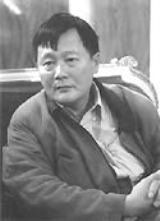
Wei Jingsheng

Encyclopedia
Wei Jingsheng is a Chinese activist known for his involvement in the Chinese democracy movement
, most prominent for authoring the document Fifth Modernization
on the "Democracy Wall
" in Beijing
in 1978. He is generally known for getting arrested and spending 15 years in prison due to the document. However, some sources suggest he was imprisoned to ensure Communist Party
leader Deng Xiaoping
a political victory during the Sino-Vietnamese War
.
Still a Chinese
citizen, Wei is now based in the New York City
area.
as a 16 year-old student during the Cultural Revolution
. In 1973 he was an electrician in Beijing
's Zoo.
When Deng Xiaoping
came to power and during the failing Cultural Revolution, Wei attacked the government of the Communist Party of China
becoming one of the first few daring to denounce Paramount leader
Deng Xiaoping
. Most notably he described Deng as a dictator.
in Beijing
the Fifth Modernization
stating "democracy" to be added to the list of Four Modernizations
, which includes industry, agriculture, science and technology and national defense. Wei Jingsheng is known for his editorial work in a short-lived magazine Exploration (探索) in 1979.
He had also published a letter under his name in March 1979 denouncing the inhuman conditions of the Chinese Qincheng Prison
, where the 10th Panchen Lama
was imprisoned. However, there have been unsubstantiated claims that a major part of Wei's essay came from other anonymous authors with personal experiences involving Qincheng.
However some sources suggest other reasons. On February 17, 1979 the Sino-Vietnam conflict
broke out. Deng Xiaoping knew that an international war could have a strong impact on domestic politics if China would win the war. As the Sino-Vietnamese War
was proceeding, Wei and other political activists were arrested. Wei Jingsheng was charged with attempt to sell military secrets to a British
correspondent. In November 1979 Wei was sentenced to 15 years in prison term.
He stayed in prison until September 14, 1993, when he was released just one week prior to a vote by the International Olympic Committee over whether to award the 2000 Summer Olympics to Beijing or Sydney. Wei soon became politically active after his release, and Chinese officials repeatedly warned him that his political activities were in violation of his parole agreement, and he could be arrested again. On February 27, 1994, Wei met with United States Assistant Secretary of State for Human Rights John H. Shattuck
to discuss human rights conditions in China. Wei was arrested the following week along with 15 other democracy and labor activists. Although released shortly afterward and sent into exile in Tianjin, Wei was arrested once more on April 1, 1994 when he tried to return to Beijing. Charged with plotting against the state, he was sentenced to 14 years in prison, but he would only remain in jail until November 16, 1997, when he was released for "medical reasons" and promptly deported to the United States. He was sent to the United States
due to international pressure, especially the request by then US President Bill Clinton
.
. He is a winner of numerous other human rights and democracy awards, including the Robert F. Kennedy Human Rights Award
in 1996, the National Endowment for Democracy
Award in 1997, the Olof Palme
Memorial Prize
in 1994, and the International Activist Award by the Gleitsman Foundation, etc. In 2008, he was chosen as one of the 15 Champions of World Democracy by the Europe-based magazine A Different View
. He has been praised in numerous places with titles such as "Father of Chinese Democracy" and "Nelson Mandela of China". Thousands of entries about him can be found on the Internet in various languages. In 2009 he was one of two hundred nominees for the Nobel Peace Prize.
His writings have been translated and published in the 1997 book "The Courage to Stand Alone: Letters from Prison and Other Writings."
Chinese democracy movement
The Chinese democracy movement refers to a series of loosely organized political movements in the People's Republic of China against the continued one-party rule by the Communist Party. One such movement began during the Beijing Spring in 1978 and was taken up again in the Tiananmen Square...
, most prominent for authoring the document Fifth Modernization
Fifth Modernization
The Fifth Modernization originally began as a signed wall poster placed by Wei Jingsheng on December 5, 1978 on the Democracy Wall in Beijing.-Summary:...
on the "Democracy Wall
Democracy Wall
The Democracy Wall was a long brick wall on Xidan Street, Xicheng District, Beijing, which became the focus for democratic dissent. Beginning in December 1978, in line with the Communist Party of China's policy of "seeking truth from facts," activists in the Democracy movement—such as Xu...
" in Beijing
Beijing
Beijing , also known as Peking , is the capital of the People's Republic of China and one of the most populous cities in the world, with a population of 19,612,368 as of 2010. The city is the country's political, cultural, and educational center, and home to the headquarters for most of China's...
in 1978. He is generally known for getting arrested and spending 15 years in prison due to the document. However, some sources suggest he was imprisoned to ensure Communist Party
Communist Party of China
The Communist Party of China , also known as the Chinese Communist Party , is the founding and ruling political party of the People's Republic of China...
leader Deng Xiaoping
Deng Xiaoping
Deng Xiaoping was a Chinese politician, statesman, and diplomat. As leader of the Communist Party of China, Deng was a reformer who led China towards a market economy...
a political victory during the Sino-Vietnamese War
Sino-Vietnamese War
The Sino–Vietnamese War , also known as the Third Indochina War, known in the PRC as and in Vietnam as Chiến tranh chống bành trướng Trung Hoa , was a brief but bloody border war fought in 1979 between the People's Republic of China and the Socialist Republic of Vietnam...
.
Still a Chinese
China
Chinese civilization may refer to:* China for more general discussion of the country.* Chinese culture* Greater China, the transnational community of ethnic Chinese.* History of China* Sinosphere, the area historically affected by Chinese culture...
citizen, Wei is now based in the New York City
New York City
New York is the most populous city in the United States and the center of the New York Metropolitan Area, one of the most populous metropolitan areas in the world. New York exerts a significant impact upon global commerce, finance, media, art, fashion, research, technology, education, and...
area.
Early years
In 1966 Wei joined the Red GuardsRed Guards (China)
Red Guards were a mass movement of civilians, mostly students and other young people in the People's Republic of China , who were mobilized by Mao Zedong in 1966 and 1967, during the Cultural Revolution.-Origins:...
as a 16 year-old student during the Cultural Revolution
Cultural Revolution
The Great Proletarian Cultural Revolution, commonly known as the Cultural Revolution , was a socio-political movement that took place in the People's Republic of China from 1966 through 1976...
. In 1973 he was an electrician in Beijing
Beijing
Beijing , also known as Peking , is the capital of the People's Republic of China and one of the most populous cities in the world, with a population of 19,612,368 as of 2010. The city is the country's political, cultural, and educational center, and home to the headquarters for most of China's...
's Zoo.
When Deng Xiaoping
Deng Xiaoping
Deng Xiaoping was a Chinese politician, statesman, and diplomat. As leader of the Communist Party of China, Deng was a reformer who led China towards a market economy...
came to power and during the failing Cultural Revolution, Wei attacked the government of the Communist Party of China
Communist Party of China
The Communist Party of China , also known as the Chinese Communist Party , is the founding and ruling political party of the People's Republic of China...
becoming one of the first few daring to denounce Paramount leader
Paramount leader
Paramount leader literally "the highest leader of the party and the state ", in modern Chinese political science, unofficially refers to the political leader of the People's Republic of China....
Deng Xiaoping
Deng Xiaoping
Deng Xiaoping was a Chinese politician, statesman, and diplomat. As leader of the Communist Party of China, Deng was a reformer who led China towards a market economy...
. Most notably he described Deng as a dictator.
Authorship
On December 5, 1978 Wei posted on the Democracy WallDemocracy Wall
The Democracy Wall was a long brick wall on Xidan Street, Xicheng District, Beijing, which became the focus for democratic dissent. Beginning in December 1978, in line with the Communist Party of China's policy of "seeking truth from facts," activists in the Democracy movement—such as Xu...
in Beijing
Beijing
Beijing , also known as Peking , is the capital of the People's Republic of China and one of the most populous cities in the world, with a population of 19,612,368 as of 2010. The city is the country's political, cultural, and educational center, and home to the headquarters for most of China's...
the Fifth Modernization
Fifth Modernization
The Fifth Modernization originally began as a signed wall poster placed by Wei Jingsheng on December 5, 1978 on the Democracy Wall in Beijing.-Summary:...
stating "democracy" to be added to the list of Four Modernizations
Four Modernizations
The Four Modernizations were goals, set forth by Zhou Enlai in 1963, to strengthen the fields of agriculture, industry, national defense, science and technology...
, which includes industry, agriculture, science and technology and national defense. Wei Jingsheng is known for his editorial work in a short-lived magazine Exploration (探索) in 1979.
He had also published a letter under his name in March 1979 denouncing the inhuman conditions of the Chinese Qincheng Prison
Qincheng Prison
Qincheng Prison is a maximum-security prison located in the Changping District, Beijing in the People's Republic of China, near Xiaotangshan...
, where the 10th Panchen Lama
Panchen Lama
The Panchen Lama , or Bainqên Erdê'ni , is the highest ranking Lama after the Dalai Lama in the Gelugpa lineage of Tibetan Buddhism...
was imprisoned. However, there have been unsubstantiated claims that a major part of Wei's essay came from other anonymous authors with personal experiences involving Qincheng.
Arrest and imprisonment
Wei is generally known for getting arrested and spending 15 years in prison due to the Fifth Modernization document.However some sources suggest other reasons. On February 17, 1979 the Sino-Vietnam conflict
Sino-Vietnamese conflicts 1979-1990
The Sino-Vietnamese conflicts of 1979–1990 were a series of border clashes between China and Vietnam following the Sino-Vietnamese War in 1979....
broke out. Deng Xiaoping knew that an international war could have a strong impact on domestic politics if China would win the war. As the Sino-Vietnamese War
Sino-Vietnamese War
The Sino–Vietnamese War , also known as the Third Indochina War, known in the PRC as and in Vietnam as Chiến tranh chống bành trướng Trung Hoa , was a brief but bloody border war fought in 1979 between the People's Republic of China and the Socialist Republic of Vietnam...
was proceeding, Wei and other political activists were arrested. Wei Jingsheng was charged with attempt to sell military secrets to a British
United Kingdom
The United Kingdom of Great Britain and Northern IrelandIn the United Kingdom and Dependencies, other languages have been officially recognised as legitimate autochthonous languages under the European Charter for Regional or Minority Languages...
correspondent. In November 1979 Wei was sentenced to 15 years in prison term.
He stayed in prison until September 14, 1993, when he was released just one week prior to a vote by the International Olympic Committee over whether to award the 2000 Summer Olympics to Beijing or Sydney. Wei soon became politically active after his release, and Chinese officials repeatedly warned him that his political activities were in violation of his parole agreement, and he could be arrested again. On February 27, 1994, Wei met with United States Assistant Secretary of State for Human Rights John H. Shattuck
John Shattuck
John Shattuck is an international legal scholar and human rights leader, became the fourth President and Rector of Central European University in August 2009. CEU is a global institution of graduate education in the social sciences, the humanities, law, business, environmental studies, government...
to discuss human rights conditions in China. Wei was arrested the following week along with 15 other democracy and labor activists. Although released shortly afterward and sent into exile in Tianjin, Wei was arrested once more on April 1, 1994 when he tried to return to Beijing. Charged with plotting against the state, he was sentenced to 14 years in prison, but he would only remain in jail until November 16, 1997, when he was released for "medical reasons" and promptly deported to the United States. He was sent to the United States
United States
The United States of America is a federal constitutional republic comprising fifty states and a federal district...
due to international pressure, especially the request by then US President Bill Clinton
Bill Clinton
William Jefferson "Bill" Clinton is an American politician who served as the 42nd President of the United States from 1993 to 2001. Inaugurated at age 46, he was the third-youngest president. He took office at the end of the Cold War, and was the first president of the baby boomer generation...
.
Awards
In 1996, Wei Jingsheng was awarded the Sakharov Prize for Freedom of ThoughtSakharov Prize
The Sakharov Prize for Freedom of Thought, named after Soviet scientist and dissident Andrei Sakharov, was established in December 1988 by the European Parliament as a means to honour individuals or organisations who have dedicated their lives to the defence of human rights and freedom of thought...
. He is a winner of numerous other human rights and democracy awards, including the Robert F. Kennedy Human Rights Award
Robert F. Kennedy Human Rights Award
The Robert F. Kennedy Human Rights Award was created by the Robert F. Kennedy Memorial in 1984 to honour individuals around the world who show courage and have made a significant contribution to human rights in their country....
in 1996, the National Endowment for Democracy
National Endowment for Democracy
The National Endowment for Democracy, or NED, is a U.S. non-profit organization that was founded in 1983 to promote US-friendly democracy by providing cash grants funded primarily through an annual allocation from the U.S. Congress...
Award in 1997, the Olof Palme
Olof Palme
Sven Olof Joachim Palme was a Swedish politician. A long-time protegé of Prime Minister Tage Erlander, Palme led the Swedish Social Democratic Party from 1969 to his assassination, and was a two-term Prime Minister of Sweden, heading a Privy Council Government from 1969 to 1976 and a cabinet...
Memorial Prize
Olof Palme Prize
The Olof Palme Prize is an annual prize awarded for an outstanding achievement in the spirit of Olof Palme. The Prize consists of a diploma and 75,000 US dollars.-Receivers of the Olof Palme Prize :*1987 Cyril Ramaphosa...
in 1994, and the International Activist Award by the Gleitsman Foundation, etc. In 2008, he was chosen as one of the 15 Champions of World Democracy by the Europe-based magazine A Different View
A Different View
A Different View is the International Association for Political Science Students' monthly Online Magazine. Founded in 2005, ADV deals with a wide range of topics including political, social, cultural and/or economic affairs....
. He has been praised in numerous places with titles such as "Father of Chinese Democracy" and "Nelson Mandela of China". Thousands of entries about him can be found on the Internet in various languages. In 2009 he was one of two hundred nominees for the Nobel Peace Prize.
His writings have been translated and published in the 1997 book "The Courage to Stand Alone: Letters from Prison and Other Writings."