

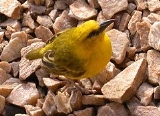
Weaver

Encyclopedia


Passerine
A passerine is a bird of the order Passeriformes, which includes more than half of all bird species. Sometimes known as perching birds or, less accurately, as songbirds, the passerines form one of the most diverse terrestrial vertebrate orders: with over 5,000 identified species, it has roughly...
bird
Bird
Birds are feathered, winged, bipedal, endothermic , egg-laying, vertebrate animals. Around 10,000 living species and 188 families makes them the most speciose class of tetrapod vertebrates. They inhabit ecosystems across the globe, from the Arctic to the Antarctic. Extant birds range in size from...
s related to the finch
Finch
The true finches are passerine birds in the family Fringillidae. They are predominantly seed-eating songbirds. Most are native to the Northern Hemisphere, but one subfamily is endemic to the Neotropics, one to the Hawaiian Islands, and one subfamily – monotypic at genus level – is found...
es.
These are seed-eating birds with rounded conical bills, most of which are from Sub-Saharan Africa
Sub-Saharan Africa
Sub-Saharan Africa as a geographical term refers to the area of the African continent which lies south of the Sahara. A political definition of Sub-Saharan Africa, instead, covers all African countries which are fully or partially located south of the Sahara...
, with fewer species in tropical Asia
Asia
Asia is the world's largest and most populous continent, located primarily in the eastern and northern hemispheres. It covers 8.7% of the Earth's total surface area and with approximately 3.879 billion people, it hosts 60% of the world's current human population...
. A few species have been introduced
Introduced species
An introduced species — or neozoon, alien, exotic, non-indigenous, or non-native species, or simply an introduction, is a species living outside its indigenous or native distributional range, and has arrived in an ecosystem or plant community by human activity, either deliberate or accidental...
outside their native range. The weaver group is divided into the buffalo, sparrow, typical, and widow weavers. The males of many species are brightly coloured, usually in red or yellow and black, some species show variation in colour only in the breeding season.
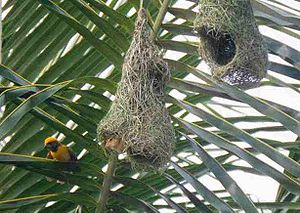
Weaver birds, also known as weaver finches, get their name because of their elaborately woven nests (the most elaborate of any birds'), though some are notable for their selective parasitic nesting habits. The nests vary in size, shape, material used, and construction techniques from species to species. Materials used for building nests include fine leaf-fibers, grass, and twigs. Many species weave very fine nests using thin strands of leaf fiber, though some, like the buffalo-weavers, form massive untidy stick nests in their colonies, which may have spherical woven nests within. The sparrow weavers of Africa
Africa
Africa is the world's second largest and second most populous continent, after Asia. At about 30.2 million km² including adjacent islands, it covers 6% of the Earth's total surface area and 20.4% of the total land area...
build apartment-house nests, in which 100 to 300 pairs have separate flask-shaped chambers entered by tubes at the bottom. Most species weave nests that have narrow entrances, facing downward.
Many (but not all) species of weavers are gregarious birds that breed colonially
Bird colony
A bird colony is a large congregation of individuals of one or more species of bird that nest or roost in close proximity at a particular location. Many kinds of birds are known to congregate in groups of varying size; a congregation of nesting birds is called a breeding colony...
. The birds build their nests together for protection, often several to a branch. Usually the male birds weave the nests and use them as a form of display to lure prospective females. The weaver bird colonies may be found close to water bodies. They sometimes cause crop damage, notably the Red-billed Quelea
Red-billed Quelea
The Red-billed Quelea is the world's most abundant wild bird species, with an estimated adult breeding population of 1.5 billion pairs. Some estimates of the overall population have been as large as 10 billion...
, reputed to be the world's most numerous bird.
Species list
- Genus BubalornisBubalornisBubalornis is a genus of bird in the Ploceidae family.It contains the following species:* Red-billed Buffalo Weaver * White-billed Buffalo Weaver...
- White-billed Buffalo Weaver, Bubalornis albirostris
- Red-billed Buffalo Weaver, Bubalornis niger
- Genus Dinemellia
- White-headed Buffalo Weaver, Dinemellia dinemelli
- Genus SporopipesSporopipesSporopipes is a genus of bird in the Passeridae family.It contains the following species:* Speckle-fronted Weaver * Scaly-feathered Weaver...
- Speckle-fronted WeaverSpeckle-fronted WeaverThe Speckle-fronted Weaver is a species of bird in the Ploceidae family.It is found in Benin, Burkina Faso, Cameroon, Central African Republic, Chad, Eritrea, Ethiopia, Gambia, Ghana, Guinea-Bissau, Kenya, Mali, Mauritania, Niger, Nigeria, Senegal, Somalia, Sudan, Tanzania, and Uganda.Its natural...
, Sporopipes frontalis - Scaly-feathered Weaver, Sporopipes squamifrons
- Speckle-fronted Weaver
- Genus PlocepasserPlocepasserPlocepasser is a genus of bird in the Passeridae family. It contains the following species:* Donaldson Smith's Sparrow-Weaver * Chestnut-backed Sparrow-Weaver...
- White-browed Sparrow-WeaverWhite-browed Sparrow-weaverThe White-browed Sparrow-Weaver is a predominantly brown, sparrow-sized weaver found throughout central and northcentral southern Africa. It is found in...
, Plocepasser mahali - Chestnut-crowned Sparrow-WeaverChestnut-crowned Sparrow-weaverThe Chestnut-crowned Sparrow-Weaver is a species of bird in the Passeridae family.It is found in Benin, Burkina Faso, Cameroon, Central African Republic, Chad, Democratic Republic of the Congo, Ivory Coast, Eritrea, Ethiopia, Gambia, Ghana, Guinea, Guinea-Bissau, Kenya, Mali, Niger, Nigeria,...
, Plocepasser superciliosus - Chestnut-backed Sparrow-WeaverChestnut-backed Sparrow-weaverThe Chestnut-backed Sparrow-Weaver is a species of bird in the Ploceidae family.It is found in Angola, Democratic Republic of the Congo, Malawi, and Zambia.-References:...
, Plocepasser rufoscapulatus - Donaldson Smith's Sparrow-Weaver, Plocepasser donaldsoni
- White-browed Sparrow-Weaver
- Genus Histurgops
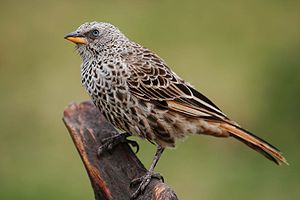
- Rufous-tailed WeaverRufous-tailed WeaverThe Rufous-tailed Weaver is an East African songbird. Despite its name, it is placed the Old World sparrow family ....
, Histurgops ruficauda
- Rufous-tailed Weaver
- Genus PseudonigritaPseudonigritaPseudonigrita is a genus of bird in the Ploceidae family.It contains the following species:* Grey-capped Social Weaver * Black-capped Social Weaver...
- Grey-capped Social Weaver, Pseudonigrita arnaudi
- Black-capped Social Weaver, Pseudonigrita cabanisi
- Genus Philetairus
- Sociable WeaverSociable WeaverThe Sociable Weaver or Social Weaver is a species of bird in the Ploceidae family endemic to Southern Africa. It is monotypic within the genus Philetairus. It is found in Botswana, Namibia, and South Africa. but their range is centred around Northern Cape Province and southern Namibia...
, Philetairus socius
- Sociable Weaver
- Genus PloceusPloceusPloceus is a genus of birds in the weaver family Ploceidae.-Species list in taxonomic order:* Compact Weaver, Ploceus superciliosus - sometimes separated in monotypic genus Pachyphantes* Black-chinned Weaver, Ploceus nigrimentus...
(c.60 species)
- Genus Pachyphantes
- Compact WeaverCompact WeaverThe Compact Weaver is a species of bird in the Ploceidae family.It is found in Angola, Benin, Burkina Faso, Burundi, Cameroon, Central African Republic, Republic of the Congo, Democratic Republic of the Congo, Ivory Coast, Ethiopia, Gabon, Ghana, Guinea, Guinea-Bissau, Kenya, Liberia, Nigeria,...
, Pachyphantes superciliosus
- Compact Weaver
- Genus MalimbusMalimbusMalimbus is a genus of bird in the Ploceidae family. It contains the following species:* Gola Malimbe * Cassin's Malimbe * Red-crowned Malimbe...
- Red-crowned MalimbeRed-crowned MalimbeThe Red-crowned Malimbe is a species of bird in the Ploceidae family.It is found in Cameroon, Central African Republic, Republic of the Congo, Democratic Republic of the Congo, Equatorial Guinea, and Gabon.-References:...
, Malimbus coronatus - Cassin's Malimbe, Malimbus cassini
- Gola MalimbeGola MalimbeThe Gola Malimbe is a species of bird in the Ploceidae family.It is found in Ivory Coast, Guinea, Liberia, and Sierra Leone.Its natural habitat is subtropical or tropical moist lowland forests.It is threatened by habitat loss....
, Malimbus ballmanni - Rachel's MalimbeRachel's MalimbeThe Rachel's Malimbe is a species of bird in the Ploceidae family.It is found in Cameroon, Equatorial Guinea, Gabon, and Nigeria.It is also known under the name Rachel's weaver...
, Malimbus racheliae - Red-vented MalimbeRed-vented MalimbeThe Red-vented Malimbe is a species of bird in the Ploceidae family.It is found in Benin, Cameroon, Ivory Coast, Ghana, Guinea, Liberia, Nigeria, Sierra Leone, and Togo.Its natural habitat is subtropical or tropical swamps....
, Malimbus scutatus - Ibadan MalimbeIbadan MalimbeThe Ibadan Malimbe is a rare species of bird in the Ploceidae family. It is endemic to Nigeria, where it is known only from the southwestern part of the country. It was first discovered in 1951 and was common at one point. Forest clearing made it rare.The bird is about 20 centimeters long. The...
, Malimbus ibadanensis - Red-bellied MalimbeRed-bellied MalimbeThe Red-bellied Malimbe is a species of bird in the Ploceidae family.It is found in Cameroon, Central African Republic, Republic of the Congo, Democratic Republic of the Congo, Equatorial Guinea, Gabon, Nigeria, Sudan, and Uganda....
, Malimbus erythrogaster - Blue-billed Malimbe, Malimbus nitens
- Crested MalimbeCrested MalimbeThe Crested Malimbe is a species of bird in the Ploceidae family.It is found in Angola, Cameroon, Central African Republic, Republic of the Congo, Democratic Republic of the Congo, Ivory Coast, Equatorial Guinea, Gabon, Ghana, Guinea, Liberia, Mali, Nigeria, Sierra Leone, Togo, and Uganda.Its...
, Malimbus malimbicus - Red-headed MalimbeRed-headed MalimbeThe Red-headed Malimbe is a species of bird in the Ploceidae family.It is found in Angola, Benin, Cameroon, Central African Republic, Republic of the Congo, Democratic Republic of the Congo, Ivory Coast, Equatorial Guinea, Gabon, Ghana, Guinea, Guinea-Bissau, Kenya, Liberia, Mali, Nigeria, Sierra...
, Malimbus rubricollis
- Red-crowned Malimbe
- Genus Anaplectes
- Red-headed WeaverRed-headed WeaverThe Red-headed Weaver is a species of bird in the Ploceidae family. It is monotypic within the genus Anaplectes....
, Anaplectes rubriceps
- Red-headed Weaver
- Genus Brachycope
- Bob-tailed WeaverBob-tailed WeaverThe Bob-tailed Weaver is a species of bird in the Ploceidae family. It is monotypic within the genus Brachycope.It is found in Cameroon, Central African Republic, Republic of the Congo, and Democratic Republic of the Congo....
, Brachycope anomala
- Bob-tailed Weaver
- Genus QueleaQueleaQuelea is a small genus of passerine birds that belongs to the weaver family Ploceidae, confined to Africa. These are small-sized, sparrow- or finch-like gregarious birds, with bills adapted to eating seeds...
- Cardinal QueleaCardinal QueleaThe Cardinal Quelea is a species of bird in the Ploceidae family.It is found in Burundi, Democratic Republic of the Congo, Ethiopia, Kenya, Malawi, Rwanda, Sudan, Tanzania, Uganda, and Zambia.-Origin:...
, Quelea cardinalis - Red-headed QueleaRed-headed QueleaThe Red-headed Quelea is a species of bird in the Ploceidae family.It is found in Angola, Benin, Botswana, Burkina Faso, Burundi, Cameroon, Central African Republic, Chad, Republic of the Congo, Democratic Republic of the Congo, Ivory Coast, Equatorial Guinea, Ethiopia, Gabon, Gambia, Ghana,...
, Quelea erythrops - Red-billed QueleaRed-billed QueleaThe Red-billed Quelea is the world's most abundant wild bird species, with an estimated adult breeding population of 1.5 billion pairs. Some estimates of the overall population have been as large as 10 billion...
, Quelea quelea
- Cardinal Quelea
- Genus Foudia
- Red Fody, Foudia madagascariensis
- Red-headed FodyRed-headed FodyThe Red-headed Fody is a species of bird in the Ploceidae family. It is found in Comoros, Mayotte and Seychelles. The taxon aldabrana, by most authorities considered a subspecies of the Red-headed Fody, has occasionally been considered a separate species, the Aldabra Fody , in which case the...
(or Comoro Fody for if species is split), Foudia eminentissima- Aldabra Fody, Foudia (eminentissima) aldabrana
- Comoros Fody, Foudia eminentissima
- Forest FodyForest FodyThe Forest Fody is a species of bird in the Ploceidae family.It is endemic to Madagascar.Its natural habitat is subtropical or tropical moist lowland forests.-References:* BirdLife International 2004. . Downloaded on 25 July 2007....
, Foudia omissa - Mauritius FodyMauritius FodyThe Mauritius Fody is a rare species of bird in the weaver family. It is endemic to the island of Mauritius. It is classified by BirdLife International as being endangered. It is also on the United States' Endangered Species List with an endangered status.This bird is 14 centimeters long...
, Foudia rubra - Seychelles FodySeychelles FodyThe Seychelles Fody Foudia sechellarum is a small yellowish songbird that lives in the Seychelles islands of Aride Island, Cousin Island, Cousine Island, Fregate Island, D'Arros Island and as of 2004 Denis Island. The IUCN has recently changed the status of the bird from "endangered" to "near...
, Foudia sechellarum - Rodrigues FodyRodrigues FodyThe Rodrigues Fody is a rare species of bird in the weaver family. It is endemic to Rodrigues, an island of Mauritius. It is classified by BirdLife International as being vulnerable. It is also on the United States' Endangered Species List with an endangered status.This bird is 12 to 13...
, Foudia flavicans
- Genus EuplectesEuplectesEuplectes is a genus of passerine bird in the weaver family, Ploceidae. It contains the bishops and widowbirds. They are all native to Africa south of the Sahara...
- Yellow-crowned BishopYellow-crowned BishopThe Yellow-crowned Bishop is a species of passerine bird in the family Ploceidae native to Africa south of the Sahara. It is highly sexually dimorphic in its breeding season, during which the male adopts a distinctive yellow and black plumage, contrasting with the female's predominantly brown...
, Euplectes afer - Fire-fronted BishopFire-fronted BishopThe Fire-fronted Bishop is a species of bird in the Ploceidae family.It is found in Kenya, Somalia, and Tanzania.-References:* BirdLife International 2004. . Downloaded on 25 July 2007....
, Euplectes diadematus - Black BishopBlack BishopThe Black Bishop is a species of passerine bird in the Ploceidae family native to Africa south of the Sahara. Three subspecies are recognised.- Taxonomy :...
, Euplectes gierowii - Black-winged Red BishopBlack-winged Red BishopThe Black-winged Red Bishop is a resident breeding bird species in tropical Africa from Senegal to Sudan and south to Angola and Tanzania....
, Euplectes hordeaceus - Northern Red BishopNorthern Red BishopThe Northern Red Bishop or Orange Bishop is a resident breeding bird species in Africa south of the Sahara Desert and north of the Equator. It has been introduced to Puerto Rico, Martinique and Guadeloupe in the West Indies. It was formerly regarded as a subspecies of the Southern Red Bishop of...
or Orange Bishop, Euplectes franciscanus - Southern Red BishopSouthern Red BishopThe Southern Red Bishop or Red Bishop is a small passerine bird belonging to the bishop and widowbird genus Euplectes in the weaver family Ploceidae. It is common in wetlands and grassland in Africa south of the Equator. North of the Equator, it is replaced by the Northern Red Bishop or Orange...
or Red Bishop, Euplectes orix - Zanzibar Red Bishop, Euplectes nigroventris
- Golden-backed BishopGolden-backed BishopThe Golden-backed Bishop is a species of bird in the Ploceidae family.It is found in Angola and São Tomé and Príncipe.-References:* BirdLife International 2004. . Downloaded on 25 July 2007....
, Euplectes aureus - Yellow BishopYellow BishopThe Yellow Bishop or Yellow-rumped Widow is a resident breeding bird species in Angola, Botswana, Burundi, Cameroon, Congo, Equatorial Guinea, Ethiopia, Kenya, Lesotho, Malawi, Mozambique, Nigeria, Rwanda, South Africa, Sudan, Swaziland, Tanzania, Uganda, Zambia and Zimbabwe.This common weaver...
, Euplectes capensis - Fan-tailed WidowbirdFan-tailed WidowbirdThe Fan-tailed Widowbird is a species of bird in the Ploceidae family.It is found in Angola, Botswana, Burundi, Cameroon, Central African Republic, Chad, Republic of the Congo, Democratic Republic of the Congo, Ethiopia, Kenya, Lesotho, Malawi, Mali, Mozambique, Namibia, Niger, Nigeria, Rwanda,...
, Euplectes axillaris - Yellow-mantled Widowbird, Euplectes macroura
- White-winged WidowbirdWhite-winged WidowbirdThe White-winged Widowbird is a species of passerine bird in the family Ploceidae native to Africa south of the Sahara. It is highly sexually dimorphic in its breeding season, during which the male's yellow plumage turns dark and he gains more white feathers, contrasting with the female's...
, Euplectes albonotatus - Red-collared WidowbirdRed-collared WidowbirdThe Red-collared Widowbird is a species of bird in the Ploceidae family.It is found in Angola, Botswana, Burkina Faso, Burundi, Cameroon, Central African Republic, Republic of the Congo, Democratic Republic of the Congo, Ivory Coast, Eritrea, Ethiopia, Gabon, Gambia, Ghana, Guinea, Guinea-Bissau,...
, Euplectes ardens - Marsh WidowbirdMarsh WidowbirdThe Marsh Widowbird is a species of bird in the Ploceidae family.It is found in Angola, Cameroon, Republic of the Congo, Democratic Republic of the Congo, Gabon, Kenya, Nigeria, Tanzania, Uganda, and Zambia.-References:...
, Euplectes hartlaubi - Montane Widowbird, Euplectes psammacromius
- Long-tailed WidowbirdLong-tailed WidowbirdThe Long-tailed Widowbird is a species of bird in the Ploceidae family.It is found in Angola, Botswana, Democratic Republic of the Congo, Kenya, Lesotho, South Africa, Swaziland, and Zambia.-References:...
, Euplectes progne - Jackson's WidowbirdJackson's WidowbirdThe Jackson's Widowbird is a species of bird in the Ploceidae family.It is found in Kenya and Tanzania.Its natural habitats are subtropical or tropical high-altitude grassland and arable land.It is threatened by habitat loss....
, Euplectes jacksoni
- Yellow-crowned Bishop
- Genus Anomalospiza
- Cuckoo Finch or Parasitic Weaver, Anomalospiza imberbis - probably belongs in Viduidae
- Genus Amblyospiza
- Thick-billed Weaver, Amblyospiza albifrons