
Wave making resistance is a form of
dragIn fluid dynamics, drag refers to forces that oppose the relative motion of an object through a fluid . Drag forces act in a direction opposite to the oncoming flow velocity...
that affects surface
watercraftA watercraft is a vehicle, vessel or craft designed to move across water, including saltwater and freshwater, for pleasure, recreation, physical exercise, commerce, transport and military missions. It is derived from the term "craft" which was used as term to describe all types of water going...
, such as
boatA boat is a watercraft of modest size designed to float or plane, to provide passage across water. Usually this water will be inland or in protected coastal areas. However, boats such as the whaleboat were designed to be operated from a ship in an offshore environment. In naval terms, a boat is...
s and
shipA ship is a large vessel that floats on water. Ships are generally distinguished from boats based on size and passenger capacity. Ships may be found on lakes, seas, and rivers and they allow for a variety of activities, such as the transport of people or goods, fishing, entertainment, public...
s, and reflects the energy required to push the water out of the way of the hull. This energy goes into creating the
wakeA wake is the region of recirculating flow immediately behind a moving solid body, caused by the flow of surrounding fluid around the body.-Fluid dynamics:...
.
For small displacement hulls, such as sailboats or rowboats, wave making resistance is the major source of drag. The unique properties of deepwater waves (where the water depth is deeper than half the wavelength) mean that the wave making resistance is very dependent upon the
hull'sA hull is the watertight body of a ship or boat. Above the hull comes the superstructure and deckhouse. The line where the hull meets the water surface is called the waterline.The structure of the hull varies depending on the vessel type...
interaction with the wake.
The propagation speed of deepwater waves is proportional to the square root of the
wavelengthIn physics, the wavelength of a sinusoidal wave is the spatial period of the wave – the distance over which the wave's shape repeats.It is usually determined by considering the distance between consecutive corresponding points of the same phase, such as crests, troughs, or zero crossings, and is a...
of the generated waves, and the wavelength of a boat's wake is based on its
waterline lengthThe Waterline length is a measurement of ships and boats. The term denotes the length of the vessel at the point where it sits in the water. It excludes the total length of the boat, such as features that are out of the water...
— so: there is a direct relationship between the waterline length (and thus wave propagation speed) and the rate at which drag increases.
A simple way of considering wave-making resistance is to look at the hull in relation to its wake.
Wave making resistance is a form of
dragIn fluid dynamics, drag refers to forces that oppose the relative motion of an object through a fluid . Drag forces act in a direction opposite to the oncoming flow velocity...
that affects surface
watercraftA watercraft is a vehicle, vessel or craft designed to move across water, including saltwater and freshwater, for pleasure, recreation, physical exercise, commerce, transport and military missions. It is derived from the term "craft" which was used as term to describe all types of water going...
, such as
boatA boat is a watercraft of modest size designed to float or plane, to provide passage across water. Usually this water will be inland or in protected coastal areas. However, boats such as the whaleboat were designed to be operated from a ship in an offshore environment. In naval terms, a boat is...
s and
shipA ship is a large vessel that floats on water. Ships are generally distinguished from boats based on size and passenger capacity. Ships may be found on lakes, seas, and rivers and they allow for a variety of activities, such as the transport of people or goods, fishing, entertainment, public...
s, and reflects the energy required to push the water out of the way of the hull. This energy goes into creating the
wakeA wake is the region of recirculating flow immediately behind a moving solid body, caused by the flow of surrounding fluid around the body.-Fluid dynamics:...
.
Physics
For small displacement hulls, such as sailboats or rowboats, wave making resistance is the major source of drag. The unique properties of deepwater waves (where the water depth is deeper than half the wavelength) mean that the wave making resistance is very dependent upon the
hull'sA hull is the watertight body of a ship or boat. Above the hull comes the superstructure and deckhouse. The line where the hull meets the water surface is called the waterline.The structure of the hull varies depending on the vessel type...
interaction with the wake.
The propagation speed of deepwater waves is proportional to the square root of the
wavelengthIn physics, the wavelength of a sinusoidal wave is the spatial period of the wave – the distance over which the wave's shape repeats.It is usually determined by considering the distance between consecutive corresponding points of the same phase, such as crests, troughs, or zero crossings, and is a...
of the generated waves, and the wavelength of a boat's wake is based on its
waterline lengthThe Waterline length is a measurement of ships and boats. The term denotes the length of the vessel at the point where it sits in the water. It excludes the total length of the boat, such as features that are out of the water...
— so: there is a direct relationship between the waterline length (and thus wave propagation speed) and the rate at which drag increases.
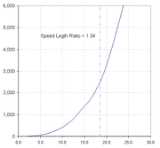
A simple way of considering wave-making resistance is to look at the hull in relation to its wake. At speeds lower than the wave propagation speed, the wave rapidly dissipates. As the hull approaches the wave propagation speed, however, the wave at the bow begins to build up faster than it can dissipate, and so it grows in
amplitudeAmplitude is the magnitude of change in the oscillating variable, with each oscillation, within an oscillating system. For instance, sound waves are oscillations in atmospheric pressure and their amplitudes are proportional to the change in pressure during one oscillation...
. Since the water is not able to "get out of the way of the hull fast enough", the hull, in essence, has to climb over or push through the bow wave. This results in an
exponentialIn mathematics, the exponential function is the function ex, where e is the number such that the function ex equals its own derivative. The exponential function is used to model phenomena when a constant change in the independent variable gives the same proportional change ...
increase in resistance with increasing speed.
To calculate the speed of wave propagation, the following formula is used:
Plugging in the appropriate value for gravity and solving yields the equation:
Or, in
metricThe metric system is an international decimalised system of measurement, first adopted by France in 1791, that is the common system of measuring units used by most of the world. It exists in several variations, with different choices of fundamental units, though the choice of base units does not...
units:
These values, 1.34 and 2.5, are often used in the
hull speedHull speed, sometimes referred to as displacement speed, is a rule of thumb used to provide an approximate maximum efficient speed for a hull. It is only ever an approximation and only applies where the hull is a fairly traditional displacement design...
rule of thumbA rule of thumb is a principle with broad application that is not intended to be strictly accurate or reliable for every situation. It is an easily learned and easily applied procedure for approximately calculating or recalling some value, or for making some determination...
used to compare potential speeds of displacement hulls, and this relationship is also fundamental to the
Froude numberThe Froude number is a dimensionless number comparing inertia and gravitational forces. It may be used to quantify the resistance of an object moving through water, and compare objects of different sizes...
, used in the comparison of different scales of watercraft.
When the vessel exceeds a speed/length ratio of 0.94, it starts to outrun most of its
bow waveA bow wave is the wave that forms at the bow of a ship when it moves through the water. As the bow wave spreads out, it defines the outer limits of a ship's wake. A large bow wave slows the ship down, poses a risk to smaller boats, and in a harbor can cause damage to shore facilities and moored ships...
, the hull actually settles slightly in the water as it is now only supported by two wave peaks. As the vessel exceeds a speed/length ratio of 1.34, the hull speed, the wavelength is now longer than the hull, and the stern is no longer supported by the wake, causing the stern to squat, and the bow rise. The hull is now starting to climb its own bow wave, and resistance begins to increase at a very high rate. While it is possible to drive a displacement hull faster than a speed/length ratio of 1.34, it is prohibitively expensive to do so. Most large vessels operate at speed/length ratios well below that level, at speed/length ratios of under 1.0.
Ways of reducing wave making resistance
Since wave making resistance is based on the energy required to push the water out of the way of the hull, there are a number of ways that this can be minimized.
Reduced displacement
Reducing the displacement of the craft, by eliminating excess weight, is the most straightforward way to reduce the wave making drag. Another way is to shape the hull so as to generate
liftA fluid flowing past the surface of a body exerts a force on it. Lift is defined to be the component of this force that is perpendicular to the oncoming flow direction. It contrasts with the drag force, which is defined to be the component of the fluid-dynamic force parallel to the flow...
as it moves through the water. Semi-displacement hulls and
planingPlaning describes the state in which the hull of a waterborne craft is lifting up higher up to the point where it merely skims across the water, rather than moving through it....
hulls do this, and they are able to break through the
hull speed barrier and transition into a realm where drag increases at a much lower rate. The downside of this is that planing is only practical on smaller vessels, with high power to weight ratios, such as
motorboatAn outboard motor is installed on the rear of a boat and contains the internal combustion engine, the gearbox, and the propeller.An inboard/outboard contains a hybrid of a powerplant and an outboard, where the internal combustion engine is installed inside the boat, and the gearbox and propeller...
s. It is not a practical solution for a large vessel such as a supertanker.
Fine entry
A hull with a blunt bow has to push the water away very quickly to pass through, and this high
accelerationIn physics, and more specifically kinematics, acceleration is the change in velocity over time. Because velocity is a vector, it can change in two ways: a change in magnitude and/or a change in direction. In one dimension, i.e. a line, acceleration is the rate at which something speeds up or slows...
requires large amounts of energy. By using a
fine bow, with a sharper angle that pushes the water out of the way more gradually, the amount of energy required to displace the water will be less, even though the same total amount of water will be displaced. A modern variation is the
wave-piercingA wave-piercing boat hull has a very fine bow, with reduced buoyancy in the forward portions.When a wave is encountered, the lack of buoyancy means the hull pierces through the water rather than riding over the top - resulting in a smoother ride than traditional designs, and in diminished stress on...
design.
Bulbous bow
A special type of bow, called a
bulbous bow, is often used on large motor vessels to reduce wave making drag. The bulb alters the waves generated by the hull, but due to its very limited range of effect, is only useful on large motor vessels operating at constant speeds.
Semi-displacement and planing hulls
Since semi-displacement and planing hulls generate a significant amount of lift in operation, they are capable of breaking the barrier of the wave propagation speed and operating in realms of much lower drag, but to do this they must be capable of first pushing past that speed, which requires significant power. Once the hull gets
over the hump of the bow wave, the rate of increase of the wave drag will start to reduce significantly.
A qualitative interpretation of the wave resistance plot is that a displacement hull resonates with a wave that has a crest near its bow and a trough near its stern, because the water is pushed away at the bow and pulled back at the stern. A planing hull simply pushed down on the water under it, so it resonates with a wave that has a trough under it, which has about twice the length and therefore four times the speed.