
All Topics  
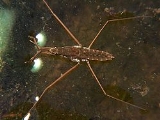
Water strider

 
Water Strider

   Email Print
   Bookmark   Link


Water strider


The family Gerridae contains insects commonly known as water striders, water bugs, magic bugs, pond skaters, skaters, skimmers, water scooters, water skaters, water skeeters, water skimmers or water skippers. These are predator
Predation

In ecology, predation describes a biological interaction where a predator feeds on its prey, the organism that is attacked. Predators may or may not kill their prey prior to feeding on them, but the act of predation always results in the death of the prey....
y insect
Insect

Insects are the biggest class of arthropods and the only ones with wings. They are the most diverse group of animals on the planet. They are most diverse at the equator and their diversity declines toward the poles....
s which rely on surface tension
Surface tension

Surface tension is an attractive property of the surface of a liquid. It is what causes the surface portion of liquid to be attracted to another surface, such as that of another portion of liquid ....
 to walk on top of water
Water

Water is a common chemical substance that is essential for the survival of all known forms of life. In typical usage, water refers only to its liquid form or States of matter, but the substance also has a solid state, ice, and a gaseous state, water vapor or steam....
. They live on the surface of ponds, slow streams, marshes, and other quiet waters.


Discussion
Ask a question about 'Water strider'
Start a new discussion about 'Water strider'
Answer questions from other users
Full Discussion Forum


Encyclopedia


The family Gerridae contains insects commonly known as water striders, water bugs, magic bugs, pond skaters, skaters, skimmers, water scooters, water skaters, water skeeters, water skimmers or water skippers. These are predator
Predation

In ecology, predation describes a biological interaction where a predator feeds on its prey, the organism that is attacked. Predators may or may not kill their prey prior to feeding on them, but the act of predation always results in the death of the prey....
y insect
Insect

Insects are the biggest class of arthropods and the only ones with wings. They are the most diverse group of animals on the planet. They are most diverse at the equator and their diversity declines toward the poles....
s which rely on surface tension
Surface tension

Surface tension is an attractive property of the surface of a liquid. It is what causes the surface portion of liquid to be attracted to another surface, such as that of another portion of liquid ....
 to walk on top of water
Water

Water is a common chemical substance that is essential for the survival of all known forms of life. In typical usage, water refers only to its liquid form or States of matter, but the substance also has a solid state, ice, and a gaseous state, water vapor or steam....
. They live on the surface of ponds, slow streams, marshes, and other quiet waters. They can move very quickly, up to 1.5 m/s
Metre per second

Metre per second is an SI derived unit of both speed and velocity , defined by distance in metres divided by time in seconds.This is the main unit of speed....
.

"Five species of Halobates sea skaters are the only insects that have successfully colonized open ocean habitats. [...] H. micans populations from the Pacific, Atlantic and Indian Oceans have been isolated for 1 to 3 million years".

Nature of the hydrophobic legs


Water striders can stand effortlessly on water due to their non-wetting legs
Arthropod leg

The arthropod leg is a form of jointed appendage of arthropods, usually used for walking. Many of the terms used for arthropod leg segments are of Latin origin, and may be confused with terms for bones: coxa , trochanter , femur, tibia, tarsus , ischium, metatarsus, carpus, dactylus , patella....
. Writing in Nature
Nature (journal)

Nature is a prominent scientific journal, first published on 4 November 1869. Although most scientific journals are now highly specialized, Nature is one of the few journals, along with other weekly journals such as Science and Proceedings of the National Academy of Sciences, that still publishes original research articles ac...
, biophysicists
Biophysics

Biophysics is an interdisciplinary science that employs and develops theories and methods of the physical sciences for the investigation of biology systems....
 Xuefeng Cao and Lei Jiang show that the water resistance of the legs is due to the "special hierarchical structure of the legs, which are covered by large numbers of oriented tiny hair
Hair

Hair is a protein filament that epidermal growth from hair follicle deep within the dermis. The fine, soft hair found on many nonhuman mammals is typically called fur; wool is the characteristically curly hair found on sheep and goats....
s (microsetae) with fine nanogrooves". They go on to demonstrate that the water resistance is due more to this physical structure than the chemical properties of the wax
Wax

Wax has traditionally referred to a substance that is secreted by bees and used by them in constructing their honeycombs.It is an imprecisely defined term generally understood to be a substance with properties similar to beeswax, namely...
 coating of the legs.

Gao and Jiang calculate the maximal supporting force of a single leg to be is 1.52 millinewton
Newton

The newton is the International System of Units SI derived unit of force, named after Isaac Newton in recognition of his work on classical mechanics....
s (152 dyne
Dyne

In physics, the dyne is a Units of measurement of Force specified in the Centimetre gram second system of units system of units, a predecessor of the modern International System of Units....
s or 0.011 poundal
Poundal

The poundal is a non-SI Units of measurement of force. It is a part of the foot-pound-second system of units, a coherent subsystem of English units introduced in 1879, and one of several specialized subsystems of mechanical units used as aids in calculations....
), which is about 15 times the total body weight of the insect. This shows that the surface of the leg is strikingly water repellent.

For comparison, Gao and Jiang made a hydrophobic 'leg' from a smooth quartz
Quartz

Quartz is the most abundant mineral in the Earth's continental crust . It is made up of a Crystal structure of silica tetrahedra. Quartz has a hardness of 7 on the Mohs scale and a density of 2.65 g/cm?....
 fibre that was similar in shape and size to a strider's leg. Its surface was coated with a thin layer of heptadecafluorodecyltrimethoxysilane (FAS-17), whose contact angle
Contact angle

The contact angle is the angle at which a liquid/vapor interface meets the solid surface. The contact angle is specific for any given system and is determined by the interactions across the three interfaces....
 with water
Water

Water is a common chemical substance that is essential for the survival of all known forms of life. In typical usage, water refers only to its liquid form or States of matter, but the substance also has a solid state, ice, and a gaseous state, water vapor or steam....
 is 109°. However, this artificial leg supported a force of only 0.19 mN (19 dyn or 0.0014 pdl): this would be just about enough to support the strider at rest, but not to enable it to dart around rapidly on the surface.
Gerris Sp01
Gao and Jiang went on to calculate that the contact angle with water on a real strider's leg would be greater than 150° (and described this using the neologism
Neologism

A neologism is a newly coined word that may be in the process of entering common use, but has not yet been accepted into mainstream language . Neologisms are often directly attributable to a specific person, publication, period, or event....
 'superhydrophobic') and, using a sessile water-drop showed that the contact angle of the insect's legs with water was 167.6° ± 4.4°.

They went on to infer that the observed superhydrophobicity was due to microstructures on the legs and, using a scanning electron microscope
Scanning electron microscope

The scanning electron microscope is a type of electron microscope that images the sample surface by scanning it with a high-energy beam of electrons in a raster scan pattern....
, showed that the legs were covered in many needle shaped seta
Seta

Seta is a biology term derived from the Latin word for "bristle". It refers to a number of different bristle- or hair-like structures on living organisms....
e, with diameters ranging from 3 micrometre
Micrometre

A micrometre or micron is one Micro- of a metre, or equivalently one thousandth of a millimetre. It is also commonly known as a micron....
s down to a few hundred nanometre
Nanometre

A nanometre is a Units of measurement of length in the metric system, equal to one billionth of a metre .It is one of the more often used units for very small lengths, and equals ten ?ngstr?m, an internationally recognized non-International System of Units of length....
s. Most of the setae were about 50 micrometres long and were at an angle of about 20° from the surface of leg. Each microseta also had nanoscale grooves, contributing to the hierarchical structure of the leg.

Gao and Jiang used Cassie's law
Cassie's law

Cassie's law describes the effective contact angle thetac for a liquid on a composite material . The law explains how simply roughing up a surface increases the apparent surface angle....
 to show that air
AIR

Air is the part of Earth's atmosphere that humans breath and as such Air .Air may also refer to:...
 is trapped in spaces in the microsetae and nanogrooves, forming a cushion at the leg–water interface. This cushion prevents the legs from being wetted.

See also

  • Veliidae
    Veliidae

    Veliidae is a family of predatory insects in the suborder Heteroptera. They are commonly known as riffle bugs,smaller water striders or broad-shouldered water striders because the segment immediately behind the head is wider than the rest of the abdomen, unlike in the typical water striders , close relatives which are also...
     (Smaller water strider)
  • Animal locomotion on the surface layer of water
    Animal locomotion on the surface layer of water

    Animal locomotion on the surface layer is the study of animal locomotion in the case of small animals that live on the surface layer of water, relying on surface tension to stay afloat....


Sources and notes


Further reading