
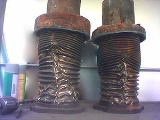
Water hammer is a
pressurePressure is the force per unit area applied in a direction perpendicular to the surface of an object. Gauge pressure is the pressure relative to the local atmospheric or ambient pressure.- Definition :...
surge or wave resulting when a
fluidIn physics, a fluid is a substance that continually deforms under an applied shear stress. Fluids are a subset of the phases of matter and include liquids, gases, plasmas and, to some extent, plastic solids....
(usually a liquid but sometimes also a gas) in motion is forced to stop or change direction suddenly (momentum change). Water hammer commonly occurs when a valve is closed suddenly at an end of a
pipelinePipeline transport is the transportation of goods through a pipe. Most commonly, liquids and gases are sent, but pneumatic tubes that transport solid capsules using compressed air are also used....
system, and a pressure wave propagates in the pipe. It may also be known as
hydraulic shock.
This pressure wave can cause major problems, from noise and vibration to pipe collapse. It is possible to reduce the effects of the water hammer pulses with
accumulatorsA 'hydraulic accumulator' is an energy storage device. It is a pressure storage reservoir in which a non-compressible hydraulic fluid is held under pressure by an external source. That external source can be a spring, a raised weight, or a compressed gas...
and other features.
Rough calculations can be made either using the Joukowsky equation, or more accurate ones using the method of characteristics.
Cause and effect
If the pipe is suddenly closed at the outlet (downstream), the mass of water before the closure is still moving forward with some velocity, building up a high pressure and
shock waveA shock wave is a type of propagating disturbance. Like an ordinary wave, it carries energy and can propagate through a medium or in some cases in the absence of a material medium, through a field such as the electromagnetic field...
s. In domestic
plumbingPlumbing is the system of pipes and drains installed in a building for the distribution of potable drinking water and the removal of waterborne wastes, and the skilled trade of working with pipes, tubing and plumbing fixtures in such systems. A plumber is someone who installs or repairs piping...
this is experienced as a loud banging resembling a hammering noise. Water hammer can cause pipelines to break if the pressure is high enough. Air traps or stand pipes (open at the top) are sometimes added as dampers to water systems to provide a cushion to absorb the force of moving water in order to prevent damage to the system. (At some
hydroelectric generating stationsHydroelectricity is the term referring to electricity generated by hydropower; the production of electrical power through the use of the gravitational force of falling or flowing water. It is the most widely used form of renewable energy...
what appears to be a
water towerA water tower or elevated water tower is a large elevated drinking water storage container constructed to hold a water supply at a height sufficient to pressurize a water distribution system....
is actually one of these devices, known as a
surge drumA surge tank is a standpipe or storage reservoir at the downstream end of a closed aqueduct or feeder pipe to absorb sudden rises of pressure as well as to quickly provide extra water during a brief drop in pressure...
).
In the home, water hammer may occur when a
dishwasherA dishwasher is a mechanical device for cleaning dishes and eating utensils. Dishwashers can be found in restaurants and private homes.Unlike manual dishwashing, which relies largely on physical scrubbing to remove soiling, the mechanical dishwasher cleans by spraying hot water, typically between ...
,
washing machineA washing machine is a machine designed to wash laundry, such as clothing, towels and sheets...
, or
toiletA toilet is a sanitation fixture used primarily for the disposal of human excrement, often found in a small room referred to as a toilet/bathroom/lavatory...
shuts off water flow. The result may be heard as a loud bang, repetitive banging (as the shock wave travels back and forth in the plumbing system), or as some shuddering.
On the other hand, when an upstream
valveA valve is a device that regulates, directs or controls the flow of a fluid by opening, closing, or partially obstructing various passageways. Valves are technically pipe fittings, but are usually discussed as a separate category...
in a pipe is closed, the water downstream of the valve will attempt to continue flowing, creating a vacuum that may cause the pipe to collapse or implode. This problem can be particularly acute if the pipe is on a downhill slope. To prevent this, air and vacuum
relief valveThe relief valve is a type of valve used to control or limit the pressure in a system or vessel which can build up by a process upset, instrument or equipment failure, or fire....
s, or air vents, are installed just downstream of the valve to allow air to enter the line and prevent this vacuum from occurring.
Other causes of water hammer are pump failure, and
check valveA check valve, clack valve, non-return valve or one-way valve is a mechanical device, a valve, which normally allows fluid to flow through it in only one direction....
slam (due to sudden deceleration, a check valve may slam shut rapidly, depending on the dynamic characteristic of the check valve and the mass of the water between a check valve and tank).
Related phenomena
Steam distribution systems may also be vulnerable to a situation similar to water hammer, known as
steam hammer. In a steam system, water hammer most often occurs when some of the steam condenses into water in a horizontal section of the steam piping. Subsequently, steam picks up the water, forms a "
slugA slug is a term used for a solid ballistic projectile. It is "solid" in the sense of being composed of one piece; the shape can vary widely, including partially hollowed shapes...
" and hurls it at high velocity into a pipe fitting, creating a loud hammering noise and greatly stressing the pipe. This condition is usually caused by a poor condensate drainage strategy.
Where air filled traps are used, these eventually become depleted of their trapped air over a long period of time through absorption into the water. This can be cured by shutting off the supply, opening taps at the highest and lowest locations to drain the system (thereby restoring air to the traps), and then closing the taps and re-opening the supply.
Water hammer during an explosion
When an explosion happens in an enclosed space, water hammer can cause the walls of the container to deform. However, it can also impart momentum to the enclosure if it is free to move. An underwater explosion in the
SL-1The SL-1, or Stationary Low-Power Reactor Number One, was a United States Army experimental nuclear power reactor which underwent a steam explosion and meltdown on January 3, 1961, killing its three operators. The direct cause was the improper withdrawal of the central control rod, responsible for...
reactor vessel caused the water to accelerate upwards through 2.5 foot (0.762 m) of air before it struck the vessel head at 160 feet per second (48.8 m/s) with a pressure of 10000 pound per square inches (68,947,572.9 Pa). This pressure wave caused the 26000 pounds (11,793.4 kg) steel vessel to jump 9 feet 1 inch (2.77 m) into the air before it dropped into its prior location.
Mitigating measures
Water hammer has caused accidents and fatalities, but usually damage is limited to breakage of pipes or appendages. An engineer should always assess the risk of a pipeline burst. Pipelines transporting hazardous liquids or gases warrant special care in design, construction, and operation.
The following characteristics may reduce or eliminate water hammer:
- Reduce the pressure of the water supply to the building by fitting a regulator.
- Lower fluid velocities. To keep water hammer low, pipe-sizing charts for some applications recommend flow velocity at or below 5 ft/s (1.5 m
The metre , symbol m, is the base unit of length in the International System of Units . Originally intended to be one ten-millionth of the distance from the Earth's equator to the North Pole , its definition has been periodically refined to reflect growing knowledge of metrology...
/s).
- Fit slowly-closing valves. Toilet flush valves are available in a quiet flush type that closes quietly.
- High pipeline pressure rating (expensive).
- Good pipeline control (start-up and shut-down procedures).
- Water tower
A water tower or elevated water tower is a large elevated drinking water storage container constructed to hold a water supply at a height sufficient to pressurize a water distribution system....
s (used in many drinking water systems) help maintain steady flow rates and trap large pressure fluctuations.
- Air vessels work in much the same way as water towers, but are pressurized. They typically have an air cushion above the fluid level in the vessel, which may be regulated or separated by a bladder. Sizes of air vessels may be up to hundreds of cubic meters on large pipelines. They come in many shapes, sizes and configurations. Such vessels often are called accumulators or expansion tank
An expansion tank or expansion vessel is a small tank used to protect closed water heating systems and domestic hot water systems from excessive pressure...
s.
- A hydropneumatic device
North American, European, and other languages refer to hydropneumatic devices such as a hydropneumatic accumulator or pulsation damper using very different words. In many cases this can cause a great deal of word usage confusion...
similar in principle to a shock absorberA shock absorber is a mechanical device designed to smooth out or damp shock impulse, and dissipate kinetic energy. It is a type of dashpot.-Nomenclature:...
called a 'Water Hammer Arrestor' can be installed between the water pipe and the machine which will absorb the shock and stop the banging.
- Air valves are often used to remediate low pressures at high points in the pipeline. Though effective, sometimes large numbers of air valves need be installed. These valves also allow air into the system, which is often unwanted.
- Shorter branch pipe lengths.
- Shorter lengths of straight pipe, i.e. add elbows, expansion loops. Water hammer is related to the speed of sound in the fluid, and elbows reduce the influences of pressure waves.
- Arranging the larger piping in loops that supply shorter smaller run-out pipe branches. With looped piping, lower velocity flows from both sides of a loop can serve a branch.
- Flywheel
A flywheel is a rotating mechanical device that is used to store rotational energy. Flywheels have a significant moment of inertia, and thus resist changes in rotational speed. The amount of energy stored in a flywheel is proportional to the square of its rotational speed...
on pump.
- Pumping station bypass.
- Hydroelectric power plants must be carefully designed and maintained because the water hammer can cause water pipes to fail catastrophically.

The magnitude of the pulse
One of the first to successfully investigate the water hammer problem was the Italian engineer
Lorenzo AllieviLorenzo Allievi was an Italian engineer best known for his studies on the water hammer problem.-Biography:...
.
Water hammer can be analyzed by two different approaches,
rigid column theory which ignores compressibility of the fluid and elasticity of the walls of the pipe, or by a full analysis including elasticity. When the time it takes a valve to close is long compared to the propagation time for a pressure wave to travel the length of the pipe, then rigid column theory is appropriate; otherwise considering elasticity may be necessary.
Below are two approximations for the peak pressure, one that considers elasticity, but assumes the valve closes instantaneously, and a second that neglects elasticity but includes a finite time for the valve to close.
Instant valve closure; compressible fluid
The pressure profile of the water hammer pulse can be calculated from the Joukowsky equation
So for a valve closing instaneously, the maximum magnitude of the water hammer pulse is:
where

is the magnitude of the pressure wave (Pa),

is the density of the fluid (kgm
−3),

is the speed of sound in the fluid (ms
−1), and

is the change in the fluid's velocity (ms
−1). The pulse comes about due to Newton's laws of motion and the
continuity equationA continuity equation in physics is a differential equation that describes the transport of a conserved quantity. Since mass, energy, momentum, electric charge and other natural quantities are conserved under their respective appropriate conditions, a variety of physical phenomena may be described...
applied to the deceleration of a fluid element.
Equation for wave speed
As the speed of sound in a fluid is the

, the peak pressure will depend on the fluid compressibility if the valve is closed abruptly.

,
where
- a = wave speed
- K = bulk modulus of elasticity of the fluid
-
= density of the fluid
- E = elastic modulus
An elastic modulus, or modulus of elasticity, is the mathematical description of an object or substance's tendency to be deformed elastically when a force is applied to it...
of the pipe
- D = internal pipe diameter
- t = pipe wall thickness
- c = dimensionless parameter due to system pipe-constraint condition on wave speed
Slow valve closure; incompressible fluid
When the valve is closed slowly compared to the transit time for a pressure wave to travel the length of the pipe, the elasticity can be neglected, and the phenomenon can be described in terms of
inertance or rigid column theory. For this case, one approximation to the maximum pressure (using Imperial units),

, produced in a water filled line is:
where

is the inlet pressure in psi,

is the flow velocity in ft/sec,

is the valve closing time in seconds and

is the upstream pipe length in feet.
Expression for the excess pressure due to water hammer
When a valve with a volumetric flow rate Q is closed, an excess pressure δP is created upstream of the valve, whose value is given by the Joukowsky equation:
In this expression:
- overpressurization δP is expressed in Pa;
- Q is the volumetric flow in m3/s;
- Zh is the hydraulic impedance, expressed in kg/m4/s.
The hydraulic impedance Z
h of the pipeline determines the magnitude of the water hammer pulse. It is itself defined by:
with:
- ρ the density of the liquid, expressed in kg/m3;
- A cross sectional area of the pipe, m2;
- Beff effective modulus of compressibility of the liquid in the pipe, expressed in Pa.
The latter follows from a series of hydraulic concepts:
- compressibility of the liquid, defined by its adiabatic compressibility modulus Bl, resulting from the equation of state of the liquid generally available from thermodynamic tables;
- the elasticity of the walls of the pipe, which defines a modulus of equivalent compressibility Beq. In the case of a pipe of circular cross section whose thickness e is small compared to the diameter D, the equivalent modulus of compressibility is given by the following formula:
; in which E is the Young's modulus (in Pa) of the material of the pipe;
- possibly compressibility Bg of gas dissolved in the liquid, defined by:
- γ being the ratio of specific heats of the gas
- α the rate of ventilation (the volume fraction of undissolved gas)
- and P the pressure (in Pa).
Thus, the effective compressibility modulus is:
As a result, we see that we can reduce the water hammer by:
- increasing the pipe diameter at constant flow, which reduces the inertia of the liquid column;
- choosing to use a material with a reduced Young's modulus;
- introducing a device that increases the flexibility of the entire hydraulic system, such as a hydraulic accumulator;
- where possible, increasing the percentage of undissolved air in the liquid.
Dynamic equations
The water hammer effect can be simulated by solving the following partial differential equations.
where
V is the fluid velocity inside pipe,

is the fluid density and

is the equivalent bulk modulus,
f is the friction factor.
Column separation
Column separation is a phenomenon that can occur during a water-hammer event. If the pressure in a pipeline drops rapidly to the
vapor pressureVapor pressure or equilibrium vapor pressure is the pressure of a vapor in thermodynamic equilibrium with its condensed phases in a closed system. All liquids have a tendency to evaporate, and some solids can sublimate into a gaseous form...
of the liquid, the liquid will vaporise and a "bubble" of vapor will form in the pipeline. This is most likely to occur at specific locations such as closed ends, high points or knees (changes in pipe slope). When the pressure later increases above the vapor pressure of the liquid, the vapor in the bubble returns to a liquid state, which leaves a vacuum in the space formerly occupied by the vapor. The liquid either side of the vacuum is then accelerated into this space by the pressure difference. The collision of the two columns of liquid, (or of one liquid column if at a closed end,) results in
CavitationCavitation is the formation and then immediate implosion of cavities in a liquidi.e. small liquid-free zones that are the consequence of forces acting upon the liquid...
and cause a large and nearly instantaneous rise in pressure. This pressure rise can damage hydraulic machinery, individual pipes and supporting structures. Many repetitions of cavity formation and collapse may occur in a single water-hammer event.
Simulation software
Most water hammer software packages use the
method of characteristicsIn mathematics, the method of characteristics is a technique for solving partial differential equations. Typically, it applies to first-order equations, although more generally the method of characteristics is valid for any hyperbolic partial differential equation...
to solve the
differential equationA differential equation is a mathematical equation for an unknown function of one or several variables that relates the values of the function itself and its derivatives of various orders...
s involved. This method works well if the wave speed does not vary in time due to either air or gas entrainment in a pipeline. The Wave Method (WM) is also used in various software packages. WM allows large networks to be analyzed efficiently. Many commercial and non commercial packages exist today.
Software packages vary in complexity, dependent on the processes modeled. The more sophisticated packages may have any of the following features:
- Multiphase flow capabilities
- An algorithm
In mathematics and computer science, an algorithm is an effective method expressed as a finite list of well-defined instructions for calculating a function. Algorithms are used for calculation, data processing, and automated reasoning...
for cavitationCavitation is the formation and then immediate implosion of cavities in a liquidi.e. small liquid-free zones that are the consequence of forces acting upon the liquid...
growth and collapse
- Unsteady friction - the pressure waves will dampen as turbulence is generated and due to variations in the flow velocity distribution
- Varying bulk modulus for higher pressures (water will become less compressible)
- Fluid structure interaction - the pipeline will react on the varying pressures and will cause pressure waves itself
Applications
- The water hammer principle can be used to create a simple water pump
A pump is a device used to move fluids, such as liquids, gases or slurries.A pump displaces a volume by physical or mechanical action. Pumps fall into three major groups: direct lift, displacement, and gravity pumps...
called a hydraulic ramA hydraulic ram, or hydram, is a cyclic water pump powered by hydropower. It functions as a hydraulic transformer that takes in water at one "hydraulic head" and flow-rate, and outputs water at a higher hydraulic-head and lower flow-rate...
.
- Leaks can sometimes be detected using water hammer.
- Enclosed air pockets can be detected in pipelines.
See also
- Blood hammer
The blood hammer phenomenon is a sudden increase of the upstream blood pressure in a blood vessel when the bloodstream is abruptly blocked by vessel obstruction...
- Cavitation
Cavitation is the formation and then immediate implosion of cavities in a liquidi.e. small liquid-free zones that are the consequence of forces acting upon the liquid...
- Fluid dynamics
In physics, fluid dynamics is a sub-discipline of fluid mechanics that deals with fluid flow—the natural science of fluids in motion. It has several subdisciplines itself, including aerodynamics and hydrodynamics...
- Impact force
In mechanics, an impact is a high force or shock applied over a short time period when two or more bodies collide. Such a force or acceleration usually has a greater effect than a lower force applied over a proportionally longer time period of time...
- Watson's water hammer pulse
Watson's water hammer pulse is the medical sign which describes a pulse that is bounding and forceful, or, in other words, rapidly increasing and subsequently collapsing, as if it were the hitting of a water hammer that was causing the pulse....
External links